You’re under pressure, the paperwork is coming fast, and somebody is already telling you the facts “aren’t that bad.” Don’t buy that. In negligence cases, the first move that matters is spotting the right defenses to negligence before the other side locks the story in place.
If you wait, you lose ground. If you preserve evidence early, you force the other side to prove every element, every witness, every assumption. That’s how cases get won, or buried before they ever reach a hearing.
Table of Contents
- Why Defenses to Negligence Matter Before You Are Ever Charged
- The Four Elements Every Negligence Claim Must Prove
- Contributory vs Comparative Negligence and Why the Difference Is Outcome-Determinative
- Assumption of Risk Consent and Statute of Limitations as Doctrinal Traps
- The Overlooked Defenses That Win Cases When the Big Three Will Not
- Three Real-World Fact Patterns and How the Defense Plays Out
- Why Early Action and Experienced Civilian Defense Counsel Change the Outcome
Why Defenses to Negligence Matter Before You Are Ever Charged
A service member gets a knock at the door after a base-side wreck. A civilian demand letter lands in the mailbox. A command sponsor says “don’t worry about it” while a family member is already talking to the other driver’s lawyer. That is the start of a negligence case, not the hearing date.
Arguing about fault before you understand the defense structure is backwards. A strong case starts by identifying which defenses to negligence fit the facts, because the defense chosen early affects whether the claim gets dismissed, settled cheaply, or pushed into trial.
Negligence defenses are not just classroom doctrine. They control who stays in the case, who drops out, and who has to explain the bad facts to a judge or jury. Empirical research shows the doctrine shapes claim retention, and the practical lesson is simple: jurisdictions do not treat plaintiff fault the same way. That difference changes the dynamics immediately.
That matters because the defense gets built in the first seventy-two hours, not at the hearing. A good lawyer does not just ask, “What happened?” He asks, “What element can I kill, what jurisdiction am I in, and what evidence is disappearing right now?” If you are already dealing with a military justice issue too, the overlap with the UCMJ can be immediate, and you need to understand that early. A useful primer on that overlap is Article 31 of the UCMJ.
Practical rule: If the first version of the story is being told by the other side, you are already behind. Lock down photos, witnesses, timestamps, and any warning signs before anyone “helps” you.
The Four Elements Every Negligence Claim Must Prove
A negligence claim lives or dies on four elements, duty, breach, causation, and damages. If the plaintiff can’t prove even one of them, the claim falls apart. That’s the cleanest way to think about the whole fight.

Duty and breach are the front end
Duty asks whether the defendant owed a legal responsibility to the plaintiff. In plain terms, did the defendant have to act with reasonable care in that situation? A driver on a base road owes that duty to other drivers. A landlord usually owes a duty to maintain common areas in a safe condition. A contractor on a worksite may owe a duty to people exposed to the hazard.
Breach asks whether the defendant failed to meet that standard. Running a red light is the easy example. Leaving a stairwell unlit, ignoring a known hazard, or failing to control a dangerous condition can also count as breach.
Causation is where most cases break
Causation is usually the battleground. The plaintiff has to show the breach caused the injury and that the injury was a foreseeable result of the conduct. If the fall happened because of a third party, a preexisting condition, or a separate event, the defense gets room to work.
Damages are the final gate
Damages mean actual harm. No injury, no case. That injury can be physical, financial, or both, but it has to be real and provable. If the plaintiff has no medical bills, no wage loss, and no measurable harm, the lawsuit gets much weaker fast.
The strategic point is simple. You don’t need to blow up all four elements. Defeat one cleanly and the claim can collapse. In practice, causation is often the best target because it lets the defense separate the alleged mistake from the actual harm.
Contributory vs Comparative Negligence and Why the Difference Is Outcome-Determinative
A bad fall on a wet deck, a collision on base, a slip in a barracks hallway, the fight is not always about who was mainly at fault. The key issue is whether the jurisdiction treats the plaintiff’s own negligence as a total bar or just a reduction in damages. Contributory negligence and comparative negligence produce very different results, and that rule choice can matter more than the story the witnesses tell.

Contributory negligence can end the case
Under contributory negligence, any fault by the plaintiff can bar recovery entirely. That is a hard rule, and the defense should treat it that way. If the plaintiff was jaywalking, cutting across a lane without headlights, or ignoring a posted warning, build the case around that conduct and push it early.
The study data shows why the doctrine matters. The accident-claim research found negligence claims involving 4.02% under contributory negligence rules, versus 7.27% under pure comparative negligence rules (core study). More permissive rules kept more claims alive and litigated. That affects bargaining power, settlement posture, and how hard the plaintiff will press the case.
Comparative negligence reduces, it doesn’t erase
Comparative negligence divides fault and cuts damages by the plaintiff’s share. If the plaintiff was partly responsible, the defense does not need to wipe out the claim. It needs enough plaintiff fault to drive down exposure.
That is why a plaintiff who was 30% at fault may still recover under comparative negligence, just less than the full demand. Under contributory negligence, that same 30% can kill the case outright. Same facts. Different rule. Very different result.
The practical move is simple. Rebuild the plaintiff’s conduct with the same discipline the plaintiff’s lawyer uses against your side. Do not stop at defending the accident scene. Go after the plaintiff’s choices, visibility, warnings, and timeline. In a contributory negligence jurisdiction, that proof can decide the case before trial.
Bottom line: If the plaintiff helped cause the injury, prove it early and cleanly. The jurisdiction decides whether that proof reduces the claim or destroys it.
Assumption of Risk Consent and Statute of Limitations as Doctrinal Traps
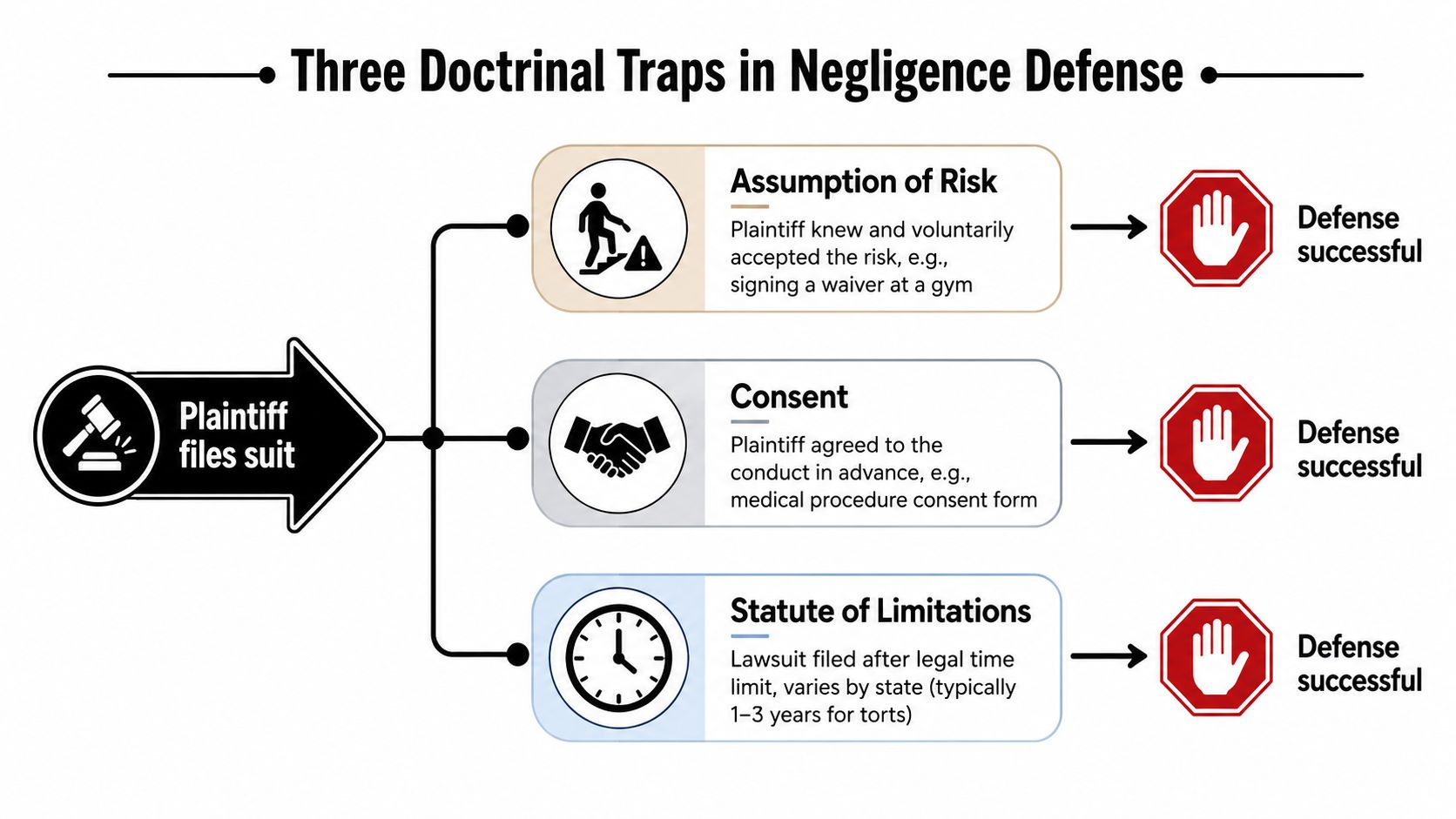
Some defenses don’t look dramatic, but they kill cases. Assumption of risk, consent, and statute of limitations are exactly that kind of trap. They’re technical, and that’s why people miss them until it’s too late.
Assumption of risk is about knowing the danger
Assumption of risk turns on knowledge and voluntary exposure. The defendant has to show the plaintiff knew the specific hazard, understood how serious it was, and still chose to proceed. That’s why it’s so strong in sports, recreation, and training environments.
In practical terms, the best evidence is usually documentary. Waivers, safety briefs, warning signs, signed acknowledgments, and witness testimony about what the injured person was told matter a lot. If those records exist, use them. If they don’t, you’ve got a weakness.
Consent is related but not the same
Consent asks whether the plaintiff agreed in advance to the conduct at issue. It’s fact-specific. A medical procedure consent form is not the same as a waiver at a gym, and neither one is the same as casual participation in a risky event. The defense lives or dies on the scope of the agreement.
The limitations clock can end a winning case
Statute of limitations is pure timing. Miss the deadline and the case can die even if the facts look good for the plaintiff. Some deadlines start at injury, some at discovery, and some depend on the type of claim and jurisdiction.
A defense lawyer should never assume the clock is running the way the plaintiff says it is. The paper trail decides this. Dates on reports, medical records, notice letters, and prior complaints are often more important than the plaintiff’s memory.
If you need a procedural mindset for an investigation tied to negligence allegations, the military side matters too. The tactics used in 15-6 investigations often decide whether the facts are preserved or lost before anyone files suit.
The Overlooked Defenses That Win Cases When the Big Three Will Not
Most consumer articles stop at plaintiff-fault doctrines. That’s lazy. The better defense is often a direct attack on the claim itself, no duty, no breach, no causation, intervening cause, and immunity. If the plaintiff never gets past those gates, the case doesn’t survive long enough to matter.
The real fight is often over duty and causation
No duty is a strong defense when the law never imposed a responsibility in the first place. No breach is even simpler, the defendant acted reasonably under the circumstances. No causation is where many cases collapse because the injury came from something else, not the alleged negligence.
An intervening or superseding cause can break the chain entirely. If a third party’s act created the actual harm, the defense should press that hard. Don’t let the plaintiff glue every bad event into one story if the evidence doesn’t support it.
Immunity is the complete-shield argument
Immunity is different from fault denial. It says the defendant can’t be held liable at all, or can’t be sued in that forum, because the law shields the conduct or actor. Governmental immunity, qualified immunity, and other immunity doctrines can matter in military-adjacent or public-entity cases. Charitable and volunteer-response rules can also change the analysis in the right case.
The point is not to recite doctrine. It’s to find the shield that matches the facts. That’s what experienced counsel does.
| Defense | Element Attacked | Strongest Fact Pattern | Winning Evidence |
|---|---|---|---|
| No duty | Duty | No legal relationship or no owed obligation | Policies, contracts, role definitions |
| No breach | Breach | Conduct was reasonable under the circumstances | Photos, logs, training records, expert review |
| No causation | Causation | Injury came from another source | Medical records, timelines, third-party evidence |
| Intervening cause | Causation | A new actor broke the chain | Witnesses, surveillance, incident reports |
| Immunity | Liability or forum | Government, military, or protected function | Statutes, orders, official status, jurisdiction facts |
Three Real-World Fact Patterns and How the Defense Plays Out
A wreck, a fall, or a training injury does not decide the case by itself. The facts do. Your job is to force the plaintiff to prove every element of negligence, then attack the weak one, and if the facts support it, bring in plaintiff fault, assumption of risk, or immunity as separate defenses.
Base gate rear-end collision
A service member rear-ends another vehicle at a base gate. The plaintiff says the impact caused lasting injury. The first defense move is to attack causation, then test comparative fault or contributory negligence based on the jurisdiction.
The first evidence sweep is simple. Pull dashcam footage, gate-camera footage, vehicle damage photos, witness names, and the timing of the medical complaints. If the plaintiff waited to treat, changed the story, or built the injury claim after the fact, that cuts hard against causation. If the collision itself is minor and the medical timeline is messy, the defense should press that point from the start. In a military setting, a 15-6 investigation can lock in those facts early if counsel moves fast enough.
Don’t let the other driver define the wreck before you’ve seen the video.
Recreational injury at a command-sponsored event
A service member gets hurt during a command-sponsored recreational activity. The likely defense is assumption of risk, plus any immunity or jurisdictional limit that fits the facts. If the injured person knew the activity was dangerous and still chose to join, that defense gets stronger.
The record should show what warnings were given, what safety briefings were delivered, and whether participation was voluntary. That paper trail matters more than a post-injury complaint. Counsel should also pin down who organized the event, who controlled the site, and whether the risk was obvious enough that the plaintiff accepted it by participating.
On-base housing patio injury
A child is injured on a poorly maintained on-base housing patio. Defense counsel should look at duty, breach, and intervening cause immediately. If a contractor, maintenance vendor, or third party created the hazard, responsibility may shift away from the defendant.
A clean defense starts with early interviews, maintenance logs, inspection records, and photos before anyone fixes the scene. If you wait, the hazard gets repaired, the timeline gets fuzzy, and the case gets harder to fight. The military investigation phase matters here, because the first evidence collected often becomes the evidence that controls the lawsuit.
Why Early Action and Experienced Civilian Defense Counsel Change the Outcome
A negligence defense turns on timing. The lawyer who moves first usually controls the record, and the lawyer who controls the record usually controls the case. If you are under stress, stop improvising and start preserving facts right now.
Military-appointed counsel can do solid work, but serious cases need someone who is not boxed in by a command chain. Independent civilian military defense counsel can coordinate the civil claim, the command investigation, and any UCMJ exposure without divided loyalties. That independence matters when your career, pay, and future assignments are at risk.
The medical-malpractice review data shows why early defense work pays off. Physicians won 80% to 90% of jury trials in weak-evidence cases, about 70% of borderline cases, and about 50% even where evidence of negligence was strong. The same review said 80% to 90% of claims rated defensible were dropped or dismissed without payment, and settlement values rose from $14,109 for “good” care to $146,160 for “ambiguous” care and $203,209 for “bad” care (PMC review of malpractice outcomes).
That is the lesson. Early defense work changes outcomes.
If you are under investigation, dealing with a demand letter, or already facing a lawsuit, act now:
- Stop talking: Do not explain, speculate, or try to “clear things up” with investigators or the other side.
- Preserve evidence: Save texts, photos, vehicle data, maintenance records, and witness names.
- Pin down the jurisdiction: Contributory fault, comparative fault, and deadlines vary by state and claim type.
- Get civilian defense counsel involved: Choose someone who handles court-martial and civil exposure, not a generalist.
The right lawyer also knows how to move during the military inquiry before the story hardens. See how experienced counsel win cases during the military investigation phase.
If the allegation is already on your desk, do not wait for it to get worse. Contact experienced counsel, preserve what you can, and force the other side to prove every element before the narrative locks in against you.