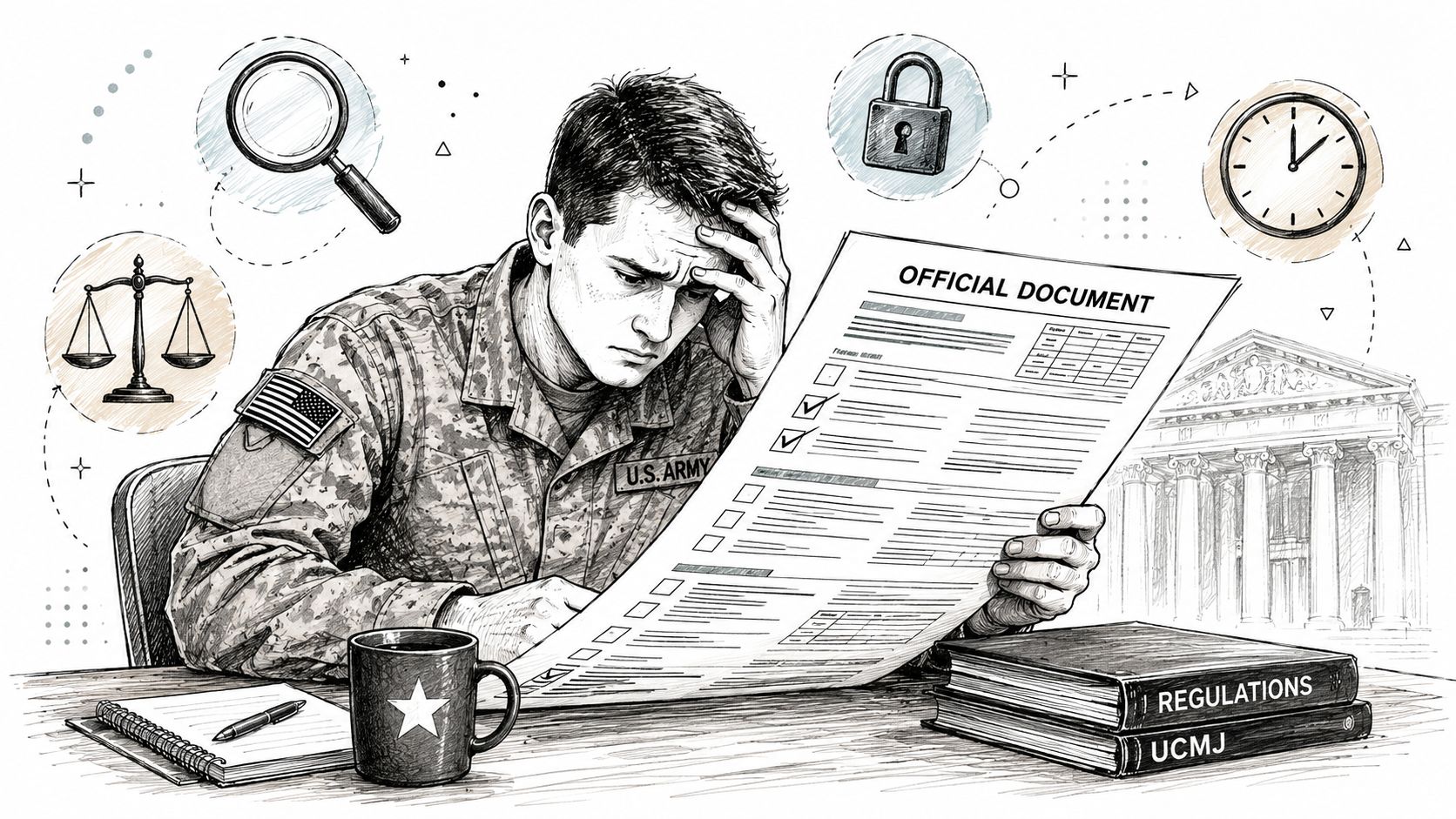
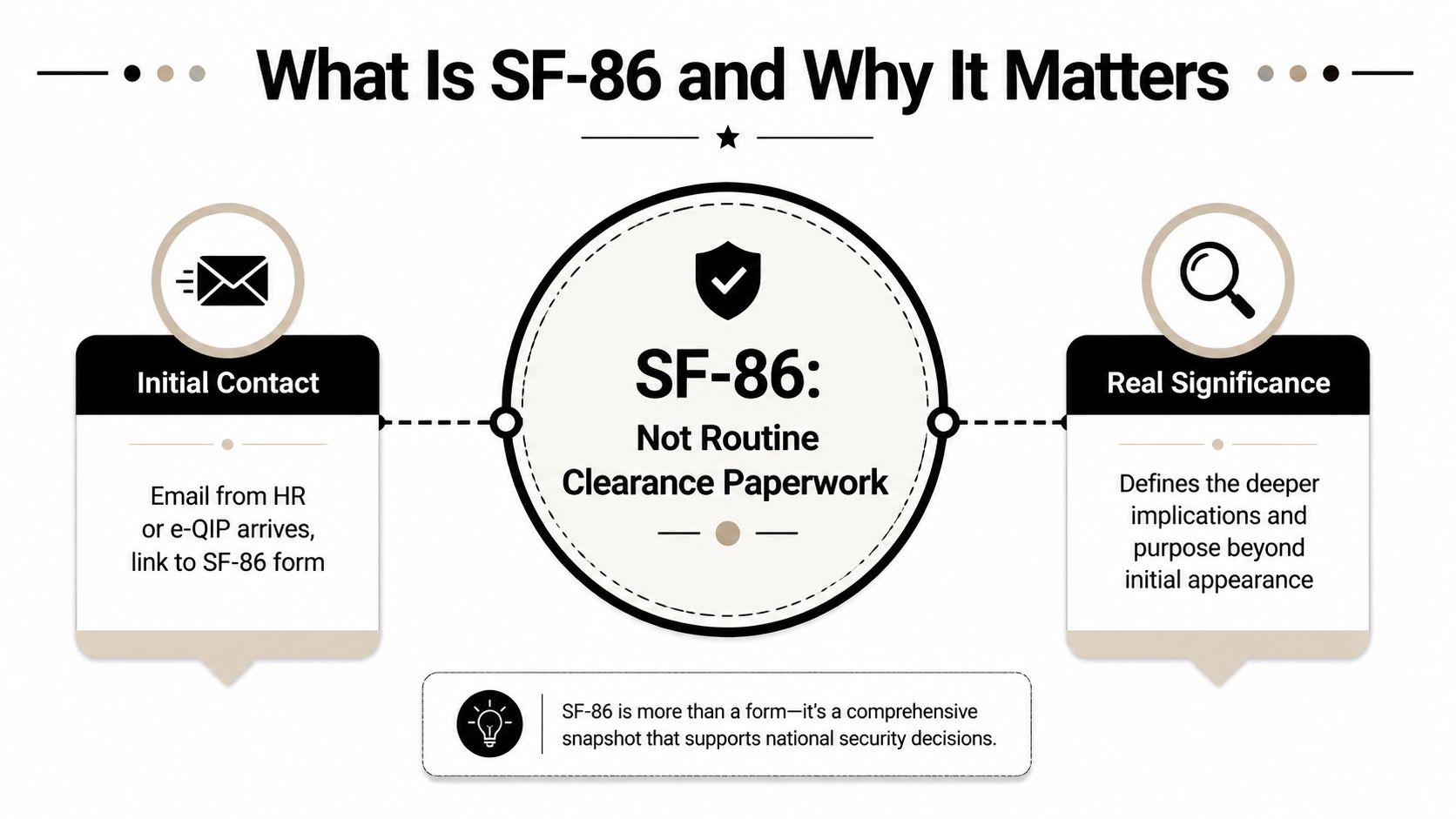
The email lands in your inbox, and the subject line says SF-86. Most service members think it’s routine clearance paperwork, something to knock out between briefs or after dinner. That’s a mistake. The SF-86 is where people create problems for themselves, because they treat a legal-grade investigation form like admin churn and start guessing, omitting, or polishing answers that should be plain and complete.
If you’re in uniform, this form can follow you into promotions, reinvestigations, and command action. The government uses it as a permanent record for future investigations, and investigators can compare what you write now with what you wrote before, which means inconsistency matters as much as the underlying issue itself. For anyone asking what is SF 86, the short answer is this, it’s the form where your personal history becomes evidence, and careless answers can turn into a clearance problem, a false statement problem, or both.
Table of Contents
- What Is SF 86 and Why It Matters More Than You Think
- Who Has to Complete the SF-86
- The Sections That Get Service Members in Trouble
- The SF-86 Is a Legal Document, Not a Personnel Form
- Two Realistic Scenarios Every Service Member Should Picture
- Common Mistakes That Create Real Risk
- What to Do the Moment the SF-86 Lands in Your Inbox
- Why You Need Civilian Defense Counsel Before You Certify
What Is SF 86 and Why It Matters More Than You Think
The SF-86, officially the Questionnaire for National Security Positions, is the first place many service members can create a clearance problem for themselves. Government instructions treat it as a permanent record used for current and future investigations, and it is the basis for judging access to sensitive positions and clearances across federal civilian, military, and contractor populations. The form is built to decide whether the government can trust your history, your answers, and your consistency. OPM SF-86 instructions
The structure of the form shows why sloppy completion causes real trouble. The DCSA SF-86 factsheet and the OPM SF-86 instructions show that the questionnaire reaches deep into your background, including three personal references, 10-year residence and employment histories, and 7-year foreign travel disclosures, including travel to Canada and Mexico unless it was official U.S. Government business. Missing dates, skipped gaps, or careless estimates do more than slow processing. They give investigators a reason to look harder, and that is where service members start building their own exposure.
Practical rule: If you would hesitate to say it aloud in a sworn interview, slow down before you type it into the SF-86.
A lot of service members think the form only asks what happened. It also checks whether your story stays consistent from section to section. Inconsistent dates, half-finished answers, and “close enough” entries are exactly the kind of mistakes that create follow-up questions, delay clearance processing, and can turn a routine review into a credibility problem.
Who Has to Complete the SF-86
The SF-86 is not limited to one branch or one type of job. It shows up for active duty members in sensitive or critical billets, reservists and Guard members moving into cleared work, federal civilian employees seeking national security access, and contractors whose jobs touch classified information. ClearanceJobs describes the form as broad enough to cover citizenship, residence, education, employment history, family and associates, foreign connections and travel, criminal records, drug involvement, financial delinquencies, mental health treatment, alcohol-related incidents, military service, prior clearances and investigations, civil court actions, misuse of computer systems, and subversive activities. That is not paperwork for a casual hire. ClearanceJobs SF-86 summary
What usually triggers it
The form tends to enter your career path when you are commissioned, moved into a cleared slot, promoted into a designated position, or pulled into a reinvestigation cycle. The FBI says applicants invited through e-QIP must complete and submit the SF-86 within 10 days of the email invitation after accepting a conditional job offer, and that same guidance says the form has more than 20 sections and can take up to 2 hours to complete depending on whether your records are ready. FBI SF-86 applicant guidance
If you’re already in uniform, refusal is not a clever tactic. Withdrawing or failing to certify can end access immediately, and the withdrawal itself becomes part of the record. That is why commanders and security offices treat this as a career issue, not a paperwork preference.
Bottom line: If your billet depends on access, the SF-86 is part of the job, and walking away from it usually means walking away from the job.
The Sections That Get Service Members in Trouble
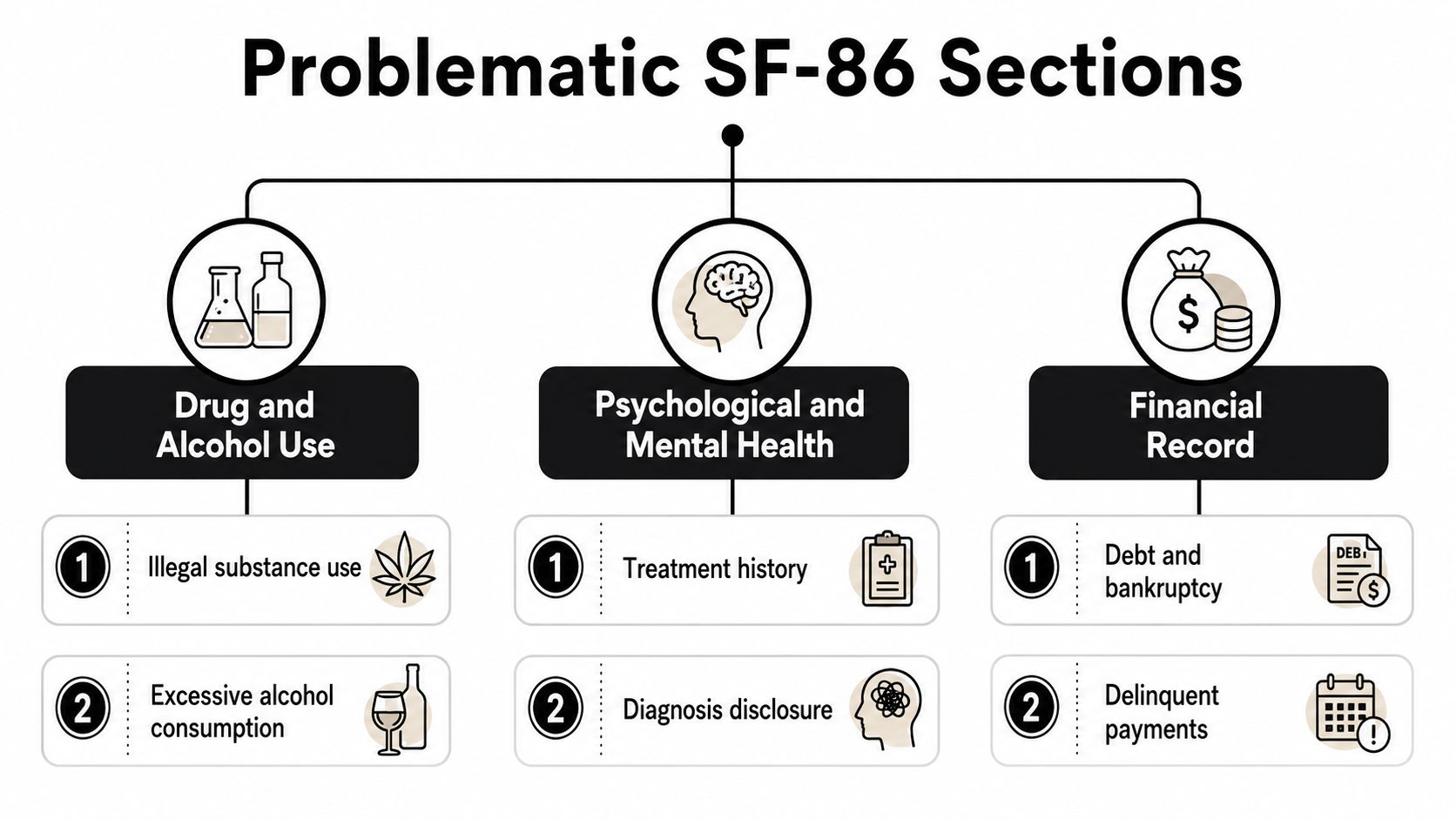
The form is broad, but a few sections do most of the damage. These are the ones that turn honest people into problem cases because they think a minor incident, an old mistake, or an embarrassing treatment history is safe to hide. It isn’t. The government can forgive a disclosed issue far more easily than it can forgive a lie, a gap, or a story that changes.
Drug and alcohol history
Marijuana, other drug use, and alcohol incidents are the classic traps. People treat a college-era mistake or a night that never turned into charges as irrelevant. It isn’t irrelevant if the form asks for it, and it absolutely isn’t irrelevant if your answer changes later. The government cares about candor, not your personal opinion about whether the incident was “serious enough.”
Finances and money trouble
Delinquencies, garnishments, debts, bankruptcies, and similar issues matter because they are often read as pressure points. If you guess on payment dates or skip the ugly parts, you create a credibility problem that sits next to the financial issue. That is how a manageable debt becomes a security concern. The form wants the actual pattern, not the cleaned-up version.
Foreign contacts and travel
Trips, contacts, and relationships outside the United States get attention because they can reveal ties you might not think matter. The DCSA SF-86 factsheet shows that the form asks for detailed background information across several areas, and some items reach back further than people expect. DCSA SF-86 factsheet That means one careless omission can pull in more than one section at once.
Mental health and prior investigations
Mental health treatment and prior clearance activity are sensitive because people often overcorrect and hide them. That is a bad move. The form is looking for consistency and completeness, not perfection. If you had treatment, a prior clearance, or a prior investigation, the safe move is to document it accurately and keep your story tight.
The SF-86 Is a Legal Document, Not a Personnel Form
Treat the SF-86 like a sworn statement, because that is how it behaves when the government is done with it. False answers can be prosecuted under federal false-statement laws, and for service members they can also trigger Article 107 issues, which is why commanders, investigators, and prosecutors care so much about whether you were precise or just trying to get through the form. A bad answer can also drive clearance denial or revocation, which means the career hit arrives even before any criminal case does.
A sloppy form is dangerous because it starts a chain. Once the government sees an omission, someone asks follow-up questions. Those interviews often become written statements, and those statements can become exhibits. If the story changes from draft to draft or from interview to interview, the damage gets worse, not better. For the false-statement side of the problem, see this Article 107 overview.
Why this matters more for service members
Civilian applicants can sometimes walk away from a job. Service members usually can’t walk away from the consequences that follow the form. Your career, promotion path, and clearance are tied together, which makes the SF-86 more dangerous for you than for a private-sector applicant. The question is never just whether you can explain something. The question is whether you can explain it cleanly and consistently under scrutiny.
If the answer is hard to defend, it’s too early to certify.
That is the part often missed. The government does not need a dramatic lie to open a case. It only needs an inconsistency that looks deliberate.
Two Realistic Scenarios Every Service Member Should Picture
A staff sergeant in a cleared billet rushes through the form. He guesses on residence dates, leaves out a 2019 family trip overseas, and downplays college-era marijuana use because he thinks it was too old to matter. Three years later, the reinvestigation catches the gaps, and command starts treating the file like a deception problem. That is how a form issue turns into an Article 15 inquiry and a clearance headache. For the downstream personnel consequences, see military discharge and separation issues.
A different airman takes the opposite approach. He pulls old records, lists every residence and employer for the full lookback period, discloses the marijuana use with dates, adds a short explanation for late payments, and has counsel review the draft before he certifies it. The investigator still asks questions, but the file stays clean because the answers are consistent and complete. That does not guarantee a perfect adjudication. It does avoid the self-inflicted damage that sloppy drafting creates.
What separates the two cases
The difference is not moral character. It’s preparation. One person guessed. The other documented. One created inconsistencies. The other reduced them before the government ever saw the file.
If you remember nothing else, remember this, honesty helps only when it is organized. Random honesty with bad dates is still a problem.
Common Mistakes That Create Real Risk
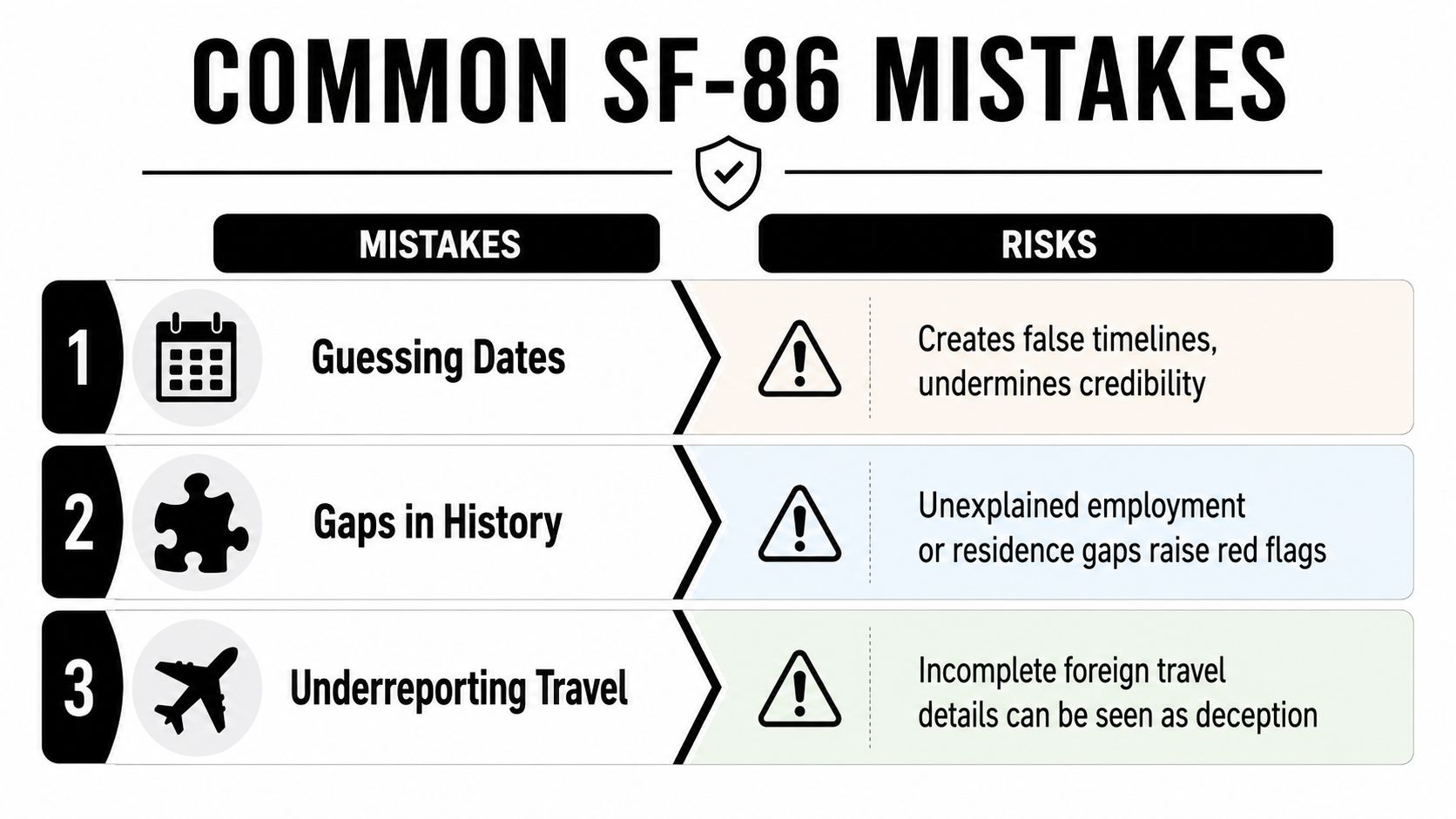
The same mistakes show up over and over because people underestimate how exact the form really is. Don’t make that mistake. The government does not need a perfect memory from you, but it does need a complete and defensible record.
- Guessing dates: A made-up timeline creates a false statement problem and makes every later answer look weaker.
- Leaving unexplained gaps: If you have a residence or employment gap, fill it in. Silence looks like concealment.
- Underreporting foreign travel: Personal trips still count. “It was just vacation” is not a defense to omission.
- Hiding mental health treatment: Stigma is not a strategy. Silence can become a credibility issue if the record surfaces later.
- Minimizing marijuana use: A five-year-old incident is still worth disclosing if the question reaches it. Hiding it often causes more damage than the underlying conduct.
- Volunteering extra narrative: Answer the question asked. Overexplaining invites confusion and can create new inconsistencies.
- Skipping expunged or juvenile matters: If the question reaches the event, don’t assume a court seal solves the disclosure problem.
- Forgetting prior investigations or clearances: The government already has records in many cases, and mismatches are easy to spot.
The hidden cost of these errors is not always immediate. Sometimes the first hit is a follow-up interview. Sometimes it is a clearance delay. Sometimes it becomes a command referral or a false-statement allegation. That is why the safest rule is simple, never guess when you can verify, and never certify when you still have a hole in the story.
What to Do the Moment the SF-86 Lands in Your Inbox
Do not certify it the same day. That is how service members create problems they do not see until an investigator, a security manager, or command starts comparing answers line by line. Open the form, then stop and build a clean record before you type the final version. Save every draft, every attachment, and every email tied to the form, because once the story changes, those versions matter.
The sequence that works
- Gather the documents. Pull leases, W-2s, passport pages, prior SF-86s, travel records, school records, and anything else that helps you pin down dates.
- Map the lookback windows. Build one timeline for residences, employers, schools, travel, and contacts so you can spot gaps before the government does.
- Flag the risk areas first. Drugs, finances, mental health, foreign contacts, criminal matters, and prior investigations need attention before you write final answers.
- Draft explanations separately. Keep them short, factual, and tied to the exact question asked.
- Get counsel involved before certification if anything raises exposure. If the form touches potential UCMJ exposure, you need legal review before you send it.
The lookback periods do most of the work here. Residence and employment history generally reach 10 years, personal references and several conduct-related disclosures reach 7 years, and some topics have no time limit. If you do not organize the file around those windows, you will miss something. Use the official SF-86 instructions as your guide, and read them before you start filling blanks just to get the form done fast.
| Topic | Lookback | Why It Matters |
|---|---|---|
| Residence history | 10 years | Missing dates create gaps investigators notice quickly. |
| Employment history | 10 years | Unexplained work breaks look like concealment. |
| Personal references | 7 years | References are used to test consistency in your story. |
| Foreign travel | 7 years | Trips and contacts can trigger extra questions. |
| Some conduct disclosures | 7 years | Old conduct still matters if the form asks for it. |
If you are already flagged or the security office is asking questions, do not start freelancing in informal interviews. Article 31 rights can come into play in military questioning, and you should not assume every conversation is harmless admin. Article 31 of the UCMJ
Why You Need Civilian Defense Counsel Before You Certify
The time to call civilian counsel is when the e-QIP invite arrives, not after the investigator starts asking questions. A misstatement on the SF-86 can become a federal or UCMJ case, and once you’ve spoken carelessly, it is hard to clean up the damage. Experienced civilian military defense counsel can review disclosures before certification, coordinate clearance strategy with potential UCMJ exposure, and keep your story consistent before the government starts building its file.
Do not wait for the interview to become your first legal meeting. If the form touches drugs, finances, foreign contacts, mental health, criminal matters, or prior investigations, get counsel involved before you certify. The SF-86 is the first place service members can self-incriminate, and it’s usually the easiest place to stop the damage if you move early.
If your SF-86 is sitting open in your inbox and any part of it worries you, stop guessing and get legal eyes on it now. The wrong answer can cost you your clearance, trigger command action, and put your career in the hands of people who are not there to protect you. Reach out to a civilian military defense lawyer before you certify, before the investigator calls, and before a small omission turns into a charge.