
Don't mistake an AR 15-6 investigation for a simple chat or an informal effort to "clear things up." It’s a formal, fact-finding process, and its results give commanders the evidence they need to take career-ending administrative action. The moment an Investigating Officer (IO) is appointed, you must assume a case is being built to take you down.
Table of Contents
- What a 15 6 Investigation Really Means for Your Career
- Navigating the AR 15-6 Investigation Process
- Protecting Your Rights During an Investigation
- Common Mistakes That Will Destroy Your Career
- Why a Civilian Defense Lawyer Is a Necessity
- Your Top Questions About 15-6 Investigations, Answered
What a 15 6 Investigation Really Means for Your Career
Let's be direct. If you are the subject of 15 6 investigations, your military career, your reputation, and your future are on the line. This isn't a neutral, fact-finding mission designed to help you. It's a command tool used to gather information that can justify anything from a formal reprimand to a court-martial.
The Investigating Officer's job is not to protect your interests. Their duty is to gather the facts, collect witness statements, and assemble documents to support a finding against you. More often than not, that finding substantiates an allegation of misconduct. These investigations lay the groundwork for serious penalties that will impact your life long after you take off the uniform.
The Real-World Stakes of an AR 15-6
The findings from a 15-6 are the official justification for a wide range of adverse actions. Depending on what the IO concludes, you could be facing:
- A General Officer Memorandum of Reprimand (GOMOR): This is a formal censure placed in your official military file. A "filed" GOMOR can effectively halt promotions and kill your chances for desirable assignments or schools. It's a career death sentence.
- Administrative Separation: Your command will use the investigation as the basis to start involuntary separation proceedings. This could lead to an Other Than Honorable (OTH) discharge, which strips you of your veteran's benefits and cripples future employment opportunities.
- Loss of Rank and Pay: The report can be used to support nonjudicial punishment (Article 15) or other administrative measures that demote you and slash your income.
- Referral to Court-Martial: If the evidence points to serious criminal offenses under the UCMJ, the 15-6 report often becomes the starting point for prosecutors to build a criminal case against you.
From toxic leadership and hazing to financial liability for lost equipment, AR 15-6 investigations are the Army's go-to administrative weapon. These proceedings are initiated by commanders at all levels and are a core component of the military justice system. The decisions made based on these reports can fundamentally alter a service member's life and career trajectory.
AR 15-6 Investigation vs Other Military Actions
It’s crucial to understand how a 15-6 differs from other military processes. While they can feel similar, their purpose, standards, and potential outcomes are distinct. Think of the 15-6 as the first step that can lead to these other, more serious actions.
The table below breaks down the key differences between an AR 15-6, nonjudicial punishment (Article 15), and a full-blown criminal investigation.
| Action | Purpose | Standard of Proof | Worst-Case Outcome |
|---|---|---|---|
| AR 15-6 Investigation | Administrative fact-finding to inform a commander. | Preponderance of the Evidence (more likely than not) | Administrative separation, GOMOR, or referral to criminal investigation. |
| Article 15 (NJP) | Nonjudicial punishment for minor offenses. | Beyond a Reasonable Doubt | Reduction in rank, loss of pay, extra duties, restriction. |
| Criminal Investigation (CID/NCIS/OSI) | Investigate felony-level criminal misconduct for potential court-martial. | Beyond a Reasonable Doubt | Federal conviction, confinement in prison, punitive discharge (Dishonorable, etc.). |
At the end of the day, an AR 15-6 investigation is the administrative starting block. Its findings can either end the matter or serve as the foundation for much more severe nonjudicial or criminal punishments.
Navigating the AR 15-6 Investigation Process
If you're facing an AR 15-6 investigation, you need to understand that this isn't just a series of questions—it's a formal process with specific rules and high stakes. Think of it less like a conversation and more like a tactical minefield. Knowing the terrain, the key players, and where the dangers lie is absolutely essential to protecting your career.
The ground rules for these investigations actually changed in June 2025. A major update to the AR 15-6 regulation now forces commanders to perform an initial "credibility assessment" before green-lighting a full-blown investigation. This means they have to decide if there's "sufficient credible information" to even justify fact-finding, a move designed to weed out baseless claims from the start.
This infographic shows just how quickly a simple "fact-finding" inquiry can spiral into a career-ending event.
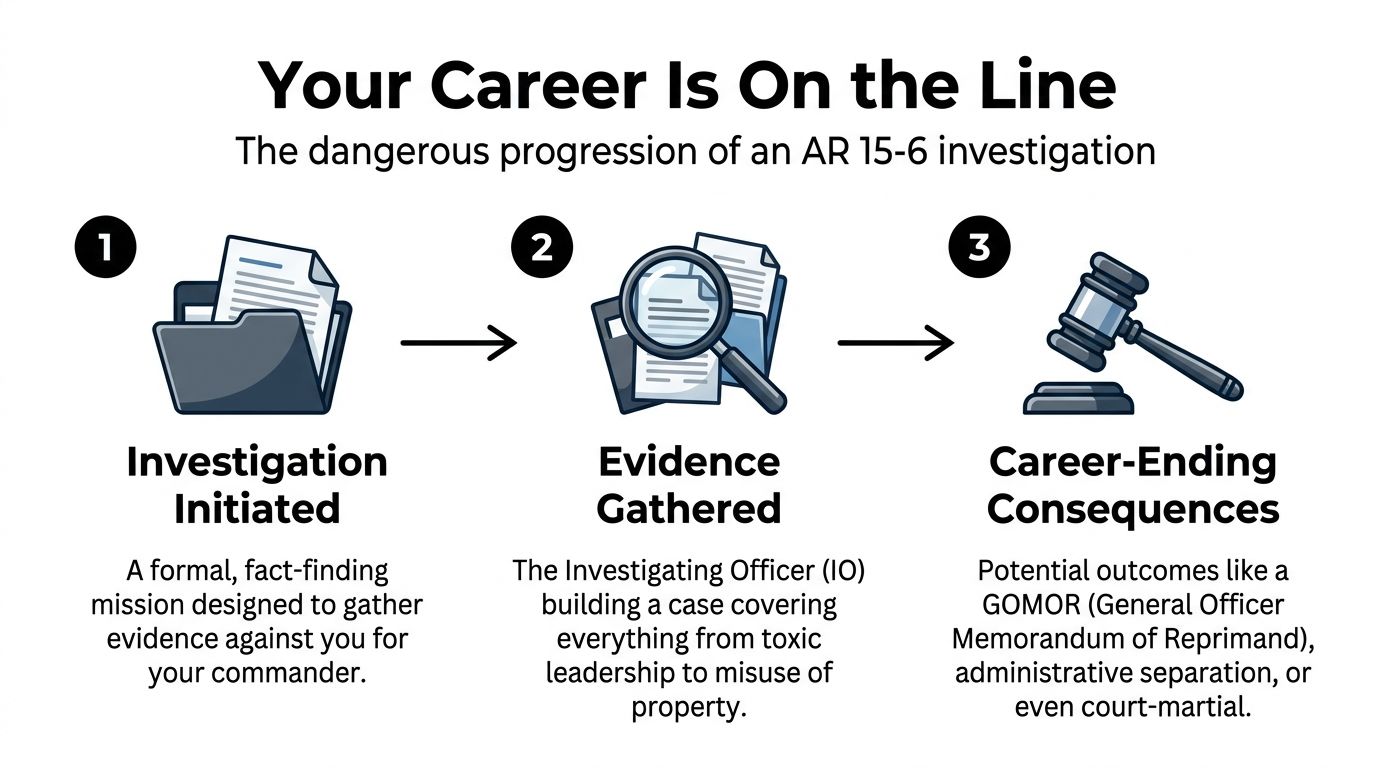
As you can see, what begins as a simple inquiry can easily lead to serious administrative or even criminal consequences.
The Stages of an AR 15-6 Investigation
Once your command decides an allegation is credible, the formal process kicks off. Here’s a breakdown of what to expect.
Step 1: The Investigating Officer (IO) Is Appointed
First, the appointing authority (typically your commander) will pick an Investigating Officer, or IO. This is usually a commissioned officer or senior NCO tasked with gathering the facts. Let's be clear: the IO is not your friend. Their sole mission is to find facts for the commander. They are often overworked, undertrained in investigative procedures, and under immense pressure to close the case quickly.
Step 2: Evidence Collection and Interviews
The IO will start digging. They’ll gather documents, pull text messages and emails, and take sworn statements from everyone involved—the accuser, any witnesses, and you. This is the most dangerous stage. Too many service members walk into the IO's office without a lawyer, thinking a "friendly chat" will clear things up. It won't.
Never forget: The IO’s questions are calculated. There are no casual "off-the-record" remarks. Every question is a tool designed to get admissions, find inconsistencies in your story, and build a case against you.
Step 3: The IO Submits a Report with Findings
After the interviews are done, the IO writes a formal report. This report includes their findings (what they believe happened) and recommendations (what they think the commander should do about it). The standard of proof here is shockingly low: a preponderance of the evidence. This means they only have to believe it's "more likely than not" (a 51% certainty) that the misconduct occurred.
Step 4: You Get to Submit a Rebuttal
You have the right to see the evidence against you and submit a formal rebuttal. This is your chance to fight back. A weak, quickly written rebuttal is basically a white flag. A strong, evidence-based rebuttal drafted with legal counsel can completely dismantle the IO’s report and end the investigation in its tracks.
While this whole process is administrative, it can easily spin into a criminal matter. If the IO uncovers evidence of a serious crime, they will stop and refer the case to criminal military investigations agencies like CID. An experienced UCMJ defense attorney can step in at any of these stages to safeguard your rights and build the strongest possible defense.
Protecting Your Rights During an Investigation
Your command has its mission, but you have your rights. It's a tough spot to be in, and under the pressure of 15 6 investigations, too many service members end up surrendering those rights. They think that simply "cooperating" will make the whole mess go away.
It won't. In fact, it often does the exact opposite—making the investigator's job easier while digging your own hole deeper.
This isn't about being uncooperative for the sake of it. It's about understanding the rules of the game and forcing the Investigating Officer (IO) to build their case on solid evidence, not on your own words twisted and used against you. Think of this as your personal tactical guide for navigating the process when you're the one in the crosshairs.
Know Your Rights as a Respondent
The moment you're formally named a "respondent," your status changes. You are no longer just a witness providing information; you are the subject of the investigation. The system gives you a specific set of rights at this point, but it's entirely up to you to actually use them.
You have the right to:
- Be Notified: They must officially tell you that you are a respondent. No ambiguity.
- Review the Evidence: You get to see everything the IO has collected—every witness statement, every document, every piece of evidence that could be used against you.
- Have Counsel: You have the right to a lawyer. This can be a military-appointed attorney or a civilian one you hire. Whatever you do, never, ever waive this right.
- Submit a Rebuttal: This is your chance to fight back. You have the right to submit your own evidence and arguments to challenge the IO's findings. A well-crafted rebuttal from an experienced attorney can dismantle a weak case before it ever gets to the commander.

The Most Important Right: The Right to Remain Silent
Of all the rights you have, one stands above the rest: your absolute right to remain silent. You cannot be forced to make any statement, written or oral, that might incriminate you. An IO simply cannot compel you to answer their questions.
Don't fall for the friendly investigator routine or the idea that you can talk your way out of it. Every word you say is being recorded and scrutinized. Your statements will be picked apart for inconsistencies and used to build the case against you.
When an IO sits you down for an interview, there's only one thing you need to say: "I am exercising my right to remain silent and I want to speak with an attorney."
That's it. Say nothing else.
Asserting your right to silence forces the investigation to proceed based on actual evidence, not your potentially self-incriminating testimony. This is the first and most critical move in your defense. An experienced lawyer can show you how to win cases during the military investigation phase by controlling the narrative from the very beginning. Protecting your rights isn't just a defensive move; it's the first step toward taking control of your future.
Common Mistakes That Will Destroy Your Career
When the weight of an AR 15-6 investigation comes down, it's easy to panic. Under that kind of pressure, countless service members make the same catastrophic errors, time and time again. These aren't just small missteps; they are career-ending decisions. I’m going to be straight with you—my goal is to lay out these traps so you can steer clear, because once you fall into one, there’s often no climbing back out.
Talking to the Investigating Officer Without a Lawyer
This is, without a doubt, the single most damaging mistake you can make. The Investigating Officer (IO) isn't your buddy, a guidance counselor, or a neutral party. They are an arm of the command, and their mission is to gather facts. More often than not, those "facts" will be used to build a case against you. They are trained to build rapport, get you talking, and spot any inconsistencies in your story.
Let me paint a picture for you. The IO calls you in for a quick, "informal chat" just to "get your side of things." You walk in thinking you can explain it all away and clear your name. An hour later, you've not only confirmed key details for them but have also contradicted yourself and handed them everything they need. You’ve just volunteered to be the star witness for the prosecution—against yourself.
Believing the IO Is on Your Side
The IO might be someone you know from your unit, maybe even a friendly face. They might say things like, “I just want to hear your side,” or “Let’s get this wrapped up quickly so we can all move on.” Don’t let the casual demeanor fool you. Their job is to write a report for the commander. It's not to protect you. Their career isn’t on the line, but yours absolutely is.
An IO's friendliness is a tactic, not a sign of friendship. Their objective is to get information. Your objective is to protect your career. These two goals are in direct conflict.
Deleting Texts, Emails, or Social Media Posts
The moment you find out you're under investigation, the urge to "clean up" your digital life can be powerful. You might be tempted to delete texts, emails, or old social media posts that you worry could be misinterpreted. This is a disastrous move. In the eyes of the military, this is obstruction of justice or evidence tampering.

Frankly, it's much better to deal with the content of a message than to be accused of destroying evidence. Investigators often have forensic tools to recover deleted data anyway, and the very act of deleting something signals that you knew you had something to hide. It creates a new, and often more severe, offense.
Waiting Until the Investigation Is Over
This happens all the time. A service member decides to "wait and see" what the investigation turns up before contacting a lawyer. This is like waiting for the enemy to overrun your position before you call for air support. It’s too late.
The most critical window to shape the outcome of 15 6 investigations is while the inquiry is active. A good lawyer can engage with the IO, present counter-evidence, offer context, and start building your defense before the damaging report lands on the commander's desk. Once that report is filed, you’re stuck playing defense on their terms, and it’s a much harder fight to win.
Why a Civilian Defense Lawyer Is a Necessity
When you're notified you are the subject of an AR 15-6 investigation, command will tell you that you're entitled to a free military lawyer from Trial Defense Service (TDS). You should absolutely speak with them. But you must understand what you’re getting—and what you're not.
The TDS attorney you're assigned is probably a sharp, hardworking junior officer with the best of intentions. The problem is, they are almost certainly buried under a mountain of cases. They’re also a product of the very system that’s investigating you. They work in the same buildings as the prosecutors, answer to a military chain of command, and might have to face your commander again next week on an entirely different matter. That’s a tough spot to be in.
The Critical Difference of Independence
A civilian defense lawyer has a much simpler job. We answer to one person and one person only: you. My loyalty is to your case, your career, and your future—that's it. I don’t have to worry about command politics, a pending Officer Evaluation Report, or whether I’m making waves. My sole mission is to find the holes in the government's case and protect you from a finding that could end your career.
This independence isn't just a talking point; it's a massive tactical advantage. It frees me up to be aggressive with the Investigating Officer (IO), to directly challenge the command’s version of events, and to call out every single procedural mistake without looking over my shoulder.
An appointed military lawyer works within the system. An experienced civilian defense lawyer knows how to fight the system from the outside. When your career is hanging in the balance, that distinction is everything.
Experience Is Your Greatest Weapon
Think about it: the average IO has probably run few, if any, 15 6 investigations before yours. The TDS lawyer assigned to help you might only have a handful under their belt. A seasoned civilian military defense lawyer, on the other hand, has likely navigated hundreds of these.
This isn't just repetition; it's about building a library of strategic knowledge. Investigating Officers tend to make predictable mistakes: they cut corners when gathering evidence, and some of their interview tactics are flawed. That depth of experience lets me spot weaknesses in an IO's report that a less experienced attorney would almost certainly miss.
This allows me to take immediate, decisive action:
- Get in Front of the Investigation: We don't just sit back and wait for the IO to finish their report. Effective defense counsel get involved from day one, feeding the IO counter-evidence and shaping the narrative with their own theory of the case.
- Build a Powerful Rebuttal: A good rebuttal does more than just deny the claims. We methodically take apart the IO's logic, challenge their credibility, and attack their findings using solid evidence and legal precedent.
- Prepare for the Next Battle: We always assume the 15-6 is just the first step. A strong defense anticipates how adverse findings could be used to justify a GOMOR, a separation board, or even a court-martial, and is ready for whatever comes next.
Choosing your advocate is the single most important decision you can make at this stage. To get a better handle on what you should be looking for, check out our guide on how to choose the right military defense lawyer for your case. When the stakes are this high, you can't afford to settle.
Your Top Questions About 15-6 Investigations, Answered
When you find out you're the subject of an AR 15-6 investigation, your world can feel like it's spinning out of control. The questions hit you all at once, and the uncertainty is the worst part. These are honest, direct answers to the questions that are likely keeping you up at night.
Do I Have to Talk to the Investigating Officer in a 15-6?
No. You absolutely do not. This is, without a doubt, the most important right you have. You are never required to answer questions from an Investigating Officer (IO).
The correct and only response is to state, politely but firmly, "I am exercising my right to remain silent and I wish to speak with an attorney." Stop talking right there. Don't try to explain, don't add "but," just stop.
So many service members think they can talk their way out of it or "just clear things up." Trust me, this is almost always a disaster. The IO isn't there to be your friend or hear your side of the story; their job is to gather facts for the command. Every word you say can be misunderstood, taken out of context, and used to build a case against you. Your silence is your best defense—use it.
What's the Standard of Proof in a 15-6 Investigation?
This is where things get really dangerous. The standard of proof is just a preponderance of the evidence. This means the IO only has to believe it’s 51% likely that the misconduct happened. It’s a far cry from the "beyond a reasonable doubt" standard you see in criminal court.
This incredibly low bar is why these investigations are so perilous. A career-altering finding can be built on flimsy, circumstantial evidence or the word of a single, unreliable witness. It’s also why a powerful, evidence-backed rebuttal from your defense counsel is non-negotiable.
Will a 15-6 Investigation Go on My Record?
An adverse finding in a 15-6 almost always leads to a paper trail that can cripple your career. If the IO "substantiates" the allegations, that report becomes the justification for an adverse action, very often a General Officer Memorandum of Reprimand (GOMOR). Once a GOMOR is filed in your official military file, it's permanent. It essentially kills any chance for promotion, key assignments, or command.
Don't be fooled into thinking it's "just paperwork." Even if the allegation seems minor, the stain on your record can follow you for the rest of your service.
How Long Does a 15-6 Investigation Take?
Frustratingly, there’s no set timeline. While regulations might suggest 30-45 days as a target, extensions are handed out like candy. I have personally seen 15 6 investigations drag on for many months, leaving a service member’s career and life hanging in the balance.
Keep in mind, the IO is usually just another officer doing this as an additional duty. They’re juggling the investigation with their actual job, which often leads to long delays, sloppy work, and procedural mistakes—all things a sharp defense attorney can use to your advantage.
Do I Really Need a Lawyer for an AR 15-6?
To be as clear as possible: trying to handle 15 6 investigations on your own is playing with fire. The entire system is built to process you, not protect you. The IO is not your advocate, and the command is often just looking for a quick resolution.
You might be offered a military-appointed lawyer, and that's a start. But they are often overworked, juggling dozens of cases, and are ultimately part of the same command structure you're up against. An independent, civilian defense counsel works for one person: you. Effective defense counsel get involved from day one to control the narrative, challenge the IO's every move, and build a defense designed to get the investigation shut down before it can ruin your life. Your career is not a DIY project—get an expert in your corner.