You’re already in the worst part of this. The texts are ugly, the house feels unstable, command may be asking questions, and somebody is telling you to “just stay calm” while you’re trying to figure out how to keep people apart and keep your career from getting dragged into the mud.
If you need to know how to file for a no contact order, stop thinking like this is a paperwork problem. It’s a protection problem, a jurisdiction problem, and for military families, a command problem too. If you choose the wrong forum, miss a service step, or assume command action is the same as court protection, you can lose time you don’t get back.
Table of Contents
- Your World Just Exploded What Do You Do Now
- Military vs Civilian Orders The Two Battlefields
- The Step-by-Step Filing Process Decoded
- Common Mistakes That Will Sink Your Case
- After You File Hearings Service and Enforcement
- FAQ About No Contact Orders in the Military
- Can I file for a no contact order if the other person is in another county or state
- Does a civilian no contact order apply on base
- Can a judge issue something quickly before the full hearing
- What happens if the other person does not respond
- Does filing online count
- Can violations be enforced right away
- Do I need a lawyer immediately
- Your Career Is on the Line Dont Go It Alone
Your World Just Exploded What Do You Do Now
The phone rings, the messages stop sounding like arguments and start sounding like threats, and now somebody is telling you not to go home, not to talk, or not to let the other person near the kids. That is the moment to get serious. Not later. Not after “one more conversation.”
If the risk is real, you need a paper trail and a court track. In many places, a civil no-contact order starts in the local district or circuit court, and venue matters because some states let you file where you live, where the other person lives, or where the incident happened. Illinois says a civil no contact order may be filed in the county where you live, where the abuser lives, or where the incident occurred, and Texas uses a similar county-based filing structure for protective orders. Those venue rules decide where the petition is accepted and which judge sees it first. Illinois orders of protection guidance
A commander can issue a Military Protective Order, but that is not the same thing as a civilian court order. An MPO is a command tool. A civilian order is a court order backed by state enforcement. If you are trying to protect yourself, your spouse, or your kids, you need to know which lane gets you actual, enforceable relief fastest.
Practical rule: if the situation feels unstable enough that you’re checking doors, phones, and duty schedules, don’t wait for the next blowup. Start documenting now and choose the filing path that gives you enforceable protection, not just reassurance.
North Carolina shows how fast this can move once filed. There, a civil no-contact order petition goes to district court, the respondent has 10 days after service to file a written answer, and if they don’t respond or appear, the court may grant the order by default. North Carolina procedure summary The point is simple. The filing is only the opening move. The court process is already running once you file.
Military vs Civilian Orders The Two Battlefields
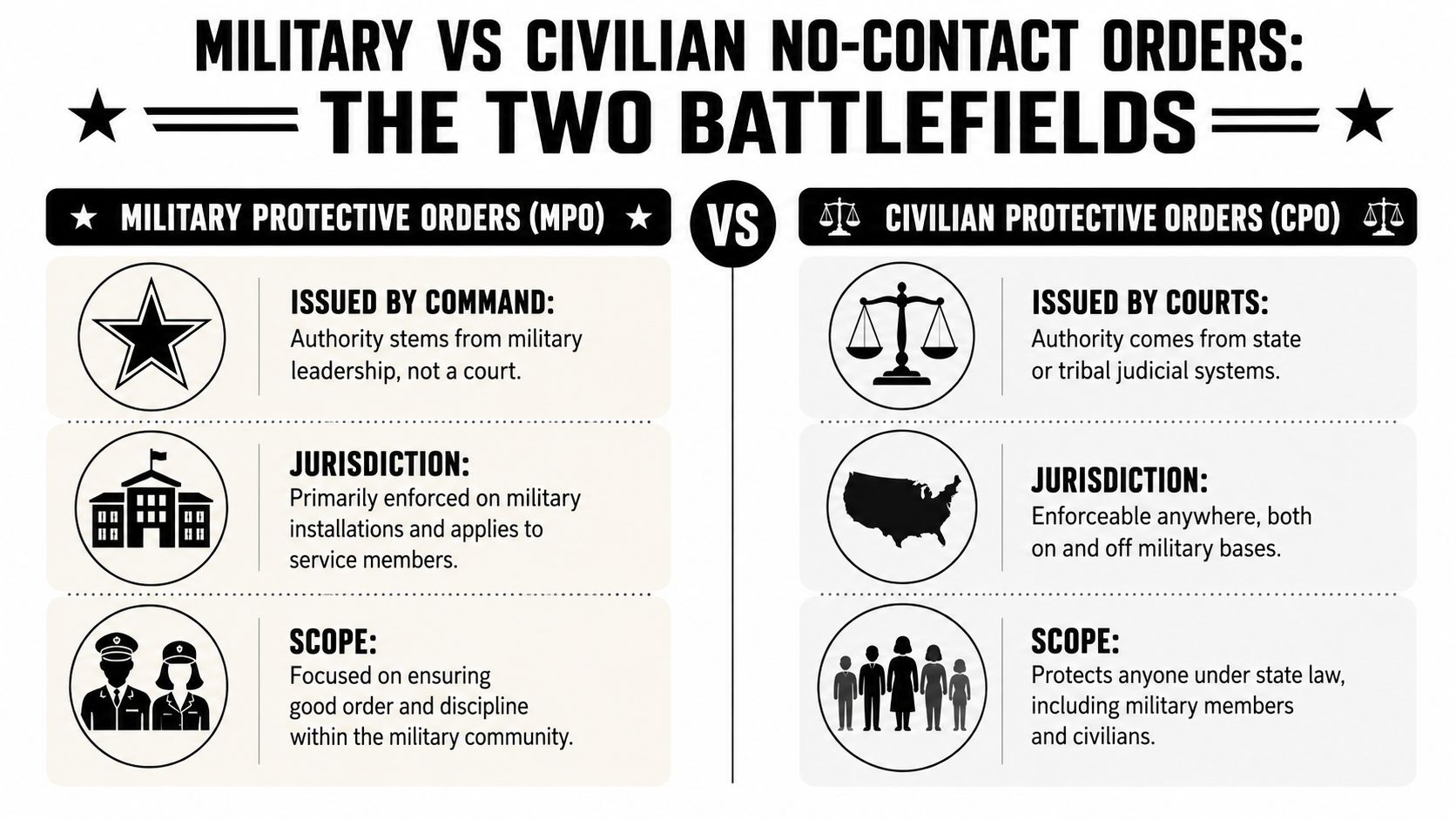
A lot of people blur these together because both can tell someone to stay away. That’s a mistake. They operate in different systems, they are enforced differently, and they can hit a service member’s life in very different ways.
MPOs and civilian orders are not interchangeable
An MPO comes from command authority. It’s designed to control contact inside the military environment and preserve good order and discipline. A civilian no-contact or protective order comes from a judge, usually through district or circuit court, and it can be enforced by civilian law enforcement. The difference is not academic. One is a command directive. The other is a court order.
That difference matters for the person under stress and for the person seeking protection. If you only get an MPO, you may get immediate separation on base, but you may not get the broader legal consequences that come with a court order. If you only get a civilian order, you may have stronger legal enforcement, but you still need to think through base access, duty schedule conflicts, and command notification.
Here’s the short version. MPOs are command-focused. Civilian orders are court-focused. If you’re military or married to someone who is, you often need to think about both tracks at the same time.
Why the choice affects your case
A civilian order can follow a service member off base. That matters when the conduct spills into off-duty housing, schools, child exchanges, or text-message harassment. A command order may be faster in some situations, but it doesn’t replace the court process if you need a durable order that law enforcement can enforce outside the gate.
Many individuals waste time. They assume command will “handle it,” or they assume a court filing will automatically solve the barracks or installation problem. It usually doesn’t. Good strategy means using the track that fits the threat.
If you want the broader military justice context, the structure of the UCMJ matters too. UCMJ system overview for service members
A judge can review a petition quickly. In some situations, courts issue an ex parte temporary order before the other side has even been heard. According to a legal guide, that kind of temporary restraining order can be effective for 10 to 22 days pending the next steps. Temporary restraining order timeline Once you understand that, the tactical question becomes obvious. Which forum gives you protection now, and which one gives you staying power later?
The Step-by-Step Filing Process Decoded
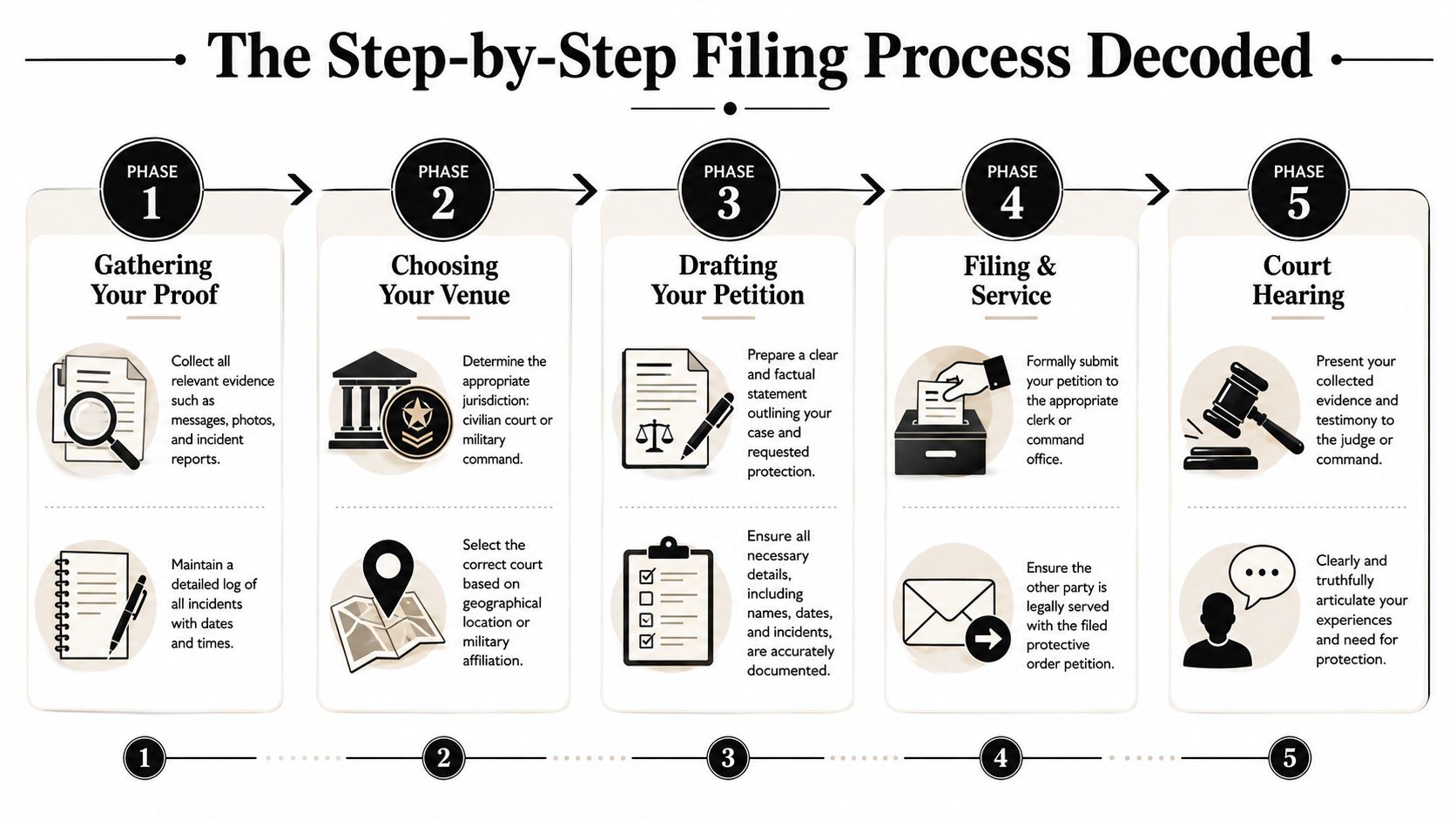
The first point to understand is this. Do not show up to court with a story in your head and nothing on paper. Judges do not protect people based on adrenaline. They protect people based on evidence, chronology, and a petition that makes sense.
Gather your proof first
Start with the material that shows pattern and immediacy. Messages, photos, incident reports, call logs, and witness names are the basics. If the situation involves harassment, threats, or repeated contact, build a timeline before you go to court or the command.
The strongest petitions read like a clean chronology, not a rant. The judge should be able to follow who did what, when, and why you’re asking for protection.
If you can’t prove every detail, don’t panic. But you do need enough reliable material to show the court why the order is necessary. For military families, that often means saving screenshots, preserving voicemail files, and writing down duty-related conflicts that show why no-contact relief has to be immediate.
Choose your venue
Venue means where you file. In plain English, it’s the court that has the authority to take your petition first. Minnesota allows a harassment restraining order petition to be filed in the county where the petitioner lives, the respondent lives, or where the harassment happened. Minnesota court guidance Illinois and Texas use county-based filing options too, which is why people shouldn’t guess.
Oklahoma County gives victims a concrete starting point. The victim protection order process begins with the county court clerk’s VPO Fillable Form (PDF) and a return to the Court Clerk’s office. Oklahoma County victim protective orders That kind of detail matters because filing in the wrong place wastes time when you’re already in a crisis.
File, serve, and prepare for hearing
Illinois law is unusually clear that a civil no contact order petition may be filed in person or online, and that a separate summons must be issued and served. Illinois Civil No Contact Order Act Don’t treat service as a formality. If the other side isn’t properly notified, you can lose time and force another round of filings.
North Carolina’s process shows why deadlines matter. The respondent may file an answer within 10 days of being served, and service is normally handled by personal service through the sheriff. If the respondent can’t be located, publication may be used in limited circumstances. North Carolina service and response rules That is not the place for sloppy paperwork or loose dates.
If you’re standing in the middle of a military crisis, think in phases. First, gather. Second, pick the right venue. Third, file cleanly. Fourth, make sure service happens. Fifth, show up ready to prove why protection is necessary.
Common Mistakes That Will Sink Your Case

The worst outcomes do not always come from the weakest facts. They’re the ones where somebody made avoidable mistakes and handed the other side an opening.
The mistakes that cost people protection
- Waiting too long: If you know things are escalating, delay helps the wrong person. Courts move faster when you can show immediate risk.
- Relying on memory alone: Write the timeline down while the details are still fresh. Screenshots disappear, and people forget exact wording.
- Talking to the respondent after filing: Mixed signals can wreck credibility and complicate enforcement.
- Assuming command action is enough: An MPO may help on base, but it doesn’t automatically replace civilian relief.
- Missing service details: If the other side isn’t properly served, the case can stall.
- Treating the hearing like a formality: It isn’t. If you underprepare, the other side will exploit every gap.
- Exaggerating: Judges spot drama fast. Clean facts beat inflated claims every time.
A key strategy is documentation discipline. Build a narrative that a judge or commander can act on without guessing. That means dates, names, locations, messages, and the smallest facts that prove pattern and risk. A sloppy story gets challenged. A clean story gets traction.
If the situation already overlaps with military discipline or witness-contact issues, that’s not a side note. It’s part of the battlefield. Article 31 UCMJ rights overview matters because people often talk their way into bigger problems before they get real advice.
Bottom line: if you’ve got a good case, don’t weaken it by improvising. Precision beats emotion in court, every time.
After You File Hearings Service and Enforcement
After the petition goes in, people often make the same dangerous assumption. They think the filing itself changes everything. It doesn’t. The next few hours and days decide whether the order protects anyone or just sits in a file.
What happens after filing
A judge may review the request in an ex parte hearing and, if immediate danger is shown, issue a Temporary Restraining Order (TRO). According to a legal guide, that TRO can be effective for 10 to 22 days before the next hearing steps play out. TRO process and duration That temporary window exists to prevent harm while the court gathers both sides.
The service requirement is where many petitions bog down. The other person has to be officially notified. In practice, that means the sheriff or another authorized process server, not a casual text, not a spouse, and not a commander sending a warning email. If service fails, the hearing may be delayed or reset.
For military readers, the civilian and command tracks intersect. A court filing can put civil law enforcement in motion, while a command action can shape access to the workplace, barracks, or base housing. The two tracks should be coordinated, not confused.
What violations mean in real life
If the order is violated, document it immediately. Save messages, note dates and times, and contact law enforcement or command depending on where the violation occurred. Don’t argue about whether the contact “counts.” Let the order and the evidence speak.
A court order can create long-term consequences. Texas protective orders can remain in effect for up to two years, which is why people need to think beyond the emergency moment. Texas protective order duration The short-term TRO gets you breathing room. The full order can shape housing, parenting, and contact restrictions for a lot longer.
If the case involves military discipline, don’t ignore how one process affects the other. A poorly handled violation can spill into command action, administrative trouble, or related criminal exposure. That’s why you don’t wing enforcement. You document, report, and preserve the record.
FAQ About No Contact Orders in the Military
Can I file for a no contact order if the other person is in another county or state
Yes, but you need the right venue. Many courts allow filing where you live, where the other person lives, or where the incident happened, and some jurisdictions have special rules for military families. Don’t guess. File where the court has authority to hear it.
Does a civilian no contact order apply on base
Often, yes, if it’s a valid court order and law enforcement or command is notified. A civilian order and an MPO can coexist, but they do different jobs. One does not automatically replace the other.
Can a judge issue something quickly before the full hearing
Yes. Courts can grant ex parte temporary relief when the facts show immediate risk. That temporary order is short-term protection while the case moves toward a full hearing.
What happens if the other person does not respond
In some jurisdictions, the court can grant the order by default if the respondent doesn’t answer or appear after proper service. North Carolina’s process is a good example, where the respondent has 10 days to respond after service. North Carolina default response rule
Does filing online count
Sometimes it does, depending on the state. Illinois allows filing in person or online for a civil no contact order. Illinois filing method Online filing is not the same as completed service, so don’t confuse the two.
Can violations be enforced right away
Yes, but only if you report them correctly and preserve proof. Keep messages, document sightings, and get law enforcement or command involved when appropriate. Your report has to be clean enough to stand up later.
Do I need a lawyer immediately
If this case touches military service, housing, custody, a security clearance, or command action, yes. The earlier you get strategy, the better your odds of avoiding a preventable mistake.
Your Career Is on the Line Dont Go It Alone
A no-contact order is never just about distance. For service members and spouses, it can touch your duty status, your housing, your family access, your reputation, and your future in uniform. That’s why you don’t want a lawyer who’s learning military pressure for the first time on your case.
A military-appointed lawyer may be competent, but that lawyer is still operating inside the system. An experienced civilian defense lawyer works for you alone, with no command pull and no institutional pressure. That independence matters when the case can spill from a civilian petition into military consequences fast. If you need serious representation, review court-martial defense lawyers who handle high-stakes military cases and get help before you say or sign anything that can’t be undone.
If you’re in the middle of a threat, a filing, or a command problem right now, do not wait for the situation to stabilize on its own. Pull together your evidence, choose the correct venue, and talk to an experienced military defense lawyer immediately.