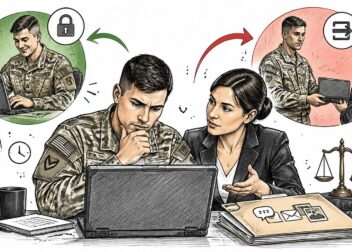
You get called into an office. Maybe it’s CID. Maybe NCIS, OSI, or CGIS. Maybe it’s your commander, first sergeant, or a senior NCO who says they just need to “clear something up.” Your pulse spikes. You start thinking like an innocent person. If I just explain this, they’ll see I didn’t do anything wrong.
That instinct destroys cases.
When you’re facing questioning, article 31 of the ucmj isn’t some technical legal rule for a classroom. It’s the line between protecting yourself and handing the government the statement they needed to build the case. Investigators are there to gather evidence. Command is there to protect the unit and mission. Neither exists to protect your career, your clearance, your retirement, or your freedom.
The next minute matters more than most service members realize. If you say the wrong thing, try to sound cooperative, or think silence makes you look guilty, you can create problems that no lawyer can fully undo. If you handle it correctly, you give your defense room to work. If you want to understand how experienced counsel evaluates these situations, start with guidance on selecting the right military defense lawyer.
Table of Contents
- The Conversation You Never Want to Have
- What Article 31 of the UCMJ Actually Guarantees You
- Article 31 vs Miranda A Critical Distinction for Service Members
- When Your Article 31 Rights Activate And When They Don't
- Common Mistakes That Waive Your Rights and Ruin Your Case
- How to Invoke Your Rights A Step-by-Step Script for Any Situation
- When Investigators Violate Article 31 Your Strongest Defense
- Your Questions About Article 31 Answered
The Conversation You Never Want to Have
You’re told to sit down. The tone is calm. Someone says this is routine. They may even act like you’re not the target. That’s deliberate. They want you relaxed, talking, filling silence, and trying to look helpful.
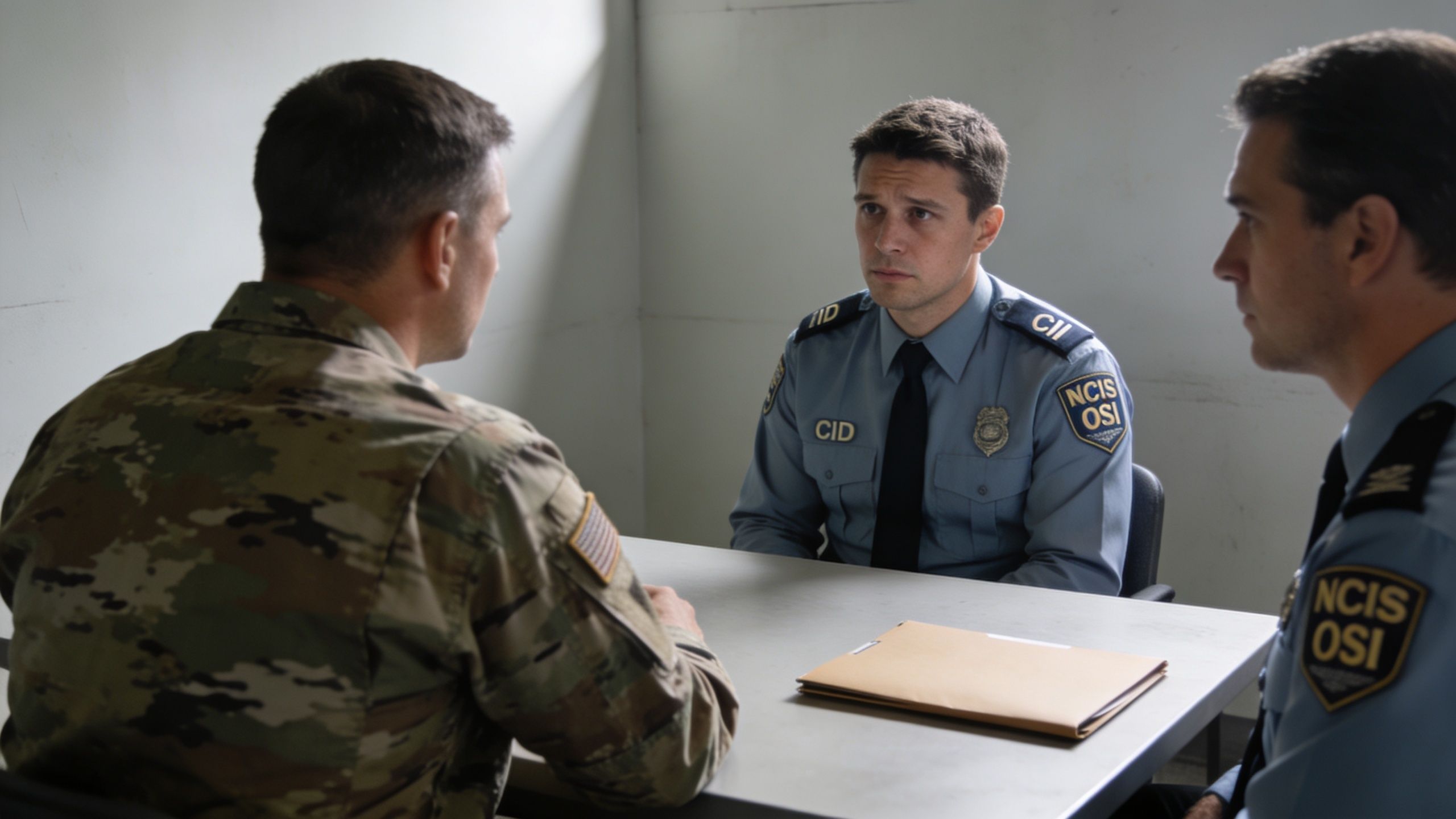
Here’s how it usually starts. “We just want your side.” “You’re not under arrest.” “Help us understand what happened.” “If there’s nothing wrong, now is the time to clear it up.” Service members hear that and think cooperation ends the problem. In reality, talking often creates the problem, or turns a weak case into a stronger one.
Investigators recognize a common discomfort with awkward silence. They know military culture rewards obedience. They know many good troops will answer questions from authority figures even when it’s against their own interest. That’s exactly why article 31 of the ucmj exists.
Investigations are not neutral fact-finding sessions. They are evidence-gathering operations.
If you’re in that chair right now, understand the stakes. A statement can affect a court-martial, an Article 15, an administrative separation, a security clearance, a promotion, and your standing with command. Families feel the damage fast. Reputations collapse even before formal charges appear.
Your job in that moment is not to persuade the investigator that you’re a good person. Your job is to stop making the government’s case for them.
What Article 31 of the UCMJ Actually Guarantees You
Article 31 of the ucmj gives service members statutory protections before questioning in military settings. These are not favors. They are legal requirements. Congress built them into military law because service members operate inside a system where rank, duty, and obedience create pressure that civilians don’t face in the same way.
One core protection is absolute and simple. Article 31(a) establishes an absolute prohibition on compelling any person subject to the UCMJ to incriminate themselves or answer questions whose answers may tend to incriminate them under the text of 10 U.S.C. § 831. That restriction applies to the government’s power to compel answers and to your obligation to respond when the answer could incriminate you.
The three warnings that matter
Before questioning a service member suspected of an offense, military authorities must give a proper Article 31(b) warning. In plain English, that warning has three parts:
- Nature of the accusation: They must tell you what you’re suspected of.
- Right to remain silent: They must tell you that you do not have to make any statement about the offense.
- Use against you: They must tell you that any statement you make may be used as evidence against you in a court-martial.
A service member can’t make a smart decision if the government hides the ball.
What this means in practice
If someone in a military law enforcement or disciplinary role wants to ask you about suspected misconduct, your first question should be internal and immediate: Am I about to help them prove a case? Most of the time, the answer is yes.
A proper rights advisement does not mean it’s safe to talk. It means the danger is now obvious.
Practical rule: The warning is your signal to stop, not your cue to start explaining.
Another point many people miss: rights only protect you if you use them. A service member who knows the right exists but keeps talking can still damage the defense. Silence is not disrespect. Silence is strategy.
Article 31 vs Miranda A Critical Distinction for Service Members
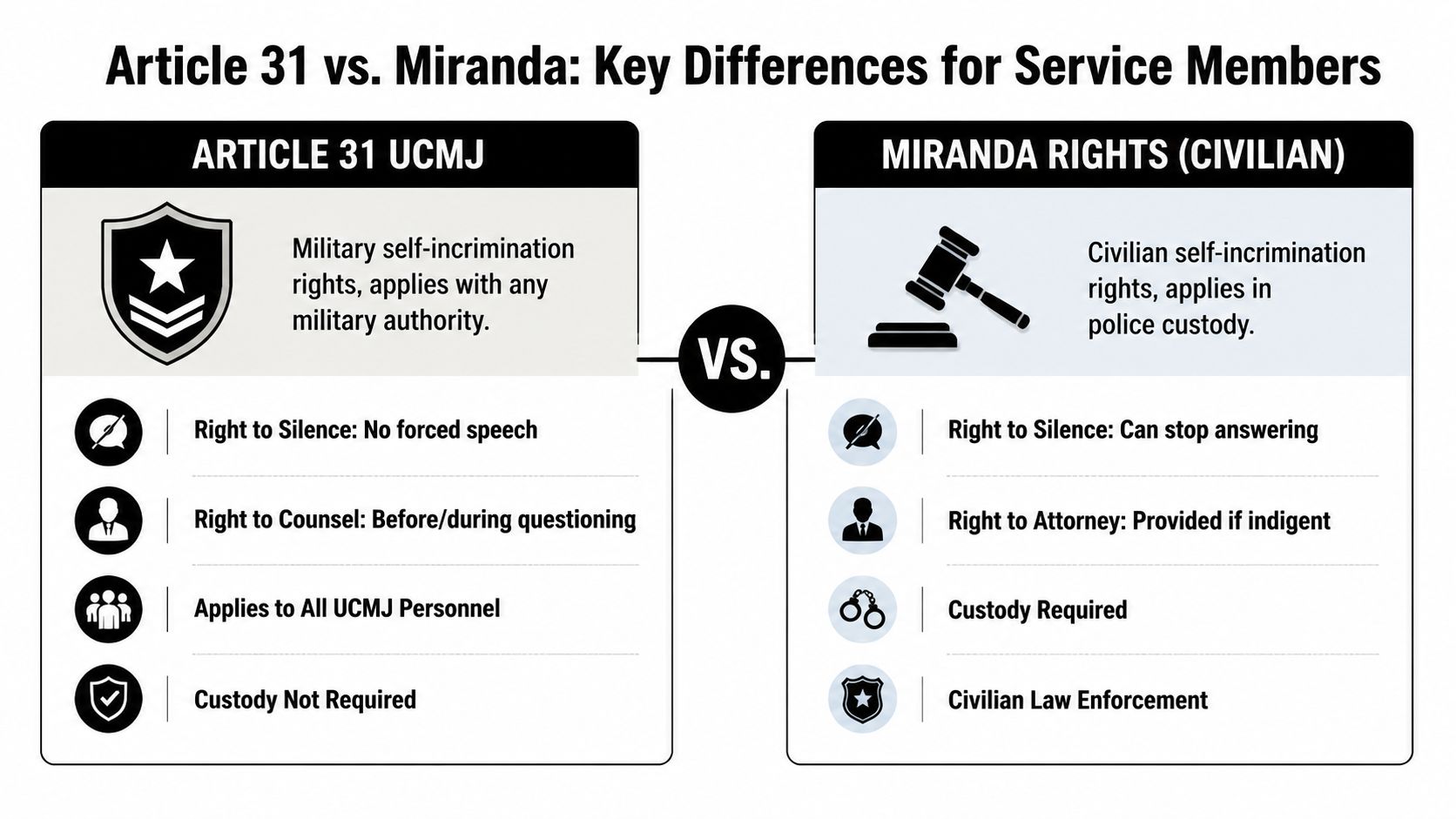
Many are familiar with Miranda from television. That comparison causes confusion because service members assume military questioning works the same way. It doesn’t. In one critical respect, article 31 of the ucmj gives stronger protection.
Why military rights are different
Article 31 of the UCMJ was established in 1950, predating Miranda by 16 years, and one key difference is that Article 31 requires investigators to inform a service member of the specific nature of the accusation before questioning, a protection civilians do not get as part of Miranda according to this Article 31 analysis.
That difference is not minor. It is tactical. If the government has to identify the accusation, you have a clearer basis to decide whether to stay silent, ask for counsel, and spot when the questioning drifts into other areas.
Miranda has become the cultural reference point, but military members shouldn’t think in civilian terms when they’re dealing with military investigators or command-directed questioning. The military justice system has its own rules, and if you rely on TV-law assumptions, you’ll walk straight into avoidable mistakes.
Article 31 Rights vs. Miranda Rights
| Feature | Article 31 (Military) | Miranda Rights (Civilian) |
|---|---|---|
| Source of protection | Statutory military protection under the UCMJ | Civilian constitutional warning framework |
| Timing background | Established in 1950 | Became standard in 1966 |
| Notice of accusation | Must include the specific nature of the accusation before questioning | Does not require that level of charge detail |
| Who commonly gives the warning | Military personnel acting in law enforcement or disciplinary roles | Civilian law enforcement |
| Why this matters | Service member can make a more informed decision before speaking | Civilian suspect may get less detail about the allegation |
That table leads to one practical conclusion. If someone reads you Article 31 rights, your response should not be, “Good, now I can explain.” Your response should be, “Good, now I know I need to shut up and call a lawyer.”
People also ask whether Article 31 replaces the Fifth Amendment. It doesn’t. Service members can have both protections operating together. But for your immediate decision-making, the important point is simple: military law gives you tools. Use them early, or they won’t save you later.
When Your Article 31 Rights Activate And When They Don't
The trap for many lies in this scenario. They wait for a formal interrogation room, a badge, or a scripted warning. By then, they may already have said enough.
Who can trigger article 31 of the ucmj
Article 31 protections apply when any person subject to the UCMJ questions another service member they suspect of an offense, and that requirement binds personnel in disciplinary roles including Army CID, NCIS, OSI, as well as commanders and NCOs conducting inquiries into suspected misconduct under this military defense explanation of Article 31 scope.
That means the danger isn’t limited to a formal criminal investigator. A commander, first sergeant, platoon sergeant, or other person in authority can create the same problem if they’re asking questions because they suspect misconduct.
If you need a fast primer on how these agencies and military investigative bodies operate, review CID, NCIS, OSI, and CGIS explained.
The gray area investigators exploit
Not every interaction triggers Article 31 warnings. Basic administrative questions, routine operational matters, or non-disciplinary conversations may not. That’s where the government gets room to maneuver.
Common examples include:
- “We’re just doing paperwork” conversations: A supervisor frames the contact as administrative, then starts asking who did what and when.
- Health and welfare or command climate pretexts: The setting looks routine, but the questions target suspected misconduct.
- Informal fact gathering: Someone in your chain says they just need a quick statement for the file.
The label doesn’t control. The function does.
If the person asking questions suspects you committed an offense, the issue is no longer casual, no matter how friendly the tone sounds.
Your safest move in a gray-area conversation is not to debate whether Article 31 technically applies. That’s lawyer work. Your move is to say you want counsel before answering questions about any suspected misconduct.
That protects you whether the government later calls it administrative, disciplinary, or investigative.
Common Mistakes That Waive Your Rights and Ruin Your Case
Most bad outcomes don’t start with a dramatic confession. They start with ordinary, predictable mistakes made by decent service members under pressure.
The mistakes I see over and over
Trying to “clear things up”
Innocent people love this move. Investigators love it more. Once you start talking, they compare every detail to texts, witnesses, digital records, and prior statements. Small mistakes become “lies.” Gaps become “consciousness of guilt.”Giving a partial statement
Service members think a limited explanation is safer than a full interview. It usually isn’t. A partial statement still gives prosecutors admissions, timelines, relationships, and details they can use to box you in.Believing silence looks guilty
Silence looks disciplined. Talking looks useful to the government. Commands may not like it, but your legal defense does not exist to make investigators comfortable.Trusting “off the record” talk
There is no magic phrase that turns a suspected-offense interview into a protected therapy session. If you’re speaking to someone who may report what you say, assume it can hurt you.Thinking command will handle it internally if you cooperate
Maybe they will. Maybe they won’t. You do not control that decision. Once you provide admissions, apologies, explanations, or excuses, you’ve supplied material for every forum that follows.Consenting too broadly after invoking rights
Some people get one part right, then immediately undo it by volunteering access, explanations, or context. Invoking rights means stop talking. It does not mean start negotiating in the hallway.Waiting to call a lawyer because “there’s no real evidence”
Your statement may be the evidence they need most. Cases that looked weak at the start often become much more dangerous after the target talks.
Good intentions do not protect you. Procedure does.
The service member who says less usually preserves more options. The service member who tries to manage the interview alone often gives away defenses before a court-martial attorney ever sees the file.
How to Invoke Your Rights A Step-by-Step Script for Any Situation
When stress hits, people freeze, ramble, or start explaining. That’s why you need a script before the moment comes.
What to say
Use plain words. Be respectful. Be firm. Don’t improvise.
If questioning starts or is about to start
Say: “I am invoking my right to remain silent. I want to speak with a lawyer before answering any questions.”If it’s your commander, first sergeant, or NCO
Say: “Sir/Ma’am/Sergeant, I respect the chain of command. I am invoking my rights and want a lawyer before making any statement.”If they say this is just informal
Say: “I’m not answering questions or making a statement without legal counsel.”If they keep pushing
Repeat: “I am invoking my right to remain silent and I want a lawyer.”
Don’t add explanations like “because I didn’t do anything” or “I’ll talk later once this blows over.” Just invoke and stop.
What to do after you say it
After you invoke, do these things:
- Stop talking about the facts: No clarification, no side comments, no “just one thing.”
- Don’t argue the case: Investigators may act disappointed, offended, or sympathetic. None of that matters.
- Don’t fill silence: Silence feels uncomfortable. That discomfort passes. A bad statement stays.
- Ask for counsel and wait: If you have appointed military counsel available, use that access. Then evaluate whether you also need experienced civilian military defense lawyers.
A lot of service members expect the room to get tense after invocation. It often does. That reaction is meaningless. Investigators may say they’re trying to help you. They may suggest that asking for a lawyer slows things down or makes you look bad. Ignore it.
“I want a lawyer” is not aggression. It is self-protection.
If you’ve already started talking, stop anyway. You can still invoke. You are not required to continue just because the conversation has begun.
When Investigators Violate Article 31 Your Strongest Defense
A rights violation is not a technicality. It can become the pressure point that breaks the government’s case.
Why violations matter
Under Article 31(d), any statement obtained in violation of the Article 31(b) warning requirement is automatically inadmissible in a court-martial, and that exclusion can extend to derivative evidence under the fruit of the poisonous tree doctrine, as described in this discussion of Article 31 suppression consequences.
In plain English, if investigators get your statement the wrong way, the statement can be thrown out. If that bad statement led them to other evidence, that later evidence may also be vulnerable.
That changes the balance of power fast. Cases often look stronger on paper than they really are because prosecutors count heavily on what the accused said. Remove that piece, and witness credibility, timelines, motive, and proof problems can get ugly for the government.
How defense lawyers use the violation
An experienced defense lawyer doesn’t just ask whether you made a statement. The lawyer asks:
- Who questioned you
- Why they questioned you
- Whether you were suspected
- Exactly what warning was given
- When the warning was given
- What happened before and after
- What evidence flowed from that statement
Those details matter because suppression work is often built from sequence and pressure. A sloppy advisement, a misleading setup, or questioning by command before formal investigators get involved can create real pretrial litigation opportunities. If you want to understand how serious lawyers attack cases before charges harden, review how elite counsel win cases during the military investigation phase.
The point is bigger than one motion. Strong defense strategy doesn’t wait for trial and hope for fairness. It forces the government to follow the rules, then punishes them when they don’t.
Your Questions About Article 31 Answered
Fear makes people ask the same urgent questions. Here are the answers you need.
Frequently asked questions
Can I refuse to talk to CID, NCIS, OSI, or CGIS?
Yes. If questioning concerns suspected misconduct, invoke your right to remain silent and ask for a lawyer. Be respectful. Be clear. Then stop talking.
Will invoking my rights make me look guilty to command?
Maybe to some people. That does not matter. Your command’s irritation is less dangerous than a usable statement in a criminal or administrative case.
If I already started talking, is it too late to stop?
No. Stop immediately. Invoke your rights and ask for counsel. You may not be able to erase what you already said, but you can stop making it worse.
What’s better, staying silent or asking for a lawyer?
Do both. Say you are invoking your right to remain silent and that you want a lawyer. Clear language prevents later arguments about what you meant.
Does article 31 of the ucmj only apply to criminal investigators?
No. As discussed earlier, the issue is not just the badge. Command personnel and others in disciplinary roles can trigger the warning requirement when they question a service member they suspect of an offense.
Can Article 31 matter in an Article 15 or separation case, not just a court-martial?
Yes. Statements made early can affect every later proceeding, even if the case never reaches a general court-martial. That’s one reason early silence matters so much.
Do I really need civilian counsel if I can get a military lawyer?
In serious cases, you should at least consult experienced civilian military defense lawyers right away. Appointed military counsel can be skilled and dedicated, but civilian counsel brings independence from command, outside perspective, and often deeper long-term focus on military criminal defense. In high-stakes allegations, that matters.
What should my family do if I’ve been contacted by investigators?
Tell them not to contact witnesses, not to post online, and not to help you “explain” the case through texts or calls. They should help you secure counsel, gather basic documents, and keep you from making panic decisions.
If you are under investigation, being asked for a statement, or worried that command is about to “just ask a few questions,” act now. Invoke your rights. Stop talking. Get legal help before the next interview, not after it.
Your career can be lost long before trial. Your freedom can be put at risk by one bad conversation. Strategy starts early, and delay helps the government.
If you need to identify experienced civilian court-martial attorneys quickly, use the UCMJ Lawyer Directory to compare serious defense counsel. Then pick up the phone and call.