If you’re reading this, your phone has probably already buzzed with the message you didn’t want. CID wants to talk. NCIS left a card. Your first sergeant says the commander has questions. Maybe your spouse knows something is wrong, but you haven’t told them much. Maybe you’re telling yourself this will blow over if you just explain what happened.
That instinct can wreck you.
The military investigation process is not a neutral truth-finding exercise. It’s a machine built to collect statements, lock in evidence, and hand command a file they can act on. Your career, your clearance, your PCS, your separation date, and in serious cases your freedom can all move in the wrong direction long before anyone proves anything in court.
What matters now is strategy. Not panic. Not overexplaining. Not trusting that command will “be fair.”
Table of Contents
- The Different Types of Military Investigations You Face
- The Military Investigation Process from Start to Finish
- Your Fundamental Rights When Under Investigation
- Strategic Flaws We Hunt for in Every Government Case
- Career-Ending Mistakes Service Members Make Under Pressure
- Why Your Free Military Lawyer Is Not Enough
- Military Investigation Frequently Asked Questions
The Different Types of Military Investigations You Face
Before you can defend yourself, you need to identify what kind of case you’re facing. Most service members lump everything together and call it “an investigation.” That’s a mistake. A commander’s inquiry is not the same as an AR 15-6. An AR 15-6 is not the same as a CID, NCIS, OSI, or CGIS criminal case.
Think of it this way. An administrative investigation is a command tool. A criminal investigation is a prosecution pipeline.
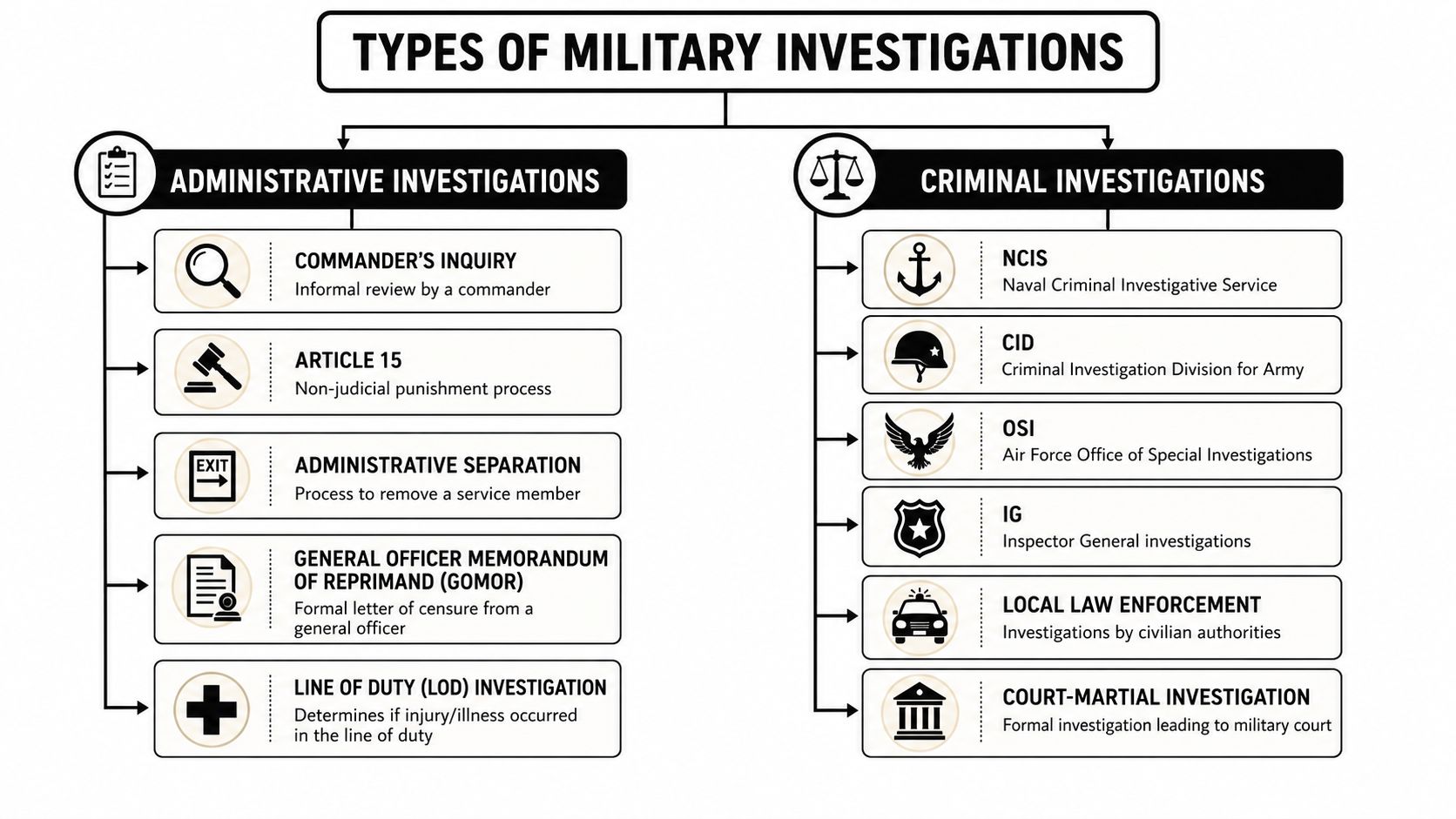
Administrative trouble and criminal trouble are different fights
Administrative investigations usually exist so command can answer a question and take action. That action can still be brutal. It can lead to a reprimand, adverse paperwork, separation processing, or referral for more serious consequences.
Common examples include:
- Commander’s inquiry: An informal review by command when they want facts fast.
- AR 15-6 investigation: A structured Army administrative process that can produce findings command will rely on.
- Administrative separation processing: A path toward pushing you out of the service.
- GOMOR-related fact finding: A record-building exercise before formal censure.
- Line of duty matters: Cases that affect benefits, duty status, and future consequences.
A criminal investigation is different. CID, NCIS, OSI, or CGIS is not there to help you “clear things up.” These agencies build cases that can support UCMJ charges, nonjudicial punishment, or referral toward court-martial.
Why the label on the case changes your defense
In an AR 15-6, the investigating officer works inside a defined process. The AR 15-6 investigation framework matters because the sequence itself can create openings for the defense. The process includes Appointment, Planning, Evidence Collection, Rights Advisement, Interviewing, Report of Investigation, Legal Review, and Approval, and a failure in legal review can invalidate the investigation.
That matters because administrative cases often look informal from the outside while still creating a paper record that follows you for years.
Practical rule: Don’t relax because someone says, “This is only administrative.” Administrative cases often become the foundation for career damage.
There’s also a critical difference in how findings are made. Under AR 15-6, findings are based on a preponderance of evidence, not proof beyond a reasonable doubt. That lower standard makes these cases dangerous. Command doesn’t need a trial-level case to hurt you administratively.
So your first job is simple. Identify the forum. Identify the investigator. Identify the risk. Once you know whether you’re in an administrative file-building process or a criminal prosecution track, your defense stops being reactive and starts becoming deliberate.
The Military Investigation Process from Start to Finish
It’s a misconception that the military investigation process starts when individuals are called in for questioning. Wrong. By the time you hear from investigators, the case may already be moving.
This visual gives you the big picture first.
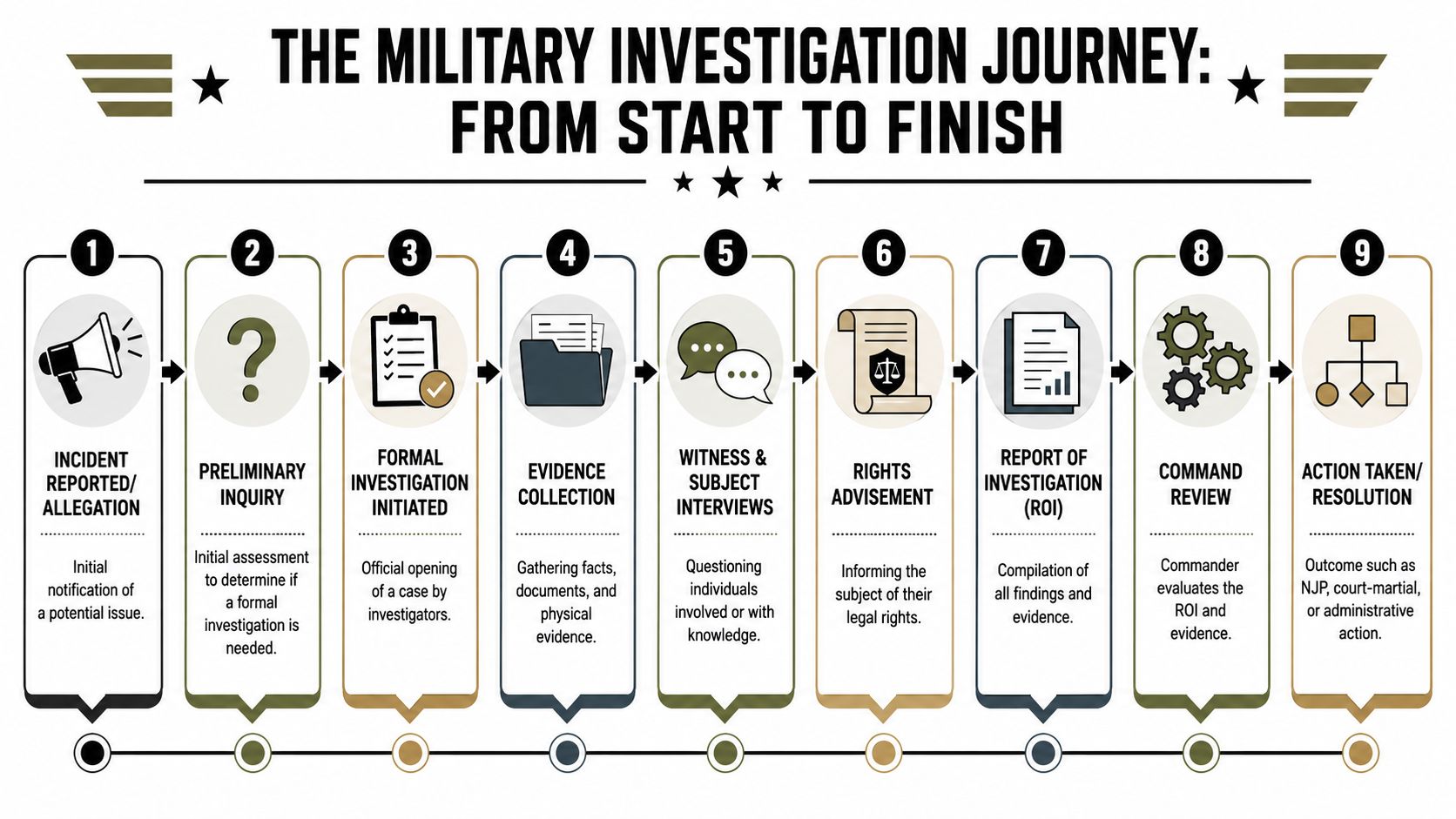
How a case starts
A military criminal case can start with almost nothing. A single report or complaint is enough to trigger a full investigation, and serious criminal investigations often last 6 to 12 months, with some extending to 18 months or longer because of forensic backlogs.
That means two things.
First, don’t assume “they have no evidence” means “I’m safe.” Second, don’t assume the case will be over quickly.
The opening phase usually looks like this:
- An allegation is reported. It may come through command, law enforcement, a SARC, anonymous reporting, or another channel.
- An initial assessment happens. Someone decides whether the matter stays administrative or gets pushed to criminal investigators.
- The case is formally opened. Once that happens, the machine starts collecting facts that may later be framed against you.
What investigators do after the case opens
Investigators gather documents, digital data, physical evidence, surveillance, witness statements, and interviews. They may talk to people around you before they ever contact you. They may pull records that you forgot existed. They may build a timeline before you even know you need one.
Later in the section, watch this overview if you want a basic visual explanation of how the process unfolds:
What should you be thinking during this phase?
- Control your statements: Every word can become an exhibit.
- Preserve evidence: Messages, calendars, travel records, photos, call logs, and witnesses matter.
- Assume delay is part of the pressure: Long investigations wear people down and push them into bad decisions.
- Prepare for parallel consequences: Command action often tracks the criminal file closely.
A lot of service members make the mistake of treating the investigation like a conversation. It isn’t. It’s evidence production.
Investigators don’t need your side of the story to start building the case. They need your side of the story so they can test it, pin you to it, and use parts of it later.
What the end of the investigation really means
When investigators finish gathering evidence, they assemble a Report of Investigation. That report goes through legal review and then becomes the basis for command decisions about adverse action, charging, or other consequences. In AR 15-6 matters, the legal sufficiency review is especially important because procedural defects can sink the whole product, as noted earlier.
Here’s the strategic point most people miss. The end of the investigation is not the end of danger. It’s often the beginning of the next phase.
A criminal case can move toward preferral of charges. Once charges are preferred, the clock speeds up in a way that shocks people who waited too long to hire experienced help. An administrative case can feed a reprimand, separation, or clearance problem without ever giving you the clean courtroom battle you were expecting.
The military investigation process rewards early action. It punishes delay.
Your Fundamental Rights When Under Investigation
This is the part you need to remember under stress. You have rights before you have an advantage. Use them.
Article 31 is your shield
Service members who are suspected of an offense must be advised of their Article 31 UCMJ rights, including the right to remain silent and the right to consult counsel, as explained in this guide to military investigations. Those rights are not paperwork. They are protection.
If questioning may lead to adverse action in an AR 15-6, the rights advisement step is also required in that process. That matters because statements collected without proper rights handling can become a battleground later.
Your silence is not evidence of guilt. It’s evidence that you understand the system.
What to say when investigators contact you
Say this, clearly and calmly:
I am invoking my right to remain silent and I want to speak with a lawyer.
Then stop talking.
Don’t soften it. Don’t explain it. Don’t add “but I didn’t do anything.” Don’t try to sound cooperative by giving background. Don’t volunteer your phone. Don’t consent to a “quick clarification.”
Use these rules:
- If CID, NCIS, OSI, or CGIS calls: Invoke and stop.
- If command wants an “informal chat” about suspected misconduct: Invoke and stop.
- If someone says talking now will help you: It probably helps them more than you.
- If you already made a statement: Stop making more. Damage control is still possible, but only if you stop digging.
Investigators are trained to make silence feel awkward. Ignore that. Awkward is survivable. A bad statement is not.
Strategic Flaws We Hunt for in Every Government Case
The government’s case is rarely as clean as it looks in the first briefing. A seasoned civilian defense lawyer doesn’t just read the file. Attack how the file was built.
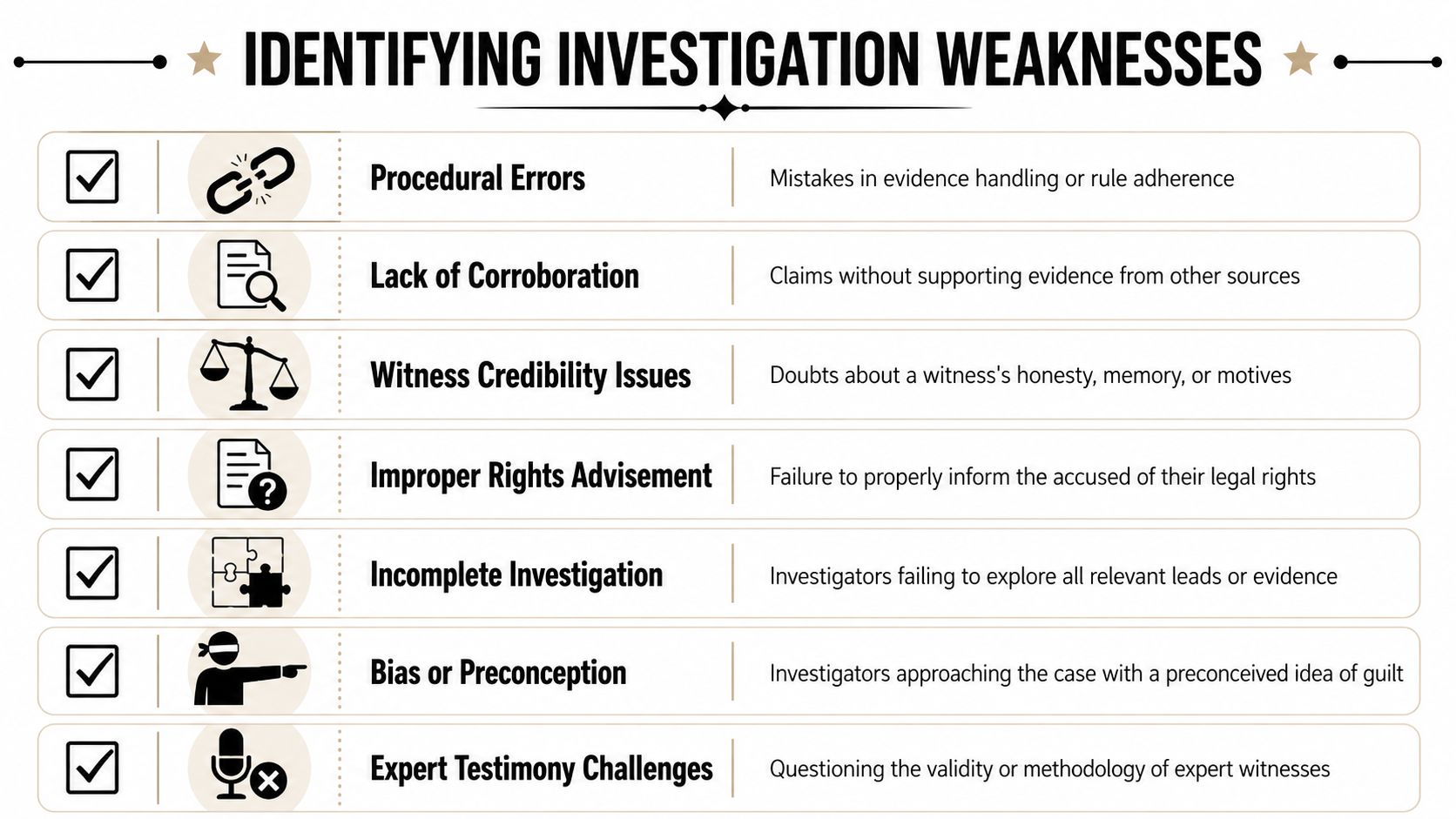
The weak points inside the file
Here are the pressure points that matter most:
- Procedural breakdowns: Rights advisement errors, sloppy evidence handling, or failure to follow required steps.
- Tunnel vision: Investigators latch onto one theory and ignore facts that cut the other way.
- Weak corroboration: Big accusations with thin support are still common.
- Witness credibility problems: Memory issues, motive to lie, contamination from other interviews, or changing stories.
- Incomplete digital review: Investigators often seize a mountain of data but only highlight fragments that support their theory.
- Forensic overconfidence: Lab results and technical extractions still need interpretation, chain of custody, and context.
A lot of cases don’t collapse because one dramatic bombshell appears. They weaken because multiple defects stack up. One witness is shaky. One search is questionable. One timeline doesn’t fit. One statement was taken badly. That’s how strong-looking cases become negotiable or beatable.
Good defense work is often subtraction. Strip away weak assumptions, bad procedure, and selective reporting, and the government’s certainty starts to look thin.
The hidden damage outside the criminal case
The criminal allegation is only one battle. The collateral damage can start immediately.
If you are identified as a subject, command may place a flag on your record. That flag legally blocks PCS, TDY, and separation, effectively freezing your movement and career until the case ends.
Security clearance danger is also real. The Defense Counterintelligence and Security Agency explains that background investigations can lead to suitability, fitness, or employment decisions based on the report of investigation itself, even before charges are preferred or a court-martial happens.
That’s why experienced military defense lawyers don’t just fight the accusation. Fight the paper trail, the timing, the framing, and the administrative fallout.
Career-Ending Mistakes Service Members Make Under Pressure
People in crisis usually don’t fail because they’re guilty. They fail because they panic and start helping the case against themselves.
The mistakes that hand the government evidence
These are the classic self-inflicted wounds:
-
Talking to investigators to “clear it up”
This is the biggest mistake. Your explanation becomes evidence. If any detail shifts later, they call it a lie. -
Consenting to searches
Phone, car, barracks room, house. Don’t hand over consent when they can be forced to do the paperwork. -
Contacting the accuser or complaining witness
Even a harmless-sounding text can be framed as pressure, consciousness of guilt, or witness tampering. -
Explaining the case to your chain of command
Your commander is not your defense lawyer. Your first sergeant is not your defense lawyer. Your buddy in the unit is definitely not your defense lawyer. -
Deleting texts, photos, or messages
That looks like destruction of evidence. Even if your reason was panic, it can become a separate problem.
The mistakes that poison your defense later
Some errors don’t explode immediately. They rot the case from underneath.
-
Trusting delay
People tell themselves they’ll get counsel if things get “serious.” By then, witness memories have shifted and evidence is gone. -
Believing no charges means no danger
Administrative action can still hit hard. -
Acting normal on social media
Posts, likes, DMs, jokes, location tags, and late-night rants all become discoverable headaches. -
Letting command define the narrative first
If you don’t move early, the official version hardens before your defense starts. -
Treating this like a reputation problem instead of a legal problem
You can’t charm your way out of an evidence file.
Here’s the blunt truth. Under pressure, your instincts are usually wrong. Your instinct is to explain, reassure, apologize, or smooth things over. In a military investigation process, that instinct feeds the government.
Why Your Free Military Lawyer Is Not Enough
You may be offered military defense counsel. Use them. But in a serious case, don’t fool yourself into thinking that alone is always enough.
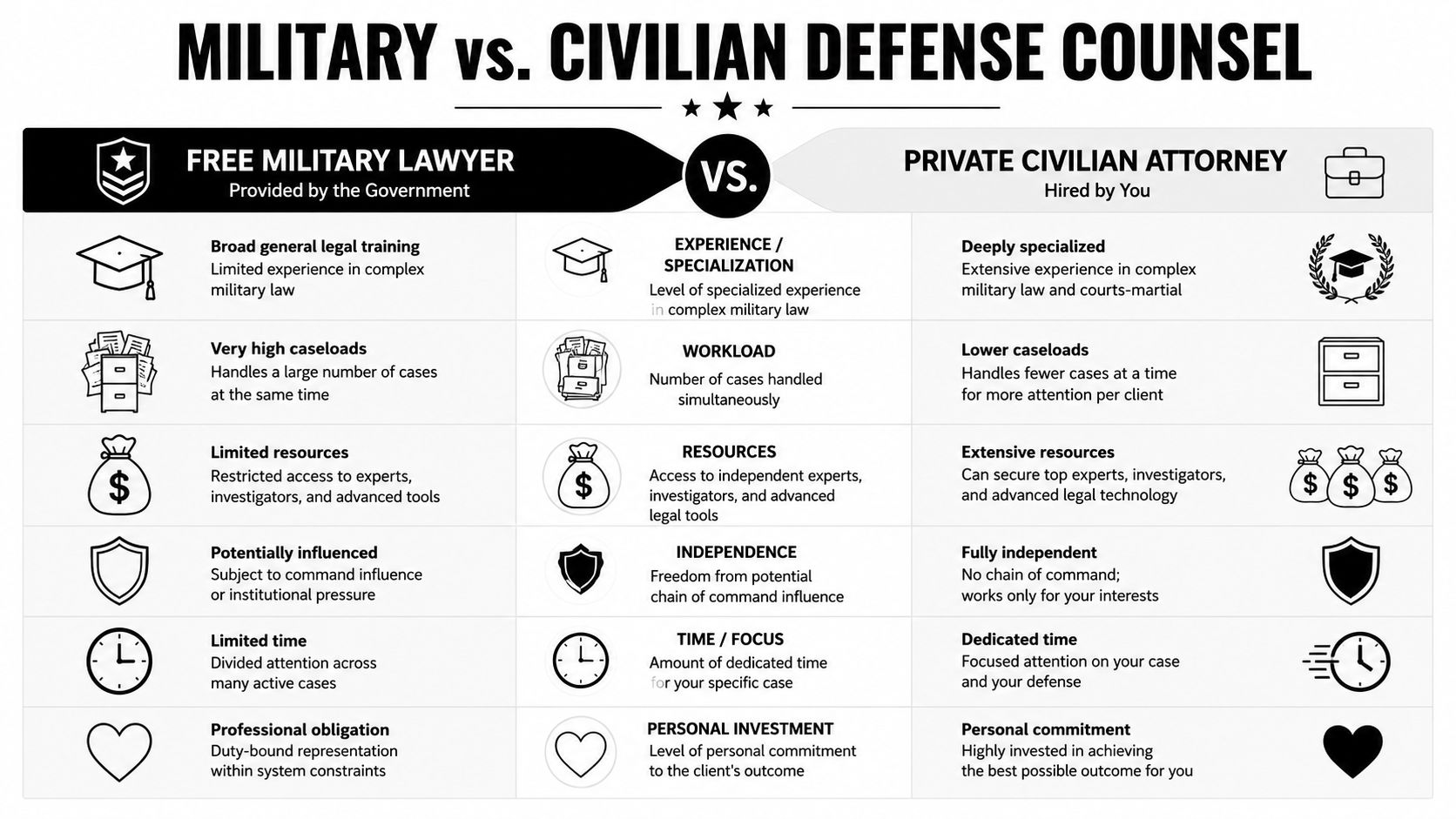
Appointed counsel versus independent counsel
This isn’t about insulting JAG defense lawyers. Some are excellent. The problem is structural.
A military-appointed lawyer often carries a heavy caseload and works inside the same broader institution prosecuting you. A private civilian attorney is independent, chosen by you, and usually better positioned to devote concentrated attention, strategy, and outside resources to your case. That matters when the fight turns on aggressive pretrial investigation, expert review, digital analysis, and command-facing advocacy.
If you want a deeper comparison of what early independent representation changes, read how experienced counsel win cases during the military investigation phase.
Why timing changes everything
Once charges are preferred, the pace can become brutal. The prosecution has a strict 120-day deadline from preferral of charges to arraignment. That timeline compresses decision-making, witness prep, motions practice, and case theory development.
If your defense starts late, you’re already behind.
The best time to build a defense is before the government decides your file is trial-ready.
Experienced court-martial attorneys and UCMJ lawyers know how to work before the case hardens. That includes pushing back during the investigation, protecting favorable evidence, shaping command submissions, and preparing for the next stage before it arrives.
Military Investigation Frequently Asked Questions
Can I refuse to talk to CID or NCIS
Yes. Invoke your right to remain silent and ask for a lawyer. Then stay silent.
What happens at an Article 32 hearing
Before a General Court-Martial can proceed, there must be an Article 32 hearing. It functions like a civilian grand jury process, where a Preliminary Hearing Officer evaluates whether there is enough evidence to justify trial.
Will I go to jail
Maybe, maybe not. It depends on the allegation, the evidence, your statements, and what your defense does early. Don’t assume the worst, but don’t gamble with the possibility.
Can I lose my clearance even if I’m never convicted
Yes. Administrative and vetting consequences can hit before a court-martial ever happens.
Can command stop me from PCSing or getting out
Yes. If you’re flagged as a subject, your movement and separation can be frozen while the case is pending.
Do I need a lawyer immediately
Yes. Early action gives you options. Delay burns them.
If you are under investigation, act like your career and freedom are on the line. Because they are.
Stay silent. Preserve evidence. Stop trying to explain your way out. Get experienced civilian counsel involved now, before the government locks in its version of events. Do not wait for charges. By then, you’ve already given away time you can’t recover.