The call usually comes fast. The verdict is in, the sentence lands, and your family is asking the same question you’re asking: “What now?”
If you’ve been convicted at a court-martial, you’re not dealing with a paperwork problem. You’re dealing with a threat to your freedom, your rank, your retirement, your benefits, and your name. Most service members make the same mistake at this stage. They think the fight is over because the trial is over. It isn’t.
The court martial appeal process is a separate war with different rules, different pressure points, and different ways to win. Trial was about witnesses, credibility, and persuasion in real time. Appeal is about identifying legal error, preserving your rights, and moving before deadlines close doors permanently. If you wait, drift, or assume someone else is handling it, you can lose your chance before the main appellate fight even starts.
Table of Contents
- The Verdict Is In But the Fight Is Not Over
- Understanding the Appellate Battlefield
- The Clock Is Ticking Critical Appeal Deadlines
- Building a Winning Appeal What Lawyers Look For
- Critical Mistakes That Will Destroy Your Appeal
- Why Your Trial Lawyer Is Not Your Appellate Lawyer
- Frequently Asked Questions
The Verdict Is In But the Fight Is Not Over
The hardest moment for most clients isn’t the investigation. It isn’t even sentencing. It’s the silence right after the panel announces “guilty” and reality hits all at once.
That reaction is common. A staff sergeant stares at the floor because he thinks his career just ended. A young officer stops listening because she assumes the system has already made up its mind. A spouse starts planning for the worst before anyone has even reviewed the record. That’s exactly when disciplined legal strategy matters most.
A conviction does not end the legal fight
A conviction at trial doesn’t mean the case was handled correctly. It means the government got a result. Those are two different things.
The appeal isn’t a do-over. You don’t walk back in and retell the facts because you think the panel got it wrong. Appellate judges examine the trial record and ask a sharper question: did legal errors, procedural mistakes, bad rulings, or unfair handling poison the result? If the answer is yes, the conviction or sentence can be attacked.
Practical rule: A bad result at trial is not the same thing as a legally sound result.
That distinction is where serious appellate work lives. Maybe the military judge gave the wrong instruction. Maybe harmful evidence came in when it shouldn’t have. Maybe the defense failed to object where it mattered. Maybe the government overreached and nobody framed the issue properly for review. These are not emotional complaints. These are appellate targets.
What you should be thinking right now
Right after conviction, the convicted often want to argue innocence. I understand that instinct. It usually isn’t the first appellate move that wins.
The smart move is to shift from outrage to analysis. Get the record. Protect deadlines. Identify preserved issues and unpreserved issues. Figure out whether the sentence triggers direct appellate review or sends you into a different lane. That mindset shift is what separates a serious appeal from a dead-on-arrival filing.
Use this stage to ask better questions:
- What legal rulings shaped the verdict
- What objections were made, and which ones were missed
- Did trial counsel preserve the strongest issues
- Does this case qualify for automatic review
- Who is driving appellate strategy
If nobody is asking those questions yet, you’re already behind.
Understanding the Appellate Battlefield
The military appellate system isn’t simple, and that’s one reason people lose rights they never knew they had. The path depends on the type of court-martial, the sentence, and where the case sits in post-trial processing.
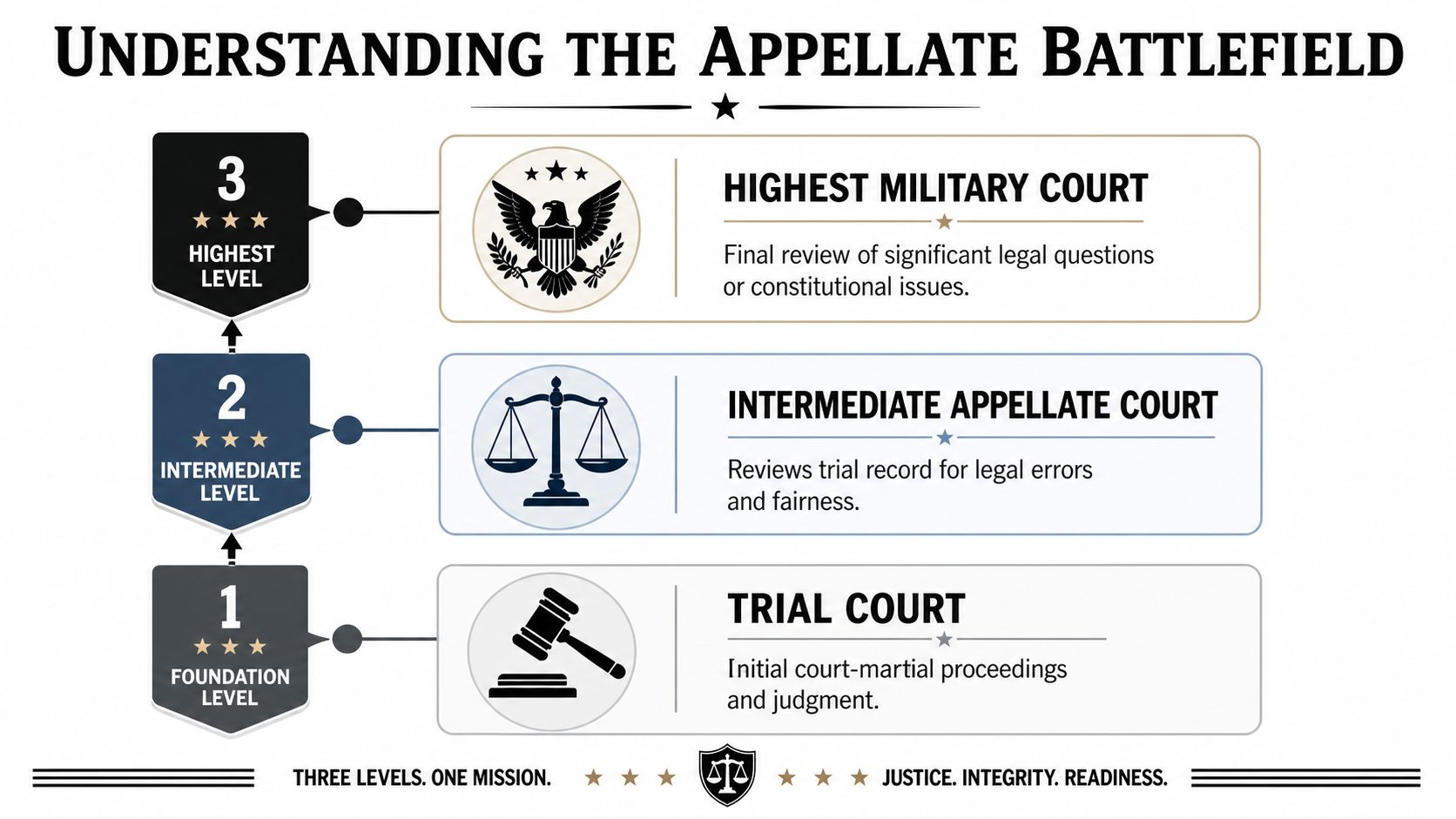
The main lanes of review
The formal court martial appeal process starts with post-trial action, not panic. One key stage is the clemency petition to the convening authority. The process begins with a mandatory clemency petition to the convening authority within 90 days of the final order, and automatic review by the service-level Court of Criminal Appeals occurs only if the sentence includes confinement of two years or more, a dishonorable or bad-conduct discharge, or dismissal for officers, as explained in this overview of military appellate review.
Clemency matters, but don’t confuse it with a true appeal. You’re asking for relief from a command authority that can reduce or eliminate punishment, not relitigate the case. It can be useful. It is not where complex legal error arguments usually win.
After that, some cases move to the service Court of Criminal Appeals. That means the Army, Navy-Marine Corps, Air Force, or Coast Guard appellate court, depending on branch. These courts review the record, legal sufficiency, jurisdiction, legal errors, and sentence appropriateness. If you need a basic primer on how the system starts before appeal, this court-martial basics guide is worth reading.
Separate routes outside the direct appeal
If your case doesn’t fit the automatic-review lane, the route changes. That is where many service members get blindsided.
The Fiscal Year 2023 National Defense Authorization Act expanded Article 66 of the UCMJ to require judicial review for all court-martial convictions, including summary court-martial cases that previously had only command review within five days of sentencing. Before that change, automatic review at the service CCA was limited to cases involving a punitive discharge or at least two years of confinement. The same source notes that Article 69 review by the Judge Advocate General remains available for cases outside the old thresholds, typically requiring submission within one year after the end of the 90-day post-conviction period, with extensions for good cause, as detailed in this discussion of court-martial appeals under the FY2023 NDAA.
That doesn’t mean every convicted service member automatically gets a clean trip through the same courts. Some cases still move first through administrative or command channels before they ever resemble a traditional appeal. That procedural reality catches people who rely on generic internet advice.
Outside the direct appeal, some clients also need to think about record correction boards such as BCNR or BCMRs. Those are not substitutes for a direct appeal. They’re separate tools for separate problems, and the sequencing matters.
The system has lanes. If you file in the wrong lane, the merits of your case may never get heard.
The Clock Is Ticking Critical Appeal Deadlines
Most appeals don’t die because there was no issue. They die because someone waited.
The fastest way to lose in the court martial appeal process is to miss a filing deadline and then discover your arguments never mattered because the court won’t reach them.
The deadlines that hurt people most
Start with this. Under the UCMJ, a petition to the U.S. Court of Appeals for the Armed Forces must be filed within 60 days of the CCA decision, and the entire process from initial filing to a final CAAF ruling typically lasts several months to over a year, as explained in this military appeals deadline overview.
Here’s the timeline you need to treat like a combat order, not a suggestion.
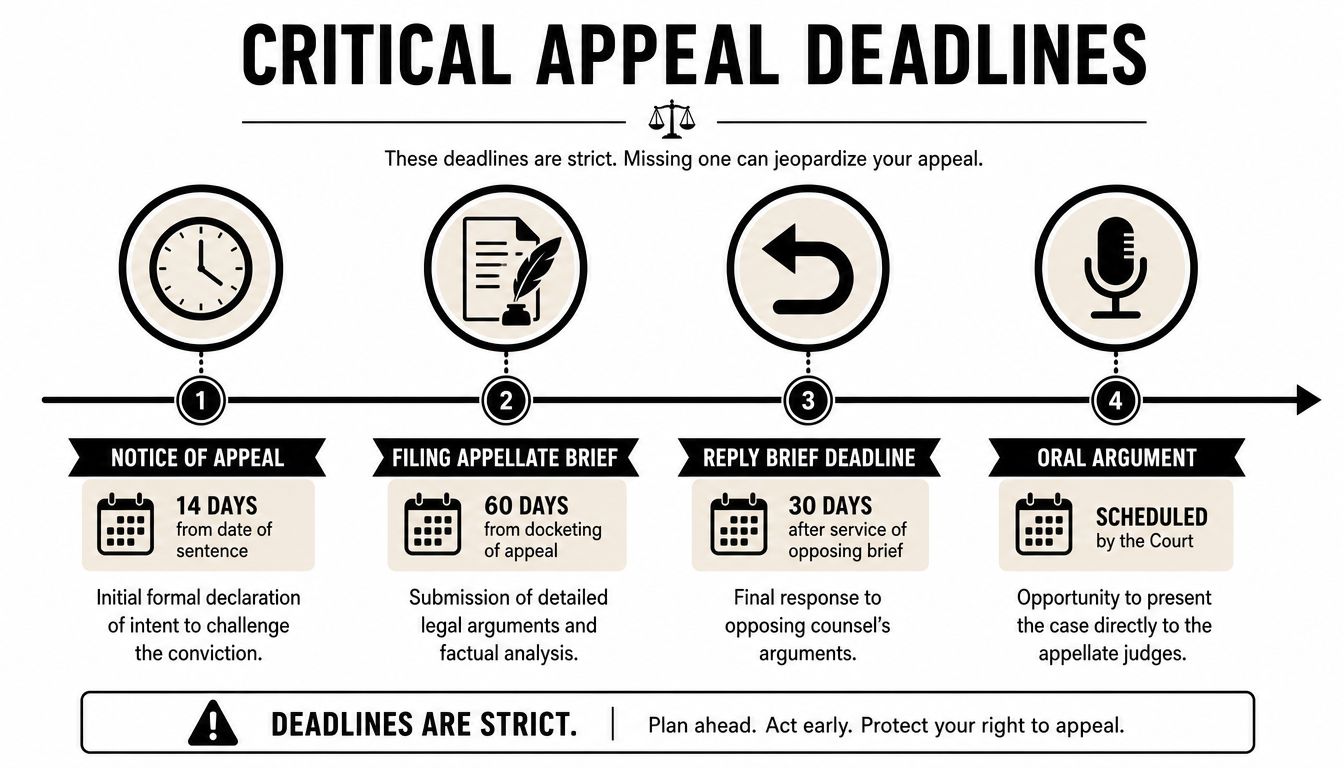
- Clemency stage: The post-trial process includes a mandatory clemency petition to the convening authority within 90 days of the final order.
- CAAF petition: After the CCA acts, the next major deadline is 60 days.
- Supreme Court petition: If the case proceeds beyond CAAF, a petition to the U.S. Supreme Court is filed within 90 days of the CAAF decision.
- Article 73 new trial request: In rare circumstances involving fraud or newly discovered evidence, Article 73 allows a petition for a new trial within three years from final judgment.
A visual explanation helps, but don’t confuse a graphic with legal protection. Watch this only as a supplement, not a substitute for case-specific advice.
Why timing matters more than emotion
Clients often tell me, “I needed time to process what happened.” I get it. But appellate clocks do not care how unfair the trial felt.
Use the first days after conviction to do four things:
- Secure the record
- Confirm which appellate lane applies
- Calendar every deadline immediately
- Get independent appellate counsel involved before strategic decisions get made without you
Waiting to “see what happens” is not strategy. It’s surrender by delay.
Building a Winning Appeal What Lawyers Look For
A strong appeal isn’t built on anger, and it isn’t built on repetition of the defense theory from trial. It’s built on targeted legal analysis.
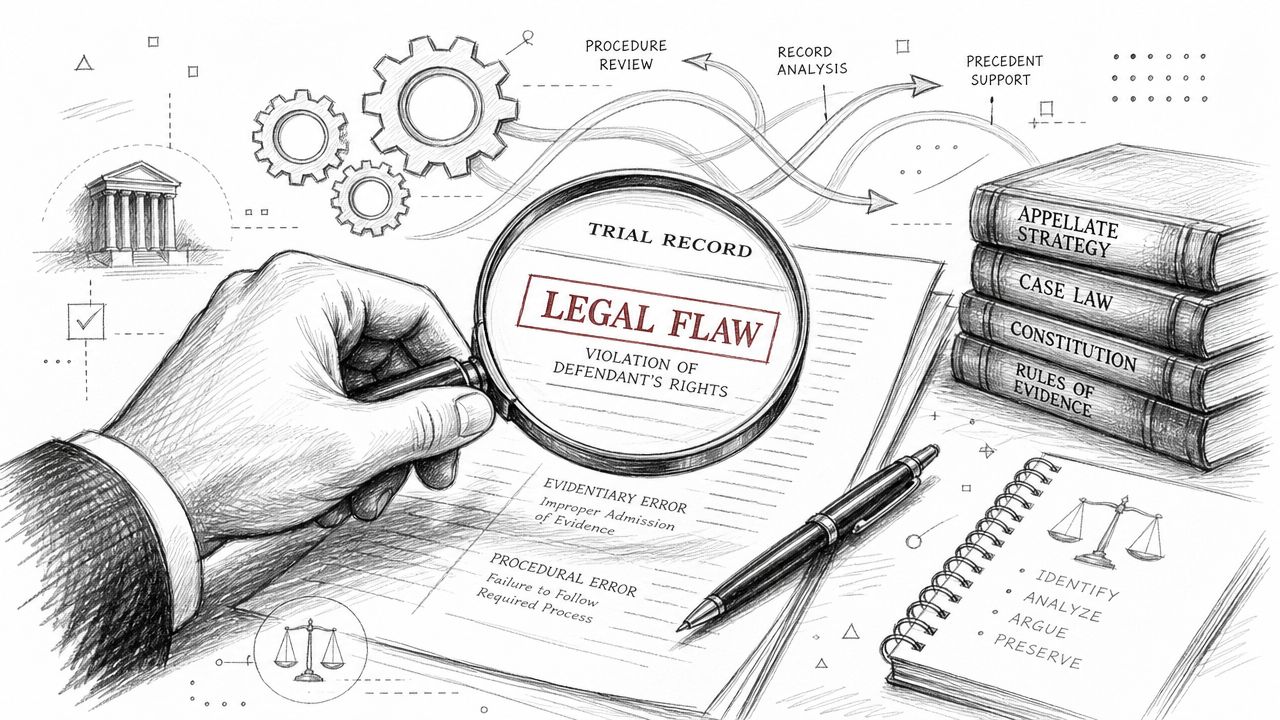
An appeal is about legal error
The service Courts of Criminal Appeals are the level where many serious appellate fights are won or lost, but even there the probability of a successful appeal ranges between 15% and 25%. At the next level, CAAF grants review in only about 10% to 15% of petitions filed, according to this analysis of military appeal outcomes and strategy.
Those numbers should change your mindset. Appellate courts don’t reward volume. They reward precision.
A winning brief usually centers on a small set of issues with real legal force. That may include a flawed instruction, a ruling that admitted improper evidence, an Article 31 problem, a jurisdiction issue, sentencing error, or ineffective assistance of counsel. If your case involved a rights-warning issue or statement problem, the law behind Article 31 of the UCMJ may matter more than you think.
The issues that actually move appellate judges
Here is what experienced appellate lawyers hunt for when they dissect a record:
| Appellate target | Why it matters |
|---|---|
| Incorrect instructions | A bad instruction can corrupt how the panel understood the law. |
| Improper admission of evidence | Evidence errors can affect findings and sentencing. |
| Failure to object | Missed objections can become ineffective assistance issues or change the standard of review. |
| Article 31 or constitutional violations | Bad statements and unlawful questioning can infect the entire case. |
| Sentencing mistakes | A lawful challenge to sentence can materially reduce damage even if findings remain. |
Not every mistake is reversible. Some are harmless. Some are fatal. The lawyer’s job is to separate irritation from appellate value.
Strong appeals don’t throw every complaint at the court. They force the court to confront the mistakes that mattered.
What strong appellate counsel does immediately
Good appellate work starts with discipline, not drama.
- Read the transcript aggressively: Not casually. Line by line.
- Map preserved and unpreserved issues: This affects how the court reviews the error.
- Audit the government’s theory: Many trial theories look cleaner in closing argument than they do in the actual record.
- Examine defense performance objectively: If trial counsel missed key moves, appellate counsel must say so.
- Choose the issues with care: Scattershot briefing weakens credibility.
That last point matters more than most clients realize. Appellate judges read for force, not frustration.
Critical Mistakes That Will Destroy Your Appeal
The period right after conviction is when bad advice does the most damage. Friends weigh in. Command says something reassuring. Someone tells you “the military will automatically review it.” That statement alone has buried more than one viable appeal.
Errors that come up over and over
Here are the mistakes that cost people cases, careers, and influence:
- Missing the first deadline: If you miss the filing window, the court may never reach the merits.
- Assuming automatic review applies: It doesn’t apply the same way to every case.
- Arguing facts instead of legal error: Appellate courts are not there to hear your whole story again.
- Using the wrong forum: Filing in the wrong place can waste the little time you have.
- Trusting that detailed military counsel will automatically handle the appeal correctly: Sometimes they do solid work. Sometimes appellate specialization is missing.
- Failing to secure transcripts and records early: Appellate strategy starts with the record, not memory.
- Treating summary court-martial cases like ordinary direct appeals: That is a trap.
The summary court-martial trap
For summary court-martial convictions, the first appeal is strictly to the next higher level of command within exactly five days of sentencing, and there is no right to appeal summary convictions directly to the Court of Criminal Appeals, as explained in this summary court-martial appeal guide.
That five-day rule is brutal because people don’t expect it. They assume “appeal” means appellate court. In summary cases, that assumption can kill the case before it starts.
Another trap sits behind the law change many people only half understand. Public guidance often misses the practical gap created by the FY2023 NDAA changes. Summary cases may now qualify for broader judicial review in theory, but many still funnel first into Article 69 review by the Judge Advocate General, which has a 1-year filing deadline and rarely grants relief. One source says this practical gap is missing from 90% of appeal guides, which is exactly why so many people miss the window, as discussed in this analysis of Article 69 and summary court-martial procedural traps.
If that sounds technical, good. Technical traps are what wreck appeals.
Why Your Trial Lawyer Is Not Your Appellate Lawyer
This is the part many clients resist at first. They like their trial lawyer. They fought hard. There may be trust there. I respect that.
It still doesn’t mean that lawyer should lead the appeal.
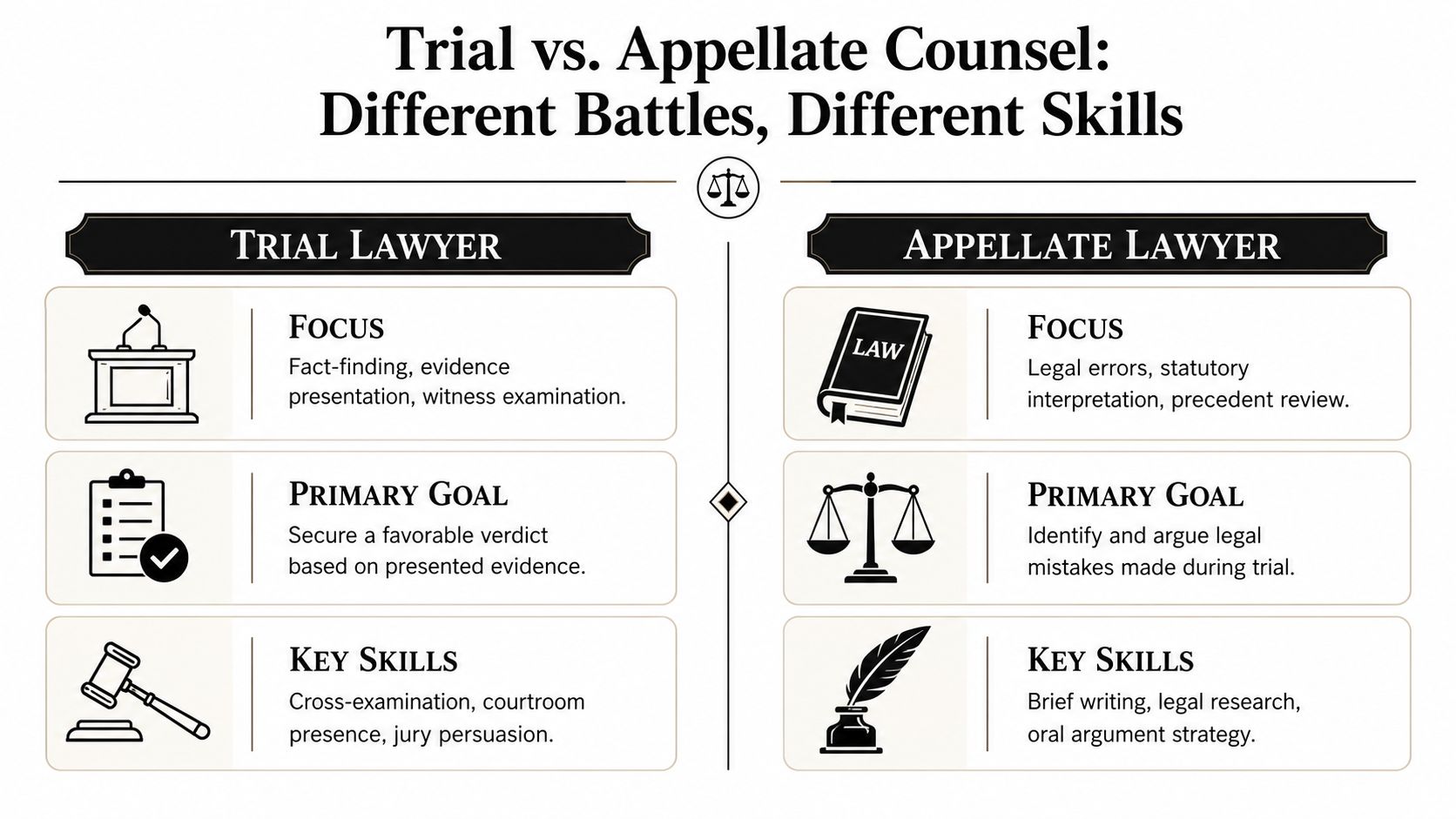
Different forums demand different skills
Trial advocacy and appellate advocacy are different crafts.
Trial lawyers win with witness control, evidentiary combat, instinct, and presence in the room. Appellate lawyers win with transcript mastery, legal writing, issue selection, and the ability to persuade judges who care about doctrine, preservation, and standards of review.
Here is the blunt version:
- Trial asks: Who is more believable?
- Appeal asks: What legal error happened, how was it preserved, and why did it matter?
Those are not the same questions. They don’t reward the same habits. If you want a sense of how specialized serious representation can be, review these civilian court-martial defense lawyers and compare appellate-focused experience, not just courtroom biography.
Independence matters on appeal
There is also a conflict problem that clients need to understand.
If one appellate issue is ineffective assistance of counsel, your trial lawyer cannot realistically be the clean, independent voice arguing that their own decisions damaged the case. Even if they are ethical and hardworking, the posture is wrong. Appeals need fresh eyes.
A second lawyer doesn’t signal disloyalty. It signals that you’re serious about finding what the first fight may have missed.
That independence matters even when trial counsel did a respectable job. Good appellate counsel can spot subtle legal issues that nobody in the courtroom fully appreciated at the time.
Why civilian appellate counsel can change the outcome
Military-appointed counsel can be capable and committed. Some are excellent. But it’s a structural issue. Appointed lawyers may be overloaded, junior, rotating assignments, or balancing multiple obligations inside a system that is not built around one client’s long-range appellate strategy.
A seasoned civilian appellate lawyer brings advantages that matter:
- Independence from command
- Focused appellate writing experience
- The willingness to challenge trial decisions directly
- A narrower caseload and more strategic issue development
- A broader view from handling cases across branches and forums
That doesn’t mean every civilian lawyer is the right lawyer. It means you should evaluate appellate experience, military justice depth, writing strength, and actual record-review habits. Appeals are not won by titles. They’re won by judgment.
Frequently Asked Questions
Can I appeal a court-martial conviction
Yes, in many cases you can. The path depends on the type of court-martial, the sentence, and where the case falls in post-trial review. The biggest mistake is assuming the route is the same for everyone.
How long do I have to act
You often have to act fast. Some post-trial steps begin almost immediately, summary court-martial review can involve a five-day command appeal window, and a petition to CAAF must be filed within 60 days after the CCA decision if your case reaches that stage.
Can I submit new evidence on appeal
Usually, no. The appeal generally focuses on the existing trial record, not brand-new testimony. Rare exceptions may involve a petition for a new trial based on fraud or newly discovered evidence.
Will the appellate court hear my side of the story again
Not as one might expect. Appeals are legal-error fights. If your plan is to reargue innocence, you’re using the wrong tool.
What happens if I was convicted at a summary court-martial
Do not assume you can appeal straight to a military appellate court. Summary cases follow a different path, and the first step is tightly controlled and time-sensitive.
Do I need a civilian military defense lawyer for an appeal
In a serious case, you should at least consult one immediately. The issue is not ego. The issue is specialization, independence, and whether someone with appellate judgment is reviewing your record before deadlines pass.
If you’re under investigation, convicted, or sitting in that awful period after sentencing where nobody is giving you a straight answer, move now. The court martial appeal process punishes hesitation.
Talk to a lawyer who handles military appeals, not just military trials. Get a fresh review of the record. Confirm your deadlines. Identify the issues that matter.
Your career is on the line. Your record is on the line. In some cases, your freedom is on the line. Don’t wait for the system to protect you. It won’t.