You’re probably here because a line in your military record is poisoning everything that comes after it. A discharge characterization. A fitness report. A pay issue. A disability finding. A paper trail that command created in a few days and you’ve been living with for years.
Often, people make a dangerous mistake, treating the Board for Correction of Naval Records like a customer service desk. It isn’t. It’s the last serious administrative battlefield inside the Department of the Navy, and if you show up with a thin packet, a personal plea, and hope, you’ll likely lose.
The board of corrections for naval records can fix career-killing errors. It can also bury weak petitions without much trouble. Strategy matters. Evidence matters. Framing matters. The story you tell has to prove a legal wrong, not just personal unfairness.
Table of Contents
- What Is the Board for Correction of Naval Records
- The Application Process A Step-by-Step Guide
- Strategic Insight Building a Petition to Win
- Common Mistakes That Guarantee a Denial
- Why Civilian Military Counsel Is Not Optional It Is Essential
- Frequently Asked Questions About the BCNR
What Is the Board for Correction of Naval Records
A sailor gets separated with a record that tells the wrong story. A Marine loses a promotion, a retirement benefit, or a civilian job because one bad document stayed in the file too long. By the time they come to the BCNR, the damage is already on paper. That is why you need to understand one point early. The Board for Correction of Naval Records is not a customer service desk. It is the last serious administrative forum inside the Department of the Navy for fixing record errors and injustices.
What the BCNR is
The Board for Correction of Naval Records, usually called the BCNR, exists under 10 U.S.C. 1552 and serves as the highest administrative review authority for correcting Navy and Marine Corps records. Its power is broad. It can recommend changes to service records, fitness reports, separation documents, pay-related entries, and other official records when the applicant proves a material error or injustice.
That burden matters more than applicants think.
The board starts from a presumption that the existing record is correct. If your petition does not prove what went wrong, why it was wrong, and what exact correction fixes it, the board has an easy path to deny you. This is why weak filings fail. The BCNR responds to evidence, credibility, and a clean legal theory tied to the record, not outrage, not vague unfairness, and not a stack of documents with no roadmap.

The BCNR works like an appellate records forum, not a trial court. It reviews the written record. It weighs the documents you submit. It makes recommendations to the Secretary of the Navy. If you file as if the board will sort out your case for you, you are making a rookie mistake.
What the BCNR cannot do for you
The BCNR operates under 32 CFR Part 723. Its authority is significant, but it has limits, and strategy starts with choosing the right lane.
| Issue | BCNR role |
|---|---|
| Personnel record corrections | Can review |
| Performance record issues | Can review |
| Pay-related corrections | Can review |
| Some discharge-related matters | Can review, often after prior remedies are exhausted |
| Physical disability proceedings excluded by regulation | Not the right forum |
| Punishments from General Court-Martials | Not the right forum |
That distinction is not technical. It decides whether your case gets heard on the merits or dies on jurisdiction.
If your goal is a discharge upgrade, confirm first whether the BCNR is the right board or whether another remedy comes before it. This guide on how to upgrade a military discharge is a useful starting point.
Practical rule: The BCNR fixes records when the petition proves a record-based wrong and asks for a precise correction.
What this means for you right now
Treat a BCNR case like a written campaign, not a form submission. The board may take months to act, and you usually do not get a live chance to clean up a sloppy theory after filing. Your first submission needs to carry the whole case.
That means your real job is not describing what happened. Your real job is proving why the record is wrong, identifying the strongest supporting evidence, and giving the board a correction it can grant without guessing what you want. That is how winning petitions are built.
The Application Process A Step-by-Step Guide
A BCNR petition starts with DD Form 149, but if you think this is about filling in boxes, you’re already behind. The form is the cover sheet. The core case is the packet behind it.

Step 1 through Step 3 build the case before you file
Step 1 is document control. Get the record before you argue about the record. That means your service documents, evaluations, medical records, separation paperwork, prior submissions, and anything else that proves what happened and what should have happened.
Step 2 is precision on DD Form 149. State exactly what correction you want. If your request is vague, the board has room to deny it cleanly. Ask for a specific correction tied to a specific part of the record.
Step 3 is argument building. The BCNR operates under 32 CFR Part 723 and reviews service records and submitted evidence to make recommendations to the Secretary of the Navy, who has final authority. The process is an informal administrative adjudication, which means it turns on the written record you provide, as outlined in the Cornell Legal Information Institute text of 32 CFR Part 723.
That means your packet must do three jobs at once:
- Identify the error: Show what in the record is wrong.
- Prove the injustice: Explain why leaving it unchanged creates an unjust result.
- State the remedy: Tell the board exactly what correction should be ordered.
For readers dealing with broader adverse personnel actions, this resource on administrative separation and military discharges helps put BCNR strategy in context.
Step 4 through Step 6 after the packet leaves your hands
The video below gives useful context on the process and stakes.
Step 4 is submission. Once your packet goes in, you lose control over speed. That’s why your first filing has to be organized, indexed, and complete.
Step 5 is board review. The board studies the records and your evidence. It is not building your case for you. It is judging the one you gave it.
Step 6 is decision. Relief may be full, partial, or denied. A well-built packet makes the board’s path easier. A chaotic packet makes denial easy.
The BCNR reads paper, not potential.
What to include in a serious BCNR package
Don’t submit a stack of documents with no roadmap. Give the board a structure.
Use a packet like this:
- Cover brief that states the requested correction and legal theory.
- DD Form 149 completed carefully and consistently with the brief.
- Exhibits index so every document can be located fast.
- Sworn statements from witnesses who are relevant.
- Medical or mental health records when they explain the event or its context.
- Service records and evaluations that support credibility, chronology, or inconsistency.
- Prior administrative decisions if exhaustion of remedies matters.
- Proposed corrected outcome so the board knows exactly what action you seek.
People lose because they file a story. Strong applicants file a record.
Strategic Insight Building a Petition to Win
The biggest difference between a denied petition and a successful one is usually not the underlying unfairness. It’s the way the case is built. A winning petition to the board of corrections for naval records reads like a disciplined legal brief, not a plea for sympathy.
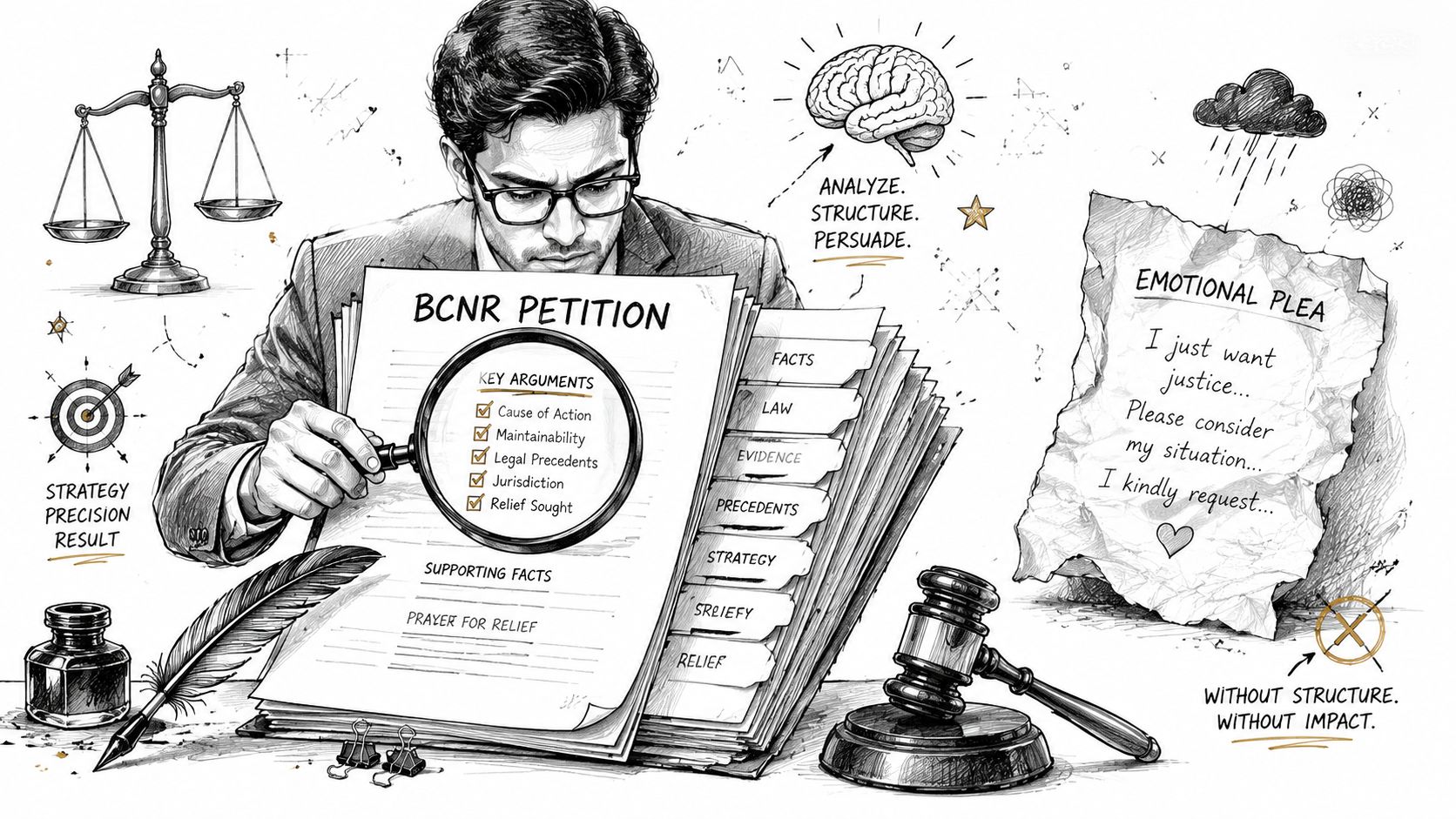
A winning petition is a legal brief
A weak petition says, “This was unfair and it hurt my life.”
A strong petition says, “The record contains a material error or injustice, here is the documentary proof, here is the governing standard, here is the specific correction requested, and here is why denial would preserve an inaccurate official record.”
Those are not the same thing.
The board doesn’t award relief because your suffering is real. It awards relief when your proof and your legal framing give it an administratively defensible reason to act. If you want results, stop writing for therapy and start writing for decision-makers.
Build the narrative the board can act on
The best petitions are built around one clean theory. Not five. Not every grievance you’ve had since boot camp. One theory, supported by exhibits.
A useful structure looks like this:
| Part of petition | Purpose |
|---|---|
| Statement of relief requested | Tells the board the exact correction sought |
| Timeline of key events | Gives chronological control |
| Record error or injustice | Defines the legal problem |
| Evidence section | Connects documents to each factual point |
| Regulatory and fairness argument | Shows why relief is authorized |
| Requested corrective action | Makes the remedy administratively easy |
Your narrative should answer four questions fast:
- What happened
- What in the record is wrong
- Why it meets the standard for correction
- What exact fix you want
If your evidence doesn’t support each of those points, the petition isn’t ready.
The board is far more likely to act when the requested correction feels obvious from the documents.
What experienced military defense lawyers look for
Seasoned military defense lawyers and court-martial attorneys demonstrate their value. They don’t just collect records. They seek strategic advantages.
Here’s what to look for first:
- Contradictions inside the government file: Evaluation language that conflicts with other records, timelines that don’t line up, or findings unsupported by the underlying paperwork.
- Missing procedural steps: Notices that were defective, rights advisements that were mishandled, or required reviews that never happened.
- Credibility anchors: Performance history, prior awards, documented medical conditions, contemporaneous communications, and statements made before anyone had a reason to lawyer up.
- Overreach by command: Conclusions that went beyond the facts documented.
- Relief framing: Whether the requested remedy is narrow, realistic, and easy for the board to grant.
A smart petition also anticipates the board’s skepticism. If there’s a weak spot, address it directly. Don’t hide from it. Explain it, document it, and limit the damage.
Here’s the blunt truth. The BCNR is not impressed by indignation. It responds to clarity, order, and proof. If your package makes board members work to understand your case, you’ve already made their job harder than denying you.
Common Mistakes That Guarantee a Denial
You spend months pulling records, write a heartfelt statement, mail the packet, and wait. Then the denial arrives because you asked for the wrong relief, skipped a required prior remedy, or failed to tie your evidence to a legal error. That is how careers get buried at the BCNR. Bad facts hurt. Bad strategy kills.
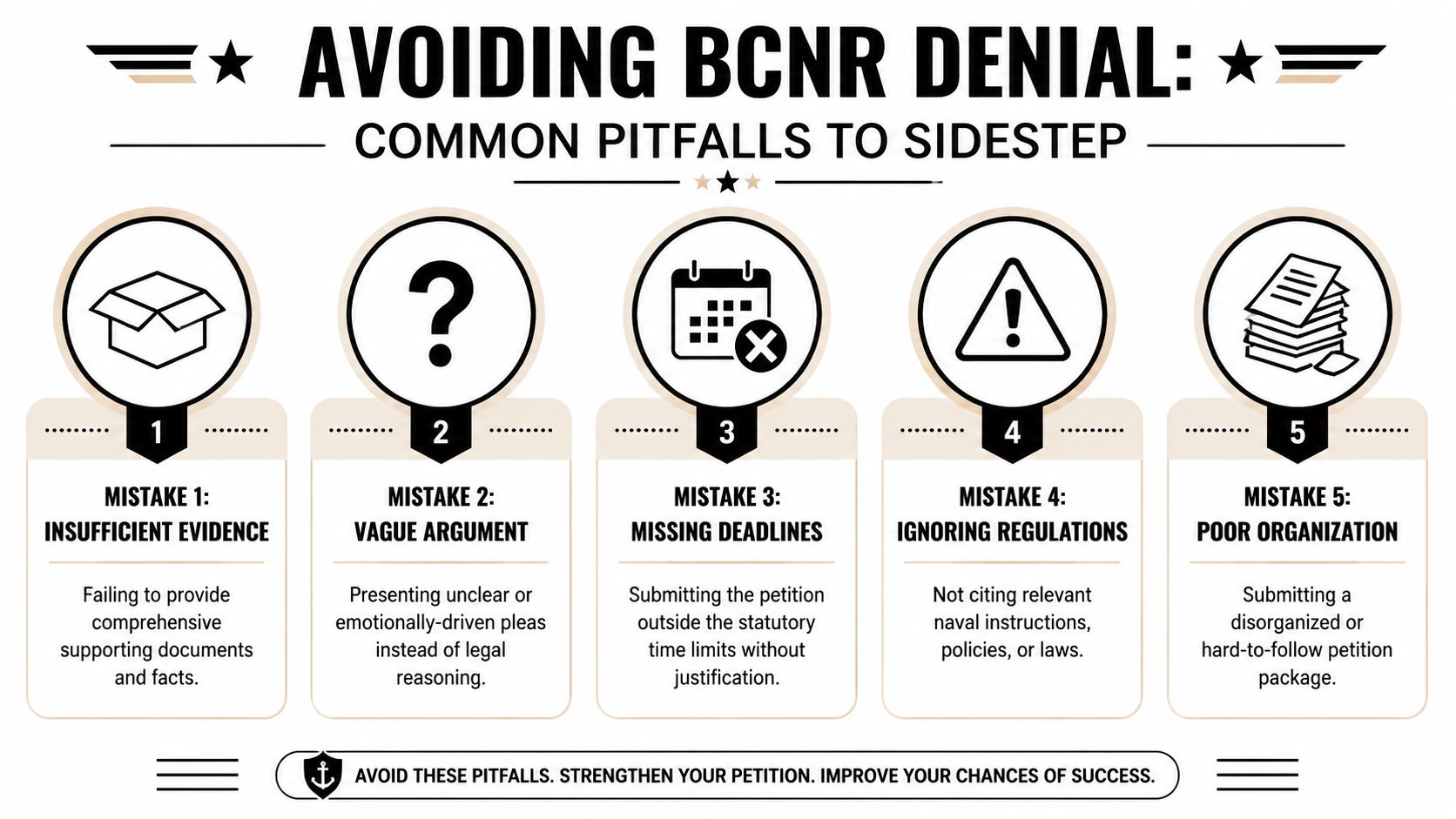
The denial traps that keep showing up
The board reviews what you submit. It does not build your case for you, chase missing records, or rewrite a vague request into one it can grant. If your packet leaves gaps, the government’s version of events usually wins by default.
The worst mistakes are predictable:
- Writing to be heard instead of writing to win: Anger, betrayal, and hardship matter to you. The board cares whether the record is erroneous or unjust and whether your exhibits prove it.
- Targeting the wrong problem: Many applicants attack the outcome while ignoring the document, finding, or process failure that created it.
- Skipping exhaustion and jurisdiction issues: If another board or remedy had to be used first, the BCNR can dispose of the case without reaching the merits.
- Submitting fragments instead of a record: Missing evaluations, medical records, endorsements, or separation documents leave room for the board to accept the existing file.
- Requesting broad relief: “Fix my record” is useless. Ask for the exact correction, date, document, and downstream relief tied to it.
- Filing late with a weak excuse: If the case is outside the normal window, your interest-of-justice explanation must be as disciplined as the merits argument.
- Sending a paper dump: Volume does not create persuasion. Disorganized exhibits tell the board you do not understand your own case.
One more mistake belongs on this list. Applicants treat the BCNR like a customer service desk. It is closer to appellate work than complaint intake. That is why experienced court-martial defense lawyers build these petitions around proof, sequence, and a narrow remedy the board can sign without guessing.
A blunt self-audit before you file
Use this test before you submit anything:
| Question | If your answer is no |
|---|---|
| Did I identify the exact record entry, finding, or action I want corrected | You’re not ready |
| Did I state the legal or factual reason that item is wrong or unjust | You’re not ready |
| Did I attach proof for every important claim, not just the ones that sound compelling | You’re not ready |
| Did I address any prior-remedy, exhaustion, or jurisdiction problem | You’re not ready |
| Did I request a precise correction the board can grant in writing | You’re not ready |
Hard truth: An incomplete BCNR package usually gets treated as an unconvincing one.
Honesty is not the standard. Sympathy is not the standard. A winning petition gives the board a clean path to yes. If your submission forces board members to hunt for the issue, connect the documents, or guess at the remedy, you built a denial packet.
Why Civilian Military Counsel Is Not Optional It Is Essential
You can file your own BCNR petition. You can also defend yourself at a contested board, answer investigators because you think cooperation will clear things up, and trust that command will be fair. Those are all bad bets.
The board is not neutral in the way people hope
Relief from the BCNR is, in the words reported by a long-running military law commentary, “less than an even bet” because of near-paternalistic board powers and institutional bias. That same discussion notes the board aims for an 18-month processing time, while complex mental health or combat trauma cases now average 2.5 years, according to this USNI analysis of how hard record correction can be.
That should change how you think about this process. You are not stepping into a system eager to reverse itself. You are asking a bureaucracy to admit its own record should be changed. That is why precision matters so much.
What civilian counsel does that a DIY filing does not
A serious civilian military lawyer brings three things the average applicant does not have.
First, independence. Civilian counsel answers to one person. You. Not command. Not office culture. Not internal staffing limits.
Second, pattern recognition. Experienced UCMJ lawyers and court-martial attorneys know what bad command action looks like on paper. They know where missing process hides. They know when a medical record changes the meaning of a disciplinary event. They know when a narrow remedy is smarter than a dramatic one.
Third, written advocacy. BCNR cases are document cases. That means the quality of your brief matters more than generally understood. The board sees a packet, not your intentions.
If you’re comparing options, start with lawyers who focus on this area. This guide to court-martial defense lawyers can help you identify civilian counsel with military justice depth, not general-practice branding.
When the stakes are highest
This matters most when your case touches any of the following:
- Mental health evidence: These cases often require careful framing and record development.
- Combat trauma history: The facts must be tied to the requested correction, not just mentioned.
- Discharge upgrades with downstream consequences: Benefits, employment, and reputation are all in play.
- Adverse evaluations or misconduct findings: A single record entry can ripple into promotions, clearances, and civilian opportunities.
- Cases with prior denials: You need a new strategy, not a recycled argument.
Military-appointed counsel can be excellent in the right case. But BCNR work often rewards specialized civilian drafting, persistence, and strategy. This is not a form-filling exercise. It is administrative combat on paper.
Frequently Asked Questions About the BCNR
Can I file after the three-year deadline
Yes, sometimes. Federal law generally requires BCNR requests to be filed within three years of discovering the error, but the board may waive that deadline “in the interest of justice.” The problem is that these waivers are applied inconsistently and require substantial justification, as explained in this guide to the military records correction timeline and waiver issue.
If you’re late, don’t apologize vaguely. Explain exactly why you could not reasonably file earlier and why justice requires review now.
How long does the BCNR really take
You should expect a long process. Standard cases can take many months, and harder cases can take much longer. Build your packet as if there won’t be a quick second chance.
Can I appeal a BCNR denial
Yes, but the road is narrow. Denials may be challenged through the U.S. District Court for the District of Columbia under the Administrative Procedure Act. That is not a do-over on the facts. The court generally reviews whether the process was lawful and whether the board abused its discretion.
If you’re thinking about an appeal, the quality of the administrative record becomes even more important. That record is the battlefield.
Does the BCNR investigate my case for me
No. That assumption kills petitions. The board reviews what you submit. It does not function as your investigator, and it will not assemble the proof you forgot to include.
Do I need a lawyer for a discharge upgrade or records correction
Need is the wrong word. You can file on your own. The better question is whether you should trust a high-stakes administrative fight to a self-prepared packet.
If the correction affects your discharge, pay, disability-related consequences, promotion history, or reputation, get legal help. At minimum, have a civilian military defense lawyer review your theory and evidence before filing.
What kind of cases are strongest
The strongest cases usually have three things:
- A clearly identifiable error or injustice
- Documents that prove it
- A specific correction the board can order cleanly
Strong cases are built, not found. Sometimes a mediocre-looking case becomes solid once the timeline, records, and legal framing are fixed.
Will a strong personal statement be enough
Usually no. A personal statement can help explain context, chronology, and impact. It rarely carries the case by itself.
Use your statement to support the documents, not replace them.
If you’re dealing with the Board for Correction of Naval Records, time is not your friend, and hope is not a strategy. A bad petition can lock in a bad record for even longer. A strong one can protect benefits, restore reputation, and correct damage that should never have stayed in your file.
If your career, discharge status, benefits, or legacy are on the line, get serious help now. Talk to experienced civilian military defense lawyers before you file. Waiting feels easier. It usually makes the case worse.