You’re a staff sergeant in a logistics unit. Your first sergeant tells you to report to OSI on Monday after a funds audit flags missing receipts. You’re worried about your career, your clearance, your family, and whether one conversation can turn an administrative problem into a breach of trust charge under the UCMJ.
The immediate risks are real. Investigators may ask you to explain events before you understand the evidence. Your access to systems may be restricted. A government-issued phone or computer may be imaged. Administrative separation can move forward while the criminal investigation continues.
The next 72 hours can matter more than the next 72 days. Every statement, text, email, and form signed before counsel gets involved may later appear in an Article 31 rights analysis, at an Article 32 preliminary hearing, or before a court-martial panel.
Table of Contents
- What You Are Up Against Right Now
- What a Breach of Trust Charge Actually Means Under the UCMJ
- How These Cases Actually Look in the Real Military
- From Investigation to Court-Martial Step by Step
- Punishments and the Consequences That Follow You After
- Where Defense Lawyers Win These Cases
- Seven Mistakes That Hand the Government the Case
- Why Civilian Military Defense Counsel and Your Next Move
What You Are Up Against Right Now
A breach of trust allegation often begins as an audit problem, an inventory discrepancy, a vehicle-use complaint, or a report from someone inside the unit. Commanders may describe the matter as a fact-finding exercise. Investigators may say they only want your side. That language doesn’t change the practical reality: once the allegation concerns entrusted money, property, access, or authority, the government is building a case file.
Don’t try to solve the problem by giving a complete explanation on your own. A well-intended answer can establish who controlled the property, what rules applied, when the alleged conduct occurred, and what you knew at the time. It can also lock you into a version before counsel has obtained bank records, duty schedules, access logs, receipts, text messages, or witness statements.
Practical rule: Invoke your right to remain silent, request counsel, and stop discussing the facts until a lawyer has reviewed the situation.
Take these steps immediately:
- Preserve evidence: Keep receipts, messages, calendars, travel records, finance documents, and relevant device data. Don’t delete, alter, or hide anything.
- Avoid contact about the facts: Don’t coordinate stories with coworkers, confront accusers, or ask witnesses what they told investigators.
- Identify the parallel tracks: A criminal investigation, Article 15 proceedings, a GOMOR, security-clearance action, or administrative separation may proceed on separate timelines.
- Get counsel before signing: Don’t sign an investigative statement, rights form, sworn statement, polygraph-related document, or administrative response without legal advice.
Early defense work isn’t about making dramatic arguments. It’s about preventing avoidable admissions, securing evidence before it disappears, and identifying the actual theory of the allegation.
What a Breach of Trust Charge Actually Means Under the UCMJ
There isn’t a standalone UCMJ statute titled “breach of trust.” In military practice, prosecutors commonly use Article 134, particularly the clause addressing conduct prejudicial to good order and discipline, when they allege that a service member abused a position involving special trust.
Article 134 is a general article used when conduct isn’t specifically covered elsewhere. The government must prove the charged act and at least one terminal element, meaning that the conduct was prejudicial to good order and discipline, service-discrediting, or a qualifying federal offense. The official Article 134 text and explanation shows why the terminal element can’t be ignored in defense preparation.
A practical breach-of-trust theory usually has four essential questions:
- Did you hold a position of trust? The government must identify the authority, access, responsibility, or fiduciary role allegedly given to you. Rank alone doesn’t answer this question.
- What conduct did you commit? The charge should identify the property, funds, vehicle, records, authority, or other entrusted subject and describe the alleged misuse.
- How did that conduct violate the trust? Prosecutors must connect your conduct to an actual duty or limitation. A policy, appointment letter, written delegation, standard operating procedure, or established practice may matter.
- Why did the conduct satisfy Article 134? The government must prove the required terminal element rather than relying on the label “breach of trust.”
Dishonesty is often the dividing line between criminal misconduct and poor administration. Negligence, confusion, sloppy bookkeeping, or bad judgment may create serious command problems, but those facts don’t automatically prove that you intentionally converted or misused entrusted property or authority.
That distinction shapes every defense decision. Counsel should ask what was entrusted, what instructions were given, whether you had permission or apparent permission, whether someone else controlled the records, and whether the alleged conduct caused the kind of military harm Article 134 requires. A plain-English discussion of UCMJ Article 134 offenses can provide background, but the charge sheet and evidence control the case.
How These Cases Actually Look in the Real Military
The same legal label can describe very different conduct. A junior service member accused of taking merchandise, a senior NCO accused of using a government vehicle, and a fund custodian accused of mishandling money present different proof problems.
Commissary or shoplifting allegations
A service member uses a military identification card or position-related access to take merchandise from a commissary or exchange. The government may investigate through military police, loss-prevention personnel, or another investigative office, depending on the facts and installation.
Typical evidence includes surveillance video, transaction records, entry data, witness accounts, and the service member’s own explanation. Defense counsel will examine whether the video identifies the person clearly, whether the merchandise was removed without payment, whether the identification card mattered to the alleged offense, and whether investigators preserved the original footage.
The prosecution may argue that military status and access created a special relationship with the installation or facility. The defense should force the government to identify the precise trust duty rather than treating any suspected theft as proof of a military breach of trust.
Government vehicle misuse
A senior NCO takes a tactical vehicle home overnight or uses it for personal errands. The alleged misuse may be investigated by command, military police, or an investigative agency after a report from a supervisor or coworker.
The evidence may include dispatch logs, vehicle trackers, fuel records, duty rosters, photographs, text messages, and unit policies. Counsel will look for unclear authorization, customary practices, conflicting instructions, emergency circumstances, and proof that another person approved or expected the movement.
A vehicle policy violation may support discipline. It doesn’t automatically establish that the accused improperly abused entrusted authority or that the conduct met Article 134’s terminal element.
Unit funds or MWR mismanagement
A commander, treasurer, or fund custodian can’t account for cash, deposits, or disbursements. The investigation may involve command finance personnel, CID, OSI, or an audit team.
The government will likely rely on ledgers, bank statements, vouchers, receipts, appointment orders, access records, and interviews. The defense must separate missing paperwork from missing money, and missing money from intentional conversion. Bookkeeping gaps, shared passwords, delayed deposits, informal approvals, and multiple custodians can materially change the analysis.
The question isn’t simply whether the records balance. The question is who controlled the asset, what authority that person had, and what the evidence proves about intent.
From Investigation to Court-Martial Step by Step
Military justice doesn’t begin with a formal charge in every case. It can start with a preliminary inquiry, followed by a written charge sheet if the commander or accuser believes further action is warranted. The charging pipeline and the role of Article 32 are outlined in the Congressional Research Service overview of courts-martial.
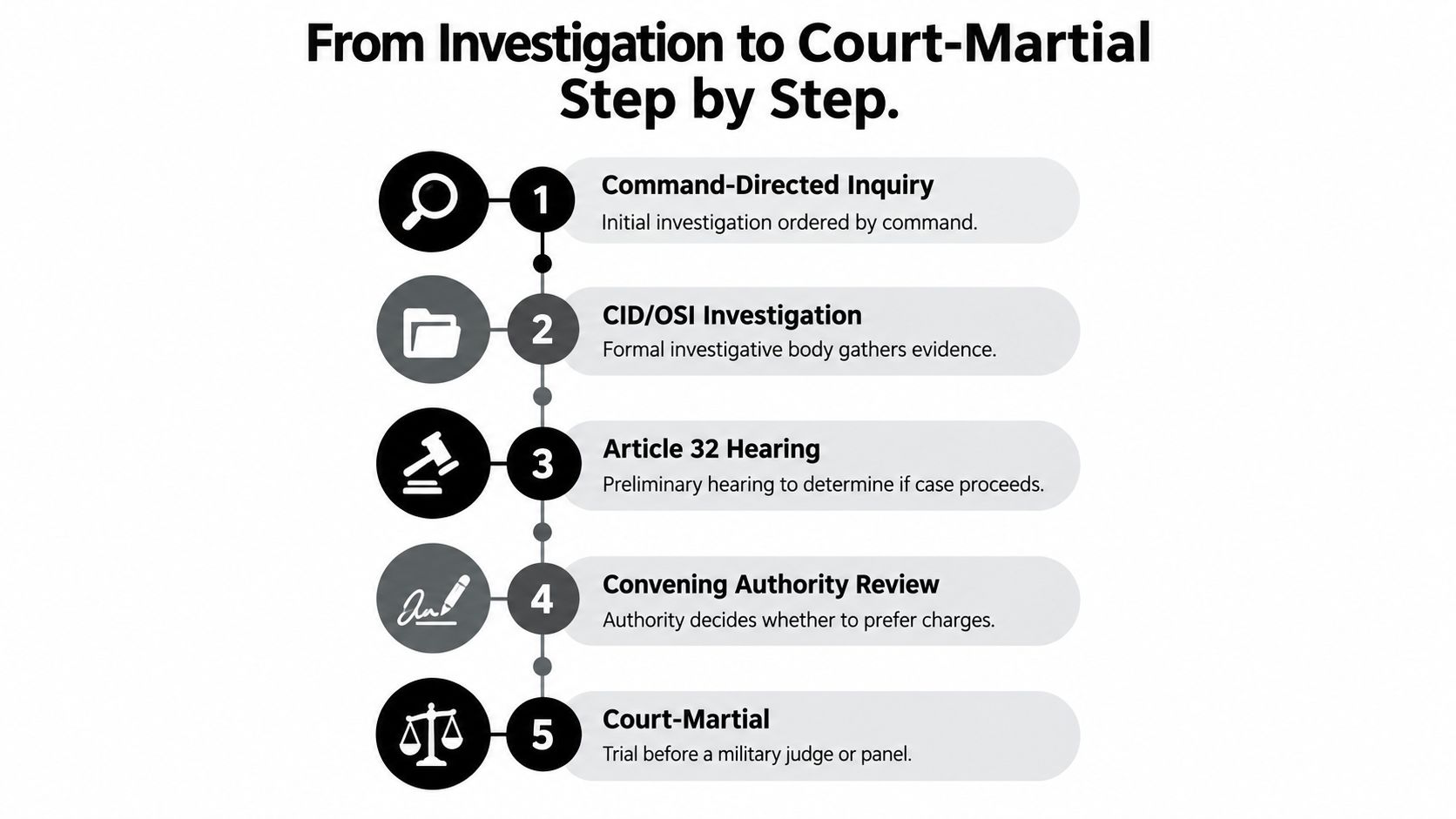
Step 1: Preliminary inquiry or command investigation
Command may collect documents, interview personnel, review audits, or refer the matter to CID, OSI, NCIS, or CGIS. Your task is not to persuade the investigator. Your task is to preserve your rights and avoid creating evidence that fills gaps in the government’s theory.
A defense lawyer begins by identifying the allegation, obtaining available records, locating witnesses, and determining whether the investigation followed lawful procedures. Counsel may also address search issues, compelled statements, privilege questions, and unlawful command influence concerns.
Step 2: Formal investigative agency work
CID, OSI, NCIS, or CGIS may interview witnesses, image devices, obtain records, and prepare a report. Investigators don’t have to be personally hostile for the process to be adverse. Their job is to collect evidence for command and prosecution review.
The defense should request discoverable material, track missing evidence, compare statements, and test whether investigators pursued exculpatory leads. A military investigation defense guide explains the broader investigative setting, but your case requires a fact-specific response.
Step 3: Article 32 preliminary hearing
An Article 32 hearing functions as a preliminary screening process before referral to a general court-martial. An investigating officer reviews evidence, hears witnesses when appropriate, and considers whether probable cause supports the charges.
Defense counsel can cross-examine witnesses, challenge unreliable statements, expose missing records, and present evidence that changes the probable-cause analysis. The hearing isn’t the trial, but it can reveal the government’s weaknesses and create useful testimony for later litigation.
Step 4: Referral decision
The convening authority decides whether the charges should proceed to court-martial. Counsel should address legal insufficiency, discovery failures, factual weaknesses, and alternatives before referral when possible.
Step 5: Court-martial
At trial, the government must prove every required element beyond a reasonable doubt. The defense may litigate suppression issues, seek dismissal, challenge admissibility, cross-examine witnesses, and present a theory showing that the evidence proves confusion or negligence rather than dishonest misuse.
Punishments and the Consequences That Follow You After
The possible sentence depends on the specific offense specification, charging theory, forum, and applicable Manual for Courts-Martial provisions. A general Article 134 breach-of-trust theory can carry serious exposure, including confinement, forfeitures, a fine, and a punitive discharge where the charged offense and authorized punishment permit those outcomes.
The sentence is only part of the damage. A conviction can affect security-clearance eligibility, future employment, licensing, immigration questions, federal background checks, and possible civilian prosecution when the underlying conduct also violates state or federal law. A former service member may continue answering questions about the case long after leaving active duty.
Maximum punishment and collateral consequences
| Court-Imposed Sentence | Collateral Consequence |
|---|---|
| Confinement | Separation from family, interruption of service, and effects on future employment |
| Forfeiture of pay | Immediate financial pressure and disruption to household obligations |
| Fine | Additional financial liability tied to the court’s sentence |
| Punitive discharge | A lasting separation record and serious civilian consequences |
| Reduction in rank, where authorized | Lower pay, diminished standing, and effects on post-service records |
An administrative separation isn’t the same as a punitive discharge. Administrative action may still produce a damaging characterization of service, while a punitive discharge results from a court-martial sentence. The difference matters for benefits, records, and future explanations, but neither outcome should be treated casually.
Security-clearance holders face a separate risk. Even before trial, investigators and security officials may examine alleged dishonesty, financial conduct, misuse of authority, or failure to disclose. Defense counsel should coordinate the criminal defense with clearance and administrative strategy instead of treating each proceeding as isolated.
Where Defense Lawyers Win These Cases
Strong defense work attacks the government’s proof element by element. The goal isn’t to deny every mistake. The goal is to prevent the prosecution from converting an unclear event into intentional criminal misconduct.
Intent and authorization
The government may have evidence that paperwork was incomplete or property was used outside a preferred procedure. That isn’t the same as proof that you intended to betray a trust. Counsel will examine instructions, permissions, customs, emergency conditions, delegated authority, and whether you believed the conduct was authorized.
A credible mistake-of-fact theory can matter. So can evidence that the accused sought approval, followed prior practice, relied on a supervisor, or lacked control over the asset.
Scope of the alleged trust
Prosecutors sometimes describe a broad position of responsibility and then assume every later act violated that trust. Defense counsel should demand precision. What exactly was entrusted? For what purpose? Under which written or verbal limitation? Who else had access?
A narrow authority record can reduce a sweeping accusation to a disputed policy violation. It may also show that the charge doesn’t match the evidence.
Fair notice under Article 134
Article 134 is flexible, but it isn’t limitless. The Court of Appeals for the Armed Forces has emphasized that a service member must receive fair notice that the conduct is punishable before facing a service-discrediting charge, with notice potentially supplied by the Manual for Courts-Martial. The fair-notice digest is relevant when the government relies on a broad theory.
Counsel may file a motion to dismiss for failure to state a legally sufficient offense, litigate motions under Article 39(a), or challenge the government’s terminal-element theory.
Investigation and evidence problems
Investigators may overlook alternative custodians, fail to preserve original records, accept a witness’s assumption as fact, or treat an audit discrepancy as proof of loss. Defense counsel examines chain of custody, device imaging, interview methods, inconsistent accounts, and missing exculpatory material.
Suppression motions can address unlawful searches or involuntary statements. Discovery litigation can force the government to produce records. At trial, accumulated weaknesses can create reasonable doubt without requiring the defense to prove an alternative story.
Seven Mistakes That Hand the Government the Case
Giving a sworn statement without counsel: A CID, NCIS, OSI, or CGIS interview can turn uncertainty into admissions about access, timing, and intent. Invoke your rights before answering substantive questions.
Trying to explain everything to command: A commander may not be able to resolve a matter once an investigation begins. Ask for counsel instead of offering an unreviewed account.
Texting or emailing explanations: Messages create a permanent timeline and may include speculation, apologies, or language that sounds like an admission. Preserve existing messages, but stop discussing the facts electronically.
Confiding in coworkers: A coworker can become a witness, even if you believed the conversation was private. Discuss the facts with your lawyer, not with the unit.
Waiting until Article 32 is scheduled: By then, investigators may already have interviewed witnesses and collected records. Counsel needs time to find contradictions and preserve favorable evidence.
Signing polygraph or PASG-related documents without review: Forms and results can affect later decisions about credibility and admissibility. Don’t sign or participate without understanding the legal consequences.
Posting online: Social media posts can expose your theory, contradict your formal statement, or influence witnesses. Don’t discuss the case publicly.
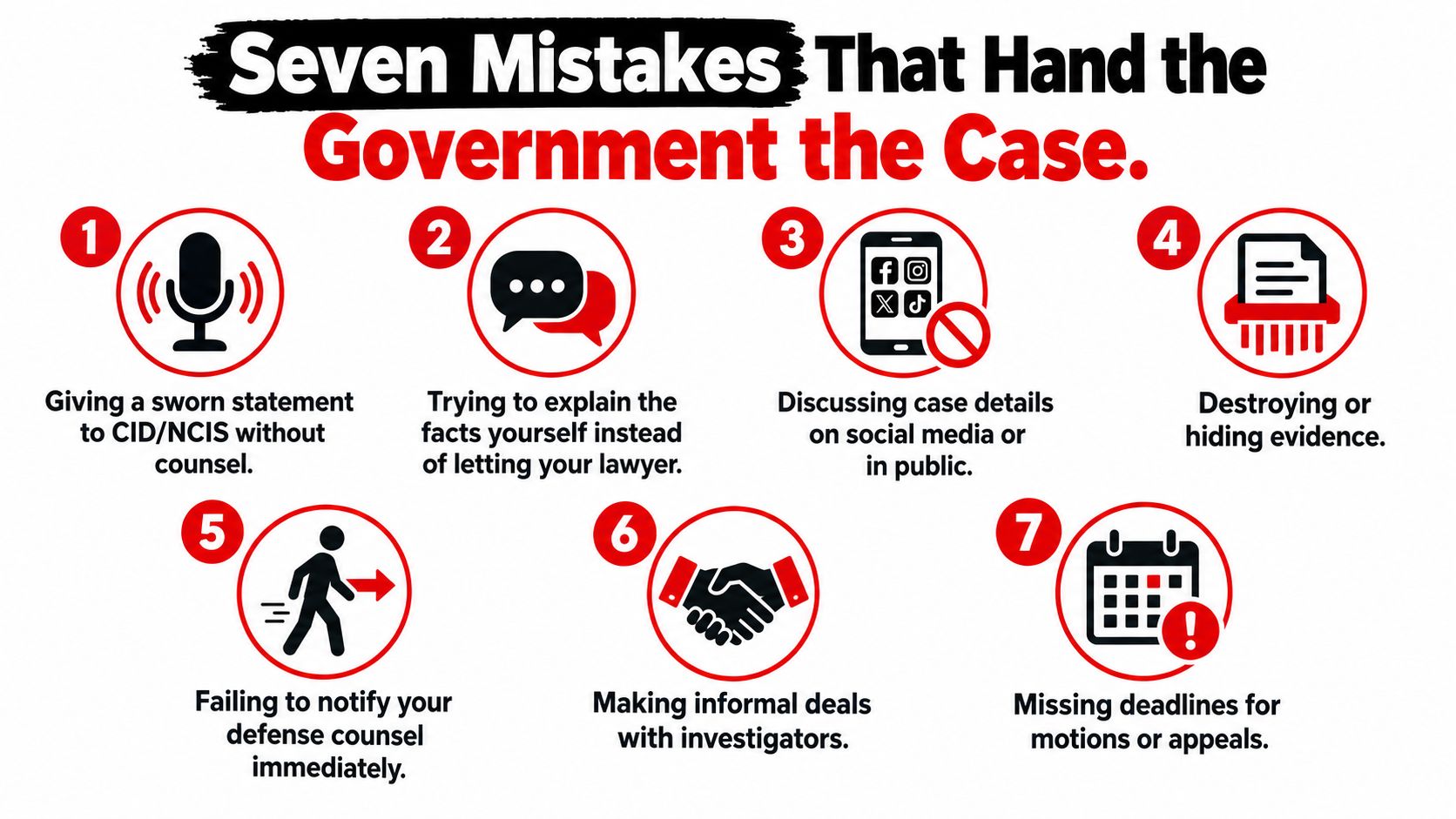
None of these actions requires bad intent. Each one can still damage a defense that might otherwise have challenged intent, authorization, credibility, or notice.
Why Civilian Military Defense Counsel and Your Next Move
Military-appointed defense counsel can provide capable representation and owe you a duty of loyalty. A serious case may nevertheless require more time, specialized resources, and independent attention than a busy military defense office can provide.
A civilian military defense lawyer works outside the command structure. Experienced court-martial attorneys can investigate before referral, hire or coordinate forensic resources when appropriate, analyze financial and digital records, prepare witnesses, litigate suppression issues, and build a trial theory around the exact specifications. They can also coordinate criminal, administrative, and security-clearance consequences.
The difference isn’t that appointed counsel lacks commitment. The practical difference may involve caseload, availability, geographic flexibility, and the depth of prior experience with the particular evidence problem.
Your next 72 hours
- Invoke counsel: Tell investigators and command that you want a lawyer before answering questions.
- Stop factual discussions: Don’t contact witnesses, accusers, coworkers, or supervisors about the allegation.
- Preserve records: Keep phones, computers, receipts, calendars, messages, and financial documents in their existing condition.
- Build a witness list: Write down names and contact information for people with firsthand knowledge, then give the list to counsel.
- Collect paperwork: Obtain the notification, rights advisement, charge sheet, and Article 32 materials when available.
- Ask for the hearing report: Request a copy of the Article 32 preliminary hearing officer’s report through counsel and review it carefully.
The window between allegation and referral is where a real defense gets built. If you’re under investigation or facing a breach of trust charge, contact experienced civilian military defense counsel now, before signing a statement, answering another question, or allowing command to define the facts without you. Your career, freedom, clearance, and reputation are at stake.