
You’re sitting across from your detailed military defense counsel with a referral sheet in front of you. Several UCMJ charges are listed. The trial counsel has offered a deal that avoids a contested trial, but only if you accept a conviction. You maintain that you’re innocent. At the same time, the government has a recorded statement, a service member who identifies you, or digital evidence that could persuade a factfinder.
Your lawyer has mentioned two unusual options, an Alford plea and a no contest plea. Neither option makes the case disappear. Both can lead to a conviction, punishment, career damage, clearance problems, and administrative separation. The difference is what you say about the facts, how the military judge handles your answers, and how the conviction may affect later proceedings.
A plea decision at a court-martial is not a paperwork exercise. It’s a decision about confinement exposure, sentencing strategy, appellate posture, credibility, and your life after the uniform. Before you choose, review the court-martial basics with counsel and insist on advice tied to the actual evidence in your case.
Table of Contents
- Facing a Court-Martial With Two Plea Options
- What an Alford Plea and a No Contest Plea Actually Mean
- Side-by-Side Comparison Under the UCMJ
- How Military Judges and Panels Treat Each Plea
- Strategic Reasons to Choose One Plea Over the Other
- Decision Checklist and Questions for Your UCMJ Lawyer
- Common Mistakes and Long-Term Consequences
- Get Civilian Military Defense Counsel Before You Plead
- Frequently Asked Questions
- Is an Alford plea the same as a no contest plea?
- Can a military judge reject an Alford plea?
- Is a no contest plea commonly accepted at a court-martial?
- Will an Alford plea affect my security clearance?
- Can either plea prevent administrative separation?
- Does no contest protect me in a later civil lawsuit?
- Do I preserve appellate rights by entering an Alford plea?
- Should I wait until the plea hearing to decide?
Facing a Court-Martial With Two Plea Options
A senior noncommissioned officer may believe the allegation is false but still recognize that the government’s evidence is dangerous. A junior officer may understand that a panel trial could preserve an acquittal but also expose them to a sentence that ends their commission, clearance, and military career. In both situations, an Alford plea or no contest plea can look like a narrow path between admitting guilt and gambling everything at trial.
The pressure usually comes from several directions at once:
- The referral decision: Once charges are referred, the case moves into a formal prosecution posture, and command’s appetite for compromise may shrink.
- The plea offer: Trial counsel may offer reduced charges, sentencing limitations, or other terms in exchange for a prompt resolution.
- The evidence: A recorded statement, forensic extraction, text messages, witness identification, or prior inconsistent account may make a contested trial riskier than the accused expected.
- The career consequences: A conviction can affect rank, pay, assignments, clearance eligibility, retention, and administrative separation.
- The family pressure: Spouses and parents often want certainty, while the accused may be weighing a legal gamble that nobody else can fully understand.
An Alford plea lets you plead guilty while maintaining that you didn’t commit the offense. You accept the conviction because the evidence creates a serious risk of conviction at trial. A no contest plea, also called nolo contendere, avoids an express admission of guilt while accepting treatment as though you were guilty.
Practical rule: Don’t choose the plea label first. Choose the outcome you can live with after reviewing the evidence, sentencing limits, collateral effects, and realistic trial risk.
The military justice system generally treats both pleas as conviction-producing resolutions. That makes this decision different from a not-guilty verdict, dismissal, or successful suppression motion. Your military defense lawyers should explain not only what happens at the plea hearing, but also what the conviction communicates to the judge, command, appellate courts, licensing bodies, and clearance reviewers.
What an Alford Plea and a No Contest Plea Actually Mean
An Alford plea is a guilty plea in legal effect. The term comes from North Carolina v. Alford, where the U.S. Supreme Court upheld a guilty plea from a defendant who maintained his innocence but accepted punishment because the evidence created a serious trial risk. The decision recognized that a defendant can plead guilty without making a traditional admission of guilt.
At a court-martial, the practical sequence is direct:
- You plead guilty.
- You tell the military judge that you maintain your innocence, or you decline to admit the conduct.
- The government presents facts supporting each required element.
- The judge decides whether the plea is voluntary, knowing, and factually sufficient.
An Alford plea does not produce a finding of innocence. The court enters a conviction, and sentencing follows. Your denial stays in the record, but it does not cancel the guilty plea or prevent the conviction from affecting your military career.
A no contest plea, also called nolo contendere, takes a different position. You do not expressly admit guilt, and you do not affirmatively claim innocence. You accept punishment without contesting the charge. The Cornell Legal Information Institute’s explanation of nolo contendere describes it as something other than an express admission of guilt while recognizing its criminal consequences.
The military judge’s role
A negotiated plea does not bind the military judge automatically. The judge questions you personally, tests your understanding, and requires a factual basis for the offense. Your answers must fit the elements, stipulation, government proffer, and other materials before the court. A contradiction can lead the judge to reject the plea or require clarification.
The military-law explanation of Alford pleas states the central distinction: an Alford plea remains a formal guilty plea, while a no contest plea refuses to contest the charge without admitting the underlying facts.
That difference can affect how your record is read in later civil litigation, administrative action, licensing review, or security-clearance proceedings. It also affects sentencing. The judge hears more than the label. Your answers, tone, explanations, and willingness to accept responsibility can shape the sentencing record, even when you avoid an express admission.
Side-by-Side Comparison Under the UCMJ
The label Alford plea vs no contest hides the practical issue at a court-martial. Both options can end with a conviction, confinement, a punitive discharge, and lasting career effects. The differences appear in the record the judge builds, the factual basis supporting the finding, and how later decision-makers interpret your position.
| Issue | Alford plea | No contest plea |
|---|---|---|
| Acceptance standard | The military judge must find the plea voluntary and informed, with evidence supporting each element even though you do not admit the conduct. | The judge must approve a less common plea that avoids an express admission while still permitting a conviction and sentence. |
| Factual admission required | You need not admit guilt, but the record must contain facts supporting every required element. | You need not admit guilt, but the government still must provide a sufficient factual basis. |
| Providence inquiry outcome | The judge can accept the plea when the evidence establishes the offense and you understand the consequences of the disposition. | The judge can reject the plea if the factual record is inadequate or the procedure does not fit the court-martial. |
| Sentencing exposure | A conviction carries the criminal judgment and sentencing consequences attached to a guilty disposition. | A conviction can bring the same military sentencing consequences, even without an express admission. |
| Evidentiary use later | The formal guilty-plea posture may be easier to use against you in later civil or administrative proceedings. | Later civil use may be more limited because you did not expressly admit guilt, but the conviction remains significant. |
| Appeal rights | The plea can narrow litigation over factual guilt. Post-trial and appellate issues may still exist based on the record. | Avoiding an admission does not restore the full trial posture or preserve every factual challenge. |
| Collateral consequences | The conviction may affect clearance reviews, separation, licensing, benefits, and post-service opportunities. | The same military and career consequences may follow, even if later evidentiary treatment differs. |
The practical choice is usually about record management, not avoiding consequences. An Alford position preserves a claim of innocence while accepting a guilty finding. A no contest position avoids an express admission, but it does not make the conviction disappear from personnel, clearance, licensing, or employment reviews.
The legal comparison of Alford and no contest pleas identifies the main distinction in later civil use. Apply that distinction carefully in a military case. A clearance adjudicator or command authority may focus on the conviction, the offense, the evidence, and your conduct after the case, rather than relying only on the plea label.
Neither plea gives you a right to acceptance. The military judge may reject either option if the providence inquiry does not establish a reliable basis for the findings. No contest is especially unusual in a court-martial because the judge still must have enough evidence to support the offense. Before choosing, have counsel compare the proposed stipulation, sentencing evidence, collateral reporting requirements, and likely interpretation of your record. Because the Alford record already establishes every element, the practical fight is usually over the sentencing narrative, not the findings. That makes the stipulation language more important than the plea label.
How Military Judges and Panels Treat Each Plea
Military judges scrutinize an Alford plea because the accused wants the court to enter a guilty finding while denying the underlying conduct. That tension forces the judge to examine the government’s evidence closely. Counsel must identify the facts that establish the elements, explain the aggravating evidence, and show that your decision is rational rather than coerced or confused.
Your answers matter. If you say the government has no evidence, deny facts that are necessary to an element, or contradict a signed stipulation, the judge may stop the inquiry. An Alford plea works only when the record can support the conviction even though you won’t personally adopt the government’s factual narrative.
A no contest plea presents a different problem. It avoids an express admission, but it doesn’t eliminate the need for a factual basis. The judge may rely on a stipulation, documentary evidence, witness statements, or a government proffer, subject to the governing plea procedures and the judge’s assessment of whether the record is sufficient.
The sentencing audience changes the risk
A judge-alone sentencing hearing gives one military judge control over how the plea, your answers, and the evidence fit together. A panel introduces a different dynamic. Members may interpret an Alford position as refusal to accept responsibility, even when your lawyer has a legitimate reason for preserving your innocence.
That perception can affect how members evaluate extenuation and mitigation. It can also affect how they view your credibility when you later describe your record, family circumstances, service history, or rehabilitation.
R.C.M. 910 governs guilty pleas and the providence inquiry. The exact treatment of an Alford or no contest plea depends on the case, the military judge, the negotiated terms, and the quality of the factual record. A lawyer who treats the plea label as universally accepted is giving you incomplete advice.
A plea colloquy is evidence about you. The judge is evaluating the legal basis, but also your understanding, consistency, and credibility.
Strategic Reasons to Choose One Plea Over the Other
Start with the conviction itself. If the core issue is a conviction that can trigger separation, clearance action, licensing trouble, or other restrictions, changing the words you use at the plea stage may not fix it. The question is not which plea sounds less guilty. The question is which resolution leaves you with the least harmful lawful outcome after the court-martial ends.
An Alford plea is worth serious consideration when:
- You maintain a genuine innocence claim: You cannot truthfully give a conventional factual admission, but the evidence still creates serious trial risk.
- The negotiated outcome is materially safer: The offer limits charges or punishment in a way that makes the plea better than the trial risk the evidence creates.
- The record needs to preserve your position: Your continued denial may matter in later personal, professional, or civil settings, even though the conviction remains.
- The government’s evidence is strong but not complete: The factual basis may support a plea while leaving important disputes for sentencing, post-trial litigation, or collateral proceedings.
A no contest plea may fit better when:
- You want to avoid an express admission: That matters when later civil litigation is a real possibility.
- The government can prove the charge without your admission: Counsel must confirm that the judge will accept the proffer or stipulation.
- The sentencing narrative benefits from restraint: In some cases, refusing to contest the charge is less damaging than making a statement that clashes with the record.
- The plea terms are otherwise favorable: The label means little if the agreement does not limit the consequences that matter most.
Do not assume either plea earns cooperation credit. Cooperation has to be negotiated and documented under the applicable rules, including R.C.M. 705 where appropriate. Ask counsel how the plea affects sentencing arguments, deferment requests, clemency submissions, administrative separation timing, and clearance reporting.
No contest pleas often matter differently in civil litigation, but that does not shield the conviction from later use in every forum. A commander, licensing board, clearance adjudicator, or civilian prosecutor can still evaluate the conviction, the surrounding evidence, and your statements under other authority.
Decision Checklist and Questions for Your UCMJ Lawyer
Don’t enter a plea until your lawyer has connected the legal choice to the evidence and the consequences. You need a written or clearly explained decision map, not a general statement that one plea is “better.”
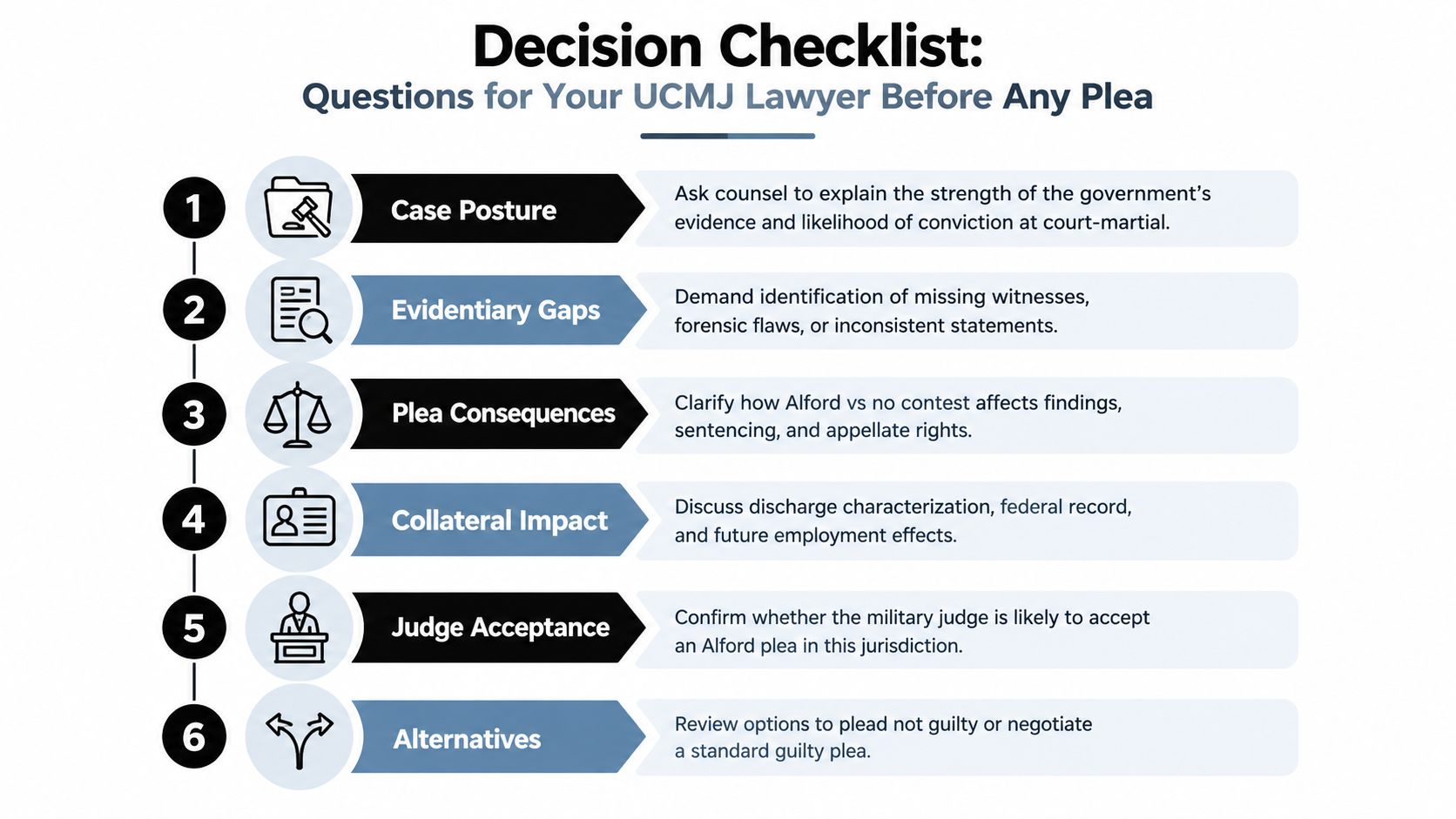
Use this sequence before the providence inquiry:
- Identify the case posture. Know which charges are referred, which terms are offered, and what the government can still change.
- Test the evidence. Separate admissible proof from allegations, hearsay, incomplete forensic work, and witnesses with credibility problems.
- Calculate the actual exposure. Review confinement, punitive discharge risk, rank and pay effects, and sentencing limits in the proposed agreement.
- Examine the factual basis. Determine whether the government can prove every element without forcing you into an answer that contradicts your position.
- Map collateral effects. Discuss clearance reporting, administrative separation, licensing, benefits, immigration, and post-service employment.
- Compare every alternative. Include pleading not guilty, litigating motions, negotiating a conventional guilty plea, or seeking a different charge disposition.
Questions that deserve direct answers
Ask your UCMJ lawyer:
- What is the strongest prosecution evidence against me?
- Which witnesses, forensic results, or digital records are vulnerable?
- How will my denial during the providence inquiry affect the judge or panel?
- What stipulations will the government accept to support findings?
- How does each plea affect sentencing deferment or clemency under R.C.M. 1105?
- What collateral triggers apply to my MOS, assignment, or clearance tier?
- Is a no contest plea realistically available before this military judge?
- What do I preserve, and what do I surrender, by pleading now?
Review any Article 31 rights issue before discussing facts with investigators or command. The Article 31 guidance for service members is a useful starting point, but your lawyer must apply it to your specific questioning, statements, and timeline.
The government may use pre-referral Article 32 testimony and inconsistent sworn statements to challenge the plea narrative. Consistency matters from the first interview through sentencing. Do not let a rushed explanation create a contradiction that later undermines your credibility.
The following video offers general context about military justice plea decisions. It isn’t a substitute for advice on your charges, evidence, or proposed agreement.
Common Mistakes and Long-Term Consequences
The most common error is treating “no contest” as though it means “nothing happens.” It doesn’t. A no contest plea can still produce a conviction and sentence, with serious military consequences.
A second mistake is believing an Alford plea prevents factual findings. It doesn’t. The judge still needs a factual basis, and the conviction remains part of the criminal record. The Justia explanation of Alford and no contest pleas explains that an Alford plea carries guilty-plea legal effect even though the accused maintains innocence.
Watch for these additional mistakes:
- Ignoring the sentencing forum: A judge and panel may react differently to a denial-based plea and to mitigation evidence.
- Assuming clearance problems wait until separation: Clearance authorities may evaluate the conviction and underlying conduct while you remain in service.
- Focusing only on confinement: A sentence can damage rank, pay, assignment eligibility, clearance status, retention, and civilian prospects even without lengthy confinement.
- Treating collateral consequences as identical: Some effects attach to the conviction, while others depend on the offense, jurisdiction, agency policy, or later proceeding.
- Signing an incomplete agreement: A plea agreement should address sentencing limits, charge treatment, stipulations, cooperation, and post-trial requests where possible.
- Making emotional statements: Anger, sarcasm, or an unplanned denial can make the providence inquiry more difficult.
- Waiting for command to protect your future: Command’s priorities aren’t the same as your defense objectives.
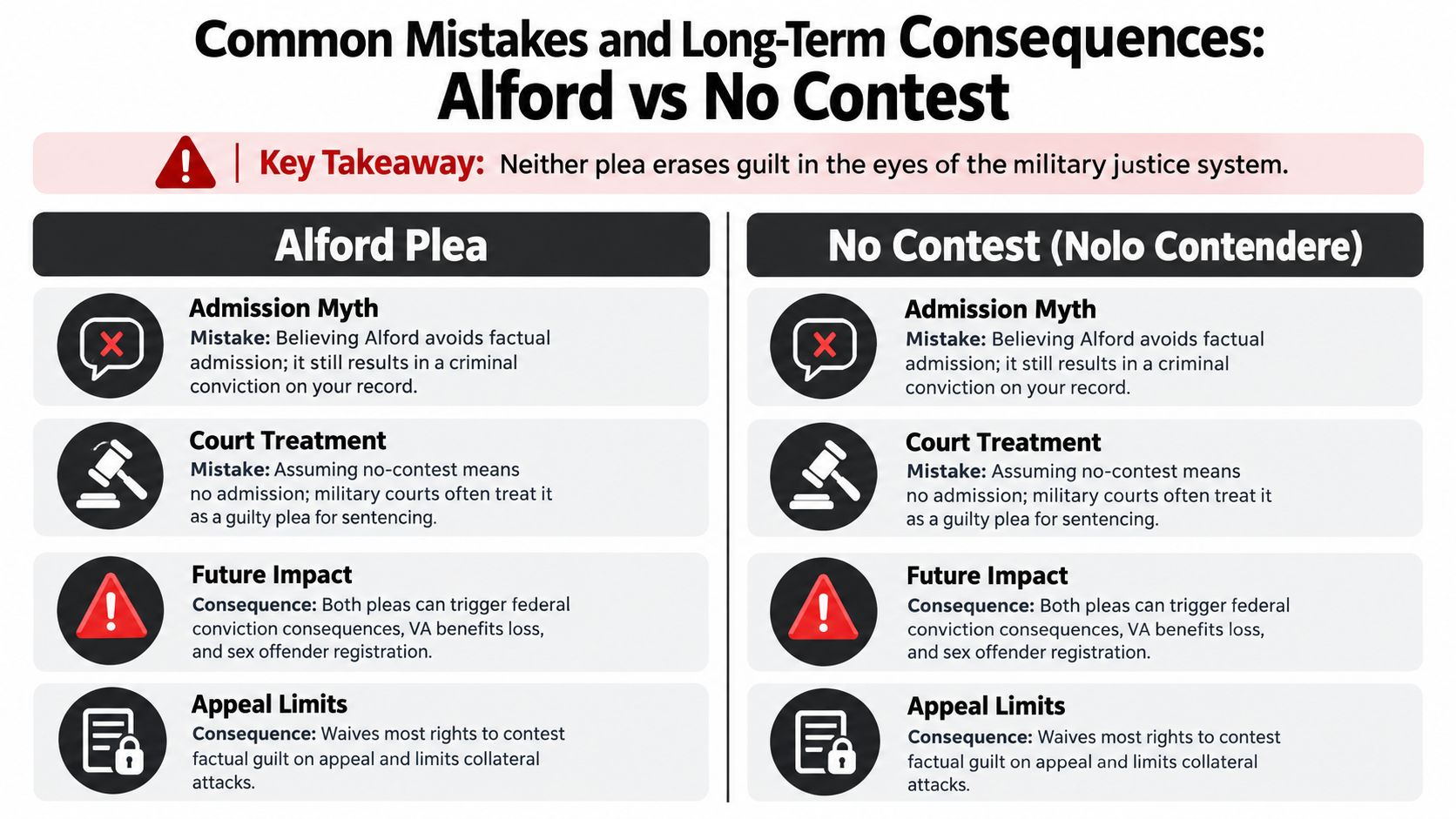
The long-term effects can reach beyond military service. A conviction may be considered in civilian employment, professional licensing, immigration, firearm restrictions, registration requirements, and benefits decisions. The exact result depends on the offense and the governing authority, so counsel must identify the actual trigger rather than rely on general assurances.
Get Civilian Military Defense Counsel Before You Plead
Your appointed defense counsel may be capable, dedicated, and fully committed to protecting you. The issue is capacity and independence. Military defense counsel manage institutional caseloads, operate within assignment structures, and may have limited time to investigate every forensic issue, negotiate every term, and prepare you for the consequences of an unusual plea.
An experienced civilian military defense attorney can add focused attention before the plea becomes irreversible. That work should include:
- Evidence review: Analyze reports, recordings, digital extractions, witness statements, Article 32 materials, and investigative gaps.
- Negotiation: Press trial counsel on charge reductions, sentencing limits, stipulations, cooperation terms, and timing.
- Providence preparation: Rehearse the questions without scripting false answers, identify dangerous ambiguities, and ensure your factual position is consistent.
- Sentencing strategy: Prepare mitigation that addresses both the offense and the practical consequences of conviction.
- Collateral planning: Identify clearance, separation, licensing, immigration, benefits, and post-service risks before you sign.
Civilian counsel isn’t automatically better because the lawyer works outside the military. The lawyer should have meaningful court-martial experience, understand the UCMJ and military procedure, and be willing to challenge an attractive plea when the evidence supports a trial defense.
Ask every candidate about recent court-martial work, trial experience, branch familiarity, communication expectations, and who will personally handle your case.
Questions about timing and cost
Do I need civilian counsel before referral? If possible, yes. Early counsel can influence investigation strategy, preserve evidence, and shape negotiations before positions harden.
Can civilian counsel coordinate with appointed counsel? Often, yes. The attorneys can divide responsibilities, but you should understand who controls communication, motions, negotiations, and trial preparation.
Is a plea agreement automatically safer? No. Safety depends on the charges, evidence, sentencing limits, factual basis, and collateral consequences.
What will civilian counsel cost? Fees vary by attorney, case complexity, location, investigation demands, and trial posture. Obtain a written fee agreement and ask what services it includes.
Read the practical guidance on court-martial defense lawyers before selecting counsel. If your Article 32 hearing or referral decision is approaching, schedule a confidential consultation now. Waiting until the plea hearing leaves your lawyer defending the timeline instead of controlling it.
Frequently Asked Questions
Is an Alford plea the same as a no contest plea?
No. An Alford plea is formally a guilty plea while the accused maintains innocence. A no contest plea avoids an express admission of guilt and consents to punishment as though guilty. Both can produce a conviction and sentence.
Can a military judge reject an Alford plea?
Yes. The judge may reject it if the plea isn’t voluntary, knowing, or supported by a sufficient factual basis. The judge may also question whether your answers establish the elements without contradiction.
Is a no contest plea commonly accepted at a court-martial?
No contest is an unusual option in military practice. Acceptance depends on the military judge, the government’s position, the plea agreement, and whether the record provides a reliable basis for conviction.
Will an Alford plea affect my security clearance?
It can. A conviction and the underlying conduct may be considered in a clearance review. The plea’s label doesn’t guarantee that clearance authorities will disregard the case.
Can either plea prevent administrative separation?
Not automatically. A conviction may support administrative action, and the timing and result depend on the offense, service regulations, command action, and characterization rules.
Does no contest protect me in a later civil lawsuit?
It generally creates less direct admission evidence than a guilty plea because it doesn’t expressly admit guilt. That protection isn’t absolute, and the conviction, surrounding evidence, or other statements may still matter.
Do I preserve appellate rights by entering an Alford plea?
A plea can narrow challenges to factual guilt, although other post-trial or appellate issues may remain. Your court-martial attorneys should explain the waiver provisions and preserved issues in the specific agreement.
Should I wait until the plea hearing to decide?
No. By the hearing, the government may have committed to its litigation position, key negotiations may be over, and your lawyer may have less time to address factual or collateral problems. Get advice after discovery review and before signing.
If you’re under investigation, facing referral, or considering an Alford plea vs no contest disposition, contact experienced civilian military defense counsel immediately. Don’t discuss the facts with investigators or sign a plea agreement until a qualified UCMJ lawyer has reviewed the evidence, sentencing limits, and career consequences. Your freedom, rank, clearance, reputation, and future employment may depend on decisions made before the courtroom doors open.