
Your clearance letter landed, and suddenly everything that felt stable is on a timer. Badge access, project assignments, onboarding, promotions, and even your standing with the command or contracting office can freeze the moment the adverse decision issues. If you’re staring at a Statement of Reasons or revocation notice, you’re not in a paperwork dispute, you’re in a career survival fight.
A good security clearance appeal lawyer doesn’t sell comfort. He or she builds the record, strips out weak allegations, and gets the right evidence in front of the right decision-maker before the file closes for good. That matters because the government does not need to prove you’re a bad person, it only needs a reason to doubt your reliability, and the burden then shifts hard onto you to rebut or mitigate the concern.
Table of Contents
- When a Clearance Denial Changes Everything
- The Appeal Channels You Actually Have
- What the Data Says About Winning on Appeal
- Inside the DOHA Hearing Path
- The PSAB Timeline for Military and Civilian Personnel
- Evidence and Mitigation That Move Decisions
- How to Choose a Security Clearance Appeal Lawyer
- Your Next Move After the Denial Letter
When a Clearance Denial Changes Everything
Marcus, a defense contractor with a strong record, lost a TS/SCI adjudication over a messy divorce and one unreimbursed corporate credit card balance. The charge was only $4,200, but the issue wasn’t the amount, it was the way the debt sat unresolved long enough to trigger a Guideline F concern. One day he was supporting a cleared program, and the next day the revocation letter hit, the badge stopped working, and the pipeline he’d built over 14 years went quiet.
That’s the part people miss. The letter is not just a legal notice, it’s the point where career trajectory, daily access, and future onboarding all stall at once. If you wait to “see how it plays out,” you usually waste the narrow window where a customized response can still change the record.
The first move is not a generic apology. It’s a line-by-line rebuttal tied to mitigation, supported by documents that match the actual allegation. If you need a basic refresher on the sequence from application to adjudication, the SF-86 and clearance timeline overview is a useful reference before you start drafting your response.
Practical rule: the appeal packet has to tell a coherent story, not just dump paperwork on the judge or board.
Marcus’s problem was common. The money issue was real, but the bigger failure was strategic, because the first draft he showed me didn’t connect the debt to any rehabilitation, repayment plan, or stabilized financial picture. Without that narrative, even strong documents can read like clutter. A security clearance appeal lawyer earns his keep right there, before the government’s file hardens into the final version.
The Appeal Channels You Actually Have
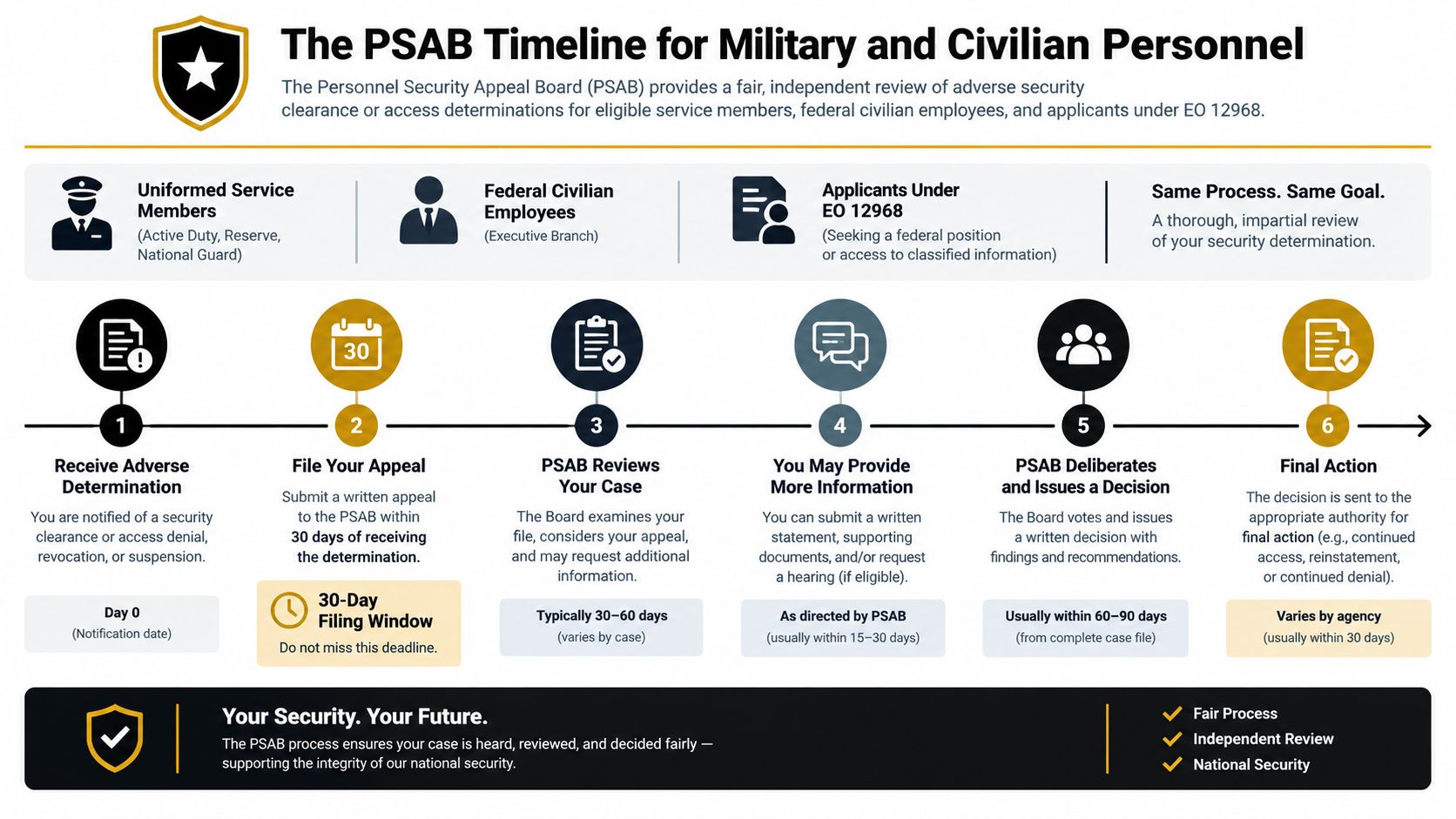
The appeal forum controls the record, deadlines, hearing rights, and decision-maker. A contractor case generally proceeds through DOHA, where a Department of Defense Administrative Judge reviews the matter and an appeal board may consider the decision afterward. Military and federal civilian cases usually follow a Personnel Security Appeals Board (PSAB) or comparable agency process. DCSA’s guidance on trust decision adjudications distinguishes the contractor route from the agency-board route.
Pick the right lane first
Contractors facing an adverse decision under the adjudicative guidelines usually belong in DOHA. Uniformed personnel and federal civilian employees should expect a PSAB-style review, often governed by their agency’s filing rules. Intelligence community matters may follow a separate track. Recent reporting describes changes affecting NSA and NGA, so general clearance advice may point you toward the wrong office or procedure. The 2026 clearance process update provides relevant context.
The procedural differences affect case strategy. A written-record review rewards a focused submission with organized exhibits and direct answers to each allegation. A hearing permits live testimony, witness questioning, and credibility assessment. Those rights can justify the added time and expense, but only when testimony adds something the documents cannot establish.
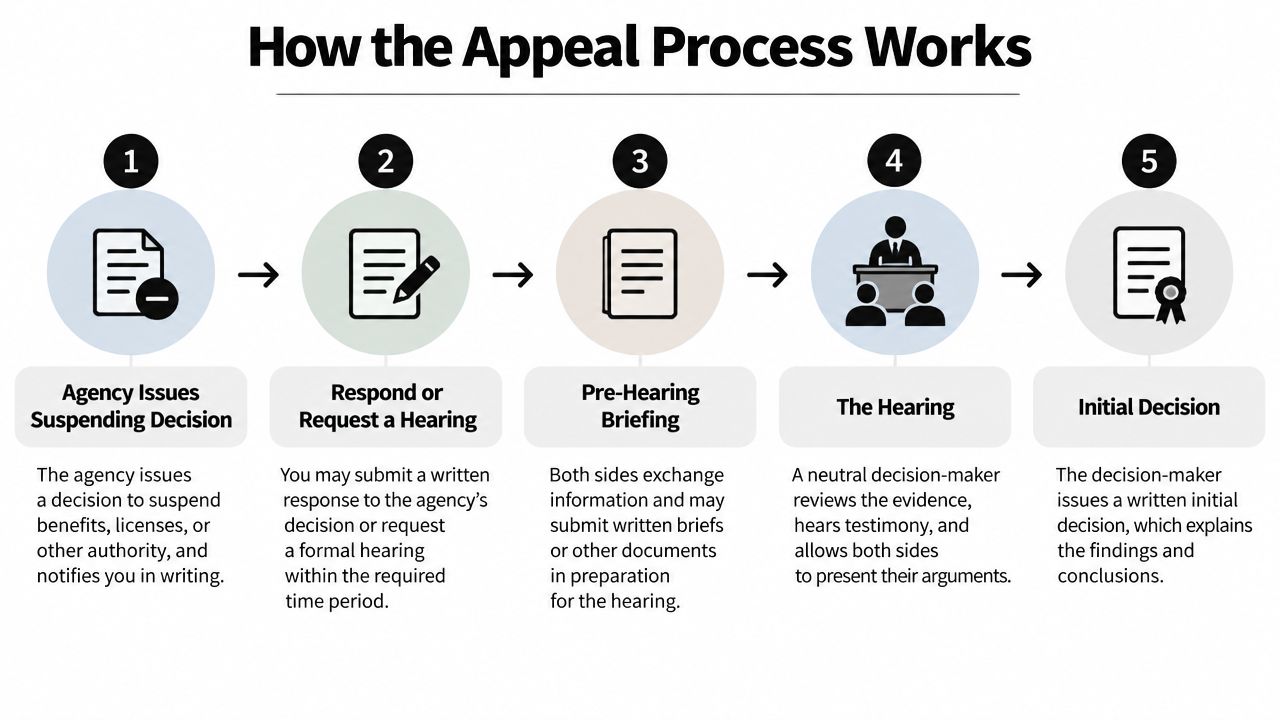
The forum also affects how quickly counsel must act and whether a late filing can be excused. For related administrative separation context, see this guide to upgrading a military discharge.
Do not file into the wrong system and hope the error gets corrected. Confirm the issuing authority, your employment status, the response deadline, and whether the process offers a hearing before preparing the appeal.
What the Data Says About Winning on Appeal
The numbers are hard to ignore, and anyone promising easy reversals is overselling the case. In one DoD-related dataset, 13,623 applicants, or 68%, were denied on appeal, while 6,112, or 31%, were granted DoD appeals study. Earlier review data also showed that only 2 of 133 appealed denials were granted at the Appeal Board stage, about 1.5%, and when administrative judge and Appeal Board decisions were counted together, DoD clearances were denied in approximately 72% of cases.
That is the practical reality. A judge or board moves when the applicant answers the actual concern with records, corroboration, and a stable post-incident history.
Where reversal is more realistic
Financial problems are the hardest category to overcome because adjudicators treat them as a sign of judgment pressure and future risk. Alcohol, drug, and some personal conduct cases can improve when the applicant shows treatment, rehabilitation, and a clean record after the incident. Foreign influence and allegiance cases stay difficult, but they become more workable when the applicant documents real steps that reduce or sever the concern, not just future promises.
The forum matters too. DCSA explains that contractor cases can include a hearing before a DOHA administrative judge, with testimony and cross-examination, followed by Appeal Board review before the process ends DCSA facility clearance FAQs. A well-built record matters in that setting because live credibility and documentary proof usually carry more weight than a polished argument with thin exhibits.
| Guideline | Category | Approx. Reversal Rate | Key Mitigation Lever |
|---|---|---|---|
| F | Financial Considerations | Lower than most categories | Targeted debt resolution, repayment proof, stable budgeting |
| G | Alcohol Consumption | Higher when rehabilitation is documented | Treatment records, sobriety milestones, clean conduct |
| H | Drug Involvement | Higher when post-incident record is clean | Testing records, counseling, sustained abstinence |
| E | Personal Conduct | Better when credibility is restored | Consistent explanation, corroboration, discipline record |
| A | Allegiance | Very difficult | Strong documentary rebuttal, limited relief |
| B | Foreign Influence | Very difficult | Narrow foreign ties, verified mitigation steps |
| J | Criminal Conduct | Case dependent | Post-incident conduct, rehabilitation, honesty |
| M | Sexual Behavior | Highly fact specific | Direct supervisor or witness testimony, context, corroboration |
A security clearance appeal lawyer who knows the record will not waste time pretending every guideline is equal. The key question is whether the evidence answers the concern the adjudicator is using to judge risk.
Inside the DOHA Hearing Path
DOHA cases move fast, and the first deadline matters. After the Statement of Reasons arrives, the applicant normally has a short election window to decide whether to respond in writing or request a hearing. If you choose the wrong path, or choose late, you can lose the chance to shape the record the way a live case demands.
What actually happens
The government produces its File of Relevant Material, and that file becomes the backbone of the case. From there, the applicant either submits a written response or prepares for a hearing before a DOHA Administrative Judge, where opening statements, direct testimony, cross-examination by Department Counsel, witness testimony, and closing argument all matter. The hearing is not casual, and it is not a place to “explain things from the heart” without a plan.
Plain truth: the judge is not there to rescue you from a bad record. He or she is there to decide whether the record supports retention or denial.
A strong pre-hearing brief frames the issue before the hearing starts. It tells the judge what the evidence means, which allegations are disputed, and which ones are being mitigated rather than denied. That distinction is important because a sloppy response can sound defensive, while a clean response sounds credible.
If the decision goes against you, DOHA has a further appeal path to the appeal board, but the record is usually what matters most by then. That’s why hearing-day performance is only part of the job. The documents, witness list, and written theory have to be right before anyone takes the stand.
The PSAB Timeline for Military and Civilian Personnel
PSAB deadlines can end a case before anyone examines the underlying facts. The Navy’s training materials provide a concrete example: after a denial or revocation, the member must submit a Notice of Intent to Appeal within 10 days, followed by a direct written appeal within 30 calendar days of that notice Navy training materials. Treat those dates as hard deadlines. A late filing can prevent review of otherwise useful evidence.
Written appeal or personal appearance
A written appeal depends on the record, mitigation documents, and legal argument. It can be less expensive and faster when the dispute turns on objective material, such as payment records or a clear documentary history. A personal appearance adds testimony, witnesses, and live questioning. That format earns its place when the decision depends on credibility, judgment, honesty, or conduct that changed after the incident.
The format also affects preparation. A written track requires a precise response to each concern and supporting exhibit. A hearing requires witness preparation, a consistent account, and readiness to address unfavorable facts under questioning. Choose the hearing when live explanation can resolve an important credibility issue. Choose written review when the documents already establish the facts and mitigation.
Reconsideration is not an immediate second chance. After final denial or revocation, a one-year wait applies before a reconsideration request may be made, per the same Navy GMT training materials. The first appeal therefore deserves the strongest record you can assemble.
Military clearance cases may also overlap with adverse administrative action. The compressed deadlines and record-control problems described in Army administrative discharge guidance can affect how the clearance appeal is prepared. Coordinate the two matters rather than allowing one submission to undermine the other.
Deadline discipline wins cases. A strong packet has no value if it arrives after the filing period closes.

Evidence and Mitigation That Move Decisions
The government rarely loses because a lawyer wrote a clever paragraph. It loses, when it loses, because the applicant produced better evidence, better context, and better mitigation than the file suggested. That’s especially true under Guideline F, where generic explanations don’t beat hard financial documents.
What actually shifts the file
A character letter matters when it is specific. A supervisor who can describe how you handled pressure, deadlines, and judgment on actual projects is worth more than a vague endorsement from a famous name who barely knows you. For drug, alcohol, and mental-health related concerns, the strongest exhibits are treatment records, counseling notes, sobriety milestones, and objective proof of stable conduct after the incident.
The same goes for any response packet. A high-impact submission should cross-walk each allegation to a document, not just to a promise. If the SOR says a debt went unpaid, show the repayment, the current status, and the reason the problem no longer exists. If the concern is conduct, show the incident’s aftermath, not just regret.
Use the whole-person frame with proof. A board wants to see consistency, accountability, and change, not a speech about who you are inside.
This is also where specialized tools can help.
A solid mitigation file usually includes:
- A numbered response to each allegation, matched to an exhibit
- Financial records showing resolution or realistic repayment
- Treatment or counseling documents for rehabilitative cases
- Witness statements that are concrete, not ceremonial
- Any administrative or post-conviction conduct records that show stability
The goal is not to sound persuasive. The goal is to make the adjudicator’s whole-person analysis easier to support with the file in hand.
How to Choose a Security Clearance Appeal Lawyer
Don’t hire a lawyer because he handled a divorce, a DUI, or a court-martial two counties away. Clearance appeals are their own discipline, and the wrong lawyer can waste your one real shot. If you want a serious result, ask whether the attorney has actual DOHA or PSAB experience, not just general litigation confidence.
Non-negotiables in a consultation
Start with the basics:
- Active bar status and no discipline problems
- Prior JAG or DoD component experience
- Published DOHA or PSAB results
- Real familiarity with SEAD-style adjudicative analysis
- Enough volume to know the judges and the rhythm of the docket
Then ask hard questions. How many hearings did you handle last year? Which judges have you appeared before? Who writes the witness outlines? Who’s going to be in the hearing room with me? What happens if the case needs an appeal board review?
If you want a practical guide on evaluating civilian military defense counsel more broadly, the right military defense lawyer checklist is a useful starting point. For market context and practitioner commentary, the capture manager blog posts also help show how government-contracting professionals think about risk, access, and clearance pressure.
A lawyer who guarantees a win is a problem. So is a lawyer who sends a paralegal to run the case or never appears at the hearing. A security clearance appeal lawyer should be able to explain the forum, the likely weaknesses, and the mitigation path without bluffing.
Your Next Move After the Denial Letter
A denial letter starts a deadline, not a waiting period. Contractors should confirm the DOHA election period at once. Military personnel may face Navy-style 10-day and 30-day deadlines, which can move faster, according to Navy training materials. Counsel retention, record collection, and witness contact should begin the same day.
Gather these documents first
- The full Statement of Reasons, with each allegation numbered
- The report or financial record that triggered the concern
- Prior reinvestigation findings
- Notes, emails, or messages confirming the timeline
- Treatment, repayment, or counseling records supporting mitigation
Protect the appeal from preventable errors. Do not miss the filing deadline, submit late exhibits without the required motion, argue with the wrong office, or discuss the case online. Those choices can damage credibility before the merits receive review.
Contractors should contact DOHA counsel within 72 hours. Military members and civilian employees should request the appeal file immediately and confirm whether the case belongs in a PSAB or agency-specific track before the response window closes. The forum changes the procedure, but every path rewards a complete record and a focused explanation of what changed.
If a denial or revocation notice arrived, involve a security clearance appeal lawyer while the deadline remains open. Early action preserves evidence and gives counsel time to address financial issues, documentation gaps, and witness problems before they control the outcome.