You got a call from CID, NCIS, OSI, or your command. They want to “ask a few questions” about a friendship, a dating relationship, time spent off duty, shared housing, or money that changed hands. You’re probably telling yourself this has to be a misunderstanding.
That instinct gets people hurt.
UCMJ Article 134 Fraternization cases are dangerous because they often start with facts that look personal and end with allegations that sound criminal, disloyal, and career-ending. A dinner becomes “private socialization.” A loan becomes “financial entanglement.” A relationship that felt separate from work becomes proof, in the government’s hands, that you damaged authority and unit discipline.
If investigators are circling, your problem isn’t just what happened. Your problem is how the government will frame it, how command will react, and whether anybody is forcing the prosecution to prove its case instead of coasting on rumor and moral outrage.
Table of Contents
- The Phone Call That Changes Everything
- What the Government Must Prove for Article 134 Fraternization
- Service-Specific Rules and Real-World Examples
- The Anatomy of a Fraternization Investigation
- Punishments Collateral Consequences and Your Security Clearance
- Common Defenses and Critical Mistakes to Avoid
- Your First Moves When Accused and Choosing Counsel
The Phone Call That Changes Everything
It usually starts small. You gave someone a ride. You spent time together off duty. You shared jokes in a group chat. Maybe you loaned money, stayed over, split a hotel room on leave, or got too comfortable with someone command thinks you should’ve kept at arm’s length.
Then the call comes.
A supervisor tells you CID wants to speak with you. NCIS leaves a voicemail. OSI asks if you can “clear something up.” Someone from command says, “If there’s nothing to hide, just tell the truth.” That advice is poison.
The government doesn’t investigate fraternization like a relationship problem. It investigates it like a leadership and integrity problem. That means your texts, your silence, your explanations, your social media, and your judgment all become targets. Investigators look for a storyline they can hand to command. Command looks for a way to protect itself.
Practical rule: The moment you learn you’re under scrutiny, stop treating this like a misunderstanding and start treating it like a case.
Service members sink themselves when they think honesty alone will save them. They talked freely, tried to sound cooperative, and filled in details investigators never would’ve found on their own. Then command used those statements to build the very case the member thought he or she was defusing.
If you’re in that moment now, understand the reality. The system is not trying to calm you down. It’s collecting evidence. Your career, clearance, promotion path, and liberty can all get pulled into this fast. You need discipline immediately, not optimism.
What the Government Must Prove for Article 134 Fraternization
UCMJ Article 134 Fraternization is not supposed to be a vibes-based offense. The government has a burden, and a good defense starts by making prosecutors carry it all the way.
Under the Manual for Courts-Martial, the maximum punishment includes dismissal for officers, forfeiture of all pay and allowances, and confinement for 2 years, and the charge sits under 10 U.S.C. § 934 as explained in this Article 134 fraternization overview and UCMJ system guide and in the verified discussion at My Military Lawyers on UCMJ Article 134 fraternization.
The five elements decide the case
To convict, the government must prove five elements beyond a reasonable doubt:
- Officer status. The accused was a commissioned or warrant officer.
- Military equality. The accused fraternized with enlisted member or members on terms of military equality.
- Knowledge. The accused knew the other person was enlisted.
- Custom violation. The conduct violated the service custom against that kind of equality.
- Terminal element. The conduct was prejudicial to good order and discipline or was service-discrediting.
That list matters because most commands act as if the relationship itself proves the offense. It doesn’t. The government still has to prove the legal line was crossed.
What counts as fraternization in practice
People often get blindsided. Fraternization doesn’t require sex. It doesn’t even require romance. The verified source above makes clear that frequent private socialization, co-habitation, or financial loans between officers and enlisted members can trigger charges if they violate service customs.
That means prosecutors will study facts like these:
| Conduct | How the government frames it |
|---|---|
| Off-duty time together | Private social relationship on terms of equality |
| Living arrangement | Co-habitation undermining boundaries |
| Shared finances or loans | Business or financial entanglement |
| Private communications | Concealment, favoritism, or undue familiarity |
The prosecution wants the panel thinking about authority, fairness, and discipline. The defense needs the panel focused on proof.
The weak points in these cases are usually the fourth and fifth elements. “Custom of the service” is often described too broadly. “Prejudice to good order and discipline” is often argued as if it’s automatic. It isn’t. If the government can’t show how this specific relationship created actual institutional harm, the case becomes far more vulnerable than command wants you to believe.
Service-Specific Rules and Real-World Examples
Every branch talks about professionalism. Each branch enforces it through its own customs, regulations, and command culture. That matters because the same conduct can be described very differently depending on where you serve and who’s writing the memo.
Army
The Army tends to look hard at relationships that threaten the chain of command, create the appearance of favoritism, or involve financial ties and business arrangements. Soldiers often underestimate how aggressively command can characterize off-duty contact when the ranks and roles make people uncomfortable.
A blunt Army example: an officer privately spending regular time with an enlisted soldier, mixing personal favors with work proximity, and then trying to explain it away as mentorship. That explanation often lands badly once witness statements start piling up.
Navy and Marine Corps
The Navy and Marine Corps have a culture that pays close attention to rank boundaries, leadership appearance, and the effect of relationships on command credibility. In that environment, a dating relationship between senior and junior members can become explosive quickly, especially if anybody thinks one person had influence over the other’s working conditions.
Here’s the practical reality:
- Public familiarity hurts. If shipmates or Marines are talking about it, the command problem gets bigger.
- Rank structure matters. A relationship can look far worse on paper once leadership layers are mapped out.
- Mixed professional and personal contact is dangerous. Friendly contact outside work may be reframed as compromised authority.
Air Force and Space Force
The Air Force and Space Force often focus on professional boundaries, supervisory relationships, and digital evidence. Social media, messages, and electronic records can become the backbone of the case. Service members think casual online contact is harmless until investigators build a timeline around it.
A direct comparison helps:
| Branch culture issue | Typical prosecution angle |
|---|---|
| Army | Unit cohesion, favoritism, improper financial or social ties |
| Navy and Marine Corps | Rank barriers, command respect, visible familiarity |
| Air Force and Space Force | Digital trail, appearance issues, supervisory boundaries |
Branch rules matter, but command interpretation matters more. A regulation on paper is one thing. A commander trying to prove a climate problem is another.
That’s why “other people do this all the time” is a terrible defense. Uneven enforcement exists. It won’t save you unless your lawyer knows how to use it strategically.
The Anatomy of a Fraternization Investigation
A fraternization case rarely arrives in a neat package. It grows. Someone gets angry. Somebody feels slighted. A spouse complains. A coworker talks. A command team decides there’s a climate issue. Then investigators start collecting fragments and forcing them into one accusation.
The danger is not just the evidence they find. It’s the narrative they build before you ever get a chance to fight back.
How these cases usually start
Investigators commonly look for:
- Messages. Texts, DMs, chat logs, deleted-thread remnants.
- Photos and posts. Social media images, tagged locations, comments.
- Money trail. Transfers, loans, shared purchases, reimbursements.
- Witness statements. People who saw you together, people who heard gossip, people who already dislike you.
- Living and travel evidence. Housing patterns, leave overlap, hotel records, ride history.
And prosecutors don’t always keep the theory narrow. As noted in the verified discussion at National Security Law Firm’s Article 134 fraternization analysis, courts have applied Article 134 beyond the classic officer-enlisted model, including officer-officer fraternization in United States v. Callaway, 21 M.J. 770 (A.C.M.R. 1986) and enlisted-enlisted relationships in United States v. Clarke, 25 M.J. 631 (A.C.M.R. 1987), aff’d 27 M.J. 361 (C.M.A. 1989). If you still think “we’re the same rank” or “this isn’t a normal fraternization setup” protects you, you’re already behind.
If you need a plain-English breakdown of who these agencies are and how they operate, read this guide on CID, NCIS, OSI, and CGIS investigations.
How defense counsel dismantles the file
A real defense lawyer doesn’t just deny the accusation. He breaks apart the government’s construction.
Start with context. A text message screenshot is rarely the whole conversation. A witness statement often reflects jealousy, command pressure, or hindsight. A photo proves almost nothing by itself. Investigators also have a bad habit of collecting incriminating facts and ignoring exculpatory ones.
Here’s where experienced court-martial attorneys go to work:
- Timeline pressure. Does the government have exact dates, or are they guessing?
- Relationship characterization. Was this truly “military equality,” or just contact prosecutors are stretching?
- Unit impact. Who was supposedly harmed, and what concrete effect did they experience?
- Custom proof. Can command witnesses define the custom clearly, or do they drift into opinions and moral judgment?
- Search issues. How did the government get the phone, messages, or account access?
A strong defense in these cases is not emotional. It is surgical. Every element, every witness, every screenshot gets tested.
That’s how fraternization cases are beaten. Not by hoping command “understands.” By forcing the government to prove what it usually assumes.
Punishments Collateral Consequences and Your Security Clearance
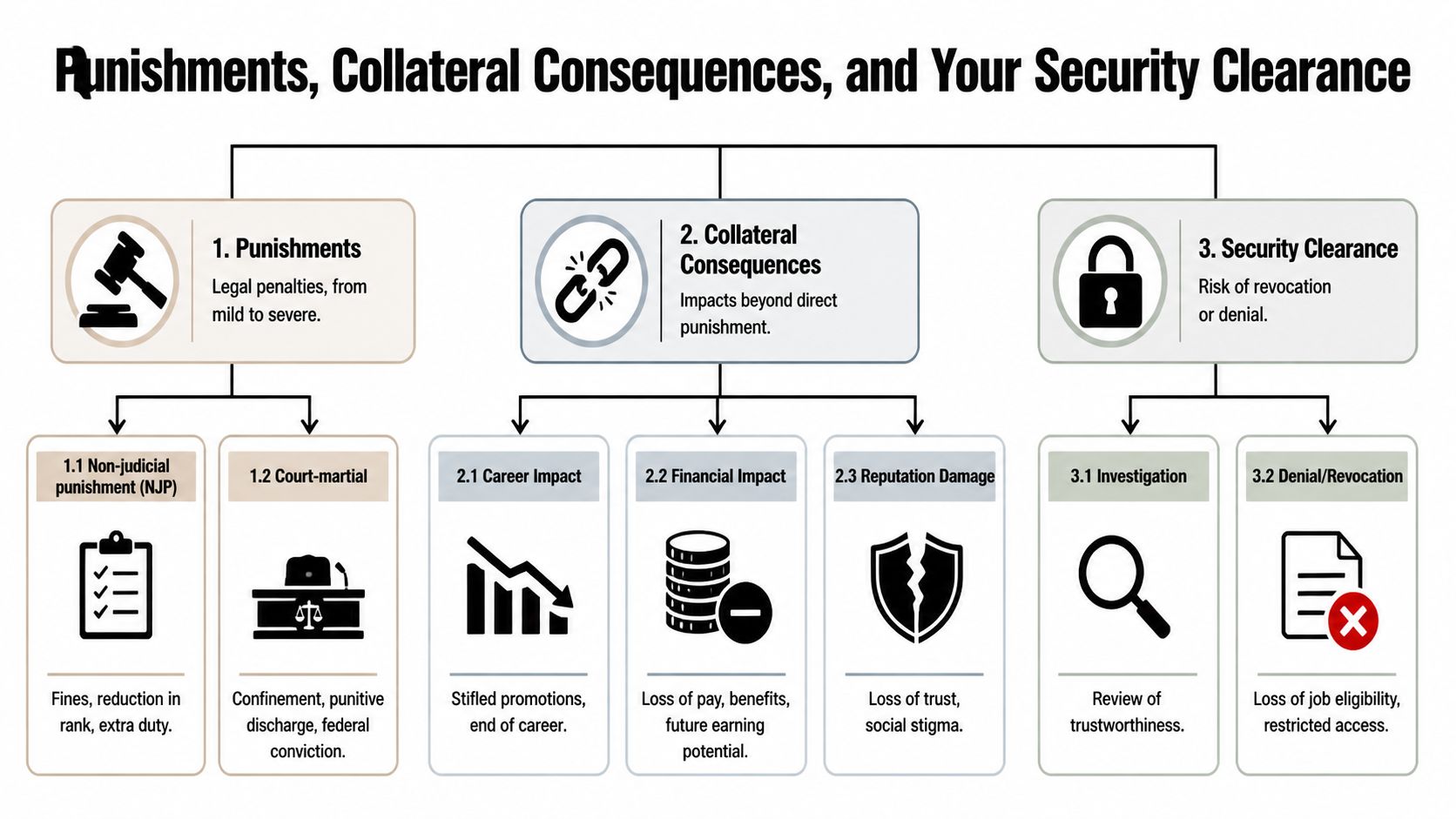
Some service members hear “fraternization” and think they’re looking at a counseling statement, maybe an Article 15, maybe a stern conversation. That is fantasy. Even when the case doesn’t end in a court-martial conviction, the fallout can gut a career.
The criminal punishment is only part of the danger
The top-end criminal exposure was already covered earlier, and it’s severe. But many overlook the administrative machinery that kicks in around the allegation itself.
That can include:
- Non-judicial punishment. Command may push for NJP or Article 15 even where the evidence is contested.
- Written reprimands. A GOMOR or similar letter can poison promotion and retention decisions.
- Administrative separation. You can beat or avoid one forum and still get pushed out in another.
- Officer elimination or board action. For officers, the paper trail alone can become a career-ending weapon.
A fraternization allegation also invites tag-along accusations. Leadership concerns. Judgment concerns. Integrity concerns. A supposedly narrow case becomes a broad attack on your fitness to serve.
Clearance trouble can outlast the case
Security clearance holders have a second battlefield. The issue stops being only whether a relationship crossed a line. It becomes whether command or adjudicators believe you exercised poor judgment, concealed facts, or ignored professional standards.
That matters because plenty of military jobs don’t survive a clearance loss, even if the criminal case weakens or dies.
Use this quick risk view:
| Problem area | Why it matters |
|---|---|
| Command confidence | Loss of trust affects assignments and evaluations |
| Administrative record | Reprimands and findings follow you |
| Security clearance | Trustworthiness and judgment come under review |
| Civilian future | Post-service employment can get harder |
If you focus only on “Will I go to jail?” you’re asking the wrong question. The better question is, “What record is being built about me right now?”
That record starts early. It forms through interviews, command impressions, digital evidence, and what you do in the first days after the allegation surfaces.
Common Defenses and Critical Mistakes to Avoid
Most accused service members make the same bad move. They assume they can explain the relationship better than the government can distort it. They can’t. Not alone.

Defenses that actually matter
Good defenses in UCMJ Article 134 Fraternization cases are element-driven. They aren’t built on “I’m a good person” or “we didn’t mean anything by it.”
They usually look more like this:
- No true military equality. The contact didn’t cross into the kind of equal-status relationship the law punishes.
- No actual prejudice. The government can talk about harm to discipline, but it still has to prove it.
- No clear custom violation. Command cannot invent a criminal custom after the fact.
- Weak witness credibility. Bias, gossip, revenge, and career self-protection infect these files constantly.
- Bad digital interpretation. Investigators love excerpts. Defense demands the full thread, the timing, and the missing context.
One of the hardest parts for clients to accept is this: facts that look ugly aren’t always legally sufficient. Some cases are defensible even when the relationship itself is embarrassing.
A short primer on how lawyers think through these fights can help:
Mistakes that bury your case
Avoid these immediately:
- Talking to investigators. You are not going to outsmart a trained interview.
- “Clarifying” things with command. Your chain of command is not your defense team.
- Consenting to searches casually. Phones and rooms are evidence goldmines.
- Deleting messages. That can turn panic into an obstruction-looking fact pattern.
- Contacting the other person to get stories straight. Investigators love that. It looks like consciousness of guilt.
- Trusting rumors about what CID already has. Most accused people act on bad assumptions.
- Waiting to hire counsel. Delay lets the government build an unchallenged record.
“Cooperation” without strategy usually means handing the government cleaner evidence.
The smartest move is controlled silence, fast case assessment, and a defense plan built before command has locked in its narrative.
Your First Moves When Accused and Choosing Counsel
If you’ve been accused, suspected, or contacted, you need an immediate response plan. Not tomorrow. Not after your interview. Now.
Your emergency plan
First, invoke your right to remain silent and your right to counsel. Say it clearly. Then stop talking.
Second, discuss the case with nobody except your lawyer. Not your friend. Not the other person involved. Not your first sergeant. Not the sympathetic chief who “just wants to help.” Every conversation creates risk.
Third, preserve evidence but don’t manipulate it. Keep messages, screenshots, calendars, travel records, and anything else your attorney may need. Just don’t start editing your history.
Use this checklist:
- Say less. A short, firm invocation beats a long explanation.
- Shut down side conversations. Loose talk becomes witness material.
- Get legal advice fast. Delay is expensive.
- Start thinking strategically. Your goals may include avoiding charges, saving a clearance, or surviving administrative action.
If you’re trying to evaluate counsel, this breakdown on how to choose the right military defense lawyer is a good starting point.
Why civilian counsel changes the fight
Detailed military defense is not generic criminal defense, and it isn’t ordinary personnel advice either. You need someone who understands command pressure, Article 32 strategy, digital evidence fights, military witnesses, and the split between criminal exposure and administrative destruction.
Civilian military defense lawyers matter for one simple reason. Their loyalty is to you. They’re not inside your command. They’re not balancing office politics. They’re not trying to preserve a relationship with the same system that is targeting you.
Military-appointed counsel may be dedicated and capable. Some are excellent. But in serious fraternization cases, independent civilian court-martial attorneys often bring a level of focused experience, strategic aggression, and trial-tested judgment that changes the posture of the case.
If you are under investigation, facing NJP, staring at a board, or worried that this allegation is about to destroy your career, get help immediately.
If CID, NCIS, OSI, CGIS, or your command has contacted you about UCMJ Article 134 Fraternization, do not wait for the case to “sort itself out.” It won’t.
Stay silent. Protect the evidence. Get experienced counsel. Your career, your freedom, your clearance, and your future may turn on what you do next.