You’re sitting in a cramped interview room on base. The agent has a calm voice, a neat stack of forms, and a story designed to lower your guard. “We just need your side so we can clear this up.” If you’re hearing that from CID, NCIS, OSI, or CGIS, you’re already in danger.
The paper they slide across the table is not paperwork. It is a sworn statement, and if you handle it badly, it can cost you your clearance, your rank, your retirement, your reputation, and in serious cases, your freedom. Service members keep making the same mistake. They think honesty alone will save them. It won’t. Strategy does.
If you came here asking what is sworn statement, here’s the answer you need. In the military system, a sworn statement is often less about fact-finding and more about locking you into words the government can use later. That’s why your first move should never be to start writing. Your first move should be to stop talking and get counsel.
Table of Contents
- An Investigator Slides a Paper Across the Table What Now
- What a Sworn Statement Really Is and What It Is Not
- How Investigators Use Your Sworn Statement Against You
- Preparing and Challenging Sworn Statements
- Career-Ending Mistakes with Sworn Statements
- Why Your Appointed Military Counsel Is Not Enough
- Your Questions Answered and Your Next Move
An Investigator Slides a Paper Across the Table What Now
The room is cold. The table is metal. The agent already knows more than you think, or at least wants you to believe that. Then comes the form. In Army cases it may be DA Form 2823. Other branches use their own paperwork. The script is usually the same: write down what happened, help us understand, clear this up.
That is the trap.

A service member under stress does predictable things. He tries to sound cooperative. She tries to fill in gaps from memory. They soften wording, guess at timelines, and add harmless details that feel explanatory in the moment. Later, those same words become admissions, contradictions, or proof that the member was deceptive.
What that moment really means
When an investigator asks for a sworn statement, this isn’t a friendly chat. It’s a formal evidence-gathering event. If you haven’t already reviewed your rights under Article 31 of the UCMJ protections against self-incrimination, you are already behind.
Here’s what to understand immediately:
- You are not there to educate the investigator. They are trained to collect statements, compare versions, and pressure people into committing to details.
- You are not required to rescue yourself on demand. Panic talking is not a defense strategy.
- You do not win credibility points by waiving your rights. Investigators may act offended when you ask for a lawyer. Ignore that.
Practical rule: If an agent wants a written statement right now, that usually means the statement helps them more than it helps you.
Your first three decisions
- Stop filling silence with words. Silence feels awkward. That’s why investigators use it.
- Do not pick up the pen. Once you start writing, you start committing.
- Ask for a lawyer. Not later. Not after “just a few questions.” Now.
Military families often think the crisis starts when charges arrive. It usually starts much earlier, in that interview room, with one bad document. The sworn statement is often the first brick in the wall they build around you.
What a Sworn Statement Really Is and What It Is Not
Most articles answer what is sworn statement with legal vocabulary. That’s not enough. You need the field version.
A sworn statement is a written statement of facts that you sign as true under penalty of perjury. It can function as evidence in legal proceedings, including military proceedings. It does not require the same notarization process that a traditional affidavit usually requires. As US Legal Forms explains in its description of a sworn statement, a sworn statement is a written, and sometimes oral, declaration of facts made under oath, and unlike an affidavit, it is typically signed by the declarant with a self-declaration that the contents are true and made under penalty of perjury.
The definition that matters to you
Forget abstract doctrine. Focus on consequences.
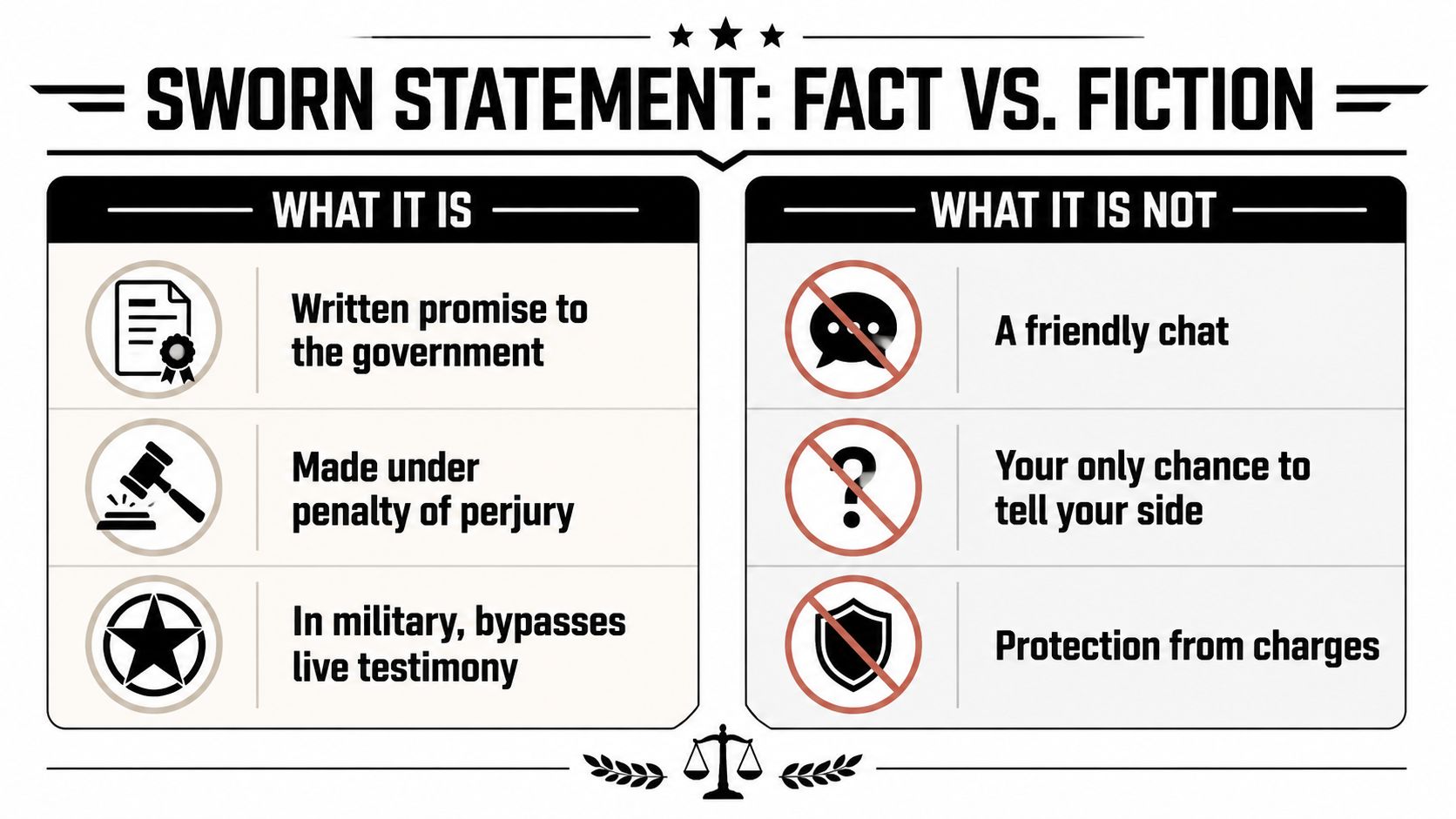
A sworn statement is:
| What it is | Why it matters |
|---|---|
| A written promise to the government | You are adopting every sentence as your own |
| Made under penalty of perjury | False material facts can become a separate problem |
| A fixed version of events | You can be confronted with it again and again |
A sworn statement is not:
- Not a casual clarification. It’s evidence.
- Not your only chance to be heard. Good defense work is not built on panic writing.
- Not protection from charges. Talking rarely shuts down a case by itself.
What investigators want from this document
Investigators like sworn statements because they freeze you in place. Once you sign, they have a clean exhibit with your name on it. If your memory changes later, if another witness says something different, or if digital evidence tells a different story, they don’t say memory is complicated. They say you lied.
That’s one reason false statement allegations become dangerous. If your case touches official statements, you should understand how the government builds those cases under UCMJ Article 107 false official statement allegations.
The phrase “under penalty of perjury” is the entire game. It turns a page into leverage.
The other thing service members miss is this. A sworn statement does not need to be dramatic to hurt you. A wrong date. A guessed timeline. A sentence that sounds more certain than you really were. That’s enough to start a credibility attack.
If you are innocent, that risk is still there. Innocent people guess. Innocent people explain too much. Innocent people try to be helpful. Those are exactly the people investigators often handle most easily.
How Investigators Use Your Sworn Statement Against You
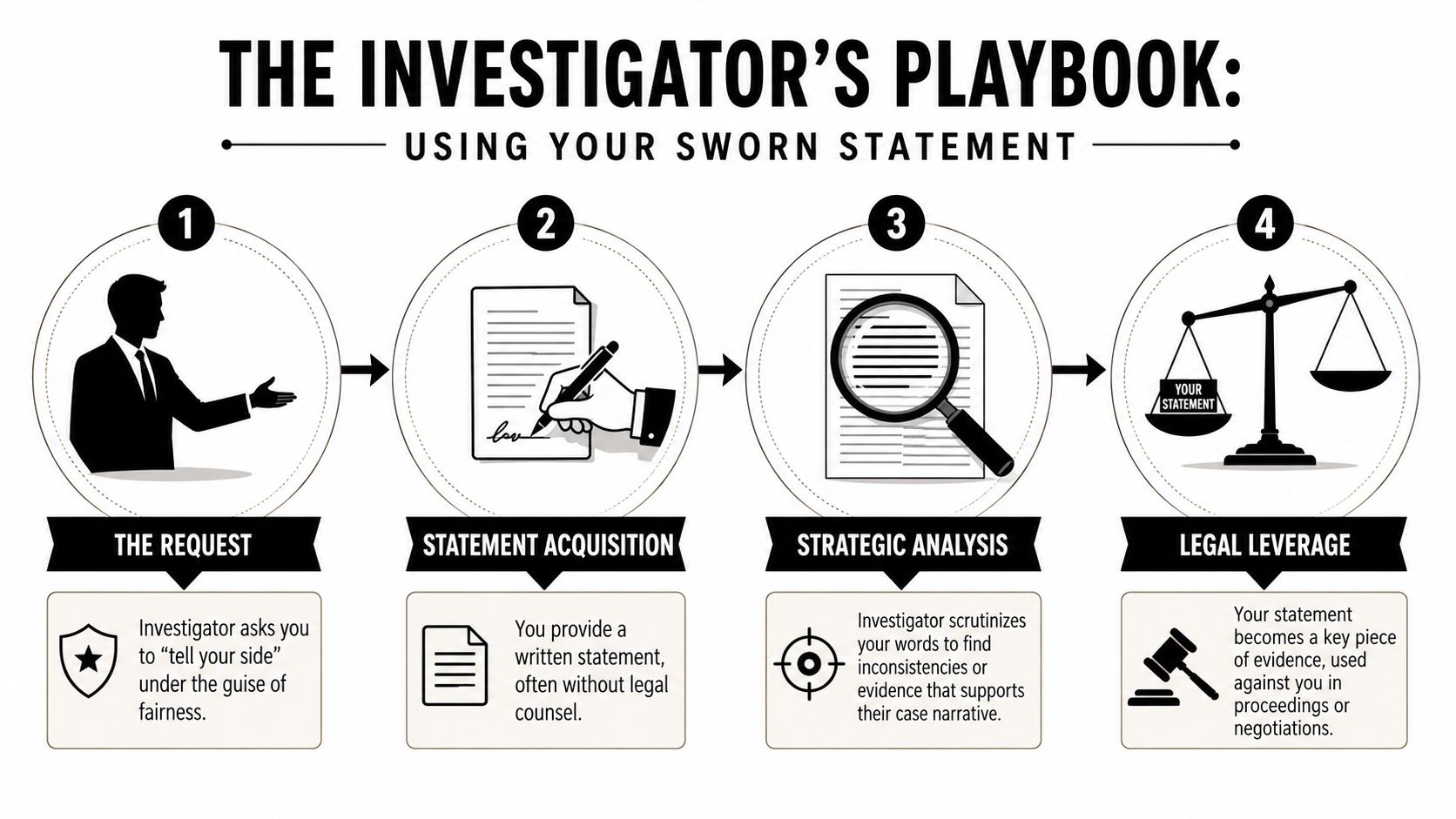
Investigators love to say the sworn statement is your chance to tell your side. I don’t buy it, and you shouldn’t either. Their job is to build a prosecutable file. If your own words help them do that, they will use those words hard.
Early in the interview, they often act open-minded. Later, the same statement becomes the foundation for command action, Article 32 preparation, negotiation pressure, impeachment at trial, and attacks on your credibility.
They are locking you into a version
In military justice practice, investigative sworn statements from witnesses or accused service members are often collected on standard forms such as DA Form 2823 and can serve as foundational records for proceedings such as Article 32 investigations. Misstatements in those documents can trigger administrative punishment, credibility damage, or standalone perjury exposure, as described in LawDistrict’s discussion of sworn statements in military justice contexts.
That’s why investigators push for detail. Not because detail helps you. Because detail gives them material.
They use your statement to:
- Freeze your memory in writing. If you later remember something differently, they call it inconsistency.
- Harvest admissions. Maybe not to the main offense. Maybe to alcohol use, fraternization, texting, location, or contact.
- Compare every line with every other source. Phones, gate logs, witnesses, social media, command records.
- Box you into “yes or no” themes. Cases are easier to prosecute when they can present a clean contradiction.
Here’s a video worth watching before ever writing a statement:
They are building leverage, not fairness
Agents also use sworn statements to pressure outcomes outside trial. A bad statement can influence command decisions, flag actions, administrative separation efforts, security clearance issues, and plea discussions.
Watch for these common tactics:
- The minimization move. “We know this isn’t a big deal. Just explain it.”
- The inevitability move. “We already know what happened.”
- The isolation move. “This is your chance before command sees the file.”
- The false choice. “If you don’t write, you’ll look guilty.”
None of those lines changes your rights. None of them changes the risk.
A sworn statement doesn’t need to contain a confession to damage you. It only needs to contain enough language for the government to shape a story.
Experienced court-martial attorneys read these documents backward. Ask what facts were fed to the witness, what assumptions were built into the wording, where the timeline is unstable, and which phrases sound more like agent language than service member language. That’s where the weakness lives.
Preparing and Challenging Sworn Statements
There are only two smart reasons to deal with a sworn statement. First, you and your lawyer decide that a carefully prepared statement helps your defense. Second, you’re attacking a statement somebody else made against you.
Everything else is noise.

When your defense should prepare a statement
Sometimes a written declaration makes sense. But only if it’s strategic, lawyer-reviewed, and built around facts you know.
Under 28 U.S.C. § 1746 and the model federal unsworn declaration language, a person may execute a written declaration in substantially this form: “I declare (or certify, verify, or state) under penalty of perjury that the foregoing is true and correct. Executed on (date). (Signature).” That statute allows such declarations to be used with like force and effect where written sworn statements or affidavits are permitted.
That matters because form alone can carry legal force. If your defense team uses one, it must be deliberate.
Ground rules for a defensible statement
- Stick to personal knowledge. If you didn’t see it, hear it, or do it, don’t write it as fact.
- Treat timelines cautiously. If you’re estimating, say that you’re estimating.
- Cut adjectives and arguments. Facts help. Spin hurts.
- Review every sentence line by line. One loose phrase can become the entire cross-examination.
- Don’t “fix” prior damage alone. If a statement already exists, your lawyer needs a strategy before anything new is submitted.
For a deeper look at precharge strategy, see how experienced counsel work during the military investigation phase.
How experienced court-martial attorneys attack a bad statement
When a witness gives a sworn statement against you, find out how that statement was created. Fast.
Use this checklist:
| Defense question | Why it matters |
|---|---|
| Who drafted the wording | Agent-written language may distort the witness’s actual memory |
| What was promised | Implied benefits can create coercion or bias |
| What did the witness actually know | People often repeat assumptions or rumors |
| What changed over time | Evolving details expose credibility problems |
Then look for the stress fractures.
- Missing sensory basis. Could the witness see, hear, or identify what they claim?
- Timeline collapse. Does the sequence conflict with messages, duty logs, travel records, or other testimony?
- Loaded wording. Does the statement use legal-sounding language the witness would never naturally use?
- Interview pressure. Was the witness exhausted, frightened, intoxicated, or coached?
Defense perspective: The government treats sworn statements like clean evidence. Good defense counsel treats them like crime scenes.
A bad sworn statement can be limited, exposed, or turned into a credibility problem for the other side. But that only happens when someone attacks it aggressively and early.
Career-Ending Mistakes with Sworn Statements
Good troops wreck solid careers because they think cooperation will be rewarded. Usually it isn’t. The system rewards what helps the case move forward.
The mistakes that sink good people
Trying to talk your way out of it
The more you talk, the more raw material you hand over. Investigators don’t need a perfect confession. They need enough words to frame you.Signing what the agent typed without reading every line
If it’s your signature, it becomes your statement. “That’s not exactly what I meant” won’t save you later.Correcting one small detail and then signing anyway
That often means you adopted the entire document after review. You just made the exhibit cleaner for them.Thinking innocence makes rights unnecessary
Innocent people are often the easiest to manipulate because they think truth will sort everything out on its own.Believing promises that aren’t in writing and aren’t binding
“This will stay informal.” “Command just wants closure.” “This is your best chance.” None of that protects you.Guessing instead of saying you don’t know
Guessing is poison in a sworn statement.Trying to repair a bad statement by calling the investigator back
That usually creates a second problem, not a solution.
What you should do instead
The penalty side of this is serious. The Department of Justice explains that false statements in sworn declarations can be prosecuted as perjury, and 18 U.S.C. § 1621 carries penalties of up to five years’ imprisonment and substantial fines, as described in the Justice Department’s Criminal Resource Manual on unsworn declarations under penalty of perjury.
So keep your actions simple:
- Invoke your rights early.
- Say you want a lawyer.
- Do not draft, edit, or clarify without counsel present.
- Preserve texts, emails, and timeline material for your defense.
This is not about looking stubborn. It’s about staying alive in the file.
Why Your Appointed Military Counsel Is Not Enough
Let me be blunt. Appointed counsel matters, and many military defense counsel work hard. But in serious cases, hard work alone isn’t the issue. Structure is.
The structural problem
The military defense office is still inside the same institution that is investigating, charging, and processing you. Young counsel may be smart and committed, but many are learning under pressure while carrying heavy caseloads. They may not have the time, independence, or trial depth your case demands when sworn statements and investigative records start piling up.
That matters because these cases move fast in the early phase. Witnesses talk. Command forms opinions. Investigators finish reports. Once the narrative hardens, changing it becomes more expensive and more difficult.
What civilian military defense lawyers change
Retained civilian military defense lawyers bring a different posture.
- Independence: They answer to you, not the command structure.
- Focused experience: Serious court-martial attorneys have spent years attacking witness statements, investigative shortcuts, and weak charging decisions.
- Time and pressure: A civilian lawyer can often move earlier, push harder, and spend more time on witness preparation and statement analysis.
- Strategic range: The right lawyer doesn’t just react to charges. They fight before charges, during hearings, in negotiations, and at trial.
If your exposure is minor, maybe appointed counsel is enough. If your rank, liberty, sex offense exposure, domestic allegation, child accusation, clearance, or retirement is at stake, betting your life on “good enough” is reckless.
Your Questions Answered and Your Next Move
You already know the basic truth. A sworn statement is not neutral when investigators want one from you. It is usually a tool they intend to use.
FAQ
Can I refuse to talk to CID, NCIS, OSI, or CGIS?
Yes. You can invoke your right to remain silent and ask for counsel. That is the smart move in a criminal or disciplinary investigation.
Can I be ordered to make a sworn statement about suspected misconduct?
You should speak with a lawyer immediately before responding to any claimed order. In a rights-warning setting, trying to force a self-incriminating statement creates danger fast.
Is DA Form 2823 a sworn statement form?
Yes. In Army practice, DA Form 2823 is commonly used for sworn statements. Other branches use different forms, but the risk is the same.
What if my sworn statement contains a mistake?
Don’t call the investigator to clean it up. Don’t send a follow-up text. Don’t try to explain it away. Let a defense lawyer decide whether silence, correction, or a broader strategy makes sense.
Do sworn statements always need a notary?
No. In many settings, a written declaration can carry legal force without notarization if it follows the required form. Under 28 U.S.C. § 1746 and its two model forms for statements inside and outside the United States, the wording differs depending on where the statement is executed.
Will a sworn statement be used at an Article 32 or court-martial?
It can become part of the case file and shape how the government, command, and later decision-makers view the facts and your credibility.
Do I need a lawyer before charges are preferred?
Yes. Waiting for formal charges is one of the worst mistakes people make.
The only smart next step
If investigators want a statement, the danger isn’t coming. It’s already here.
Your next words should be to a defense lawyer, not to an agent. Then start making calls.
Do not wait for command to “see how this plays out.” Do not assume your innocence will protect you. Do not hand the government the cleanest exhibit in its case against you.
If you are under investigation, have been read your rights, or have been asked to give a sworn statement, act immediately. Get counsel. Protect the timeline. Stop talking. Your career is on the line, and in the wrong case, so is your freedom.