You're sitting in a small office, staring at your phone, waiting for CID, NCIS, OSI, or CGIS to call back. Maybe command already told you they “just want your side.” Maybe you already gave a statement because you thought cooperation would make this go away. Maybe your spouse is asking whether this can cost you your career, your retirement, or your freedom.
Yes, it can.
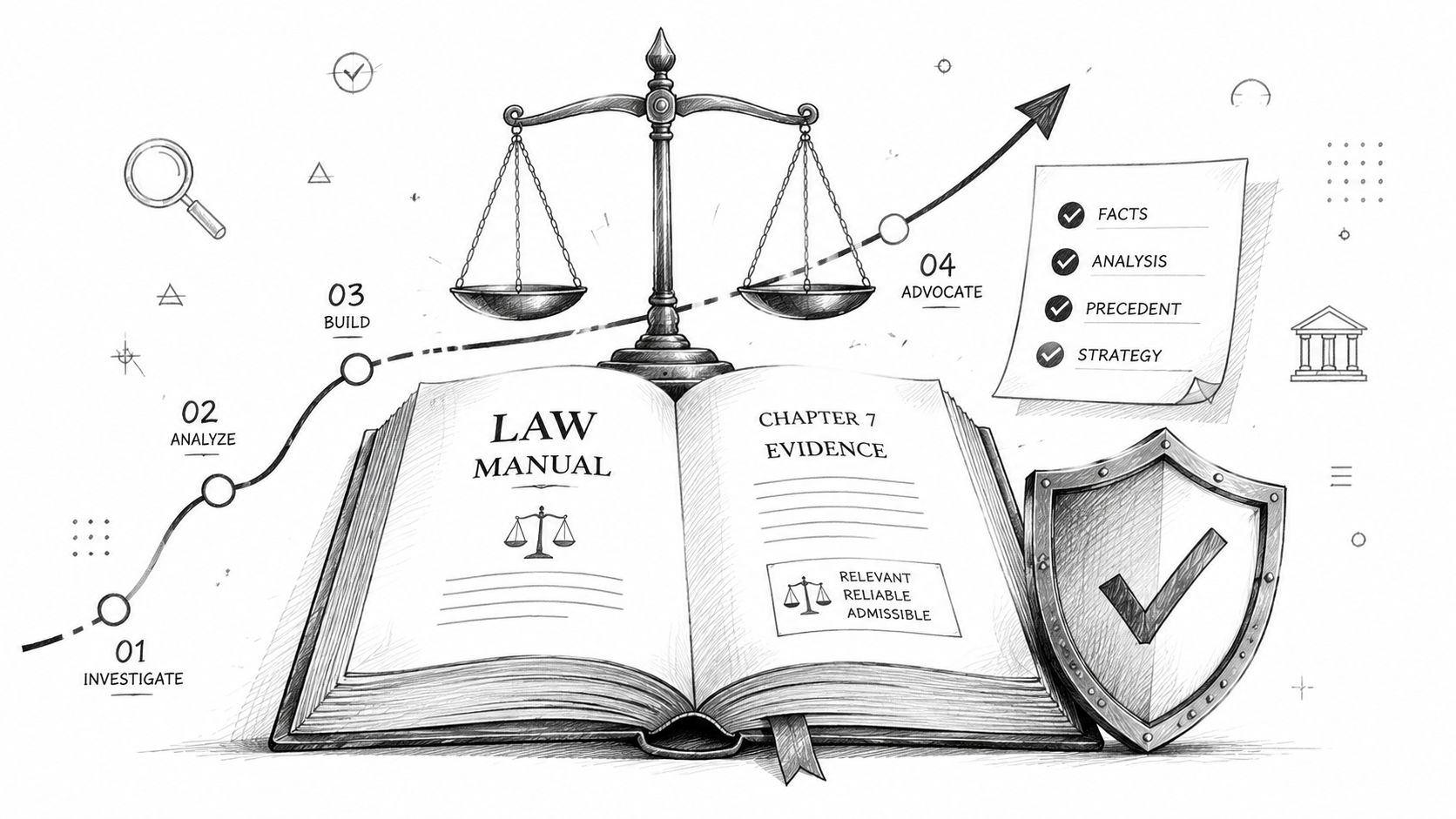
In a court-martial, the fight usually isn't about who talks the most. It's about what evidence the military judge lets the panel hear. That's where the Military Rules of Evidence decide whether the government gets to use your words, your phone, your past, or your silence against you. If you don't understand that battlefield early, you can lose before trial even starts.
Most service members learn the rules too late. They focus on “telling the truth.” The government focuses on building an admissible case. Those are not the same thing.
Table of Contents
- Your Freedom and Career Are on the Line
- What Are the Military Rules of Evidence
- The Rules That Decide Your Fate
- How a Lawyer Uses the MRE to Win
- The Government's Playbook Using Evidence Against You
- Why Your Free Military Lawyer Is Not Enough
- Frequently Asked Questions About Military Evidence
Your Freedom and Career Are on the Line
You don't need a lecture right now. You need clarity.
When investigators identify you as a subject, the system is already moving. Command starts managing risk. Investigators start building a file. Trial counsel starts thinking about admissibility. Meanwhile, you're often still deciding whether this is “serious enough” to call a lawyer.
That hesitation is where people get hurt.
The same pattern repeats over and over. A service member thinks the interview is informal. He believes his text messages will “speak for themselves.” She assumes command will see this was a misunderstanding. Then the government turns a messy situation into a clean courtroom narrative because the accused gave them one thing they desperately wanted. A statement. Consent to search. An inconsistency. A bad fact they can frame as consciousness of guilt.
The real fight starts before trial
Court-martial cases are won and lost long before anyone sits in the courtroom. The vital decisions happen when:
- Investigators ask for an interview and make it sound routine
- Command requests a phone search and pretends consent is harmless
- Witnesses start coordinating stories before the defense gets involved
- Digital evidence gets collected without anyone testing what it really proves
Practical rule: If the government is asking for information, it's because they think that information helps them, not you.
The Military Rules of Evidence matter because they control what survives that early phase. A coerced statement can be excluded. A weak consent search can be attacked. A smear dressed up as “intent” can be blocked. But none of that happens by accident. Someone has to identify the problem, litigate it, and force the issue.
What this means for you right now
If you are under investigation, facing NJP, looking at an Article 32 hearing, or preparing for court-martial, stop thinking like this is a personnel problem. It's an evidence problem.
Ask yourself three questions:
- What does the government have?
- How did they get it?
- Can they use it at trial?
That third question is where experienced military defense lawyers earn their keep. The government may have a lot of paper. That doesn't mean they have admissible proof.
What Are the Military Rules of Evidence
The Military Rules of Evidence are the rules that tell the judge what information can come into a court-martial and what stays out. They aren't internal office guidelines. They are binding rules inside the military justice system.
The starting point matters. The Military Rules of Evidence were formally promulgated in 1980 through Executive Order 12,198, creating the first unified federal evidentiary framework for courts-martial across the armed forces and replacing a fragmented branch-by-branch system based on differing interpretations of common law, as reflected in the Joint Service Committee materials on the Military Rules of Evidence.

These rules are binding, not suggestions
That matters because command doesn't get to make up its own evidence standards. Investigators don't get to improvise. Trial counsel doesn't get to use whatever sounds persuasive. If evidence violates the rules, it can be excluded.
The rules sit inside the Manual for Courts-Martial. In plain terms, that manual is the operating authority for courts-martial. If you need a simple overview of how the process works around those rules, start with this guide to court-martial basics.
Here's the practical point. The MRE exist to control the flow of information to the factfinder. In a members case, that means the panel. In a judge-alone case, that means the military judge. Either way, the rules decide what story the government is allowed to tell.
What that means in a real case
A lot of accused service members think evidence means “anything connected to the case.” That's wrong. In court, evidence must survive legal screening.
Some examples:
- A statement may exist but still be inadmissible if rights were violated or the statement was involuntary.
- A search may uncover something damaging but still be challengeable if the government can't justify the search.
- A witness may say something harmful but the statement may be hearsay or lack foundation.
- A prior allegation or bad act may sound ugly but still be barred if it's offered only to show character.
The government doesn't just need facts. It needs facts that can get through the gate.
That's why the Military Rules of Evidence aren't a side issue. They are the gate.
The Rules That Decide Your Fate
Not every evidence rule will control your case. A few usually do. If you understand these, you'll understand where the main battle unfolds.
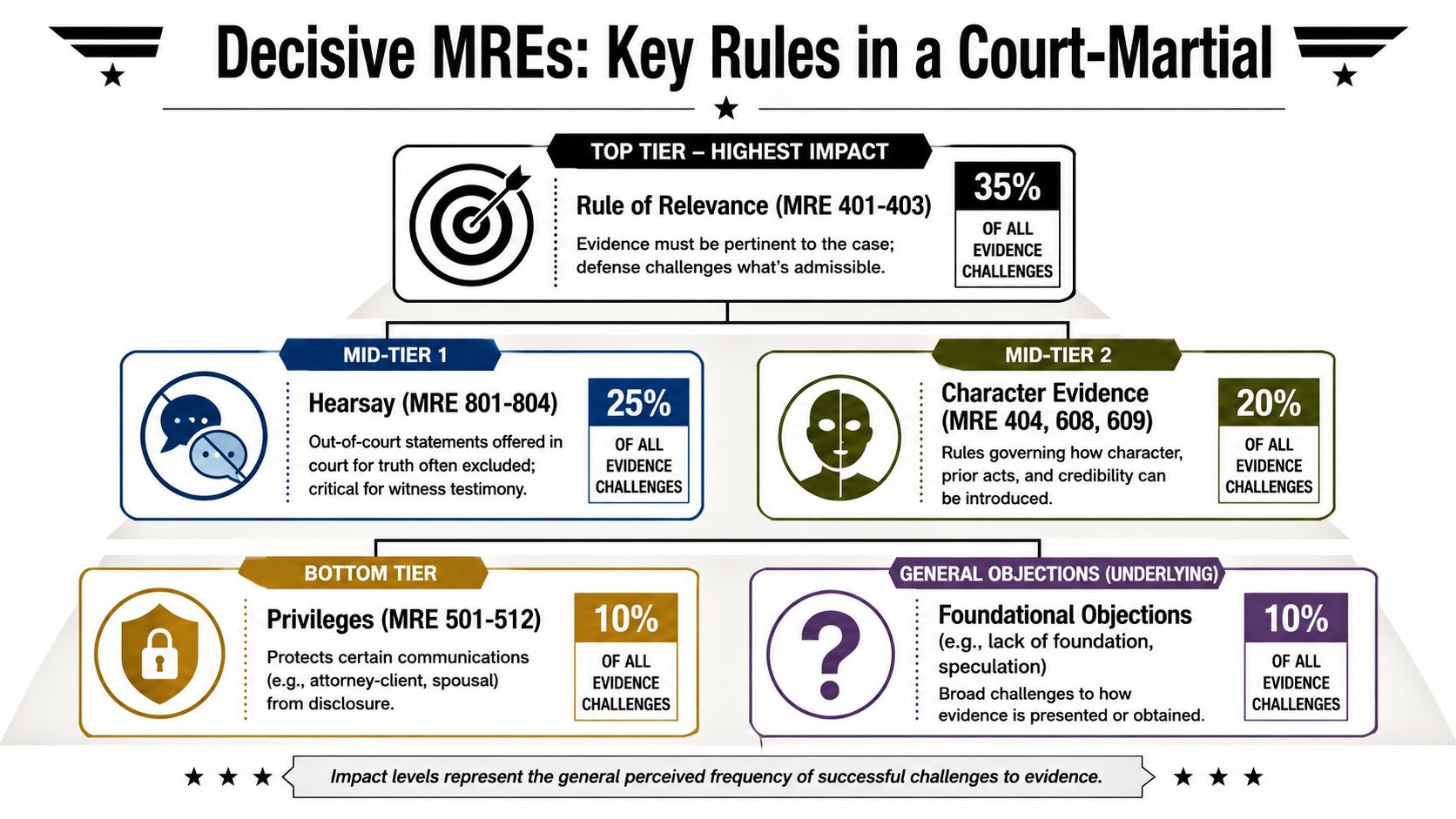
Research indicates that MRE 401, 402, and 403 influence admissibility in approximately 78% of military trials, and Rule 801 leads to exclusion of out-of-court statements in roughly 65% of attempted introductions unless an exception applies, according to the Georgetown Law military justice research guide.
Relevance is where most evidence fights happen
MRE 401 asks a simple question. Does this evidence make a fact more or less probable? The threshold is low. That's why relevance fights are dangerous if your lawyer treats them casually.
MRE 402 is the basic gatekeeper. If evidence isn't relevant, it stays out. If it is relevant, that still doesn't end the analysis.
MRE 403 is where experienced court-martial attorneys do real damage to a prosecution case. Even relevant evidence can be excluded if its value is substantially outweighed by unfair prejudice, confusion, misleading the panel, or needless cumulative presentation.
Hearsay can gut a weak government case
Hearsay sounds technical, but the practical idea is simple. The government often wants one witness to repeat what another person said outside court. That can be powerful, especially when the original speaker is unavailable, unreliable, or would fall apart on cross-examination.
A sharp defense lawyer listens for this constantly. The objection isn't academic. It forces the prosecution to either produce the actual witness, fit the statement into a proper exception, or lose the statement.
When the government's theory depends on people repeating each other, hearsay objections can take the oxygen out of the case.
Character evidence is where prosecutors try to poison the room
MRE 404 exists because courts know a simple truth. If panel members hear enough ugly background about you, some will want to punish you for being the kind of person they dislike, not for the charge they're deciding.
That's why the government generally can't argue, “He did bad things before, so he probably did this too.” But prosecutors are trained to look for ways around that rule. They'll call it motive. Intent. Knowledge. Plan. Absence of mistake.
If the government starts talking about your past, don't assume it's automatically allowed and don't assume the judge will stop it without a fight.
Privileges protect what should stay protected
Some communications are protected for a reason. Attorney-client privilege matters. Spousal privilege matters. The right to remain silent matters.
These protections are only useful if you invoke them early and consistently. People damage their own cases by speaking loosely with supervisors, investigators, friends in the unit, or even well-meaning family members over monitored systems. A privileged conversation can protect you. A casual conversation often becomes evidence.
How a Lawyer Uses the MRE to Win
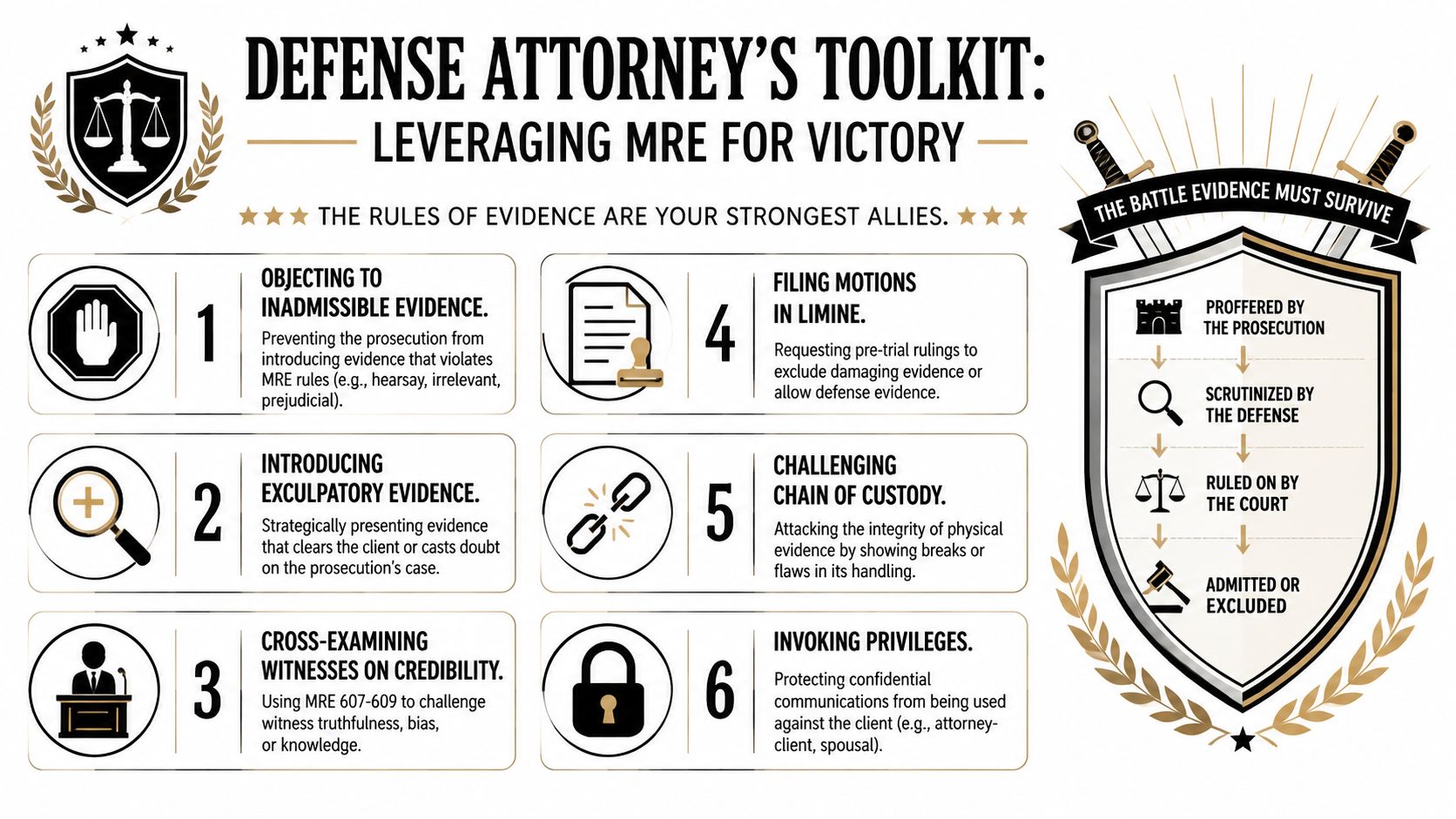
Good defense lawyers don't wait for trial to “see what happens.” They attack the government's proof before the panel ever hears it.
That starts with motions. A motion to suppress asks the military judge to exclude evidence because the government got it unlawfully or can't satisfy the rule for admissibility. A motion in limine asks the judge to block certain evidence before it poisons the courtroom. Both are central to serious defense work.
Motions to suppress change cases fast
MRE 305 is one of the strongest defense battlegrounds in military practice. Under that rule, a coerced statement is inadmissible unless the government proves by a preponderance of the evidence that the statement was voluntary. The same rule also excludes a statement if the government can't show the accused understood the rights involved and the consequences of waiver. In court-martial practice, defense counsel reportedly suppress coerced statements in about 35% of cases where interrogation occurred without a clear waiver or with a “cooperative” but uncounselled attorney, as described in the verified MRE 305 data above.
If your statement goes out, the case can shrink overnight. Sometimes that means the government loses its strongest admissions. Sometimes it means witnesses suddenly look less certain because they were relying on your own words to fill their gaps.
For a deeper look at pretrial strategy, review how experienced counsel win cases during the military investigation phase.
The rank pressure problem in consent searches
MRE 311 fights often turn on “consent.” On paper, consent sounds simple. In military life, it isn't.
A junior enlisted service member is approached by a superior, investigators are present, and someone says, “You don't mind if we look through your phone, right?” That can sound voluntary in a transcript. In real life, rank pressure, command presence, and fear of looking uncooperative can shape every word.
The strategic move is to build the coercion picture with facts:
- Who was in the room
- What rank they held
- What exact words were used
- Whether the service member believed refusal was realistic
- Whether command logs, witnesses, or follow-up messages support pressure
Many online summaries fail people. They tell you consent must be voluntary, then stop. That's useless. Winning the issue takes details.
The MRE 403 fight is where strategy shows
Under MRE 403, a military judge may exclude relevant evidence when its probative value is substantially outweighed by unfair prejudice, confusion, misleading the panel, undue delay, or cumulative presentation, as explained in the Army Criminal Law Deskbook discussion of MRE 403.
That balancing test sounds polite. It's not. It's a battlefield.
A strong civilian defense lawyer uses MRE 403 to challenge:
- Graphic material that inflames emotion more than it proves a fact
- Stacked witnesses who say the same thing repeatedly to overwhelm the panel
- Weak digital exhibits that look impressive but prove very little
- Prior-acts evidence that creates moral disgust without real probative force
The best objection isn't “that hurts my client.” It's “that evidence will cause the panel to decide this case for the wrong reason.”
The Government's Playbook Using Evidence Against You
The government's job is to tell a coherent story that ends in conviction. Trial counsel will package facts, witnesses, texts, search results, and your own words into one theme. If they can't prove the charge cleanly, they often try to prove your mindset. That's where MRE 404(b) becomes dangerous.
MRE 404(b) permits admission of other crimes, wrongs, or acts to prove things like motive, opportunity, intent, or plan. According to the verified data tied to military-defenseattorney.com, admission of prior acts often corresponds with a 28% increase in guilty verdicts compared to trials without that evidence.

How prior acts get dressed up as intent
Here's how this usually works. The government can't just stand up and say you're a bad soldier, sailor, airman, Marine, or guardian. So they relabel the evidence.
A prior allegation becomes “knowledge.”
An old text becomes “intent.”
Past misconduct becomes “absence of mistake.”
A similar accusation becomes “plan.”
Once that evidence comes in, the risk is obvious. Panel members may claim they're using it for a limited purpose, but human nature doesn't work that neatly. Bad past facts contaminate the present charge.
In high-stakes trials, prior bad acts are reportedly admitted in roughly 42% of cases involving sexual misconduct or fraud when intent is central, according to the verified data above. That's exactly why defense counsel must attack notice, similarity, timing, and the actual purpose of the evidence.
What a defense lawyer does about it
The rule requires notice. The prosecution must identify the prior act, the time, and the evidence source. If they fail to do that, the evidence should be excluded.
Even when notice is technically proper, the fight is not over. The defense should force the judge to confront hard questions:
- Is the prior act similar enough to matter?
- Is it too remote in time?
- Is the prosecution proving intent, or just smuggling in character evidence?
- Does MRE 403 still bar it because prejudice overwhelms value?
A weak defense lets the government say “intent” and move on. A strong one makes them prove every inch of that claim.
Why Your Free Military Lawyer Is Not Enough
You are sitting in a small interview room after charges hit. The government already has your phone extraction, your statements, and a witness they plan to clean up before trial. At that point, your case does not turn on good intentions. It turns on who can spot the evidentiary weak points fast enough to cut them out.
You have the right to a detailed military defense counsel, and many of those lawyers work hard. The problem is structural. In a serious court-martial, especially one built on digital evidence, consent searches, recorded statements, or credibility fights, structure decides outcomes.
Military defense counsel work inside the same system bringing the case. They often carry heavy dockets, rotate out, and have limited time to build the kind of targeted MRE record that wins suppression motions and keeps bad evidence away from the panel. That matters because military evidence fights are rarely won by citing a rule number. They are won by forcing specific facts into the rule and making the judge choose.
That is the defense perspective too many articles ignore. The MRE are not classroom material. They are tools. The right lawyer uses them to attack search authority, expose unreliable digital proof, box in witnesses, and preserve appellate issues before the government realizes where the significant risk is.
Independent civilian counsel usually brings advantages that matter immediately:
- Independence: civilian counsel answers to you and builds the case around your priorities.
- Time and focus: serious civilian defense lawyers can spend more time on forensic review, witness preparation, motion practice, and cross-examination planning.
- Sharper evidence strategy: they are hired to find pressure points in the government's proof and exploit them early, not react late.
That does not mean your detailed defense counsel has no value. It means a high-risk case deserves more than one set of eyes, especially when the government's evidence looks stronger on paper than it does under the rules.
If you are weighing that decision, read this guide on how to choose a military defense lawyer.
Here is my advice. If your liberty, rank, retirement, clearance, or registration exposure is on the table, treat civilian counsel as part of your defense plan, not an upgrade. In court-martial practice, the lawyer who understands how to use the MRE aggressively from the defense side can change the entire case before members ever hear a word.
Frequently Asked Questions About Military Evidence
You are sitting in an interview room. CID wants “your side.” Your command says cooperation helps. Someone mentions they already pulled your texts. That is when the military rules of evidence stop being abstract and start deciding whether the government gets a clean case or a damaged one.
From the defense side, the right question is never “What do the rules say in theory?” The right question is “What can the government get in front of the judge or members, and how do we keep the bad parts out?”
Key MRE Questions for Accused Service Members
| Question | Answer |
|---|---|
| Can I refuse to talk to CID, NCIS, OSI, or CGIS? | Yes. Use that right. Investigators are building a case. Your first move is counsel, not conversation. |
| Can the government use my prior mistakes against me? | Sometimes. Trial counsel will often try MRE 404(b) to dress up weak facts as “intent,” “plan,” or “absence of mistake.” A defense lawyer should force the judge to make the government justify every inch of that theory. |
| What if I already gave a statement? | The fight is not over. A statement can still be attacked based on rights advisement, voluntariness, pressure, wording, omissions in the recording, and how investigators framed the interview. |
| If I consented to a search, is the issue over? | No. Consent is one of the most litigated pressure points in military cases because rank, authority, timing, and surrounding circumstances matter. |
| Will text messages, screenshots, or metadata automatically come in? | No. Digital evidence fails all the time when the government cannot prove authorship, accuracy, completeness, or chain of custody. |
| What happens at an Article 32 hearing? | It is an early chance to pin down witnesses, expose weak spots, and learn how the government plans to package its evidence. A defense lawyer who treats it seriously can create later motion issues. |
| Will I go to jail if I'm convicted? | Serious charges can bring confinement, punitive discharge, registration problems, and long-term career damage. Treat the case like the consequences are real, because they are. |
| Do I need a lawyer immediately? | Yes. Early defense work protects evidence, stops avoidable mistakes, and gives you a chance to attack the case before the record hardens. |
Five mistakes that hurt accused service members
- Talking because you think silence looks guilty: Investigators are trained to turn casual explanations into admissions.
- Trusting command to sort it out fairly: Command is managing risk to the unit. Your defense is a separate job.
- Handing over a phone “to cooperate”: Phones carry location data, photos, app history, messages, contacts, and timelines. One bad consent can supply the government with months of evidence.
- Assuming there's no case because the accusation is weak: Weak accusations get stronger when the defense waits and the government controls the narrative.
- Waiting for charges before hiring counsel: By then, witness memories shift, digital evidence disappears, and avoidable statements are already in the file.
Focus on admissibility. Court-martial outcomes turn on what gets admitted, what gets excluded, and what gets exposed as unreliable.
The short answer on strategy
If you are the accused, do five things fast.
- Stop giving the government new evidence.
- Preserve messages, records, screenshots, names, and timelines.
- Get counsel who knows how to use the MRE as a defense weapon.
- Attack the statement, the search, the digital proof, and any prior-acts theory early.
- Make sure every evidence issue is raised clearly and preserved.
One strong motion can change plea talks, witness decisions, charging strategy, and trial risk. One bad interview can do the same thing for the prosecution.
If you are under investigation, facing court-martial, or dealing with evidence problems in a UCMJ case, act now. Do not wait for charges. Do not wait for command to “explain” your options. Do not wait for trial counsel to define the facts for you.
Your freedom, rank, retirement, clearance, and reputation can all turn on evidence rulings. Early defense strategy wins cases.