They call it a request to “clarify a few things.” That’s how many UCMJ Article 107 – False Official Statements cases start.
A staff sergeant gets told to report to CID. A sailor is asked to come by NCIS after lunch. An airman thinks OSI just wants a timeline. A Marine believes he can clean up a bad situation by talking calmly and being cooperative. Then one bad answer, one sloppy written statement, or one attempt to “fix” an earlier answer turns into a career-threatening charge.
Service members get hurt. Not because they are hardened criminals. Because they think honesty alone will save them after they’ve already stepped into an interview designed to test, pressure, and lock in their words.
Article 107 is one of the government’s favorite tools because it is flexible, easy to add to bigger cases, and powerful in plea negotiations. If you are under investigation, you need to stop thinking like a good troop trying to help and start thinking like a target.
Table of Contents
- Your Career Is On The Line The Moment They Start Asking Questions
- The Law Explained Breaking Down UCMJ Article 107
- How We Fight Article 107 Charges A Defense Counsel’s Playbook
- From Investigation to Court-Martial The Article 107 Timeline
- Career-Ending Mistakes Service Members Make
- Why Your Appointed Counsel Is Not Enough For This Fight
- FAQ
- Can I refuse to talk to CID NCIS OSI or CGIS
- Is Article 107 just about lying on paperwork
- Will I go to jail for a false official statement charge
- What if I made a mistake and did not mean to deceive anyone
- Can a statement to a civilian count under Article 107
- Should I wait until charges are preferred to hire a lawyer
Your Career Is On The Line The Moment They Start Asking Questions
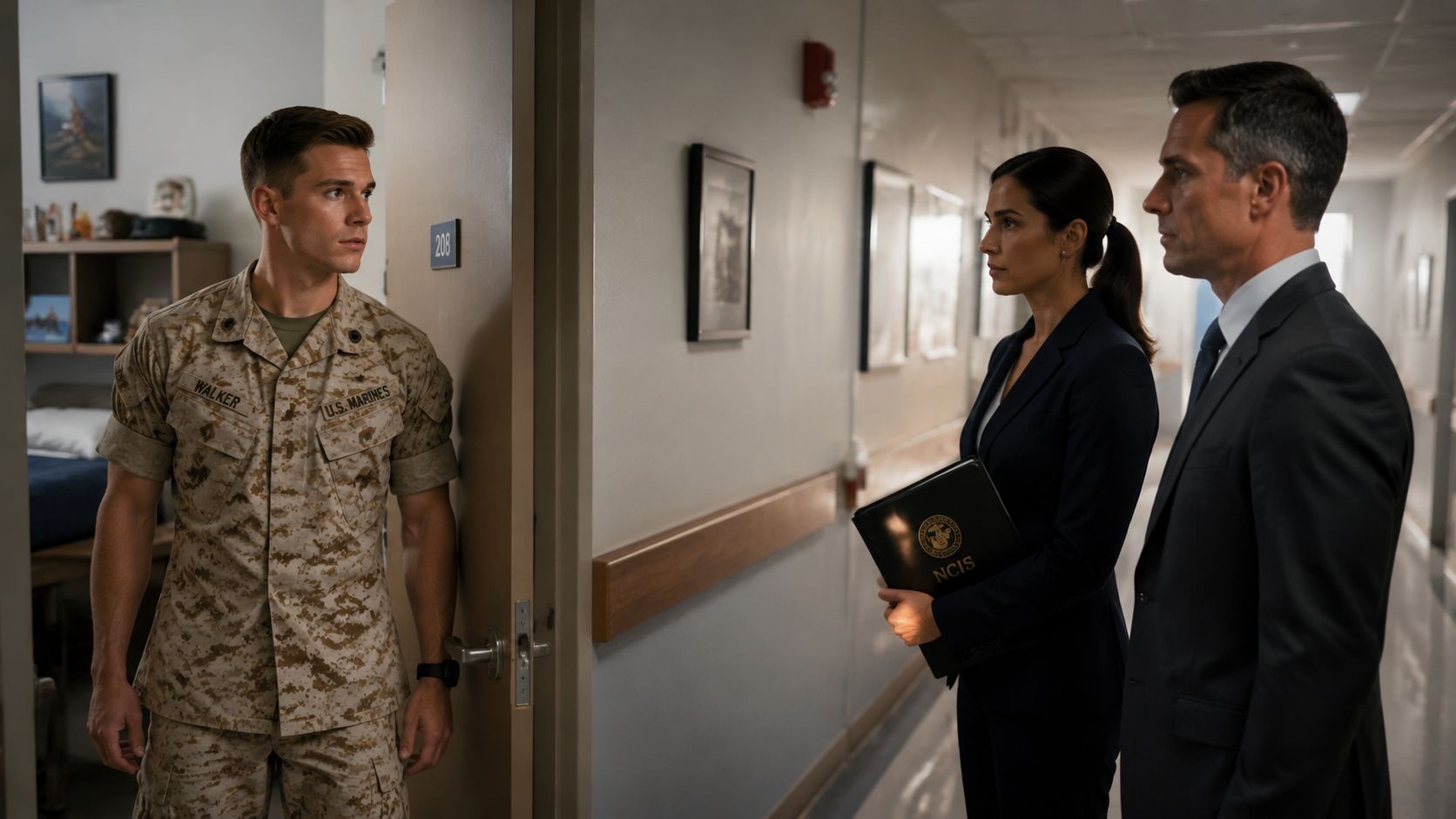
The danger starts before charges. It starts when someone in authority asks for “your side.”
Investigators are usually polite. Command may sound supportive. They may tell you they just need to close gaps in the timeline. They may even suggest that asking for a lawyer makes you look guilty. That is nonsense. Once they think you may have said something inaccurate, incomplete, or self-serving in an official setting, they start building an Article 107 theory around your words.
At major installations, over 10% of general courts-martial in recent years have included at least one Article 107 specification, and the charge carries a maximum punishment of a dishonorable discharge, total forfeitures, and confinement for five years, according to this Article 107 overview from Military Defense Attorney.
That should change how you view the first interview.
This is how people walk into the trap
A service member gets surprised by a question and guesses. Another leaves out a detail because it seems minor. Someone else tries to protect a spouse, a friend, or his own privacy. Then investigators compare statement one to statement two, or compare your words to text messages, logs, witness accounts, or body camera footage. What felt like a conversation becomes the basis for saying you knowingly lied.
Practical rule: If investigators want to “clear something up,” they are not helping you. They are collecting proof.
Why the first response matters so much
The government loves locked-in statements. They can use your wording, your pauses, your corrections, and your attempts to explain. Even if the main allegation is weak, a false official statement charge provides prosecutors an advantage. It lets them argue you are dishonest. It damages your credibility before the panel ever hears the rest of the case.
Your first job is not to be cooperative. Your first job is to protect yourself.
If you are being asked questions by CID, NCIS, OSI, CGIS, command, or anyone gathering facts for official action, stop talking and get counsel involved immediately.
The Law Explained Breaking Down UCMJ Article 107
Article 107 is not a general rule against saying something wrong. It is a specific offense with specific elements. That matters because defense is built by attacking the exact points the government must prove.
What the government actually has to prove
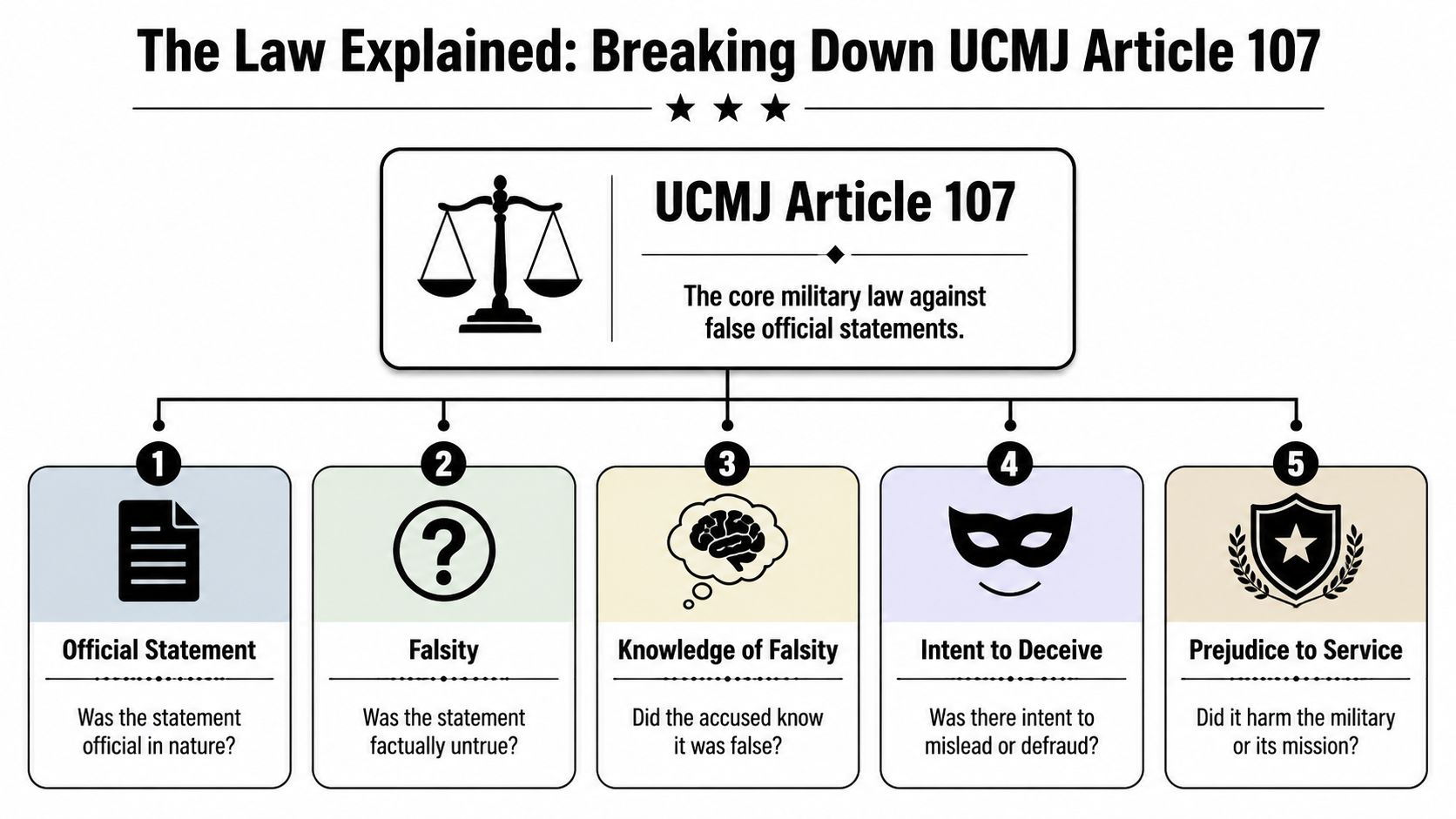
Under Article 107, the prosecution must prove a specific chain of intent: the accused made an official statement, knew it was false at the time, and made it with the intent to deceive. A merely inaccurate statement is not enough, and the government must prove your state of mind beyond a reasonable doubt under the statutory text of 10 U.S.C. § 907.
That breaks into practical fight points:
| Element | What it means in plain English | Why it matters |
|---|---|---|
| Official statement or document | The statement has to be official in context | Casual talk is different from an official response |
| Falsity | The statement has to be false in some particular | Ambiguity and interpretation matter |
| Knowledge of falsity | You had to know it was false when you said it | Bad memory is not the same as lying |
| Intent to deceive | You meant to mislead | Stress and confusion can destroy this theory |
What official really means
Many cases turn here.
People hear “official statement” and assume that means a sworn document or formal report. Wrong. The law reaches much further than that. It can cover oral statements, written statements, electronic communications, and official records when tied to an official function.
A statement can become “official” because of the setting, the person asking, the duty involved, or the function affected. That is why the same sentence can be harmless in one conversation and criminally charged in another.
Why mistakes are not the same as crimes
A lot of service members panic because they said something wrong. Wrong is not automatically criminal.
If you misunderstood the question, guessed at a time, mixed up a sequence, repeated bad information you believed was true, or answered while stressed and confused, those facts matter. Article 107 requires knowledge and intent to deceive. Those are mental-state issues. Good defense lawyers focus there because prosecutors often try to blur the line between inconsistency and deception.
A poor answer is not the same thing as a criminal lie. The government still has to prove what was in your head when you said it.
That is why wording, context, timing, and the exact question asked all matter. If the investigator wrote the statement for you, summarized your words loosely, or folded multiple ideas into one answer, the risk goes up. So does the opportunity for a skilled defense attack.
How Article 107 Charges Are Fought: A Defense Playbook
A strong defense does not rest on arguing “my client is a good person.” That’s worthless if the government has a signed statement and a prosecutor eager to call it a lie. Strong defense counsel make the government prove every element and expose where its theory is stretched, lazy, or dishonest.
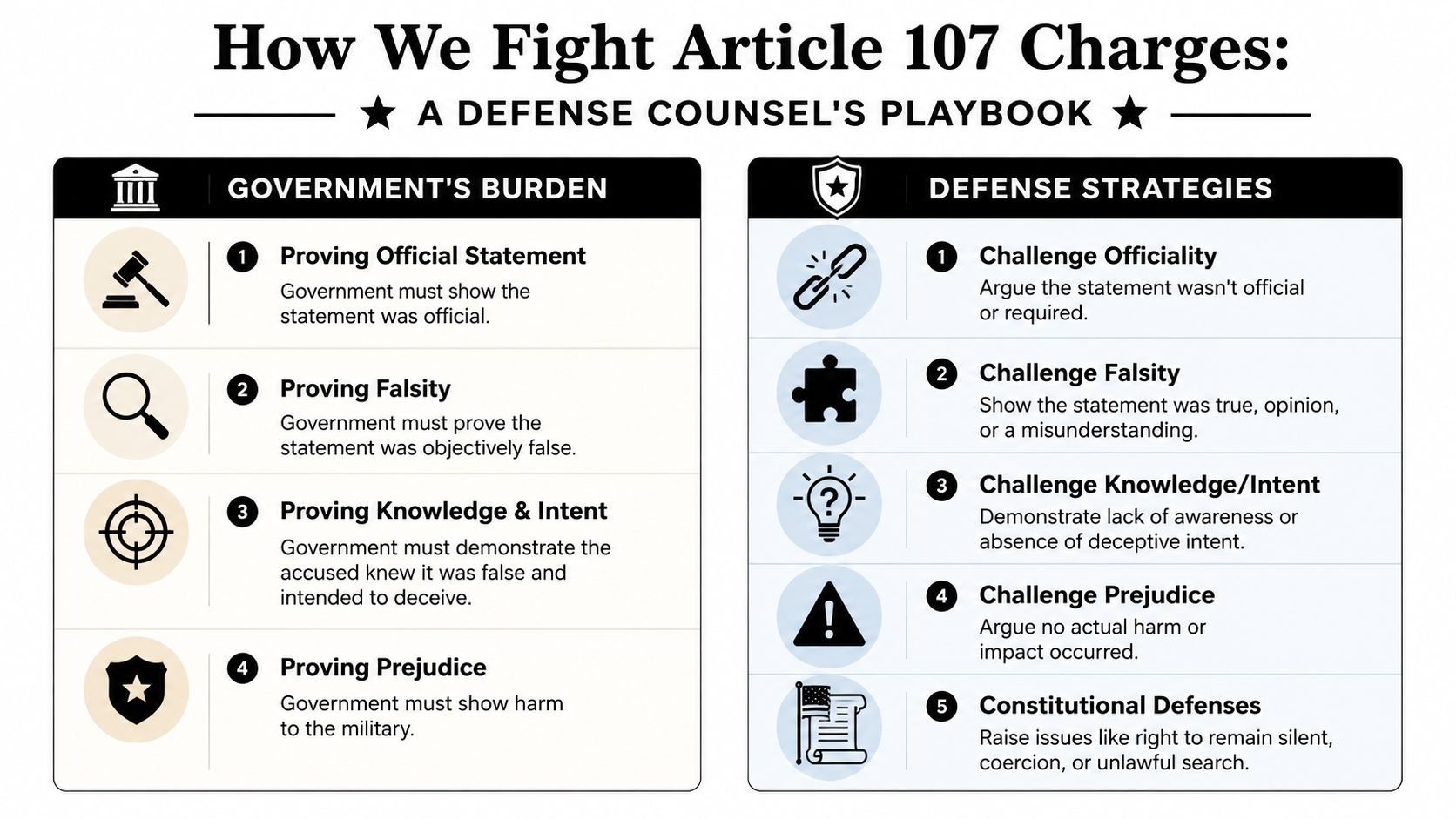
The legal fight often centers on what qualifies as an “official” statement. A statement can be official if made in the line of duty, if it relates to official duties, or even if given to a civilian performing a military function. Appellate courts have also emphasized that the statement must have the capacity to affect military functions, as reflected in the CAAF digest on Article 107 official statements.
Battleground one officiality
Not every conversation is official just because a service member is wearing a uniform.
Look at who asked the question, why it was asked, what function was being performed, and whether the statement had a direct military nexus. If the government is stretching a routine exchange into an official statement case, that is a pressure point.
Questions to ask immediately:
- Who was the listener: Was this command, law enforcement, medical staff, finance, or someone with no real official function tied to the issue?
- What was the purpose: Was the exchange administrative, disciplinary, operational, personal, or casual?
- What military function was affected: If the answer changed nothing official, the prosecution may have a problem.
- Was the statement truly required: Some cases start with informal conversation that later gets dressed up as official.
Battleground two falsity
Prosecutors love to pretend language is cleaner than it really is.
People use estimates. They speak in shorthand. They answer broad questions with narrow facts. They use words like “around,” “basically,” or “I think.” A statement may be misleading without being demonstrably false in the way charged. Sometimes it is technically true but incomplete. Sometimes the investigator’s summary creates the falsehood.
That is why it helps to compare:
- the exact question asked
- the exact words used
- any recording, notes, or typed statement
- later interpretations added by investigators
A case can collapse if the alleged false statement is vague, qualified, ambiguous, or investigator-generated.
Battleground three knowledge and intent
This is the blood and guts of Article 107 defense.
The statute requires more than inconsistency. The government must prove the accused knew the statement was false at the time and made it with intent to deceive. Many cases rise or fall on whether stress, fear, embarrassment, memory gaps, intoxication, confusion, trauma, or rushed questioning explain the answer better than criminal intent.
Here is the reality. People under pressure do not speak like transcripts. They backtrack. They forget. They minimize. They answer the question they think they heard, not the one asked.
Defense insight: Intent is rarely found in a vacuum. Prosecutors usually try to infer it from circumstances. That means circumstances can also defeat it.
A seasoned defense lawyer looks for the alternative explanations the government ignores. If you want a deeper look at early strategic intervention, read how experienced counsel win cases during the military investigation phase.
Why prosecutors add Article 107 to other allegations
Article 107 is often used as a tack-on charge. If the main allegation is weak, the government adds false official statement to increase pressure, damage credibility, and make a plea deal more tempting.
That changes defense strategy. Sometimes the smartest move is not just disproving the statement charge. It is showing the panel why the government needed to pile it on in the first place. When prosecutors use Article 107 to rescue a shaky underlying case, that overreach can become part of your defense theme.
From Investigation to Court-Martial The Article 107 Timeline
Most service members lose ground because they do not understand the sequence. They react to each event as it comes. That’s a mistake. The process has stages, and each stage creates opportunities or damage depending on what you do.
Early on, you need to understand the investigating agency and its habits. This overview of CID, NCIS, OSI, and CGIS investigations helps explain who is doing what and why it matters.
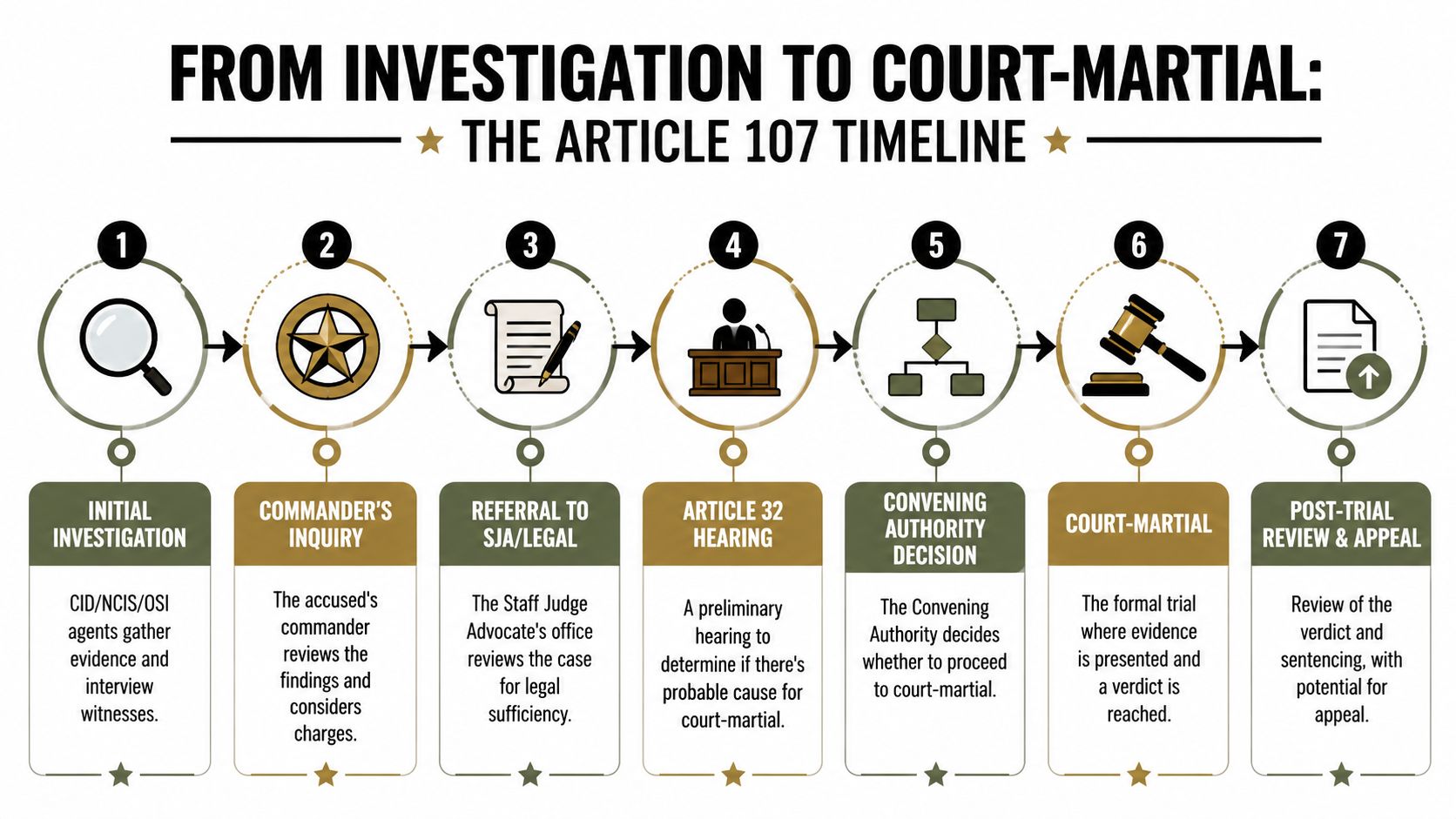
Step one the investigation is already underway
By the time you are contacted, the government usually already has something. It may be a complaint, a witness statement, digital records, a command referral, or a contradiction they think matters.
Your decision point comes fast:
- You are asked to talk. This may be informal at first. It is still dangerous.
- You are asked for a written statement. This is often where Article 107 cases are born.
- You are asked to consent to a search. Phones, rooms, vehicles, and accounts can all expand the case.
At this stage, silence is strategy. Explanations usually make the file bigger.
A lot of clients need to hear this from someone other than family or command, so here is a useful primer on the process side of military investigations before charges start moving.
Step two command and legal review
Once investigators package the case, command and the legal office start making decisions about disposition. Some cases stay administrative. Some go toward nonjudicial punishment. Some get pushed toward court-martial because command wants a record of seriousness or because the allegation sits next to another offense.
This is where timing matters. If defense gets involved early, counsel can shape how the file is understood, identify missing context, challenge weak assumptions, and sometimes prevent a bad Article 107 theory from hardening into charges.
A short comparison helps:
| Stage | What the government is doing | What you should be doing |
|---|---|---|
| Investigation | Collecting statements and records | Say nothing without counsel |
| Command review | Deciding seriousness and forum | Get a strategic case assessment |
| Charge drafting | Framing allegations for leverage | Attack wording and theory early |
Step three the hearing trial and aftermath
If the case proceeds toward a general court-martial, an Article 32 preliminary hearing may follow. Then come referral decisions, motions practice, discovery review, witness preparation, and trial.
The maximum punishment for Article 107 can include up to 5 years’ confinement, a dishonorable discharge, and total forfeiture of all pay and allowances, according to this Article 107 penalty discussion. That is why every pretrial decision matters.
By the time the case reaches trial, defense should already have mapped out:
- Statement issues: Was the statement recorded, summarized, translated, or drafted by someone else?
- Mental-state defenses: What facts show mistake, confusion, fear, or lack of deceptive purpose?
- Officiality challenges: Did the statement affect a military function?
- Suppression issues: Were rights violated or was the statement coerced?
If there is a conviction, post-trial review and appeal become the next battlefield. But the best work is done long before that.
Career-Ending Mistakes Service Members Make
The people most likely to make disastrous decisions in an Article 107 case are disciplined, responsible, high-functioning service members. They are used to answering questions, fixing problems, and respecting authority. Those instincts can wreck the defense.
The instincts that get people convicted
Here are the mistakes that come up over and over:
- Talking to investigators without counsel: This is the classic self-inflicted wound. You think you’re clarifying. They think you’re locking in a theory.
- Trying to correct a bad statement alone: A second statement often creates a cleaner prosecution exhibit, not a solution.
- Signing a drafted statement too fast: If the investigator typed it, you should assume the language serves the case, not you.
- Confusing command support with legal protection: Your commander may like you and still let the case roll forward.
- Consenting to searches because you want to look cooperative: You are not earning points. You are giving away leverage.
- Talking to friends, coworkers, or your chain about details: Those people can become witnesses.
- Waiting until charges are preferred: By then, the file may already contain avoidable damage.
Stop trying to look innocent. Start acting smart.
What to do if you already talked
Then stop talking now.
Do not try to smooth it over. Do not send a text to “clear up” what you meant. Do not ask a witness to back you up. Do not write a memo for record because you are nervous.
Do these things instead:
- Write down your memory privately for your lawyer.
- Preserve texts, emails, screenshots, and call logs.
- Identify every person present during questioning.
- Get counsel involved before the next contact.
If you already made a bad statement, the case may still be defendable. But every unsupervised attempt to fix it usually makes it worse.
Why Your Appointed Counsel Is Not Enough For This Fight
You are entitled to detailed military defense counsel. That is important. It is also not the same thing as having the right lawyer for a complex Article 107 case.
Many litigated Article 107 cases involve overlapping theories and require counsel who can parse the differences between false official statements, false swearing, and obstruction. That kind of nuance demands significant court-martial trial experience, and that resource is not guaranteed in the military’s detailed counsel system, as discussed in this Article 107 defense attorney analysis.
The experience problem is real
A detailed defense counsel may be smart, hardworking, and sincere. But sincerity does not replace repetitions at trial.
Article 107 cases reward lawyers who have seen investigators overstate “officiality,” prosecutors blur inconsistency into intent, and command use false statement charges to exert pressure. Experience matters because these cases are won in details. A junior lawyer may know the elements. A seasoned civilian court-martial attorney knows where the file is lying.
Here is the practical difference:
| Appointed counsel limitations | What experienced civilian counsel often adds |
|---|---|
| Heavy caseload | More time on statement analysis and witness prep |
| Limited trial repetitions | Sharper instincts on cross-examination themes |
| System constraints | Full independence from command structure |
| Less flexibility in resources | Ability to build a more aggressive defense plan |
What civilian counsel changes immediately
Civilian counsel answers to one person. You.
That changes the tone, pace, and aggression of the defense. It affects whether early outreach is made, whether a statement is challenged hard, whether command is confronted directly, and whether the case is prepared for trial instead of quiet surrender.
If you are comparing lawyers, use tools that help you assess actual military justice experience and fit.
If Article 107 is in play, free is not the issue. Consequences are.
FAQ
Can I refuse to talk to CID NCIS OSI or CGIS
Yes. You should invoke your rights and ask for a lawyer before answering questions.
Is Article 107 just about lying on paperwork
No. It can involve oral statements, written statements, electronic communications, and official records when tied to an official function.
Will I go to jail for a false official statement charge
You can. Article 107 carries severe punishment exposure, including confinement, punitive discharge, and forfeitures if the case goes to court-martial and ends in conviction.
What if I made a mistake and did not mean to deceive anyone
That matters. The government must prove knowledge of falsity and intent to deceive. Mistake, confusion, misunderstanding, and faulty memory can be central defense issues.
Can a statement to a civilian count under Article 107
Yes, it can, if the statement bears the necessary connection to military duties or military functions. The setting matters. The listener’s role matters. The purpose matters.
Should I wait until charges are preferred to hire a lawyer
No. Early intervention is where the biggest mistakes can be prevented and where the defense can still shape the case.
If you are under investigation for UCMJ Article 107 – False Official Statements, act now. Stop talking. Stop trying to fix it yourself. Get experienced civilian military defense counsel involved before the next interview, the next written statement, or the next command decision.
Your career, your record, your clearance, and your freedom can all turn on what happens in the first days of this case. Waiting is not a strategy. Calling the right lawyer is.