You’re probably reading this because somebody handed you a counseling statement, a commander’s memo, or a vague warning that your “performance and conduct” are not where they need to be. If you’re still in your first few months, that should set off alarms. A failure to adapt discharge is not a slap on the wrist. It is the kind of early-service separation that can end a military career before it really starts, and it often lands on a DD-214 in a way that follows you into civilian life, benefits questions, and background checks.
The worst mistake service members make is treating this like a paperwork issue. It isn’t. It’s a retention judgment. Once command decides you can’t meet the standard, the clock starts moving fast, and the record they build in those first weeks usually becomes the story that follows you for years. If you don’t fight it early, you are letting other people define your future for you.
Table of Contents
- What a Failure to Adapt Discharge Is
- The Three Discharge Lanes and Why Uncharacterized Hurts
- How to Fight the Discharge Through Appeals and Records Correction
- Why Civilian Military Defense Counsel Changes the Outcome
- What a Winning Case Actually Looks Like
- Questions Service Members Ask Their Lawyer First
What a Failure to Adapt Discharge Is
A junior Soldier gets a counseling statement after missing standards, not once, but enough times that the chain of command stops treating it as adjustment and starts treating it as failure to adapt. That is usually how this starts. By the time the member understands the seriousness of it, command has already begun building a record of inability, lack of reasonable effort, or a poor fit for military life under Army Chapter 11. The entry-level window is generally the first 180 days of service, and that matters because this is the period when the Army is still deciding whether you belong in uniform at all.
The label sounds soft. It is not. In military terms, failure to adapt means command believes you cannot meet minimum training standards, cannot adapt socially or emotionally to military life, or lack the aptitude, ability, motivation, or self-discipline to continue. That language appears in Chapter 11 practice as a formal basis for separation tied to unsatisfactory performance, conduct, or both. Army DRB Chapter 11 reference
Practical rule: if your paperwork starts using words like “inability,” “lack of effort,” or “unable to adapt,” stop treating this like a coaching problem. You are already in separation territory.
What makes this dangerous is how fast it becomes official. The command memo, the counseling statements, the training notes, and the peer chatter all start feeding the same narrative. By the time the discharge is processed, the record often looks neat and final, even if the underlying story is messier than command admits. If you want to compare your paperwork with the Army’s separation process, use the Army separation and discharge framework.
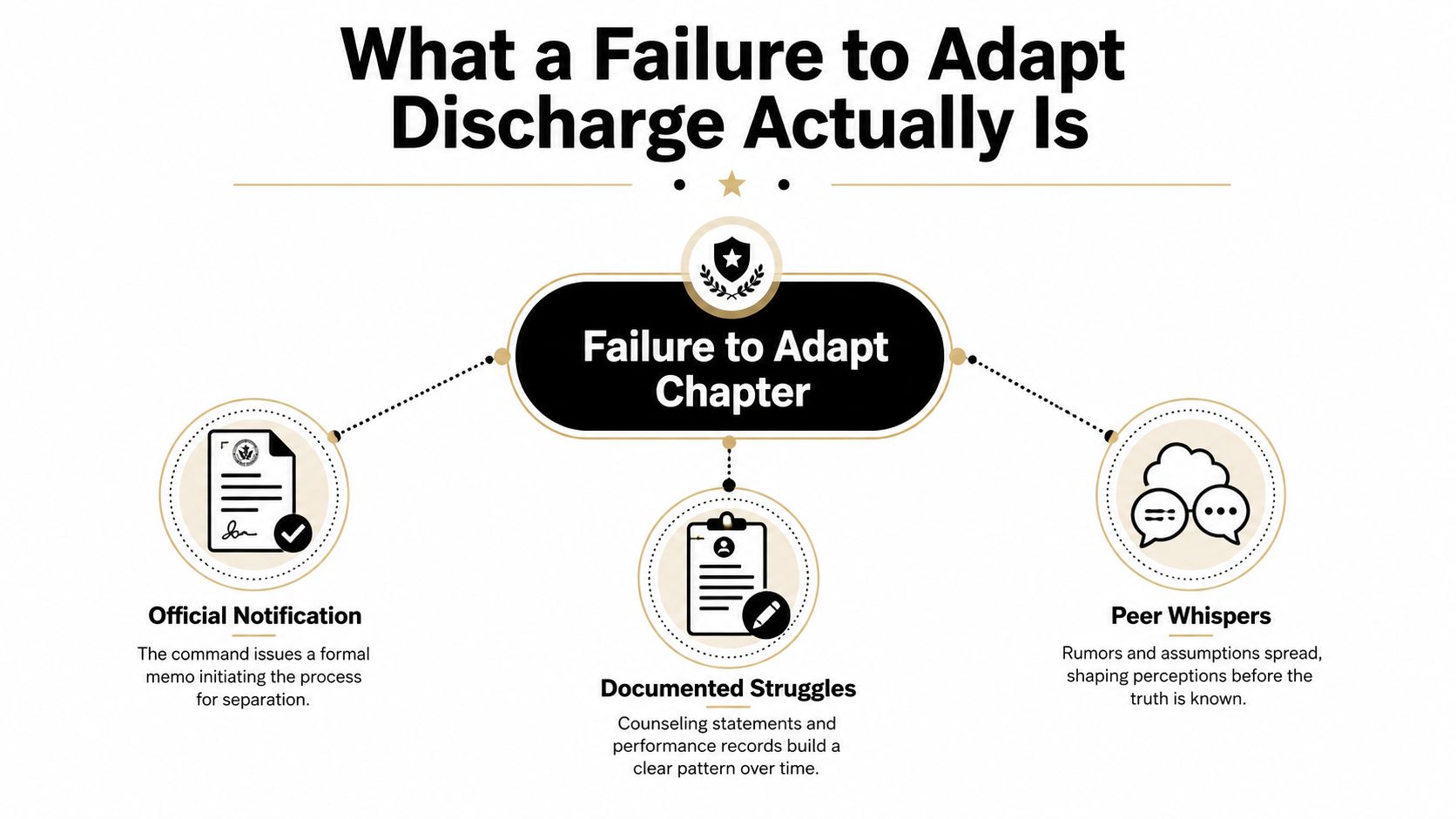
The separation is dangerous, and the stigma multiplies the damage. A failure-to-adapt label tells future reviewers that you were evaluated early and found wanting. That is why it wrecks momentum, even when no one calls it a punishment.
The Three Discharge Lanes and Why Uncharacterized Hurts
A discharge is a lane, and the lane decides how hard the rest of your life gets. The military generally moves people toward honorable, general under honorable conditions, or uncharacterized service, and a failure-to-adapt case usually lands in the last category when the member is still in entry-level status.
Here is the plain-English version. Honorable tells the world you served acceptably. General tells the world your service had problems, but not enough to deny you everything. Uncharacterized is different. It means the service ended before the military was ready to give your service a full character label, but civilian employers, benefits reviewers, and background investigators do not treat it as harmless.
The most important fact is this. Entry-level separations are often paired with uncharacterized service, not a clean honorable discharge. In one Air Force case, the discharge authority directed an entry level separation on January 6, 1993, the member was discharged on January 16, 1993, and the narrative reason was “Entry Level Performance” after only six months and two days of active service. In an Army reserve case, a Soldier released after 1 month and 1 day of active service also received an uncharacterized DD Form 214 for entry level status performance and conduct.
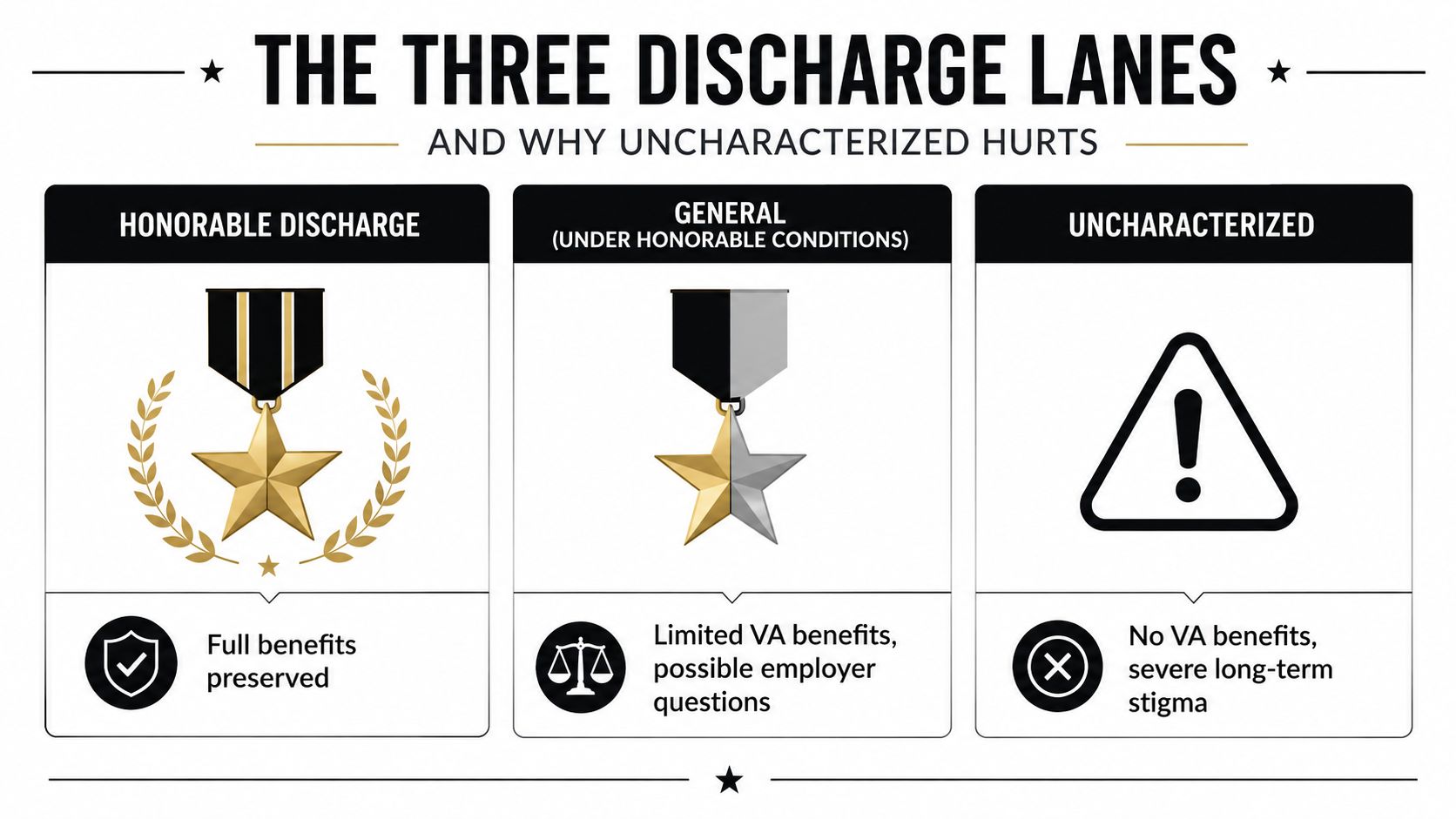
That matters because an uncharacterized discharge is not the same as “nothing happened.” It can still create friction with benefits, reenlistment, and civilian hiring. The label invites questions, and once a reviewer sees a separation tied to failure to adapt, the burden shifts to you to explain the gap in your record.
What you need to do is simple. Even if it is not easy.
- Read the separation packet carefully. Look for the exact reason, the characterization, and the entry-level dates.
- Check the service dates. If you are inside or near the first 180 days, that window is the line that matters for entry-level status.
- Assume the paperwork will be used against you later. The DD-214 travels farther than the barracks.
If you want a deeper breakdown of discharge categories and upgrade strategy, the discharge upgrade guide is the place to start.
How to Fight the Discharge Through Appeals and Records Correction
A failure-to-adapt case is fought in layers. If you wait until the separation is final, you’ve already lost the cheapest fight. The first move is to push back while the command still has discretion, then move to the formal records process if the discharge goes through.
Start with the command. That means a hard, respectful response to the counseling trail, not a dramatic speech. You want the chain of command looking at evidence that contradicts the narrative they’re building. Medical issues, performance trends, training records, and strong character statements can matter, but only if they land before the discharge becomes a done deal.
The board does not reward emotion. It rewards a record that shows the command’s story is incomplete.
After separation, the first appeal lane is usually the Discharge Review Board using DD Form 293. That is the practical upgrade route when you’re challenging the characterization or narrative reason. If the record is still wrong after that, the next step is DD Form 149 to the Board for Correction of Military Records. That board can correct the official record when the discharge packet, medical evidence, or command process was flawed.
The evidence that moves these cases is concrete. You want:
- Counseling statements that show the command ignored improvement or overstated failure.
- Medical records that explain the behavior or training issues.
- Character letters from people who observed you under stress.
- Command climate documents when the unit culture itself was part of the problem.
- Contradicting performance evaluations that break the government’s “incapable” narrative.
The same rule applies in every board case. Build the record as if the board knows nothing about you, because it probably doesn’t. And if the BCMR denies relief, the final move is federal court review under the Administrative Procedure Act, where the fight becomes about whether the military’s decision was arbitrary, unsupported, or legally wrong.
A discharge fight is not instant. Boards take time, and the BCMR level is slower. That delay is exactly why you need to file cleanly and strategically the first time.
Here’s the video that lays out the appeal path in plain English.
If you’re still deciding whether to act, read the upgrade process guide. Then move.
Why Civilian Military Defense Counsel Changes the Outcome
A free military lawyer can help, but be honest about the limits. Assigned defense counsel works inside the system, inside the schedule, and inside the command structure that is already trying to separate you. A seasoned civilian military defense lawyer brings distance, time, and an edge. That difference matters in a failure-to-adapt case because the fight is about how the record gets framed, and that framing can decide whether the discharge sticks.
A smart civilian lawyer goes beyond filing forms, they build the case like trial work. They shape the narrative, identify the weak points in the command packet, and force the military to defend the exact language it used against you. In an upgrade case, that means preparing the DD-293 or DD-149 package with discipline and precision, not guesswork.
The warning signs of a bad lawyer are easy to spot if you pay attention.
Big promises are a red flag, because nobody can guarantee an upgrade. No board experience is another, because anyone who has not handled discharge cases is learning at your expense. No regulatory focus means the lawyer cannot point to the exact separation basis being challenged, which means they are winging it. No hearing strategy is a final warning, because a paper filing without a plan is weak lawyering.
The right counsel knows how to attack the record strategically, not just appeal for leniency. They look for what command missed, what it exaggerated, and what it never documented. They use the same facts the government relied on and turn them into evidence of immaturity, temporary struggle, or a flawed evaluation process.
That is why civilian counsel changes outcomes. They do not erase a discharge by wishful thinking, they make the board confront the case the command never built correctly. If you are weighing your options, use the other-than-honorable discharge benefits guide as a reality check before you decide to handle this alone.
What a Winning Case Actually Looks Like
A junior Sailor gets flagged early after a stretch of minor infractions. Command says the problem is motivation. The file says the member can’t adapt. That is the government’s favorite story because it’s clean, tidy, and easy to repeat.
A strong defense turns that story inside out. The first thing counsel does is look for a medical explanation the command ignored. Untreated adjustment problems, anxiety, sleep disruption, and stress-related symptoms often show up before behavior collapses. If the medical record supports that, the argument changes from “this Sailor failed” to “the command misread a treatable condition as defiance.”
Then comes the witness work. A good civilian lawyer gets sworn statements from roommates, trainers, supervisors, and anyone else who saw the service member’s actual effort. The point is not to pile on praise. The point is to show the command’s “lack of motivation” label is overstated or incomplete.
Strong case rule: if the government built its story from a few bad weeks, you win by showing the whole timeline.
A winning packet also includes post-service proof. Stable work, school attendance, certifications, and responsibility after discharge all matter because they undercut the idea that the member was permanently unsuitable. That doesn’t erase the service record, but it can show the military’s prognosis was too harsh.
The best possible result is a full upgrade to honorable. The next-best result is a move to general under honorable conditions if the board won’t go all the way. Sometimes the board denies relief, but even that can expose errors that make federal court review more realistic.
A civilian trial lawyer is valuable here because they don’t treat the file like a form submission. They treat it like a case. The government wrote a narrative. You need a better one, and it has to be backed by documents, not hope.
If you’re trying to understand how an upgrade can change your long-term position, read the benefits guide for less-than-honorable discharges and compare it to your own situation. Then build your evidence accordingly.

Questions Service Members Ask Their Lawyer First
A failure-to-adapt discharge can be challenged later, yes. If the record is wrong, incomplete, or unfairly written, an upgrade fight is still worth taking. The harder question is not whether you can file. It’s whether you have the evidence to beat the story already in the file.
Will it block reenlistment in another branch? Usually, it creates a problem, because another service will look hard at why you were separated in the first place. An uncharacterized or failure-to-adapt discharge invites scrutiny even when it doesn’t say “bad” in plain language.
Will an employer see it? Often, yes. Maybe not every detail, but enough to ask uncomfortable questions. That is why the reason code and characterization matter more than people think.
How long does a board case take? Long enough that waiting is the wrong strategy. You should assume months, and sometimes longer, before a final decision. That delay is exactly why your packet has to be right from day one.
Can a civilian military defense lawyer help more than a free military lawyer? In many cases, yes. The civilian lawyer is independent, can spend the time the case needs, and knows how to build a persuasive record for a board, not just survive the immediate separation process.
Should you file a DD-293 first or go straight to the BCMR? If the discharge has already happened and the record is clearly wrong, the upgrade path often starts with the review board and then moves to correction if needed. If the packet is riddled with errors, a lawyer may advise a more aggressive route depending on the record and the relief you need.
The blunt answer is this. If your chain of command has already decided you don’t fit, you need a legal plan, not a pep talk. That plan starts with a hard look at your paperwork, your medical history, and the exact way the record was built against you.
If you’re facing a failure to adapt discharge, don’t wait for the packet to become final and unfixable. Talk to a civilian military defense lawyer now, get the record reviewed, and make the government defend its label before it hardens into your permanent story.