
The knock comes early. A first sergeant calls. CID, NCIS, or OSI wants “just a quick conversation.” Your phone suddenly matters. Your texts matter. That joke, that photo, that video, that angry ex, that roommate, that barracks incident, that night you barely remember. Now your command is watching you, investigators are collecting evidence, and your career is in free fall.
If you’re being accused under UCMJ Article 120c – Other Sexual Misconduct, you are not dealing with a misunderstanding that fixes itself. You are dealing with a charge category that can cost you your freedom, your rank, your retirement, your clearance, your reputation, and the life you planned after the military. The system moves fast when it wants to. It is slow only when delay hurts you.
Most service members make things worse in the first day. They try to explain. They hand over devices. They text the complainant. They trust command. They assume innocence will protect them. It won’t. Strategy protects you. Silence protects you. Counsel protects you.
Table of Contents
- Your Career Is on the Line The Moment They Knock on Your Door
- Decoding UCMJ Article 120c What It Actually Means
- The Process From Investigation to Court-Martial
- Sentencing The Real-World Punishments for an Article 120c Conviction
- Strategic Defense How a Battle-Tested Lawyer Fights Article 120c
- Critical Mistakes That Will Destroy Your Defense Before It Begins
- Why Your Appointed Military Lawyer Is Not Enough
- Urgent Questions About Article 120c Charges
- Your Next Move Is Critical Do Not Wait
Your Career Is on the Line The Moment They Knock on Your Door
A lot of these cases start the same way. Someone says you looked where you shouldn’t have looked. Recorded what you shouldn’t have recorded. Sent something you shouldn’t have sent. Exposed yourself in a way someone now calls indecent. You think there must be some simple way to clear it up.
That instinct gets people convicted.
Investigators are trained to sound calm. They act like they’re gathering facts. Sometimes they already have your messages, screenshots, witness statements, command pressure, and a working theory of guilt before they ever contact you. They are not calling because they’re confused. They’re calling because they want evidence they can use.
What’s at stake right now
This isn’t only about whether charges get preferred. It’s about what starts happening immediately:
- Your chain of command reacts fast: restrictions, lost trust, pulled duties, no-contact orders, and informal career damage can begin before trial.
- Digital evidence hardens early: phones, cloud accounts, chats, screenshots, and metadata become central before you’ve even spoken to a lawyer.
- People start talking: roommates, coworkers, former partners, and supervisors may give statements long before your defense is organized.
Practical rule: If law enforcement or command contacts you about sexual misconduct, your first move is not explanation. Your first move is silence and counsel.
Families often ask whether this can still “stay small.” Sometimes yes. Often no. But it only has a chance of staying containable if you stop feeding the case. The first hours matter because most government cases get stronger from the accused’s own words, own phone, own panic, and own bad decisions.
Decoding UCMJ Article 120c What It Actually Means
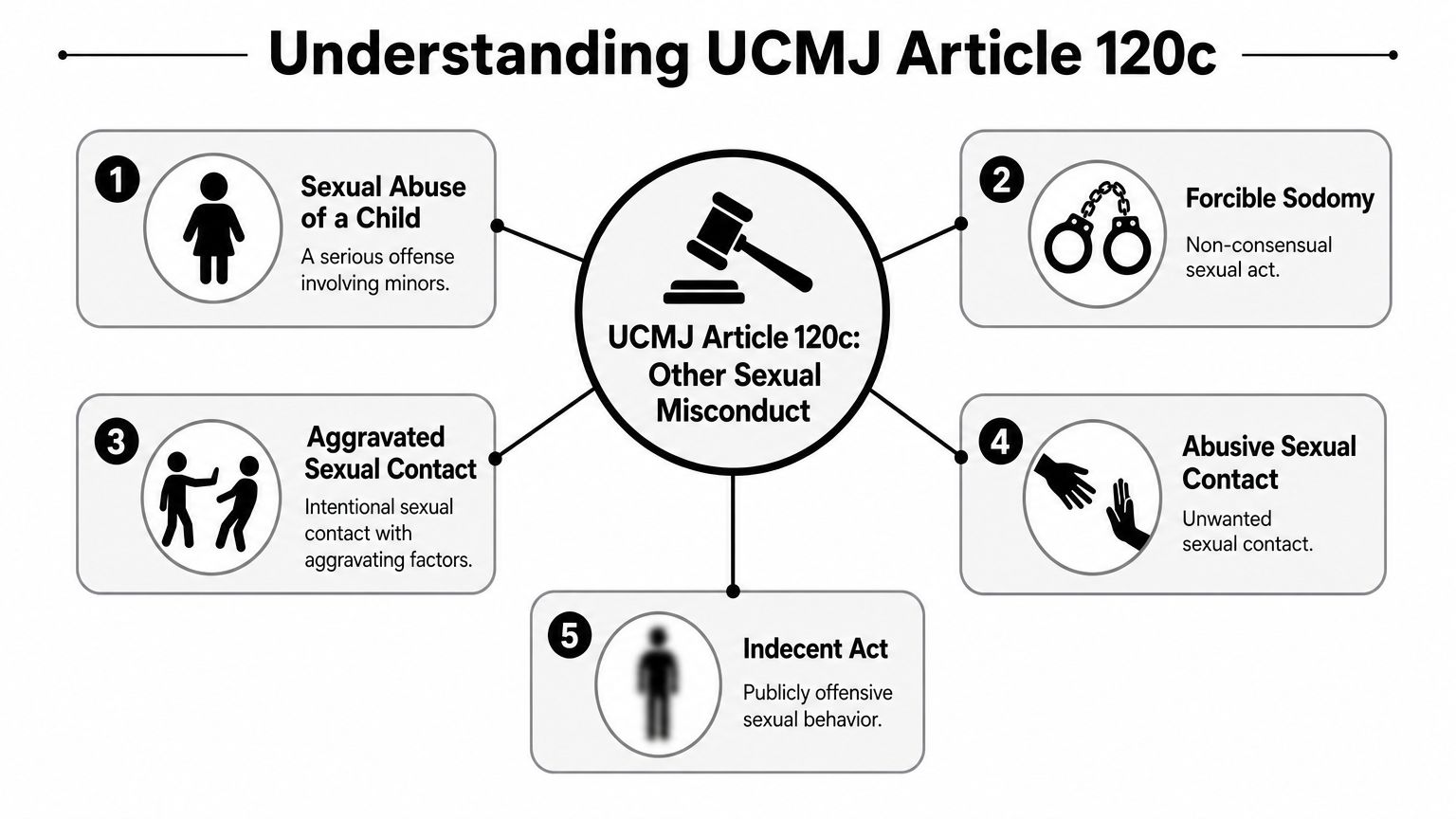
A lot of service members hear “120c” and assume the government can sweep every awkward, sexual, or embarrassing allegation into one bucket. That mistake hands prosecutors room they have not earned. Article 120c is a set of specific offenses with specific elements. If your lawyer does not force the government to stay inside those lines, the case gets more dangerous than it should be.
Investigators also like to blur Article 120c with assault allegations because it sounds worse and puts pressure on command. Do not let that framing control your defense. If you need a clear comparison, read this breakdown of UCMJ Article 120 sexual assault.
Article 120c covers separate offenses, not one vague accusation
The statute identifies five different offenses in 10 U.S.C. § 920c:
- Indecent viewing
- Indecent visual recording
- Broadcasting or distributing an indecent visual recording
- Forcible pandering
- Indecent exposure
That list matters for one reason. Each charge requires different proof, and weak cases often fall apart when you isolate the exact elements instead of arguing over labels.
A seasoned civilian defense lawyer attacks the gaps immediately. What exactly was seen? What exactly was recorded? Who sent the file? Was there consent? Was there a real expectation of privacy in that setting? Did the image even show what investigators claim it showed?
Those are not side issues. Those are the pressure points.
Privacy is often the central legal battle
For viewing and recording cases, the government usually has to prove three things that sound simple and often are not. A private area was viewed or recorded. It happened without consent. It happened in circumstances where the person had a reasonable expectation of privacy.
That last phrase drives a lot of these cases. In a shower, barracks room changing area, or bathroom, the government starts with a stronger argument. Outside those settings, the case gets harder fast. Positioning, visibility, prior communications, camera angle, who else was present, and what the image captured can all change the analysis.
Here is how that plays out in practice:
| Allegation | What the government will try to prove | What the defense should press hard |
|---|---|---|
| Viewing | You intentionally looked at a private area | Whether the view was deliberate, whether privacy existed, and whether the witness identified you accurately |
| Recording | You knowingly captured a private area | Whether the image actually shows that, whether recording was intentional, and whether consent or mistake is in play |
| Distribution | You shared an indecent recording | Whether you were the sender, whether the file was altered or forwarded by someone else, and what you actually knew |
| Exposure | You intentionally exposed yourself in an indecent manner | Context, intent, audience reaction, and whether the conduct meets the statute instead of just sounding bad |
The distinction between experienced defense work and generic representation becomes clear. The government may present the accusation as obvious. Good defense work breaks it into timestamps, metadata, screen captures, witness motives, phone handling, and exact statutory language. Cases that look ugly in a CID summary often look much weaker once the evidence is pinned down.
Indecent exposure deserves the same disciplined analysis. The government still has to prove an intentional exposure in an indecent manner, involving the body parts covered by the statute. Bad judgment, drunken behavior, horseplay, or a misunderstanding can trigger an investigation. That does not automatically satisfy the charge.
The government wins these cases by selling a story. The defense wins by forcing proof, element by element.
The Process From Investigation to Court-Martial
The military justice process feels chaotic when you’re living it. It isn’t chaotic. It is organized, and every stage gives the government a chance to tighten the case if you let them.
A defense perspective helps because the official version sounds cleaner than real life.

What usually happens first
Initial allegation. Someone reports you. That can be a direct complaint, a screenshot, a discovered file, gossip that reaches command, or a relationship dispute that turns into a formal accusation.
Law enforcement gets involved. CID, NCIS, OSI, or another agency starts gathering statements, devices, records, and command input. If there’s a related command inquiry, this overview of 15-6 investigations helps explain how parallel fact gathering can complicate your defense.
Command starts making decisions before charges exist. You may be flagged, restricted, reassigned, ordered not to contact someone, or treated like the case is already proved.
Where the case gets shaped
This short video gives a useful overview of how military justice cases move:
After the investigation, the case can move through a sequence like this:
Evidence collection
Investigators build the file. That includes statements, phones, social media, location data, screenshots, and witness interviews.Charge decision
Command and legal advisors decide whether to prefer charges, use other disciplinary tools, or keep building the file.Article 32 hearing
In a serious case headed toward general court-martial, this stage tests whether enough evidence exists to continue. It is not the full trial, but it matters.Referral to court-martial
If referred, the case becomes much more dangerous. Trial preparation accelerates.Trial
The government presents its evidence. Your defense attacks the evidence, the witnesses, the legal sufficiency, and the narrative.
What you should be doing at each stage
- At first contact: invoke your right to remain silent and ask for a lawyer.
- When devices become an issue: don’t consent casually, don’t destroy anything, and don’t try to outsmart digital forensics.
- Before charges: get your timeline straight, identify witnesses, preserve texts and messages, and stop discussing the case.
- Before hearing or trial: work with counsel on motions, forensic review, witness preparation, and damage control with command.
The worst mistake is thinking the core fight starts in the courtroom. It often starts with the first search request, the first “voluntary” interview, and the first version of events that gets locked into a report.
Sentencing The Real-World Punishments for an Article 120c Conviction
A conviction under Article 120c can end your military career even before the confinement piece fully hits you. Service members fixate on jail time. That is a mistake. The charge language, the findings, and the forum can shape your discharge, your pay, your benefits, your clearance, and your civilian future.
The exposure depends on what they prove
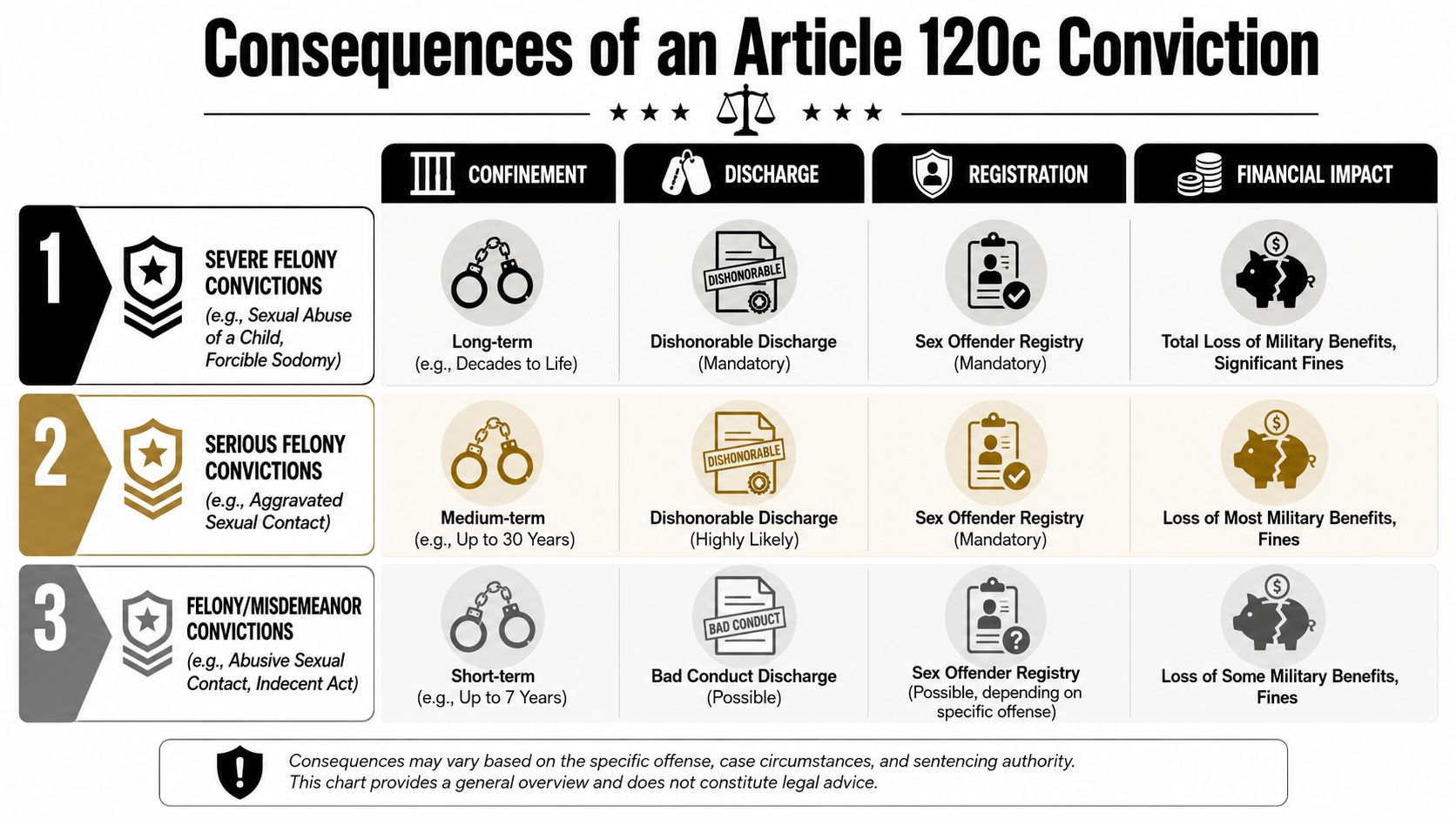
Article 120c is not one punishment bucket. It is a ladder, and every rung matters. If the government can turn an allegation from viewing into recording, or from recording into broadcasting or distribution, your sentencing exposure jumps fast. That is why experienced defense counsel fights over the exact act, the exact file, and the exact wording of the specification.
Here is the basic confinement structure:
| Offense | Maximum confinement |
|---|---|
| Indecent viewing | 1 year |
| Indecent exposure | 1 year |
| Indecent visual recording | 5 years |
| Broadcasting or distributing an indecent visual recording | 7 years |
| Forcible pandering | 12 years |
That spread is not academic. It tells you where the fight is. If the prosecution is stretching weak proof into a distribution theory, that issue is not a side argument. It is often the difference between a survivable outcome and a career-ending one.
Confinement is only part of the sentence
The sentence can also include a punitive discharge and forfeitures. This means even a shorter confinement term can destroy your career, strip your income, and follow you long after you leave the service.
A bad paper discharge changes everything. Jobs, professional licensing, housing applications, VA-related consequences, and your reputation all get harder from there.
Some Article 120c cases also carry sex-offender-registration risk depending on the offense of conviction and how the case is resolved. If that risk exists in your case, your lawyer needs to address it early, not after findings. Sentencing strategy starts well before the sentencing hearing.
Sentencing is shaped long before the judge announces it
The government usually walks into sentencing with a simple theme. They call it sexual misconduct, treat every digital act as intentional, and ask the court to punish you as if the worst version of the accusation is already proven. A strong civilian defense lawyer breaks that pattern.
That means forcing precision. Was there actual distribution, or only possession on a device? Was there intentional viewing, or accidental exposure to an image? Was there proof you created the recording, or only proof that it existed on hardware the government tied to you loosely? Those distinctions decide sentencing exposure and often decide whether the government can sell its punishment theory at all.
If you are facing Article 120c charges, do not treat sentencing as the part that happens after you lose. Treat it as a battlefield from day one. That is how these cases are contained, and sometimes won.
Strategic Defense How a Battle-Tested Lawyer Fights Article 120c
The knock comes. CID, OSI, NCIS, or command already thinks your phone holds the story. By the time they talk to you, they usually have a theory built from screenshots, half-read message threads, witness statements, and a forensic report written to sound cleaner than the facts really are.
That is the opening a seasoned defense lawyer uses.
Article 120c cases look powerful at first because the allegation sounds bad. The government counts on that. What wins these cases is forcing the prosecution to prove each element with clean evidence, lawful searches, reliable timelines, and a witness story that survives scrutiny. A battle-tested civilian lawyer does not defend these charges by asking for sympathy. He makes the government carry weight it often cannot carry.
Digital evidence is where the government often overreaches
These cases regularly turn on phones, laptops, cloud accounts, app histories, metadata, and screenshots. Prosecutors love digital evidence because it feels objective. It often is not.
A screenshot does not prove who sent a message. A file on a device does not automatically prove who created it. An image in a cache folder does not mean intentional viewing. Auto-sync, shared access, borrowed devices, app defaults, and sloppy chain of custody can turn weak proof into a charging decision.
A strong defense lawyer goes after the mechanics, not the labels. That means asking hard questions early:
- Who used the device or account
- When the file appeared and how it got there
- Whether the government can prove intentional recording, viewing, or distribution
- Whether investigators preserved metadata or only grabbed what supported their theory
- Whether the search authorization, consent, or seizure was lawful
One bad assumption in a digital case can infect the whole prosecution.
The charge sheet is narrower than the accusation
Investigators and command often speak in broad moral language. Courts do not convict on outrage. They convict, if at all, on elements.
That is where experienced defense counsel starts cutting.
Reasonable expectation of privacy
The government has to prove the setting and circumstances fit the offense. Location matters. Visibility matters. Access matters.Consent
In recording and viewing cases, consent can be disputed, limited, withdrawn, or badly investigated. Prosecutors routinely try to blur that issue. A good defense lawyer forces them to define it.Indecent conduct
In exposure cases, context decides a lot. Intent, setting, surrounding behavior, and who was present all matter.Knowledge and intent
If the statute requires knowing conduct, the government must prove that mental state with evidence, not guesswork dressed up as certainty.
The best defense theme is simple. The government charged a specific offense and cannot prove it cleanly.
Witness problems break cases open
Plenty of Article 120c files are built around one witness whose story grew sharper after command involvement, repeated interviews, or pressure from unit politics. That is common. It is also dangerous for the government once a real defense investigation starts.
A seasoned court-martial lawyer tests the timeline against phone records, app logs, prior statements, social media activity, and third-party witnesses. He looks for memory contamination, exaggeration after a breakup, omitted facts, inconsistent descriptions of where people stood, what they could see, what they heard, and when they first reported it.
Details matter here. Small contradictions become a powerful tool when the charge depends on privacy, intent, consent, or what a device supposedly captured.
Motions win these cases before trial
If investigators searched your room, phone, laptop, or accounts without proper authority, suppression can gut the case. If they exceeded the scope of the search, failed to preserve exculpatory material, or used a consent search that was shaky from the start, the defense has something to work with.
Good lawyers do not wait for trial theatrics. They attack the foundation. They challenge the search. They challenge the forensic process. They challenge whether the government can authenticate what it wants to show the panel. Sometimes that pressure gets charges reduced. Sometimes it strips out the evidence that mattered most. Sometimes it changes the entire posture of the case before findings.
That is how Article 120c cases are fought and won. Not with panic. Not with explanations to investigators. With precision, pressure, and a lawyer who knows where the government cut corners.
Critical Mistakes That Will Destroy Your Defense Before It Begins
Most bad Article 120c cases get worse because the accused helps build them.
If you’re in crisis, keep this simple. Don’t do stupid things because you’re scared.
Mistakes that come up over and over
Talking to investigators
You will not out-explain a trained investigator in a sexual misconduct case. You will give them details to box you in later.Consenting to searches
If they want your phone, laptop, barracks room, or cloud access, don’t casually say yes because you think cooperation makes you look innocent.Deleting messages or files
Panic deletion looks like consciousness of guilt and can create a new problem on top of the old one.Contacting the accuser
Even a message that feels polite or apologetic can be twisted into intimidation, admission, or witness tampering.Talking about the case in the unit
Your friends are not your defense team. Your roommate is not protected. Your squad leader is not your therapist.Trusting command to fix it
Command protects command. Sometimes they help. Sometimes they don’t. You should never build your defense around hope.Waiting to hire counsel
Delay is expensive in these cases. Evidence gets interpreted before your side is organized.
If you feel desperate to explain yourself, that’s exactly when you need to stop talking.
There is one smart early move. Write down a private timeline for your lawyer. Dates, times, locations, witnesses, devices, accounts, messages, and any reason a witness may be biased. Then shut up and get counsel.
Why Your Appointed Military Lawyer Is Not Enough
You are entitled to military defense counsel. Use that resource. But don’t confuse “assigned” with “sufficient.”
A detailed military lawyer may be hardworking and committed. Some are excellent. But serious UCMJ Article 120c – Other Sexual Misconduct cases often demand more than basic representation. They demand experience, independence, technical fluency with digital evidence, aggressive motion practice, and the confidence to fight command pressure without hesitation.
What civilian counsel adds
A seasoned civilian military defense lawyer brings advantages that matter in real cases:
- Independence: no rating chain, no career concern, no institutional pressure
- Focused trial experience: many civilian court-martial attorneys build entire practices around defending cases like yours
- More strategic bandwidth: outside counsel can often devote more concentrated attention to your case
- A broader perspective: experienced civilian lawyers have seen the same investigative patterns across commands, branches, and installations
If you’re comparing options, this guide to court-martial defense lawyers is a practical starting point for evaluating civilian counsel with real military justice focus.
This isn’t about insulting appointed counsel. It’s about recognizing the stakes. If your liberty, discharge status, and future are on the table, you want the strongest team you can build. In high-risk litigation, “free” is not always the best bargain.
Urgent Questions About Article 120c Charges
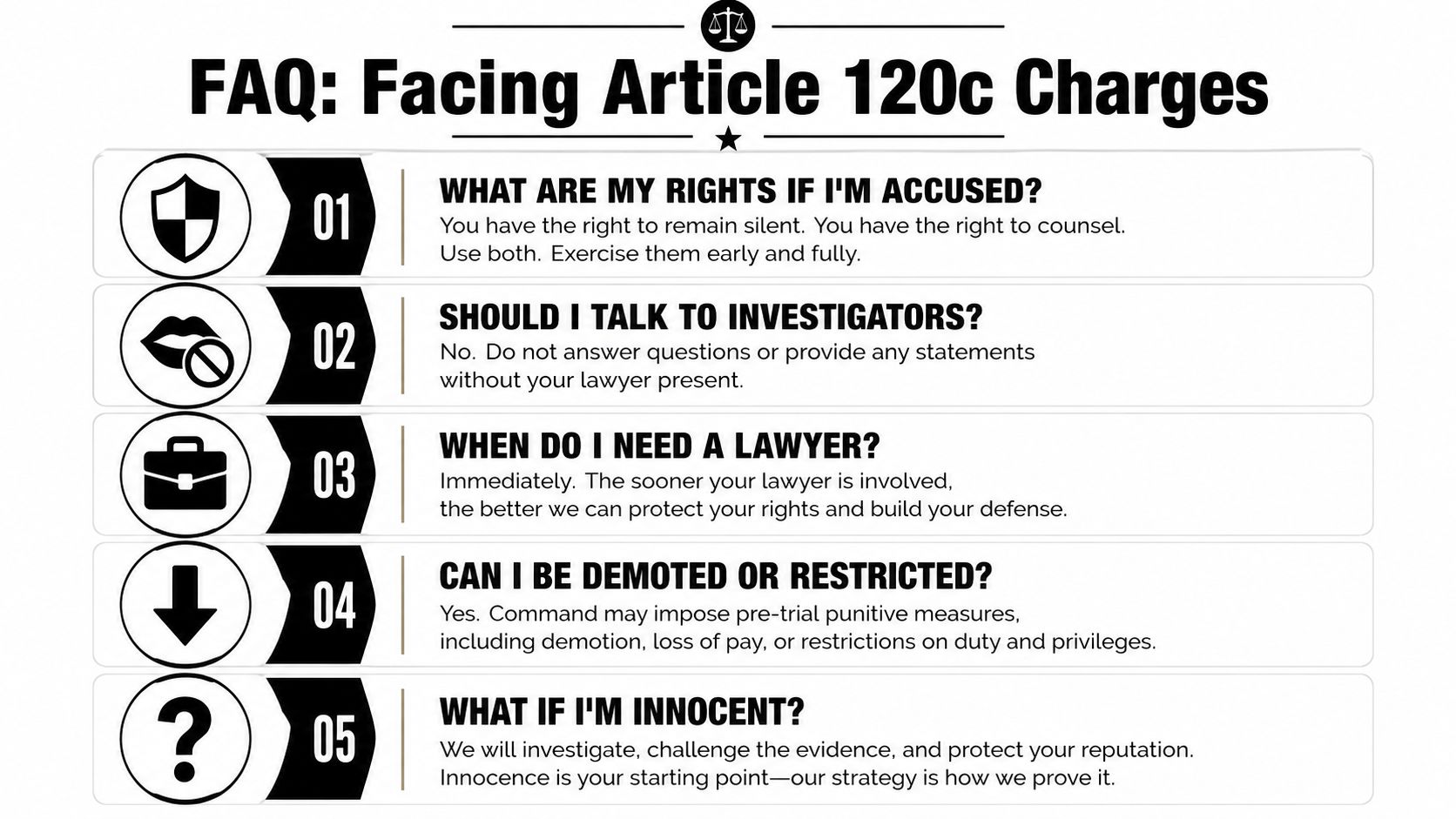
When people call me about Article 120c, the same urgent questions come up. Here are the direct answers.
Can I refuse to talk to CID NCIS or OSI
Yes. You should invoke your right to remain silent and ask for a lawyer.
Should I give them my phone password
Don’t make that decision without counsel. Device access issues can define the entire case.
Will I definitely go to jail if charged
No. A charge is not a conviction. But you are in danger if you treat the charge casually.
Can Article 120c lead to sex offender registration
It can in some situations depending on the offense and forum, which is why charge selection and litigation strategy matter so much.
Is this just an Article 15 issue
It can be, but serious Article 120c allegations can go to court-martial. You should assume the risk is real until proven otherwise.
Should I talk to command to show cooperation
No. Polite silence is safer than helpful-sounding statements that get written down and reused against you.
What if I’m innocent
Then act like someone protecting an innocence case. Preserve evidence. Stop talking. Get a lawyer immediately.
Your Next Move Is Critical Do Not Wait
If you are under investigation or accused of UCMJ Article 120c – Other Sexual Misconduct, hesitation is dangerous. The case is already moving. Investigators are collecting evidence. Command is forming opinions. Witnesses are being interviewed. Digital records are being framed in the worst possible light.
Do not talk to investigators. Do not consent to searches without legal advice. Do not contact the complainant. Do not try to clean up your devices. Do not trust this to blow over.
Call an experienced civilian military defense lawyer now. Then compare counsel carefully. If you need a place to start, the guide to choosing a military defense lawyer explains how to identify civilian attorneys who focus on court-martial and military defense work. Your career, your freedom, and your family’s future may turn on what you do next.