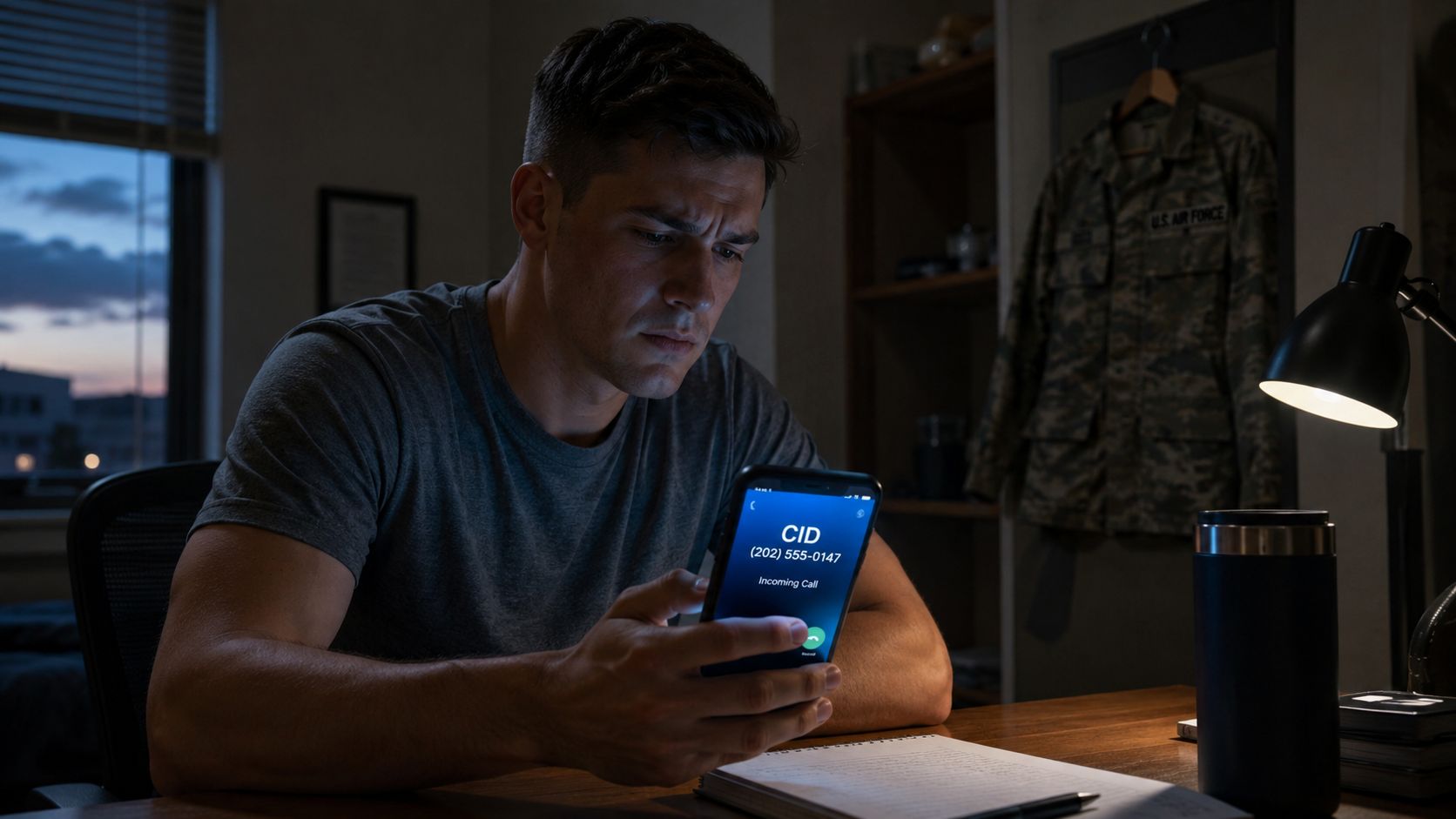
You get a call from CID, NCIS, OSI, or CGIS. The agent sounds calm. Professional. Almost helpful. They say they just want your side of it. They tell you this is your chance to clear things up.
That is the danger point.
If you’re reading this because money is missing, gear can’t be accounted for, a government vehicle was used, or somebody says you took something you had no right to take, you’re already in the part of the case where people destroy themselves. Not at trial. Not in court. In the first conversation.
UCMJ Article 121 larceny and wrongful appropriation cases are usually won or lost on intent. The government has to prove what you meant to do with the property. That sounds abstract. It isn’t. They build that proof from your words, your texts, your movements, your silence, your return of the item, your excuses, and every bad decision you make after contact.
If you talk carelessly, you hand them intent. If you move smart, you make them prove it.
Table of Contents
- The Knock on the Door Your First Article 121 Warning
- Larceny vs Wrongful Appropriation Explained
- What the Government Must Prove to Convict You
- Strategic Defenses the Government Hopes You Don’t Know
- Maximum Punishments and Real-World Sentencing
- Critical Mistakes That Can Destroy Your Case
- Why an Experienced Civilian Defense Lawyer Is Non-Negotiable
- Frequently Asked Questions
- Can I refuse to talk to CID NCIS OSI or CGIS
- If I returned the property can they still charge me
- What is the difference between larceny and wrongful appropriation
- Will I automatically go to court-martial
- Does borrowing without permission count
- Can later repayment fix the case
- What if I thought I had permission
- Do I need a lawyer before charges are filed
- Get Counsel Before You Try to Explain Anything
The Knock on the Door Your First Article 121 Warning
A lot of Article 121 cases start the same way. Somebody notices property is missing. A card transaction looks wrong. A tool, phone, laptop, or vehicle was used when it shouldn’t have been. Then an investigator reaches out and acts like this is still just an administrative misunderstanding.
It isn’t.
Investigators in these cases don’t need you to confess in dramatic fashion. They need you to fill in gaps. They need you to agree that you knew the item wasn’t yours, that you took it without asking, that you used it anyway, that you planned to deal with it later. Once you’ve said those things, they start shaping your statement into proof of criminal intent.
What that first contact really means
If CID or NCIS wants to “hear your side,” they’re not doing you a favor. They’re collecting evidence. They may already have records, witness statements, access logs, text messages, or unit inventory documents. What they want now is your explanation, because explanations can be attacked.
Practical rule: The first safe move is usually silence and counsel, not clarification.
You need to understand your rights before you say a word. If you haven’t done that yet, read about Article 31 rights under the UCMJ and then use them.
What clients usually get wrong
Panicked service members tell themselves one of three lies:
- “I can explain this.” Maybe you can. But if you explain it badly, you’ve made the government’s case stronger.
- “I returned it, so this should go away.” Return helps optics sometimes. It doesn’t erase the allegation.
- “They’ll know I didn’t mean to steal it.” No, they won’t. They’ll infer your intent from conduct, and they will often infer the worst version.
That first interview is not the time to test your storytelling skills. It’s the moment to protect your future.
Larceny vs Wrongful Appropriation Explained
Article 121 in plain English
Article 121 of the UCMJ was enacted on August 10, 1956 as part of the modern Uniform Code of Military Justice, and the current statute is codified at 10 U.S.C. § 921. It creates two separate offenses: larceny, when a person acts with intent to permanently deprive or defraud, and wrongful appropriation, when the intent is only to temporarily deprive or defraud. The statute covers taking, obtaining, or withholding property “by any means,” including money, personal property, or any article of value, as stated in 10 U.S.C. § 921.
That difference in intent is the whole fight in many cases.
If the government can prove you meant for the owner not to get the property back, you’re in larceny territory. If they can only prove you meant to use it temporarily without permission, that’s wrongful appropriation. Both are serious. One is much more dangerous.
Article 121 at a glance
| Factor | Larceny | Wrongful Appropriation |
|---|---|---|
| Intent | Intent to permanently deprive or defraud | Intent to temporarily deprive or defraud |
| Nature of conduct | Wrongfully taking, obtaining, or withholding property | Wrongfully taking, obtaining, or withholding property |
| What the government argues | You meant to keep it, convert it, or cheat the owner out of it | You meant to use it without authority and return it later |
| Typical fact pattern | Selling, hiding, keeping, or treating property like your own | Borrowing without permission, unauthorized use, temporary control |
| Core defense issue | Attack proof of permanent intent | Attack proof that the use was wrongful or intentional at all |
Here is the plain-English version.
If someone takes a fellow service member’s gaming system and sells it, the government will argue permanent deprivation. If someone takes it for the weekend without permission and returns it, the government will push wrongful appropriation. If someone grabbed the wrong item during a move, thought they had permission, or believed the item was theirs, the case shifts again. Then the fight is over mistake, consent, or ownership.
The label on the charge sheet matters, but the facts underneath it matter more.
In real life, most Article 121 cases aren’t about elegant legal definitions. They’re about messy facts. Shared spaces. Unit gear. Sloppy accountability. Informal borrowing. Bad assumptions. Missing texts. People who don’t like each other. That’s why strong defense work starts with reconstruction, not excuses.
What the Government Must Prove to Convict You
The prosecution’s checklist
The government doesn’t get to convict you because command is angry or because something looks bad. It has to prove each required point. In practical terms, prosecutors usually try to establish four things:
You wrongfully took, obtained, or withheld property.
They need to show more than mere possession. They need to tie you to a wrongful act.The property belonged to someone else.
Ownership and lawful possession matter. Shared access can complicate this.The property had value.
Value affects seriousness. It also affects exposure.You had the required intent.
For larceny, the government argues permanent deprivation. For wrongful appropriation, temporary deprivation.
That’s where many cases become vulnerable.
Where these cases usually crack
The weakest part of an Article 121 prosecution is often the thing everyone assumes is obvious. Intent. Nobody can read your mind. Prosecutors build intent from surrounding facts and then present their interpretation as if it were inevitable.
A good defense lawyer attacks that process, piece by piece.
- Wrongful taking: Was there permission, implied permission, or a pattern of shared use?
- Ownership: Was the property clearly identified, properly logged, or assigned to another person?
- Value: Is the government’s claimed value inflated, unsupported, or based on guesswork?
- Intent: Does the conduct fit confusion, mistake, temporary use, panic, or poor judgment better than theft?
If you’re new to the military justice process, get grounded fast in court-martial basics and how the system actually moves.
Beyond a reasonable doubt is not a slogan. It’s a burden, and your defense should force the government to carry all of it.
The government’s narrative often sounds clean only because nobody has challenged it yet. Once you dig into timelines, access, permissions, statements, inventory records, and digital communications, “obvious theft” can start looking a lot less obvious.
Strategic Defenses the Government Hopes You Don’t Know
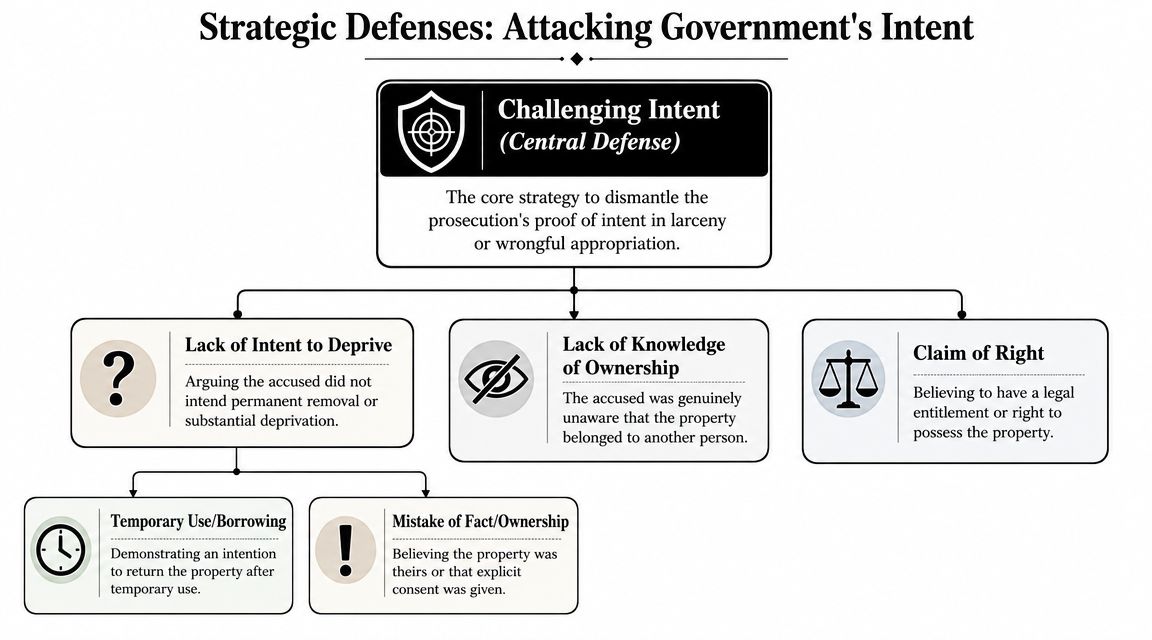
Intent is inferred not read
This is the center of the fight. The government cannot read intent directly. It has to infer intent from what happened before, during, and after the taking. That is why these cases turn on details that clients often dismiss as minor.
The line between temporary borrowing and criminal intent is a major evidentiary problem, especially in cases involving government equipment or borrowed vehicles. Wrongful appropriation requires only temporary deprivation, but proving intent from conduct after the taking is difficult. That distinction becomes critical in cases involving accidental use, borrowing without permission, mixed personal and government use, or later repayment, as discussed in this analysis of Article 121 investigations and intent.
A useful visual summary is below.
Defense themes that actually matter
Here are the defenses to look at early, because these are the pressure points that weaken Article 121 cases.
Lack of intent to deprive
Sometimes the item was taken, but the mental state the government wants isn’t there. People grab the wrong gear. They use the wrong vehicle. They think an item is unit-use equipment when it’s personally owned. They expect to return it. They act carelessly, not criminally.
That doesn’t make the situation good. It can still be charged. But it may destroy the government’s preferred theory.
Mistake of fact or ownership
This defense matters more than clients think. If you believed the property was yours, assigned to you, abandoned, or available for your use, that belief can undercut intent. The key is whether the surrounding facts support that belief.
Text messages, past practice, sign-out confusion, duplicate items, and poor labeling can all matter here.
Consent or apparent permission
Plenty of military property cases happen in environments where people routinely borrow tools, devices, keys, and vehicles informally. If a supervisor, roommate, NCO, or custodian gave permission before, that history matters. If access was usually open, that matters too.
The government wants to narrow permission. The defense often needs to widen context.
Claim of right
If you believed you had a legal or practical right to possess the property, the government’s theft theory gets weaker. This can arise in disputes over jointly used property, property left behind, items exchanged during a move, or reimbursement disputes where someone takes property believing they’re owed it.
Value is not a side issue
Value drives exposure. If the government overstates value, the charge may look more serious than the proof supports. Smart defense work doesn’t ignore valuation. It tests it.
Good defense work doesn’t just ask, “Did you take it?” It asks, “What exactly was taken, who had authority, what was your understanding, and what can the government actually prove?”
Take a common scenario. A service member uses a government tool or vehicle for a personal errand, returns it, and then makes a bad statement when questioned. The government tries to turn temporary misuse into evidence of theft by focusing on concealment, after-the-fact excuses, or unauthorized use. A strong lawyer reframes the case around temporary use, confusion over authority, lack of permanent intent, and weak proof of value or loss.
That’s how cases get reduced, beaten, or resolved on terms that protect careers instead of ending them.
Maximum Punishments and Real-World Sentencing
What the maximums look like
You need to understand the stakes without exaggerating them.
For larceny of property valued at $1,000 or less, the maximum punishment is typically a bad-conduct discharge, forfeiture of all pay and allowances, and up to 1 year of confinement. For larceny of military property over $1,000, the maximum can include a dishonorable discharge and up to 10 years of confinement. For wrongful appropriation, the maximums are lower. The $1,000-or-less category can bring up to 3 months of confinement and forfeiture of two-thirds pay per month for 3 months, while wrongful appropriation of military property over $1,000 can reach 2 years of confinement, as summarized in this Article 121 punishment overview.
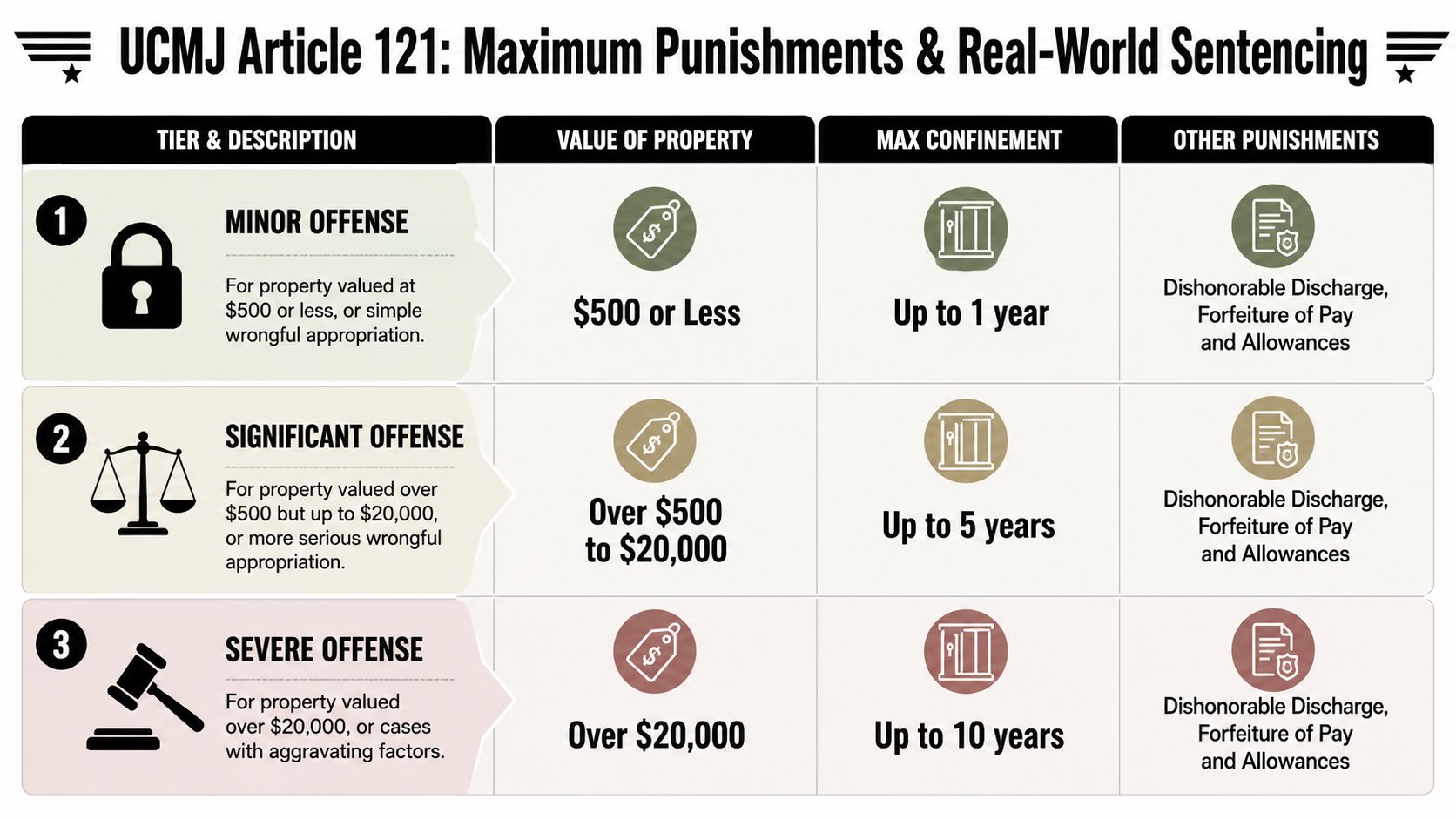
That should get your attention. It should also sharpen your strategy.
What matters in real cases
Maximum punishment is not the same thing as inevitable punishment. But it defines the danger zone. It affects negotiation, forum selection, command posture, and how aggressively the government pushes the case.
Here are the factors that often shape the practical path of an Article 121 case:
- Type of property: Military property usually drives harder treatment.
- Value disputes: If the number can be challenged, exposure may change.
- Intent evidence: Temporary use and permanent theft are not punished the same way.
- Post-incident conduct: Returning the item can help some arguments, but lying about it usually hurts.
- Service record: A strong record can matter. A bad one can make command less flexible.
- Case posture: Investigation stage, Article 15, separation action, or court-martial all create different risk calculations.
A lot of clients obsess over one question: “Am I going to jail?” That’s too narrow. You should also be asking whether this becomes a punitive discharge case, whether it triggers separation, whether rank and pay are at risk, and whether the government can be pushed off a larceny theory and toward something less destructive.
The strategic takeaway
The jump in punishment between categories is exactly why valuation and intent cannot be treated as side issues. If your lawyer isn’t fighting over those points early, you’re already behind.
Critical Mistakes That Can Destroy Your Case
Errors that come up over and over
These mistakes are common because stressed people want relief fast. They usually get the opposite.
- Talking to investigators without counsel: This is the biggest self-inflicted wound. You think you’re adding context. You’re usually adding admissions.
- Trying to explain your way out of it: Rambling is deadly in intent cases. Every extra sentence gives prosecutors more language to reinterpret.
- Consenting to phone, car, barracks, or device searches without thinking strategically: Once the government gets more evidence, you don’t get to put that back in the box.
- Contacting the complaining witness or owner: Clients do this to apologize, repay, or smooth things over. Investigators often treat it as consciousness of guilt, pressure, or witness interference.
- Trusting command to discreetly fix it: Command’s priorities are order, discipline, and optics. Your career is not their first concern.
- Waiting until charges are preferred: By then, the government may already have your statement, your texts, your search results, and a polished theory of intent.
- Assuming return or repayment ends the case: It doesn’t. Sometimes it helps. Sometimes it becomes part of the government’s narrative.
- Deleting messages or cleaning up records: That can make a weak case look far worse.
- Taking advice from friends in the unit: Barracks legal advice is how good defenses die.
Silence is not guilt. Unplanned talking is often damage.
If you’re under suspicion for UCMJ Article 121 larceny and wrongful appropriation, your first job isn’t persuasion. It’s containment. Stop making the government’s intent case for them.
Why an Experienced Civilian Defense Lawyer Is Non-Negotiable
Independence matters
You may have access to appointed military defense counsel, and many military lawyers work hard. But hard work is not the same thing as strategic advantage.
A seasoned civilian military defense lawyer brings independence that the system can’t duplicate. Civilian counsel isn’t rated by command, doesn’t rotate out, and doesn’t have to balance your case against a stack of other government-created demands inside the same institution. In serious theft-related cases, that independence matters.
Experience changes outcomes
Article 121 cases look simple from the outside. They are not. Intent cases require disciplined fact development, witness preparation, suppression analysis, cross-examination skill, and a realistic understanding of how commands react to theft allegations.
You want counsel who has lived in that fight for years, not someone learning on your case.
A strong civilian lawyer does things differently:
- Moves early: before your statement hardens into the government’s centerpiece.
- Tests the evidence: ownership, authority, valuation, digital proof, and search issues.
- Controls the theory: mistake, temporary use, consent, claim of right, weak intent.
- Pushes both tracks: criminal defense and career protection, including administrative fallout.
- Speaks bluntly: telling you what helps, what hurts, and what needs to happen now.
If you want to understand what dedicated representation looks like in these cases, review how civilian court-martial defense lawyers handle serious military charges.
The military justice system will keep moving whether you’re ready or not. The right lawyer slows the panic, finds the weak points, and starts taking control.
Frequently Asked Questions
Can I refuse to talk to CID NCIS OSI or CGIS
Yes. In most situations, the smart move is to invoke your rights and speak with counsel first. If investigators are contacting you in an Article 121 case, they’re usually trying to lock down intent and eliminate innocent explanations before you understand the danger.
If I returned the property can they still charge me
Yes. Returning property does not automatically defeat an Article 121 allegation. It may help the defense on intent, but it does not erase the government’s ability to accuse you.
What is the difference between larceny and wrongful appropriation
The difference is intent. Larceny alleges intent to permanently deprive. Wrongful appropriation alleges intent to temporarily deprive. In real cases, the fight is usually over what the facts show about your purpose and understanding.
Will I automatically go to court-martial
No. Some cases are handled through nonjudicial punishment or administrative action. But you should not relax because the command hasn’t chosen a forum yet. Early decisions often shape which path the case takes.
Does borrowing without permission count
It can. Unauthorized borrowing can support a wrongful appropriation allegation, and the government may try to push it further depending on what happened afterward. The details matter. So do your statements.
Can later repayment fix the case
Not by itself. Repayment may help presentation and mitigation, but it can also be framed by the government as a reaction after discovery. Don’t assume repayment is a substitute for defense strategy.
What if I thought I had permission
That can be a strong defense theme if the facts support it. Prior practice, shared use, unclear ownership, and communication history can all matter. Your lawyer needs to develop that evidence early.
Do I need a lawyer before charges are filed
Yes. Waiting until formal charges appear is a mistake. The investigation stage is where intent evidence gets built, shaped, and preserved.
Get Counsel Before You Try to Explain Anything
If you’re under investigation for UCMJ Article 121 larceny and wrongful appropriation, stop trying to talk your way out of it.
The government is not confused about why it wants your statement. It wants your words to prove intent. It wants to turn uncertainty into certainty. It wants to close the gaps in its case before you know where the weak points are.
That is why early action matters.
Call experienced civilian military defense counsel immediately. Get advice before you answer questions, consent to searches, hand over devices, contact witnesses, or try to “fix” the situation yourself. Your rank, your discharge, your benefits, your reputation, and your freedom may all turn on what happens in the next move.
If investigators have contacted you, or command says Article 121 is on the table, get legal help now. Waiting is not a strategy.