If you're reading this, there's a good chance your phone already lit up with a call from CID, NCIS, OSI, or command. Or a spouse, ex, parent, or supervisor just told you an allegation has surfaced. Your mind is probably in the same place as every client I talk to in this situation: shock, panic, and the dangerous belief that if you just explain yourself, this thing will go away.
It won't.
An accusation involving UCMJ Article 120b – Sexual Abuse of a Child puts your freedom, career, family, and permanent reputation in play immediately. Command won't “sort it out” for your benefit. Investigators aren't calling to clear you. They are building a case. Your job now is not to talk. Your job is to stop making the government's case easier.
Table of Contents
- Deconstructing UCMJ Article 120b What the Government Must Prove
- The Critical Battlegrounds of Age and Intent
- The Investigation and Court-Martial Process Step by Step
- Strategic Insights How We Fight Article 120b Charges
- Career Ending Mistakes to Avoid at All Costs
- Why Your Appointed Military Lawyer Is Not Enough
- Urgent Questions About Article 120b Allegations
- Can I refuse to talk to CID, NCIS, OSI, or CGIS
- Will this just stay an investigation if I cooperate
- What happens at an Article 32 hearing
- Is Article 120b separate from general sexual assault law in the military
- Does age really control how the case gets charged
- Should I wait until charges are preferred to hire a lawyer
- What should I do today
Deconstructing UCMJ Article 120b What the Government Must Prove
An Article 120b accusation is one of the most dangerous cases in military law. The punishment structure alone tells you how seriously the system treats it. Under 10 U.S.C. § 920b, rape of a child carries life without eligibility for parole and a mandatory dishonorable discharge or dismissal, sexual assault of a child carries up to 30 years of confinement and a mandatory punitive discharge, and sexual abuse of a child carries up to 20 years of confinement with punitive discharge authorized.
That means this is not paperwork trouble. This is prison exposure and a career-ending charge sheet.
The three charging tiers
Article 120b has three main offense tiers. You need to know which lane the government is trying to put you in.
| Charge tier | Basic allegation | Maximum punishment |
|---|---|---|
| Rape of a child | The most serious child-sex offense category under the statute | Life without parole plus mandatory dishonorable discharge or dismissal |
| Sexual assault of a child | A separate child-sex offense tier with severe confinement exposure | 30 years plus mandatory punitive discharge |
| Sexual abuse of a child | Often centers on a statutory “lewd act” theory | 20 years plus authorized punitive discharge |
A lot of service members make the mistake of focusing on the label. They think sexual abuse sounds less severe than rape or sexual assault. That is a rookie mistake. If you're charged with sexual abuse of a child, the government still has enough punishment power to destroy your future.
If you need context on how military prosecutors think about related sexual offense cases generally, review this overview of Article 120 sexual assault cases.
What has to be proven
The government still has to prove actual legal elements. That's where the fight starts.
For sexual abuse of a child, the key issue is usually whether the alleged conduct qualifies as a lewd act under the statute. That is not just a moral label. It is a legal requirement. Under military appellate guidance, a lewd act includes sexual contact with a child when the government can prove the required sexual intent.
Practical rule: If prosecutors can't prove the exact statutory elements, they don't get to convict you because the accusation sounds ugly.
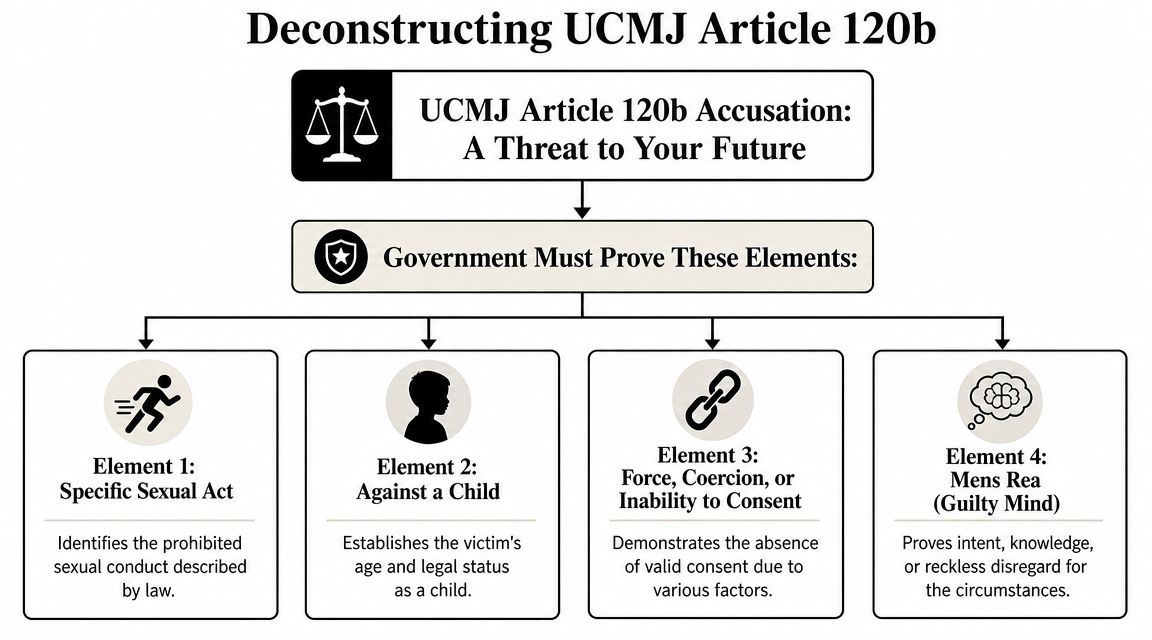
In real litigation, I break these cases down into four proof questions:
- What specific act do they claim happened
- Can they prove the alleged child's age
- Does the alleged conduct fit the statute's narrow definitions
- Can they prove the required mental state
That last point matters more than most accused service members realize. Article 120b cases are not won by emotional arguments. They are won by forcing the government to prove each element beyond a reasonable doubt, with admissible evidence, reliable witnesses, and a consistent theory.
The Critical Battlegrounds of Age and Intent
The two facts that usually matter most in these cases are age and intent. Everything else often gets argued around those points.
Age is not a side issue
Under military law, any sexual act with a child under 12 is treated as rape of a child, and for these cases the law draws hard age lines that affect how the case is charged and defended, as reflected in the military appellate digest on Article 120b lewd-act requirements. In practice, that means age is not background information. It is a liability trigger.
If the allegation involves someone older, the charging analysis shifts. The statute's structure is age-specific, and that gives prosecutors clear lanes to charge into. It also gives defense counsel clear lanes to attack. Dates matter. Birth records matter. Timeline sloppiness matters.
A related area where military prosecutors often push hard is conduct involving trainees and younger service members. That is a different statute, but the government's instinct to frame age, power, and sexual purpose aggressively shows up there too. See Article 93 prohibited activities with a recruit or trainee for that separate framework.
Intent is where many cases are won or lost
For sexual abuse of a child, the government must prove a lewd act. That means more than proving touch. They must prove the act was done with the specific intent to arouse or gratify sexual desire.
That is a huge battleground.
Touching can be innocent, accidental, misunderstood, or stripped of context by a hostile witness. Prosecutors know that. So they try to build intent from surrounding circumstances, wording, timing, prior messages, inconsistent explanations, or witness interpretation. Your defense has to attack that chain directly.
Ambiguous conduct is not automatically criminal. The government has to connect the conduct to sexual intent, and that connection is often weaker than they claim.
Here are the pressure points to focus on early:
- Context of the contact: Was this caregiving, horseplay, routine family contact, or something the government is recasting after the fact?
- Language evidence: Did anyone hear indecent language, or are investigators stretching vague statements into sexual meaning?
- Timeline consistency: Did the allegation evolve after repeated interviews or outside influence?
- Behavior after the event: Does the surrounding conduct fit the prosecution's theory of sexual purpose, or does it cut against it?
When the government can't prove intent cleanly, the case becomes much harder for them than the initial accusation suggests.
The Investigation and Court-Martial Process Step by Step
The process usually starts before you understand how serious it is. By the time law enforcement contacts you, someone has already made a report, and people inside the system are already comparing notes.
A clear process chart helps. Here is the basic path most of these cases follow.
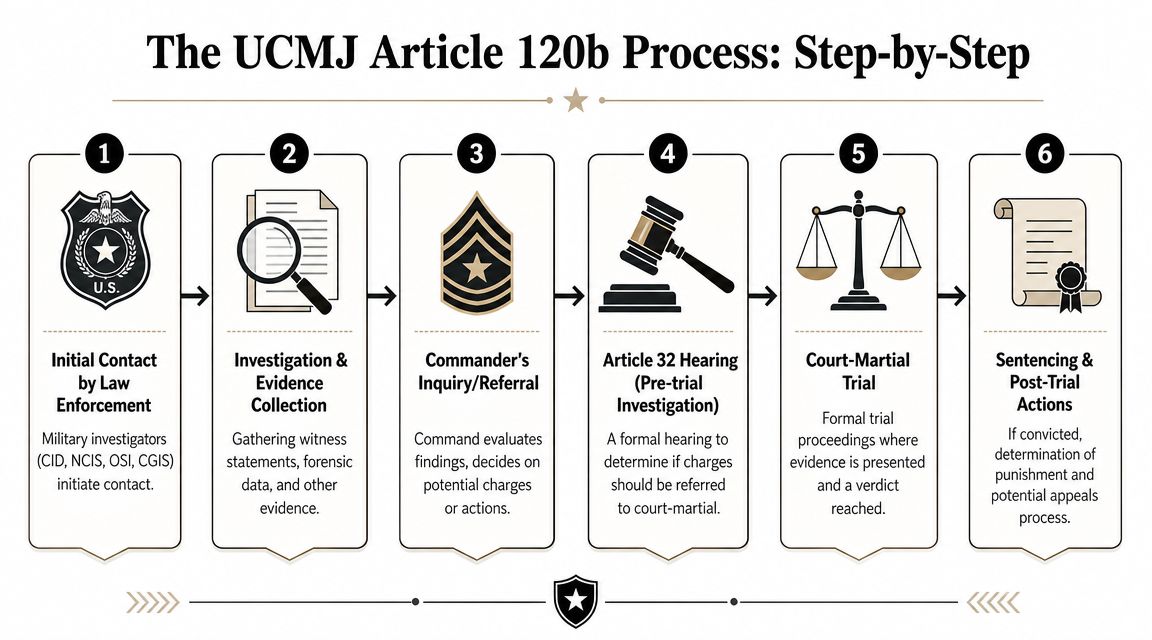
How the case usually moves
Initial contact by investigators
CID, NCIS, OSI, or CGIS reaches out. Sometimes it's framed as “just come in and clear this up.” That is interrogation language, not a favor.Evidence collection
Investigators gather statements, messages, social media, photos, and device data. They may also talk to command, family members, teachers, medical personnel, or anyone else who can help them build a narrative.Command review and charging decisions
The command starts looking at collateral issues fast. Flagging actions, no-contact directives, duty changes, clearance concerns, and reputational damage can begin before charges are preferred.
For readers dealing with parallel command fact-finding, 15-6 investigations are worth understanding because administrative inquiries can create serious downstream problems if handled badly.
Some people absorb process better by watching it explained, so here is the same material in video form:
What you should be doing at each stage
Preferral of charges
Once charges are preferred, the case turns formal. The paperwork matters. The wording matters. The date ranges matter. Small charging details can expose major weaknesses.Article 32 hearing
This is a preliminary hearing stage. It is not the final trial, but it can expose holes in the government's evidence, lock in testimony, and shape referral decisions.Court-martial trial
If the case goes forward, at this stage witness credibility, element-by-element proof, evidentiary motions, and cross-examination decide your future.
Your job at the investigation stage is simple: stop giving the government new evidence. Stop talking. Stop texting about the case. Get counsel involved.
What should be on your mind at each step?
- At first contact: invoke your rights and ask for a lawyer.
- During evidence collection: preserve your own evidence. Don't alter or delete anything.
- Before charge decisions: make sure your defense counsel is pushing back before the government's version hardens.
- Before Article 32 and trial: know that credibility and precision matter more than outrage.
The military justice system rewards early, disciplined defense work. It punishes delay.
Strategic Insights How We Fight Article 120b Charges
The government always acts like the case is obvious. It usually isn't. Article 120b prosecutions often depend on interpretation, inference, and witness credibility dressed up as certainty.
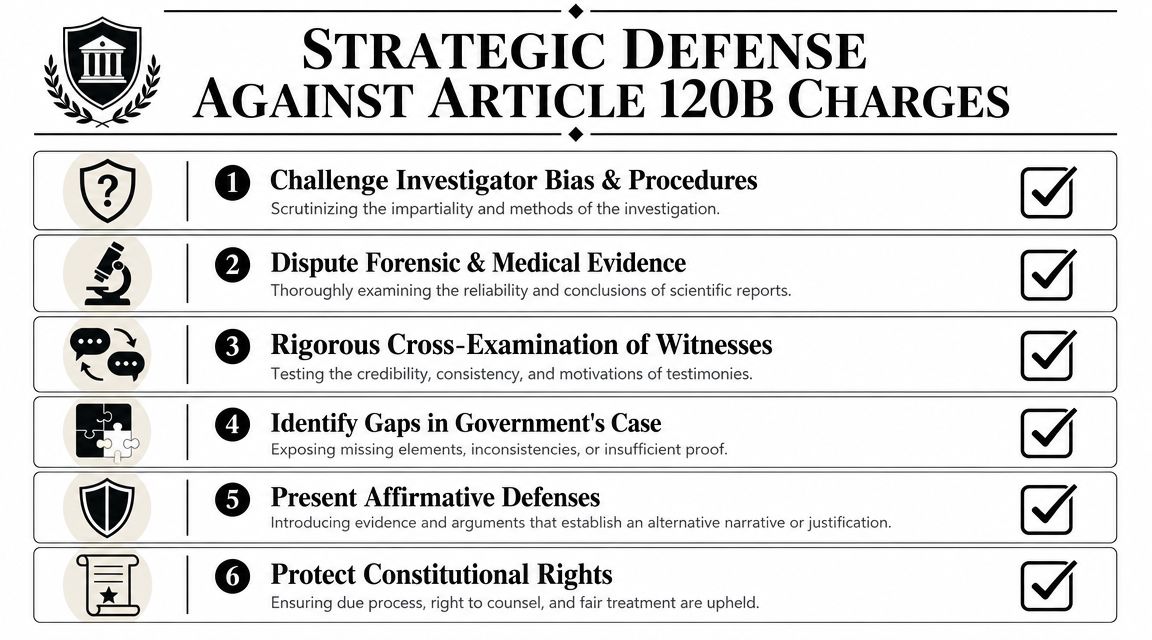
The punishment exposure drives everything. Practitioner guidance notes that sexual abuse of a child can carry up to 20 years of confinement, and that defense teams focus early on proof of age, the nature of the alleged contact, and especially specific intent because those points control both guilt and sentencing exposure, as summarized in this Article 120b defense discussion.
Attack the government's proof, not its confidence
A serious defense does not start with “my client would never do this.” That may be true, but it doesn't win a court-martial by itself.
A serious defense starts with questions like these:
- What did the witness say first, and how many times did that story change?
- Who interviewed the child, and how suggestive were those interviews?
- What independent evidence exists?
- Did investigators ignore facts that didn't fit their theory?
- Are prosecutors relying on vague language to imply sexual intent they can't prove directly?
Most weak cases don't look weak at intake. They look emotional, urgent, and overcharged.
Where experienced defense counsel finds leverage
Look for pressure points in layers.
Layer one is the allegation itself. Was the statement spontaneous, coached, repeated after prompting, or contaminated by adult influence? In child allegation cases, interview quality matters. A bad interview can infect the whole case.
Layer two is corroboration. Does the government have anything beyond accusation and interpretation? If they claim digital support exists, does it prove sexual purpose, or just contact? If they claim physical evidence exists, does it connect to the charged conduct or merely create suspicion?
Layer three is statutory fit. The government may have facts that sound bad without having facts that satisfy the statute. That's a major difference.
Use this checklist when evaluating any defense team:
| Question | Why it matters |
|---|---|
| Do they try Article 120 cases regularly | These cases turn on military evidentiary detail and trial skill |
| Do they challenge forensic interviews and digital evidence | Many prosecutions rely heavily on those categories |
| Do they build defense themes early | Waiting until referral is too late |
| Do they work independently of command pressure | Independence matters when the climate is hostile |
If you're comparing civilian military defense lawyers, the Military Justice Guide explains what to ask, and its sister directory lists civilian court-martial counsel by state and installation. Use it as a starting point, not as a substitute for interviewing lawyers yourself.
Career Ending Mistakes to Avoid at All Costs
Your instincts can wreck your case faster than the evidence.
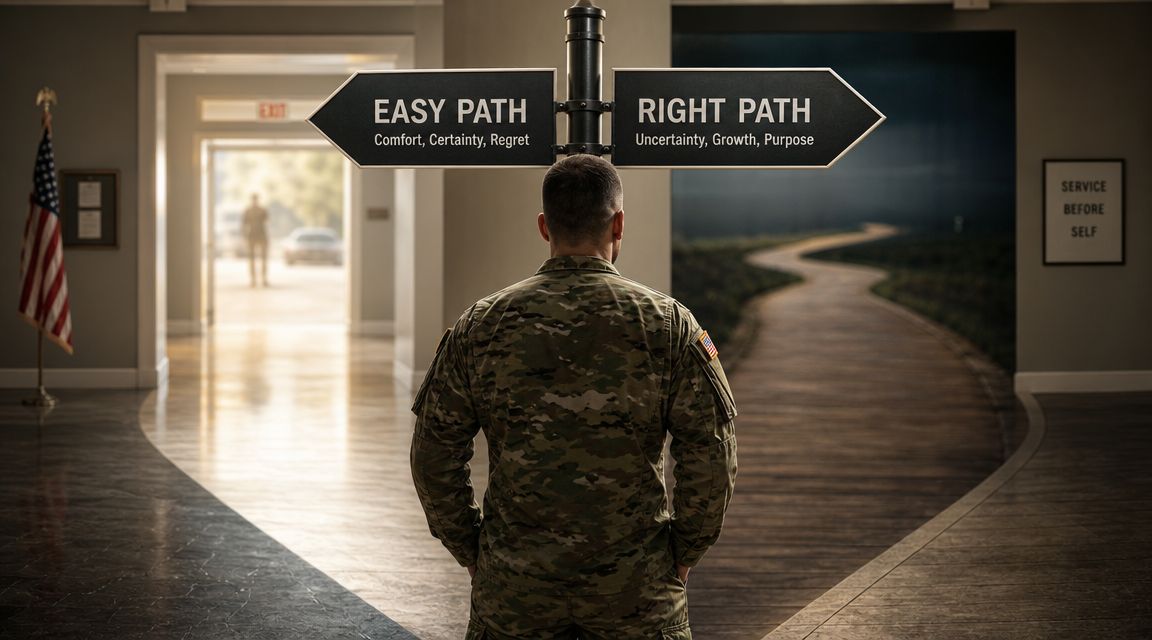
Here are the mistakes that come up over and over:
Talking to investigators to “clear things up”
You will not talk your way out of an allegation this serious. You will usually talk your way into a cleaner prosecution exhibit.Giving consent to search your phone, car, room, or house
Don't make their evidence collection easier. Let your lawyer assess the request first.Texting the accuser, family members, or mutual friends
Those messages get screenshot, forwarded, misread, and used against you.Trusting command to be neutral
Command is managing mission, optics, and risk. Command is not your defense team.Assuming “there's no evidence” means you're safe
These cases often rise or fall on statements, context, and credibility. Lack of physical evidence doesn't mean no prosecution.Deleting messages or cleaning up devices
That creates a new problem and makes innocent conduct look guilty.Waiting to hire experienced counsel because the allegation is false
False accusations still produce real investigations, real charge sheets, and real convictions when handled badly.
If you've already made one of these mistakes, don't compound it by making another. Get counsel and start damage control.
Why Your Appointed Military Lawyer Is Not Enough
You are entitled to military defense counsel. Use that right. But in a case like this, relying on appointed counsel alone is a gamble.
Many military lawyers work hard and show profound care. That isn't the issue. The issue is bandwidth, experience, and independence. Article 120b cases are technical, document-heavy, credibility-driven, and high stakes. You need someone whose practice is built around these fights.
A seasoned civilian military defense lawyer brings a different value set:
Independent judgment
Civilian counsel does not answer to your command structure.Trial-focused strategy
Strong civilian court-martial attorneys build the case backward from motion practice, witness control, and findings strategy.More time on your file
Serious sex-offense allegations demand obsessive case review. That takes time.Outside experts when needed
A real defense may require forensic, interview, digital, or medical consultation.
Here is the blunt version. If you're facing UCMJ Article 120b – Sexual Abuse of a Child, this is not the moment to hope a generalist can grow into your case. You want a specialist. Keep your appointed lawyer involved, but add experienced civilian firepower early.
Urgent Questions About Article 120b Allegations
Can I refuse to talk to CID, NCIS, OSI, or CGIS
Yes. You should invoke your rights and ask for a lawyer. Politely. Clearly. Then stop talking.
Will this just stay an investigation if I cooperate
No one can promise that. Cooperation often gives investigators more material to use against you.
What happens at an Article 32 hearing
It is a preliminary hearing where the government presents its case for referral. It is a major opportunity for the defense to test evidence, expose gaps, and lock in testimony.
Is Article 120b separate from general sexual assault law in the military
Yes. Article 120b became a standalone article after reforms around 2012, creating a distinct, age-based framework for child sexual offenses in military law, as reflected in the Army criminal law deskbook discussion of sexual offenses.
Does age really control how the case gets charged
Yes. The statute uses bright age lines, and those lines heavily shape charging decisions and defense strategy.
Should I wait until charges are preferred to hire a lawyer
No. Early action matters most in the investigation phase, when statements are being taken and evidence is still being framed.
What should I do today
Do three things. Stop discussing the allegation. Preserve all potential evidence. Retain experienced counsel immediately.
If you are under investigation or already charged with UCMJ Article 120b – Sexual Abuse of a Child, move now. Don't wait for command to “see reason.” Don't assume silence from investigators means safety. Don't gamble your future on the hope that the case is too weak to move forward.
Get a military defense lawyer who knows how to dismantle child-sex-offense allegations in the court-martial system. Your career is on the line. Your freedom may be on the line. The earlier your defense starts, the more options you keep.