The phone lights up. It’s CID. Or NCIS. Or OSI. The agent sounds calm, almost casual. They want to “get your side” and “clear a few things up.” Your first instinct is to cooperate because you know what happened, and you think truth will protect you.
That instinct gets service members charged.
An accusation under UCMJ Article 120 Sexual Assault is not a misunderstanding you can smooth over with a clean statement and good military bearing. It is the start of a machine built to collect evidence, lock in your words, frame your conduct, and move the case toward court-martial if command and prosecutors think they can get there. Once that machine starts, every hour matters. What you say, what you save, who you text, whether you panic, and whether you get a real defense strategy in place early can decide the outcome.
If you’re the accused, or your spouse, parent, or partner is reading this for you, treat this like a combat brief. You need a map. You need priorities. And you need to stop making the government’s job easier.
Table of Contents
- The Knock on the Door Your Life After an Article 120 Accusation
- Decoding UCMJ Article 120 The Four Types of Sexual Assault
- The Government’s Playbook The Investigation and Court-Martial Process
- How We Win Strategic Defenses to an Article 120 Charge
- Career-Ending Mistakes Service Members Make Under Investigation
- Beyond Jail Time The Full Consequences of an Article 120 Case
- Your Appointed Lawyer vs a Civilian Court-Martial Specialist
- Urgent Questions About Article 120 Sexual Assault Charges
- Can I refuse to talk to CID, NCIS, OSI, or CGIS
- Do I need a lawyer before charges are filed
- What happens at an Article 32 hearing
- Will I go to jail if I’m accused
- Can I refuse a polygraph
- What if the allegation is old
- Should I tell my commander my side of the story
- What should my family do right now
The Knock on the Door Your Life After an Article 120 Accusation
The call usually comes when you least expect it. You’re at work, in the barracks, driving home, or halfway through a normal day. An agent says they’d like to talk. Maybe your command tells you to report somewhere. Maybe you hear the phrase “just an allegation” and think that means the danger is still distant.
It isn’t.
This pattern has played out for years. A service member believes honesty alone will save him. He agrees to an interview. He fills in gaps because he wants to sound helpful. He guesses about times, drinks, texts, and who initiated what. Months later, prosecutors call those guesses lies, consciousness of guilt, or proof he knew more than he admitted.
That is how cases get built.
The government doesn’t need every report to become a prosecution to make this dangerous. Once an unrestricted report enters the system, momentum matters. The DoD’s FY2023 SAPRO Report data states that about 10% of an estimated 18,100 sexual assaults result in unrestricted reports, and 38% of investigated cases are referred to a general court-martial. If your case is being investigated, you are not in a casual fact-finding exercise. You are on a track that can lead straight to trial.
What investigators are actually doing
Investigators want a statement they can use. They want your phone. They want your timeline before you’ve had time to build one. They want to compare your memory today against every digital record they seize later.
They are not there to protect your career or your clearance.
Practical rule: If law enforcement contacts you about UCMJ Article 120 Sexual Assault, your first job is silence. Your second job is counsel.
What you should do in the first hours
Start here:
- Invoke your rights clearly: Tell investigators you want a lawyer and won’t answer questions.
- Preserve evidence: Save texts, call logs, photos, social media records, ride-share history, and location data.
- Stop discussing the case: Not with friends, not with your chain, not with the accuser, not in a group chat.
- Write a private timeline for your lawyer: Keep it factual. Times, places, names, messages, alcohol, witnesses.
- Get civilian defense counsel involved early: Early strategy changes outcomes. Late strategy cleans up damage.
If you remember nothing else from this article, remember this. Your case can get worse fast, and most of that damage happens before charges are even preferred.
Decoding UCMJ Article 120 The Four Types of Sexual Assault
Article 120 isn’t one offense. It’s a cluster of offenses, and the labels matter. The government charges conduct differently depending on the type of act alleged, the claimed lack of consent, and the theory they want to use at trial.
If you don’t know exactly which charge is in play, you can’t understand your exposure or build the right defense.
The four charges you need to separate immediately
Here is the clean breakdown.
| Offense | Key Elements | Maximum Confinement |
|---|---|---|
| Rape | Sexual act charged under the most serious force-based or equivalent theory | Life without parole eligibility |
| Sexual Assault | Sexual act allegedly committed without legally valid consent or under a prohibited theory such as incapacitation | Up to 30 years |
| Aggravated Sexual Contact | Sexual contact, rather than a sexual act, charged under an aggravated theory | Up to 20 years |
| Abusive Sexual Contact | Sexual contact allegedly without legally valid consent under the charged facts | Up to 7 years |
Under the current statute, this Article 120 overview explains that rape carries a mandatory minimum dishonorable discharge and a maximum of life in confinement without parole, while sexual assault carries up to 30 years confinement. The same source notes that conviction rates for tried Article 120 cases hover between 55% and 60%, and over 90% of those convicted receive a punitive discharge.
That should reset your thinking immediately. This is not a paperwork problem.
Why the exact charge matters early
The biggest mistake is accused service members treating every Article 120 allegation as basically the same. They aren’t.
A sexual act allegation and a sexual contact allegation create different litigation issues. A force theory is different from an incapacitation theory. A case built around injuries is different from a case built around memory gaps, intoxication, or delayed reporting.
Your defense strategy changes based on what the government has to prove.
The distinctions in plain English
Use this practical guide:
- Rape: The government is alleging the highest level offense under Article 120. Exposure is catastrophic, and sentencing risk alone changes how you approach every decision.
- Sexual assault: This often becomes the center of litigation over consent, alcohol, memory, statements, and digital reconstruction.
- Aggravated sexual contact: No alleged penetration, but still treated as a severe felony-level military offense.
- Abusive sexual contact: Service members sometimes underestimate this charge because the maximum punishment is lower than rape or sexual assault. That’s a mistake. A conviction can still end your career and trigger lasting consequences.
The charge sheet tells you what the government wants the panel to believe. The evidence tells you whether they can prove it.
What the law changed about these cases
Article 120 in its current form was enacted through the National Defense Authorization Act for Fiscal Year 2006 and became effective January 1, 2007, reforming how military sexual assault prosecutions were structured and consolidating offenses that had previously been spread across different articles. That overhaul mattered because the old system had been criticized for inconsistent charging and weak handling of serious sexual misconduct. If you’re fighting one of these charges today, you’re dealing with a framework designed to prosecute these cases more aggressively and more uniformly.
That doesn’t mean the government’s proof is strong. It means the system is built to move.
The Government’s Playbook The Investigation and Court-Martial Process
The military process is predictable. That helps you if you understand it early. It hurts you if you wait until your first formal hearing to get serious.
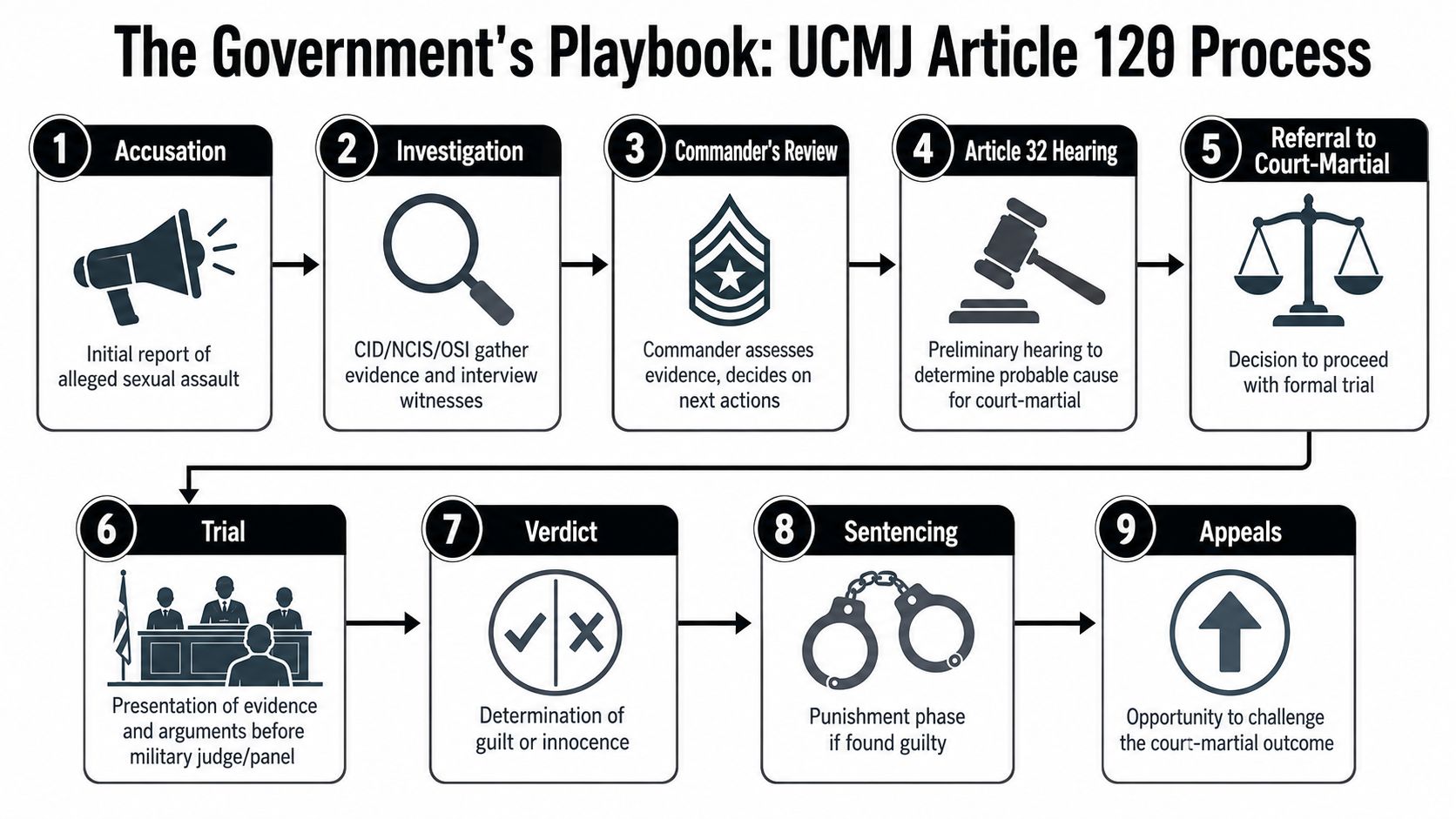
If you need a primer on who these agencies are and how they operate, review CID, NCIS, OSI, and CGIS explained. Then focus on what happens next.
Step 1 The interview trap
The first move is usually contact by law enforcement. Sometimes it’s direct. Sometimes command “requests” that you appear. Sometimes they already have a search authorization lined up for your phone or room.
At this stage, the government is trying to do three things:
- Lock you into a statement.
- Capture inconsistencies before you’ve seen the evidence.
- Gather digital material they can interpret against you.
Don’t confuse speed with strength. Fast contact often means they’re trying to get to you before you get organized.
Step 2 The command decision point
Once agents finish enough of the investigation, command reviews the file. By then, the case often looks cleaner on paper than it really is because reports tend to emphasize inculpatory facts and minimize context.
That command review matters because commanders and prosecutors are asking a practical question. Can they move this case forward without taking political heat for dropping it?
That’s one reason early defense intervention matters. A well-built defense packet, witness outreach, digital reconstruction, and targeted legal analysis can change how the case looks before referral momentum hardens.
Step 3 The Article 32 fight
The Article 32 preliminary hearing is not a full trial, but don’t underestimate it. It is your first real opportunity to expose weaknesses in the government’s case, test parts of their theory, and preserve material for cross-examination later.
Apply it for advantage, not spectacle.
A good Article 32 strategy can do several things at once:
- Freeze testimony: Statements made early matter later.
- Highlight contradictions: Weak narratives start to split when these inconsistencies emerge.
- Attack probable cause assumptions: Especially in alcohol-based and delayed-report cases.
- Educate the decision-makers: Sometimes the referral authority sees the case differently once flaws are on the record.
Most Article 120 cases are shaped before the panel ever enters the courtroom.
Step 4 Trial is built long before trial
By the time referral happens, many accused service members think the actual work is just beginning. Wrong. Trial outcomes often turn on what happened months earlier.
Here’s the basic sequence you should expect:
| Stage | What the government wants | What your defense should do |
|---|---|---|
| Investigation | Get your statement and devices | Shut down questioning, preserve evidence |
| Preferral and review | Package a clean prosecution theory | Counter with defense facts and contradictions |
| Article 32 | Survive scrutiny and keep momentum | Expose gaps and lock in testimony |
| Motions practice | Protect their evidence and witnesses | Suppress, limit, and challenge |
| Trial | Sell a simple moral narrative | Break their proof, not just their rhetoric |
| Post-trial | Preserve conviction and punishment | Protect appellate and administrative position |
The government wants a story that sounds simple. Your job is to force them back into the messy details. Times. Messages. Witness vantage points. Memory failures. Contradictory conduct. Investigative omissions.
That is how real defense work looks in UCMJ Article 120 Sexual Assault cases. Not broad denials. Precision.
How We Win Strategic Defenses to an Article 120 Charge
An accusation is only the opening move. The government still has to prove its case. In many Article 120 prosecutions, the file looks powerful until you break it apart piece by piece.

If you want to understand why early intervention matters so much, read how experienced counsel win cases during the military investigation phase. Most wins start before trial.
Consent cases are credibility wars
A large share of these cases turn on one issue. Did the government prove lack of consent beyond a reasonable doubt?
That fight is rarely won with one dramatic moment. It’s won by reconstruction. Texts before the encounter. Conduct during it. Messages after it. Witness observations. Timeline gaps. Shifts in the accuser’s language over time. What was said to friends. What was omitted in the first statement and added later.
The goal isn’t to make the panel like your client. The goal is to make the government’s version unreliable.
Here’s what experienced defense lawyers look for first:
- Story evolution: Did the account change after outside conversations?
- Behavioral mismatch: Does later conduct clash with the allegation?
- Motive: Regret, relationship fallout, fear of exposure, command pressure.
- Timeline fracture: Are the alleged facts impossible, compressed, or inconsistent with digital records?
- Missing context: What did investigators ignore because it hurt their theory?
Incapacitation cases require a different counterattack
Alcohol changes everything in these cases because prosecutors often treat drinking as a shortcut to guilt. The law is more dangerous than most service members realize.
Under Article 120(b)(3), prosecutors don’t have to prove you actually knew the accuser was incapacitated. They need to show a reasonable person in your position “should have known.” That objective standard, explained in the statutory language for Article 120, gives the government a major advantage.
That means the defense can’t just argue, “He didn’t know.” That’s too weak.
You have to attack the reasonableness premise itself. That often means:
- Objective signs: What did the accused see and hear?
- Functioning evidence: Was the complainant walking, talking, texting, making choices, or communicating clearly?
- Environmental factors: Noise, darkness, crowd conditions, fragmented observation.
- Expert support: Alcohol metabolism, variability in presentation, and limits of retrospective intoxication claims.
A strong lawyer doesn’t let the government use hindsight as proof.
Bad investigations create good defenses
Some of the strongest defenses come from the government’s own shortcuts.
Look hard at these failure points:
| Weak spot | Why it matters |
|---|---|
| Incomplete witness interviews | Neutral witnesses often carry the context investigators skipped |
| Phone extraction delay or tunnel vision | Agents may seize data but analyze only what supports the allegation |
| Inconsistent summaries | Report language can flatten uncertainty into false certainty |
| Overreliance on memory claims | Memory loss is not proof of assault |
| Poor scene reconstruction | Physical layout and movement often expose impossible allegations |
Good defense work doesn’t chase every issue. It picks the pressure points that collapse the government’s theory.
That’s how we win these cases. Not by hoping the panel sees fairness on its own. By forcing the government to prove what it usually assumes.
Career-Ending Mistakes Service Members Make Under Investigation
Your instincts under pressure can destroy your case. Smart, disciplined service members can wreck strong defenses by acting before they think.
The mistakes that wreck defense cases
Talking to investigators to “clear it up”
This is the most common mistake. You think an innocent explanation helps. In reality, you give them a transcript to dissect, compare, and weaponize.Texting the accuser
Even a polite message can become evidence of guilt, pressure, witness influence, or consciousness of wrongdoing.Trusting command to protect you
Command may act professionally, but command is not your defense team. Command also has institutional pressures you do not control.Believing there’s no case because there’s no DNA
Article 120 cases are often built on statements, timelines, credibility, and digital fragments. Lack of physical evidence doesn’t stop prosecution.Deleting messages or cleaning up your phone
That move looks terrible, and it can destroy material that would have helped you.Talking to friends, roommates, or coworkers
Loose talk becomes witness testimony. People misremember, embellish, or try to save themselves.Waiting too long to hire counsel
Delay gives the government a head start on evidence framing, witness access, and narrative control.Failing to preserve old records in delayed-report cases
Since the statute of limitations for Article 120 offenses was eliminated as of January 1, 2019, allegations can surface decades later. As noted in this analysis of defending old Article 120 cases, contemporaneous evidence like texts, emails, and command records becomes critical when cases rely heavily on degraded memories and testimonial evidence.
Save first. Speak later. Preferably never, except through counsel.
If you’re already under investigation, go backwards through your recent actions and stop the bleeding. Silence. Preservation. Counsel. Those three steps still matter even if you’ve already made mistakes.
Beyond Jail Time The Full Consequences of an Article 120 Case
Too many service members think the only question is whether they’ll go to jail. That’s far too narrow. An Article 120 case can break your career, clearance, reputation, and post-service life even before a conviction.

The punishment doesn’t stop with the sentence
For the most serious Article 120 offenses, convictions can trigger lifetime sex offender registration under DoD rules and SORNA, in addition to confinement, discharge, and forfeitures. That means where you live, where you work, what jobs you can hold, and how your name appears in background systems can all change permanently.
Security clearance damage is often just as devastating. Under DoD Directive 5220.6 and SEAD 4, a sustained Article 120 allegation or conviction can trigger clearance revocation proceedings. According to this discussion of Article 120 and clearance fallout, DCSA data from 2025 showed 4,728 revocations linked to sexual misconduct. If you work in intelligence, aviation, cyber, or special operations, that collateral consequence can end your profession even apart from the criminal case.
Why acquittal may not end the fight
Here is the part many families never see coming. Even after an acquittal, the military may still pursue:
- Administrative separation
- A GOMOR or equivalent reprimand
- Adverse evaluations
- Career stagnation
- Clearance problems
- Loss of trust inside the unit
This matters early because strategy has to account for more than the verdict form. A narrow trial win with a terrible administrative record can still destroy your future.
There’s also a practical reality in some cases. You may face pressure from both military and civilian authorities depending on the facts and location. When that risk exists, defense planning has to be coordinated from the start. Forum choice, statement control, and evidence handling get more complicated fast.
If you’re only thinking about confinement, you’re planning too late and too small.
Your Appointed Lawyer vs a Civilian Court-Martial Specialist
You are entitled to appointed military defense counsel. Use that right. But don’t confuse constitutional minimums with optimal defense in a high-risk sexual assault case.
The real differences that matter
A typical appointed lawyer may be smart, ethical, and hardworking. But Article 120 litigation is unforgiving. It demands cross-examination skill, command-level credibility, expert witness judgment, digital evidence strategy, and trial seasoning that often comes only from deep repetition.
The differences usually come down to this:
- Caseload: Appointed counsel often carry many matters at once.
- Experience concentration: A civilian court-martial specialist may spend a career focused on military criminal defense.
- Independence: Civilian counsel is outside the chain and not shaped by office rotation cycles.
- Resources: Complex sexual assault cases often need independent investigators and experts.
- Continuity: Your civilian lawyer doesn’t PCS in the middle of your case.
This is not a knock on military defense counsel. It’s a reality statement. In a serious UCMJ Article 120 Sexual Assault case, trial experience and strategic focus matter.
If you’re trying to compare options, review practical criteria in this guide on how to choose a military defense lawyer.
Interview more than one lawyer. Ask who tries these cases. Ask who handles experts. Ask who builds the timeline. Ask who will be in court, not just who answers the intake call.
Urgent Questions About Article 120 Sexual Assault Charges
Can I refuse to talk to CID, NCIS, OSI, or CGIS
Yes. You should invoke your right to remain silent and ask for a lawyer. Silence is not guilt. It is discipline.
Do I need a lawyer before charges are filed
Yes. The investigation phase is where many cases are won or lost. Waiting for charges means you’re already behind.
What happens at an Article 32 hearing
It is a preliminary hearing where the government’s case gets tested. It is not the final trial, but it can expose weaknesses, preserve testimony, and shape referral decisions.
Will I go to jail if I’m accused
Being accused is not the cause. Jail exposure results from conviction and sentencing. However, the potential consequences are significant enough that you should act as if your liberty is at risk from the first day.
Can I refuse a polygraph
You can refuse. Whether taking one is smart depends on the facts, the forum, and your counsel’s advice. Don’t make that decision alone.
What if the allegation is old
Old allegations are dangerous because memory fades and records disappear. That makes preservation, reconstruction, and experienced defense work even more important.
Should I tell my commander my side of the story
Not without legal advice. Command is not a confidential safe space, and your statement can travel fast.
What should my family do right now
Help preserve records, stop harmful communication, and help you retain qualified counsel quickly.
If you are under investigation for UCMJ Article 120 Sexual Assault, act now. Stop talking. Stop texting. Stop assuming this will blow over.
Get your evidence preserved. Get your timeline built. Get a real defense strategy in place before investigators and prosecutors define the case for you.
Your career is on the line. Your freedom may be on the line. Your clearance, retirement, and reputation are absolutely on the line. Waiting is not a strategy. Contact experienced civilian military defense counsel immediately.