Under R.C.M. 916(h), duress is available as an affirmative defense to nearly any UCMJ offense except killing an innocent person, but only when unlawful human coercion caused the act, the apprehension involved immediate death or serious bodily injury, the fear continued during the offense, and no reasonable escape existed. Once the defense is reasonably raised, the prosecution must disprove it beyond a reasonable doubt.
You may be reading this after a CID, NCIS, OSI, or CGIS contact, a command-directed interview, or a conversation in which someone warned you that a family member would be harmed if you refused an order. You may also be facing a charge based on conduct you performed while deployed, isolated, controlled by another person, or convinced that reporting the threat would make the danger worse. Your career, liberty, clearance, reputation, and family stability can all be affected before a court ever hears the word “duress.”
Table of Contents
- Why This Guide Exists for Service Members
- The Legal Elements of Duress Under R.C.M. 916(h)
- How Military Duress Differs from Civilian Standards
- Key Cases That Define What Works in Court-Martial
- The Evidence Gap Most Service Members Miss
- Trial Strategy and Sentencing Uses for Duress
- Appellate Considerations and Preservation Rules
- Common Mistakes That Destroy a Duress Defense
- Why Civilian Defense Counsel Matters
- Frequently Asked Questions About the Defense of Duress
- Can I refuse to talk to CID, NCIS, OSI, or CGIS?
- Is duress available for every UCMJ offense?
- Does fear of losing my career qualify as duress?
- Can a delayed threat be immediate?
- What happens if the judge won’t give the duress instruction?
- Can a threat involving suicide support duress?
- Will duress keep me out of jail?
- Do I need a lawyer immediately?
Why This Guide Exists for Service Members
The defense of duress is often described too casually. Someone threatened you, so you raise duress. That explanation is incomplete and can create dangerous confidence. Military courts demand a connection between a specific unlawful threat and each act charged, not merely a general atmosphere of fear or pressure.
This guide is for active-duty personnel, Guard and Reserve members, military spouses, and families dealing with an investigation, Article 15 or NJP, administrative separation, or court-martial. It also matters to anyone contacted by CID, NCIS, OSI, or CGIS who believes another person forced the conduct now under scrutiny.
A realistic case may involve a junior service member ordered by a criminal associate to transport property, a deployed member threatened with harm to a partner, or a person controlled by an abusive intimate partner who believes command notification will trigger immediate retaliation. The command may see only the completed act. Defense counsel must reconstruct the coercion that surrounded it.
Practical rule: A duress theory lives or dies on the timeline. Preserve what happened before, during, and immediately after each charged act.
The defense can sometimes defeat criminal liability, but it isn’t a general answer to poor judgment, career pressure, embarrassment, loss of promotion, or fear of disciplinary consequences. The earlier you identify the theory, the sooner counsel can preserve messages, identify witnesses, examine command notifications, and challenge an investigation that treated the accused as a willing participant.
For foundational context on the military justice process, review these court-martial basics, then obtain advice suited to your facts. Do not give investigators a polished explanation before a defense lawyer has tested whether the evidence supports every required element.
The Legal Elements of Duress Under R.C.M. 916(h)
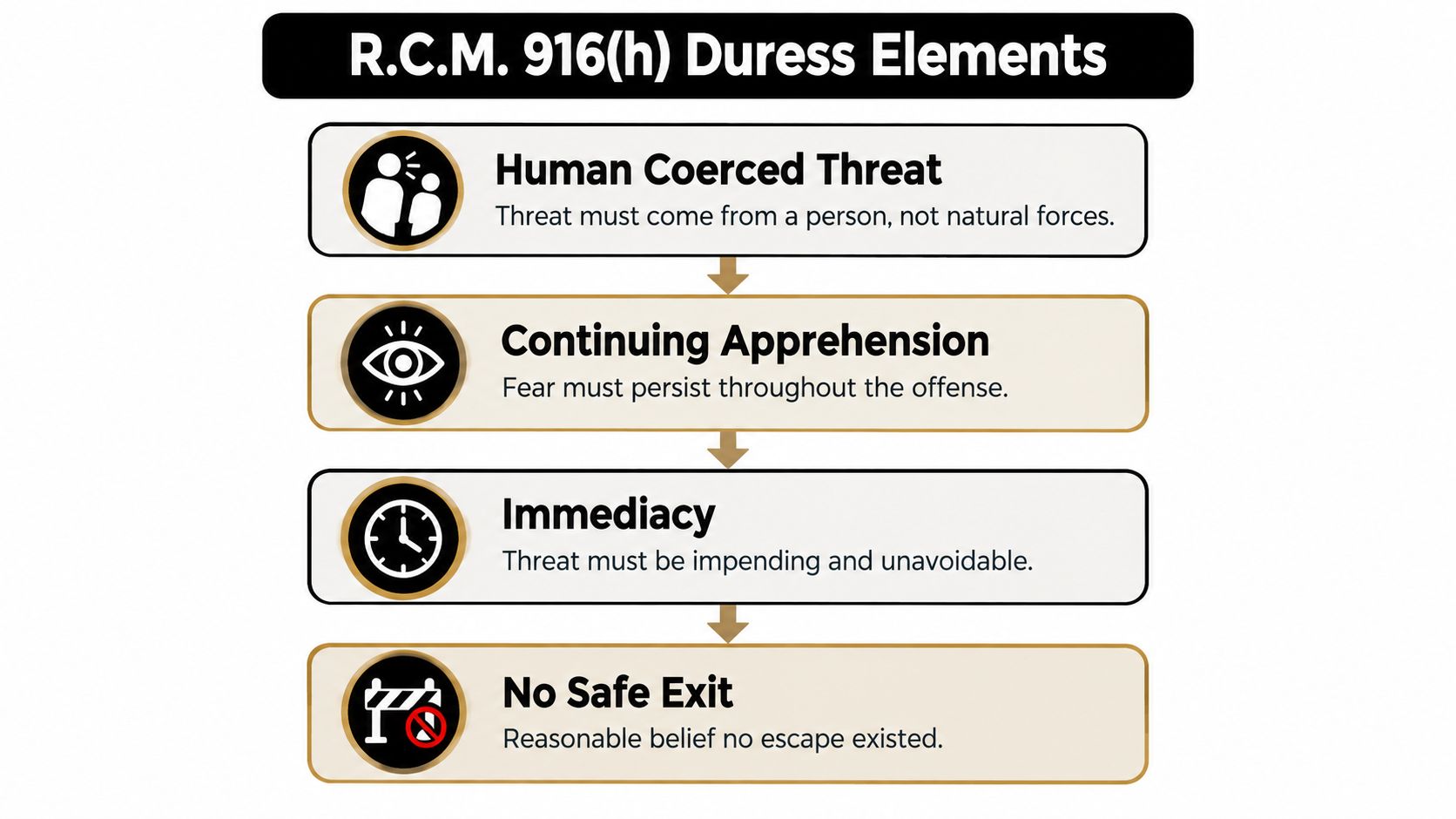
R.C.M. 916(h) provides the operative military framework. The rule recognizes duress as an affirmative defense to nearly any offense except killing an innocent person. The accused must produce some evidence that participation was caused by a reasonable apprehension of immediate death or serious bodily injury. If the issue is reasonably raised, the prosecution must disprove duress beyond a reasonable doubt. The Court of Appeals for the Armed Forces’ discussion of R.C.M. 916(h) explains that the defense is not established by fear alone.
Human coercion must cause the conduct
Duress generally requires a threat arising from another person’s unlawful conduct. Natural forces, financial inconvenience, operational hardship, or ordinary command pressure belong in a different legal analysis, often necessity or mitigation. Counsel must identify the person making the threat, the threatened victim, the words or conduct used, and the precise act the threat allegedly compelled.
The apprehension must be reasonable and immediate
The question isn’t whether you felt anxious. It is whether the circumstances created a reasonable apprehension of immediate death or serious bodily injury. Military courts examine the surrounding facts, including the accused’s access to help, isolation, location, relationship to the coercer, and ability to protect the threatened person.
Immediacy isn’t always measured by a clock. A threat involving harm on a later date may still present an immediate danger if the accused has no meaningful opportunity to contact authorities, protect the victim, or safely disengage. That doesn’t make every delayed threat sufficient. It makes the factual record essential.
Fear must continue throughout the offense
A threat that explains an initial decision may not explain later conduct. Investigators and trial counsel will examine pauses, later communications, travel, access to a phone, contact with command, and any other event that could have allowed safe withdrawal. The prosecution will argue that an intervening opportunity broke the causal chain.
No reasonable escape and proportionality
The defense weakens when a safe avenue of escape existed before or during the offense. The threatened harm must also be more serious than the offense committed. Killing an innocent person remains outside the ordinary scope of the rule, even where the accused claims coercion.
That makes evidence selection decisive. Messages, witness testimony, prior reports, medical records, location data, command notifications, and proof that contacting authorities wasn’t realistically safe can help establish the sequence. None is automatically conclusive. Each must fit a coherent account of why the threat caused the charged conduct.
How Military Duress Differs from Civilian Standards
Civilian duress law isn’t one uniform doctrine. The modern American framework is strongly associated with § 2.09 of the Model Penal Code, which uses unlawful force or threats and asks whether a person of reasonable firmness in the defendant’s situation would have been unable to resist. The provision also limits the defense when the defendant recklessly placed themself in a situation where duress was probable. The Model Penal Code discussion of duress describes the combined threat and reasonableness approach.
Military practice is narrower in important ways. R.C.M. 916(h) focuses on immediate death or serious bodily injury, continuing apprehension, causation, a human threat, and the absence of a reasonable opportunity to avoid the offense. Civilian cases about economic pressure, hard bargaining, psychological influence, or broad subjective fear may distract from the military elements rather than help prove them.
| Factor | UCMJ Practice | Civilian/MPC Influence |
|---|---|---|
| Source of danger | Generally requires another person’s unlawful threatening conduct | MPC centers on unlawful force or threats |
| Harm required | Immediate death or serious bodily injury | The formulation may be broader depending on jurisdiction |
| Timing | Fear must remain operative during the criminal act | Courts often examine immediacy and resistance under the circumstances |
| Escape | A reasonable opportunity to avoid the offense can defeat the defense | The MPC uses a reasonable-firmness inquiry |
| Homicide | R.C.M. 916(h) excludes killing an innocent person | Jurisdictions differ sharply on murder and partial defenses |
The policy conflict is especially visible in homicide cases. A 2008 survey summarized in the Oxford Handbook of Philosophy of Criminal Law found that 12 American states followed the Model Penal Code approach by statute and one additional state followed it by case law, allowing duress to be raised even in murder prosecutions. The same survey reported partial defenses in two states by case law, while 17 states by statute and 14 by case law retained a no-defense rule for murder. The Oxford Handbook discussion of the homicide divide shows why civilian precedent must be handled carefully.
For a service member, command structure changes the evidence. A threat may occur in a barracks room, during deployment, inside an abusive relationship, or in a unit where reporting appears unsafe. Those facts can matter, but they don’t eliminate the requirement to prove the military elements.
Key Cases That Define What Works in Court-Martial
In United States v. Washington, the Court of Appeals for the Armed Forces identified three practical limits. The threat must involve serious imminent harm, the offense committed must be lesser than the threatened harm, and an obviously safe avenue of escape can defeat the defense. The court also recognized that a military judge must instruct the members on duress when some evidence reasonably raises the issue.
That instruction issue matters. The accused doesn’t have to prove duress before receiving the instruction. Defense counsel must identify evidence that, if believed, could support the elements. A judge shouldn’t require the defense to win the factual dispute before allowing the members to decide it.
Consider a hypothetical. A service member receives a credible threat against a spouse and transfers information while physically isolated from command resources. The defense needs more than testimony that the member was frightened. It needs the threat, the timing, the member’s access to help, the reason reporting wasn’t safe, and evidence that the fear remained operative during the transfer.
The government may respond that the member had a phone, passed a law-enforcement office, or spoke with a trusted person. Those facts don’t automatically defeat duress, but they create a factual dispute about escape and causation. The defense must explain why those options weren’t realistically safe under the circumstances.
United States v. Hayes addressed threats involving suicide. The court held that R.C.M. 916(h) doesn’t categorically bar a duress defense based on such a threat. The inquiry still requires an immediate threat of death or serious bodily injury, a well-grounded fear that the threat would be carried out, and no reasonable opportunity to avoid the harm. The CAAF opinion addressing Washington and Hayes leaves application to the facts.
The lesson is precise. A suicide-related threat isn’t automatically enough, and it isn’t automatically excluded. Counsel must prove credibility, immediacy, causation, and the absence of a safe alternative through admissible evidence.
The Evidence Gap Most Service Members Miss
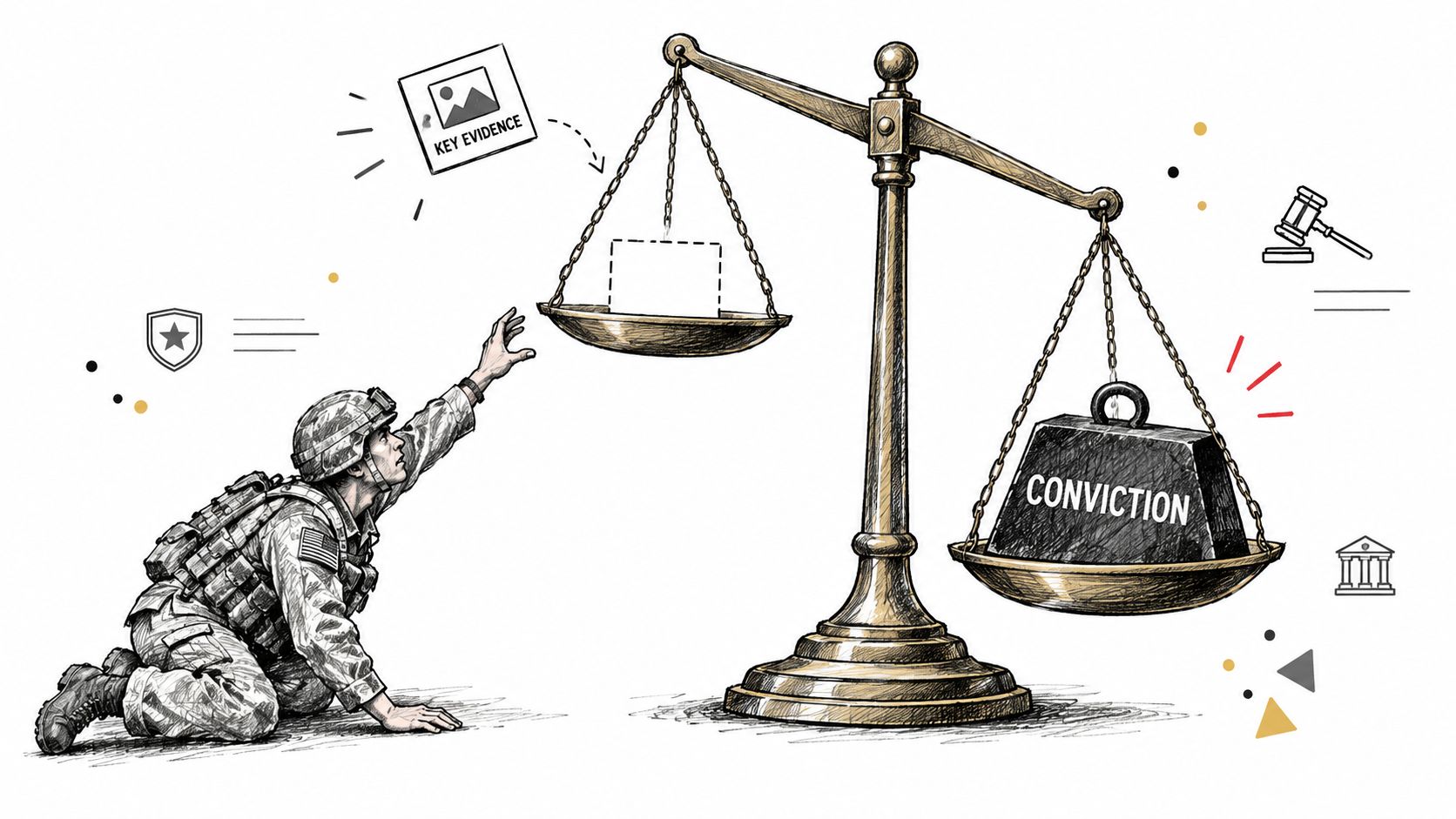
Raising duress is easier than proving it. Routine professional pressure, fear of losing a career, embarrassment, social retaliation, or an unpleasant order generally won’t satisfy the military standard. The threat must involve another person’s unlawful conduct and create a reasonable apprehension of immediate death or serious bodily injury, with fear continuing during the offense and no reasonable opportunity to avoid it. The 2024 Manual for Courts-Martial.PDF) sets out that constrained framework.
Situational immediacy matters
A delayed threat isn’t automatically stale. If a coercer threatens to kill someone “the next day,” the danger may still be immediate when the accused has no meaningful way to contact law enforcement, protect the victim, or avoid the compelled act. The defense must show why the passage of time didn’t create a safe option.
Command climate can become part of that explanation. A service member may fear that reporting will expose the threatened person, trigger retaliation, or place the member under the coercer’s control before protection is available. Those concerns need evidence, not speculation.
A useful investigation record may include:
- Threat communications: Preserve texts, emails, direct messages, voicemails, photographs, and call records without editing or selectively deleting context.
- Prior warnings: Identify reports to command, medical personnel, family members, law enforcement, or trusted colleagues.
- Physical and medical evidence: Medical records, injury photographs, treatment notes, and records documenting the coercive relationship may establish vulnerability and credibility.
- Location and timing: Location data, duty schedules, travel records, access logs, and messages can test whether escape was realistically available.
- Operational constraints: Document deployment conditions, communications limits, confinement, transportation control, language barriers, and the practical risks of contacting authorities.
The strongest file tells a time-sequenced story. It shows what the coercer knew, what the accused feared, what alternatives existed, and why each charged act occurred when it did.
Later, counsel should compare that record with the investigative narrative. A useful discussion of defense work during the military investigation phase can help families understand why early evidence preservation matters before memories and devices change.
Investigators may collect the completed act first and only later ask whether coercion existed. That sequence can produce a misleading record. Defense counsel should test omitted witnesses, missing messages, selective interviews, command assumptions, and whether the investigator treated fear as an excuse rather than investigating the threat itself.
Trial Strategy and Sentencing Uses for Duress
A duress theory should begin during the investigation, not on the morning trial starts. Counsel should create a chronology that connects every threat to every charged act and identifies what happened between them.
Step 1 Build the causal record
Write down the sequence privately for counsel. Identify the threat, the threatened person, the exact harm feared, the location, available communications, attempted reports, and the moment each act occurred. Don’t circulate a narrative to command or investigators before counsel reviews it.
Step 2 Test the escape theory
List every alleged escape route and analyze it realistically. Could the accused leave? Could the threatened person be protected? Was contacting command safe? Did the coercer control transportation, weapons, communications, housing, or access to medical care? A theoretical option may not be a reasonable option.
Step 3 Secure the instruction
At trial, counsel must identify evidence sufficient to raise duress and request the appropriate instruction. Objections and proffers should preserve the issue if the judge refuses, narrows, or inaccurately describes the defense.
Step 4 Use the facts honestly at sentencing
Sometimes the evidence won’t support a complete acquittal theory, yet coercion remains powerful mitigation. Counsel can present the threats, vulnerability, command environment, and reduced moral blameworthiness without overstating the legal defense.
| Scenario | Likelihood of Viability | Key Evidence Needed |
|---|---|---|
| Direct threat of immediate serious bodily injury | Stronger when independently corroborated | Messages, witnesses, prior reports, medical records |
| Threat against an innocent family member | Fact dependent | Proof of credibility, timing, access to protection |
| Suicide-related threat | Fact dependent, not categorically barred | Evidence of immediate danger, credibility, and no safe alternative |
| Career or social pressure alone | Generally weak | Evidence showing an unlawful physical threat, if one exists |
| Conduct after a clear safe opportunity | Weakened substantially | Explanation of why the option wasn’t actually safe |
The central trade-off is credibility. A disciplined, limited theory can survive scrutiny. An exaggerated claim that labels every command demand as coercion can damage both the duress issue and the accused’s overall credibility.
Appellate Considerations and Preservation Rules
Appellate strategy starts before trial. If the military judge refuses a duress instruction, limits relevant evidence, excludes corroborating records, or accepts an incomplete theory of causation, counsel must create a clear record of what the defense offered and why it mattered.
Preservation usually requires more than disagreement. Counsel should identify the ruling, explain the legal basis, make the necessary proffer, and state the prejudice. If evidence was excluded, the record should show its substance through a stipulation, witness testimony, document, or other permitted method.
The instruction record
An appellate court needs to know what evidence reasonably raised the defense. That means counsel should tie the proffer to the elements:
- Threat: Who made it and why was it unlawful?
- Harm: Why did it involve death or serious bodily injury?
- Causation: Which charged act did it cause?
- Continuity: Why did the apprehension persist?
- Escape: Why wasn’t a reasonable alternative available?
A vague request for a “duress instruction” may not preserve the factual theory adequately. The record should show the exact instruction requested and the evidence supporting it.
The evidentiary record
Credibility disputes often determine duress cases. If the prosecution relies on delayed reporting, inconsistent statements, or later contact with the coercer, counsel must explain those facts before they become an unexplained contradiction. A military judge or panel may interpret silence as consent unless the defense supplies the reason for silence.
The same discipline applies to Article 31 rights. Statements obtained during a rights problem can shape the entire case, including the duress narrative. Counsel should address Article 31 of the UCMJ early, before investigators define the record through an unwarned or coercive interview.
The factual record after an adverse result
An unsuccessful trial doesn’t end the value of the defense. A preserved duress issue may support appellate review, while an unpreserved objection can leave a strong argument difficult or impossible to raise. Civilian counsel should coordinate with appointed counsel, protect exhibits, identify rejected instructions, and maintain a complete chronology for review.
Common Mistakes That Destroy a Duress Defense
- Talking to investigators without counsel: A spontaneous explanation can contain omissions, contradictions, or admissions that the government later uses to show voluntary participation.
- Calling ordinary pressure duress: Fear of career consequences, embarrassment, poor evaluations, or discipline doesn’t ordinarily meet the death-or-serious-bodily-injury standard.
- Waiting to preserve digital evidence: Messages disappear, accounts change, and witnesses forget sequence. Preserve material lawfully and give it to counsel.
- Ignoring the threatened person: The defense must explain who faced harm and why the threat was credible. A vague reference to “my family” leaves the fact-finder without context.
- Overstating the claim: Exaggeration invites impeachment. A narrower theory supported by records is usually more durable.
- Assuming delayed conduct defeats the defense automatically: Timing matters, but situational immediacy can exist when no meaningful safe option was available.
- Failing to explain silence: Not reporting may look voluntary unless counsel develops the command-climate, safety, and retaliation evidence behind that decision.
- Treating appointed counsel as an enemy: Military defense counsel owe professional duties to the accused. Communicate fully, ask hard questions, and obtain independent advice when the case is serious or unusually complex.
- Waiting until trial to choose strategy: Investigation decisions affect admissibility, witness memory, command action, and the ability to build a coherent causal record.
Why Civilian Defense Counsel Matters
Military-appointed counsel are part of the defense system and may provide capable representation. The issue in a serious duress case is often capacity and specialized experience, not a simple judgment about loyalty. These cases require simultaneous work on military law, digital evidence, command dynamics, witness safety, expert consultation, trial presentation, and appellate preservation.
A civilian military defense lawyer brings independence from the accused’s command structure. That independence can matter when the theory implicates a superior, a unit culture, an investigative failure, or a command decision that made reporting appear unsafe. Civilian counsel can also begin work before charges, coordinate with appointed counsel, and help the family preserve evidence without turning the family into uncontrolled witnesses.
What experienced counsel looks for
A strong UCMJ lawyer will ask questions that go beyond “Were you threatened?”
- What exact words or conduct conveyed the threat?
- Who was supposed to be harmed?
- Why did you believe the coercer could carry it out?
- What did you do after receiving the threat?
- What options did you consider?
- Why wasn’t command, law enforcement, or a medical provider a safe alternative?
- Did the fear continue during every charged act?
- What evidence confirms the timeline?
Court-martial attorneys also examine the government’s weaknesses. Did investigators interview the coercer but not the threatened person? Did they preserve only selected messages? Did command personnel interpret a delayed report as proof that no threat existed? Did the government charge conduct that occurred after the alleged danger had ended?
Speak with more than one lawyer when possible, ask who will handle the case personally, and demand a clear explanation of the proposed strategy.
Frequently Asked Questions About the Defense of Duress
Can I refuse to talk to CID, NCIS, OSI, or CGIS?
You should not answer substantive questions before consulting a military defense lawyer. Ask whether you are suspected or accused, invoke your rights clearly, and avoid guessing, minimizing, or trying to “clear things up” informally. Your lawyer can address the interview and determine whether a controlled statement serves your defense.
Is duress available for every UCMJ offense?
R.C.M. 916(h) makes duress available to nearly any offense except killing an innocent person. The defense still requires evidence of unlawful human coercion, immediate death or serious bodily injury, continuing apprehension, causation, and no reasonable escape. The charge and facts must be analyzed together.
Does fear of losing my career qualify as duress?
Usually not by itself. Career consequences, embarrassment, poor evaluations, social pressure, or nonviolent retaliation generally don’t satisfy the military threshold. A separate unlawful threat involving death or serious bodily injury may change the analysis.
Can a delayed threat be immediate?
Yes, potentially. A threat involving future harm may be situationally immediate when the accused has no meaningful way to protect the threatened person, contact authorities, or safely avoid the offense. The evidence must explain why the delay didn’t create a reasonable escape.
What happens if the judge won’t give the duress instruction?
Counsel should make a specific request, identify the evidence supporting each element, object to the refusal, and preserve the proffer for review. The accused doesn’t have to prove duress before receiving an instruction when some evidence reasonably raises the defense.
Can a threat involving suicide support duress?
It isn’t categorically barred. Under United States v. Hayes, the facts must still show an immediate threat of death or serious bodily injury, a well-grounded fear that the threat would be carried out, and no reasonable opportunity to avoid the harm.
Will duress keep me out of jail?
No lawyer can promise that. Duress may support acquittal if the government cannot disprove it, but the outcome depends on the charge, evidence, credibility, forum, and sentencing exposure. Even when a complete defense is uncertain, coercion may affect charging, negotiations, trial presentation, and sentencing.
Do I need a lawyer immediately?
Yes, if investigators have contacted you, command is considering action, or you believe coercion explains conduct under investigation. Early counsel can protect rights, preserve evidence, identify witnesses, and stop an incomplete investigative narrative from becoming the government’s version of events.
If you’re under investigation or facing UCMJ action, contact an experienced civilian military defense lawyer now. Do not delete messages, contact the alleged coercer, brief witnesses, or give investigators a detailed account before counsel advises you. Your career, liberty, and the credibility of your defense are already at risk, and the evidence needed to prove duress won’t preserve itself.