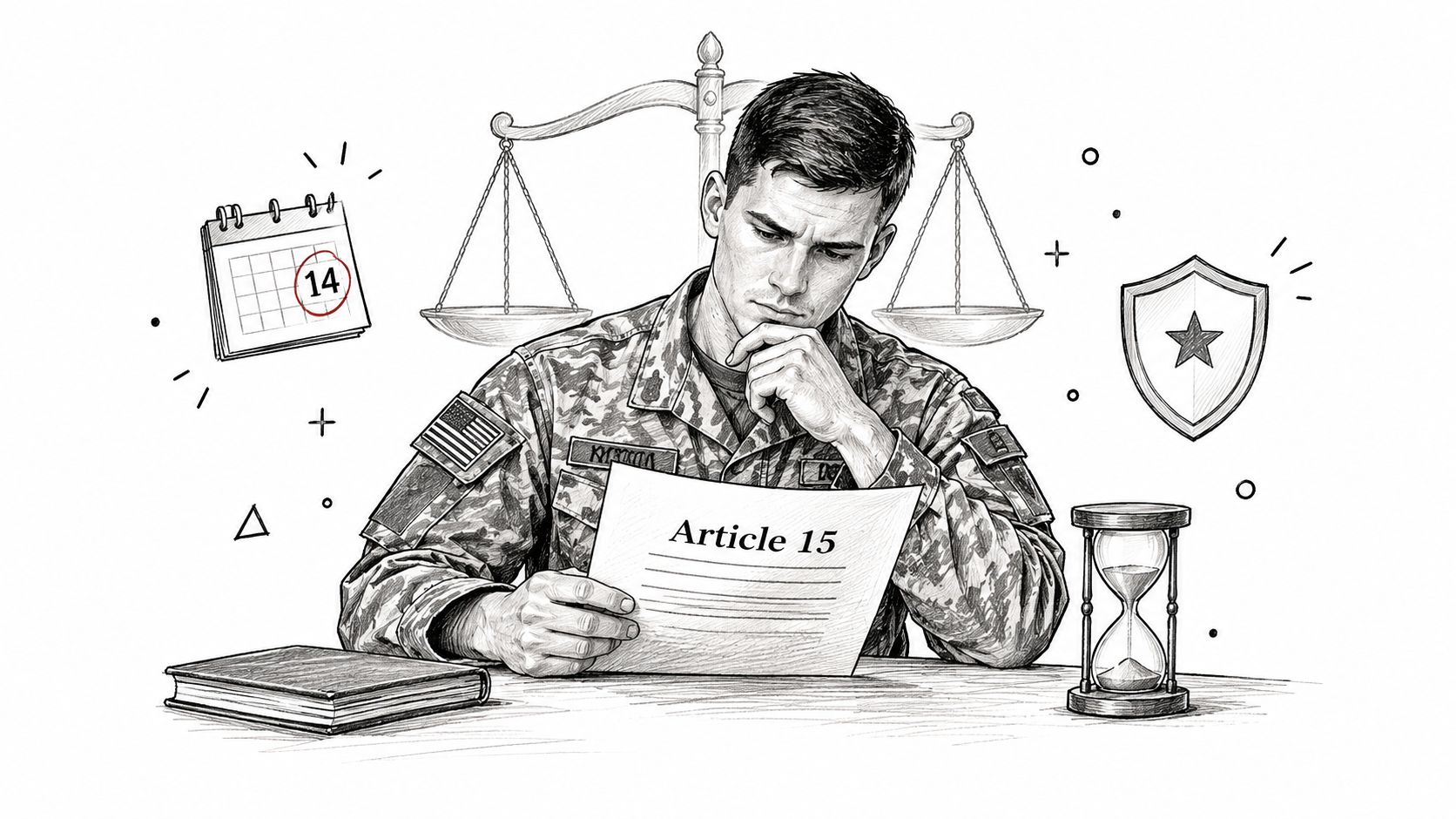
Your commander tells you an Article 15 is coming. Your stomach drops, and someone nearby says, “It's just an Article 15.” Ignore that advice. The next decisions can affect pay, rank, evaluations, security clearance, reenlistment, and separation.
The phrase “Article 15 NALC” creates a serious search problem because it combines two unrelated legal systems. The National Association of Letter Carriers, or NALC, uses Article 15 of its National Agreement with the U.S. Postal Service for a union grievance and arbitration process. Military Article 15 is a UCMJ procedure for nonjudicial punishment. If you're a service member, the military process is the one that matters here.

Table of Contents
- You Just Got Notified, What Article 15 NALC Actually Means
- Why Nonjudicial Punishment Is the Military's Default Pathway
- How the Article 15 Process Works From Notice to Hearing
- Maximum Punishments and the Court-Martial Decision
- Protecting Your Appeal Rights After Punishment Is Announced
- Mistakes That Sink Article 15 Defenses
- Why Civilian Defense Counsel Changes the Outcome
- Article 15 NALC Frequently Asked Questions
- What does NALC mean in Article 15 NALC?
- Is a military Article 15 the same as a postal grievance?
- Can I refuse an Article 15?
- Do I need a lawyer before the Article 15 hearing?
- How long do I have to appeal an Army Article 15?
- Can I change my mind after declining to appeal?
- What should an Article 15 appeal say?
- Will an Article 15 affect my career?
You Just Got Notified, What Article 15 NALC Actually Means
Your commander has notified you of an intent to impose nonjudicial punishment. Treat that notice as a legal decision point, not routine counseling. Article 15, UCMJ, allows a commanding officer to punish a minor offense without sending the matter to a court-martial. It also permits punishment alongside, or instead of, an admonition or reprimand. Read the governing statute at the official U.S. Code text for Article 15.
The term “Article 15 NALC” is confusing because it joins two unrelated systems. In the postal context, Article 15 of the NALC-USPS National Agreement is a grievance-arbitration framework, not military discipline. It covers disputes about wages, hours, working conditions, and the interpretation, application, or compliance of the agreement and related local memoranda. An employee generally must raise the issue with a supervisor within 14 days of learning, or reasonably being expected to learn, its cause. The matter may proceed through defined stages and reach arbitration, where deadlines and required documents can affect jurisdiction. The NALC's official workplace resources identify Article 15 as the contractual basis for that process.
If military paperwork led you to search “article 15 nalc,” stop relying on postal guidance. You are dealing with UCMJ Article 15, also called nonjudicial punishment or NJP. Service-specific rules control the details, so use a military-law explanation of what an NJP means in the military and speak with defense counsel before making decisions.
What the notice means for your immediate decisions
Start with the paperwork, then make these decisions:
- Alleged offenses: Read every specification. Do not rely on the commander's verbal summary.
- Proceeding type: Confirm whether the command is offering a summarized or formal proceeding, or a service-specific equivalent.
- Decision deadline: Determine when you must accept the Article 15 process or demand trial by court-martial.
- Punishment exposure: The commander's rank and jurisdiction determine the maximum available punishment.
- Evidence: Request, review, and preserve the materials supporting the allegations.
Contact defense counsel immediately. Invoke your right to remain silent, and do not explain the facts to the commander, investigators, friends, or coworkers until you have legal advice.
Practical rule: Treat every statement after notification as potentially significant. An Article 15 hearing is a legal proceeding, not an informal counseling session.
Why Nonjudicial Punishment Is the Military's Default Pathway
Nonjudicial punishment isn't an unusual detour in military justice. It's the system commanders use most often. A Department of Defense compilation for 2022 reported 37,383 nonjudicial-punishment cases and 1,455 courts-martial among the Army, Air Force, Navy, and Marine Corps, for 38,838 reported military-justice cases overall. NJP represented 96.3% of those reported cases. The same compilation reported NJP shares of 96.9% for the Army, 96.9% for the Navy, 95.2% for the Marine Corps, and 93.6% for the Air Force. Those figures come from the Army Article 15 defense guidance.

Those numbers describe workload proportions, not conviction rates and not defense-success rates. They also don't prove that an Article 15 is low risk. They prove something more practical: commanders and legal offices use this pathway constantly, and the process is built for speed, command control, and efficient disposition.
Why “it's just an Article 15” is dangerous
An Article 15 gives the command a structured way to impose punishment without the procedural demands of a court-martial. That efficiency benefits the command. It doesn't automatically protect the service member.
The command may already have statements, digital records, witness accounts, medical material, law-enforcement reports, or prior performance information. A rushed admission can fill an evidentiary gap. A vague explanation can create a credibility problem. A mitigation packet that says you're sorry without challenging the allegations may help the command justify punishment instead of preventing it.
Your response should quantify the full collateral stack:
- Pay: Forfeitures can affect immediate finances.
- Rank: Reduction can damage future promotion prospects and authority.
- Duty status: Restriction and extra duty can affect family responsibilities and unit standing.
- Career record: Reprimands and adverse evaluations may follow you.
- Clearance: The punishment may create security-clearance concerns.
- Future service: Reenlistment, assignment, separation, or retirement plans may be affected.
The rational posture is neither panic nor complacency. It's early preparation, careful silence, and a decision based on evidence and consequences.
How the Article 15 Process Works From Notice to Hearing
The process begins when the commander notifies you of the alleged UCMJ offenses and the intent to initiate action. At that point, you should obtain the paperwork, identify the decision deadline, and contact counsel. Don't write a narrative statement before a lawyer has reviewed the allegations and evidence.
Step 1, classify the proceeding
The first distinction is between summarized and formal proceedings, along with any service-specific equivalent. A formal Army Article 15 gives the member more procedural opportunities than a summarized proceeding. Your counsel needs to know which route the command is using before advising you on evidence, witnesses, and the court-martial decision.
The decision period is for legal analysis, not emotional negotiation. Use it to:
- Consult counsel.
- Preserve silence unless counsel recommends a specific statement.
- Obtain and analyze the evidence.
- Identify favorable witnesses.
- Separate guilt defenses from extenuation and mitigation.
- Assess punishment and collateral consequences.
Army guidance commonly identifies approximately 48 hours as a normal reasonable period for counsel consultation, although the actual period depends on command circumstances and applicable regulations. The Army legal training material on Article 15 proceedings explains the decision period and formal-hearing rights.
Step 2, decide whether to accept or demand trial
You may demand trial by court-martial instead of accepting Article 15 disposition. That choice requires a case-specific assessment. Counsel should compare the strength of the government's evidence, the admissibility and credibility problems, available defenses, likely punishment, and the collateral consequences of either route.
The military also has strict rules about statements and compelled questioning. Review the protections discussed in this explanation of Article 31 rights under the UCMJ. Don't assume that because the matter is called nonjudicial, every conversation is harmless.
Step 3, prepare for the formal hearing
At a formal hearing, the member may present evidence, confront available witnesses, request an open hearing, and have a spokesperson. Those rights matter only if the defense identifies what to present and why it matters.
Build the record around three separate questions:
- Guilt: Did the government prove every required element?
- Extenuation: What circumstances reduce the seriousness of the conduct?
- Mitigation: What facts should reduce the punishment even if misconduct is found?
The commander decides guilt and punishment, so the defense must make the record understandable, organized, and supported. A denial alone is not a strategy.
The process can move quickly, especially when the command believes the evidence is straightforward. Your response should be deliberate from the first notice.
Maximum Punishments and the Court-Martial Decision
An Article 15 can carry very different consequences depending on who imposes it. The commander's court-martial jurisdiction controls the available punishment authority, and a commander exercising general court-martial jurisdiction generally has substantially greater authority than a lower-level commander.
| Punishment | Commander with GCM Jurisdiction | Lower-Level Commander |
|---|---|---|
| Correctional custody | Up to 30 days | Up to 7 days |
| Forfeiture of pay | Up to two-thirds of one month's pay | Forfeiture of 7 days' pay |
| Reduction in grade | One or more grades when legally authorized | To the next inferior grade when within the commander's promotion authority |
| Extra duty | Up to 45 consecutive days | Up to 14 days |
| Restriction | Up to 60 consecutive days | Up to 14 days |
These statutory maximums come from 10 U.S.C. § 815. Your actual exposure depends on the alleged offense, the evidence, the commander's authority, applicable service regulations, and the defense presented at the hearing. The table shows the ceiling, not the punishment you automatically face.
The decision is not simply Article 15 or nothing
Before accepting or demanding court-martial, compare the proposed disposition with the risks of trial. Have counsel examine the government's proof, witness credibility, the legality of any statements, jurisdiction, notice, and whether the allegation is appropriate for NJP. Counsel should also assess the possible career effects of the Article 15 itself and the greater litigation exposure that can accompany court-martial proceedings.
Acceptance can provide a defined command process and avoid trial risk. A demand for court-martial can provide additional procedural protections and litigation opportunities, but a conviction may expose you to more serious consequences. The right choice depends on the evidence, the available defenses, and the punishment at stake. Do not make that decision based on anger or pressure.
Calculate collateral consequences before choosing
Your belief that you are innocent matters, but it does not answer the entire decision. A defense lawyer must weigh case strength and consequence severity together.
A weak government case paired with a damaging proposed punishment may justify demanding trial and litigating aggressively. Strong evidence combined with substantial mitigation may call for a focused presentation designed to reduce punishment and preserve future options. The commander's informal assurance that “this won't follow you” is not a defense strategy. Get the proposed punishment, likely consequences, and available alternatives evaluated before you choose the forum.
Protecting Your Appeal Rights After Punishment Is Announced
The most commonly missed Article 15 decision point arrives when the commander announces punishment. In Army practice, you must indicate your intent to appeal on DA Form 2627 at that time. If you initially decline to appeal, the command may reject a later appeal even when a written submission arrives within the permitted period. The Army's Article 15 appeal fact sheet explains this distinction.
Preserving the right to appeal and preparing the written appeal are separate tasks. First, preserve the right before leaving the hearing. Then prepare a written submission directed to the next superior authority.
The deadline is five calendar days
The appeal must be submitted within 5 calendar days, not five duty days, after punishment is imposed. The appeal is ordinarily written and routed through the imposing commander or successor in command to the superior authority. A company commander's punishment is ordinarily appealed to the battalion commander, while a battalion commander's punishment is ordinarily appealed to the brigade commander.
Your appeal should identify a specific basis for relief:
- Factual insufficiency: The evidence doesn't support the finding.
- Procedural error: The command violated a required rule or process.
- Excessive punishment: The penalty is disproportionate to the conduct and circumstances.
- New evidence: Material information became available after the hearing.
- Requested remedy: State whether you want reduction, suspension, overturning, or another available correction.
Supporting character statements and additional evidence may be attached. The appellate authority may affirm, reduce, suspend, or overturn the result, but cannot increase the punishment.
Army guidance also states that unexecuted restriction or extra duty can be stayed upon request while the appeal is pending, while punishments generally begin during the appeal period. Raise that issue promptly with counsel.

Same-day checklist before leaving the hearing
- Mark intent to appeal on DA Form 2627.
- Confirm the punishment date.
- Count five calendar days, including weekends and holidays.
- Request and preserve the complete Article 15 record.
- Write down every factual and procedural objection.
- Ask counsel whether restriction or extra duty can be stayed.
- Identify the next superior authority and routing path.
- Begin gathering relevant exhibits and character material.
Don't rely on memory or a verbal assurance that you can decide later. The first checkbox can determine whether the written appeal will be accepted at all.
Mistakes That Sink Article 15 Defenses
The same shortcuts damage service members repeatedly. They feel reasonable in the moment, but each one gives the command an advantage.
- Treating Article 15 as counseling: Statements made during the proceeding can be used against you and potentially elsewhere. Nonjudicial doesn't mean consequence-free.
- Explaining everything to the commander: A spontaneous explanation can lock you into an inaccurate version before you've seen the evidence.
- Trusting command to handle it fairly: Commanders may act in good faith, but they also decide whether misconduct occurred and what punishment to impose. Their view isn't a substitute for defense counsel.
- Waiting until punishment is announced: By then, evidence may be overlooked, witnesses may become harder to locate, and the defense record may be incomplete.
- Assuming there's no evidence: The actual dispute may involve credibility, notice, procedure, or proportionality rather than the existence of a document or photograph.
- Declining appeal at the hearing: You may lose the practical ability to appeal later, even if you submit a written appeal within five calendar days.
- Counting duty days: The deadline is five calendar days. A weekend doesn't stop the clock.
- Submitting only an apology: Mitigation matters, but a packet that identifies no legal or factual error doesn't adequately challenge the result.
- Ignoring career consequences: Pay, rank, evaluations, clearance concerns, reenlistment, and separation consequences should shape the decision from the beginning.
The worst Article 15 defense is often not a dramatic legal mistake. It's a series of small decisions made without understanding the deadline attached to each one.
Why Civilian Defense Counsel Changes the Outcome
Military-appointed defense counsel may be capable and committed. They also work inside the military justice system, manage demanding caseloads, and operate under institutional pressures that a retained civilian lawyer doesn't share. An experienced civilian military defense lawyer brings independence from command, deep NJP and court-martial experience, and time to examine the evidence before the commander decides.
The defense objective isn't merely to deny misconduct. It's to create a documented record addressing every element, evidentiary weakness, procedural defect, credibility problem, and career consequence. That record matters at the hearing and, if punishment is imposed, on appeal.
For administrative support, document organization, and scheduling, some families also use a legal virtual assistant while counsel handles the legal strategy. That support doesn't replace a defense lawyer, but it can help keep records and deadlines organized during a stressful proceeding.
You can begin comparing independent counsel through court-martial defense lawyers and other qualified military defense attorneys. Ask about actual Article 15 experience, court-martial work, appellate knowledge, communication, fees, and availability before choosing.
If you've been notified of an Article 15, contact counsel before the hearing, not after punishment. The decision window is short, the appeal trap is real, and your pay, rank, clearance, and career may depend on what you do next.
Article 15 NALC Frequently Asked Questions
What does NALC mean in Article 15 NALC?
NALC usually means the National Association of Letter Carriers. Its Article 15 is part of the NALC-USPS National Agreement and governs postal grievances and arbitration. Military Article 15 is a separate UCMJ process for nonjudicial punishment.
Is a military Article 15 the same as a postal grievance?
No. The postal Article 15 concerns disputes about wages, hours, working conditions, and contract compliance. The military Article 15 concerns alleged misconduct and potential punishment by a commanding officer.
Can I refuse an Article 15?
You may demand trial by court-martial instead of accepting Article 15 disposition, subject to the governing service rules and the specific notice you received. Don't make that decision based on emotion. Have counsel compare the evidence, available defenses, punishment exposure, and collateral consequences.
Do I need a lawyer before the Article 15 hearing?
Yes. Contact defense counsel immediately. You need advice before making statements, choosing a proceeding, submitting evidence, identifying witnesses, or deciding whether to demand trial by court-martial.
How long do I have to appeal an Army Article 15?
The appeal deadline is 5 calendar days after punishment is imposed. It isn't five duty days. You must also indicate intent to appeal on DA Form 2627 when punishment is announced, or a later appeal may be rejected.
Can I change my mind after declining to appeal?
You shouldn't assume you can. Army guidance warns that an appeal may be rejected if you initially decline to appeal, even when a written submission arrives within five calendar days. Preserve the right at the hearing.
What should an Article 15 appeal say?
It should identify specific grounds, such as factual insufficiency, procedural error, disproportionate punishment, or newly available evidence. It should request concrete relief and include relevant exhibits, character statements, or other supporting material.
Will an Article 15 affect my career?
It can. The consequences may include pay loss, reduction in rank, restriction, extra duty, reprimand, adverse evaluations, security-clearance concerns, and future separation or reenlistment problems. The effect depends on the punishment, service rules, record, and circumstances.
If you're under Article 15 notification now, don't wait for the hearing date. Preserve silence, secure the paperwork, mark your deadlines, and contact an experienced military defense lawyer today. Your next decision may determine whether this remains a manageable disciplinary problem or becomes a lasting career record.