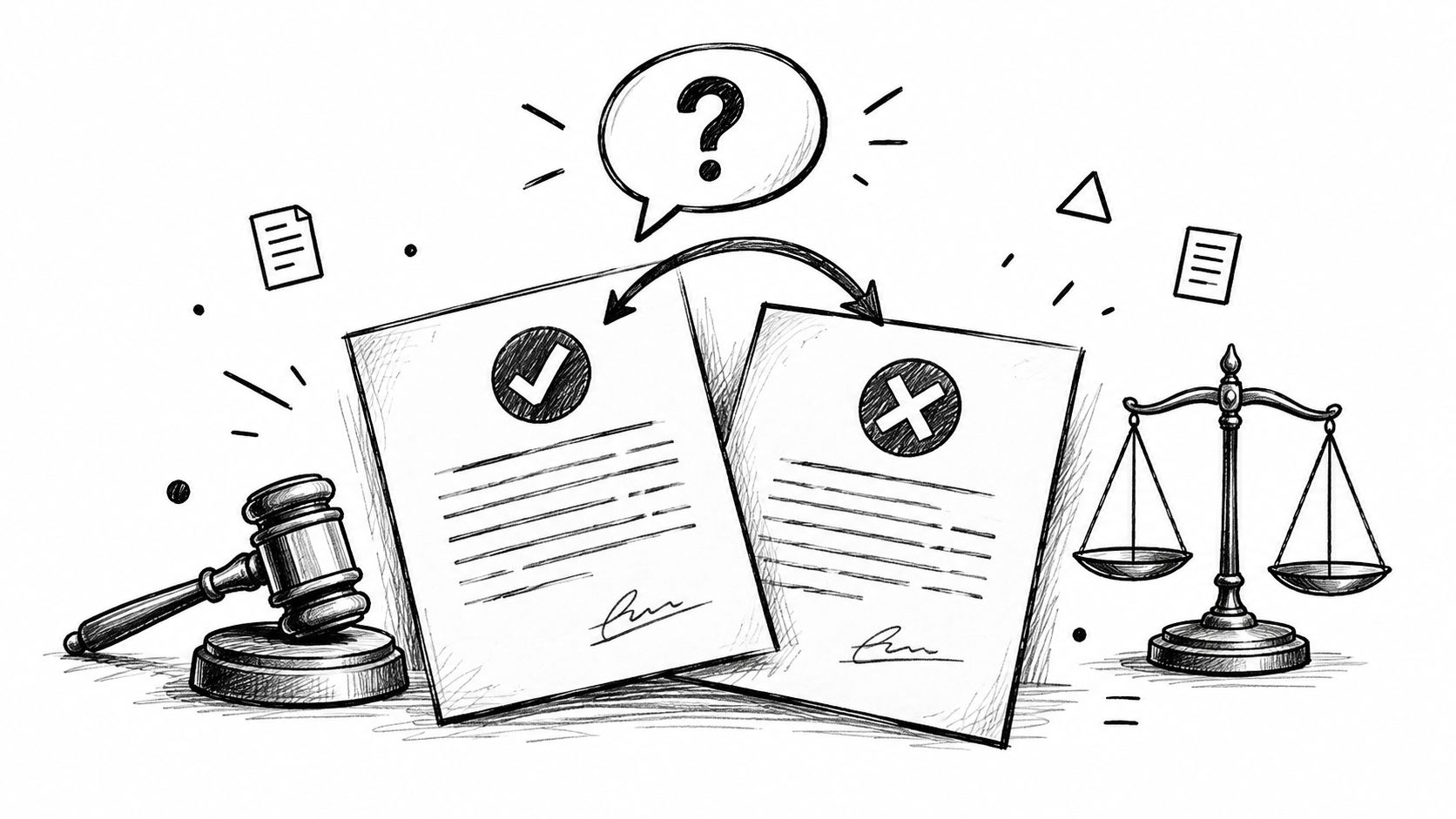
You’re sitting in an investigator’s office, facing questions about an event that may affect your career, your freedom, and your reputation. The government has a witness who sounds confident. Then you discover that the witness described the same event differently during an earlier interview, in a text message, or at an Article 32 proceeding.
That contradiction may be valuable. It may also be legally limited. A prior statement might expose a credibility problem without proving that the earlier version is true. In another setting, a sworn statement may be admitted as substantive evidence and become part of the government’s proof. Treating every inconsistency as interchangeable is how attorneys lose control of the evidence.
Military justice cases are often decided by what the fact-finder believes, what the military judge allows, and whether counsel preserved the issue correctly. Prior inconsistent statements sit at the intersection of all three.
Table of Contents
- Why Witness Contradictions Matter in Your Case
- Understanding Impeachment vs Substantive Evidence
- Military Rule 613 Procedural Requirements
- Sworn Article 32 Statements vs Unsworn CID Interviews
- Cross-Examination Examples and Sample Questions
- The Psychology of Inconsistency and Memory
- Why You Need Experienced Military Defense Counsel
- Common Mistakes That Weaken a Defense
- Talking before understanding the evidence
- Assuming an inconsistency proves the witness lied
- Waiting for the case to become formal
- Relying on a paraphrase
- Treating every statement as substantive evidence
- Ignoring the witness’s explanation
- Failing to preserve an evidentiary ruling
- Assuming the government’s investigation was neutral
- Frequently Asked Questions About Prior Inconsistent Statements
- Can I refuse to talk to CID?
- Can an unsworn CID interview be used against me?
- What happens at an Article 32 hearing?
- Does a witness changing their story mean the case should be dismissed?
- Can a prior statement prove the facts in my case?
- What if the witness denies making the statement?
- Will I go to jail because a witness changed their account?
- Do I need a lawyer immediately?
Why Witness Contradictions Matter in Your Case
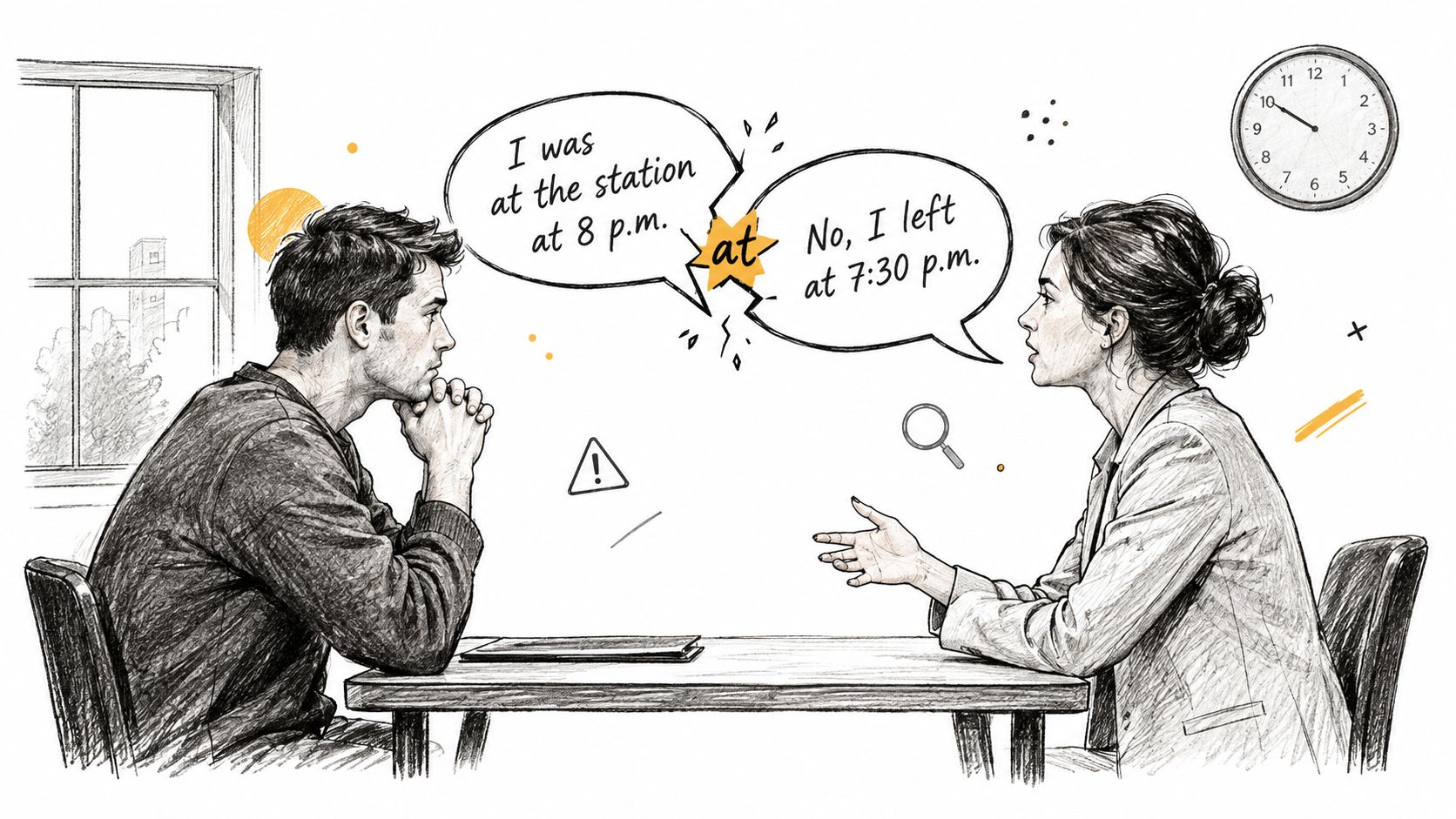
A witness tells investigators that the accused arrived at the barracks before midnight. Later, the same witness testifies that the accused arrived after midnight. The witness may explain the change as a mistake, poor lighting, fatigue, or confusion about the time. The defense sees something else, a conflict that may affect the witness’s reliability and the accuracy of the investigation.
The immediate tactical problem is that the contradiction doesn’t argue itself. If counsel merely announces, “You changed your story,” the witness gets room to explain, minimize, or blame the interviewer. A skilled examination identifies the earlier account, fixes the circumstances in which it was made, establishes the precise conflict, and then stops. The record should make the fact-finder see the inconsistency without turning cross-examination into an argument.
That work can begin during the investigation. It continues through an Article 32 preliminary hearing and may become decisive at court-martial. A witness who gives one account to CID and another under oath at a hearing creates a different problem from a witness whose only inconsistency appears between an unsworn interview and trial testimony. The source, timing, wording, and legal purpose all matter.
Practical rule: A contradiction is not automatically proof that the witness lied. It is evidence that must be classified, authenticated, and weighed.
The stakes are substantial. A fact-finder may view a material contradiction as evidence that the government’s theory is unstable. But a minor discrepancy can have little value, especially when it concerns a peripheral detail or results from imprecise questioning. The defense must show why the inconsistency matters to a central issue, not merely collect every difference in wording.
Service members facing an investigation should understand the broader court-martial process and basic military justice framework before making strategic decisions. The earlier counsel obtains original recordings, reports, messages, and interview notes, the easier it is to determine whether the contradiction is real, material, and usable.
Understanding Impeachment vs Substantive Evidence
The first question is not whether a witness contradicted themselves. The first question is what you want the fact-finder to do with the earlier statement.
If the statement is offered for impeachment, it challenges credibility. It tells the panel that the witness has given conflicting accounts and may not be reliable. It does not, by itself, establish that the earlier account is true.
Substantive evidence is different. When admitted substantively, the earlier statement may be considered as proof of the facts it asserts. Under Military Rule of Evidence 801(d)(1)(A), the principal requirements are cumulative:
- Current testimony: The declarant must testify at the current proceeding.
- Cross-examination: The witness must be subject to cross-examination about the earlier statement.
- Formal oath: The prior inconsistent statement must have been made under oath and subject to penalty of perjury.
- Qualifying setting: The statement must have been made at a trial, hearing, other proceeding, or deposition.
The federal framework follows the same basic structure. Federal evidence scholarship on Rule 801(d)(1)(A) describes the rule as a deliberate compromise between the traditional impeachment-only approach and broader substantive admissibility. The safeguards are designed to give the fact-finder a formal prior statement, a witness who can be tested in court, and an opportunity to evaluate why the accounts differ.

A sworn statement from an Article 32 preliminary hearing may therefore have a materially different evidentiary effect from an unsworn CID interview. The interview may still be powerful impeachment material. Unless another hearsay rule applies, however, counsel generally cannot offer it solely to prove that the events happened as described.
The constitutional issue is separate from the hearsay analysis. In California v. Green, the Supreme Court held that substantive use of a prior statement did not violate the Confrontation Clause when the witness testified and remained available for cross-examination about the earlier account. The decision separated constitutional confrontation from ordinary hearsay policy, as explained in this summary of the constitutional history of prior inconsistent statements.
For litigation preparation, a structured case-law summary can help organize the rule, facts, and relevance questions. Ivory Mind summary prompts can be useful for that organizational task, but they don’t replace a military evidentiary ruling or individualized legal advice.
Military Rule 613 Procedural Requirements
Rule 613 controls the mechanics of presenting a prior inconsistent statement. It doesn’t decide whether the earlier statement is admissible for its truth. That substantive question belongs to Rule 801(d)(1)(A) or another applicable hearsay provision.
Start with the witness
Military Rule of Evidence 613(a) gives counsel room to question a witness about a prior statement without first showing the document or disclosing its contents to opposing counsel. Counsel can ask whether the witness previously spoke with an investigator, gave a different account, or remembers making a particular statement.
That flexibility has tactical value. It lets counsel test memory and recognition before revealing the recording or document. If the witness admits the earlier account, counsel may not need extrinsic evidence. If the witness denies it or claims not to remember, the foundation must be developed carefully.
If the adverse party requests the statement, counsel must show it or disclose its contents to the adverse attorney. The rule permits controlled questioning, not surprise tactics that ignore disclosure obligations.
Preserve the opportunity to explain
MRE 613(b) generally requires the witness to receive an opportunity to explain or deny the prior statement before extrinsic evidence is admitted. The opposing party must also have an opportunity to examine the witness about it. The military judge may allow the evidence when justice so requires, but counsel shouldn’t build a trial plan around an exception.
A reliable sequence looks like this:
- Identify the witness and the prior statement.
- Establish when, where, and to whom it was made.
- Ask the witness about the earlier account.
- Identify the exact conflict with current testimony.
- Allow the witness to explain or deny it.
- Permit opposing examination.
- Offer the recording, report, email, or other extrinsic proof if necessary.
The current federal Rule 613 text and related procedural framework provide a useful comparison, but military counsel must apply the governing Military Rules of Evidence and the military judge’s rulings. A failure at any stage can produce an objection, delay, limiting instruction, or exclusion of the outside proof.
Sworn Article 32 Statements vs Unsworn CID Interviews
The oath is not a technical detail. It can determine whether the fact-finder may consider a prior inconsistent statement as proof of the facts asserted.
An Article 32 preliminary hearing is a formal proceeding. If a witness gives a statement under oath and later testifies while subject to cross-examination, the statement may satisfy the requirements for substantive use under MRE 801(d)(1)(A). That doesn’t make every inconsistency admissible automatically. Counsel still must establish authenticity, inconsistency, foundation, and compliance with MRE 613.
An unsworn CID, NCIS, OSI, or CGIS interview usually occupies a different position. The recording may show that the witness changed their story. It may expose leading questions, interviewer pressure, omitted facts, or a material shift in detail. But counsel generally must identify another evidentiary basis before offering the interview for the truth of its contents.
The distinction can cut both ways. A sworn statement by the accused may become substantive evidence against the defense. A sworn statement by a government witness may provide the defense with powerful affirmative material. Counsel must analyze every statement before deciding whether to use it, attack it, or keep it out.
Evidentiary Treatment of Prior Statements
| Statement Type | Sworn Status | Impeachment Use | Substantive Use |
|---|---|---|---|
| Article 32 testimony | Sworn and subject to penalty of perjury | Generally available if inconsistent | May qualify under MRE 801(d)(1)(A), subject to foundation and other rules |
| CID interview recording | Usually unsworn | Generally available if the witness testifies and the contradiction is properly shown | Usually requires another hearsay basis |
| Text message or informal account | Usually unsworn | May be used if authenticated and otherwise permitted | Depends on an applicable hearsay rule and the governing law |
| Deposition testimony | Sworn formal proceeding | Generally available when inconsistent | May qualify if the rule’s conditions are met |
| Investigator’s paraphrase | Uncertain | Risky unless the original statement and circumstances are established | Depends on authentication, hearsay, and the accuracy of the paraphrase |
For a practical explanation of the military investigation agencies and their roles, review this guide to CID, NCIS, OSI, and CGIS investigations. The critical point is simple: preserve the original wording and recording whenever possible. A summary may conceal the very qualification that makes the contradiction useful or harmless.
Cross-Examination Examples and Sample Questions
A good cross-examination does not ask the witness to agree that they are dishonest. It builds a sequence the witness can’t escape without choosing between two accounts.
Example one, changed timing
Suppose the witness testified that the accused entered the room after midnight. The recorded interview says the witness placed the arrival before midnight.
A controlled sequence might be:
- “You spoke with the investigator shortly after the event?”
- “The interview was recorded?”
- “You were asked when the accused entered the room?”
- “You answered before midnight?”
- “Today, you testified that the entry occurred after midnight?”
- “Those are different times, correct?”
The point is not to ask, “Which version is a lie?” That question invites a narrative. The point is to establish the contradiction, preserve the witness’s explanation, and let the fact-finder assess whether the timing affects an element, an alibi, identification, or opportunity.

Example two, written statement versus testimony
A witness testifies that the accused threatened them directly. The earlier written statement describes an argument but doesn’t mention a threat. Don’t overstate the omission. Ask about the statement’s completeness and the opportunity to include important details:
- “You reviewed the written statement before signing it?”
- “You understood it was intended to describe what happened?”
- “The statement describes the argument?”
- “It doesn’t say that the accused made a threat?”
- “You had an opportunity to add corrections?”
- “You didn’t add that detail?”
This approach distinguishes a true contradiction from a mere omission. The omission may matter, but its force depends on the statement’s purpose, the questions asked, the witness’s opportunity to provide detail, and whether the document was presented as complete.
Example three, documentary conflict
A witness says they were present at a location. A duty log, access record, or message places them elsewhere. The document itself may not be a prior inconsistent statement by the witness, but it can expose a conflict between testimony and objective evidence. Authenticate it separately. Don’t force Rule 613 to do work that belongs to another evidentiary foundation.
The following video can help visualize the mechanics of confronting a witness, but courtroom application depends on the record and the military judge’s ruling.
Preserve the ruling. If the judge excludes the statement, make the proffer specific enough to show the substance, relevance, and foundation. Appellate review depends on a clear record, not on counsel’s belief that the evidence was important.
The Psychology of Inconsistency and Memory
Inconsistency can damage credibility, but it doesn’t prove deception by itself. Empirical research reviewed in legal scholarship does not establish that one or more inconsistent details demonstrate that a witness’s testimony is generally inaccurate. Using one discrepancy to attack the entire account can rely on faulty assumptions about memory and accuracy, particularly in cases involving trauma, sexual assault allegations, or repeated interviews, as discussed in this legal treatment of inconsistency and memory.
Military cases add circumstances that can complicate recall. A witness may have experienced stress, sleep deprivation, medication effects, translation problems, repeated questioning, or pressure associated with rank. The investigator’s wording may also shape the answer. A contradiction can reflect ordinary memory reconstruction rather than fabrication.
Evaluate the contradiction instead of labeling it
Experienced counsel asks four questions:
- What type of inconsistency is it? Is it a direct conflict, an omission, a changed estimate, or a difference in description?
- When did it arise? Was the earlier account close in time to the event, or did it follow repeated interviews and new information?
- Is it material? Does it concern identity, consent, location, timing, an element of the offense, or only a peripheral detail?
- What circumstances produced it? Consider the question, setting, language, stress, pressure, and whether the witness reviewed or adopted the statement.
A minor discrepancy may have little value. Conversely, a seemingly small change can matter if it concerns a central fact and appeared after the witness received corrective information. The lawyer’s task is not to count contradictions. It is to explain their significance.
A careful defense doesn’t claim that every inconsistency proves a lie. It shows the panel why this inconsistency matters, or why the government is asking the panel to draw more from it than the evidence supports.
The same discipline applies to the defense. Overclaiming a weak contradiction can make counsel appear unfair and give the witness credibility. Strong cross-examination uses the evidence precisely, particularly in cases where the fact-finder must evaluate competing accounts under difficult circumstances.
Why You Need Experienced Military Defense Counsel
Evidentiary disputes are often won before the witness takes the stand. Counsel must locate the original statement, determine whether it was sworn, identify the purpose for which it will be offered, anticipate the foundation objection, and decide whether the contradiction helps or harms the defense.
Assigned defense counsel can provide important representation. They are military attorneys with professional obligations to their clients. Serious cases may still require a lawyer whose practice is concentrated in court-martial defense and who routinely handles MRE 613, MRE 801(d)(1)(A), authentication disputes, conditional admissions, and preservation for appeal.
The difference is not a claim that civilian counsel are automatically better. The difference is independence, specialization, and the ability to devote focused time to a complex evidentiary record. Civilian counsel aren’t part of the military command structure. They can challenge investigative methods, seek expert assistance where appropriate, and advise the client without treating command convenience as a case strategy.
When evaluating experienced court-martial defense lawyers, ask direct questions:
- Relevant experience: How often does the lawyer defend contested courts-martial?
- Evidence practice: Has the lawyer litigated prior inconsistent statements and hearsay objections?
- Case attention: Who will personally review the recordings, reports, and hearing transcripts?
- Strategic judgment: Can the lawyer explain whether a statement is impeachment-only or potentially substantive?
- Communication: Will the lawyer tell you what the evidence reveals, including weaknesses in your position?
Do not wait for a charge sheet before seeking advice. Early counsel can protect your statements, preserve evidence, prepare for interviews, and prevent an investigation from creating a cleaner record for the government than the underlying facts justify.
Common Mistakes That Weaken a Defense
Talking before understanding the evidence
Service members often believe that a truthful explanation will resolve the matter. Investigators may record the explanation, compare it with other accounts, and use every difference as a credibility issue. Invoke your rights and consult counsel before answering substantive questions.
Assuming an inconsistency proves the witness lied
A contradiction needs context. If counsel exaggerates a harmless discrepancy, the fact-finder may discount stronger problems that deserve attention.
Waiting for the case to become formal
An investigation can affect evidence long before referral. Messages disappear, memories change, and witnesses discuss events with one another. Early legal advice helps preserve the record.
Relying on a paraphrase
A summary may omit qualifiers, uncertainty, or the question that produced the answer. Obtain the original recording, signed statement, transcript, or document whenever possible.
Treating every statement as substantive evidence
An unsworn interview may impeach without proving the truth of the earlier account. Confusing those uses can lead to a failed objection or an improper trial theory.
Ignoring the witness’s explanation
MRE 613(b) gives the witness an opportunity to explain or deny the statement before extrinsic evidence is admitted. Counsel must prepare for the explanation rather than pretending it won’t happen.
Failing to preserve an evidentiary ruling
If the judge excludes the evidence, make a clear proffer. If the judge admits it for a limited purpose, request an appropriate ruling and ensure the record reflects the permitted use.
Assuming the government’s investigation was neutral
Investigators may pursue corroboration for an allegation while overlooking contradictory accounts or alternative explanations. Defense counsel must independently reconstruct the timeline and interview process.
Frequently Asked Questions About Prior Inconsistent Statements
Can I refuse to talk to CID?
You generally have the right to remain silent when questioning may incriminate you. Don’t guess about how that right applies to your circumstances. Politely identify that you want counsel and avoid giving a voluntary explanation before receiving advice from a military defense lawyer.
Can an unsworn CID interview be used against me?
It may be used for impeachment if the applicable foundation is established. Its use as substantive proof of the truth of its contents generally requires another hearsay basis. The precise answer depends on the statement, the witness, the purpose of admission, and the military judge’s ruling.
What happens at an Article 32 hearing?
An Article 32 preliminary hearing evaluates the allegations and the available evidence before referral decisions. Witnesses may testify under oath and may be subject to questioning. Statements made in that formal setting can have greater evidentiary significance than an unsworn investigative interview.
Does a witness changing their story mean the case should be dismissed?
Not automatically. The contradiction must be material, properly presented, and significant under the elements and overall evidence. It may weaken the government’s case, support a motion, change negotiation strategy, or affect how the panel evaluates credibility.
Can a prior statement prove the facts in my case?
It can in limited circumstances. Under MRE 801(d)(1)(A), the witness must testify, remain subject to cross-examination, and have made the earlier inconsistent statement under oath in a qualifying formal setting. Other statements may require a separate hearsay rule.
What if the witness denies making the statement?
Counsel may need extrinsic proof, such as a recording, document, or testimony from another person. Before that proof is admitted, MRE 613(b) generally requires an opportunity for the witness to explain or deny the statement and an opportunity for the opposing party to examine the witness about it.
Will I go to jail because a witness changed their account?
A change in testimony doesn’t determine punishment by itself. Confinement depends on the charges, findings, sentencing evidence, and the final decision in the case. A defense lawyer should assess the evidence before predicting an outcome.
Do I need a lawyer immediately?
Yes, if you’re under investigation, have been questioned, received notice of adverse action, or face UCMJ charges. Early advice can affect what you say, what evidence counsel preserves, and whether the government develops a damaging record before your defense begins.
If you’re facing a CID, NCIS, OSI, or CGIS investigation, an Article 32 hearing, or a court-martial, contact experienced military defense counsel immediately. Don’t give investigators another statement, delete messages, contact witnesses about their accounts, or assume the contradiction will resolve itself.