A Navy court martial can begin with a message that sounds routine: report to the command legal office, speak with NCIS, acknowledge charges, or attend a meeting with your commanding officer. By the time the word “court-martial” appears in writing, investigators may already have collected statements, messages, photographs, access records, and witness accounts. Your career, freedom, security clearance, finances, and reputation can all be affected by decisions you make before a courtroom opens.
The Navy justice system has formal safeguards, but it isn’t designed to build your defense for you. Investigations aren’t neutral, evidence is often incomplete, and credibility can decide the case. If you’re facing an investigation or charges, treat the first contact as a legal emergency and get advice from a qualified UCMJ lawyer before answering substantive questions.
Table of Contents
- The Moment Everything Changes
- Types of Navy Courts-Martial and What They Mean for You
- How a Navy Court-Martial Unfolds
- Critical Mistakes That Destroy Navy Court-Martial Defenses
- Military Appointed Counsel vs Civilian UCMJ Defense Lawyers
- Sentencing and the Collateral Consequences That Follow You for Life
- Your Immediate Action Plan for Securing UCMJ Defense Counsel
The Moment Everything Changes
A sailor gets a call from the command: report immediately, bring identification, and don’t discuss the matter with anyone. At the office, the sailor learns that NCIS wants an interview. A few hours later, the command provides paperwork identifying alleged UCMJ offenses and says the matter may proceed to a Navy court martial.
That sailor often makes the same dangerous assumption: if the facts are on their side, explaining everything will solve the problem. It usually doesn’t. Investigators document statements, compare them against other accounts, and preserve wording that the prosecution may later present to a judge or members. A nervous answer, an estimate presented as certainty, or an attempt to protect someone else can become a credibility problem.
You have the right to remain silent and the right to consult counsel. Article 31 rights are not a technical formality. They matter before you discuss the facts with NCIS, your command, or anyone acting for the government. Review the Article 31 rights and military questioning process with counsel before making a statement.
Practical rule: Don’t try to win the investigation in the interview room. Preserve your rights, obtain advice, and let counsel decide whether any statement serves your defense.
A Navy court martial is a criminal proceeding, not an administrative inconvenience. A conviction can affect confinement, rank, pay, discharge characterization, employment, benefits, and future licensing or clearance decisions. Even where the government doesn’t secure a conviction, the investigation itself can trigger command action and long-term professional damage.
Your first job is control. Don’t delete messages, don’t contact witnesses to coordinate stories, and don’t post about the allegations. Write down what happened while your memory is fresh, preserve relevant records, and contact an experienced military defense lawyer. The rest of this guide gives you the procedural map and the strategic priorities I use when evaluating a Navy case.
Types of Navy Courts-Martial and What They Mean for You
The Navy recognizes summary, special, and general courts-martial. The label affects the available punishment, who may convene the proceeding, the scope of the case, and the career consequences. A court-martial doesn’t exist merely because charges were preferred. A convening authority creates it through a convening order, and Navy guidance ties that authority to rank, billet, and delegated authority. Navy court-martial basics provides a useful starting point, but a lawyer must apply the rules to your exact charges and status.
Summary court-martial
A summary court-martial handles less serious offenses through a simpler process. It has limited jurisdiction and limited punishment authority, and the accused’s rights differ from those available at a special or general court-martial. The specific maximum punishment depends on the accused’s grade, the offense, and the governing law in effect at the time.
A summary court-martial may look manageable because the process is smaller. That doesn’t make it harmless. A finding of guilt can affect evaluations, advancement, assignments, separation decisions, and later litigation. Never accept the word “minor” from someone who won’t explain the consequences in writing.
Special court-martial
A special court-martial can address more serious allegations than a summary proceeding. It can impose significant punishment and may expose an accused to a punitive discharge where legally authorized. The practical difference between a special and general court-martial can be decisive for a sailor’s post-service life, especially when the charge profile supports a bad-conduct discharge.
The convening authority must have the required authority, and the court must proceed under the applicable rules. Defense counsel should examine the charges, the referral decision, the members or judge selection, discovery, and every proposed punishment before the case moves forward.
General court-martial
A general court-martial is the highest level of court-martial trial. It is used for the most serious cases and can expose the accused to the harshest authorized punishments, including a dishonorable discharge where applicable. The government must prove every charged element beyond a reasonable doubt.
| Court Type | Convening Authority | Max Confinement | Discharge Type | Right to Counsel |
|---|---|---|---|---|
| Summary | Authorized commander under applicable law | Depends on rank and offense | Depends on lawful authority and case disposition | Counsel rights are more limited than at higher-level courts |
| Special | Authorized special-court-martial convening authority | Depends on the charged offenses | A bad-conduct discharge may be authorized where permitted | Counsel is provided |
| General | Authorized general-court-martial convening authority | Depends on the charged offenses | A dishonorable or bad-conduct discharge may be authorized where permitted | Counsel is provided, with full trial protections |
Historical context matters because Navy military justice developed through successive legal frameworks. The Continental Congress authorized rules for the new Navy on May 6, 1778, including a court structure addressing incidents such as the loss of a vessel while ships operated together. The Navy’s summary court-martial system was formally authorized by the Act of March 2, 1855, and reaffirmed by the Act of July 15, 1870. Navy trial results and military justice history reflects the continuing institutional structure.
How a Navy Court-Martial Unfolds
A sailor can move from an NCIS interview to a formal court-martial before realizing how quickly evidence, command decisions, and deadlines are accumulating. No lawyer can promise a fixed timeline. The pace depends on the evidence, command action, defense litigation, witness availability, discovery, motions, and appellate requirements. Public Navy materials show case volume and filing access, but they do not provide a consumer-friendly timetable for every case.
In FY2022, the Navy completed 181 general and special courts-martial, including 81 general courts-martial and 100 special courts-martial. Public reporting listed 24 acquittals and an overall conviction rate of 87%. The Navy FY2022 court-martial results provide the underlying figures. These numbers do not predict your result. They do show why a defense plan must begin early, before the government’s evidence becomes organized and difficult to challenge.

Step 1, investigation
NCIS, command investigators, or another law-enforcement agency may collect statements, records, digital evidence, medical information, and witness accounts. Defense counsel should test each part of that record for inconsistencies, missing evidence, bias, motive, changed accounts, and investigative shortcuts.
Do not wait for formal charges. A civilian military defense lawyer can help preserve evidence, identify witnesses, and stop you from making statements that narrow your options. Review this investigation-phase defense strategy guide before speaking with investigators.
Step 2, preferral and Article 32
After the investigation, charges may be preferred. That means a person authorized under the UCMJ formally signs them. For a general court-martial, an Article 32 preliminary hearing may follow, but it is not automatically required in every case. Current law permits the accused to submit a written waiver, and the convening authority may determine that a hearing is not required. For charges under special trial counsel authority, that decision may belong to the special trial counsel. The current Navy SECNAV military justice manual contains the governing policy.
Article 32 is an evidence and charging review, not a full trial. Its statutory questions are limited:
- Offense alleged: Does the specification allege an offense?
- Probable cause: Is there probable cause to believe the accused committed the offense?
- Jurisdiction: Does the convening authority have jurisdiction over the accused and offense?
- Disposition: What action should the authority take?
The accused may cross-examine witnesses and present defense or mitigation evidence, but the hearing remains focused on those issues. The Article 32 statutory text controls the scope. Counsel should decide whether the hearing can expose weaknesses, preserve testimony, or create a useful record before waiving it.
Step 3, referral and arraignment
Referral sends the charges to a particular court-martial for trial. Before referral, confirm that the convening authority has the required authority and that the convening order properly creates the court. Navy guidance on convening authority and Article 32 hearings explains why the authority and billet matter.
Arraignment identifies the charges and begins the formal trial process. By then, the defense should be analyzing discovery, filing requests, preserving objections, and selecting motions that may eliminate charges or restrict prejudicial evidence.
Step 4, motions and trial
Motions may address unlawful searches, statements, discovery failures, jurisdiction, charging defects, expert evidence, witness testimony, and other constitutional or procedural issues. Motion hearings often determine what the military judge or members will hear.
At trial, the government presents evidence first and carries the burden of proof. The defense cross-examines witnesses, exposes gaps in the investigation, challenges unreliable evidence, and presents its own case only when that advances the defense theory. Every exhibit and objection should serve that theory.
Step 5, findings, sentencing, and review
The court determines findings, then conducts sentencing if there is a conviction. Sentencing preparation starts before trial. Character letters, service records, treatment records, family evidence, and a coherent rehabilitation plan can matter, but counsel must develop them carefully and ensure they do not create new problems.
Post-trial review can involve extensive records. Navy files may include the charge sheet, convening orders, court rulings, Statement of Trial Results, Convening Authority’s Action, Entry of Judgment, and appellate orders or opinions. That paper trail can expose errors, preserve issues, and shape the next defense decision.
Critical Mistakes That Destroy Navy Court-Martial Defenses
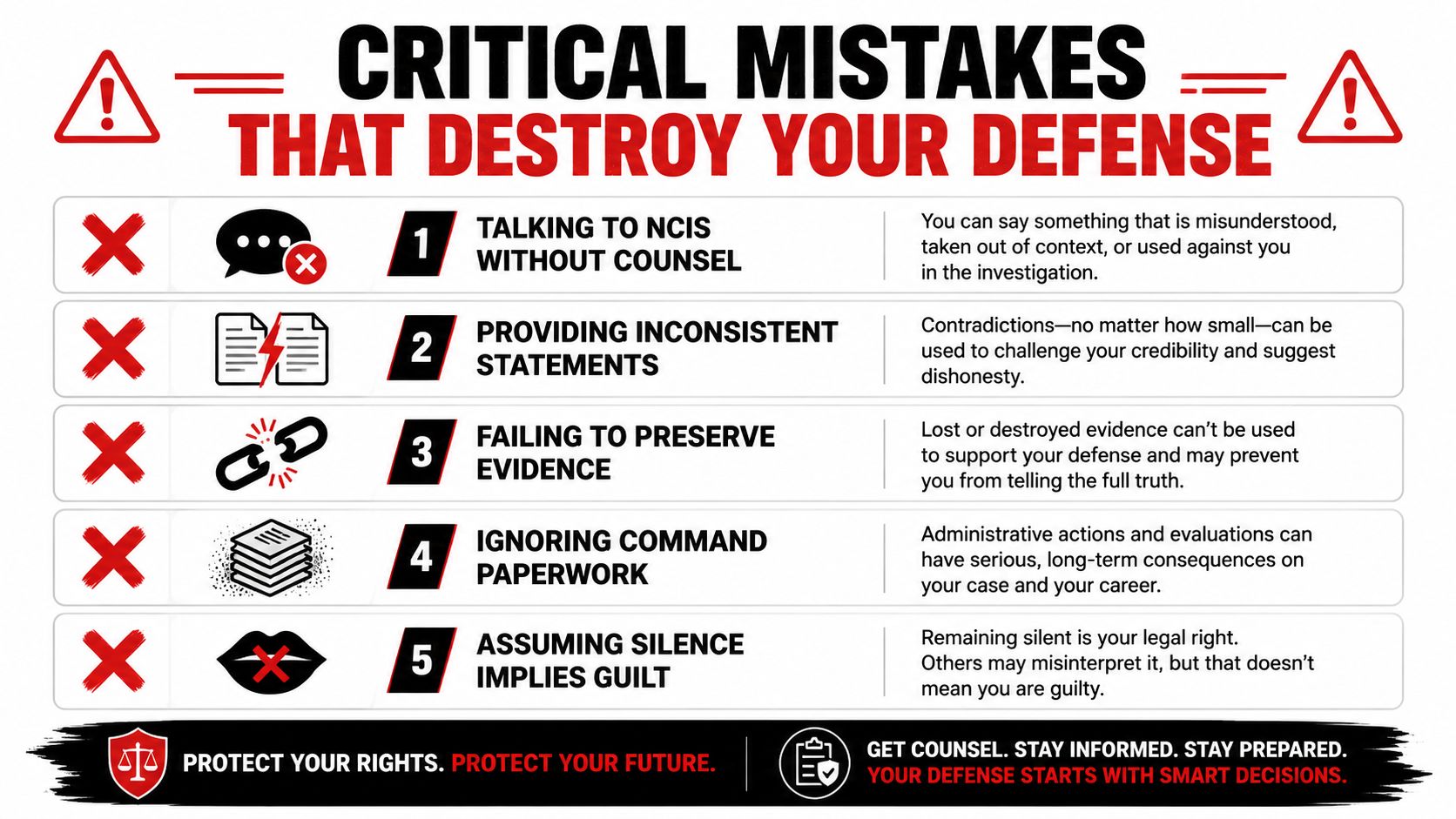
The investigation phase is where sailors often damage their own cases. They assume investigators want the full story, command wants fairness, or silence will look suspicious. Those assumptions give the government evidence it may not otherwise possess.
Talking before consulting counsel
NCIS can ask questions in a calm, conversational manner. That doesn’t change the legal purpose of the interview. Investigators compare your answers with texts, witness accounts, access records, and other evidence. A voluntary statement can become the government’s cleanest proof.
Invoke your rights clearly and respectfully. Don’t argue, speculate, or try to fill silence.
Trusting the chain of command to fix the case
Commanders may care about the unit and may believe they can resolve the matter quickly. They aren’t your defense counsel. Command personnel must consider mission requirements, discipline, reporting obligations, and the information available to them.
A promise that “this will go away” isn’t a defense strategy. Get the terms, deadlines, and consequences reviewed by counsel.
Deleting or altering evidence
Never delete messages, edit files, reset devices, or ask another person to remove material. That conduct can create a separate allegation and can destroy evidence that might help you. Preserve the device and communications exactly as they exist, then let counsel determine what matters.
Discussing the case with shipmates
Friends may be witnesses, suspects, or sources of information that later reaches investigators. Group chats create permanent records. Don’t ask anyone to change a story, don’t explain your theory, and don’t post about the allegations.
Waiting for “real evidence”
A case doesn’t require a dramatic physical exhibit. Testimony, messages, admissions, timing, and surrounding circumstances may form the prosecution’s theory. The defense must test reliability and context early, not wait for the government to reveal every weakness.
Other errors include ignoring command paperwork, missing deadlines, assuming a witness is automatically favorable, and believing that an inconsistent statement can be explained away later. Credibility is difficult to repair once counsel has allowed the government to define the story first.
Military Appointed Counsel vs Civilian UCMJ Defense Lawyers
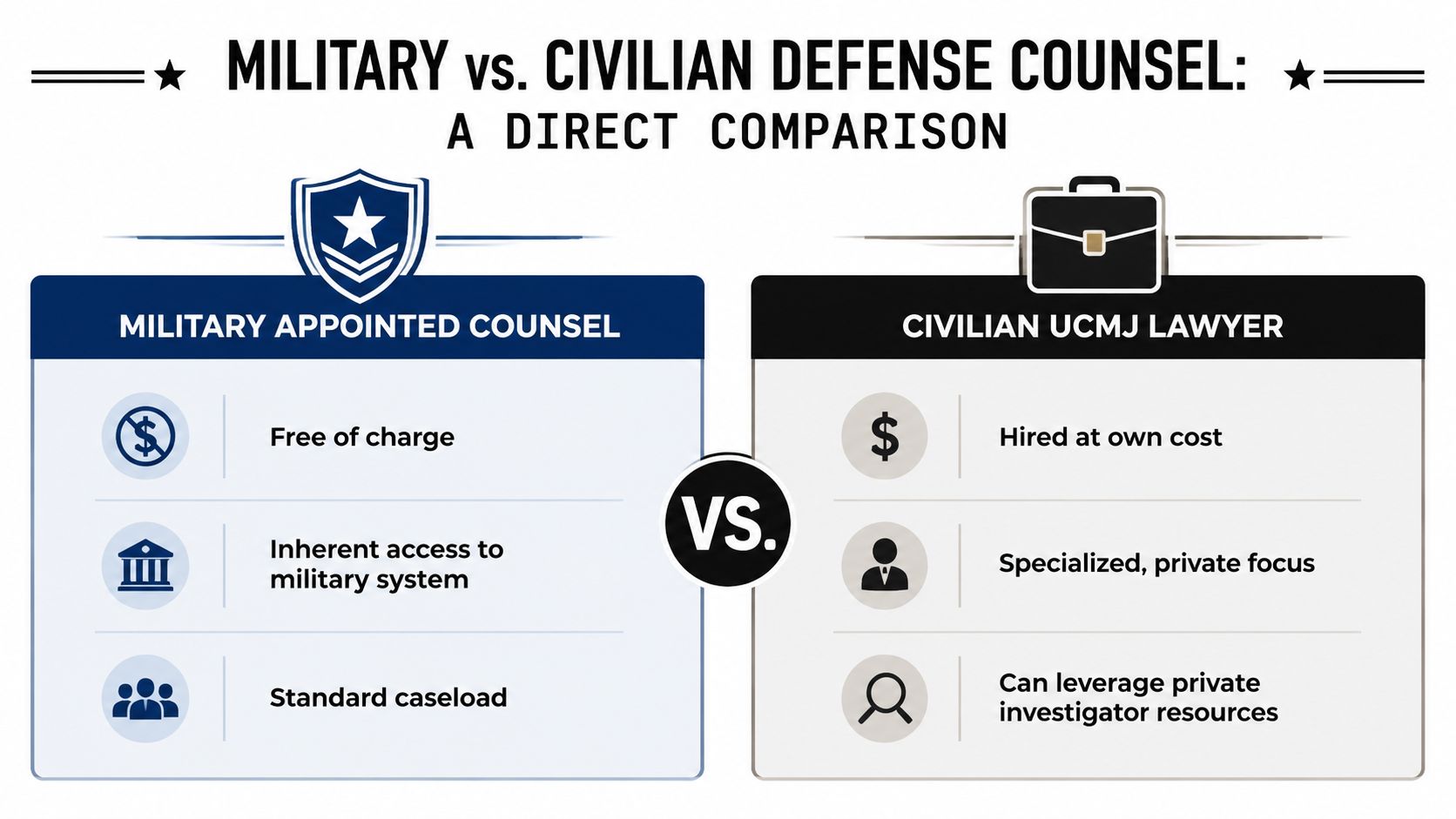
Military-appointed counsel can be competent, committed, and familiar with the system. The right question isn’t whether appointed counsel is capable. The question is whether your case requires resources, independence, and sustained attention beyond what an assigned office can provide.
Appointed counsel understands military procedure and generally has access to the system, records, and courtroom process. The service provides that representation without a separate fee. But military defense counsel also work within military organizations, manage multiple responsibilities, and serve under professional structures that differ from a private practice.
What civilian counsel adds
A civilian UCMJ lawyer works for you, not for the command and not for a military career progression. An experienced civilian attorney can devote focused time to investigation, retain appropriate experts or investigators, challenge the government’s narrative, and coordinate trial and appellate strategy from the beginning.
That doesn’t mean civilian counsel automatically wins. Credentials must be examined. Ask how much of the lawyer’s practice is court-martial defense, whether the lawyer has handled Navy cases, whether the practice includes contested trials, and who will personally work on your case.
The cost question
Civilian representation costs money, and you should demand transparent communication about fees, staffing, investigation, experts, travel, and appeals. Compare that cost with the consequences of a punitive discharge, confinement, lost income, damaged professional credentials, and a conviction that follows you beyond active service.
Choose counsel for the case you have, not the lawyer’s marketing. Serious allegations require a defense team that can investigate, litigate, negotiate, and preserve issues for review.
Sentencing and the Collateral Consequences That Follow You for Life
A guilty finding is only one part of the danger. Sentencing can include confinement, forfeiture of pay, reduction in rank, and a punitive discharge when authorized. The practical effect depends on the offense, findings, sentencing evidence, prior record, and the rules governing the court.
A bad-conduct discharge and a dishonorable discharge aren’t interchangeable labels. Each can affect post-service opportunities and benefits, and the consequences may reach well beyond the formal sentence. A dismissal can carry severe professional damage for an officer. The defense must address sentencing before trial by building a record that gives the decision-maker lawful reasons to impose less punishment.
The civilian consequences
A court-martial conviction can follow a sailor into civilian life as a criminal conviction. Employers, licensing authorities, security-clearance adjudicators, and institutions reviewing professional conduct may consider the result. Certain offenses can also create registration obligations or restrictions under separate law.
Potential consequences may include:
- Benefits problems: Discharge characterization can affect access to veterans’ benefits.
- Employment barriers: A conviction or punitive discharge can complicate hiring and professional licensing.
- Clearance consequences: The underlying conduct and disposition may affect continued eligibility for sensitive duties.
- Personal restrictions: Some convictions can create restrictions involving firearms or other legal rights.
- Family and financial damage: Confinement, lost pay, relocation, and reputational harm can destabilize a household.
Don’t treat appellate review as a second chance to conduct the trial better. The record must contain preserved objections, developed facts, and legally supported arguments. A 2010 Defense Department review reported that the entire Navy and Marine Corps trial record is reviewed by appellate defense and government counsel before judicial review by the Navy-Marine Corps Court of Criminal Appeals. That court has mandatory first-level jurisdiction over cases involving a punitive discharge or confinement of one year or more. The review also reported that the Navy and Marine Corps accounted for more than 61% of DoD courts-martial and more than 56% of appellate cases reviewed over the period examined. Defense Department review of Navy appellate practice provides the underlying discussion.
Public transparency remains incomplete. Navy public materials separate docket access from trial-results reporting, while FY25 reporting lists 170 Navy courts-martial tried and 103 cases pending at the end of the fiscal year. FY25 military justice reporting illustrates why raw case counts don’t answer the question most families ask: what happens next, and how long will it take?
Your Immediate Action Plan for Securing UCMJ Defense Counsel
If NCIS, your command, or another military authority has contacted you about suspected misconduct, act now.
- Invoke your rights. Say that you want to remain silent and speak with counsel. Don’t provide an informal explanation afterward.
- Preserve evidence. Keep phones, messages, emails, photographs, calendars, location records, and related documents. Don’t alter or delete anything.
- Create a private chronology. Write dates, locations, participants, communications, and the names of potential witnesses for your lawyer. Don’t circulate that document.
- Collect paperwork. Save every notice, rights advisement, charge sheet, counseling document, and deadline.
- Interview defense lawyers. Ask about Navy court-martial experience, contested trial work, investigation resources, appellate capability, who will personally handle the case, and the fee structure.
- Do not contact witnesses about the substance. Give names and contact information to counsel instead of trying to manage testimony yourself.
A military-appointed lawyer may be your first resource, and you should communicate with that lawyer promptly. For serious charges, also consider an independent civilian court-martial attorney who can assess the case without command ties and develop a defense team around your needs.
Your career, freedom, and future may turn on what you do in the next 24 to 48 hours. If you’re under investigation or facing Navy court-martial charges, contact experienced civilian military defense counsel immediately, preserve every relevant record, and stop discussing the allegations until a lawyer has advised you.