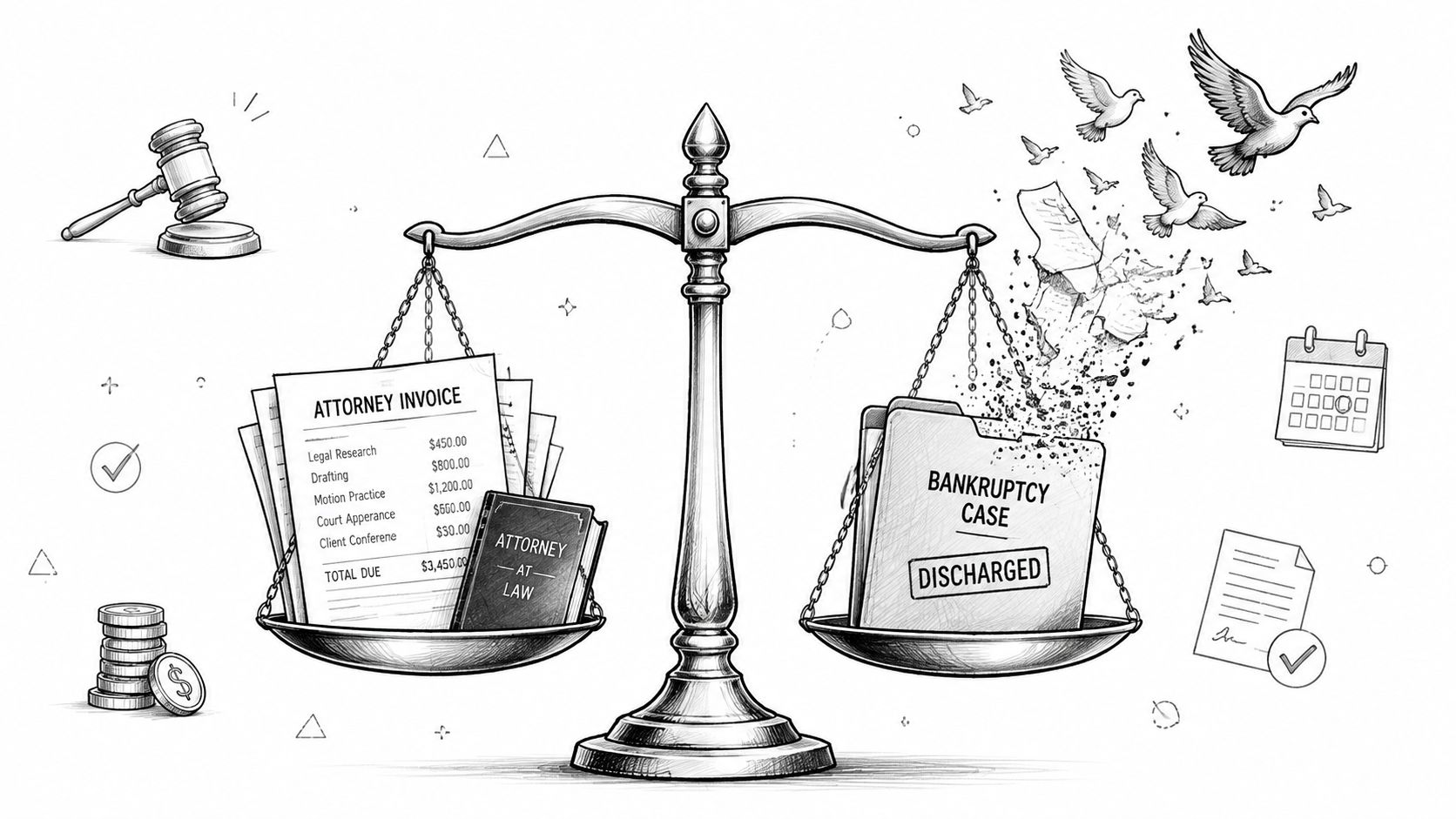
Court-ordered attorney fees can sometimes be discharged in bankruptcy, but the result depends entirely on the legal basis for the award. Family-law and criminal fees are usually not wiped out, while ordinary civil litigation fees often can be.
You may be reading this after a divorce order, civil judgment, or military-justice matter has left you with a debt you can't pay. Your paycheck is already committed to housing, support, transportation, and family expenses. Now a court order is sitting on top of everything else, and bankruptcy looks like the only exit.
For a service member, this isn't merely a balance-sheet problem. An unpaid judgment can affect financial stability, family relationships, and the pressure surrounding an investigation, administrative action, or security-clearance review. Bankruptcy may solve one debt while leaving the most important one untouched. You need to identify the legal character of the fee before you file.
Table of Contents
- The Real Question Behind Your Legal Debt
- How Bankruptcy Law Classifies Court-Ordered Attorney Fees
- Chapter 7 vs Chapter 13 Outcomes for Legal Fee Debts
- Why Criminal and Military Justice Fees Are Different
- Practical Steps Before You File for Bankruptcy
- Five Costly Mistakes Service Members Make With Legal Debt
- Why Experienced Civilian Defense Counsel Changes Everything
- Frequently Asked Questions About Discharging Court Ordered Attorney Fees
- Can I discharge court ordered attorney fees in Chapter 7?
- Are divorce attorney fees dischargeable?
- Can child-support enforcement fees be discharged?
- Can criminal court-appointed attorney fees be discharged?
- What happens to fees for legal work performed after bankruptcy filing?
- Can sanctions for contempt survive bankruptcy?
- Does Chapter 13 discharge court-ordered attorney fees?
- Will bankruptcy protect my military career or security clearance?
The Real Question Behind Your Legal Debt
The phrase court-ordered attorney fees tells you almost nothing by itself. Courts don't decide dischargeability based on the words printed on the judgment. They examine why the court awarded the fees, who benefited from the award, and what obligation the fees enforce.
A service member may face one of several very different situations:
- A former spouse received a fee award during child-support litigation.
- A divorce court ordered payment of the other spouse's lawyer.
- A civil court awarded fees after a contract dispute.
- A government authority imposed criminal justice costs.
- A court awarded fees as a sanction for contemptuous or malicious conduct.
- A lawyer is collecting for legal services performed before bankruptcy.
Those debts may look similar in a collection letter. Legally, they can land in opposite categories.
Practical rule: Never ask only whether the judgment says “attorney fees.” Ask what the underlying proceeding was about and what the fee order was designed to accomplish.
The consequences are serious for military families. A bankruptcy discharge doesn't automatically erase every judgment, and it doesn't decide whether a command sees your financial circumstances as a concern. It also doesn't undo a support obligation, criminal sentence, restitution order, or sanction. If the debt arose alongside a court-martial, UCMJ investigation, Article 15, administrative separation, or family-law dispute, preserve every related document before discussing bankruptcy with anyone.
Your first task is classification. Separate the debt into ordinary civil fees, family-law fees, criminal justice debt, sanctions, and post-petition legal work. That classification gives you an initial answer to the question, “Can I discharge court ordered attorney fees?” The final answer requires reviewing the judgment, the findings supporting it, and the governing law.
What the label hides
A fee award payable directly to an opposing lawyer may still serve the financial interests of a spouse or child. A fee award entered in a divorce case may be nondischargeable even if the order doesn't call it support. Conversely, a lawyer's bill for pre-petition services isn't automatically protected because a court later entered judgment on it.
Don't guess. The exact language matters.
How Bankruptcy Law Classifies Court-Ordered Attorney Fees
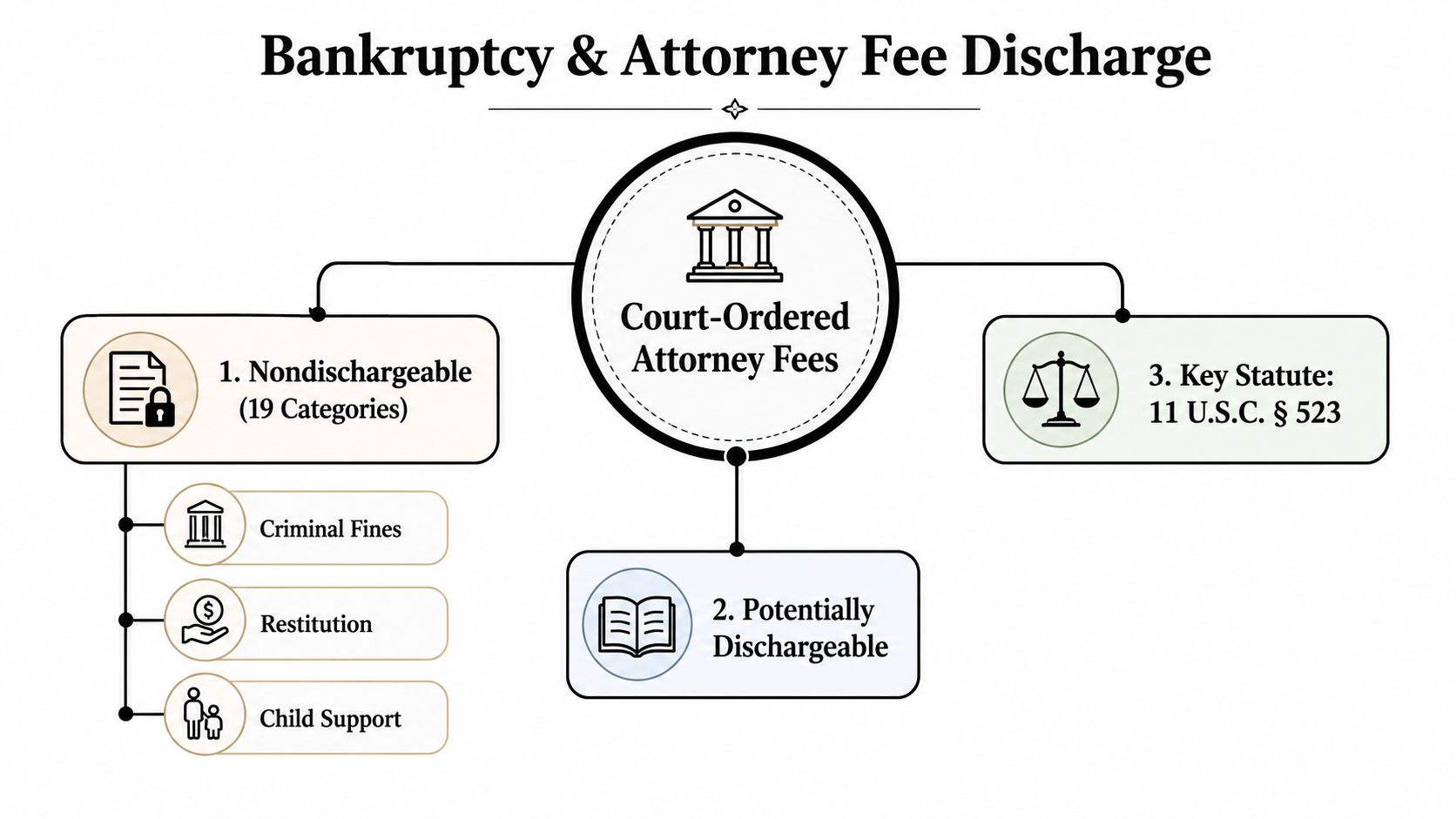
Chapter 7 generally discharges pre-petition debts, but Congress carved out 19 categories of debt in 11 U.S.C. § 523(a). Attorney fees aren't automatically exempt from discharge merely because a judge ordered them. The governing question is whether the fee obligation fits one of the statutory exceptions. The statute itself is the starting point, and 11 U.S.C. § 523(a) provides the controlling list of exceptions.
The two family-law provisions create the most common trap. Section 523(a)(5) protects domestic support obligations, including obligations in the nature of alimony, maintenance, or support. Section 523(a)(15) covers other debts owed to a spouse, former spouse, or child that arise during divorce or separation. The second provision is broader because the debt doesn't have to function as support.
The support analysis
Courts examine the substance of the award. If the fee order helps enforce child support, maintenance, or another support obligation, the court may treat it as support even when the money goes directly to the former spouse's attorney. The practical reason is straightforward. The award protects the spouse's or child's access to financial resources needed in the family proceeding.
A Missouri bankruptcy court opinion analyzing the nature of attorney-fee awards reflects this character-based approach. Fees connected to support litigation commonly receive protection because the underlying dispute determines whether support reaches the person who needs it.
The divorce-debt analysis
Section 523(a)(15) reaches divorce-related obligations that aren't support. A court-ordered fee award from a divorce or separation proceeding can therefore survive because it arose from that proceeding, even if the award was tied to property division, litigation conduct, or another family-court obligation.
The historical split confirms why blanket answers fail. In 2005, the Sixth Circuit explained that Chapter 7 discharges pre-petition debts except for the categories specifically listed in § 523(a), and it treated a debt for pre-petition legal services as outside those listed exceptions in an ordinary fee-collection setting. In 2011, the Eighth Circuit treated maintenance and attorney-fee debts from a marriage dissolution as protected under § 523(a)(5). The appellate history is discussed in the Sixth Circuit decision addressing ordinary legal-service debt.
The dates matter because Congress added § 523(a)(15) in 1994, and later statutory changes and appellate decisions continued to distinguish support-related fees from ordinary civil bills. Read the fee order in context. The court's purpose controls more than the title.
Chapter 7 vs Chapter 13 Outcomes for Legal Fee Debts
Chapter selection can change the result, especially when a family-court fee award doesn't clearly fit the support category. Chapter 7 generally discharges ordinary unsecured civil debts that arose before filing, subject to the statutory exceptions. Chapter 13 can produce a different outcome for some divorce-related obligations, particularly where the debt involves property settlement rather than support.
That doesn't mean Chapter 13 is a universal escape hatch. The classification still matters, and the plan structure creates its own obligations. You need counsel to determine whether the debt survives, receives treatment through the plan, or remains collectible after completion.
| Fee Category | Chapter 7 Outcome | Chapter 13 Outcome |
|---|---|---|
| Ordinary pre-petition civil litigation fees | Often dischargeable if no exception applies | May be handled through the repayment plan and potentially discharged if legally eligible |
| Fees for pre-petition legal services | Often dischargeable when no statutory exception applies | Treatment depends on the claim and plan structure |
| Fees tied to child support, alimony, maintenance, or support enforcement | Generally nondischargeable under § 523(a)(5) | May remain protected depending on classification and statutory treatment |
| Divorce-related fees owed to a spouse, former spouse, or child | Generally nondischargeable under § 523(a)(15) | May receive different treatment in some cases, but don't assume they disappear |
| Fees connected to a property settlement | Requires close review of the order and underlying purpose | Can sometimes produce a different result than Chapter 7 |
| Criminal justice fees, fines, or costs | Usually nondischargeable | Usually remain difficult to discharge |
| Sanctions for willful and malicious misconduct | May survive under § 523(a)(6) | Classification and statutory treatment require specific analysis |
| Fees for work performed after the petition | Not discharged as a pre-petition debt | Generally remain an ongoing obligation |
The Wisconsin Bar explanation of divorce-related debts and bankruptcy emphasizes the broad reach of § 523(a)(15). A fee award may survive through either the support path or the divorce-debt path. That is why filing Chapter 7 without reviewing the family-court record can leave you with an expensive surprise.
A separate issue concerns timing. A creditor may hold a claim for work performed before filing, after filing, or during both periods. Fees for post-petition work generally aren't discharged because they arise after the bankruptcy case begins. A Department of Justice discussion of consumer-debtor attorney-fee arrangements supports treating the date of the legal work as a central part of the analysis.
Don't let anyone reduce this to “Chapter 7 wipes out unsecured debt” or “Chapter 13 protects everything.” Both statements are too crude to guide a military family making an irreversible filing decision.
Why Criminal and Military Justice Fees Are Different
Criminal justice debt is in a different class from an ordinary civil legal bill. Fines, costs, restitution, and court-appointed attorney fees imposed in criminal proceedings are often protected because they are payable to, or imposed for the benefit of, the government. A National Consumer Law Center guide to bankruptcy and criminal justice debt identifies court-appointed attorney fees among criminal court debts that courts have treated as nondischargeable.
That distinction matters for service members who are dealing with a court-martial or related military-justice proceeding. Don't assume that calling a charge “legal fees” converts a criminal obligation into an ordinary unsecured debt. The court's authority, the recipient of the payment, and the purpose of the charge matter.

Military justice is not ordinary civil litigation
A civilian lawyer's fee for defending a contract case is usually analyzed as a private unsecured claim. A criminal or military-justice-related assessment may be tied to punishment, sentencing, restitution, or government collection. Those purposes make discharge far less likely.
The same caution applies to UCMJ-adjacent civil judgments. A divorce order entered while a service member faces command pressure remains a family-law debt if it arose from support or separation proceedings. A civil fee award entered after alleged misconduct may be treated as a sanction rather than ordinary litigation expense. The surrounding military context doesn't decide the bankruptcy issue, but it makes document review more important.
Service members should understand the difference between defense costs and court-imposed debt:
- Private defense fees: A bill owed to your retained lawyer may be an ordinary pre-petition unsecured claim, depending on the work date and applicable exception.
- Court-appointed criminal fees: These may be treated as criminal justice debt and may survive.
- Government fines or costs: These generally aren't treated like private civil fees.
- Sanctions: A court may preserve fees imposed for willful and malicious conduct under § 523(a)(6).
- Family-court awards: Support and divorce-related classifications can independently block discharge.
If you need to understand how military justice proceedings generate collateral consequences, review this guide to the UCMJ system and military justice.
Sanctions create another trap
A court may award attorney fees to punish contempt, bad faith, or other misconduct. Those fees aren't necessarily compensatory in the ordinary sense. Courts have held that attorney fees and costs arising from willful and malicious contemptuous conduct can fall under § 523(a)(6), even without a separate compensatory judgment. The decision in In re Suarez addressing fees tied to contemptuous conduct illustrates why the wording and findings in the sanction order matter.
Don't hide the order from bankruptcy counsel. The findings that make the debt painful may also make it nondischargeable.
Practical Steps Before You File for Bankruptcy
Bankruptcy is a legal operation. Treat it that way. Before filing, build a complete record and force every debt into the correct category.
Step 1 Gather every order
Collect the complaint, motions, judgments, fee applications, settlement agreements, contempt findings, sentencing documents, and payment records. Don't rely on a collection letter. It may omit the language that determines dischargeability.
The fee order should show:
- The court that entered it.
- The parties who owe and receive payment.
- The proceeding that produced the award.
- The statutory or contractual basis for fees.
- The conduct or obligation the award enforced.
- The dates when the legal services occurred.
- Whether the court described the award as support, sanctions, costs, or another obligation.
Step 2 Separate the debt by origin
Create a debt chart. Put family-law support awards in one category, divorce-related obligations in another, ordinary civil fees in another, and criminal or government debt in a separate file. If one judgment combines multiple awards, identify each component instead of treating the entire balance as one claim.
Mixed military and civilian records become dangerous. A service member may have private counsel fees, a family-court award, and government-imposed costs in the same period. They don't share a legal outcome merely because they appear on the same financial statement.
Step 3 Get coordinated advice
Use a bankruptcy attorney to analyze dischargeability and a military defense lawyer to assess the underlying military-justice consequences. One lawyer may understand bankruptcy procedure while missing the career implications of a pending investigation, adverse action, or clearance issue. The other may understand command dynamics while lacking the bankruptcy-specific tools needed to classify the debt.
Ask both lawyers to identify what they know, what they need, and what must not be disclosed to opposing parties or investigators. Privilege and case strategy matter.
Step 4 Examine negotiation and timing
Before filing, ask whether the creditor will accept a payment arrangement, settlement, or structured resolution. Don't make admissions or sign a new agreement without advice. A new promise can change the dispute and may affect how counsel analyzes the obligation.
Track when the legal work occurred. Pre-petition and post-petition services may receive different treatment, and a single account can contain both. Also preserve payment history, because it can reveal whether the balance includes interest, later services, sanctions, or separate awards.
For related military-record concerns, understand that an unfavorable discharge can create separate questions about benefits and correction options. This overview of other-than-honorable discharge benefits may help you identify issues that need separate counsel.
If you want a visual explanation of the filing process, use the following resource:
Five Costly Mistakes Service Members Make With Legal Debt
1. Assuming every court-ordered fee survives
Some service members hear “court ordered” and assume bankruptcy can't help. Others hear “unsecured” and assume the debt will vanish. Both shortcuts are reckless. Ordinary civil fees may be dischargeable, while support, divorce-related, criminal, and sanction-based obligations may remain.
2. Ignoring the underlying proceeding
The fee label isn't the analysis. If you don't identify whether the award arose from support enforcement, divorce, criminal court, contempt, or routine civil litigation, you're filing blind.
3. Waiting until collection becomes aggressive
By the time a creditor threatens enforcement, records may be scattered and settlement power may be weaker. Early counsel can preserve documents, separate claims, and prevent you from making statements that damage either the bankruptcy position or the military case.
4. Treating bankruptcy as a career shield
A discharge addresses eligible debt. It doesn't automatically protect a security clearance, erase a command concern, undo a family-court order, or eliminate an adverse administrative record. Financial pressure may continue even when one portion of the debt is discharged.
5. Signing a payment agreement without review
A desperate service member may sign anything to stop collection. That can create a new contractual dispute, concede disputed facts, or combine dischargeable and nondischargeable obligations. Put the proposed agreement in front of counsel first.
Your financial emergency doesn't suspend the government's investigation, the family court's order, or the creditor's collection rights. Handle each problem on its own legal track.
Why Experienced Civilian Defense Counsel Changes Everything
Military-appointed counsel can provide important representation within the military justice system. But serious cases often require a broader strategy, especially when a court-martial, investigation, administrative action, family-law dispute, and bankruptcy question overlap.
A civilian military defense lawyer operates independently of the command. That independence matters when your career, liberty, reputation, and finances are all under pressure. Experienced counsel can examine the government's evidence, test witness credibility, challenge investigative failures, and negotiate from a position that isn't shaped by the unit's preferred outcome.
The financial consequences begin before a judgment is entered. Counsel may help you understand potential fee exposure, negotiate the scope and structure of a retainer, and avoid unnecessary litigation that creates additional debt. If a court awards fees, civilian defense counsel can coordinate with bankruptcy counsel so the record reflects what the award represents.
That coordination is especially important when the underlying matter involves CID, NCIS, OSI, CGIS, Article 15 proceedings, administrative separation, or a court-martial. The system isn't designed to protect the accused from every collateral consequence. A technically correct defense that ignores financial survival can still leave a family exposed.
Review your options with experienced court-martial defense lawyers before you make statements, sign agreements, or file bankruptcy.
Frequently Asked Questions About Discharging Court Ordered Attorney Fees
Can I discharge court ordered attorney fees in Chapter 7?
Sometimes. Ordinary pre-petition civil fee debts may be discharged if no § 523(a) exception applies. Fees tied to domestic support, divorce or separation, criminal justice debt, or willful and malicious misconduct commonly survive.
Are divorce attorney fees dischargeable?
Usually not when the award arose during divorce or separation and is owed to a spouse, former spouse, or child. The debt may qualify under § 523(a)(15), even if it isn't support. If the award functions as alimony, maintenance, or support, § 523(a)(5) may apply instead.
Can child-support enforcement fees be discharged?
Usually not. Courts commonly treat attorney fees connected to support enforcement as support-related obligations. Read the underlying order, because the court's purpose and findings control.
Can criminal court-appointed attorney fees be discharged?
They're difficult to discharge. Criminal justice debt, including court-appointed attorney fees, fines, and costs, may be treated as government-related criminal debt rather than an ordinary civil claim.
What happens to fees for legal work performed after bankruptcy filing?
They generally aren't discharged because they arise after the case begins. Separate the work dates and account entries before filing.
Can sanctions for contempt survive bankruptcy?
Yes. Fees imposed for willful and malicious contemptuous conduct may survive under § 523(a)(6). The findings in the sanction order are critical.
Does Chapter 13 discharge court-ordered attorney fees?
It depends on the category. Chapter 13 can produce different treatment in some borderline divorce-related or property-settlement situations, but it doesn't guarantee that support, criminal, or sanction-based obligations disappear.
Will bankruptcy protect my military career or security clearance?
No automatic protection exists. Bankruptcy may address eligible debt, but it doesn't erase a command concern, investigation, adverse action, or clearance issue. Discuss the financial filing with bankruptcy counsel and the military consequences with independent defense counsel.
If you're facing court-ordered attorney fees, don't file bankruptcy based on the label on the judgment. Gather every order, identify the proceeding that produced each fee, and speak with qualified bankruptcy and civilian military defense counsel immediately. If an investigation, court-martial, administrative action, or family-law dispute is still active, waiting can increase both the debt and the damage to your career.