
You’ve just received a Letter of Reprimand, Letter of Counseling, GOMOR, adverse evaluation, or another document that could follow you for the rest of your career. Your command may tell you that it’s routine, that you can “just explain your side,” or that the matter will go away. That advice can be dangerously incomplete.
A letter of rebuttal is often your immediate opportunity to correct the record, provide mitigation, challenge unsupported facts, and influence where adverse material is filed. The deadline may be measured in duty days, not weeks. A careless response can preserve damaging language, create admissions, or surrender an opportunity you may not get back.
Table of Contents
- What a Letter of Rebuttal Actually Does in Your Case
- How to Structure and Write an Effective Rebuttal Letter
- Deadlines and Timing Rules You Cannot Miss
- Critical Mistakes That Ruin Rebuttal Effectiveness
- When and Why to Hire a Civilian UCMJ Defense Attorney
- Take Action Before Your Rebuttal Window Closes
What a Letter of Rebuttal Actually Does in Your Case
A Soldier receives a reprimand alleging misconduct during a duty incident. The document contains a correct date but an inaccurate description of what happened. A witness who could explain the timeline was never interviewed. The Soldier has a short period to respond and is tempted to write, “I deny everything.” That response feels forceful. It may also leave the most important errors untouched.
A rebuttal is a formal written reply used to counter or mitigate an adverse statement. The U.S. Court of Appeals for the Armed Forces describes rebuttal evidence as material that can “explain, repel, counteract or disprove” opposing evidence, as reflected in the court’s military evidence materials. That definition matters because it gives the document a function beyond argument. Your response should do work.

A rebuttal creates a record
Commanders, reviewing authorities, boards, and later decision-makers may see the adverse document without personally knowing you or the underlying facts. Your rebuttal gives them a structured explanation of what is wrong, what is incomplete, and what evidence supports your position.
That record can affect whether adverse material is withdrawn, corrected, filed locally, or retained in a permanent personnel file. It can also influence promotion prospects, assignments, administrative separation decisions, and the way later reviewers understand your credibility.
A rebuttal can arise in several settings:
- Administrative discipline, including letters of reprimand, counseling, admonitions, and GOMORs.
- Article 15 or nonjudicial punishment proceedings, where a written response can address the allegations and mitigation.
- Investigative or command actions, including matters connected to a 15-6 investigation.
- Medical or fitness proceedings, where a rebuttal may preserve objections to formal findings.
- Separation and personnel actions, where the response may become part of the package reviewed by later authorities.
The response doesn’t guarantee that the command will reverse its decision. Some employers and commands may only annotate the record or place your statement alongside the adverse document. That limitation makes precision more important, not less.
Practical rule: Write for the person who will read the file later, without knowing what you meant.
Denial is only one function
A factual correction identifies an incorrect date, disputed event, missing context, contradictory record, or unsupported assertion. Mitigation explains circumstances that don’t excuse conduct but help the decision-maker assess seriousness and proportionality.
Strategic narrative framing serves a different purpose. It gives the reviewer a coherent account of what happened, why the adverse document is incomplete, and why the requested outcome is appropriate. A strong rebuttal may therefore deny specific allegations, correct harmful facts, provide context, present evidence, and request a defined action.
How to Structure and Write an Effective Rebuttal Letter
A useful rebuttal is easy to audit. The reader should be able to match each allegation to your answer, then match your answer to the evidence supporting it. Generic denials fail because they force the reviewer to do the organization for you.
Start with the notice and the request
Preserve the complete packet exactly as received. Note the date, time, method of delivery, issuing authority, response deadline, and any instructions about format or submission. Don’t rely on a verbal explanation of the suspense.
Open with a short statement identifying the document and your position. Avoid dramatic language. State whether you dispute the allegations, accept some facts but challenge the characterization, provide mitigation, or request correction and a particular filing decision.
Use a point-by-point format:
- Identify the allegation. Quote or accurately restate the adverse finding.
- Answer the allegation. Say whether it is false, incomplete, misleading, or accepted in part.
- Explain the basis. Provide the relevant timeline, context, record, or witness information.
- Connect the proof. Identify the exhibit that supports the specific answer.
- State the requested action. Ask for withdrawal, correction, local filing, or another available remedy.
Army JAG guidance uses the same core evidentiary concept, rebuttal material should explain, repel, counteract, or disprove the opposing evidence. That principle is discussed in guidance on writing strong GOMOR rebuttals. An exhibit that doesn’t perform one of those functions may be unnecessary or distracting.
Build an evidence map
Don’t attach a document merely because it makes you look good. Attach it because it proves a specific proposition.
| Rebuttal issue | Useful proof | What to explain |
|---|---|---|
| Timeline error | Duty records, messages, schedules, logs | Which date or sequence is wrong |
| Missing context | Policy, orders, official correspondence | What the adverse document leaves out |
| Contradictory account | Statements, records, contemporaneous messages | Why the accounts cannot both be accurate |
| Performance or mitigation | Evaluations, awards, character statements | How the material bears on the requested outcome |
| Procedural concern | Notice, routing, or delivery documents | What step appears incomplete or irregular |
Label exhibits consistently. Refer to them in the body by name. A reviewer shouldn’t have to search through an unorganized attachment package to determine what each document proves.
Keep the tone controlled
Your frustration may be justified. Put it aside while drafting. Emotional accusations against the commander, investigator, or witness often shift attention away from the factual problem and toward your tone.
Use direct language without personal attacks. “The statement is inconsistent with the duty log” is stronger than “The investigator lied.” “The notice omits the witness’s presence at the meeting” is more useful than “The command ignored the truth.”
Close with a specific request. A request for “fair consideration” is too vague by itself. Ask the deciding authority to withdraw the document, correct identified findings, place it in a local file, decline permanent filing, or include your rebuttal with the adverse material, depending on the proceeding and available options.
Deadlines and Timing Rules You Cannot Miss
The deadline is not a suggestion. It controls whether the decision-maker must consider your written response at all.
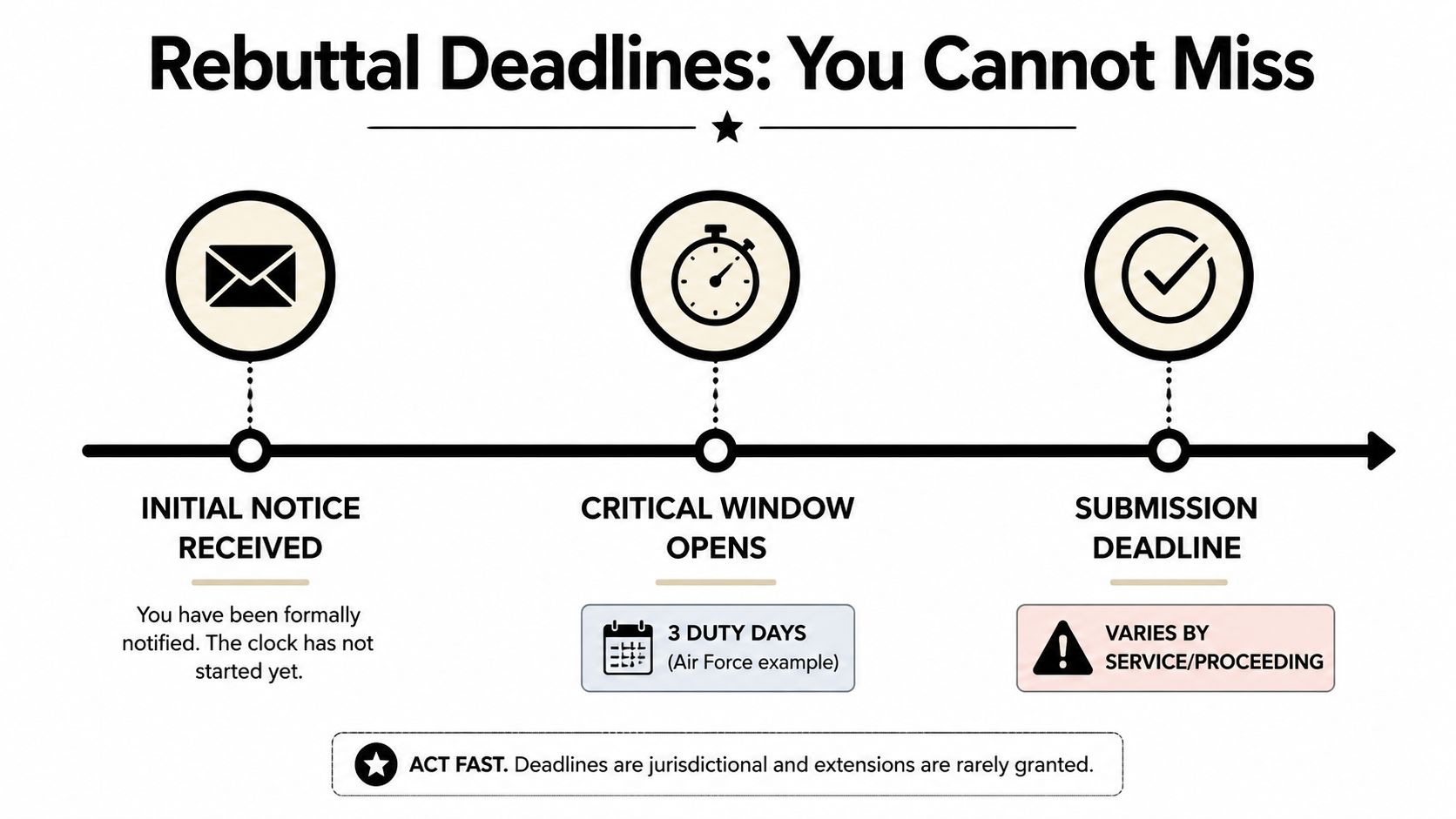
The exact suspense depends on the branch, status, document, and proceeding. One military law guide states that recipients of a Memorandum of Reprimand generally have 10 days to respond, while another military justice source describes Navy, Marine Corps, and Coast Guard response periods as usually 5–10 days. An Army-focused source describes a typical period of 7–14 days, confirming that service and command procedures differ. The military rebuttal deadline guidance should be treated as a starting point, not a substitute for reading your actual notice.
Branch and status differences
Air Force instructional material states that members normally receive three workdays to prepare a response to an admonition or reprimand, with additional time potentially available upon a reasonable request. Under the Air Force LOC, LOA, and LOR process, the period is generally three duty days from receipt, and failure to respond usually forfeits the opportunity unless the issuer waives the deadline for good cause. That distinction matters when delivery occurs near a weekend, holiday, or after duty hours. The underlying Air Force administrative response material also distinguishes between declining to respond and acknowledging in writing that the opportunity was offered but not used.
Army materials state that a Soldier generally has seven days to submit a formal rebuttal to a GOMOR or letter of reprimand. A Soldier may request an extension by memorandum to allow time to meet with legal assistance counsel, but the request must be made affirmatively and promptly. Contact legal assistance immediately and preserve the packet so you can track the date of receipt and suspense.
Texas National Guard guidance describes rebuttal statements as generally due in 3 duty days for certain EAD members, while non-EAD Reservists or ANG members may have 45 calendar days. If submitted, the rebuttal becomes part of the official record. Those differences show why generic internet advice is unsafe. Your status can change the clock.
Special proceedings have separate mechanics
A Physical Evaluation Board rebuttal follows a separate rule. Army administrative-review material states that the DA Form 199-1 and the letter of rebuttal must be received by the PEB within 10 days of receipt of the formal findings, unless the PEB president approves an extension. Any extension request must also be received within that 10-day period. The PEB rebuttal guidance illustrates why you must identify both the filing deadline and the extension-request deadline.
Do three things immediately:
- Record receipt: Preserve the document and note when and how you received it.
- Request time if needed: Submit an extension request in writing before the deadline, with a concrete reason.
- Obtain proof of delivery: Keep the sent email, signed receipt, routing record, or other confirmation.
If the deadline has already passed, don’t assume the matter is hopeless. Ask counsel to evaluate whether a waiver, correction request, later review, or other procedural option exists. Waiting longer only narrows those options.
Critical Mistakes That Ruin Rebuttal Effectiveness
Most failed rebuttals don’t fail because the writer lacked intelligence. They fail because the writer treated a formal personnel record like an angry email.

The recurring errors
Missing the suspense is the most damaging mistake. A perfect response submitted after the governing deadline may never receive meaningful consideration.
Writing an emotional narrative creates credibility problems. Anger, insults, sarcasm, and accusations make it easier for the reviewer to dismiss the response as defensive.
Answering only the headline allegation leaves subsidiary findings standing. If the document says you failed to follow an order, acted in a misleading manner, and caused a particular consequence, answer each proposition separately.
Dumping exhibits weakens the submission. Ten unrelated character letters don’t replace one document that directly disproves a key factual assertion.
Making unsupported accusations is risky. If you claim that a witness lied, identify the contradiction and the record supporting it. Let the inconsistency carry the argument.
A related mistake is confusing the type of rebuttal your case requires. Legal writing guidance distinguishes a rebuttal addressing harmful facts from one addressing opposing argument, as explained in a discussion of rebuttal functions in legal writing. Those tasks aren’t interchangeable.
Factual correction versus narrative framing
A factual correction should be tight. It answers, “What is wrong?” It may identify a false date, inaccurate quote, omitted witness, or record that contradicts the adverse statement.
Strategic narrative framing answers, “What does the complete record mean?” It organizes the facts so the reviewer understands the event without adopting the command’s framing. It can acknowledge an undisputed fact while explaining why the requested punishment or filing decision is disproportionate.
Issue preservation is different again. If the process contains a procedural defect or unresolved dispute, your rebuttal should identify it clearly and avoid language that inadvertently concedes the issue. That’s where experienced counsel matters. The safest response isn’t always the most aggressive one.
Use the following as a quality check:
- Completeness: Every allegation receives an answer.
- Traceability: Every important factual assertion points to proof.
- Credibility: You concede what can’t responsibly be disputed.
- Purpose: Each paragraph advances correction, mitigation, framing, or preservation.
- Relief: The closing request tells the authority what action you want.
When and Why to Hire a Civilian UCMJ Defense Attorney
Legal assistance is valuable, but it isn’t the same as personal defense representation. A legal assistance attorney may explain procedures, review documents, or help you understand available resources. That attorney doesn’t replace an independent civilian lawyer whose professional duty is focused on protecting your interests in the specific matter.
Military-appointed counsel serve accused service members in qualifying criminal cases and can be highly capable trial lawyers. Their role, however, is shaped by military assignments, available resources, command structures, and the scope of the proceeding. A civilian military defense attorney brings an independent practice, broader strategic continuity, and the ability to focus on your case without a military billet or reassignment controlling the relationship.
The difference is strategic, not ceremonial
A rebuttal can affect more than the document immediately in front of you. It may interact with an Article 15, administrative separation, security clearance issue, medical board, investigation, or potential court-martial. An admission that seems harmless in a rebuttal can later become useful to the government. An omitted objection may be harder to raise later.
Experienced military defense lawyers examine:
- What the command must prove in the immediate proceeding.
- Whether the adverse document accurately describes the evidence.
- Which witnesses and records were omitted.
- Whether your response should deny, explain, mitigate, or preserve an issue.
- What filing or separation consequence may follow.
- Whether the document could affect later credibility assessments.
That last point is important. A rebuttal doesn’t exist in isolation. The government may read your words as an admission, a contradiction, or evidence of evasiveness. The right response depends on the complete case posture.
When representation becomes essential
Consult civilian counsel immediately if the document involves serious misconduct, potential separation, a GOMOR with possible permanent filing, an ongoing CID, NCIS, OSI, or CGIS investigation, a court-martial referral, a contested medical finding, or facts that could affect your clearance or professional future.
You should also seek counsel when the allegations are factually complex. A timeline with multiple witnesses, conflicting records, digital communications, or disputed orders requires more than proofreading. Counsel can help preserve evidence, identify contradictions, and prevent the rebuttal from becoming an accidental confession.
You can compare attorneys, which provides profiles and information for evaluating civilian military defense counsel. Don’t choose based only on a polished website. Ask about branch experience, administrative actions, court-martial litigation, communication practices, and who will personally handle the matter.
Choose the lawyer who can explain the risk, the available options, and the cost of each mistake in plain English.
A civilian lawyer can’t promise a particular outcome. A qualified one can help you avoid surrendering control before the decision-maker has reviewed the complete record.
Take Action Before Your Rebuttal Window Closes
A letter of rebuttal is not a place to vent, and it isn’t a formality to sign at the last minute. It is evidence, advocacy, and issue preservation placed inside a personnel or legal record that may outlast the immediate dispute.
Start by preserving the complete packet and documenting receipt. Identify the exact deadline, request additional time in writing if permitted, and stop discussing the facts with coworkers or investigators until counsel advises you. Then gather only the documents and witness information that directly support your factual corrections, mitigation, or requested relief.
If the matter could lead to separation, consult guidance on administrative separation and military discharges while obtaining individualized legal advice. The same document can look very different to a commander, a separation board, or a later reviewing authority.
If you’re facing a reprimand, adverse action, investigation, Article 15, medical finding, or potential court-martial, contact an experienced civilian UCMJ lawyer now. Give counsel the notice, the delivery date, the deadline, and the entire packet. Don’t wait for the command to tell you how serious it is. Your rebuttal window may already be closing, and your career, reputation, and freedom deserve a deliberate defense.