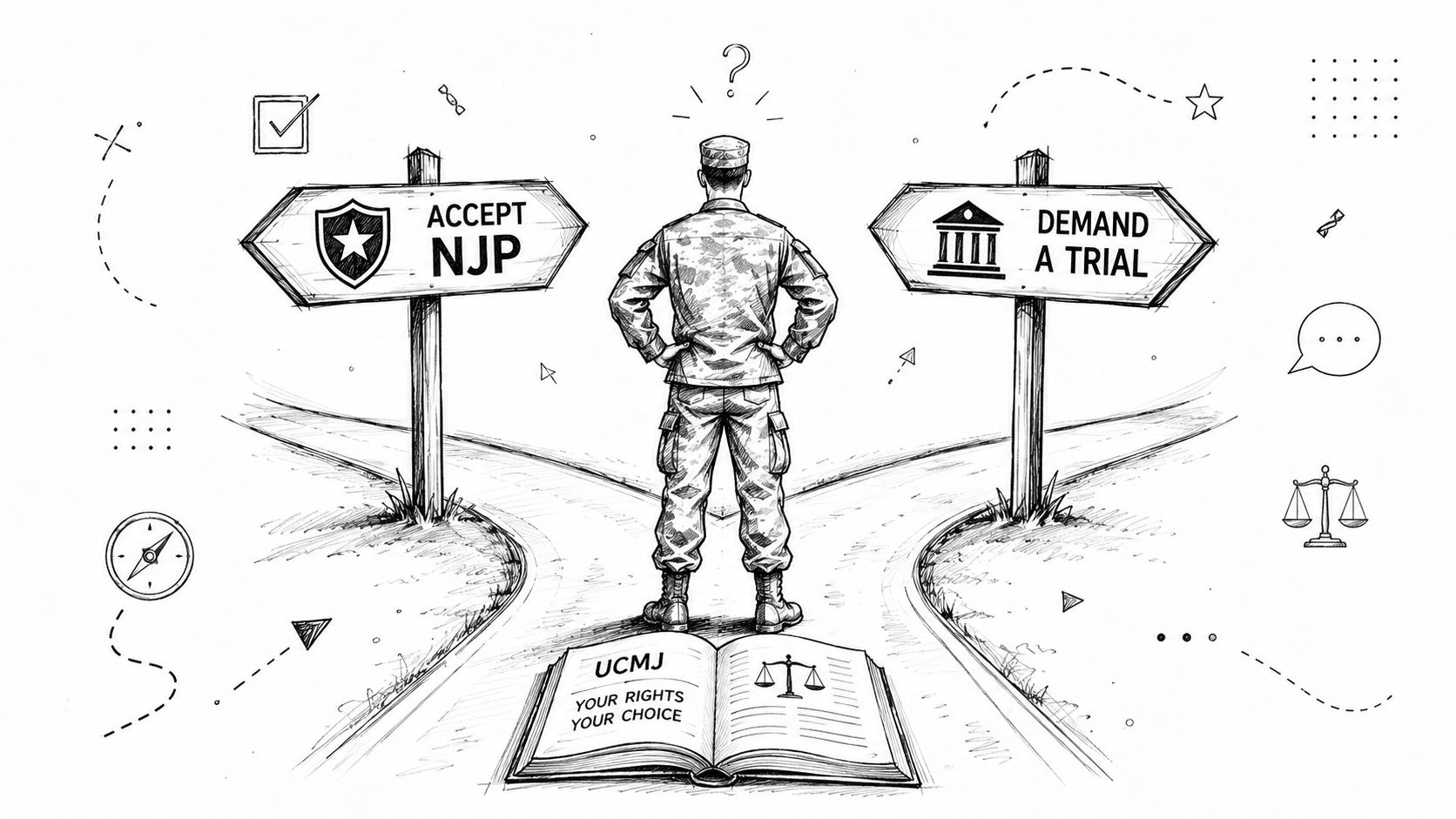
Non-Judicial Punishment, or Article 15, is a commander’s tool to discipline troops for minor misconduct without a trial. It is not a criminal conviction, but it can still bring reduction in rank, forfeiture of up to ½ of base pay for two months, and restriction for not more than 60 days, and it can do serious damage to your career.
If you just got called in, handed paperwork, or told your commander “wants to talk,” don’t treat this like a counseling statement. This is the point where a lot of service members make a lazy decision, say too much, and create a record that follows them long after the punishment ends. An NJP is often sold as the quick way to make a problem disappear. In real life, it often becomes the first document in a larger paper trail.
You’re probably asking the right questions already. What is NJP? Can I fight it? Should I accept it? Is this better than a court-martial? Those questions matter, but one matters more than all the others: what standard is your commander using to decide whether you’re guilty? If you don’t understand that, you can walk straight into a career hit thinking you’re protected by the same rules that apply in criminal court. You are not.
Table of Contents
- Your Commander Wants to Talk What Is NJP
- Company Grade vs Field Grade NJP The Punishments
- Your Rights in the NJP Process
- The Commander’s Playbook The Preponderance Trap
- Long-Term Damage The Career Consequences They Dont Mention
- Common Mistakes That Will Wreck Your Case
- Why You Must Speak to a Civilian Defense Lawyer Now
Your Commander Wants to Talk What Is NJP
When command notifies you about an Article 15, the stress hits fast. Your mind jumps to rank, pay, deployment status, promotion, family pressure, and whether this is going to end your time in uniform. That reaction is normal. It’s also why you need to slow down and think strategically.
NJP, or Non-Judicial Punishment, is a commander-level disciplinary authority under Article 15 of the UCMJ and Part V of the Manual for Courts-Martial. It lets a commanding officer impose punishment for alleged misconduct without a formal court-martial trial. That means no federal criminal conviction, but it still allows punishments such as reduction in rank, forfeiture of up to ½ of base pay for two months, and restriction for not more than 60 days. It is also permanently entered into your record and can trigger security clearance review, a GOMOR, or an administrative separation board, as explained in this overview of Article 15 and non-judicial punishment and in this NJP analysis.
That’s the first mindset shift. No criminal conviction does not mean no real damage.
What this means when the command calls you in
An NJP notice is not a casual meeting. Your chain of command is using a legal mechanism that can leave a permanent mark on your record. If you shrug it off because “it’s only an Article 15,” you’re already behind.
Practical rule: Treat every Article 15 notification like a fork in the road for your career, because that’s exactly what it is.
Some readers want a clean answer to “what is NJP” and stop there. That’s not enough. The better question is this: what can command do with it after they impose it? The answer is usually more important than the label on the form.
The part command often downplays
Command may present NJP as the easier option. Sometimes it is. Sometimes it’s a trap disguised as mercy. If the facts are disputed, if the reporting is sloppy, or if the witness statements are weak, accepting NJP can hand command an easy win and give them a lasting document to use against you later.
That is why you don’t make this decision based on embarrassment, speed, or a promise that “we’ll take care of you.”
Company Grade vs Field Grade NJP The Punishments
Before you decide how hard to fight, you need to understand the threat level. Service members often use “Article 15” as if it’s one thing. It isn’t. The authority behind the NJP matters because the likely punishment and the practical consequences can be very different.
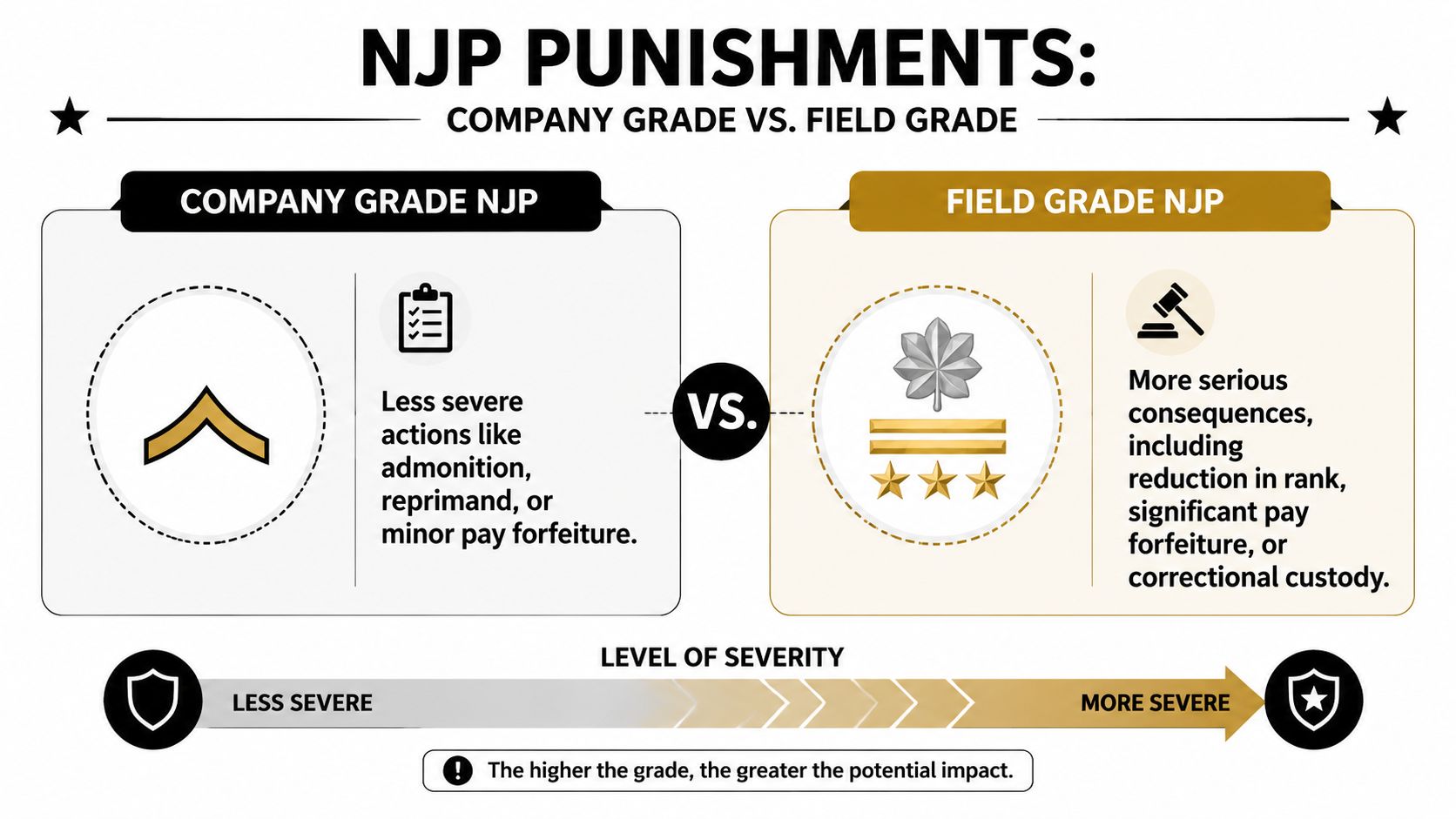
The real difference
At a practical level, Company Grade NJP is usually the less severe version and Field Grade NJP is the more dangerous version. That is the plain-English distinction most service members need to understand first.
| Type of NJP | Practical reality | Typical command posture |
|---|---|---|
| Company Grade NJP | Lower-level disciplinary action, often used when command wants to punish quickly but keep it at a more limited level | More room for mitigation, letters of support, and damage control |
| Field Grade NJP | More serious command action with greater consequences for rank, pay, and future standing | More aggressive, higher stakes, and more likely to shape later admin action |
What you should take from this
The legal label matters less than the consequence path. If command is moving toward a Field Grade NJP, assume they view the allegation as significant enough to justify a stronger response. You should respond the same way. Get organized. Get the documents. Identify witnesses. Stop talking casually to anyone who might repeat your words up the chain.
For many service members, Company Grade NJP becomes the excuse to relax. That’s a mistake. A less severe immediate punishment can still create a paper record command uses later to block opportunities, question reliability, or support separation.
Use this simple frame:
- If the evidence is solid, your focus may be mitigation, presentation, and reducing fallout.
- If the evidence is shaky, your focus should shift to challenging proof, exposing gaps, and evaluating whether accepting NJP makes any strategic sense at all.
- If command seems emotionally invested, assume fairness will not fix this on its own.
A “small” Article 15 can still become the first exhibit in the file command builds against you.
That is why military defense lawyers and court-martial attorneys look past the punishment sheet and study the command climate, the paperwork, and the downstream risks.
Your Rights in the NJP Process
Most service members know they have “rights” at NJP. Very few understand how to use them. Rights are only useful if you exercise them early and intelligently.
Your first decisions matter
Start here. When you receive NJP notice, you should think through these questions in order:
Have you reviewed exactly what they say you did?
Don’t respond to a rumor version of the allegation. Read the wording carefully.Have you spoken to counsel before making any statement?
If you haven’t, stop talking. The right move is often silence first, strategy second.Do you understand that you may be able to refuse NJP and demand a court-martial?
In the right case, that decision changes everything because it forces the government into a different forum with stronger procedural protections.Have you gathered your side of the story in documents, messages, witness names, schedules, or performance records?
Facts disappear fast when people get nervous.
Your right against self-incrimination still matters. If you need a refresher on that protection, read the basics of Article 31 of the UCMJ. A lot of Article 15 cases get worse because the service member tries to “explain” before anyone has tested the government’s version.
The deadline most people miss
There is also a procedural issue that can kill an NJP before you even get into the merits. The statute of limitations for imposing NJP is strictly two years from the date of the alleged offense, unless the accused expressly and voluntarily waives that limit. No UCMJ action, including NJP, can be taken for offenses committed more than two years earlier absent such a waiver, as discussed in this explanation of the NJP time limit.
That is not a minor technicality. It is a real defense issue.
- Check the date of the alleged offense
- Check whether command is asking you to sign anything that waives time
- Do not assume old conduct is automatically still fair game
- Do not waive a deadline unless counsel has explained the strategic reason
If the alleged misconduct is old, the calendar may be your best witness.
What experienced counsel looks for immediately
A seasoned UCMJ lawyer doesn’t just ask “did you do it?” That’s too shallow. The right questions are tougher:
- What is the actual proof?
- Who reported it, and why?
- Are there witness credibility problems?
- Did command skip steps or rush notice?
- Is there documentary evidence that contradicts the allegation?
- Is command using NJP because the case is too weak for court-martial?
Those questions shape whether you present mitigation, challenge the process, or seriously evaluate refusal.
The Commander’s Playbook The Preponderance Trap
This is the part most service members miss. It’s also the part that causes some of the worst decisions.
At NJP, the commander does not need proof beyond a reasonable doubt. The standard is preponderance of the evidence, meaning more likely than not. That lower standard is one of the biggest hidden dangers in the entire process, as outlined in this discussion of the NJP burden of proof.
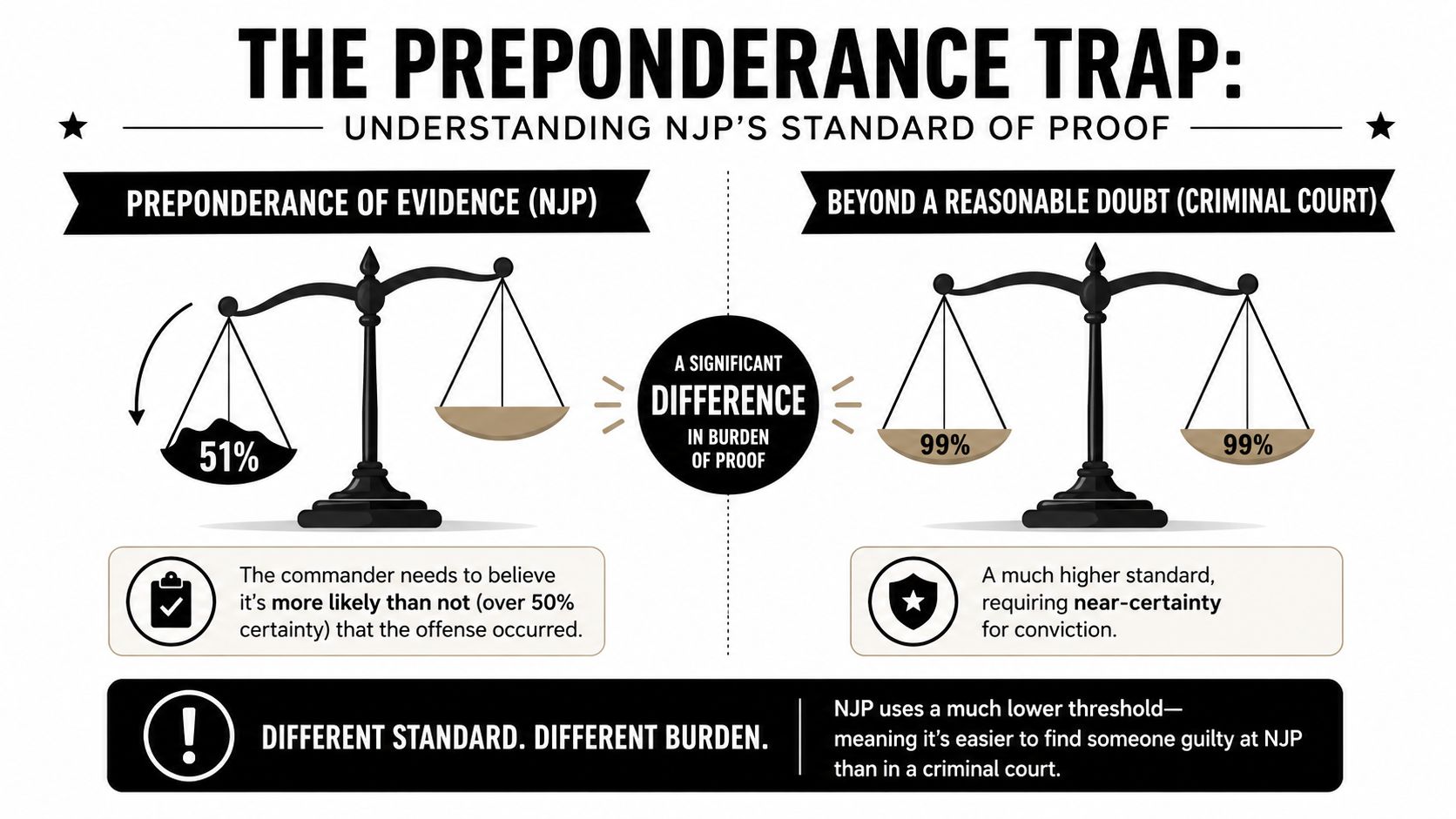
Why this standard is dangerous
A lot of service members think weak evidence protects them. That belief comes from civilian criminal court and from what they’ve heard about court-martial. But NJP is different. If the commander thinks it is more likely than not that misconduct happened, that can be enough.
That means disputed facts are dangerous here.
If one witness accuses you, another witness is uncertain, the paperwork is messy, and command already believes the accusation, you may still lose at NJP even though that same case might look much weaker in a courtroom setting. That is the trap.
The question at NJP often isn’t “can they prove it strongly?” It’s “can they get slightly over the line?”
Here’s the strategic problem. Some service members accept NJP because they think, “They don’t have enough to convict me.” That may be true in a court-martial. It may be false at NJP. Those are different questions because the standards are different.
When refusing NJP deserves serious thought
This is not advice to refuse every Article 15. That would be reckless. Sometimes accepting NJP is the better strategic move. But if the allegation is disputed, if the credibility issues are obvious, or if command appears biased, refusing NJP and demanding a court-martial may deserve serious analysis.
Why? Because a court-martial forces the government into a tougher arena. The government must meet a much stricter standard there. Witnesses face more rigorous testing. Evidence gets challenged more formally. A commander’s hunch doesn’t carry the same weight.
That does not mean refusal is risk-free. It means you should stop making the decision emotionally.
Use this checklist before you decide:
Disputed facts
If the event didn’t happen the way command says it did, the lower NJP standard becomes more dangerous.Weak witness reliability
If the key witness has motive problems, inconsistency, or memory gaps, stronger trial protections may matter.Career impact
If losing rank, pay, or future eligibility would hit hard, the decision deserves a serious defense review.Command bias
If you already know the commander has mentally decided the case, don’t expect neutral reassessment.
What this means for you
When people ask “what is NJP,” the answer should always include this point: it is a disciplinary process where command can punish you under a lower standard of proof than a court-martial would require. If you don’t understand that, you can accidentally choose the process that is easiest for the government and worst for your future.
Long-Term Damage The Career Consequences They Dont Mention
Most commands talk about the immediate punishment because it sounds manageable. Lose some pay. Maybe some restriction. Maybe a rank hit. Then move on. That sales pitch leaves out the actual problem. The record often matters more than the sentence.
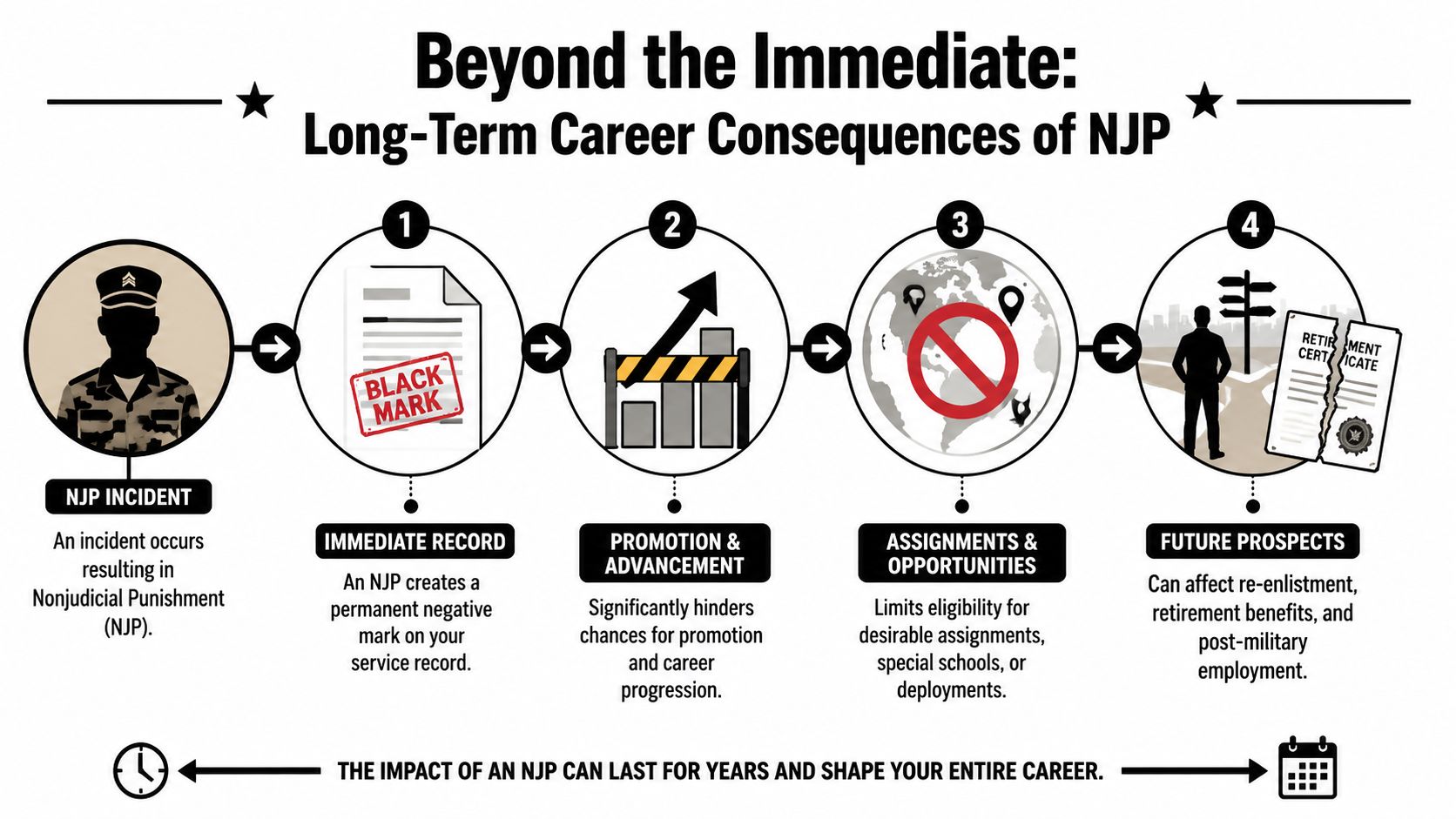
The punishment is not the whole problem
Data from service member forums indicates that an NJP can result in a loss of approximately 100 points for reenlistment, which can hurt access to high-tier reenlistment bonuses or career tracks that require a clean record, according to this discussion of how serious an NJP can be. That same discussion also notes that NJP can trigger later administrative actions and create a paper trail that undermines security clearance reviews or civilian employment.
That is why service members should stop focusing only on whether they can survive the next few weeks. The harder question is whether they can survive the next review board, the next promotion consideration, the next reenlistment decision, or the next clearance check.
For a broader look at those downstream effects, review how Article 15 and nonjudicial punishment affect a military career.
Why the record matters more than the event
An NJP often becomes a credibility marker inside the system. Once it’s in the file, command can use it to frame you as a problem. Then every later issue gets interpreted through that lens.
Here is how that usually plays out:
Promotion problems
Decision-makers may see the NJP as a sign you are not the safe choice.Reenlistment pressure
Even when the immediate punishment has passed, the record can keep hurting you.Administrative escalation
A GOMOR, separation action, or clearance concern can follow because the paper trail already exists.
A commander may call NJP “minor.” The file it creates is not minor.
If you are trying to protect a long-term career, your strategy has to account for all of that from day one.
Common Mistakes That Will Wreck Your Case
The mistakes in Article 15 cases are predictable. They happen because people panic, trust the wrong person, or convince themselves speed is the same thing as safety.
Errors that come up over and over
Talking to investigators or command to “clear it up”
That usually helps the government more than it helps you. Explanations turn into admissions, contradictions, or extra allegations.Assuming NJP is harmless because it isn’t a conviction
That thinking gets people burned. The record and follow-on consequences can be brutal.Accepting NJP just to get it over with
Quick is not the same as smart. If the evidence is weak, speed may be the government’s advantage, not yours.Ignoring witness and document issues
Texts, duty rosters, location records, training schedules, and prior statements can matter. Many service members never gather them in time.Trusting command to be neutral
Investigations are not neutral in practice. By the time NJP is offered, someone usually wants an outcome.Missing procedural defenses
Date issues, notice problems, and waiver questions can change the analysis fast.Waiting too long to get a UCMJ lawyer involved
Delay kills options. Once you’ve talked too much or signed the wrong thing, cleanup gets harder.Thinking truth alone wins
Strategy wins cases. Truth matters, but if you present it badly, late, or without evidence, command may never give it full weight.
The right posture is calm, disciplined, and skeptical. Assume every decision from notice forward matters.
Why You Must Speak to a Civilian Defense Lawyer Now
By now the pattern should be obvious. NJP is not just a commander’s meeting. It is a legal and career event. The lower burden of proof favors command. The paperwork can outlive the punishment. The wrong early decision can hand the government an easy result.
Start with this visual summary.

Military counsel and civilian counsel are not the same thing
Military defense counsel can be valuable, but they are often carrying heavy caseloads and operating inside the same larger system you are fighting. A strong civilian military defense lawyer brings independence. That matters when command is pushing hard, when the facts are messy, or when the case may spill into administrative separation, clearance trouble, or later court-martial exposure.
A battle-tested civilian attorney also tends to look wider than the immediate hearing. The question is not only “how do we argue this NJP?” It is also “how do we protect your rank, record, future options, and next stage of the fight?”
This video gives a practical sense of why early defense action matters.
What to do today
If you were just notified of an Article 15, do these things now:
- Stop making statements unless counsel has advised you.
- Preserve documents and messages that may help your defense.
- Write down the timeline while your memory is fresh.
- Identify witnesses before stories shift.
- Get legal advice before choosing whether to accept or refuse NJP.
You do not need more guesswork. You need strategy. If you are under investigation, facing Article 15, or trying to decide whether to demand a court-martial, speak with experienced civilian military defense lawyers immediately. Your career is on the line, and early action matters.