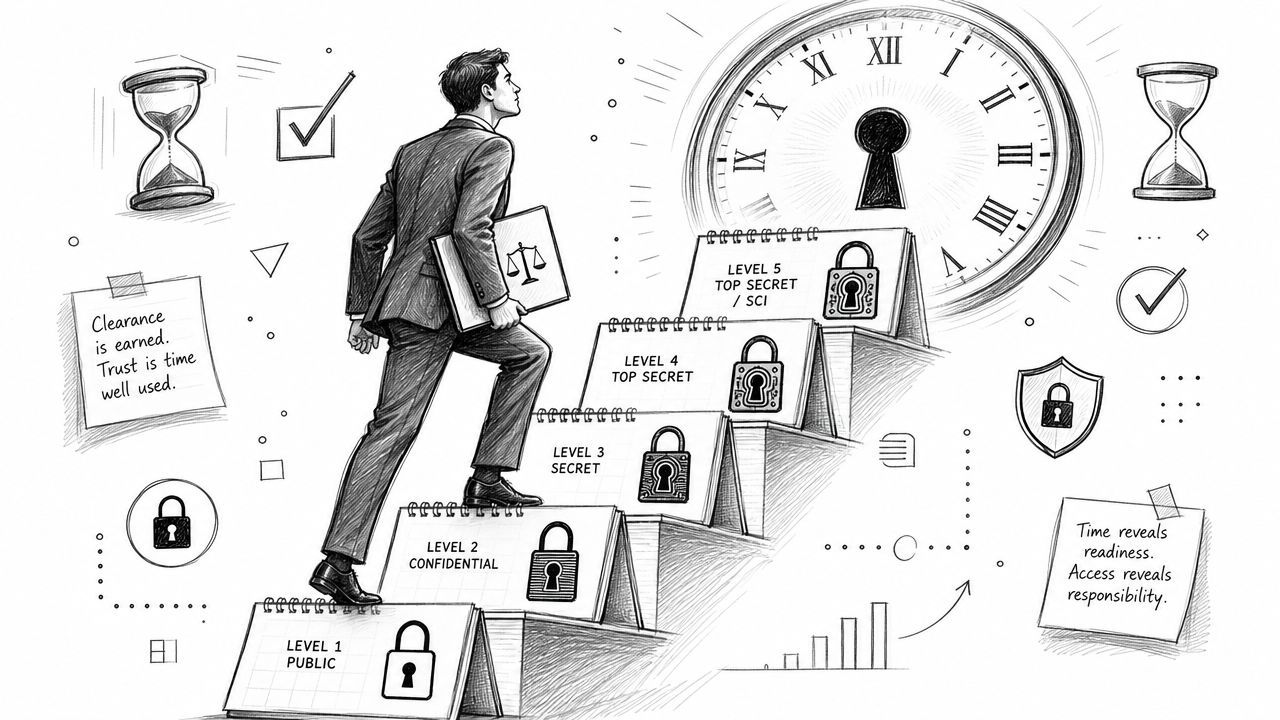
Secret clearances are taking 90 to 120 days on average, and Top Secret clearances are taking 180 to 365 days on average, with SCI adjudication adding another 60 to 180 days on top of that [DCSA FY2026 metrics summarized here]. Those 2026 numbers are already bad, but they still don’t tell the whole story, especially if you’re a service member dealing with an arrest, NJP, a GOMOR, CID, NCIS, OSI, CGIS, or a pending court-martial.
If you’re reading this, you’re probably stuck in the worst part of the process. No clear update. No timeline you trust. A command that wants answers. A spouse asking whether orders, housing, pay, or a job offer will fall apart. Careers can stall in this black box for months because service members assume the system is just slow, when in reality the case has shifted into a more dangerous phase.
Security clearance problems are never just paperwork. They affect assignments, promotions, special duty opportunities, and whether command starts viewing you as a risk. If there’s a UCMJ issue anywhere near your file, passive waiting is a mistake.
Table of Contents
- Your Career on Hold The Career Cost of Waiting for a Clearance
- Security Clearance Timelines by Level Secret vs Top Secret
- The 7 Stages of the Security Clearance Process
- Strategic Insight Why Your Clearance Is Really Delayed
- Red Flags That Wreck Your Clearance Timeline
- When a UCMJ Action Puts Your Clearance in Jeopardy
- Stop Waiting and Start Fighting Why Civilian Counsel Is Essential
- FAQ
- Can I refuse to talk to CID NCIS OSI or CGIS
- How long does security clearance take if I already have legal problems
- What’s the difference between the investigation and adjudication
- Can an Article 15 or NJP affect my clearance
- Should I wait for command to sort this out
- Do I need a civilian military defense lawyer immediately
Your Career on Hold The Career Cost of Waiting for a Clearance
Why the delay hits harder than most people expect
You are told a clearance is still pending. The school seat goes to someone else. The assignment requiring access moves on without you. Your command starts looking at you as a question mark instead of a safe choice for a sensitive billet.
That is how careers stall.
A clearance delay does not stay inside a file. It affects promotions, assignments, training opportunities, deployability, and your credibility with decision-makers who rarely wait for one person’s paperwork to catch up. In the civilian world, the result is just as harsh. A contractor can lose the role. A federal applicant can watch a start date disappear.
The danger is not just the length of the wait. The danger is misunderstanding where the wait is happening. A case can sit in investigation because records, interviews, travel, finances, or law enforcement issues need more work. It can also sit in adjudication after the investigation is done because an adjudicator sees a concern and wants more explanation. Those are different problems. They require different responses. Service members who fail to make that distinction waste time and lose options.
Practical rule: If your career depends on a clearance, treat silence as a warning sign and find out whether the delay is in investigation or adjudication.
Too many service members assume no news means no problem. Wrong. In clearance cases, silence often means no one has explained what is slowing the file, who has it, or what concern is driving the delay.
What this means for your family and your record
The family impact shows up fast. Orders become uncertain. Start dates slide. Pay plans and housing decisions get harder. Stress rises because nobody can give you a clean answer.
The professional damage can outlast the delay itself. A missed billet leaves a gap in your record. A lost school slot changes your path. A command that stops trusting your availability may stop investing in you. If the case starts bleeding into separation or adverse administrative action, the stakes jump again. If discharge status becomes part of the picture, learn how benefits after an other than honorable discharge can affect life after service.
Here is the part competitors usually skip. Ongoing UCMJ trouble does not just add stress. It can freeze meaningful progress because investigators, adjudicators, and command channels do not want to clear a case while misconduct allegations are still active or unresolved. An open Article 15 matter, pending court-martial exposure, CID, NCIS, OSI, or CGIS involvement, or disputed statements about the same conduct can keep the file from moving cleanly. That is not a routine delay. That is a career threat tied to military justice.
Once your name is connected to questions about honesty, judgment, reliability, or misconduct, your case stops being ordinary. Passively waiting is not strategy. It is how service members lose control of a process that can damage both their clearance and their future.
Security Clearance Timelines by Level Secret vs Top Secret
What the actual timeline ranges look like
The word “average” causes trouble in security clearance discussions. It makes service members think the process runs on a predictable clock. It does not.
A better question is this: are you stuck in investigation, or are you stuck in adjudication? That distinction matters more than the label on the clearance. A Secret case can drag if the file expands. A Top Secret case can sit after the investigation is finished because adjudicators need more issue development, more records, or more time to resolve concerns.
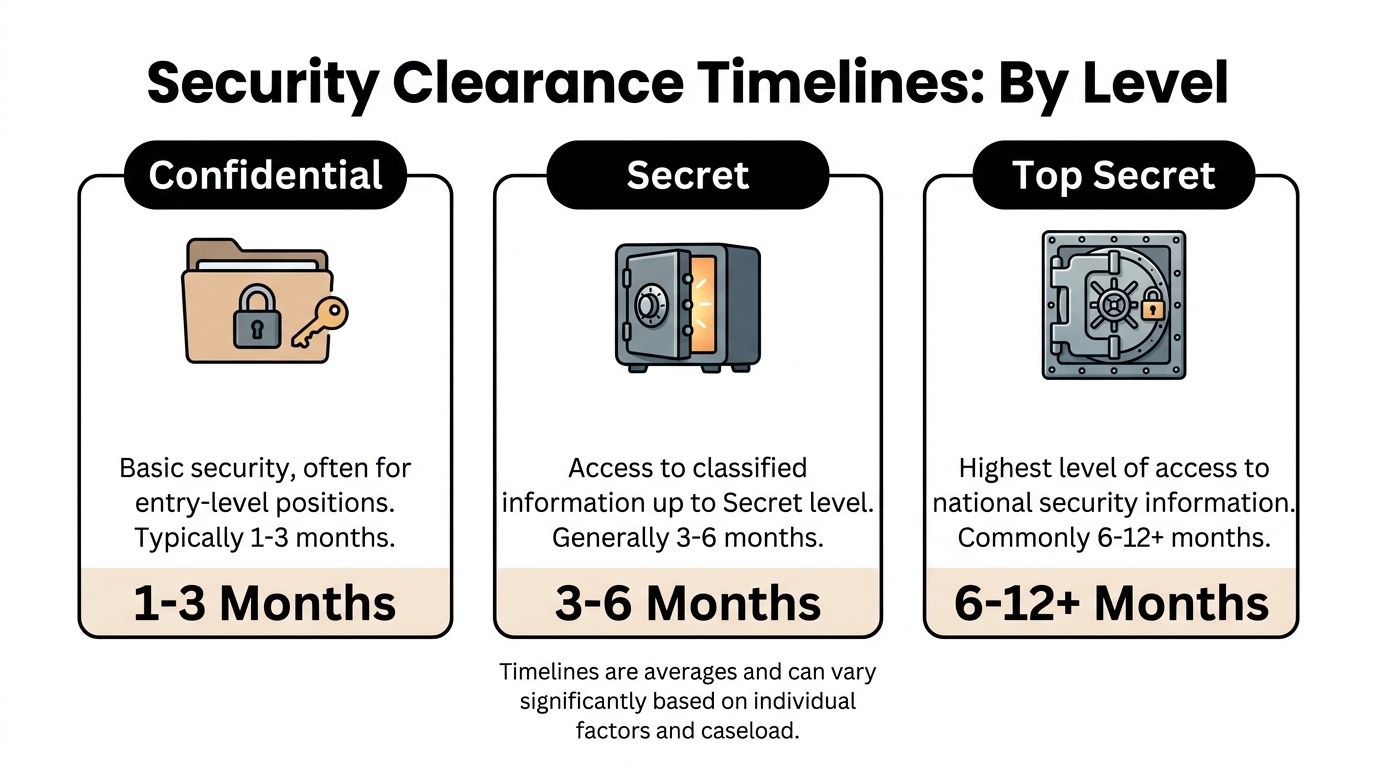
For many applicants, Secret clearances run from 60 to 150 days, Top Secret runs from 120 to 240 days, and TS/SCI cases that require a polygraph can add 180 to 365 days because polygraph waitlists become the bottleneck [clearance processing ranges and bottlenecks].
Top Secret cases usually take longer for a simple reason. The government digs deeper, interviews more sources, pulls more records, and spends more time resolving discrepancies. Then the case still has to clear adjudication. That second half is where many applicants lose track of what is really happening.
Use this as a working comparison:
| Clearance level | Common timeline range | What usually drives delay |
|---|---|---|
| Confidential | Often handled as a lower-complexity case | Sponsorship, paperwork quality, local processing issues |
| Secret | 60 to 150 days | Incomplete SF-86, missing fingerprints, record expansion |
| Top Secret | 120 to 240 days | Deeper investigation, adjudication lag, issue development |
| TS/SCI with polygraph | Top Secret base plus 180 to 365 days | Polygraph waitlists and added program review |
Why official targets don’t protect you
Federal targets for Secret and Top Secret processing sound reassuring on paper. They do not protect your career in practice.
The practical problem is not just that cases run long. It is that commands, recruiters, supervisors, and families hear a target date and treat it like a promise. Then the file hits a paperwork defect, a records issue, a foreign contact question, or a conduct-related concern, and the timeline falls apart.
A published benchmark is not a promise to you. It is a target for a system that often misses it.
Treat any quoted timeline as the start of your risk analysis, not the end of it. If your case includes financial issues, police contact, foreign influence concerns, or unresolved UCMJ exposure, use the longer end of the range. Better yet, assume the investigation may finish before the main fight begins. Adjudication is where troubled cases often stall, and an open military justice matter can keep the file from moving cleanly at all.
The 7 Stages of the Security Clearance Process
A lot of bad decisions happen because the applicant doesn’t know where the case is. They think the whole process is one long investigation. It isn’t.
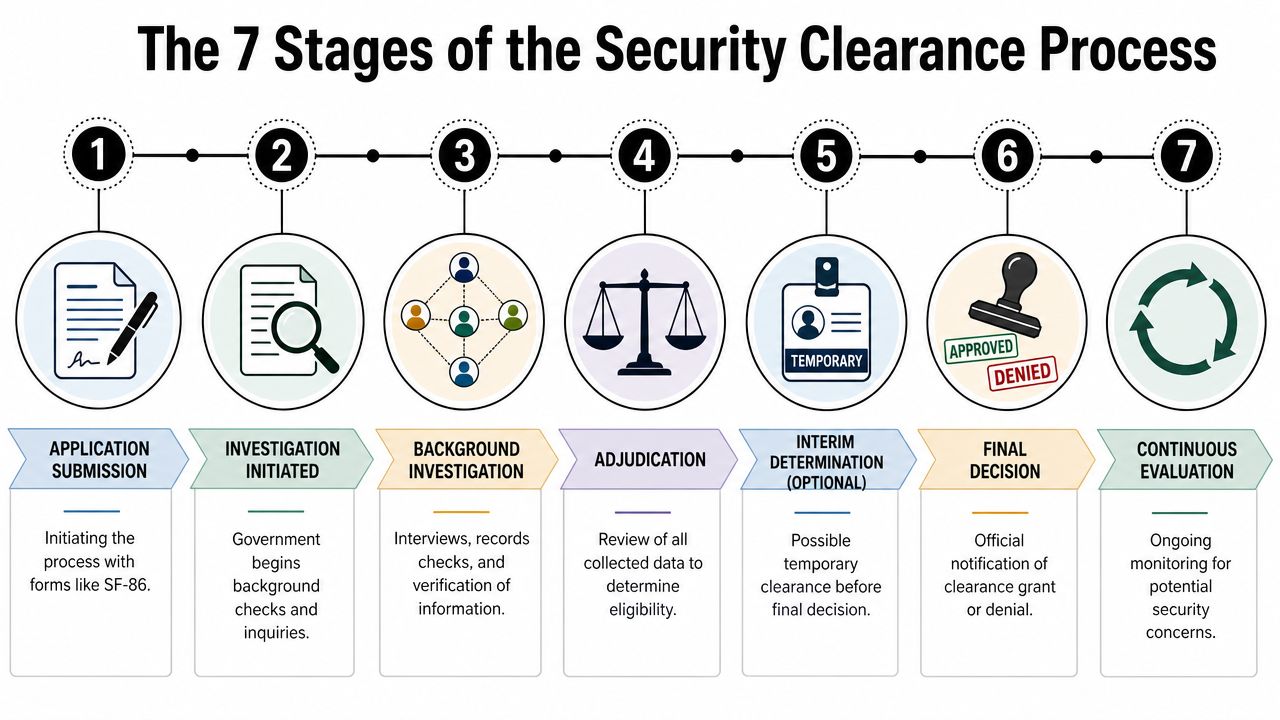
Stage 1 through Stage 3
SF-86 submission
Many delays arise at this stage. If dates don’t line up, employers are missing, addresses are sloppy, or foreign contacts are incomplete, you hand the government a reason to distrust you before the main review starts.Agency vetting and package review
Someone checks whether the submission is complete enough to move. Cases can stall here because the form is defective, fingerprints are late, or the sponsoring chain is slow to fix problems.Background investigation
This is the heavy lift. Investigators review records, contact references, test your answers against other sources, and start pulling on loose threads. If your story changes depending on who’s asking, the file gets harder, not easier.
Stage 4 through Stage 7
Subject interview
If you’re interviewed, your job isn’t to impress anybody. Your job is to be accurate, consistent, and careful. Service members often make the mistake of trying to “explain away” a problem with extra talking. That’s how small credibility issues become bigger ones.Adjudication
At this stage, the file gets judged. A completed investigation does not mean a completed case. It means the evidence package has moved to another decision-maker.Appeal or response phase
If adverse information is raised, the response must be organized, documented, and strategic. Emotional explanations rarely help. Clean timelines, corroborating records, and disciplined framing do.Periodic reinvestigation or continuous evaluation
Clearance problems don’t only hit first-time applicants. Existing holders get reviewed again, and new misconduct, debt, omission, or dishonesty can reopen old issues fast.
At each stage, keep these thoughts in mind:
- Before submission: Is every answer complete, consistent, and capable of verification?
- During investigation: Who might be contacted, and what will they say?
- During adjudication: What issue in the file could a reviewer see as judgment, reliability, or honesty trouble?
- If adverse action starts: Who is building the response, and are they treating this like a legal problem instead of an HR problem?
Most applicants focus on truth alone. Clearance cases also turn on presentation, consistency, and documentation.
Strategic Insight Why Your Clearance Is Really Delayed
Investigation is not adjudication
This is the part most public guides miss, and it’s why so many service members get blindsided.
People hear that an investigation is underway and assume the delay lives there. Sometimes it does. But 2026 Q1 data showed Top Secret investigation times dropped to 227 days while overall processing still stayed above benchmarks because adjudication timelines increased by 12 to 15 percent [Top Secret investigation versus adjudication delay].
That means your file can be “done” with the investigative leg and still sit in a decision queue where nobody gives you a useful update. This is the black box period that rattles careers. The command hears “pending.” The member hears nothing. The family assumes the whole system is frozen.
It’s worse when legal trouble exists in the background. Adjudicators don’t just look for criminal convictions. They look for unresolved judgment problems, incomplete fact patterns, and contradictions between what you disclosed and what the file shows.
What experienced defense lawyers do with that fact
A seasoned civilian military defense lawyer doesn’t just ask, “Has the investigation finished?” The better question is, “What issue is preventing a clean adjudicative decision?”
That changes the strategy.
Instead of sitting back, counsel starts identifying the specific problem category. Is it honesty? Financial pressure? Alcohol misuse? Police contact? Command documentation? A pending UCMJ event? Once you know the pressure point, you can build a response around records, witness statements, treatment proof, payment history, or a tighter legal narrative.
Common mistakes service members make here include:
- Trusting status labels: “Pending” doesn’t tell you whether the issue is factual, administrative, or legal.
- Talking too much to command: Loose explanations create extra versions of events.
- Failing to gather documents early: By the time an adverse notice arrives, the clock matters.
If your file is delayed, assume there’s a reason. Find it. Address it. Don’t romanticize bureaucracy as neutrality.
Red Flags That Wreck Your Clearance Timeline
A file stops moving for a reason. The delay usually starts with one issue and then gets worse because the service member answered it badly, documented it badly, or left it unresolved.
The issues that trigger deeper review
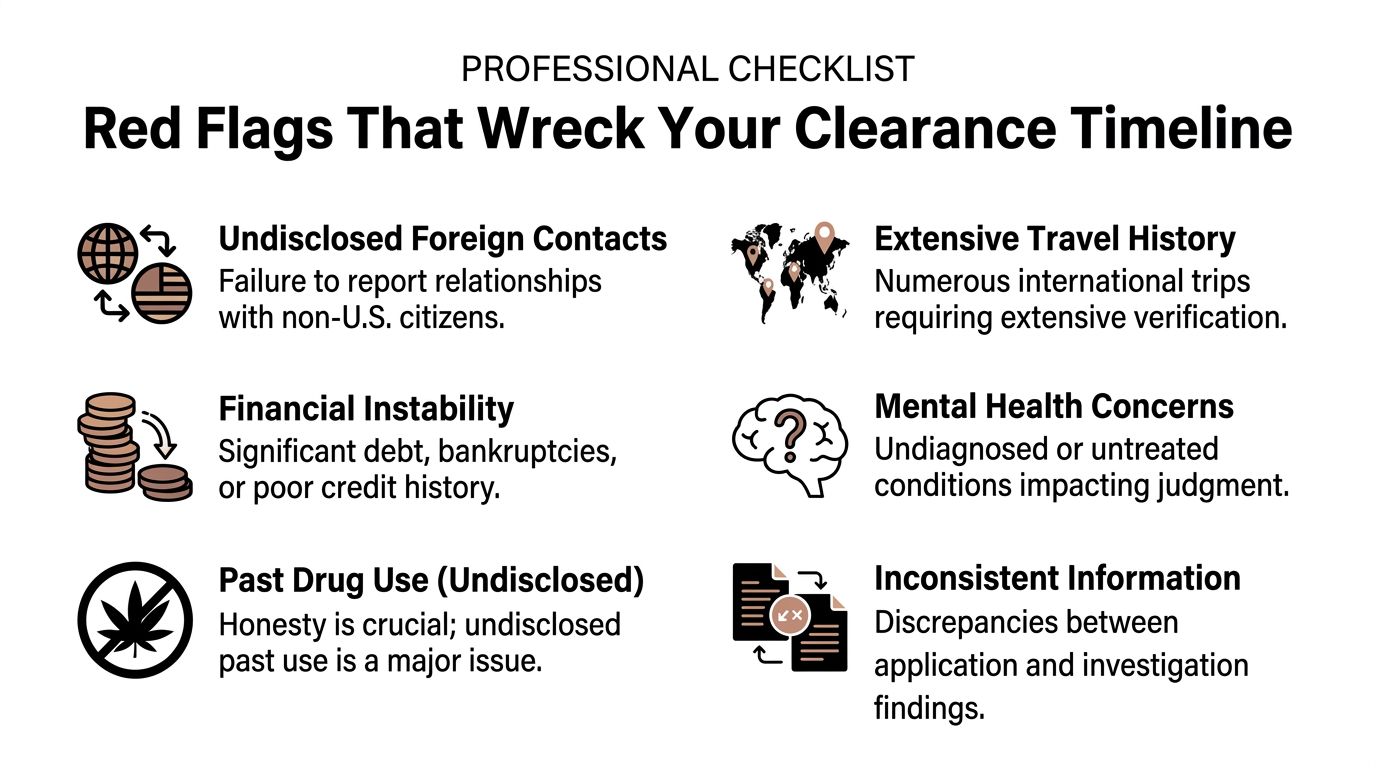
The government slows down when your file raises a credibility problem, a reliability problem, or both. Those are the cases that leave people stuck in limbo while command starts asking questions.
The most common triggers are:
- Inconsistent information: If your SF-86 does not match records, travel history, employment dates, or what references report, investigators start looking at carelessness and possible deception.
- Undisclosed legal trouble: Arrests, citations, command action, or off-base incidents that were omitted or softened create immediate trust problems.
- Financial instability: Debt alone is not the primary issue. Debt combined with missed payments, collection activity, gambling, or no repayment plan raises judgment concerns.
- Foreign contacts and travel: Foreign ties can be manageable. Hidden relationships, vague explanations, and incomplete reporting are what cause files to expand.
- Substance issues: Past use can often be mitigated. Current use, minimization, and conflicting statements create delay.
- Mental health concerns tied to reliability: Treatment is often helpful evidence. Secrecy, missed treatment, or conduct tied to instability can slow review.
A short explanation of common delay triggers can help frame the problem:
The mistakes that turn a manageable issue into a long delay
Red flags often become catastrophic not because of the initial issue, but because of how applicants respond to them.
That distinction matters. An investigation can expand because facts are missing. Adjudication can stall because the explanations, records, or mitigation are weak. Service members who do not understand that split waste months fixing the wrong problem.
Here are the mistakes that keep cases alive far longer than they should:
- Hiding a bad fact: Investigators expect imperfect records. They react far more aggressively to omission than to disclosed misconduct.
- Submitting a rushed SF-86: Bad dates, missing addresses, incomplete employment history, and inconsistent disclosures force follow-up work you could have avoided.
- Assuming command paperwork will stay local: It will not. Counseling statements, adverse actions, police reports, and sworn statements can all affect how your reliability is judged.
- Treating debt like a private problem: In clearance review, unpaid obligations can be framed as poor judgment, vulnerability to pressure, or refusal to take responsibility.
- Changing the story midstream: Casual corrections can look like deception if they are not backed by records and presented carefully.
- Waiting too long to get legal control of the facts: Early case strategy during the investigation phase often determines whether a red flag stays narrow or spreads through the whole file. Service members should review how experienced counsel build a defense during the military investigation phase before they start making statements and handing over paperwork.
Administrative mistakes also cause ugly delays. Incomplete forms, bad routing information, and missing fingerprint submissions can hold a case up before anyone even reaches the harder questions about judgment or honesty.
Clean forms do not guarantee approval. Sloppy disclosures and unresolved facts almost guarantee delay.
When a UCMJ Action Puts Your Clearance in Jeopardy
How military justice problems spill into clearance review
If you’re under investigation, facing NJP, dealing with a GOMOR, or preparing for court-martial, your clearance issue isn’t separate from your legal issue. It’s attached to it.
A pending military justice matter can freeze progress because the clearance system hates unresolved facts. It doesn’t want to guess how a criminal allegation, adverse command action, or disciplinary record will land. It wants the file developed, documented, and often finished enough to be judged.
The published guidance on timelines only hints at how destructive this gets. Prior arrests or legal matters can trigger record expansion and add 4 to 6 months to Secret clearances or 6 to 12 months to Top Secret clearances, but the available sources don’t quantify exactly how ongoing court-martial cases halt or extend processing for active-duty members [legal issues and clearance delay ranges].
That gap matters because active-duty members often aren’t applying after the legal dust settles. They’re applying while CID is still working, while command is deciding whether to impose nonjudicial punishment under Article 15, or while trial counsel is building a case.
What to do if your clearance and your case collide
When a UCMJ matter and a clearance matter overlap, think in terms of damage control on two fronts.
First, stop making admissions just because someone tells you “this is only administrative.” Statements made to save your position at work can damage your defense case. Statements made to defend the criminal side can create fresh clearance problems if they’re inaccurate, incomplete, or contradicted later.
Second, get disciplined about documents. Your defense lawyer should be looking at command memos, counseling entries, law enforcement paperwork, treatment records, financial records, and anything else that can shape how adjudicators read your judgment and credibility.
Third, prepare for the possibility of a formal adverse notice. If a Statement of Reasons or similar issue package appears, your response cannot be casual. This is not the moment for a handwritten apology and hope. It requires strategy, evidence, and consistency with your UCMJ posture.
If you have an open military justice issue, you should assume your clearance is at risk even if nobody has said those words out loud yet.
Stop Waiting and Start Fighting Why Civilian Counsel Is Essential

Why appointed counsel isn’t enough in many clearance cases
Detailed military defense counsel can be skilled and hardworking. But many service members make the mistake of assuming the assigned lawyer is built to handle the full overlap of UCMJ exposure, command pressure, adverse administrative action, and clearance fallout.
Often, they aren’t positioned to fight that entire war.
A seasoned civilian military defense lawyer brings independence from command, broader trial experience in serious cases, and a strategic view of how one statement in a disciplinary matter can damage a separate eligibility review. If your case is already in the investigation phase, you should understand how experienced counsel can shape the case before charges harden.
The move you should make now
If you’re waiting on a clearance and there’s any legal issue attached to your name, stop treating this like an administrative inconvenience. It’s a career protection problem.
Your next move should be immediate and deliberate:
- Get legal advice early: Before another interview, written statement, or command meeting.
- Preserve documents: Don’t rely on memory.
- Control your narrative: One accurate version. No improvising.
- Build a two-front strategy: One for the UCMJ or command case, one for the clearance consequences.
FAQ
Can I refuse to talk to CID NCIS OSI or CGIS
Yes. In many situations, the smarter move is to say you want a lawyer before answering questions. Service members damage their own cases every day by trying to sound cooperative.
How long does security clearance take if I already have legal problems
Longer than the published baseline in many cases. Legal issues can trigger record expansion, added review, and waiting for unresolved facts to develop. If the issue is active, the timeline can become unpredictable.
What’s the difference between the investigation and adjudication
The investigation is when facts are gathered. The adjudication is when a decision-maker reviews those facts and decides whether you’re eligible. Many applicants think the delay is all investigation. It often isn’t.
Can an Article 15 or NJP affect my clearance
Yes. Any disciplinary action can affect how your judgment, reliability, honesty, and overall trustworthiness are viewed. The facts behind the action matter, and so does how you responded.
Should I wait for command to sort this out
No. Command is not your personal case manager. Command’s interests and your interests often diverge fast, especially when readiness, optics, or discipline are in play.
Do I need a civilian military defense lawyer immediately
If a clearance delay overlaps with CID, NCIS, OSI, CGIS, NJP, a GOMOR, separation processing, or court-martial risk, yes. Early action gives your lawyer room to protect both the legal case and the clearance consequences.
If you’re under investigation, facing adverse action, or stuck in a clearance delay that threatens your career, act now. Don’t wait for command to explain it, don’t assume silence means safety, and don’t gamble your future on hope. Speak with experienced civilian military defense lawyers immediately, and use this guide to choosing a military defense lawyer to identify and compare counsel who handle serious military justice cases. Your career, your reputation, and your family stability are on the line.