You’re probably in the worst part of it right now. A supervisor pulled you aside. First sergeant is suddenly interested in you. Someone says the command is considering a summary court-martial, and another person shrugs it off like it’s no big deal because it’s “just” a lower-level court.
That kind of advice ruins careers.
A summary court-martial sounds minor. It isn’t. It’s a fast, stripped-down trial process built for command convenience. If you handle it casually, you can walk away with far more than short-term punishment. You can hand command the record it wants to push you toward separation and wreck your future as a veteran. If you’re facing one, or even hearing the phrase, you need to think strategically now, not after the paperwork is done.
Table of Contents
- Your First Warning and What a Summary Court Martial Is
- Maximum Punishments and The Real Long-Term Damage
- The Summary Court Martial Process Step by Step
- Strategic Insight The SCM as a Commander’s Trap
- Your Rights and Why They Are Dangerously Limited
- Common Mistakes That Will Destroy Your Military Career
- Why an Experienced Civilian Defense Lawyer Is Not Optional
- Frequently Asked Questions About Summary Courts Martial
Your First Warning and What a Summary Court Martial Is
You get called in. First sergeant says command wants to “keep this at a summary” and handle it fast. That sounds like a break. It often is not. It is often the first clean step toward a record command can use to justify pushing you out, including with an Other Than Honorable discharge package, without spending the time and resources of a bigger court-martial.
That is why service members get blindsided here. They hear “summary” and translate it to “minor.” Command hears “efficient.” A summary court-martial gives command a formal conviction mechanism with fewer obstacles, and that can become the administrative weapon that finishes your career.
A summary court-martial is different from an Article 15 or NJP. If you need that distinction clear before you make a bad decision, read this guide on what an NJP is in the military. NJP is command discipline. A summary court-martial is a court-martial under the UCMJ.
What lands you here
This usually starts with command saying the allegation is small enough to handle quickly. Missed movement. Disobeying an order. Property-related misconduct. A short list of charges that command presents as manageable and limited.
Do not fall for the packaging.
A significant shift occurs when command decides it wants a formal guilty finding on paper instead of informal discipline. That paper matters. It can drive separation processing, wreck your credibility with your chain of command, and make you look like an easy target for adverse administrative action.
Practical rule: If command says this is the easiest way to put it behind you, assume the process is designed to help command first.
What a summary court-martial looks like
A summary court-martial is the lowest level court-martial forum, but it still puts you in a criminal process. For enlisted personnel, it is typically handled by a single commissioned officer serving as the summary court-martial officer. One person drives the proceeding, manages the evidence, questions witnesses, and decides guilt and sentence.
That setup should concern you. A system with fewer layers of protection is easier for command to control and harder for you to stop once it starts moving.
Here is the part that matters right away:
- Who can face it: Enlisted service members.
- Who cannot: Officers and certain other categories excluded from this forum.
- Why command likes it: It is faster and easier than a special or general court-martial.
- Why you should treat it as dangerous: A quick conviction can become the foundation for separation, loss of rank, loss of pay, and a discharge fight that gets ugly fast.
If command is floating a summary court-martial, do not treat it like a paperwork problem. Treat it like an early-stage career kill shot. The “minor” label is often the bait. The objective is a record command can use against you.
Maximum Punishments and The Real Long-Term Damage
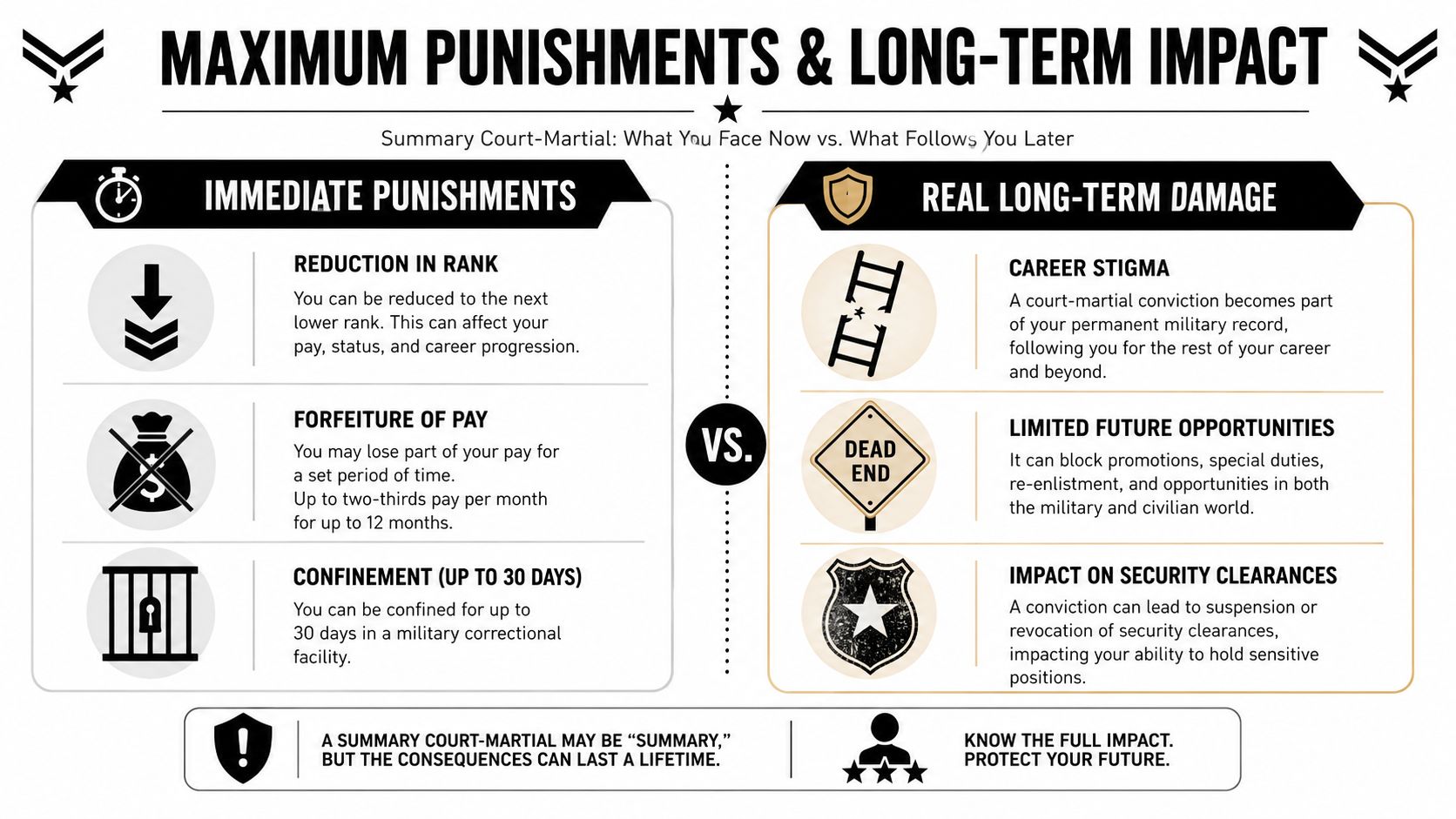
The punishment chart matters less than what command can build from it. A summary court-martial can strip pay, rank, and liberty fast. The bigger threat is the paper trail it creates for separation, clearance damage, and an Other Than Honorable push that follows you long after the hearing ends.
What the punishment chart says
For E-4 and below, the maximum punishment at a summary court-martial can include 30 days of confinement, forfeiture of two-thirds of one month’s pay, and reduction to E-1. Other verified material also describes a ceiling that can include 45 days hard labor without confinement and 60 days restriction for junior enlisted in this forum (court-martial punishment overview).
For E-5 and above, the ceiling is narrower. Senior enlisted generally do not face confinement at a summary court-martial. They can still get hit with reduction to the next lower pay grade, forfeiture of two-thirds pay for one month, and restriction.
Here’s the clean comparison:
| Pay grade | Maximum confinement | Pay impact | Rank impact |
|---|---|---|---|
| E-4 and below | 30 days | Two-thirds pay forfeiture for one month | Reduction to E-1 |
| E-5 and above | No confinement | Two-thirds pay forfeiture for one month | Reduction to next lower grade |
Do not stop your analysis at that table.
What can hurt you longer than the sentence
A lot of enlisted service members hear that a summary court-martial is the lowest forum and start treating it like a manageable disciplinary hit. That is exactly how command wants you thinking. A guilty finding gives them a clean piece of adverse paperwork to drop into a separation packet, a clearance review, a promotion file, or a bar to continued service argument.
That is where careers end.
The short sentence often burns off quickly. The record does not. Even without a federal civilian conviction in the usual sense, a summary court-martial can still function as a permanent adverse mark inside the military system, and command can use that mark to argue you are no longer fit to stay in uniform, as described in this overview of summary court-martial consequences for records and careers.
If command already wants you out, the SCM can serve as the administrative weapon that gets them there faster. It gives them a finding. It gives them language for memoranda. It gives them cover when they recommend harsh characterization of service.
That is the trap.
A service member who focuses only on 30 days, reduced pay, or busted rank is missing the larger fight. The larger fight is whether this proceeding becomes the foundation for separation with an OTH-style outcome hanging over everything that comes next.
A summary court-martial sentence may end in weeks. The record can drive your discharge characterization, benefits fight, and post-service opportunities for years.
If command is offering an SCM as the quick way to “resolve” the case, assume they are also thinking about what they can do with the result after the hearing. You should be thinking the same way, and you should be getting legal help before you hand them the record they want.
The Summary Court Martial Process Step by Step
You get called in. Someone tells you command wants to “handle this at summary.” It sounds quick, contained, and survivable. That is exactly why service members get trapped here.
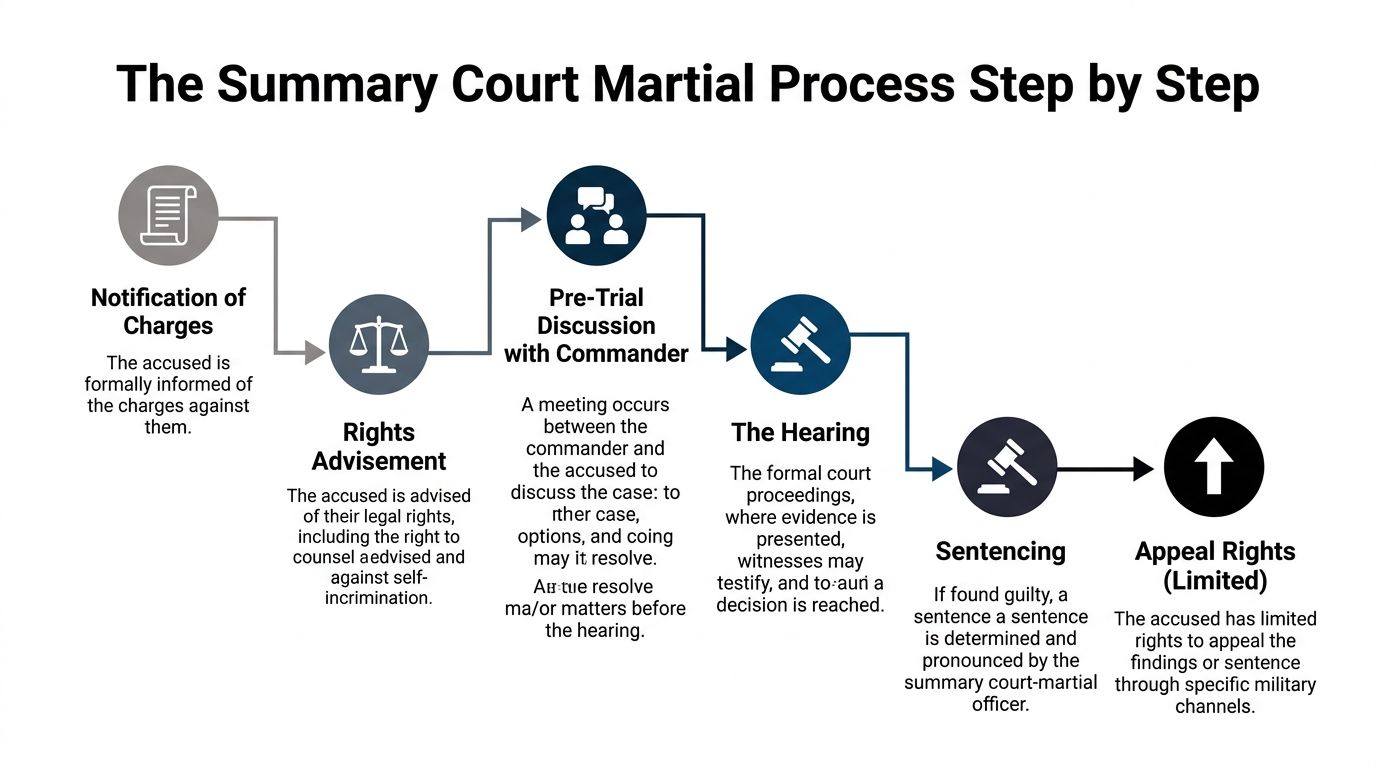
A summary court-martial moves fast. Speed helps command. Speed hurts you if you treat this like a paperwork problem instead of a record-building event that can later be used to push you out.
The decision points that matter
Step 1: You learn charges are coming.
Your first risk is not the hearing. Your first risk is your own mouth. Service members start explaining, apologizing, texting witnesses, or trying to win over the chain of command. Stop. Every statement can end up in a sworn statement, an NCIS or command file, or a memo that gets attached to later separation paperwork.
Step 2: Command tells you the case may go to a summary court-martial.
This is the moment to stop thinking emotionally and start thinking strategically. Command is not offering the SCM because it is good for you. Command uses it because it is efficient, controlled, and easier to push through than a full court-martial.
Step 3: You decide whether to accept the SCM.
For many enlisted service members, this is the most important choice in the entire case. If you consent, you are stepping into a forum with fewer protections, one officer controlling the proceeding, and a fast timetable that gives command less room to lose control of the case. If the command climate feels personal, political, or outcome-driven, you also need to understand how unlawful command influence can infect a military case.
Do not make this decision because someone says it is “better than a real court-martial.” That kind of advice gets people buried.
What happens once you consent
If you accept the SCM, the process usually looks simple on paper. In practice, that simplicity strips away protection.
One officer acts as the summary court-martial officer. That officer reviews the evidence, hears witnesses, asks questions, decides guilt, and imposes sentence if there is a conviction. You should immediately see the problem. The same system accusing you is also controlling the pace and framing of the hearing.
That means your focus has to be narrow and aggressive.
Identify the evidence early
Get clear on what command has. Many SCM cases look stronger in the charge sheet than they do in the file. Missing context, vague statements, bad assumptions, and inconsistent timelines are common.Test the witnesses
Motive matters. Bias matters. Memory fails. Supervisors protect themselves. Peers cut deals with command by shaping their statements to fit the narrative. If you do not challenge credibility before the hearing, the record hardens against you.Watch the paperwork as closely as the testimony
The hearing is only one part of the damage. Counseling entries, command memos, witness statements, and the final findings can become the backbone of later administrative action. Sloppy or one-sided paperwork needs to be challenged before it becomes the official version of events.Ask what command wants after the case ends
This is the question too many service members miss. Is command trying to punish you, or is command trying to build a file to separate you? If the actual objective is to force you out, an SCM can be the shortest path to that result.
What happens after the hearing
There is a review process, but do not build your strategy around fixing the damage later. By then, the finding exists, the paperwork exists, and command has what it wanted.
That is why the key decisions happen before and during the SCM, not after it. If you wait until the sentence is announced to get serious, you are already behind.
Strategic Insight The SCM as a Commander’s Trap
Individuals can be blindsided. The summary court-martial is often sold as mercy. In the wrong hands, it’s a trap.
Why the label minor is dangerous
The most dangerous phrase in these cases is “it’s only a summary.” That phrase gets service members to cooperate, consent, and lower their guard. Then they learn too late that command never viewed the matter as small. Command viewed it as efficient.
Verified material from a military defense source describes the overlooked risk as the “long-term administrative suicide” of a summary court-martial and states that SCM findings are the primary trigger for Other-Than-Honorable discharges, with consequences for GI Bill eligibility, VA home loans, and federal employment prospects (long-term administrative suicide warning).
That is the trap. The hearing may be framed as the easy option. The record it creates may be exactly what command needs.
If you suspect the command climate is punitive, political, or selective, you also need to understand how unlawful command influence under the UCMJ can distort supposedly fair outcomes.
What an experienced defense lawyer sees immediately
A seasoned civilian military defense lawyer doesn’t just ask, “Can we beat this charge?” The better question is, “What is command trying to accomplish?”
Sometimes the answer is obvious:
- They want speed. A summary court-martial is quicker than a bigger contested process.
- They want a formal guilty finding. That finding can carry more weight than informal discipline.
- They want to facilitate separation. A conviction-like record, even if not a federal criminal conviction, can strengthen the command narrative that you should be removed.
- They want to avoid the friction of a larger court. More rights for you means more work for them.
This is why service members should stop focusing only on the alleged offense. The offense matters, but the strategy matters more. If command is building a path toward discharge, the summary court-martial may be the first clean stone in that path.
You don’t win these cases by acting offended that the accusation is unfair. You win by identifying the command objective and disrupting it.
Your Rights and Why They Are Dangerously Limited
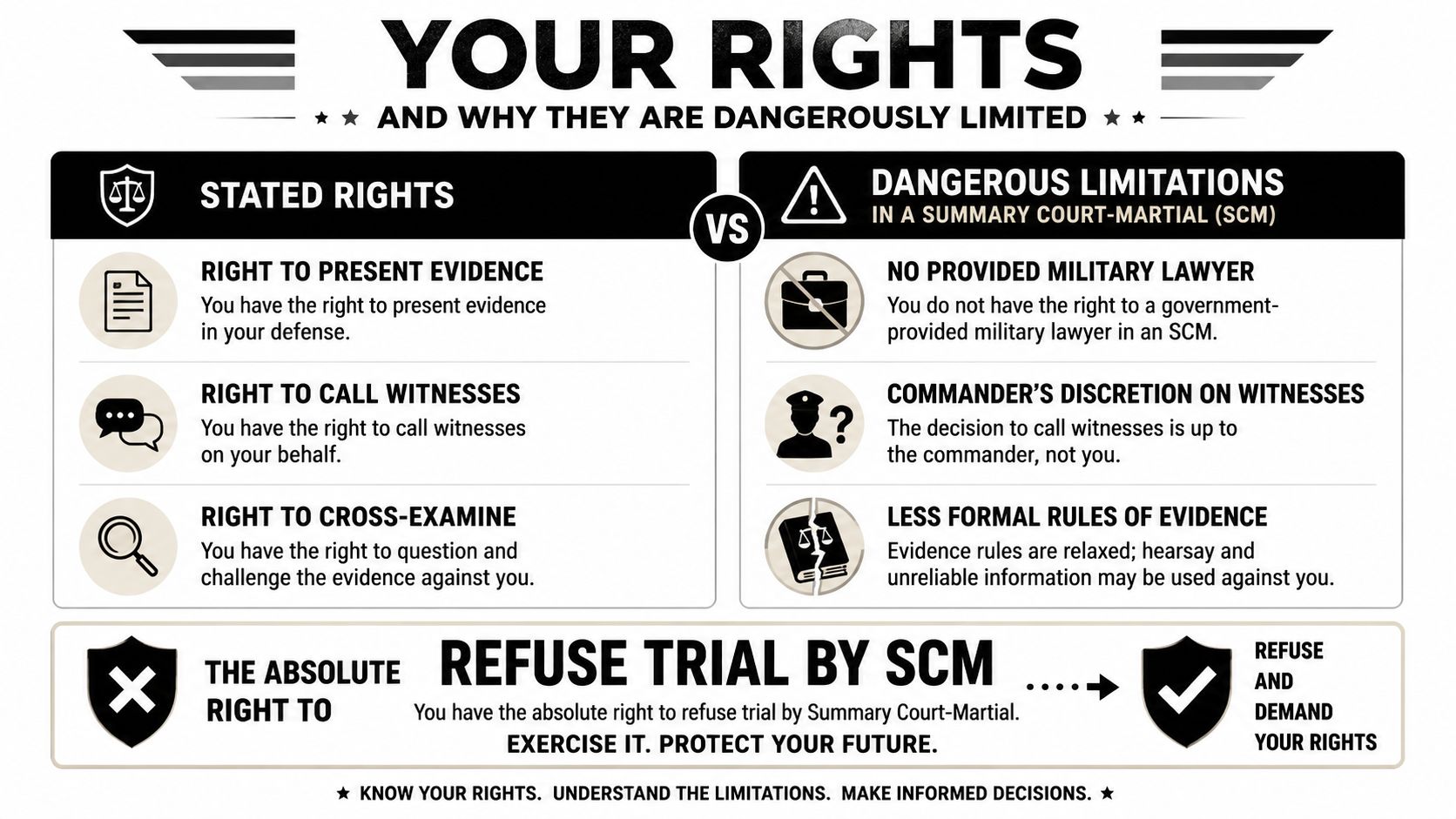
Your command tells you the summary court-martial is the quick way to clean this up. What they often mean is this: they want your consent to a stripped-down process that can hand them a usable guilty finding and make separation easier later.
The right that matters most
You can refuse trial by summary court-martial.
Start there, because that is the decision command wants you to make fast and without advice. Once you consent, you step into a forum designed for efficiency, not protection. If command is trying to build a record for an other-than-honorable discharge, your consent helps them.
Here is the comparison that matters:
| Issue | Summary court-martial | Special or general court-martial |
|---|---|---|
| Decision maker | Single officer | Military judge, and potentially a panel |
| Counsel protection | No government-provided counsel at trial | Greater formal counsel protections |
| Formality and safeguards | Reduced | Stronger procedural protections |
That chart should change how you think about this process. A summary court-martial is called “summary” for a reason. Fewer layers. Fewer checks. More room for command to get the outcome it wants.
What you give up if you consent
A guilty finding at an SCM is not treated like a federal criminal conviction, and one reason is the lack of a right to appointed counsel in that forum, as noted earlier. Do not take comfort from that. Service members hear “not a criminal conviction” and assume the danger is low. That is a serious mistake.
The actual risk is practical, not academic.
An SCM can still produce a formal adverse record, lock in findings that follow you into administrative separation, and give command a cleaner story for why you should be pushed out. If the end goal is your removal, the limited rights at an SCM are not a side issue. They are part of the design.
When you consent, you are accepting a process with:
- No military judge handling the case the way you would see in a higher court-martial
- No panel of members weighing the facts
- No government-provided defense lawyer standing beside you at trial
- One officer serving in overlapping roles in a process built for speed
That is not a setting where you casually “tell your side” and trust fairness to carry the day.
The right move is to treat the consent decision as a strategic decision about your future in the military. Look at the evidence. Look at the witnesses. Look at what command has been saying and doing. Then ask the hard question: are they trying to punish you, or are they trying to build the file they need to separate you?
If you get that answer wrong, the hearing will be the least of your problems.
Common Mistakes That Will Destroy Your Military Career
Service members don’t usually lose these cases in one dramatic moment. They lose them through a chain of avoidable mistakes.
Five mistakes that bury people
Talking because you think honesty will clear it up
Investigators, supervisors, and command reps are not there to help you talk your way out of trouble. They’re collecting admissions, locking in details, and comparing your story to everyone else’s.Consenting just to get it over with
Fast does not mean favorable. Quick resolution often serves the government first.Treating it like an Article 15
A summary court-martial is a different animal. If you defend it like NJP, you can walk yourself into a formal adverse record that causes bigger damage later.Trusting the process because it sounds informal
Informal for them does not mean safe for you. Less structure can mean less protection.Waiting until the hearing date to get help
By then, witness statements are usually set, command views are hardened, and your options may already be narrower.
What to do instead
Use this checklist instead:
- Shut up early. Stop giving free statements to anyone who isn’t your lawyer.
- Preserve evidence. Save messages, emails, screenshots, duty rosters, and names of witnesses.
- Map the command objective. Ask what they really want. Punishment, separation, or both.
- Assess witness credibility. Bias, retaliation, and inconsistency matter.
- Get strategic advice before consenting. That decision can define the entire case.
- Think beyond the hearing. The administrative consequences may be the primary fight.
A lot of service members say, “There’s no evidence.” That usually means they haven’t seen the evidence yet. Others say, “They can’t prove it.” That confidence disappears when their own texts or words fill the gap for the government.
The smart move isn’t bravado. It’s discipline.
Why an Experienced Civilian Defense Lawyer Is Not Optional
In serious military cases, independence matters. Experience matters. Trial judgment matters. A civilian lawyer who handles military justice for a living brings a different level of pressure to the case.
Appointed counsel and civilian counsel are not the same thing
Your appointed military defense counsel may be hardworking and committed. Some are excellent. Many are also overloaded, early in their careers, or limited by time and institutional realities. That’s not an insult. It’s a structural problem.
A strong civilian court-martial attorney is different in ways that count:
- Independent from command
- Focused on your case, not a rotating docket
- Able to challenge the long-term administrative angle, not just the immediate charge
- Often more battle-tested in contested military litigation
If you’re trying to compare options intelligently, this guide on how to choose the right military defense lawyer is worth your time.
What real defense strategy looks like
Real defense work in summary courts martial isn’t just standing next to you and sounding supportive. It means developing a strong position.
That can include:
- attacking weak witness statements
- exposing command overreach
- identifying missing evidence
- showing motive to exaggerate
- challenging the wisdom of consenting to the forum at all
- preparing for the separation fight that may follow
The government already has a process. Your lawyer’s job is to break its momentum.
If your rank, benefits, clearance, and future are all exposed, hiring strong civilian counsel is not some luxury item for rich people. It is a protective measure for anyone who understands how military justice really works.
Frequently Asked Questions About Summary Courts Martial
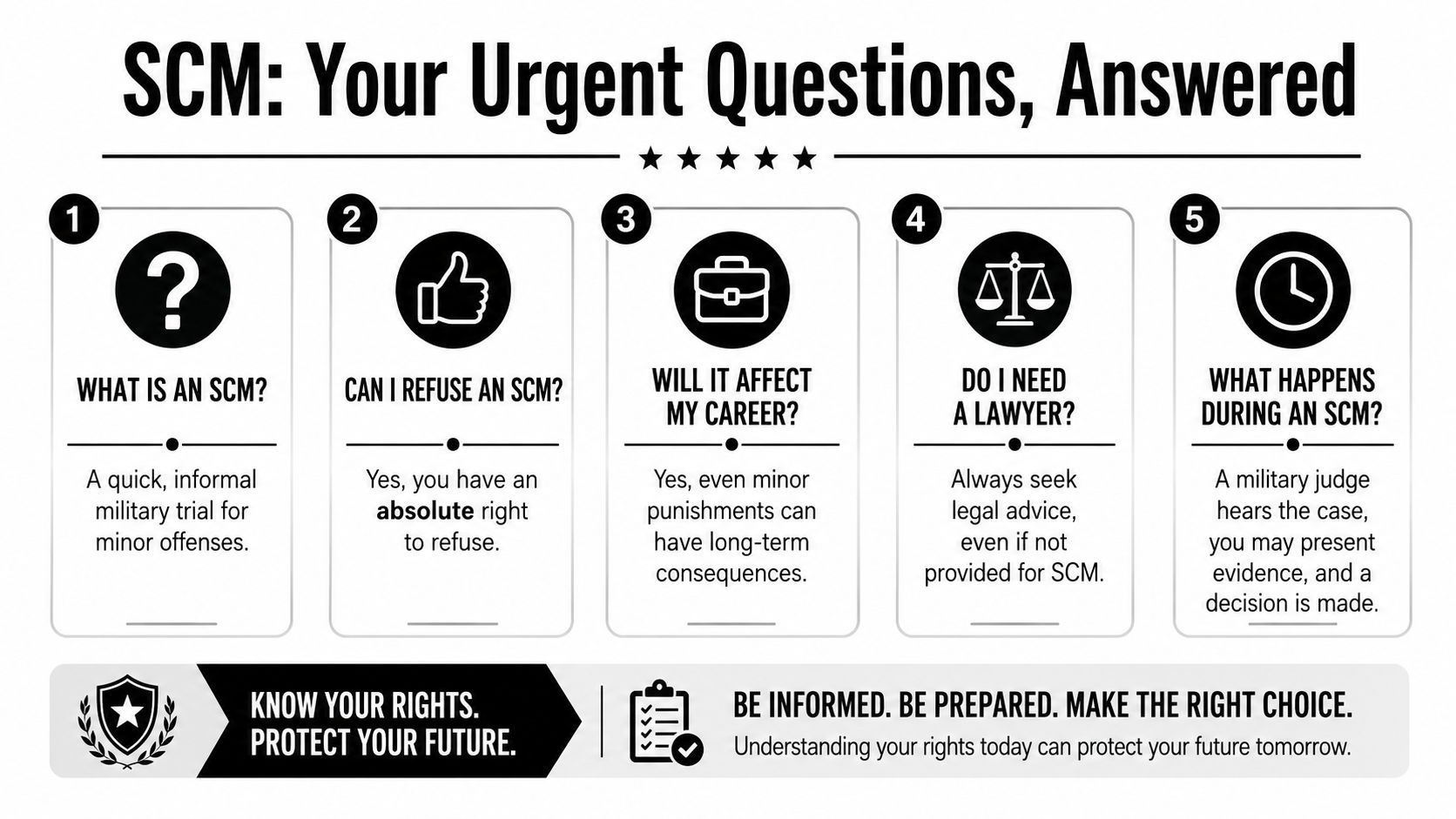
A lot of service members ask the wrong question about a summary court-martial. They ask whether it is “minor.” The right question is whether command can use it to build the record they want for separation, loss of trust, and an Other Than Honorable outcome. That is the main danger.
Direct answers
Can I refuse a summary court-martial?
Yes, if you are enlisted and legally eligible to refuse. That choice can change the entire direction of your case. Do not consent because command says it will be faster, easier, or better for you.
Is a summary court-martial a federal criminal conviction?
No. But do not take comfort from that. The absence of a federal conviction does not protect your career, your clearance, or your discharge characterization.
Can officers be tried by summary court-martial?
No. Summary courts-martial are for enlisted personnel, not officers.
Will a summary court-martial affect my career?
Yes. In many cases, that is the main point. A guilty finding, damaging admissions, or a badly handled record can hand command what it needs to push administrative separation.
Do I need a lawyer immediately?
Yes. Early mistakes are expensive. Waiting to get advice usually means you are reacting to command’s plan instead of disrupting it.
Will I go to jail?
Possibly, depending on your rank and the exact forum rules that apply. You need case-specific advice, not barracks rumors.
Should I trust command when they say this is the easiest option?
No. Command’s job is not to protect your future. If they are steering you toward a summary court-martial, assume they see an advantage in it.
Can this lead to discharge problems later?
Yes. Very often, that is where the significant damage shows up. The summary court-martial can become the administrative weapon used to justify separation and argue that you should leave with the worst paper they can support.
If I refuse the summary court-martial, does that automatically help me?
Not automatically. Refusing can be smart, but only if you understand what command may do next. They may withdraw, push for a higher forum, or shift hard into administrative action. Strategy matters more than reflex.
If I already made a statement, is it too late to fight this?
No. It is still worth fighting. But the window to contain the damage gets smaller once you have talked, signed, or tried to explain yourself without counsel.
If you are under investigation, facing charges, or being pushed to accept a summary court-martial, act now.
Get legal advice before you make a statement, sign paperwork, or consent to anything. Your rank, your benefits, your security clearance, and your future as a veteran may all turn on what you do in the next few days.
Then start making calls. Your career is on the line.