You receive an order that feels wrong. Your supervisor expects immediate compliance, the mission is moving, and everyone around you acts as if the answer is obvious. You’re left deciding whether to obey, ask questions, or refuse, while knowing that either choice could affect your career, freedom, security clearance, and reputation.
That’s the dangerous reality behind UCMJ illegal orders. Most summaries say service members must obey lawful orders and refuse unlawful ones. The law is more complicated in practice because a military judge, not the service member standing in the moment, may ultimately decide whether the order was lawful. By then, your decision has already been made.
Table of Contents
- The Moment You Must Decide
- What Makes an Order Lawful Under the UCMJ
- Recognizing When an Order Crosses the Line
- The Dangerous Gray Zone Most Guides Ignore
- Why Civilian Defense Counsel Changes Everything
- Protecting Yourself When Orders Become Questionable
- Answers to Your Most Pressing Questions
The Moment You Must Decide
A junior service member receives a verbal directive from a superior. The order is broad, the purpose is unclear, and carrying it out may conflict with a regulation or a higher-level instruction. The service member asks whether the order is legal. The response is blunt: “You don’t need to understand it. Just do it.”
That moment creates two different risks.
If the order is lawful, refusal can become willful disobedience. The command may treat the refusal as insubordination, document it in counseling or evaluations, refer it for nonjudicial punishment, or pursue a court-martial. If the order is plainly illegal, compliance can expose the service member to consequences for carrying out unlawful conduct. The rank of the person giving the order doesn’t make an illegal command lawful.
The hardest cases sit between those extremes. The service member may believe the order violates the law, but personal discomfort, political disagreement, moral objection, or distrust of the commander doesn’t establish illegality. A command can be unfair, unpopular, harsh, or strategically misguided and still be lawful if it serves a valid military purpose and falls within the issuer’s authority.
The practical problem: You may have to choose before anyone with authority has issued a definitive legal ruling.
The system also creates an evidentiary problem. Oral instructions can later be described differently by the issuer, witnesses, and the accused. Tone, timing, context, and the exact words used may determine whether the government can prove a specific, willful refusal. That’s why an immediate emotional reaction can become evidence in a future case.
Treat the situation as a legal emergency, not a workplace disagreement. Preserve the order, identify the authority behind it, ask focused questions, and obtain independent advice before making an irreversible decision whenever circumstances allow.
What Makes an Order Lawful Under the UCMJ
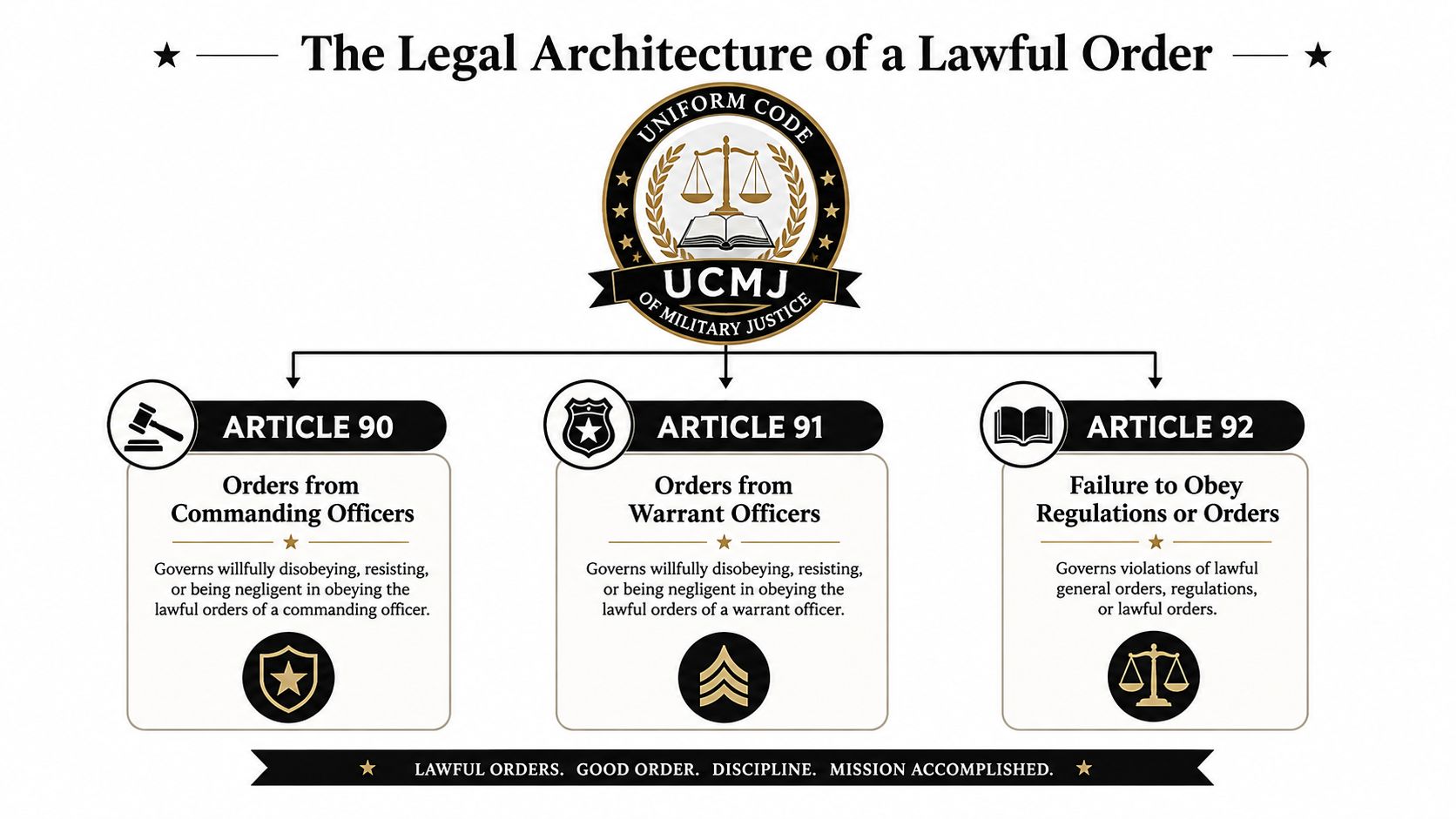
A command becomes legally enforceable only when it satisfies the UCMJ’s lawfulness requirement. The Court of Appeals for the Armed Forces explains that Article 91, like Article 90, punishes disobedience of lawful commands. Article 92 follows the same principle. CAAF’s digest on lawful commands connects a lawful order to military duty, including conduct reasonably necessary to accomplish a mission or protect morale, discipline, and the command’s usefulness.
Three provisions define the main categories:
- Article 90: Willful disobedience of a lawful command from a superior commissioned officer.
- Article 91: Insubordinate conduct toward a warrant officer, noncommissioned officer, or petty officer.
- Article 92: Failure to obey a lawful general order or regulation.
Article 90 carries the most serious statutory structure. The government must establish that a superior commissioned officer issued the command, the accused knew the officer’s status, the command was lawful, and the accused willfully disobeyed it. The statute sets different punishment rules for wartime and peacetime. During war, a court-martial may impose death or another authorized sentence. At other times, it may impose any authorized punishment except death. Read the current Article 90 text.
The threshold questions
Before deciding whether refusal is defensible, examine five points:
- Competent authority. The issuer must possess authority to give the directive.
- A specific mandate. The service member must understand what conduct the order requires.
- A relationship to military duty. The directive must concern a mission, discipline, morale, usefulness, or another legitimate military function.
- Consistency with higher authority. It cannot conflict with the Constitution, federal law, a lawful superior order, or controlling regulations.
- A valid military purpose. It cannot exist solely for a private objective or punishment beyond lawful authority.
Military law generally presumes an order lawful. The accused typically must rebut that presumption with objective evidence. CAAF materials describe lawfulness as a legal question for the military judge, rather than an element the prosecution must always prove to a panel beyond a reasonable doubt. Review the lawfulness framework in CAAF’s digest.
That rule creates the dangerous decision point. A defense lawyer may challenge the command before the fact-finder hears the full merits, but the service member usually must choose how to respond before the judge rules. Document the exact words, identify the issuing authority, ask focused questions, and seek independent advice when circumstances permit. A UCMJ Article 92 defense guide provides practical context for failure-to-obey allegations.
Recognizing When an Order Crosses the Line
The strongest illegal-order defenses rely on objective legal defects, not instinct. Start by asking what the order requires, who issued it, what authority supports it, and what military purpose it serves.
An order may be unlawful when it conflicts with the Constitution, federal law, a lawful superior order, or the issuer’s authority. It may also be unlawful when it directs a crime, violates statutory or constitutional rights, serves a private end, or exists primarily to increase punishment. The Manual for Courts-Martial discussion of unlawful orders identifies the importance of military purpose, duty-related authority, and the presumption that an order is lawful unless the accused rebuts it.
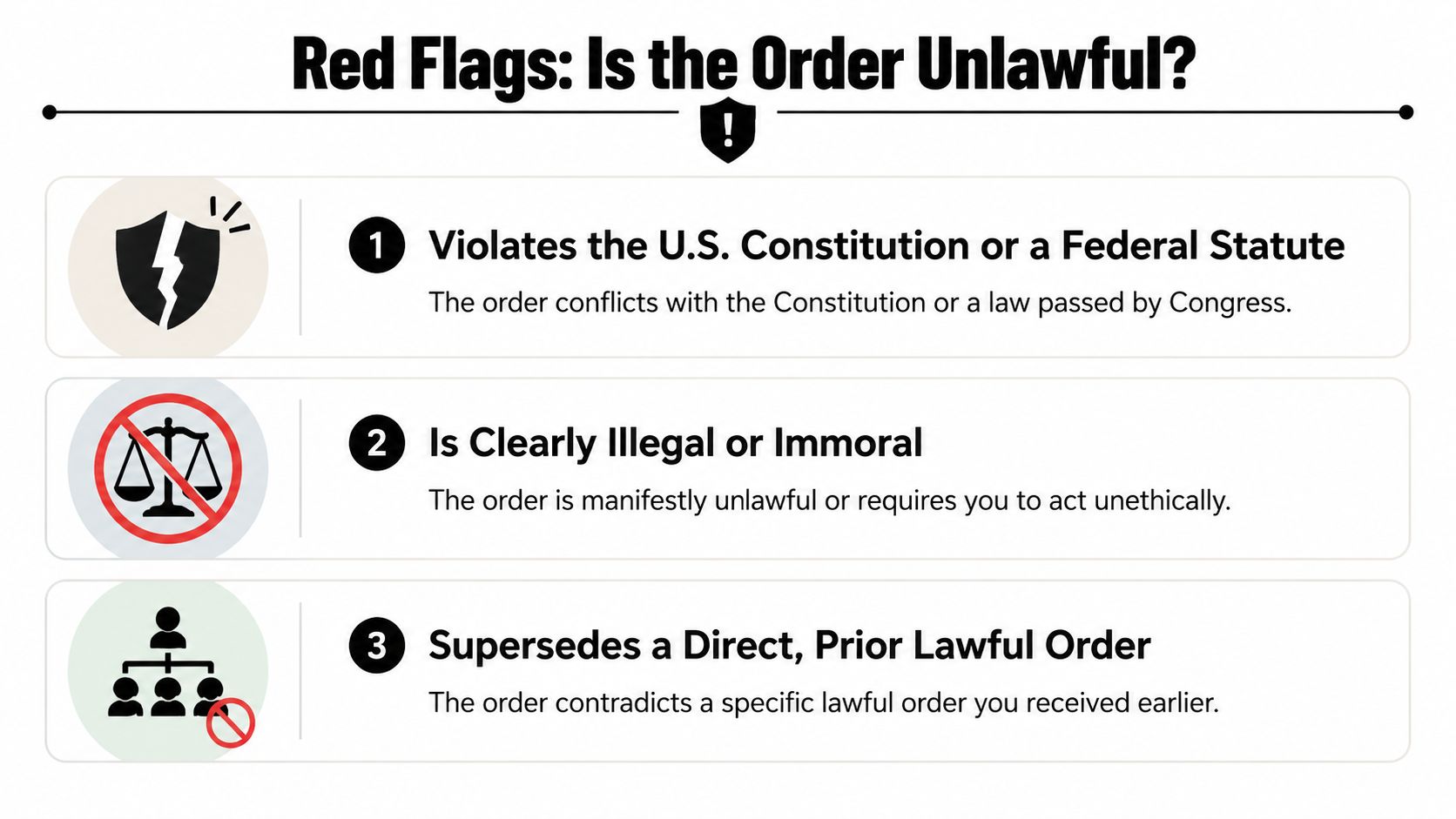
Three red-flag categories
First, the order commands illegal conduct. A directive to falsify an official record, destroy evidence, steal property, assault someone, or commit another crime presents a different problem from an order you consider unfair. A superior’s instruction doesn’t erase your individual responsibility for obvious criminal conduct.
Second, the order lacks a legitimate military purpose. Ask whether the command reasonably advances a mission, protects discipline, safeguards morale, or preserves the command’s usefulness. An order aimed at a commander’s personal retaliation, private benefit, or punishment beyond lawful authority deserves immediate scrutiny.
Third, the order conflicts with higher law or authority. A subordinate command can’t override the Constitution, federal statutes, lawful regulations, or a valid superior order. The conflict must be concrete. Political disagreement or a belief that the mission is unwise isn’t enough.
Why vague orders create danger
A vague directive can be unlawful because it lacks a clear mandate, but vagueness alone doesn’t automatically protect you. If the command later shows that the order had a valid military purpose and you understood what conduct it required, prosecutors may frame the dispute as intentional noncompliance rather than a legal objection.
Document the exact wording. Identify what was ambiguous. Ask for clarification in a professional manner, preferably through a channel that creates a reliable record. Don’t embellish the order afterward to make your refusal look more reasonable. Credibility often decides whether a judge believes the order was clear, whether you understood it, and whether your conduct was willful.
The Dangerous Gray Zone Most Guides Ignore
The common slogan is simple: illegal orders don’t have to be obeyed. That slogan is incomplete enough to cause harm.
The law recognizes that disobedience offenses require lawful commands. It also recognizes that a service member can’t escape responsibility for plainly criminal conduct by claiming a superior ordered it. But the Military Law Task Force explains the practical gap that popular summaries ignore. Lawfulness is ultimately a question for a military judge, and a service member may learn the answer only after obeying or refusing. Read the Military Law Task Force FAQ on refusing illegal orders.
The UCMJ doesn’t create a simple affirmative criminal duty requiring service members to disobey every order later found unlawful. That distinction matters because an order can be legally defective in hindsight without being obviously unlawful to the person receiving it. A service member’s personal beliefs, political views, or moral opposition also don’t excuse disobedience to a lawful command.
Use a risk-based decision framework
When time permits, work through these questions:
- Is the conduct obviously criminal? If the order plainly directs a crime, stop and seek immediate legal assistance.
- What specific law does it violate? Identify the Constitution, statute, regulation, or superior order involved.
- Does the issuer have authority? Determine whether the person giving the instruction controls the activity.
- Can the order be narrowed or clarified? Ask precise questions without making a public accusation.
- What record exists? Preserve written messages, tasking documents, rosters, and witness names lawfully available to you.
- Who can provide independent advice? Contact a military defense lawyer before taking a step that can’t be undone.
Domestic operations show why slogans fail. In November 2025, the Pentagon said it was investigating Senator Mark Kelly over a video urging troops to reject illegal orders, while reporting on that controversy emphasized that the UCMJ requires obedience to lawful orders and that personal beliefs don’t excuse disobedience. Independent analysis also discussed a September 2025 ruling that National Guard and Marine deployment to Los Angeles violated the Posse Comitatus Act. Read the analysis of the limits of lawful military orders.
Those developments don’t give an individual service member a universal answer. They demonstrate why the status of an operation, the exact task, the chain of authority, and the available legal guidance all matter. A service member shouldn’t treat a public controversy as a substitute for case-specific advice. For related concerns involving command pressure or improper influence, see this discussion of unlawful command influence under the UCMJ.
Why Civilian Defense Counsel Changes Everything
A military-appointed defense lawyer can provide representation, protect your rights, and litigate your case. That right is important. It doesn’t mean every serious illegal-order case should be handled without outside counsel.
The difference is independence. Military defense counsel works within the military justice system and may be managing a demanding caseload, changing assignments, or institutional obligations. An experienced civilian military defense lawyer answers only to the client. That independence allows counsel to challenge the command’s narrative before it hardens into an official record.
What experienced counsel examines first
A strong court-martial attorney won’t begin with your conclusion that the order was illegal. Counsel will test the facts:
- Exact language: What words did the issuer use, and did the order identify required conduct?
- Authority: Did the issuer possess the power to direct that task?
- Military purpose: Was the command tied to a mission, discipline, morale, or usefulness?
- Higher law: Did the directive conflict with a statute, constitutional protection, regulation, or superior order?
- Intent: Did you understand the command and deliberately refuse it?
- Witness reliability: Who heard the order, and do their accounts remain consistent?
- Investigation methods: Did investigators omit exculpatory witnesses, ignore context, or treat an allegation as a conclusion?
- Electronic evidence: Do messages, tasking systems, logs, or recordings support your account?
Investigations aren’t neutral exercises designed to discover every version of the truth. Investigators often collect evidence to support an allegation, and command personnel may preserve only the documents that make the refusal look deliberate. Early counsel can identify missing records, secure witnesses, and prevent you from supplying the government with an avoidable admission.
Defense strategy beats a late declaration of innocence. The strongest defenses begin before charges are preferred.
Civilian representation also matters when the case extends beyond a court-martial. An alleged refusal can affect Article 15 or NJP proceedings, a GOMOR, administrative separation, evaluations, assignment decisions, and security-clearance issues. A lawyer who understands the full consequence can choose a response that protects more than one hearing.
If investigators want an interview, Article 31 rights become central. Before answering substantive questions, review your rights and obtain advice from counsel through a guide to Article 31 of the UCMJ.
Protecting Yourself When Orders Become Questionable
Your first objective isn’t to win an argument with the commander. It’s to preserve the facts and avoid creating a stronger government case.
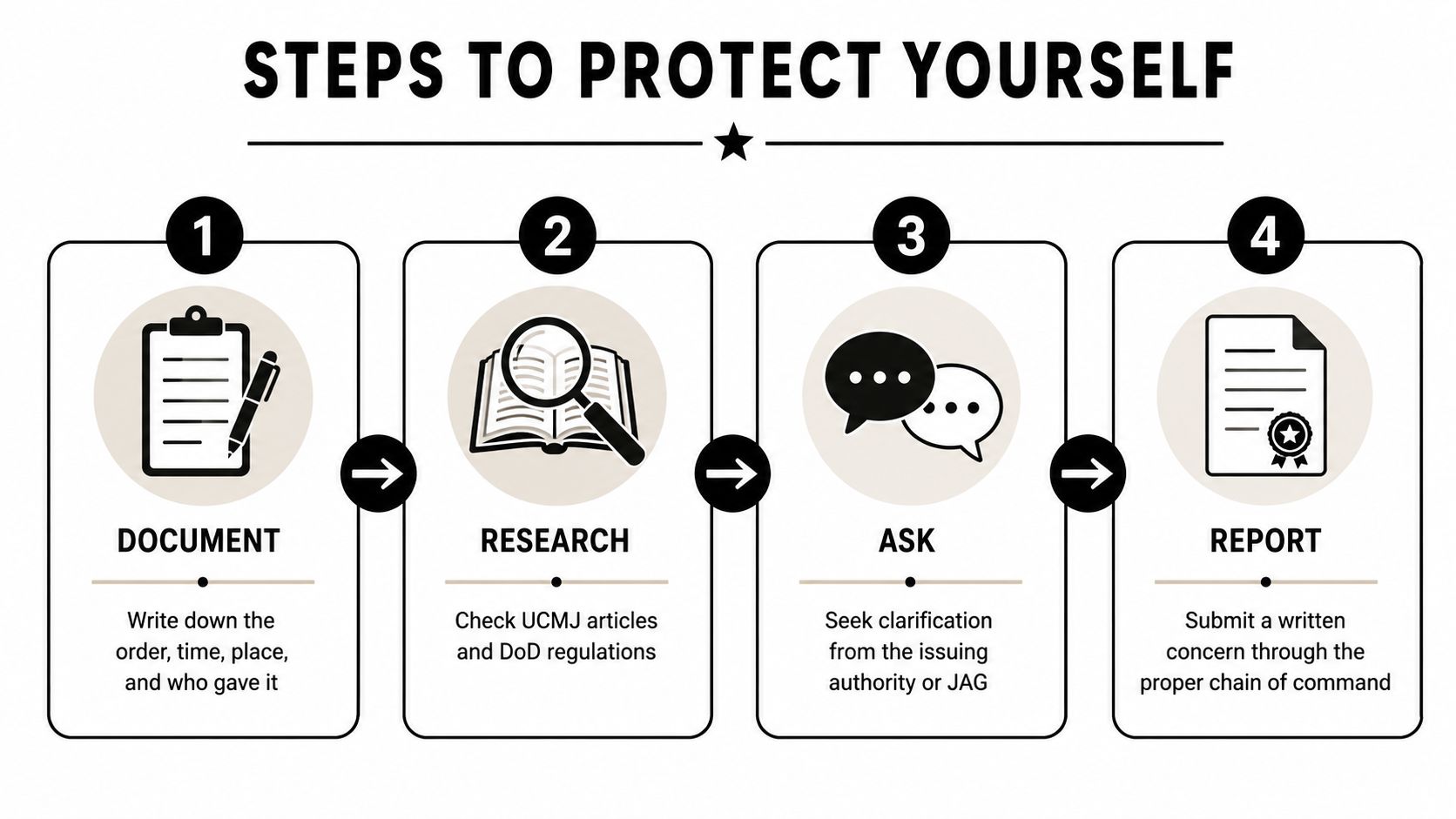
Step 1, capture the order
Write down the exact words, date, time, location, issuer, witnesses, delivery method, deadline, and required action. Preserve messages and documents in a lawful manner. Don’t alter records, delete communications, recruit witnesses to coordinate stories, or post your interpretation on social media.
Step 2, separate legality from disagreement
Identify the actual legal defect. “I think this is wrong” isn’t the same as “this conflicts with a specific federal statute or lawful superior order.” If you can’t articulate the conflict, don’t make a dramatic refusal based only on emotion or politics.
Step 3, ask focused questions
Request clarification respectfully. You might ask what task the order requires, what authority supports it, or whether the issuer intends a specific interpretation. Don’t use a clarification request as a disguised accusation. Your tone and conduct may later become part of the evidence.
Step 4, contact counsel
Call a UCMJ lawyer or civilian military defense attorney as soon as the issue becomes serious. If an investigator contacts you, don’t assume cooperation will clear things up. Ask whether you’re suspected or accused, invoke applicable rights, and consult counsel before making a substantive statement.
Common mistakes that damage defenses
- Talking to CID, NCIS, OSI, or CGIS without counsel: Investigators can use a small inconsistency to undermine your credibility.
- Assuming command will resolve it fairly: Command may already be building an adverse-action file.
- Waiting for charges: Early evidence disappears, witnesses transfer, and memories change.
- Believing there’s no evidence: Digital messages, access records, calendars, and witness accounts can establish intent.
- Deleting or editing communications: That can create a separate evidence problem.
- Making a public political statement: Public commentary can make a legal dispute look like defiance.
- Refusing before identifying the defect: A lawful order doesn’t become illegal because it feels unreasonable.
- Obeying an obviously criminal command: Rank doesn’t legalize criminal conduct.
- Relying on verbal assurances: Ask for clarification and preserve the response.
- Treating NJP or separation as harmless: Administrative action can damage a career even without a court-martial conviction.
If you’re already under investigation, stop discussing the facts with coworkers and supervisors except as counsel directs. Give your lawyer the complete story, including facts that hurt you. Counsel can’t protect you from a surprise that you concealed.
Answers to Your Most Pressing Questions
Can I refuse to talk to investigators?
You generally may decline to answer questions that could incriminate you. Ask for counsel before giving substantive answers. Do not lie, guess, minimize, or offer an off-the-record explanation. Tell investigators clearly that you want legal advice first.
What happens if I obey an order later found unlawful?
The result depends on whether the defect was obvious, what the order required, what you knew, and whether your conduct was independently criminal. Obedience does not excuse plainly criminal conduct. An ambiguous order may still support arguments about intent, reliance, or mitigation.
Can personal beliefs justify refusing an order?
Personal, political, or moral opposition does not justify refusing a lawful order. Build the defense around an objective legal defect, lack of authority, lack of military purpose, or the government’s inability to prove willful disobedience.
How do I prove an order was illegal?
Identify the conflict with the Constitution, federal law, regulation, a superior order, or the issuer’s authority. Preserve the exact wording, context, purpose, witnesses, and supporting documents. Calling a command “wrong” is not enough to overcome the presumption of legality.
Do I need a lawyer immediately?
Yes. Get counsel if you suspect an order is unlawful, have refused one, or have been contacted by investigators. Early advice affects what you say, how evidence is preserved, and whether a preventable statement becomes the government’s strongest proof.
Can an order be unfair but lawful?
Yes. Harshness, inconvenience, embarrassment, or disagreement with operational judgment does not automatically make an order unlawful. Examine authority, military duty, purpose, clarity, and conflict with higher law.
Will I go to jail?
No one can answer responsibly without reviewing the order, conduct, evidence, and procedural posture. Article 90 permits severe punishment, including death in time of war, while peacetime punishment excludes death under the statute. As noted earlier, the statutory framework makes individualized legal advice more reliable than an online prediction.
If you face a questionable order, an investigation, Article 15, administrative separation, or possible court-martial, contact an experienced civilian military defense lawyer now. Preserve the order, stop discussing facts casually, and get advice before obeying, refusing, or speaking to investigators. Your career and freedom may turn on that first decision.