You’re sitting in a conference room, waiting to learn whether the court will take your rank, your freedom, or your future in the Marine Corps. The trial may already be over, but the case isn’t. Marine sentencing is where the military judge decides what your conviction will cost, and the difference between a punitive discharge, confinement, and a survivable outcome often comes down to preparation that began long before the first sentencing witness takes the stand.
Sentencing isn’t a formality. It affects confinement, pay, rank, separation, veteran benefits, reputation, and the way you leave the service. The government will present a carefully selected story about your record and alleged conduct. Your defense must present a more complete and credible account of who you are, what happened, and whether continued punishment is necessary.
Table of Contents
- What a Marine Is Actually Facing at Sentencing
- Courts-Martial and the Sentences Each One Can Impose
- What the Government Is Allowed to Argue For
- Inside the Sentencing Hearing and How a Military Judge Decides
- Aggravating and Mitigating Factors the Military Judge Will Hear
- The Seven Mistakes That Cost Marines Their Sentence
- After the Sentence Is Announced and What Comes Next
- Frequently Asked Questions About Marine Sentencing
What a Marine Is Actually Facing at Sentencing
Sentencing begins after findings of guilty. Findings answer one question, whether the prosecution proved the charged offenses. Sentencing answers another, what punishment is sufficient for those offenses. Those phases are legally distinct, and treating sentencing as an afterthought is one of the most expensive mistakes a Marine can make.
The sentence can include confinement, forfeitures, reduction in rank, and a punitive discharge when authorized by the forum and offense. It can also shape later administrative separation, appellate litigation, veteran-benefit disputes, and the practical reputation attached to your service record. A conviction doesn’t tell your entire story, but sentencing is where the government tries to make that incomplete story control the result.
Practical rule: Start building the sentencing case before trial. If you wait until the verdict, you may have already lost access to witnesses, records, and time.
The 2023 Manual for Courts-Martial.pdf) places meaningful limits on the sentencing decision. Rule for Courts-Martial 1002 requires punishment to be “sufficient, but not greater than necessary” to promote justice and maintain good order and discipline. That language gives the military judge discretion, but it isn’t unlimited discretion. The judge must apply the authorized punishment structure and consider properly admitted sentencing evidence.
The system also changed for offenses occurring on or after 27 December 2023. In non-capital cases, the military judge determines the sentence regardless of whether the findings came from members or from a judge alone, as described in the Army Criminal Law Deskbook discussion of sentencing and credit. That change matters during plea negotiations and trial planning. The defense can no longer assume that choosing members for findings will also place sentencing in their hands.
A Marine facing sentencing should ask three questions immediately:
- What punishment is legally available? The answer depends on the offense, forum, rank, and applicable Manual provisions.
- What evidence will the judge hear? The government’s record may include material the defense hasn’t yet analyzed or rebutted.
- What outcome can the defense prove is reasonable? Sympathy without documentation rarely moves a judge.
Courts-Martial and the Sentences Each One Can Impose
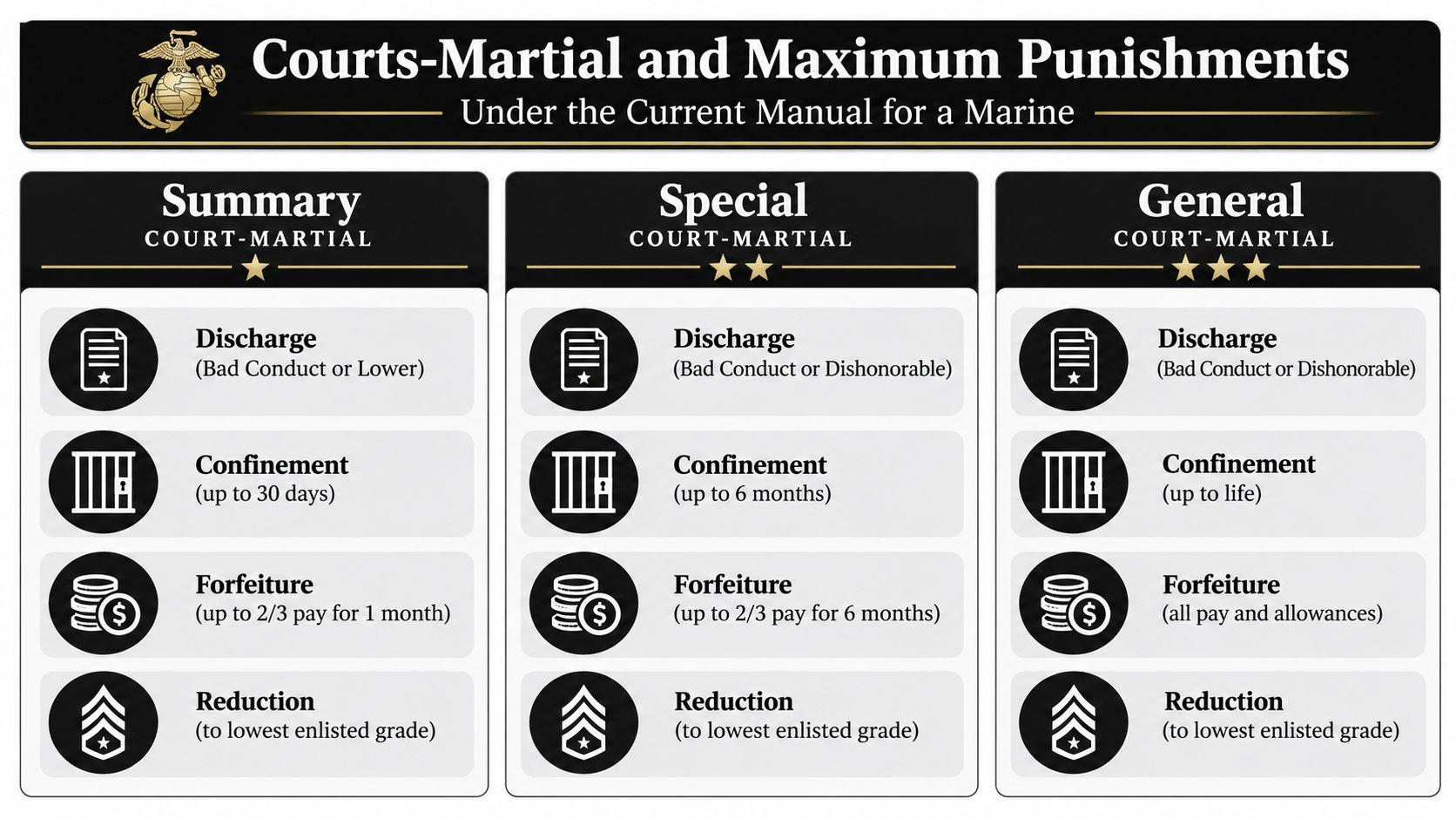
The forum controls the ceiling. A charge that sounds familiar can produce very different exposure depending on whether it proceeds by summary, special, or general court-martial. The first strategic question is therefore not “What did they charge me with?” It’s, “Where is this case being tried, and what can that forum impose?”
A summary court-martial is the most limited forum. Public-facing military justice guidance describes confinement for an enlisted Marine in the applicable lower enlisted category as limited to 30 days, with other restrictions on available punishment. A summary court-martial isn’t the same as a general court-martial, but a Marine still needs advice before accepting or contesting it because the record can matter later.
A special court-martial carries broader authority. The commonly cited ceiling includes up to 12 months of confinement and a bad-conduct discharge, although the precise authorized punishment depends on the offense and the governing rules. The court-martial overview from Military.com is useful for understanding the forum distinction, but counsel must apply the current Manual and charge-specific limits to the actual case.
A general court-martial presents the greatest exposure. Depending on the UCMJ article and offense, authorized punishment can extend to life imprisonment or death, along with forfeitures, reduction, and punitive discharge. The Defense Technical Information Center sentencing reference explains that confinement, forfeitures, reduction to E-1, and punitive discharges can be part of special and general court-martial exposure.
Why the forum matters more than the label
Forum negotiations can be more important than arguments over an abstract statutory maximum. A defense lawyer may fight to reduce the forum, narrow specifications, secure a plea agreement, or litigate the charge while preserving sentencing options. Those decisions require a close reading of the evidence, the accused’s record, and the command’s objectives.
Recent Marine Corps reports illustrate why readers should examine actual dispositions, not only maximum punishments. The Corps’ February 2026 monthly court-martial report.PDF) includes dispositions with 48 months of confinement and a dishonorable discharge, 24 months of confinement and a dishonorable discharge, and 365 days of confinement and a bad-conduct discharge. Those outcomes don’t predict your sentence, but they show the range of punishment appearing in active Marine cases.
For a plain-language explanation of how the forum, charge, and punishment interact, review the court-martial basics guide. Then have counsel calculate your actual exposure, including rank-specific restrictions and the effect of any plea agreement.
What the Government Is Allowed to Argue For
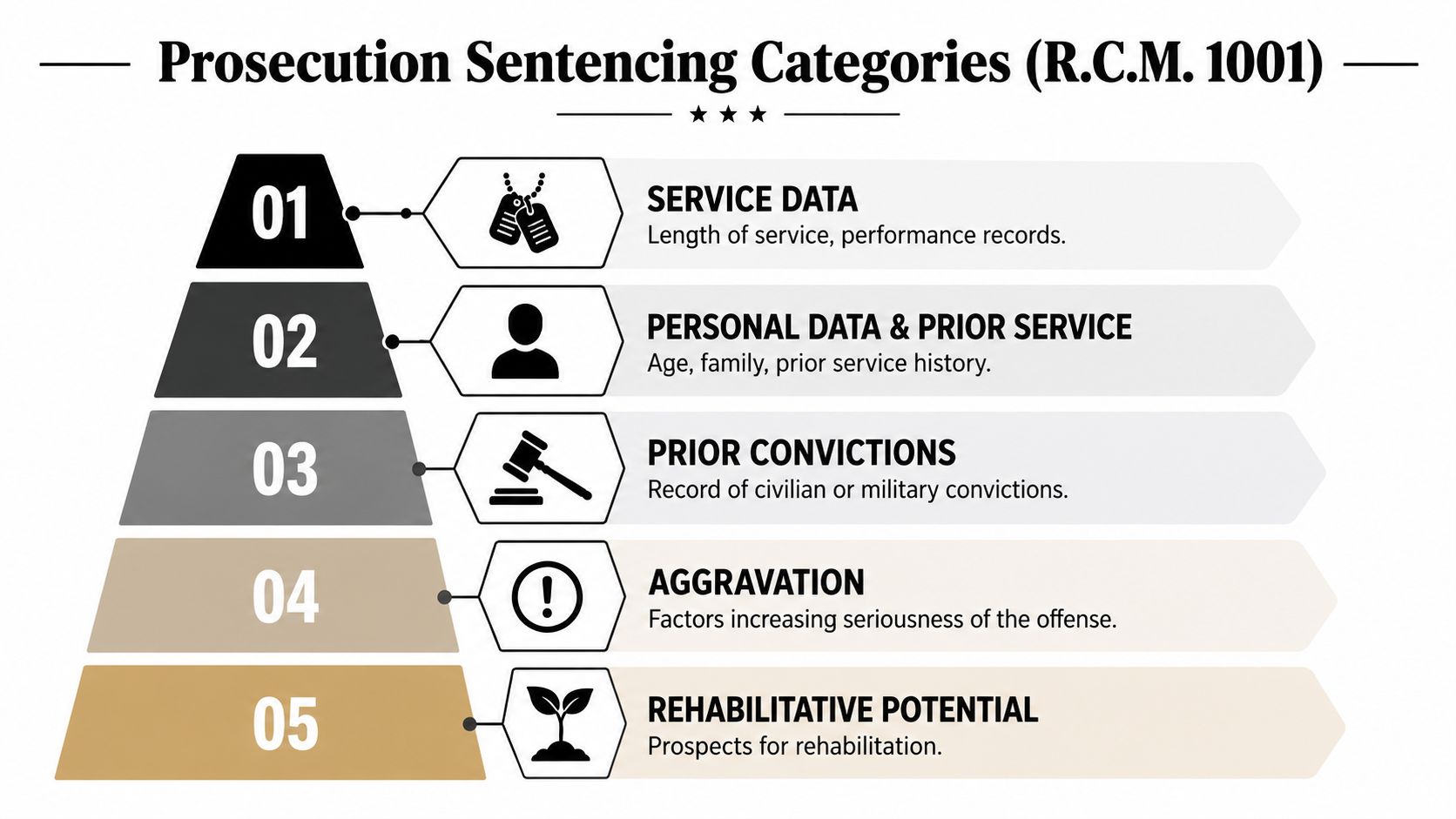
Rule for Courts-Martial 1001 gives the prosecution defined categories of sentencing evidence. The government isn’t entitled to turn sentencing into an unrestricted attack on your character. It must present evidence within the rules, and an experienced defense lawyer challenges material that is stale, unreliable, irrelevant, or improperly authenticated.
The prosecution categories include:
- Service data: The government can present service history and performance information. Evaluations, awards, qualifications, and disciplinary records may become part of its narrative.
- Personal data and prior service: Personal background and prior service history can help the judge understand the accused, but the defense must examine accuracy, context, and relevance.
- Prior convictions: Civilian or military convictions can increase perceived risk and punishment exposure. Counsel should verify what the conviction legally proves and what it doesn’t.
- Aggravation: The prosecution may offer facts that increase the seriousness of the offense, including harm, breach of trust, or circumstances surrounding the misconduct.
- Rehabilitative potential: The government may argue that the Marine is unlikely to improve or remain a productive service member.
How the prosecution builds its story
Trial counsel often presents evidence in a sequence designed to make the accused look like a continuing problem rather than a Marine who committed a specific offense. A prior NJP may be presented without its operational context. A performance evaluation may be read selectively. A character witness may repeat a reputation claim without personal knowledge. An expert opinion about rehabilitation may rest on incomplete records.
The defense response must be precise. Don’t object merely because evidence is damaging. Identify the legal defect and explain why it matters. A stale NJP, an unauthenticated letter, or testimony based on rumor can undermine the government’s narrative when counsel attacks the foundation rather than denying the conclusion.
The defense categories
RCM 1001 also recognizes defense evidence through extenuation, mitigation, and the accused’s unsworn statement. Extenuation explains the circumstances surrounding the offense without legally excusing it. Mitigation reduces moral or practical blame, such as documented trauma, treatment progress, exceptional service, or family responsibilities. The unsworn statement lets the accused address the judge without submitting to cross-examination, although the statement must be planned carefully.
The defense should review every prosecution exhibit line by line. Ask who created it, when it was created, what information it omits, and whether it proves what the government claims. Sentencing is often won by controlling the reliability and meaning of evidence, not by presenting the largest stack of documents.
Inside the Sentencing Hearing and How a Military Judge Decides
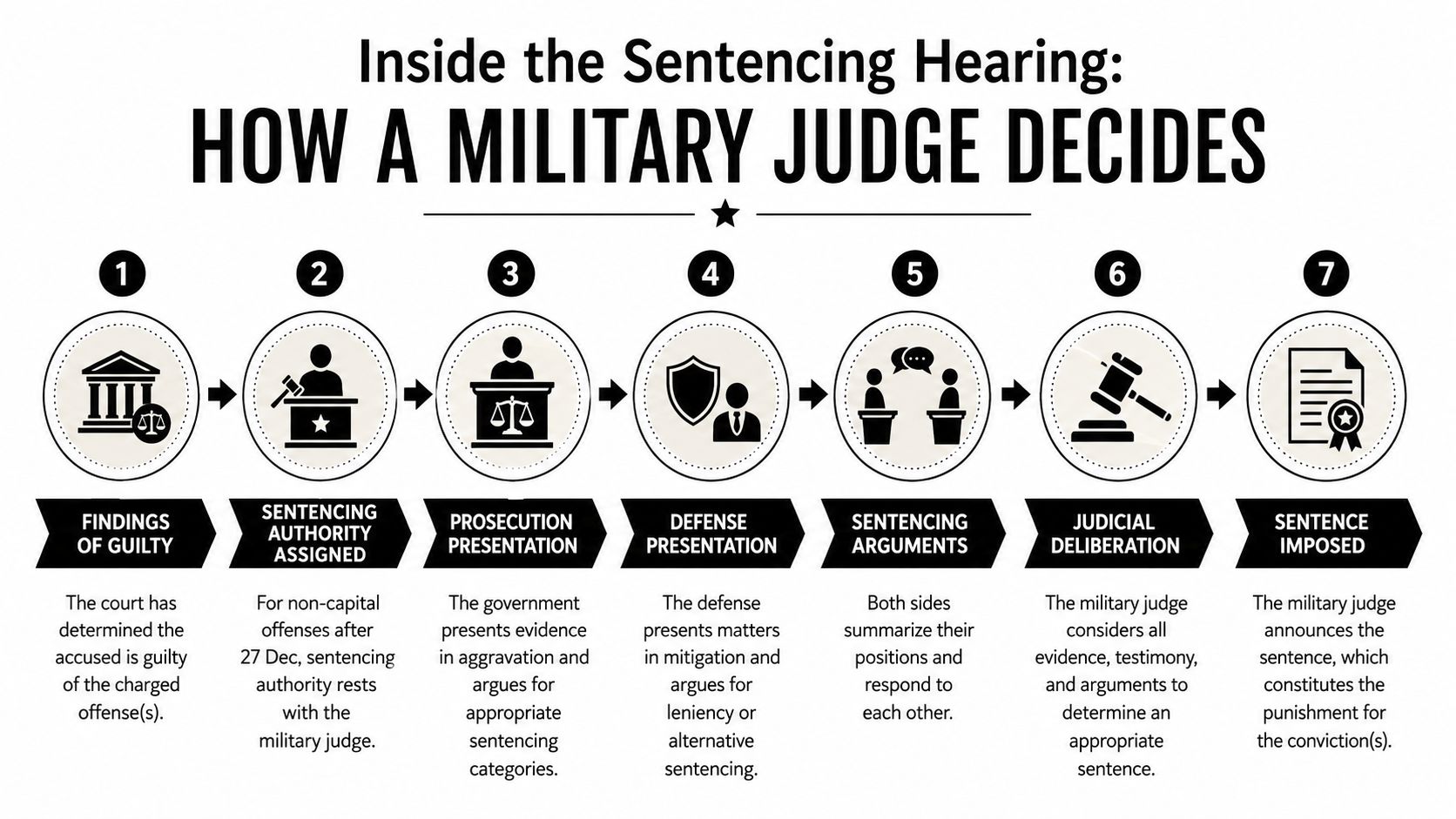
The sentencing hearing follows a practical courtroom sequence. After findings of guilty, the parties address what the judge may consider, present evidence, make arguments, and propose a lawful sentence. For qualifying non-capital offenses occurring on or after 27 December 2023, the military judge is the sentencing authority, even when members determined the findings.
The courtroom sequence
First, the court announces findings. The defense team should immediately shift from trial posture to sentencing posture. That means identifying which specifications resulted in conviction, which allegations are no longer legally relevant, and which evidence can now be used.
Next, the judge confirms sentencing authority and limits. The judge applies the Manual, the offense, the forum, and rank-specific restrictions. Rule 1002 requires a punishment sufficient, but not greater than necessary, to promote justice and good order and discipline. The 2023 Manual for Courts-Martial%20%20(2023%20Edition).pdf?ver=pECkw6O3nIfQNYsmCAwIKg==) also states that one sentencing system applies and that the sentence remains within the court-martial’s bounded discretion.
The prosecution presents its sentencing case. Trial counsel may offer admissible service data, prior convictions, aggravation, personal information, and evidence bearing on rehabilitation. The defense should object when the government exceeds the permitted categories or attempts to introduce uncharged conduct through emotional presentation.
The defense presents mitigation and extenuation. This is not a résumé recital. Counsel should connect the documents and witnesses to a specific sentencing request. A Marine’s treatment plan, deployment history, family support, and post-service plan matter most when they show why the requested sentence is both lawful and credible.
The parties make sentencing arguments. The government asks for punishment. The defense explains why that request is excessive and proposes a concrete alternative. Counsel should address confinement, discharge, rank, forfeitures, and the practical consequences together.
The judge evaluates the record. Military judges hear sentencing evidence through the lens of the conviction, the governing limits, and the competing narratives. Credibility matters. A polished witness who exaggerates can damage the entire presentation.
The judge announces the sentence. The announcement is not the end of the legal work. Counsel must review the sentence, preserve objections, prepare post-trial submissions, and assess appellate issues. Guidance on the limits of command influence is available through the discussion of unlawful command influence and the UCMJ.
Commissioned and warrant officers face rank-specific punishment restrictions that differ from enlisted Marines. The Manual also limits certain punishments by court type. Those details must be calculated before the hearing, not discovered after the judge speaks.
Aggravating and Mitigating Factors the Military Judge Will Hear
A sentence is a narrative supported by evidence. The prosecution wants the judge to see repeated misconduct, damaged trust, and a Marine who presents a continuing danger to discipline. The defense needs to show the full person, the actual context, and a credible path forward without minimizing the conviction.
The government’s aggravation case
Common aggravating themes include:
- Prior misconduct: Earlier disciplinary events can be used to argue that lesser punishment failed.
- Impact on victims: The government may present lawful evidence about harm caused by the convicted offenses.
- Breach of trust: Misconduct involving leadership, authority, or a trusted relationship can receive heightened attention.
- Abuse of rank: The prosecution may argue that position or authority made the conduct more serious.
The defense must separate proven aggravation from emotional overreach. Victim impact has legal limits. In United States v. Valdez, the discussion of the appellate litigation describes how improper references to conduct outside the offenses of conviction can create sentencing error. The lesson is direct. Counsel must object when a statement attempts to reintroduce dismissed, uncharged, or acquitted allegations.
Mitigation must tell a coherent story
A defense team may present service achievements, combat deployments, documented PTSD or TBI, family hardship, treatment progress, commendations, and credible post-service planning. None of those facts automatically cancels a conviction. They can, however, show the judge that the requested punishment is more severe than necessary.
The unsworn statement deserves special attention. It can let the Marine accept responsibility, explain important context, express concern for those harmed, and describe a realistic plan without facing cross-examination. It can also backfire if the accused attacks the verdict, blames everyone else, minimizes obvious harm, or introduces facts counsel hasn’t vetted.
Experts can help when they answer a real sentencing question. A forensic psychologist may explain documented mental-health conditions and treatment. A military career expert may explain the meaning of a service record or the practical consequences of separation. Character witnesses should know the Marine personally and speak with accuracy, not deliver rehearsed praise.
The judge doesn’t need a scrapbook. The judge needs a reliable reason to impose less punishment.
The strongest mitigation package is selective. It identifies the government’s most damaging theme, answers it with admissible evidence, and gives the judge a lawful sentence to announce. More documents don’t equal better advocacy.
The Seven Mistakes That Cost Marines Their Sentence
Marines and families make predictable errors when fear takes over. These mistakes don’t prove guilt, but they can remove options and make a difficult sentence worse.
-
Talking to CID, NCIS, or OSI without counsel. Investigators aren’t neutral counselors. Statements can create admissions, contradictions, and impeachment material. Invoke your rights and speak with a UCMJ lawyer before answering substantive questions.
-
Trusting command to handle the matter. Command may care about fairness, but command also manages discipline, readiness, and risk. Don’t confuse professional treatment with legal protection.
-
Treating Article 15 or NJP as irrelevant. A nonjudicial punishment may become part of the government’s sentencing picture. Counsel should examine the underlying record, accuracy, and whether the government can properly use it.
-
Underestimating a punitive discharge. A bad-conduct or dishonorable discharge can affect veteran benefits, employment, licensing, and reputation. Review the practical consequences before accepting a plea proposal.
-
Believing there’s no evidence. Investigators may already possess statements, messages, photographs, location data, or other digital material. You may not know what exists because the government hasn’t shown you everything.
-
Waiting until post-trial to retain civilian counsel. Post-trial work matters, but sentencing strategy is strongest before evidence is presented. Late involvement limits witness preparation, records collection, and objections.
-
Assuming an unsworn statement is mandatory. Sometimes silence is safer. The decision depends on the facts, the Marine’s credibility, the likely cross-examination risks, and the message the defense can deliver through other evidence.
Marine Corps sentencing data provides a useful warning about the stakes. In FY22, the Corps conducted 206 general and special courts-martial, with 38 acquittals and an overall conviction rate of 82%. Of those cases, 93 were general courts-martial and 113 were special courts-martial, while only 28 cases, about 14%, were tried before members rather than a military judge, according to the Marine Corps court-martial reports.
That history doesn’t decide your case. It does show why conviction and sentencing strategy must be treated as connected phases. Truth matters, but presentation, admissible evidence, credibility, and timing determine what the judge can use.
After the Sentence Is Announced and What Comes Next
The immediate post-trial period is technical and time-sensitive. Counsel should review the announced sentence, identify legal errors, prepare required post-trial motions, and preserve objections. The plan notes commonly associated with this process include a 72-hour post-trial motion window, but the exact deadline and available filing depend on the case posture and current governing rules, so counsel must calculate it from the record.
A written clemency submission to the convening authority may provide an opportunity to seek relief before appellate review. The submission should be specific. It should address the sentence imposed, explain why the punishment is excessive, attach reliable mitigation, and request defined relief rather than asking generally for mercy.
A practical post-trial sequence
- Review the record and sentence. Confirm every term, including confinement, forfeitures, reduction, and discharge.
- File post-trial motions. Raise preserved errors and address matters that require prompt judicial action.
- Submit clemency materials. Present a focused request supported by records, letters, treatment evidence, and a concrete plan.
- Prepare for appellate review. Eligible cases receive review by the Navy-Marine Corps Court of Criminal Appeals, with possible review by the Court of Appeals for the Armed Forces.
- Address execution and benefits. Ask counsel about sentence deferral, confinement logistics, discharge characterization, and later records or benefits remedies.
Clemency and appeal are different tools. Clemency asks decision-makers to reduce or change punishment. Appeal addresses legal error through a narrower and slower process. A civilian military defense lawyer can still make a meaningful difference after trial, especially when the record contains improper sentencing evidence, flawed instructions, or preserved objections.
Read about the practical consequences of separation in this guide to other-than-honorable discharge benefits.
Frequently Asked Questions About Marine Sentencing
Can I refuse to talk to CID or NCIS?
You generally have the right to remain silent and request counsel before answering investigative questions. Don’t guess about the precise status of your rights or make casual statements to investigators. Contact a military defense lawyer before providing an interview.
What happens at an Article 32 hearing?
An Article 32 preliminary hearing examines the allegations and available evidence before referral to a general court-martial. It can expose weaknesses, clarify witness issues, and shape negotiations, but it isn’t the trial itself. Your counsel should use the hearing to develop the defense, not treat it as a procedural obstacle.
Will I go to jail?
You may face confinement if the offense, forum, and adjudged sentence authorize it. The result depends on the findings, sentencing authority, evidence, plea agreement, and arguments. No responsible lawyer can promise a confinement outcome without reviewing the case.
Does a military judge sentence every Marine?
For non-capital offenses occurring on or after 27 December 2023, the military judge determines the sentence regardless of the forum used for findings. Older offenses and capital cases require separate analysis under the applicable rules.
Can the government use my prior NJP?
Potentially, but the answer depends on the nature of the record, how the government offers it, and the applicable sentencing rules. Counsel should challenge inaccurate, incomplete, or improperly presented material.
Is an unsworn statement always necessary?
No. An unsworn statement can be powerful, but it can also expose credibility problems or harmful facts. The decision should follow a review of the evidence, the Marine’s communication style, and the defense’s broader sentencing theory.
Should I hire a civilian court-martial attorney?
In a serious case, early advice from independent civilian counsel can materially improve preparation. Military-appointed counsel may be capable and dedicated, but a civilian defense team offers independence from command and may bring extensive experience with Marine trials, sentencing litigation, and appeals.
If you’re facing Marine sentencing, an investigation, an Article 32 hearing, or a pending court-martial, do not wait for the verdict to start preparing. Gather your records, stop discussing the facts with anyone who doesn’t represent you, and contact experienced military defense lawyers or court-martial attorneys now. Your freedom, rank, career, and future benefits are being shaped by decisions made before the sentencing hearing begins.