You get a text from a supervisor, a counseling statement gets shoved across a desk, or an investigator starts asking about a policy you barely remember seeing. By the end of the day, someone says the words UCMJ Article 92. That’s when a lot of service members make the same bad mistake. They tell themselves this is just a misunderstanding and command will sort it out.
That belief gets people crushed.
UCMJ Article 92 – Failure to Obey Order or Regulation is one of the most dangerous charges in military law because it gives command a flexible tool to punish conduct they say undermined discipline. It can start as an Article 15 issue, turn into a court-martial problem, and end as a career-ending federal conviction with discharge consequences that follow you long after the uniform is gone.
If you’re reading this because you’ve been called in, questioned, counseled, flagged, or formally charged, the system is already moving. Your chain of command isn’t waiting for you to catch up. Investigators aren’t trying to clear your name. Prosecutors are already thinking about how to frame your conduct as disobedience, dereliction, or both.
Table of Contents
- Your Career and Freedom Are on the Line
- What a UCMJ Article 92 Charge Actually Means
- How We Dismantle an Article 92 Prosecution
- The Real-World Consequences of an Article 92 Conviction
- 5 Mistakes That Will Destroy Your Article 92 Defense
- Your Questions Answered and Your Next Move
Your Career and Freedom Are on the Line
It starts fast. A supervisor says stay away from another service member. A staff NCO pushes out a phone policy in a group chat. A commander signs a local restriction order after an incident that no one fully explained to you. Two weeks later, you are the one under investigation, and everyone around you acts like the rule was crystal clear from the start.
That is how Article 92 cases gain momentum.
When command decides you disobeyed an order or violated a regulation, the risk goes far beyond a write-up. They start making decisions about your clearance, your weapon, your promotion, your assignment, your reenlistment, and whether you belong in uniform at all. An Article 92 allegation quickly becomes a judgment about trust and reliability. That shift is what puts good service members in real danger.
The government likes Article 92 because it gives prosecutors room to work with. They can build a case around a written regulation, a verbal order, a standing policy, or an alleged duty that was never explained as clearly as command later claims. That makes early defense work decisive. If you know how the military justice process actually works from investigation through court-martial, you can start attacking the case before the government locks in its story.
My advice is simple. Treat this like active litigation on day one.
Do not assume the order was lawful. Do not assume the wording was clear. Do not assume the government can prove you knew what they say you knew. Those are not technicalities. They are fault lines in the prosecution’s case, and in tech-related cases involving device restrictions, data handling, messaging apps, location sharing, or cybersecurity directives, those fault lines show up constantly.
The biggest mistake is panic talking. Service members under pressure try to “clear things up” with command, NCIS, CID, OSI, or their chain. That usually hands the government its best evidence. Your statement becomes the timeline. Your wording fills gaps in a weak order. Your apology gets spun into intent.
Get counsel involved early. A strong civilian military defense lawyer does not wait for charges and react. Examine the order itself, the way it was delivered, who had authority to issue it, whether it was tied to a valid military purpose, and whether the command made the common mistakes that ruin Article 92 prosecutions. That is how you protect your record, your rank, and your freedom.
What a UCMJ Article 92 Charge Actually Means
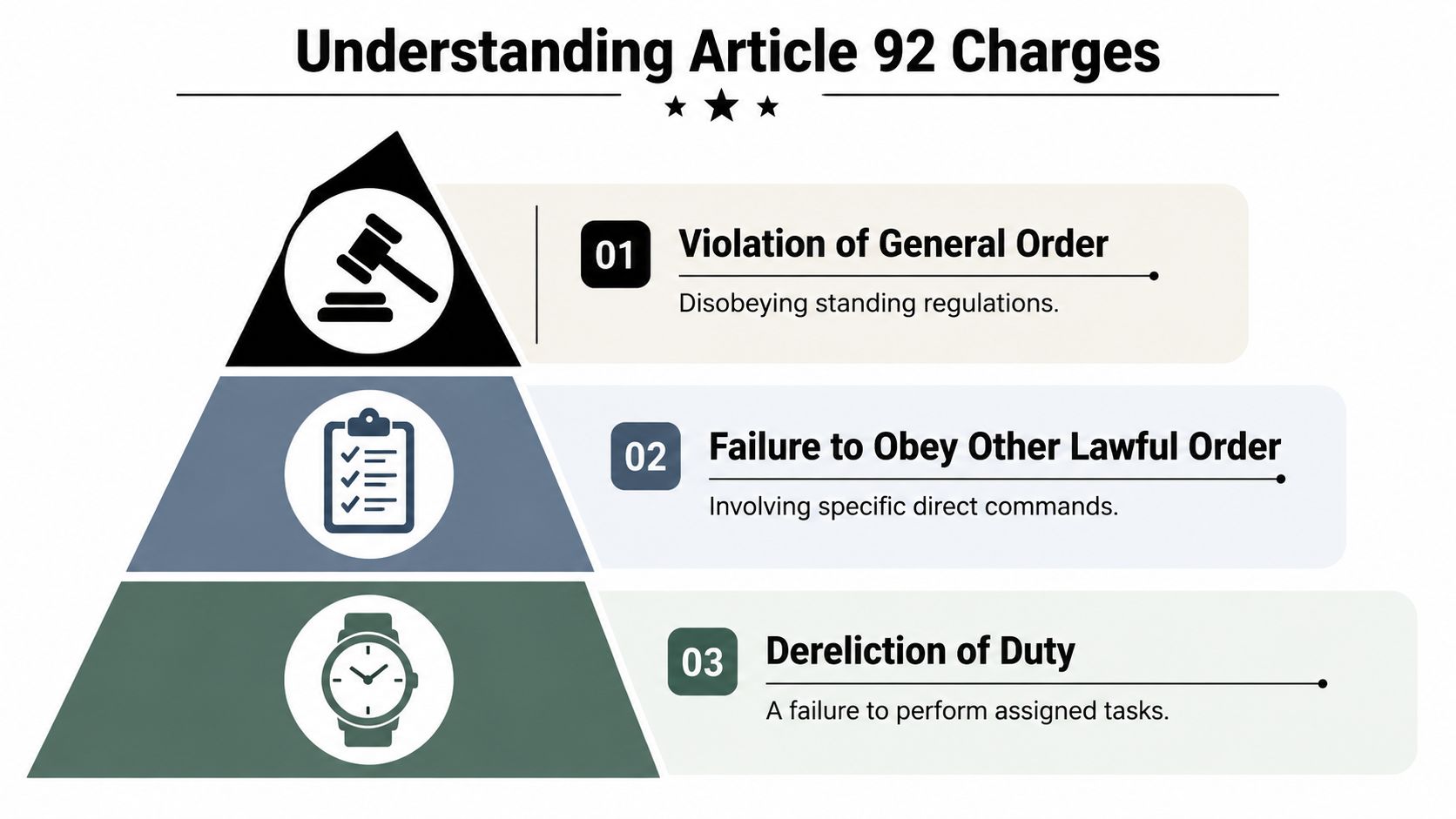
Article 92 sounds simple. It isn’t. The government can charge three different kinds of misconduct under the same article, and the defense strategy changes depending on which version they picked.
Three different offenses live inside Article 92
The first is violating a lawful general order or regulation. This is the broadest and usually the most dangerous version. The government must prove the order or regulation existed, that it was lawful, that you had a duty to obey it, and that you violated it. Under Article 92(1), the prosecution does not need to prove you had actual knowledge of the general order. That principle of constructive notice was affirmed in United States v. Pope, 63 M.J. 68 (C.A.A.F. 2006), as reflected in the U.S. Code text for 10 U.S.C. § 892.
The second is failure to obey another lawful order. This usually involves a specific command directed at a particular person or a smaller group. Here, knowledge matters a lot more. The defense often turns on whether the order was clearly given, whether it was understood, and whether the alleged noncompliance was willful.
The third is dereliction of duty. This is the military’s way of saying you failed to perform a duty you had. Sometimes the government claims the failure was intentional. Sometimes they argue it was negligent. Either way, they will try to turn poor performance, confusion, or a messy work environment into misconduct.
Think of it this way:
- General order case: more like a posted traffic rule. The government argues you were bound by it whether you personally focused on it or not.
- Specific order case: more like a direct command from an officer at the scene. The fight is often about exactly what was said, by whom, and whether you received it.
- Dereliction case: more like being accused of not doing the job the military says was yours to do in the first place.
For a broader primer on how these charges fit into the military justice system, read this guide to the UCMJ system and military justice.
Why knowledge matters in one kind of case and not the other
Service members are often blindsided by these situations. They assume the case ends with the statement, “I never saw that policy.” Sometimes it does not.
Under Article 92(1), lack of actual knowledge is usually not a complete defense to a lawful general order charge. If the order was valid and applied to you, the government will argue military channels gave constructive notice. That’s why these cases can feel unfair. The prosecution may not need to prove you read the policy.
A good defense lawyer doesn’t accept the government’s framing. Force them to prove the order was lawful, punitive, in effect, and actually applicable to the accused.
For a specific order under Article 92(2), the fight often shifts. Did the superior issue a lawful order? Was it clear? Was it contradictory? Was it impossible to comply with under the circumstances? Did witnesses hear the same words command now claims were used?
Those are very different battles. If your lawyer treats every Article 92 case the same, you’re already behind.
How We Dismantle an Article 92 Prosecution
You get called in, shown a policy memo, and told the case is simple. It never is. Article 92 prosecutions often look polished because command controls the paperwork, the timeline, and the first version of the story. My job is to break that story apart before it hardens into a conviction.
Start with the order itself, not the accusation. If the government cannot prove a lawful, enforceable order applied to you in the first place, the rest of its case starts collapsing.
Attack the order before the government gets comfortable
The first fight is over precision. Get the original text, every revision, the issuing authority, the effective date, the distribution method, the training record, the acknowledgment logs, the attached SOPs, the command emails, the text messages, and the witness statements. Article 92 cases are often built on sloppiness hidden behind confident language.
Lawfulness is the next pressure point. A superior’s instruction is not automatically a lawful order. It must serve a valid military purpose, come from someone with authority, and give clear direction that a service member could follow. If the order is vague, inconsistent with other guidance, outside the issuer’s power, or written as command anger dressed up as policy, I attack it head-on.
Punitive language matters too. A regulation can guide behavior without creating a punishable basis for an Article 92 charge. Prosecutors and commands blur that line all the time. Good defense work forces them to prove they charged a violation of a punitive rule, not a violation of preference, habit, or bad drafting.
If you need context for where these fights happen, read this court-martial basics guide.
The government loves the phrase “policy violation.” Courts-martial require proof, not labels.
Early in the case, look for pressure points like these:
- Authority defects: Did the person issuing the order have authority over this service member and this subject matter?
- Application defects: Did the order apply to this unit, location, duty status, or timeframe?
- Notice defects: Can the government prove the order was distributed in a way that gave fair notice?
- Clarity defects: Was the language specific enough to be enforced in a criminal case?
- Exception defects: Did the order include carve-outs, waiver procedures, or conflicting instructions command now ignores?
That is how weak cases hide. They sound firm in an office. They look much worse under subpoenas, motions, and cross-examination.
Attack the knowledge element and force the government to prove notice
In many Article 92 cases, command acts as if knowledge is obvious. It often is not. They point to a roster, a portal upload, a mass email, or a generic annual briefing and expect that to carry the day. I do not let that pass.
Find out who briefed the order, what was said, who attended, whether the language changed later, whether the acknowledgment was meaningful, and whether the accused was even in a position to receive the instruction. In specific-order cases, wording is everything. One witness remembers a firm command. Another remembers a suggestion. That gap can decide the case.
Constructive notice arguments deserve aggressive scrutiny. If the government claims you should have known, make it show how, when, and through what channel. Missing logs, vague training records, unsigned acknowledgments, and conflicting versions of the policy are not minor details. They are defense opportunities.
Tech-related Article 92 cases are full of government mistakes
This is one of the fastest-growing pressure points in military justice. Commands are writing rules about government devices, AI tools, cloud platforms, messaging apps, removable media, geolocation settings, and social media use at a pace that outstrips careful drafting. That creates openings for the defense.
Recent reporting has described an increase in Article 92 accusations tied to unauthorized device use and AI-related conduct. A February 2025 NMCCA ruling, discussed in this analysis of Article 92 tech-related prosecutions, also drew attention to a recurring problem. Commands try to enforce vague digital-use policies as punitive orders when the language does not support criminal enforcement.
The same pattern repeats over and over. The policy was rushed. The exceptions were never explained. Different supervisors gave different instructions. The written rule does not match the charged conduct. The command says “everyone knew,” but the documents say something else.
In tech cases, focus on five questions:
- What did the digital policy say, word for word?
- Did the policy use punitive language or just offer guidance?
- Can the government prove training and notice?
- Did the rule cover this service member’s status, device, platform, or mission?
- Does the alleged conduct fit the exact wording of the charge?
That is the defense lawyer’s playbook. Break the order. Break the notice theory. Break the government’s assumption that a modern policy memo equals a clean criminal case. That is how Article 92 prosecutions get dismantled.
The Real-World Consequences of an Article 92 Conviction
You walk into court worried about rank, pay, or a few months of confinement. You should also be worried about what follows you after the hearing ends. An Article 92 conviction gives the government a tool to cut deeper than many service members expect.
The charging decision changes everything
How the government charges the case drives punishment exposure. A charge built around violating a lawful general order or regulation carries far more danger than a lesser order-based theory. Under the Manual for Courts-Martial, that can mean a punitive discharge, total forfeitures, and lengthy confinement. Other Article 92 theories carry less exposure on paper, but they still put your record, benefits, and future service at risk.
Here is the practical comparison:
| Offense | Maximum Confinement | Maximum Punitive Discharge |
|---|---|---|
| Violating a lawful general order or regulation | 2 years | Dishonorable discharge |
| Violating another lawful order | 6 months | Bad-conduct discharge |
| Dereliction of duty | Varies by form of dereliction under the MCM | May vary based on how charged |
That difference matters early. Command often uses charging language to increase pressure, push a plea, or make the case sound stronger than it is. Look at that immediately, because overcharging creates an advantage for the government and danger for the accused.
If command is steering the matter toward nonjudicial punishment first, do not treat that as harmless cleanup. This Article 15 and non-judicial punishment overview explains why accepting NJP without a defense plan can hand command a foundation for later separation or a worse outcome.
Secondary damage is often worse than the sentence
A conviction under Article 92 reaches far beyond the courtroom.
It can stall or kill a clearance. It can stop a promotion board cold. It can turn one accusation into an administrative separation case, a bad evaluation, and a command narrative that paints you as unreliable or disobedient. If you are near retirement, that risk is brutal.
The civilian fallout is just as serious. A punitive discharge and federal conviction can show up in hiring decisions, licensing applications, and background checks for years. Benefits can disappear. Professional options can shrink fast. Your credibility takes a hit at the exact moment you need stability most.
This is why I do not let clients focus only on the announced sentence. The conviction itself is often the bigger threat. In tech-related Article 92 cases, that is even more important. Commands often charge digital policy violations aggressively, then rely on the stigma of “disobedience” to justify career-ending action even when the order was vague, poorly distributed, or never explained.
Measure the case by what a guilty finding lets the government take from you. Then build the defense around stopping that result before it hardens into a record you cannot erase.
5 Mistakes That Will Destroy Your Article 92 Defense
Your phone lights up after formation. Your supervisor wants you in the office. By lunch, command is saying you violated an order, someone is asking for a written statement, and a routine day has turned into a career threat. That is how Article 92 cases start. Fast, messy, and tilted in the government’s favor unless you get control early.

Mistakes that come up over and over
Talking to investigators because you think honesty will save you
CID, NCIS, OSI, and command investigators are building proof. They are not there to clear up misunderstandings for your benefit. If you start filling gaps, explaining intent, or trying to sound cooperative, you often supply the knowledge element or admit facts the government could not prove cleanly on its own.Assuming a verbal order does not count
Service members get trapped by this all the time. A verbal order can support a charge if the government can show it was specific, lawful, and clearly communicated. The smart move is not arguing about whether it was written. The smart move is attacking what was said, who heard it, whether it was lawful, and whether command is exaggerating it after the fact.Treating a policy issue like a minor admin problem
Article 92 gives command room to turn a disputed rule violation into a misconduct case about obedience and trust. That framing matters. Once they label you disobedient, they start building a story around your character instead of the weak spots in the order, the notice, or the proof.
Write down your own timeline immediately. Names, dates, messages, training sessions, who gave the order, the exact words used, and what records existed that day. That information helps your lawyer attack lawfulness, notice, and memory drift before command locks in its version.
Waiting until charges are preferred to hire serious counsel
That delay costs you an advantage. Early defense work means preserving texts, emails, access logs, screenshots, duty rosters, and witness accounts before they vanish or get repackaged. It also gives your lawyer time to challenge whether there was a punitive order at all, whether you had notice, and whether the government chose Article 92 because another charge was too weak.Trusting command to sort it out fairly
Command is focused on discipline, optics, and control. Those pressures shape how your case is framed, what witnesses are pushed forward, and which facts get ignored. You need someone whose job is to dismantle the case, not protect the unit’s narrative.
Here’s a short video that captures how fast these cases can turn serious:
Ignoring your digital footprint
This mistake is getting more dangerous. In tech-related Article 92 cases, the fight often turns on system logs, app use, training acknowledgments, device settings, email chains, screenshots, and access history. Commands sometimes charge first and figure out the policy later. If the order was vague, badly distributed, or never explained in a usable way, digital records may expose that. They can also bury you if you do nothing.Believing appointed counsel and civilian counsel are interchangeable
Some detailed military defense counsel are excellent. Some are overloaded, inexperienced, or learning Article 92 motion practice on your case. You need hard answers about trial experience, suppression litigation, unlawful order challenges, and whether counsel knows how to attack knowledge, dissemination, and weak tech evidence.
Make two or three of these mistakes early, and you can wreck a defense that had strong facts. Get ahead of them, and you give your lawyer room to break the government’s theory before it hardens into a conviction.
Your Questions Answered and Your Next Move
Fear makes people freeze. Clarity fixes that. Here are common questions from service members and families facing an Article 92 allegation.
Frequently asked questions
Can I be charged even if I never read the regulation?
Yes, in some general order cases. As discussed earlier, actual knowledge is not always required for a lawful general order charge. That’s one reason these cases are dangerous.
What if the order was unclear or badly written?
That can be a real defense. Vagueness, lack of punitive language, poor dissemination, and scope problems can all weaken or break the prosecution’s theory.
What if I thought the order was illegal?
You should never assume that argument will protect you unless a lawyer has evaluated the facts. The line between an unlawful order and a lawful order you disliked is not something to guess about under pressure.
Will I go to jail for UCMJ Article 92 – Failure to Obey Order or Regulation?
You could. Whether confinement is realistic depends on how the case is charged, the facts, your record, and whether the government is using the charge to gain an advantage in a broader prosecution.
Do I need a lawyer immediately, even if this is still at the inquiry stage?
Yes. Early representation matters in military cases because evidence gets packaged quickly, witnesses get shaped by command influence, and bad statements are hard to undo.
When command says, “We just want your side,” they usually mean they want a statement they can use.
Why hire civilian military defense lawyers if I already have appointed counsel?
Because independence matters. A seasoned civilian UCMJ lawyer or court-martial attorney may bring deeper trial experience, more freedom to challenge command assumptions aggressively, and more time to focus on your case.
Your next move
If you’re under investigation, facing NJP, dealing with a commander’s inquiry, or staring at a drafted charge sheet, this is not the time to be passive. UCMJ Article 92 – Failure to Obey Order or Regulation can cost you your rank, your pay, your freedom, your clearance, and your future. It can also be far more defensible than command wants you to believe, but only if someone starts attacking the case early.
Talk to an experienced civilian military defense lawyer now. Ask direct questions. Ask how they challenge lawfulness, publication, punitive language, knowledge, digital evidence, and charging decisions. Ask how many courts-martial they’ve tried.
If you’re being questioned or accused, don’t wait for command to define your future for you. Get strategic. Get represented. Get in front of the case before the case rolls over you.