One bad exchange with a superior officer can turn into a CID, NCIS, OSI, or command inquiry before you’ve even figured out what just happened. You think it was a heated moment. Your command may see it as an Article 89 case. By the time you hear words like “statement,” “charges,” or “court-martial,” the record is already being built against you.
That’s the part most service members miss. UCMJ Article 89 – Disrespect Toward a Superior Commissioned Officer is not a “minor attitude problem” once command decides to act. It can become a career-ending event with confinement exposure, loss of pay, punitive discharge risk, and administrative fallout that follows you long after the case ends. If you’re under investigation now, your first priority is not explaining yourself. It’s stopping the damage.
Table of Contents
- Your Career Is On the Line The Moment You’re Accused of Disrespect
- What the Government Must Prove Under UCMJ Article 89
- The True Cost Punishments and Career-Ending Consequences
- Strategic Defenses How We Fight an Article 89 Charge
- The Process from Accusation to Court-Martial A Step-by-Step Guide
- Why Your Appointed Military Lawyer Is Not Enough
- Frequently Asked Questions About Article 89 Charges
- Can I refuse to talk to CID, NCIS, OSI, or command?
- Can a text message or social media post become an Article 89 case?
- What if the officer started it?
- What’s the difference between disrespect and disagreement?
- Will I go to jail for Article 89?
- Can I get separated even if I’m not convicted?
- Should I apologize to the officer?
- Your Military Career Is On the Line Contact a Defense Attorney Now
Your Career Is On the Line The Moment You’re Accused of Disrespect
You mouth off in a tense counseling session. Or you snap after weeks of pressure and say something you shouldn’t have said. Maybe you didn’t even think it was that serious. Then your phone starts blowing up. First sergeant wants to talk. A witness got interviewed. Someone says the commander is “looking at UCMJ action.”
That’s when panic sets in. You start replaying every word, every text, every look in the room. Your spouse asks if this can really ruin your career. The answer is yes. It can.

Article 89 cases often start small and get worse fast because they involve command authority, pride, and discipline. Once a superior officer says your conduct crossed the line, the system tends to protect the rank structure first and sort out nuance later. If investigators think they can frame your words or behavior as contemptuous, insolent, or openly defiant, you are already behind.
What you need to do immediately
- Stop talking about the incident: Don’t explain it to your chain, your peers, or investigators.
- Preserve evidence now: Save texts, emails, call logs, screenshots, duty schedules, and names of everyone who saw what happened.
- Write down your memory privately: Do it while details are fresh. Time, place, exact words, who interrupted whom, and what the officer said matters.
- Assume the case won’t “blow over”: Hoping for mercy is not a defense strategy.
Practical rule: The first explanation you give is usually the version the government locks onto. If it’s incomplete, emotional, or poorly worded, you may spend months trying to undo it.
Families need to understand this too. A disrespect allegation can trigger much more than a counseling statement. It can feed nonjudicial punishment, administrative separation, a court-martial referral, or all three in sequence. Early action gives your defense lawyer room to shape the case before command hardens its position.
What the Government Must Prove Under UCMJ Article 89
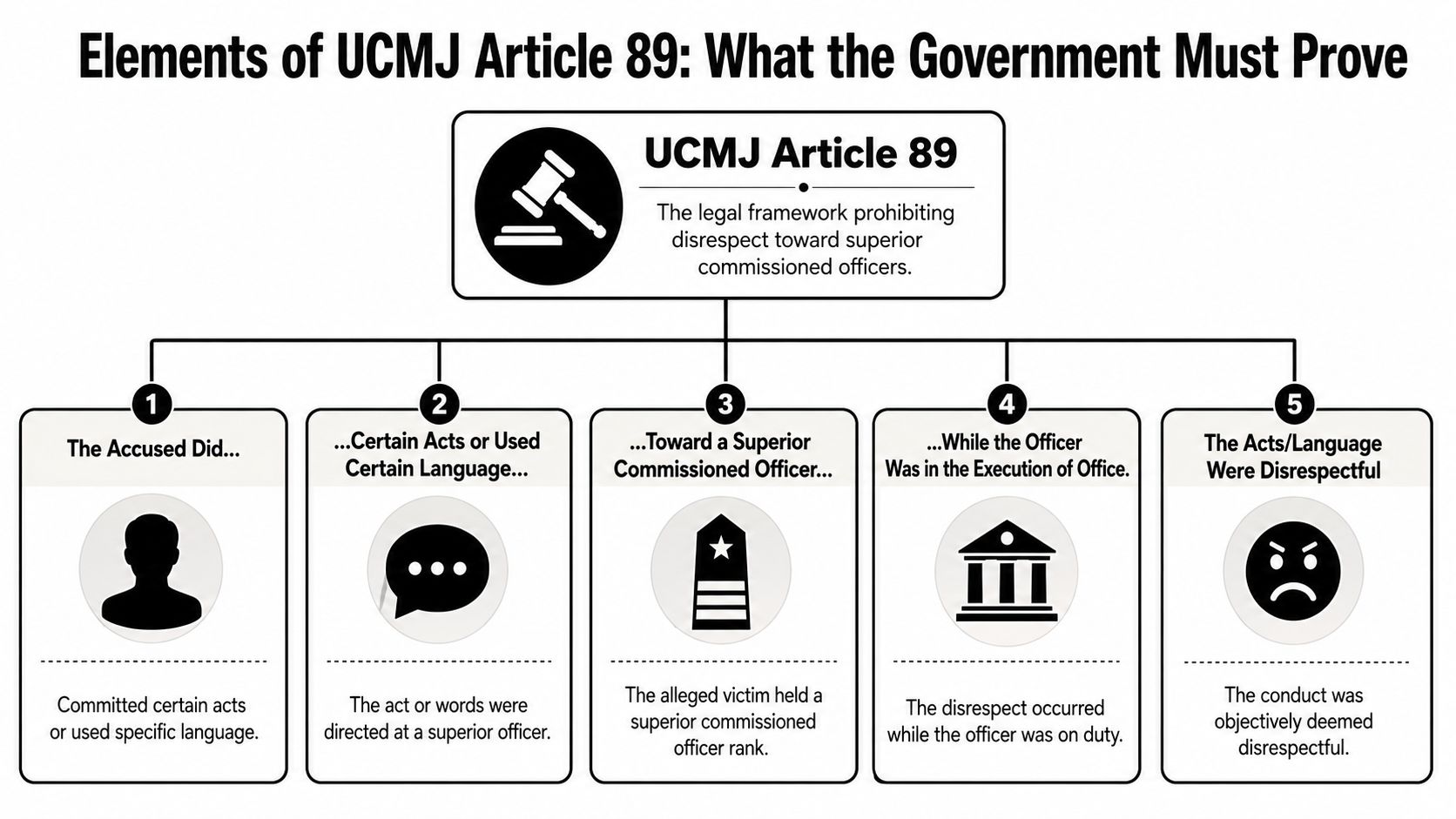
This offense is narrower than commonly perceived. The government doesn’t win because an officer felt offended. It wins only if it proves the required legal elements.
Under Article 89, the prosecution must prove four legally distinct elements: specific disrespectful acts, omissions, or language; that the conduct was directed toward the officer; that the officer was a superior commissioned officer; and that the accused knew that superior status. Circumstantial evidence can satisfy the knowledge requirement, so the government does not need an explicit admission that you recognized the rank, as explained in this Article 89 elements discussion by My Military Lawyers.
Disrespect is a legal question, not a personal reaction
The government must identify what you supposedly did or said. Not vague attitude. Not “bad bearing.” Specific conduct.
That means a real defense starts by pinning them down:
- What exact words are alleged
- Who heard them
- Whether anyone recorded them
- Whether the witnesses agree
- Whether the surrounding context changes the meaning
A raised voice isn’t automatically criminal. Silence isn’t automatically disrespect. Frustration is not the same thing as punishable contempt. Context decides a lot in these cases.
If the allegation sounds broad and emotional, that’s usually a sign the case needs to be forced into specifics.
The superior relationship is often where cases get weak
A lot of commands act as if rank alone ends the argument. It doesn’t. The law on who counts as “superior” is more technical than commonly understood.
Within the same armed force, superiority can depend on rank, command authority, or grade relationships. Across different branches, superiority generally requires chain-of-command authority, or in limited hostile detention situations, senior grade. Grade alone does not always establish superiority, and that distinction is frequently litigated. Two service members of the same rank can still raise Article 89 issues if one had lawful command authority over the other in that setting.
That matters in joint units, temporary duty, attached assignments, mixed-service environments, and situations where people assume command relationships that were never clear.
A defense lawyer will also test the knowledge element hard. Yes, circumstantial evidence can be enough. But “can be enough” doesn’t mean it always is. If the environment was chaotic, the officer was out of the expected role, or the interaction happened outside a normal military setting, knowledge becomes a real fight.
The True Cost Punishments and Career-Ending Consequences
You can survive a bad counseling. You can survive a weak evaluation. An Article 89 case can follow you for years.
Article 89 gets minimized because the label sounds minor. That is a mistake. The 2019 Manual for Courts-Martial allows, for disrespect toward a superior commissioned officer who is superior in command, a bad-conduct discharge, total forfeiture of all pay and allowances, and up to 1 year of confinement. If the officer was superior in rank only, the maximum confinement drops to 6 months, but a bad-conduct discharge and forfeitures can still be on the table, as reflected in the Manual for Courts-Martial Article 89 punishment summary hosted by the University of Houston Law Center.
That is enough to end a military career outright.
What punishment can look like on paper
| Offense | Discharge | Confinement | Pay Forfeiture |
|---|---|---|---|
| Disrespect toward superior commissioned officer superior in command | Bad-conduct discharge | Up to 1 year | Total forfeiture of all pay and allowances |
| Disrespect toward superior commissioned officer superior in rank only | Bad-conduct discharge | Up to 6 months | Forfeiture authorized |
The charge sheet also creates risk beyond the exact wording of Article 89. Congress split disrespect and assault into separate subsections in 2016. That matters because commands and prosecutors often start with a disrespect allegation, then build the case into something more damaging if they think the accused is isolated, emotional, or poorly advised. Early case strategy matters for that reason. Strong investigation-phase defense work can shut down that escalation before the government hardens its story.
The true punishment usually starts before trial and keeps going after it ends.
A disrespect allegation can damage:
- Security clearance reviews
- Promotion timing and selection
- Reenlistment and retention decisions
- Special duty screening
- Administrative separation outcomes
- Post-service hiring for law enforcement, federal work, and defense contracting
Command politics inflict real damage. Once a superior officer labels you disrespectful, that label spreads fast through the chain. Investigators tend to read later facts through that frame. A neutral witness becomes “disloyal.” A stress reaction becomes “attitude.” A sharp reply during a chaotic exchange becomes proof of character. Good defense counsel attacks that framing early, because subjective cases get worse every day they go unanswered.
Even if the case never reaches a contested court-martial, the command can still use the allegation to justify a reprimand, adverse evaluation input, loss of trust language, nonjudicial punishment, or separation processing. Service members who say, “I’ll just take the NJP and move on,” usually learn too late that the paper lasts longer than the punishment.
That is the trap. The government does not need a long sentence to do lasting damage. It only needs enough paperwork, enough command hostility, and enough unchallenged assumptions to make your future look risky on paper.
Strategic Defenses How We Fight an Article 89 Charge
Article 89 was created as part of a unified military justice framework in 1956, replacing fragmented branch-specific systems, and it was refined again in 2016 to separate disrespect from assault under 10 U.S.C. § 889, as shown in the current House version of the statute. That history matters for one reason. The law exists to protect command authority. Commands know that. Prosecutors know that. Good defense counsel knows it too and attacks the case where authority was assumed, overstated, or misused.

Subjective cases are beatable when you attack context
These cases are rarely about a clean video and an undeniable confession. They are usually about interpretation. Tone. Framing. Unit politics. Witness loyalty. A bad write-up from a superior who already decided you’re the problem.
That’s why the defense work starts with context, not labels.
A strong Article 89 defense may focus on:
- Mischaracterized language: Words quoted without the lead-up or without the officer’s own statements.
- Inflated demeanor claims: “Aggressive,” “contemptuous,” and “insolent” are often conclusions, not facts.
- Broken witness consistency: Different accounts on volume, phrasing, posture, distance, and sequence matter.
- Poor investigative technique: Investigators often lock onto the command version early and miss exculpatory context.
The government likes neat stories. Defense counsel breaks those stories apart line by line.
Where experienced defense counsel finds leverage
Some of the most effective pressure points are technical.
One is superior status. In a joint or unusual assignment, who had lawful authority over whom may be far less obvious than command wants to admit.
Another is the officer’s own conduct. If the officer was acting outside proper authority, escalating the conflict, or engaging in misconduct, that can change how the alleged disrespect is judged. The Manual for Courts-Martial recognizes that a superior who seriously departs from required standards can lose the protection that Article 89 normally provides. That isn’t automatic, but it is powerful when the facts support it.
A third pressure point is proof of knowledge. If the government has to rely on assumptions instead of direct evidence, the defense can force the issue.
And then there is the big one. Subjectivity. Was what you said criminally disrespectful, or was it sharp disagreement in a bad moment? That distinction wins and loses cases.
If you want to understand why the investigation stage matters so much, read this breakdown of how experienced counsel win cases during the military investigation phase. By the time charges are preferred, some of the best defense opportunities are already gone.
The Process from Accusation to Court-Martial A Step-by-Step Guide
When clients call, they usually don’t know where they are in the process. They just know command is asking questions and the pressure is rising. That uncertainty hurts people. It makes them talk when they should stay silent.
What usually happens first
An allegation gets reported
The officer, a witness, or someone in the chain reports the incident. Sometimes it starts as a complaint. Sometimes it starts as a counseling session that turns ugly.Command starts gathering facts
This may be informal at first. Your supervisor asks for your side. Someone wants a written statement. Many service members damage their case at this stage by trying to sound cooperative.Investigators or command interview witnesses
CID, NCIS, OSI, CGIS, or command investigators may get involved depending on the facts. Even if the case stays “administrative” at first, what people say here can shape everything later.
Your priority in this phase is simple. Say less. Preserve more. Get counsel early.
When command says, “We just want to clear this up,” they’re usually building a record, not helping you.
What happens if command pushes the case
The next phase depends on how aggressive the command wants to be.
- Nonjudicial punishment route: The command may handle it through Article 15 or NJP.
- Administrative action route: You may see reprimands, adverse evaluations, or separation processing.
- Court-martial route: Charges get preferred, reviewed, and potentially referred to trial.
If the case heads toward court-martial, you may also face an Article 32 preliminary hearing in cases that qualify for that process. By then, witness statements, text records, prior counseling, and chain-of-command narratives are already shaping the battlefield.
Here’s the right way to think about the timeline:
- Early stage. Protect yourself from making the case stronger.
- Middle stage. Challenge the investigation and preserve favorable evidence.
- Charging stage. Force the government to commit to specific allegations.
- Pretrial stage. Attack credibility, proof, and command assumptions.
For a plain-English overview of how the system unfolds, review these court-martial basics for service members and families. Then talk to counsel about your actual facts, because process only matters if your strategy matches where the case stands.
Why Your Appointed Military Lawyer Is Not Enough
You get called in after a heated exchange with an officer. By the time you meet your appointed lawyer, command has already heard one version of the story, investigators have started framing your words as insubordination, and witnesses are adjusting their memories to fit the chain of command’s narrative. That is when service members learn a hard lesson. Free counsel is not the same as fully protected.
Your appointed military lawyer may be capable, ethical, and committed. That still does not make the default option enough in a case where one accusation can derail promotion, trigger separation, or stain your record for years.
Military counsel helps, but serious cases need more
Article 89 cases are unusually vulnerable to command influence because “disrespect” is subjective. Tone, context, rank dynamics, unit politics, and who writes the first memo often matter as much as the actual words used. The government knows that. It builds these cases around perception, not just proof.
Appointed defense counsel start with a built-in disadvantage. They often carry crowded caseloads, work under assignment limits they cannot control, and may be early in their trial careers. Some are excellent litigators. Some are still learning how to attack credibility, expose investigator bias, and force command to defend its assumptions instead of repeating them.
The system shapes the case long before trial. In an Article 89 allegation, that matters.
| Appointed military counsel | Experienced civilian military defense counsel |
|---|---|
| Often juggling a heavy docket | Can give your case focused time and pressure-test the facts early |
| Assigned by the system | Chosen by you for Article 89 and court-martial experience |
| Works within military workload and command realities | Operates independently and can challenge command narratives more aggressively |
| Experience level varies case to case | You can hire someone with a track record handling disrespect allegations, NJP, separation boards, and trials |
What civilian defense counsel changes
Independent civilian counsel changes the posture of the case. Instead of reacting to what command and investigators decided happened, your defense starts building its own record early. That can include preserving texts, identifying motive problems, exposing inconsistent witness accounts, and showing that a disagreement, complaint, or frustrated response was repackaged as criminal disrespect.
That independence matters most when the case is being driven by personalities. Article 89 allegations can grow out of bruised egos, bad leadership, prior friction, and an officer who wanted to make an example out of someone. A lawyer outside the system is better positioned to call that what it is and force the government to prove more than rank-based outrage.
Good appointed counsel still has value. Keep them involved. But if your rank, retirement, clearance, or military future is in danger, add someone whose only job is protecting you.
In a serious Article 89 case, the critical question is whether appointed counsel alone gives you enough protection. Often, it does not.
Frequently Asked Questions About Article 89 Charges
Can I refuse to talk to CID, NCIS, OSI, or command?
Yes. If you’re suspected of misconduct, you should invoke your rights and ask for a lawyer. Talking rarely helps at the start. It usually gives the government a cleaner statement than it already had.
Can a text message or social media post become an Article 89 case?
Yes. Written communications can become evidence if command believes they were directed toward or concerned a superior officer in a disrespectful way. Don’t delete anything. Preserve it and let your lawyer evaluate context.
What if the officer started it?
That matters. An officer’s own conduct can affect how the interaction is judged. It may support mitigation, credibility attacks, or a more aggressive defense theory. Do not try to argue that point alone. Build it through evidence.
What’s the difference between disrespect and disagreement?
Disagreement is not automatically criminal. The problem is the government often tries to repackage blunt disagreement, frustration, or refusal to accept criticism as disrespect. Context, tone, audience, and exact wording decide that fight.
Will I go to jail for Article 89?
You can face confinement exposure if the case goes to court-martial and ends in conviction. Whether that happens depends on the facts, the forum, your record, and how well the case is defended.
Can I get separated even if I’m not convicted?
Yes. Commands can pursue administrative consequences even when a case does not end with a conviction. That is why “I beat the charge” is not the same thing as “my career is safe.”
Should I apologize to the officer?
Not before speaking with counsel. An apology can be twisted into an admission. What feels mature in the moment can become damaging evidence later.
Your Military Career Is On the Line Contact a Defense Attorney Now
If you’re under investigation for UCMJ Article 89 – Disrespect Toward a Superior Commissioned Officer, waiting is a mistake. Every hour you delay gives command more time to shape the record, secure statements, and lock in a version of events that may be incomplete or flat-out wrong.
Get legal advice now. Not after the written statement. Not after the Article 15 notice. Not after charges are preferred.
Use this guide on how to choose the right military defense lawyer and then start making calls. Your freedom, military record, clearance, benefits, and future employment can all be affected by what happens next.
Consult counsel immediately. This is not the time to hope the system protects you.