You’re probably reading this because someone says you willfully disobeyed a superior commissioned officer, and now your stomach is in knots. Maybe you were called in by command. Maybe CID, NCIS, OSI, or CGIS is circling. Maybe a spouse just heard the words “Article 90” and is trying to figure out whether this is a career problem, a jail problem, or both.
It can be both.
UCMJ Article 90 – Willfully Disobeying a Superior Commissioned Officer is one of those charges command uses when they want to frame the issue as direct defiance, not a mistake. That distinction matters. A lot. But a charge is not a conviction, and the government still has to prove a very specific kind of intent. The central fight is usually not whether an order existed. It’s whether the government can prove willfulness instead of confusion, impossibility, misunderstanding, or a command trying to overcharge a lesser offense.
If you’re in this situation, your first moves matter more than your explanations. Stop talking. Preserve every text, email, and message. Write down exactly what happened while it’s still fresh. Then get a real military defense strategy in place.
Table of Contents
- What is UCMJ Article 90 and Why Is It So Serious
- The Five Elements the Government Must Prove
- How Article 90 Differs from Article 91 and 92 Offenses
- Maximum Punishments and Career-Ending Consequences
- Strategic Defenses Against an Article 90 Charge
- Why an Experienced Civilian Lawyer Is Not Optional
- Frequently Asked Questions About Article 90 Charges
- Can I refuse an unlawful order
- What if I couldn’t physically comply
- Can this be handled at Article 15 or NJP
- Should I talk to investigators to explain myself
- Do I need a lawyer immediately
- Will an Article 90 allegation affect my clearance
- What if the order came through paperwork or a generic message
- Is being charged the same as being guilty
What is UCMJ Article 90 and Why Is It So Serious
Article 90 is the military’s blunt instrument for intentional defiance of commissioned authority. It is not about sloppy performance. It is not about ordinary noncompliance. It is about the government claiming you deliberately refused a lawful command from a superior commissioned officer.
Under 10 U.S.C. § 890, Article 90 criminalizes the willful disobedience of a lawful command from a superior commissioned officer, and the prosecution must prove five elements beyond a reasonable doubt, including receipt of the command, superior status, knowledge of that status, willful disobedience, and wartime context if applicable, as outlined by this Article 90 legal breakdown.
That’s why this charge hits differently. The allegation isn’t just “you messed up.” The allegation is “you challenged the chain of command on purpose.” Command treats that as a direct threat to authority, and prosecutors often lean into that theme hard.
This is not a minor obedience case
Article 90 sits above the routine failure-to-obey world. When command chooses this charge, they are telling the court they believe the facts show a personal, direct, intentional refusal to comply with a commissioned officer’s lawful command.
That choice has consequences:
- It increases the stakes: The charge itself signals a severe theory of misconduct.
- It frames you as defiant: That can poison command perception early.
- It pressures you to explain: That is exactly how many accused service members damage their own cases.
Practical rule: If command says “Article 90,” stop trying to talk your way out of it. Start treating the case like a serious criminal allegation.
Why service members get trapped early
Many individuals under investigation believe the problem is the order itself. Often, it isn’t. The actual problem is what they say afterward. They admit they heard something. They admit they didn’t do it. They start explaining why. Suddenly the government has a statement it can use to argue knowledge and intent.
That’s where disciplined defense work starts. You need to understand the system, not react emotionally to it. If you need a broader orientation to military justice before dealing with the specifics of Article 90, review this guide to the UCMJ system and military justice.
The Five Elements the Government Must Prove
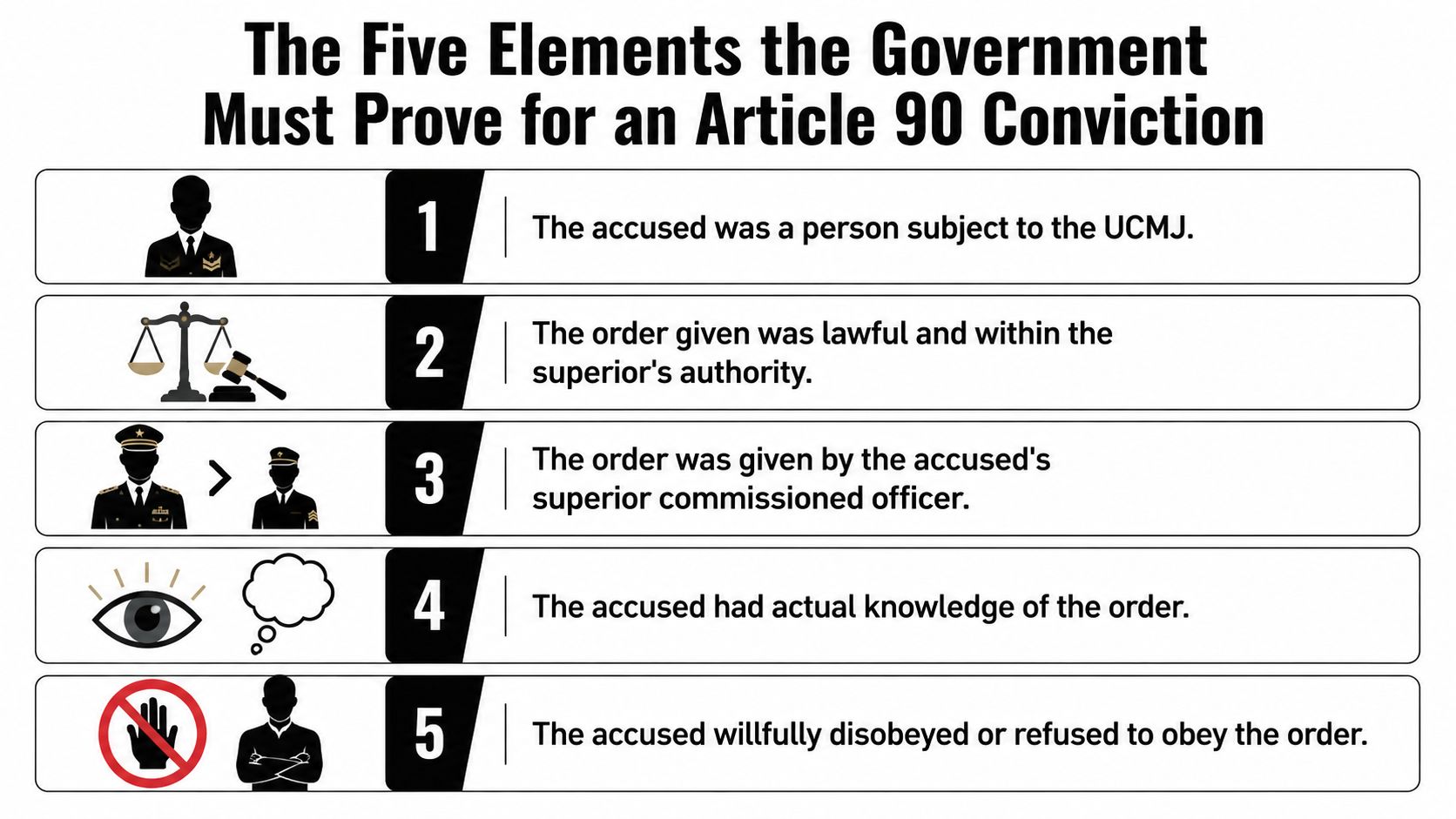
An Article 90 charge only holds if the government proves every required element. Miss one, and the case should fail. That’s not theory. That’s the framework.
What the command actually has to prove
Here’s the plain-English version of the five elements:
You received a lawful command
The order must be lawful. Not every instruction from an officer qualifies. The command must fit within proper authority and military purpose.The officer was your superior commissioned officer
Rank and command relationship matter. The government has to show the person giving the command held the right superior status in relation to you.You knew that person was your superior commissioned officer
This seems obvious in many cases, but the government still has to prove it.You willfully disobeyed the command
This is the hard part for the government in many real cases. “Willfully” means intentional defiance, not a mistake, not confusion, not inability.If the case involves wartime punishment, the offense occurred in time of war
That extra wartime context matters only when the government is dealing with that level of punishment exposure.
Why willfulness is the real battleground
Most Article 90 defenses turn on the fourth element. The government wants to collapse every failure to comply into a simple story: order given, order ignored, guilt proven. That shortcut is where good defense work destroys weak prosecutions.
A service member may fail to comply for many reasons that are not willful disobedience:
- Misunderstanding: The order was vague, rushed, or poorly delivered.
- Conflicting guidance: An NCO or another leader gave different instructions.
- Impossibility: Circumstances made compliance impossible.
- No actual refusal: The member hesitated, delayed, or misunderstood timing.
- No clear immediacy: The order did not clearly require immediate action.
The Manual for Courts-Martial framework reflected in military defense analysis also stresses that the command must be lawful, specific, and issued in execution of office, and that willful disobedience demands proof of deliberate intent. That same body of analysis explains why direct personal orders can trigger Article 90 while indirect directives often belong under Article 92, discussed in this court-martial basics resource.
A careful evaluation of an Article 90 case does not start by asking whether the accused complied. It asks whether the government can prove a conscious, voluntary refusal beyond a reasonable doubt.
Questions your lawyer should be asking immediately
A serious defense lawyer will drill into details command often ignores:
| Issue | Why it matters |
|---|---|
| Exact wording of the order | Ambiguity kills willfulness |
| Who gave it | Article 90 is limited to superior commissioned officers |
| How it was delivered | Personal command matters |
| When it was delivered | Timing can expose confusion |
| What else was happening | Chaos, noise, stress, and competing demands matter |
| What you did next | Good faith effort can undercut intentional defiance |
Those are not technicalities. They are the case.
How Article 90 Differs from Article 91 and 92 Offenses
Service members often lump these charges together because they all involve obedience problems. That’s a mistake. They are not interchangeable, and the difference tells you a lot about how aggressively the government is charging your case.
Why the charging decision matters
Article 90 is about willfully disobeying a lawful command from a superior commissioned officer. That is the most serious lane in this family of offenses because it frames the misconduct as direct defiance of commissioned authority.
Article 91 deals with insubordinate conduct involving warrant officers, noncommissioned officers, or petty officers. It’s serious, but it is not the same accusation.
Article 92 usually covers failure to obey an order or regulation. That often applies when the issue involves a general order, regulation, or administrative directive rather than a direct personal command carrying Article 90’s sharper edge.
A practical comparison
| Article | Who is involved | Core theory |
|---|---|---|
| Article 90 | Superior commissioned officer | Willful disobedience of a lawful command |
| Article 91 | Warrant officer, NCO, or petty officer | Insubordinate conduct toward enlisted or warrant leadership |
| Article 92 | Orders or regulations generally | Failure to obey order or regulation |
This is why overcharging matters. If the facts fit Article 92 better, the government may still push Article 90 because it sounds more severe and gives command more advantage.
That’s not rare in practice. It’s one reason experienced court-martial attorneys spend so much time forcing the government to justify why the case belongs in the Article 90 lane at all.
A lot of Article 90 cases should have been charged, if at all, as Article 92. The charging label is not proof. It’s a decision, and decisions can be attacked.
Maximum Punishments and Career-Ending Consequences
If you’re trying to judge whether this charge is “really that serious,” stop guessing. It is.
The formal punishment exposure
In peacetime, the maximum punishments for an Article 90 conviction include a dishonorable discharge, forfeiture of all pay and allowances, and confinement for up to 5 years. In wartime, the offense is punishable by death. Even at a special court-martial, confinement is capped at 12 months, according to the Army court digest discussing Article 90 punishment limits.
That alone should get your attention.
Here’s the practical breakdown:
- Dishonorable discharge: Your military career can end in the worst possible way.
- Total forfeitures: Your pay exposure becomes immediate and brutal.
- Confinement: Real jail time is on the table.
- Wartime exposure: The statute’s death authorization shows how seriously the system treats direct defiance in combat conditions.
The damage beyond the sentence
The official punishment is only half the problem. The rest hits your life afterward.
An Article 90 allegation can affect:
- Security clearances
- Administrative separation actions
- Reputation within the unit
- Future civilian employment
- Veterans-related consequences tied to discharge characterization
For security clearance holders, the danger is immediate. An Article 90 conviction can trigger mandatory reporting under SF-86 and put your clearance at risk. That damage can outlast the court-martial.
Strategic Defenses Against an Article 90 Charge
Weak Article 90 cases come apart. Not with speeches. With structure.

Attack willfulness first
If the government can’t prove deliberate defiance, the Article 90 theory starts to crack. That means you attack the story they want to tell about your intent.
A serious defense on willfulness often looks at:
Ambiguous wording
“Do it now” is not the same as vague language. If the order wasn’t specific, the government has a problem.Misheard or misunderstood commands
Noise, stress, confusion, or multiple voices can matter. So can rushed instructions.Conflicting directions
If another leader gave different guidance, the government’s clean story gets messy fast.Good faith effort
Trying to comply but failing is not the same as choosing not to comply.Impossibility or unavoidable circumstances
If events prevented compliance, that cuts directly against intent.
Your lawyer should be building a record of confusion, context, timing, and competing instructions. Willfulness lives or dies in details.
Challenge whether this was really an Article 90 order
A critical defense line is whether this was even the kind of order Article 90 covers.
In United States v. Phillips (74 M.J. 20), a conviction was reversed because the order not to drive on base came through a form letter, not a personal command. The court treated that as an Article 92 issue, not Article 90. That distinction is central, and it’s explained in this Article 90 defense analysis discussing Phillips.
That gives defense counsel a powerful argument:
- Was the order direct and personal
- Was it routine administrative paperwork
- Did the officer personally issue or ratify it
- Was command trying to escalate a regulation problem into a defiance case
Article 90 is not intended to encompass every order-related violation in the military.
Build the defense before the government hardens its story
Early case development wins Article 90 defenses. Once command interviews everyone and locks in its narrative, the fight gets harder.
The first things to preserve include:
Texts, emails, and message logs
These often show timing problems, ambiguity, or conflicting guidance.Witness accounts
Especially from people who heard the order, saw the environment, or watched what the accused did next.Medical or duty limitations
If compliance was affected by legitimate restrictions, get the records.The officer’s exact words and conduct
Was this an official command in execution of office, or an emotional reaction dressed up later as a lawful command?The command climate
Sometimes the case is less about obedience and more about making an example out of someone. That can connect to broader concerns involving unlawful command influence and the UCMJ.
Here is the short version of the strategic framework I use:
| Defense focus | What it targets |
|---|---|
| No willfulness | Intent was not deliberate defiance |
| No lawful order | Command exceeded authority or lacked proper basis |
| No personal command | Facts fit Article 92 better than Article 90 |
| No execution of office | Officer was not acting in the right official capacity |
| No reliable proof | Witnesses, records, or timing don’t support the accusation |
A charge is not a verdict. Article 90 cases look intimidating because of the label. Labels don’t convict people. Evidence does.
Why an Experienced Civilian Lawyer Is Not Optional
In a serious Article 90 case, relying on luck is foolish. Relying on a thin defense is worse.
Military counsel helps, but that’s not the same as strategic depth
You are entitled to military defense counsel, and many military lawyers work hard. But hard work and enough time are not the same thing. Hard work and deep Article 90 trial experience are not the same thing either.
An experienced civilian military defense lawyer brings three things that matter immediately:
Independence from command pressure
Civilian counsel is outside the installation structure and focused only on your defense.Broader trial pattern recognition
Seasoned court-martial attorneys have seen how command narratives get built, inflated, and attacked.More aggressive early intervention
A serious civilian lawyer starts shaping the battlefield before charges mature into a polished government theory.
The difference is often strategic, not symbolic. A good civilian UCMJ lawyer will identify whether the order was personal, whether the officer acted in execution of office, whether the facts support Article 92 instead, and whether your own words have already created avoidable damage.
The system is not built to protect the accused. It is built to process cases. If you want a defense built around your future, you need someone whose only job is to fight for it.
Families should understand this too. Waiting until preferral, referral, or the eve of trial is how service members lose opportunities that can’t be recovered.
Frequently Asked Questions About Article 90 Charges
Can I refuse an unlawful order
Yes. Article 90 only applies to a lawful command. But don’t confuse “I didn’t like the order” with “the order was unlawful.” Those are not the same thing. This is one of the most dangerous judgment calls in military law, and you need counsel fast if that is your defense.
What if I couldn’t physically comply
That can matter a lot. If compliance was impossible, unsafe, or blocked by circumstances outside your control, that may undercut willfulness. The issue is proof. You need records, witnesses, timing, and documentation, not just an after-the-fact explanation.
Can this be handled at Article 15 or NJP
Sometimes command may resolve order-related misconduct short of a general court-martial, but you should never assume that because the underlying facts seem minor. The moment command labels the issue as Article 90, the danger level rises. Treat it as a case that could escalate.
Should I talk to investigators to explain myself
No. That is one of the most common mistakes in military justice. Your explanation often gives the government exactly what it needs to argue knowledge and intent. Invoke your rights and speak with counsel first.
Do I need a lawyer immediately
Yes. Early action matters in every UCMJ case, but it matters even more when the issue is intent. Article 90 cases are often won or lost based on early evidence preservation, witness control, and shutting down bad statements before they happen.
Will an Article 90 allegation affect my clearance
It can. The formal effect depends on the stage of the case and what follows, but order-related misconduct involving a direct challenge to authority can create clearance trouble quickly. If you hold a clearance, your defense strategy should account for both the criminal case and the collateral fallout.
What if the order came through paperwork or a generic message
That may be a major defense issue. As discussed earlier, a routine administrative action can fall outside Article 90’s personal-command requirement. That can be the difference between a severe charge and a weaker one.
Is being charged the same as being guilty
No. Not even close. The government still has to prove the exact charge it selected. In Article 90 cases, that means proving intentional defiance, not just noncompliance.
If you are under investigation or already facing UCMJ Article 90 – Willfully Disobeying a Superior Commissioned Officer, act like your career, freedom, and reputation are on the line. Because they are.
Don’t talk to investigators. Don’t try to “clear things up” with command. Don’t assume this will stay small.
Get experienced military defense counsel involved now. The right strategy early can change the entire case.