Your phone is buzzing. Your squad leader has called. Your platoon sergeant has called. Maybe your spouse is asking what to do next. Maybe you’re sitting in a motel, at a friend’s place, in your car, or at your parents’ kitchen table trying to decide whether going back will make this better or finish your career.
That panic is real. So is the danger.
If you’re dealing with UCMJ Article 86 – Absence Without Leave (AWOL), the worst move is drifting. Every hour you spend guessing, talking too much, or trusting command to “understand” can harden the case against you. The military will document your absence. People will start writing statements. A clean misunderstanding can become a misconduct narrative fast.
You need to think like a defendant now, not like a scared service member hoping this blows over. The system won’t protect you because your reason feels valid. Strategy does that. If you need a big-picture primer on how the military justice system works, read this guide to the UCMJ system and military justice after you finish this page.
Table of Contents
- Introduction The Point of No Return
- Decoding UCMJ Article 86 The Government’s Burden
- From Hours to Months The Grades and Punishments for AWOL
- The AWOL Investigation Playbook How to Challenge the Government’s Case
- Your Options When Accused of AWOL A Step-by-Step Guide
- Common Mistakes That Can Destroy Your AWOL Defense
- Why Your Appointed Military Lawyer May Not Be Enough
- Your Questions Answered A Military Defense Lawyer’s AWOL FAQ
- Should I turn myself in if I am AWOL
- Can AWOL become desertion automatically
- Will I go to jail for AWOL
- What if I went AWOL because I was being harassed or threatened
- Can I refuse to talk to investigators or command
- Can one AWOL incident get me kicked out
- Does AWOL affect security clearance or benefits
- Do I need a lawyer immediately
Introduction The Point of No Return
Most AWOL cases don’t start with some dramatic plan to walk away from the military. They start with stress, humiliation, fear, exhaustion, family chaos, a bad decision, or one more morning where your brain says, “I can’t go back there today.”
Then the absence starts. The moment starts. And legally, that matters.
UCMJ Article 86 – Absence Without Leave (AWOL) is not just about disappearing for weeks. It can involve missing a formation, failing to report to a duty location, leaving after showing up, or staying away from your unit without authority. A lot of service members don’t realize how fast a “small” absence becomes a criminal file with your name on it.
You’re at a decision point right now
You usually have two choices that matter more than anything else:
- Return or stay away
- Talk or stay silent
Those choices shape almost everything that follows. If you keep staying gone, you increase the command’s room to frame you as unreliable, evasive, or worse. If you come back the wrong way and start explaining yourself to everyone in uniform, you may hand the government the exact admissions it was missing.
Practical rule: If you’re in crisis, your first mission is not self-justification. It’s damage control.
Service members can salvage careers by moving fast, returning strategically, and staying quiet until counsel is in place. I’ve also seen people wreck good defenses because they thought honesty alone would save them.
Decoding UCMJ Article 86 The Government’s Burden
What Article 86 actually covers
The government likes to treat AWOL cases as simple. Many aren’t.
Under UCMJ Article 86 – Absence Without Leave (AWOL), a service member can be accused of violating the law by failing to go to an appointed place of duty, going from that place after reporting, or remaining absent from a unit, organization, or duty post at the required time. Article 86 is also an instantaneous offense, meaning the offense is complete the moment the unauthorized absence begins, as explained in this Article 86 AWOL breakdown.
That matters because many service members wrongly assume they need to be gone for days before the law kicks in. They don’t.
The three things the government must prove
The prosecution still has a job to do. It must prove three core elements beyond a reasonable doubt:
| Element | What it means in plain English |
|---|---|
| Appointed duty | Someone with authority set a specific time and place for you to be there |
| Actual knowledge | You actually knew about that time and place |
| Unauthorized absence | You failed to go, left, or stayed away without authority |
The second element is where many real defenses live. Actual knowledge is not a technicality. It is a fault line.
If the order was unclear, if schedules conflicted, if leadership changed the reporting time and failed to communicate it cleanly, or if the paperwork says one thing while people were saying another, the government can have a problem. The law requires proof that you knew where and when you had to be there. It cannot just assume you “should have known.”
Why this matters more than most people realize
Commands often rely on routine paperwork and assumptions. They may think a roster, a text chain, or a supervisor’s memory is enough. Sometimes it is. Sometimes it is a mess.
A strong defense lawyer looks closely at:
- Duty notifications
- Leave or liberty paperwork
- Screenshots of texts
- Changes to formation times
- Witnesses who gave conflicting instructions
- Medical or mental health context affecting willfulness
The government does not win because your command is angry. It wins only if it proves the elements.
That’s the frame you need. Not shame. Not panic. Proof.
From Hours to Months The Grades and Punishments for AWOL
You miss one formation and think you can fix it tomorrow. Then tomorrow turns into a weekend. Then your command stops treating this like a discipline problem and starts treating it like a fugitive problem.
That is the decision point.
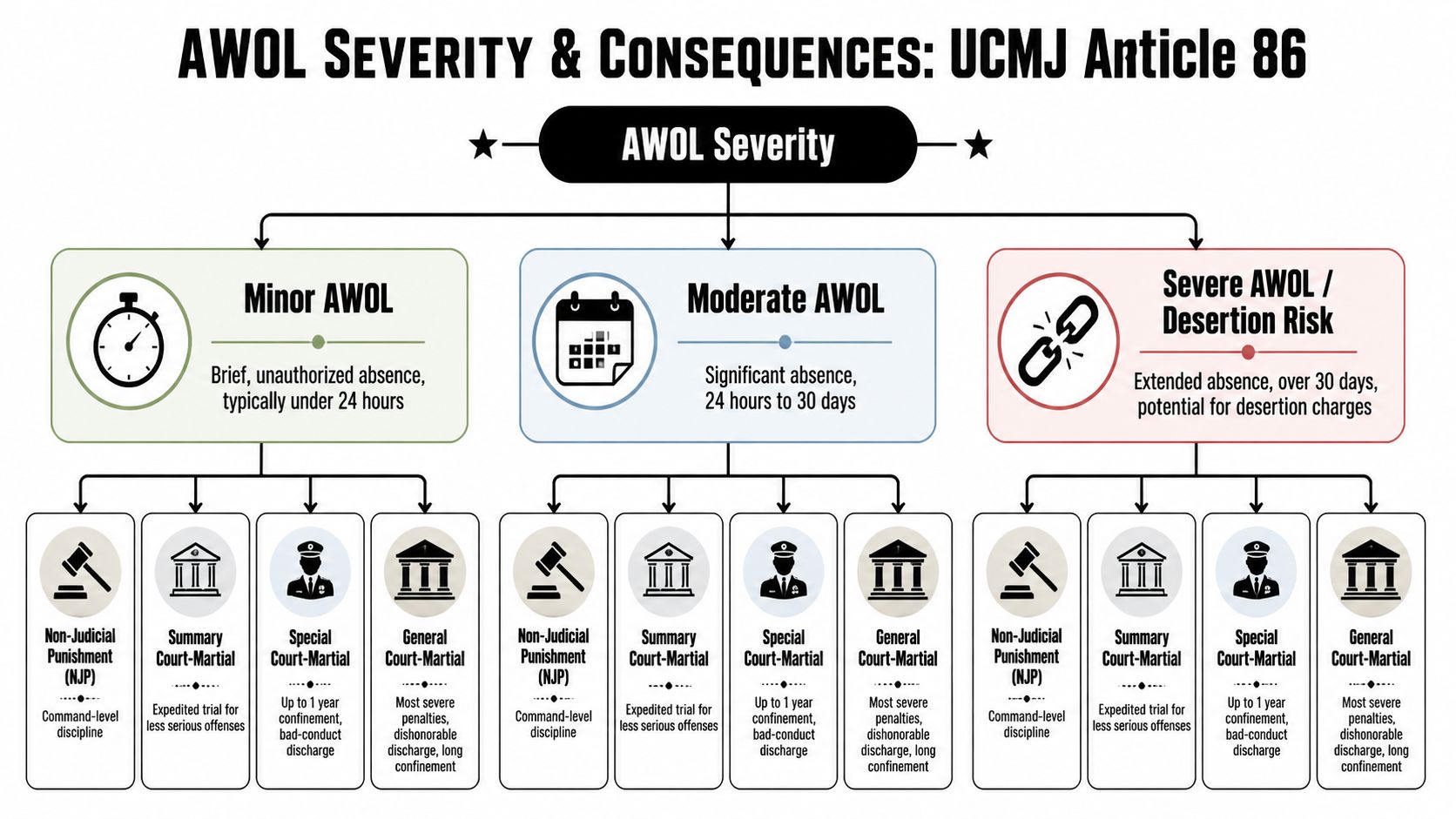
Time changes the case. It changes how aggressive your command becomes, what paperwork starts moving, what punishment they consider, and how much sympathy you are likely to get when you finally surface. Under the framework described in this Article 86 UCMJ overview, very short absences may stay at the nonjudicial level, crossing 24 hours puts you squarely in AWOL territory, and hitting 30 days can lead to dropped-from-rolls processing and reporting to civilian authorities as a deserter.
If you are away right now, do not tell yourself more time gives you better odds. It usually does the opposite.
How the command grades the absence
Commands tend to sort AWOL cases by duration first and by return method second. Those two facts drive the early strategy.
- A very short absence can still bring Article 15 or other administrative punishment.
- More than 3 days increases court-martial exposure and makes confinement a real risk.
- Approaching or passing 30 days changes the file. Now the command is often building a record for a much more serious response.
- Voluntary return usually puts you in a better position than being picked up or dragged back.
- What you say when you return can help your defense or destroy it.
That last point gets ignored far too often. Service members focus on the calendar and forget the mouth. A bad statement can do more damage than a few extra days.
What punishment can look like
The same source notes that an absence of 3 days or less can carry up to 1 month of confinement. More than 3 days and up to 30 days can raise that exposure to 6 months. Longer absences can reach 1 year, along with forfeitures, reduction in rank, and a punitive discharge in the right case.
You should read those numbers as pressure points, not automatic outcomes.
Short AWOL cases can hit hard when the member lies, ignores direct contact, or comes back with a weak story that collapses fast. I have also seen longer absences defended effectively because the service member returned the right way, stayed silent, and let counsel build the explanation instead of blurting it out in a panic.
The choices that change your legal risk
Two decisions matter more than people realize.
First, return or stay away.
Returning voluntarily usually gives your lawyer more room to work with. Staying away longer gives the command more aggravation to argue, more paperwork to stack up, and more reason to paint you as someone who quit.
Second, talk or stay silent.
Once you are back, command will want an explanation immediately. They may sound calm. They may act like they are helping. They are collecting admissions. If you are under suspicion, your words become evidence.
Here is the blunt advice. Return before the case gets worse. Then stop talking about why you left until you have legal advice.
If you want to understand how these timing and statement decisions affect the file built against you, read this guide on winning cases during the military investigation phase.
Reality check
Punishment in AWOL cases is not automatic. It turns on duration, mission impact, prior record, how you returned, what evidence the command has, and whether you handed them the case with your own statements.
Every extra day away increases pressure. Every careless word increases proof.
If you are deciding whether to keep hiding or come back, make the smart choice now. Return strategically. Return discreetly. Return with a defense plan.
The AWOL Investigation Playbook How to Challenge the Government’s Case

How the file gets built against you
Your AWOL case starts long before anyone reads you your rights. It starts with paper.
Morning reports, duty rosters, missed formations, recall logs, text messages, call attempts, supervisor notes. What looks minor on day one becomes a government file built to prove you knew where you had to be, failed to show, and stayed gone without authority.
If the absence continues, command adds dropped-from-rolls paperwork, witness statements, and a timeline built around one question: did you make a choice to stay away? By the time you return, they often already have a story drafted, and your command usually likes its own story better than yours.
A common mistake for service members is thinking, “I just need to explain.” That instinct loses cases. Explanations given too early often fill the gaps in a weak file and hand the government the missing proof.
Where experienced defense lawyers attack the case
A strong AWOL defense starts by attacking the elements, not by begging for sympathy.
Knowledge is often the first pressure point. The government may try to prove you knew exactly where you had to be through circumstantial evidence, assumptions, and sloppy unit paperwork. That creates room to fight. A sharp lawyer starts pulling that file apart during the investigation, not after command has hardened its position. This guide to winning cases during the military investigation phase explains how early intervention changes the record before it calcifies.
Look for these fracture points:
- Unit miscommunication. Written schedules, verbal instructions, and last-minute changes do not always match.
- Conflicting authority. One leader gave you permission, then someone senior denied it later.
- Broken paperwork. Dates are wrong. Signatures are missing. Message traffic tells a different story than the command summary.
- Mental health evidence. PTSD, severe depression, panic, or another serious condition can undermine the government’s claim that your absence was simple willful misconduct.
- End-date disputes. The exact moment the absence ended matters, especially if command overstates how and when you came back under control.
Mitigation and defense theory matter at this stage. If your absence grew out of duress, a dangerous command climate, a family emergency, or a genuine breakdown in communication, your lawyer needs to frame that early and frame it correctly.
The decision points that change the case
Two moments shape the file more than anything else.
First, how the absence ends. Voluntary return usually gives the defense better ground to work with because it supports a contained absence rather than a full break from service. Apprehension gives command a cleaner misconduct narrative and more confidence to push harder.
Second, what you say when contact happens. Your first statement can turn a paperwork case into a confession case.
Voluntary return changes the battlefield
Voluntary return is usually the better move, but only if you do it with discipline. Walking in alone and trying to sound honest is how service members bury themselves.
If civilian police or military authorities bring you back, command gets a stronger story. If you return through counsel, you give your lawyer a chance to control the handoff, limit pointless admissions, and preserve evidence before it disappears.
Your first statement after return can do more damage than the absence itself.
I have watched weak Article 86 cases become easy wins for the government because the service member tried to be cooperative and admitted every element. Say less. Let your lawyer decide what gets explained, when it gets explained, and to whom.
Your Options When Accused of AWOL A Step-by-Step Guide
Step 1 Stop freelancing
If you’re absent right now, stop making this up as you go. Stop texting supervisors explanations. Stop sending emotional messages. Stop asking friends in the unit to “see what command is saying.”
Write down the facts for your lawyer only. Dates. Times. Who told you what. Screenshots. Orders. Call logs. Medical issues. Family crisis. Threats. Harassment. Everything.
Step 2 Decide how to return
In most cases, returning strategically is better than staying away and hoping the problem fades. But “returning” does not mean walking in alone and giving a speech.
Use this sequence:
- Contact experienced counsel first
- Get instructions on where and how to report
- Preserve records before your phone gets searched, replaced, or wiped
- Say as little as possible on arrival
If you’re already back under command control, the advice is the same. Be respectful. Be calm. Say you want a lawyer before making any statement.
Step 3 Prepare for the first command response
The command has options. For minor situations, they may lean toward counseling or NJP. For more serious or aggravated cases, they may look at court-martial.
The process often feels chaotic from your side, but the main forks are predictable:
| Stage | What happens | What you should be thinking |
|---|---|---|
| Initial return | Command secures you and starts asking questions | Say little. Preserve your rights. |
| Fact gathering | Statements, rosters, phone logs, paperwork review | Your lawyer should shape the record early. |
| Disposition decision | Command chooses administrative action, NJP, or court-martial path | This is where mitigation and defense theory matter. |
| Formal proceedings | Article 15 or court-martial process starts | Forum choice and trial strategy become central. |
Step 4 Choose your forum carefully
If the command offers Article 15 or NJP, don’t assume accepting it is automatically smart. Sometimes it contains the damage. Sometimes it locks in a record that hurts your future and leaves defenses unused.
If the case moves toward court-martial, the sequence can include preferral of charges, an Article 32 hearing in qualifying cases, and then trial. At each stage, your focus should be the same:
- Can the government prove knowledge and lack of authority
- Can mitigation pull this downward
- Can you prevent this from turning into a career-ending record
- Did you hand the government admissions it otherwise lacked
That’s the actual roadmap. Not “be honest and hope.”
Common Mistakes That Can Destroy Your AWOL Defense
Such circumstances cause people to bury themselves.
Walking back in and confessing everything
Command is not your therapist. Your “explanation” often becomes the cleanest proof of the charge.Giving a written or recorded statement without counsel
Investigators and supervisors love memorialized admissions. You should not.Assuming a good reason automatically equals a legal defense
Family stress, depression, harassment, or burnout may matter a lot, but they must be developed strategically.Trusting command to handle it fairly on its own
Command’s job is discipline and readiness. Your protection is your lawyer’s job.Thinking a short AWOL is too small to matter
Small cases become ugly when there’s prior misconduct, bad timing, or loose talk.Deleting texts or altering your phone
That can create a brand-new problem and make you look deceptive.Letting shame keep you away longer
Delay usually helps the government more than it helps you.
The military often forgives faster than you think. It also punishes harder than you expect when you make them chase you.
Why Your Appointed Military Lawyer May Not Be Enough
A detailed defense starts with independence. That’s why many service members facing serious UCMJ exposure look closely at how to choose the right military defense lawyer.
Let me be precise. Many appointed military defense counsel work hard and care greatly. This is not personal. It is structural.
The limits you need to think about
An appointed lawyer may be carrying a heavy caseload. They may be smart but junior. They may not have spent decades trying contested military justice cases. They may not have the time, investigators, or freedom to go as hard and as early as your case needs.
A seasoned civilian military defense lawyer brings different assets:
- Independence from the command structure
- Focused court-martial experience
- The ability to act fast before the file hardens
- A broader strategic view of discharge, confinement, and collateral damage
Why this matters in AWOL cases
AWOL cases often look easy on paper. That’s exactly why they’re dangerous. Commands assume the proof is automatic. A defense lawyer who has fought these cases for years knows where the routine shortcuts are, where paperwork lies, and where command assumptions outrun actual evidence.
If your rank, benefits, liberty, or long-term record is at risk, this is not the time to settle for “good enough.”
Your Questions Answered A Military Defense Lawyer’s AWOL FAQ
Should I turn myself in if I am AWOL
In most cases, yes, but not blindly. Coordinate return through counsel if you can. Voluntary return is usually better than getting picked up, and the way you return matters.
Can AWOL become desertion automatically
No. AWOL and desertion are different offenses. Article 86 does not require the same intent issue that desertion does. Duration can increase danger, but the government still has to prove the offense it charges.
Will I go to jail for AWOL
You can. Confinement is absolutely on the table in more serious cases. Whether that happens depends on the duration, facts, aggravation, your record, and how well the case is defended.
What if I went AWOL because I was being harassed or threatened
That fact may matter a great deal. Don’t blurt it out in a panic and assume command will treat it fairly. Document it, preserve messages, identify witnesses, and let counsel decide how to present it.
Can I refuse to talk to investigators or command
Yes. You should be respectful, but you do not need to give a statement that builds the government’s case. Ask for a lawyer.
Can one AWOL incident get me kicked out
Yes. A single incident can trigger administrative separation efforts or more serious punishment, especially if command sees aggravating facts or broader misconduct concerns.
Does AWOL affect security clearance or benefits
It can. A punitive discharge or serious adverse action can create long-term fallout beyond the immediate case. That’s why short-term panic decisions can have long-term consequences.
Do I need a lawyer immediately
Yes. Early action matters more in AWOL cases than most service members realize. The strongest defense opportunities often exist before you’ve said too much and before the command settles on its theory.
If you’re facing UCMJ Article 86 – Absence Without Leave (AWOL), act now. Don’t wait for command to “see your side.” Don’t give a statement to clean this up. Don’t stay away longer because you’re ashamed.
Get experienced civilian military defense counsel involved immediately. If you’re trying to compare serious options, use this guide to choosing a military defense lawyer to identify civilian military defense lawyers and court-martial attorneys with focused military justice experience. Your career, freedom, discharge status, and future benefits may turn on what you do next.