Your phone rings. It’s your NCO, your LPO, your section chief, or your commander. The voice on the other end is clipped and angry. “Where are you? The aircraft left.” Or worse: “The ship already sailed.”
That moment hits hard. Your chest tightens. You start thinking about AWOL, desertion, handcuffs, brig time, your clearance, your family, your career. You want to explain. You want to text everyone. You want to fix it fast.
Slow down.
If you’re facing UCMJ Article 87 – Missing Movement, your first few decisions can either protect you or hand the government its case. This charge is serious. It has been federal law since August 10, 1956 under the Uniform Code of Military Justice, which governs service members and others subject to the UCMJ, not civilians, as reflected in the federal statute for Article 87.
What matters right now is strategy. Not panic. Not apologies. Not trying to charm your chain of command into mercy.
Table of Contents
- The Call You Never Want to Get You Missed Movement
- Understanding Article 87 What the Government Must Prove
- Penalties and Career-Ending Consequences
- Strategic Defense How We Dismantle an Article 87 Accusation
- The Investigation and Court-Martial Process
- Critical Mistakes That Will Destroy Your Case
- Why Your Appointed Military Lawyer Is Not Enough
- Your Immediate Action Plan and Critical Questions Answered
The Call You Never Want to Get You Missed Movement
Most Article 87 cases start the same way. A service member thought they had more time, misunderstood the report location, relied on bad gouge, got caught in a sudden mess, or froze after realizing the movement was gone. Then command starts calling.
The biggest mistake in that moment is trying to solve a criminal exposure problem like it’s a routine accountability issue. It isn’t. Once the movement leaves without you, command stops viewing this as a scheduling inconvenience. They start building a timeline.
That timeline will center on a few brutal questions:
- Who told you to be there
- When were you told
- How were you notified
- What did you do after learning the movement time
- Why weren’t you present when the ship, aircraft, or unit departed
Your instinct will be to talk. That instinct is dangerous.
Practical rule: If you think your explanation will “clear things up,” you’re probably about to give the government admissions they could never have proven on their own.
Service members damage good defenses by sending rambling texts, making panicked calls, and trying to sound cooperative. They admit they “knew something was up.” They guess at times. They exaggerate what happened because they think honesty means oversharing. Then investigators compare those statements to logs, manifests, duty records, and phone data.
You need to treat that first call as the beginning of a legal case, because that’s exactly what it is.
The first hour matters
Your job is simple.
- Stay calm: Panic produces contradictions.
- Say little: You don’t need to narrate your life to command.
- Preserve everything: Texts, screenshots, call logs, rideshare records, gate records, travel records, and medical paperwork can matter.
- Get counsel involved fast: Early intervention changes cases.
If you missed movement, this is serious. It is not automatically hopeless. But it gets much worse when you try to fix it alone.
Understanding Article 87 What the Government Must Prove
An Article 87 case rises or falls on proof. Command may talk like your absence tells the whole story. It does not. The government still has to prove each required element, and smart defense work starts by forcing them to show exactly how they intend to do it.
According to this breakdown of Article 87 elements, the government must prove four things: (1) you were required in the course of duty to move with a specific ship, aircraft, or unit, (2) you knew of the prospective movement, including its time and place, (3) you missed the movement, and (4) your absence was through design or neglect.
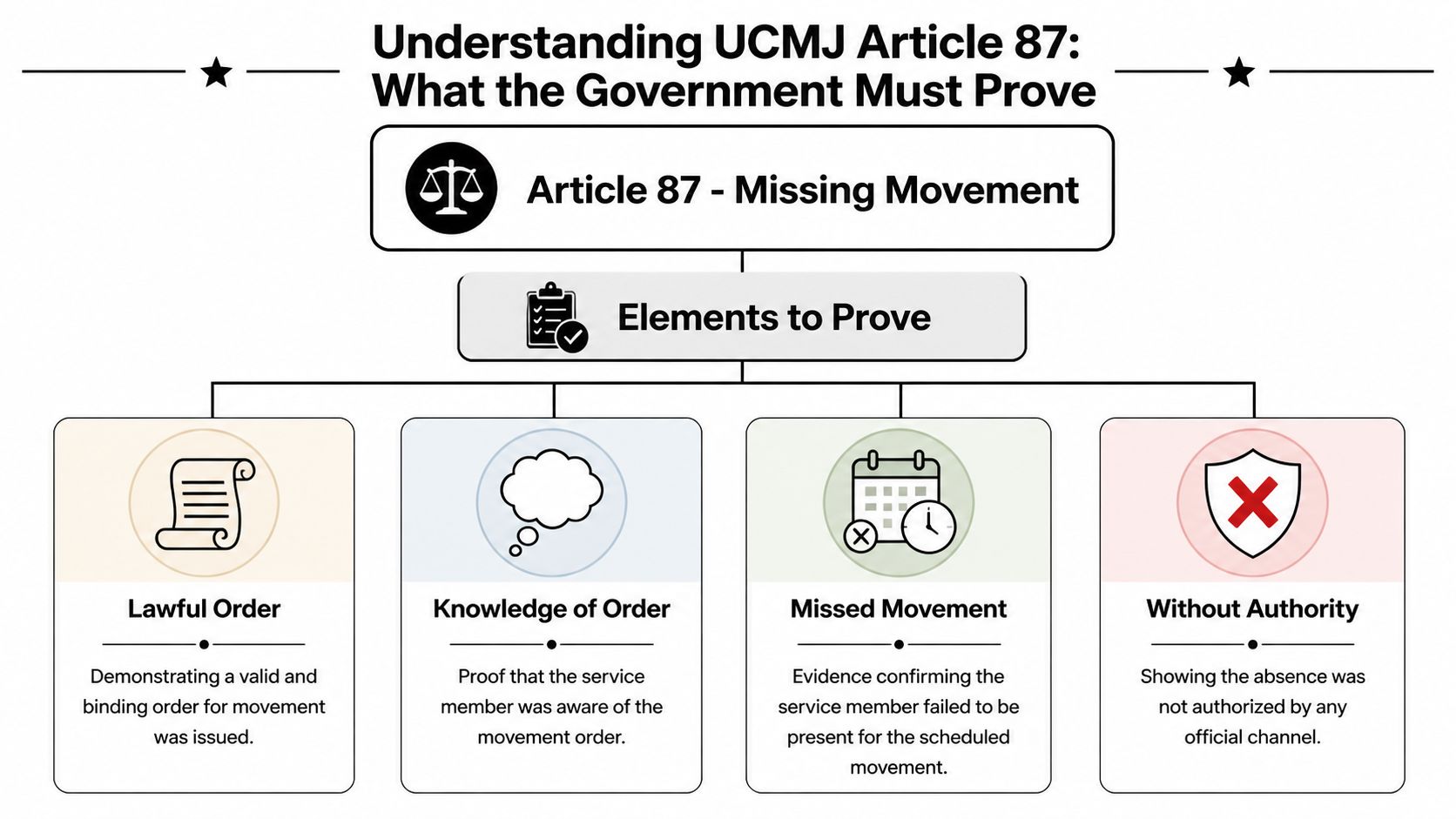
The four elements that matter
Here is the plain-English version.
| Element | What it really means | Where cases break |
|---|---|---|
| Required movement | You had a duty obligation to move with that specific ship, aircraft, or unit | Bad paperwork, wrong roster, unclear assignment |
| Knowledge | You knew the time and place of the movement | Weak notice, changed times, bad relays, conflicting instructions |
| Actual missed movement | The movement happened without you | Delay issues, reporting confusion, argument over what counts as the movement |
| Design or neglect | You either meant to miss it or failed to use due care | Intent is weak, facts suggest confusion, emergency, or poor communication |
Where the real fight is
The government usually struggles most on knowledge and intent. That is where I press first.
Knowledge sounds simple until you examine the paperwork. Who gave the order? Was the time changed? Was the change passed along clearly? Was the location specific, or was everyone relying on rumor, a group text, or a relay through three different people? If the answer is messy, the case is not clean.
“Everybody knew” is command talk, not proof. “He should have known” may support an argument about negligence, but it does not automatically prove actual knowledge of the movement time and place. That distinction matters.
The next pressure point is mental state. Article 87 separates design from neglect, and that split drives both trial strategy and punishment exposure. A design theory says you meant to miss movement. A neglect theory says you failed to act with due care. Those are very different accusations, and the government often blurs them because it wants the harsher story without doing the hard proof.
A strong defense does not argue in generalities. It attacks notice, timing, documentation, and the government’s theory of intent, piece by piece.
Do not let command collapse this into a slogan like “you missed the flight” or “you were not on the manifest.” The legal question is narrower and more useful to the defense. Were you required to move with that specific ship, aircraft, or unit? Did you know when and where? Did the movement depart without you? Can they prove design or neglect with real evidence instead of assumptions?
There is also room to fight over whether the event qualifies as the kind of movement Article 87 covers. The offense is complete only when the movement departs without the person required to be there. In some cases, the timeline, the nature of the departure, or the unit’s shifting instructions create real room for cross-examination and motion practice.
This is also where experienced counsel matters more now than many service members realize. Post-December 2023 sentencing changes add another layer of risk and strategy. If the government overcharges the mental state or inflates the facts early, that can shape the entire case unless your defense team forces precision from the start.
If command says the case is open and shut, ignore the sales pitch. Article 87 cases often look strongest before anyone demands the actual orders, manifests, phone records, notification chain, and timeline. Once we get those materials, the government’s “obvious” case often turns into a proof problem.
Penalties and Career-Ending Consequences
This charge can wreck your military future. That’s not scare tactics. That’s reality.
Why intent changes everything
Under this Article 87 punishment summary, missing movement through design can expose you to dishonorable discharge, total forfeiture of all pay and allowances, and confinement for up to 2 years. Missing movement through neglect carries bad-conduct discharge, total forfeiture of pay and allowances, and confinement for only 1 year.
That difference is enormous.
A design case tells the government’s hardest story about you. It says you intentionally avoided the movement. That supports the ugliest inferences command can push in front of a military judge or panel. Neglect is still serious, but it is not the same accusation.
So a strong defense focuses hard on anything that undercuts deliberate avoidance:
- Conflicting instructions
- Late changes
- Failure to confirm notification
- Evidence you were trying to make movement
- Anything showing confusion instead of intent
If the government wants a design conviction, make them earn it.
The sentencing framework problem
Many lawyers and almost all clients often find themselves blindsided. There was a major sentencing change effective December 27, 2023. Public writeups often mention it in passing and then move on, which is a mistake.
For cases after that date, the 2024 Manual for Courts-Martial moved to an offense-based sentencing category system. That timing question can change how a case is evaluated, negotiated, and litigated.
If your alleged offense happened around that transition, your defense team needs to know exactly which framework applies and why that alters the strategic advantage.
Here’s a short overview:
| Issue | Why it matters |
|---|---|
| Date of alleged offense | Determines which sentencing framework may apply |
| Design vs neglect theory | Changes discharge exposure and confinement exposure |
| Plea posture | Affects negotiation strategy |
| Trial strategy | Changes risk analysis from the start |
A lot of service members think sentencing is something to worry about later. Wrong. Sentencing exposure drives charging decisions, plea discussions, forum choices, and how aggressively the government pushes the case.
Before you say a word to investigators, understand the risk.
Strategic Defense How We Dismantle an Article 87 Accusation
A good defense doesn’t beg for sympathy. It attacks proof.
Article 87 cases are often won or improved by forcing the government to prove details command assumed nobody would challenge. The pressure points are usually not dramatic. They’re administrative, digital, procedural, and human. That’s where the actual work is.
Attack knowledge first
A careful defense gathers every document and every communication touching the movement.
That includes the obvious material and the overlooked material:
- Orders and amendments
- Manifest versions
- Recall rosters
- Plan of the Day or flight tasking updates
- Duty section texts
- Call logs
- Read receipts or lack of them
- Gate records, Uber records, airline records, and medical records where relevant
Knowledge is rarely as clean as command makes it sound. Times change. Locations shift. One person tells the unit one thing and another tells your section something else. Somebody assumes someone else passed the word. Then, after the movement leaves, everyone suddenly becomes certain you “knew.”
That’s not good enough.
A seasoned defense lawyer will often build a counter-timeline that asks ugly questions command doesn’t want to answer. Who gave notice? Was it direct or relayed? Was there proof of receipt? Was there a last-minute change? Did the roster even clearly show your obligation to move?
When the government’s case rests on assumptions, your lawyer’s job is to turn those assumptions into doubt.
If you want to understand what strong representation looks like in high-stakes military cases, review the criteria serious clients should use when commanding your defense with experienced military counsel.
Then attack design or reframe neglect
Once knowledge is under pressure, the intent theory often starts cracking too.
If the government alleges design, look for facts showing you were trying to report, trying to confirm, trying to travel, or acting in ways that are inconsistent with deliberate avoidance. People who intend to miss movement usually don’t leave behind evidence of frantic effort to make it.
If the facts support some failure on your part, the next move is often to push the case away from design and toward a more defensible narrative. That can affect charging, negotiations, and sentencing posture.
A strong defense theme may sound like this:
- You were told conflicting times.
- You were trying to get there.
- You did not intentionally avoid the movement.
- Command communication was sloppy.
- The government cannot prove deliberate avoidance beyond a reasonable doubt.
That is how these cases are dismantled. Not with excuses. With facts, records, and disciplined pressure on the weakest element.
The Investigation and Court-Martial Process
Once command decides this may be more than a simple accountability problem, the machine starts moving. It is not designed to protect you.
What usually happens next
The sequence often looks like this:
Initial command inquiry
Someone realizes the movement occurred without you. Supervisors begin collecting facts, often badly and quickly.Statements and records gathering
The command starts pulling rosters, manifests, orders, texts, and witness accounts. Investigators such as CID, NCIS, OSI, or CGIS may get involved depending on the facts.Charge consideration
The government evaluates whether to handle the matter administratively, with nonjudicial punishment, or by court-martial.Preferral and referral decisions
If charges are preferred, the case becomes much more dangerous. At this point, weak early statements come back to haunt people.Article 32 and litigation path
In a serious case, the Article 32 preliminary hearing can expose major flaws before trial.
For a broader orientation to the system, review these court-martial basics for service members and families.
What you should be doing at each stage
Your priorities should be disciplined and boring.
- Protect your statement: Don’t volunteer explanations.
- Preserve evidence: Save the phone, don’t wipe it, don’t “clean up” texts.
- Identify witnesses: Who gave instructions, changed times, or can confirm your efforts?
- Build your timeline: Minute by minute if necessary.
- Get counsel involved before the command frame hardens
A lot of damage happens before charges are even preferred. By the time some service members call a civilian defense lawyer, they’ve already given a written statement, consented to searches, and admitted facts that should have been challenged instead.
That is avoidable.
Critical Mistakes That Will Destroy Your Case
Most bad Article 87 outcomes start with unforced errors by the accused. Not the evidence. Not the law. The accused.

Common mistakes
Talking to investigators to “clear it up”
You are not clarifying. You are locking yourself into a version before you know the evidence.Trusting command to be neutral
Command’s job is readiness and discipline. Your interests are not their priority.Deleting messages or call logs
That makes you look guilty and can create a separate disaster.Coordinating stories with friends
Investigators love group-message stupidity. Don’t hand them consciousness-of-guilt arguments.Guessing at times and details
If you’re wrong, they call it a lie. If you hedge, they call it evasive.Assuming “I didn’t mean to” ends the case
Intent is important, but the government may still push a neglect theory.Waiting for formal charges before hiring counsel
Early action wins cases. Late action tries to contain damage.
The military rewards cooperation in many settings. A criminal investigation is not one of them.
Service members are taught to answer questions and fix problems. That conditioning hurts people in UCMJ cases. You need a defense mindset now, not a command-compliance mindset.
Why Your Appointed Military Lawyer Is Not Enough
You may get a detailed military defense counsel. That is your right, and you should use it. But in a serious Article 87 case, relying on appointed counsel alone is a gamble.
Good intentions are not enough
Most military defense lawyers work hard. That’s not the issue. The issue is structural reality.
Appointed counsel are often carrying heavy caseloads, working inside the same military system, and building experience while handling live cases. Some are excellent. Some are green. You usually won’t know which one you drew until your case is already moving.
A seasoned civilian defense attorney brings different advantages:
- Independence: Civilian counsel doesn’t answer to your chain of command.
- Singular focus: You are the client. Not the office docket.
- Outside perspective: Civilian lawyers often see command assumptions more clearly because they are not normalized by the system.
- Strategic depth: Strong civilian counsel knows how to attack proof, not just process paperwork.
If you’re weighing your options, read this guidance on how to choose the right military defense lawyer.
The smart play in a real exposure case is often a coordinated defense. Use appointed counsel. Add experienced civilian counsel. Increase pressure. Increase scrutiny. Increase your chances.
Your Immediate Action Plan and Critical Questions Answered
Your phone rings after formation. Someone from the unit asks why you were not on the aircraft, the convoy, or the ship movement. By the time that call happens, command is already building a story about what you knew, when you knew it, and whether you chose not to go. Your job now is to stop helping them prove the two hardest parts of an Article 87 case: knowledge and intent.
Start acting like every text, call log, screenshot, and statement matters. Because it does.
Your next moves
- Say nothing about the facts without counsel
- Preserve your phone, messages, email, and location data
- Write a private timeline while your memory is fresh
- Collect orders, group chats, travel records, receipts, and screenshots
- Identify every witness who can confirm what you were told and what you did
- Get experienced civilian defense counsel involved immediately
Those steps are not busywork. They are how you keep a bad case from getting worse.
The government often charges first and cleans up weaknesses later. In missing movement cases, the weak points are usually obvious if you know where to look. Did you receive clear notice of the movement? Did anyone change the reporting time or location? Were you trying to report, call, catch up, or get alternate transportation? Was the command assuming intent from a bad outcome instead of proving it with real evidence? Those are defense questions. Ask them early.
One more point that gets missed. Sentencing in military cases changed after December 2023, and that has made exposure analysis more technical than many service members realize. You need advice from someone who understands how the charged theory, forum choice, and current sentencing rules affect risk, negotiation, and trial strategy.
FAQ
Can I refuse to talk to investigators?
Yes. Use that right. A rushed explanation usually locks you into facts the government will test against your phone records and witness statements.
Should I explain everything to my commander?
No. Command is evaluating discipline and mission impact, not building your defense.
Can they really prove I knew about the movement?
Sometimes. But this is often where their case is weakest. Look hard at notice, changed instructions, conflicting communications, and whether anyone can prove you got the right information in time.
What if I was trying to make the movement?
That matters a lot. Calls, texts, ride requests, gate records, airline issues, and witness accounts can undercut an allegation that you intentionally missed movement.
Will I go to jail?
You could. The answer depends on how the case is charged, what the evidence shows about intent, and how the current sentencing rules apply.
Is missing movement the same as AWOL?
No. Missing movement is a separate offense tied to a specific unit, ship, or aircraft movement.
Do I need a lawyer before charges are preferred?
Yes. The best defense work often happens before the government locks in its theory.
If you are under investigation or already accused under UCMJ Article 87 – Missing Movement, treat the first week like the turning point. Bad statements, deleted data, and sloppy timelines wreck good defenses. Fast, disciplined case preparation puts pressure on the government where Article 87 cases are often most vulnerable.