CID, NCIS, OSI, or your command doesn’t call because they want to clear things up for your benefit. They call because they’re building a case. If someone just told you they want to talk about UCMJ Article 134, you’re probably sitting there thinking the charge sounds vague, maybe even minor. That’s exactly why it’s dangerous.
Article 134 is where the government goes when it wants room to maneuver. It is the military justice system’s catch-all. That makes it flexible for prosecutors and risky for you. A vague charge gives the government options. It also gives careless service members plenty of ways to wreck their own defense in the first day.
If you’re reading this after a phone call from your First Sergeant, commander, or an investigator who “just wants your side,” stop trying to explain anything. Stop texting about it. Stop assuming this will blow over. The decisions you make right now will shape your career, your record, and possibly your freedom.
Table of Contents
- Your World Just Turned Upside Down
- What Is UCMJ Article 134 The General Article
- Common Offenses Prosecuted Under Article 134
- Maximum Punishments and Lifelong Consequences
- How Article 134 Cases Unfold From Investigation to Trial
- Common Mistakes That Will Ruin Your Article 134 Defense
- Why An Experienced Civilian Military Lawyer Is Not Optional
- Your Immediate Next Steps and Finding Counsel
Your World Just Turned Upside Down
An NCO gets told, “CID wants to talk to you about an allegation.” An officer gets a call from the commander and hears, “Be in my office at 1400.” A spouse hears the words “general article” and assumes it must be some vague administrative issue. It isn’t.
This is the point where good people make terrible decisions. They try to sound cooperative. They figure silence looks guilty. They think if they explain enough, command will see reason. That’s how cases get handed to prosecutors on a silver platter.
Article 134 is dangerous because it sounds broad and harmless. It isn’t harmless. It gives the government room to frame conduct in the worst possible light and then argue that your behavior hurt discipline or embarrassed the armed forces. Once that narrative hardens, command starts treating you like the case is already proven.
What you need to do in the next 24 hours
Your first moves matter more than your opinions about the allegation.
- Say less: If investigators want an interview, don’t give them one.
- Ask for counsel: If they read you rights or start pushing for answers, invoke them.
- Preserve evidence: Save messages, emails, call logs, photos, and timelines.
- Stay off social media: Don’t post. Don’t hint. Don’t vent.
- Stop discussing the case: Not with friends, not with coworkers, not in the barracks.
Practical rule: The first battle in an Article 134 case is keeping the government from turning your own words into its strongest exhibit.
You’re not dealing with a neutral process. You’re dealing with a machine built to investigate, accuse, and close ranks around the command’s interests. Your job now is simple. Protect yourself before you try to explain yourself.
What Is UCMJ Article 134 The General Article
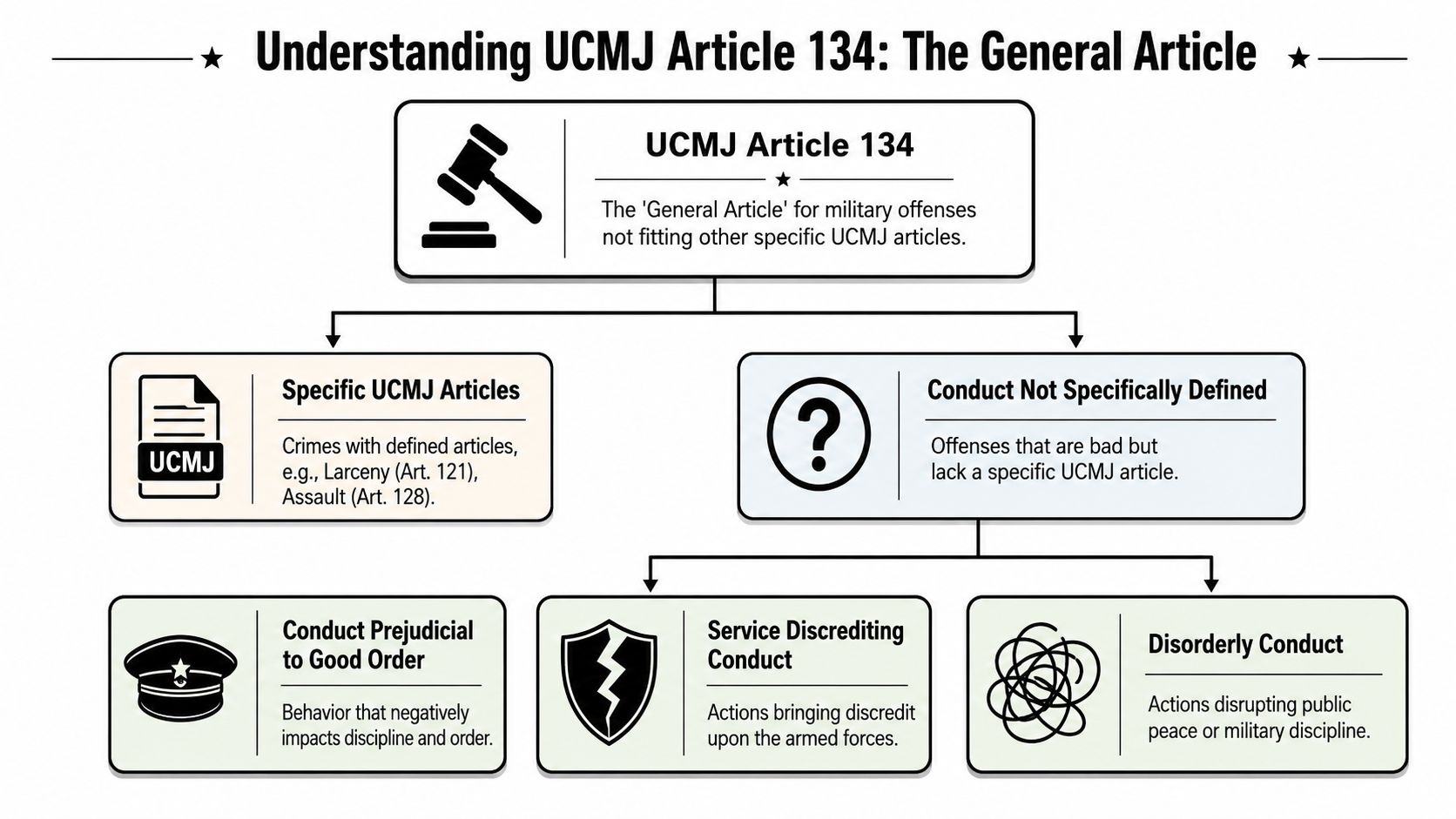
Article 134 is the military’s junk drawer for misconduct that doesn’t fit neatly into a more specific punitive article. That’s not my metaphor alone. It functions exactly that way in practice. According to this explanation of Article 134 and its three clauses, Article 134 functions as the “General Article,” covers 54 distinct non-capital criminal offenses not explicitly covered elsewhere, and is built around three jurisdictional clauses.
Why prosecutors like this charge
In plain English, Article 134 reaches three buckets of conduct:
| Clause | What it means in real life |
|---|---|
| Good order and discipline | The government says your conduct hurt the functioning or discipline of the unit |
| Service discrediting conduct | The government says your behavior made the armed forces look bad |
| Non-capital federal crimes | The government uses Article 134 to pull in certain federal offenses not otherwise listed |
That broad reach is why prosecutors lean on Article 134 when another charge is weak, unavailable, or harder to prove. They can shape the allegation around context, perception, and command climate. In weaker cases, it becomes the backup plan. In overcharged cases, it becomes the shortcut.
That overcharging matters. A prosecutor may treat Article 134 like a safety net when the facts don’t cleanly support a more specific offense. An experienced defense lawyer attacks that choice early. Sometimes the charge is bloated. Sometimes it’s legally mismatched. Sometimes the government is trying to make bad facts sound criminal.
The terminal element is the real fight
Here is the central battleground in almost every serious UCMJ Article 134 case. The government cannot just prove that something happened. It must prove the terminal element.
That means the prosecution has to show the conduct was prejudicial to good order and discipline or brought discredit upon the armed forces. And not in some vague, distant, speculative way. The same source above explains that the government must prove the conduct was directly and palpably prejudicial or discrediting, not indirectly or remotely.
The terminal element is where many Article 134 cases live or die. If the government can’t connect your conduct to real military harm, the charge is vulnerable.
At this stage, seasoned military defense lawyers press hard. Who knew about the conduct? What unit impact can the government prove? Was there real disruption, or just command disapproval? Did anyone’s performance change? Was the alleged embarrassment public, or is the government just assuming bad optics?
Those are not academic questions. They are trial questions. And they often expose that the government has a story, not proof.
Common Offenses Prosecuted Under Article 134
Article 134 isn’t one offense. It’s a container holding many different theories. According to this list of Article 134 offenses, the General Article expressly criminalizes 54 distinct offenses, ranging from animal abuse and kidnapping to carrying a concealed weapon.
Most service members I talk to aren’t facing something that exotic. They’re usually facing a smaller group of allegations where context drives everything.
Extramarital sexual conduct
This is one of the most misunderstood Article 134 charges. People still call it adultery, but the strategic issue hasn’t changed. The government doesn’t win just by proving a relationship happened.
According to this overview of adultery and Article 134, to substantiate the charge the government must prove that at least one party was married to someone else and the extramarital conduct was detrimental to the military’s reputation. That is supposed to be about actual harm to organizational integrity, not mere moral disapproval.
There are also narrow defenses that matter. The earlier source discussing extramarital sexual conduct explains that the government must prove the accused wrongfully engaged in the conduct while knowing one or both parties were married, and it notes defenses including mistake of fact about unmarried status and, since the 2019 Manual for Courts-Martial revision, legal separation by court order. That changes how these cases should be defended.
A common scenario looks like this: two adults have a private relationship, somebody in the unit learns about it, and command reacts as if private conduct automatically equals criminal conduct. It doesn’t. The terminal element still has to be proven.
Fraternization and relationship cases
Fraternization cases often arrive wrapped in command outrage and thin evidence. The government wants to paint an “unduly familiar” relationship as a threat to the chain of command. Sometimes that claim is real. Sometimes it’s inflated.
The defense focus is usually narrow and practical:
- What was the actual relationship: rumor, friendship, dating, sexual conduct, or assumption?
- Who can prove it: firsthand witnesses or gossip spread through the unit?
- What was the actual effect: favoritism, compromised authority, or just awkward optics?
If you’re facing that allegation, read this guide on Article 134 fraternization defense. Then stop talking about the relationship to anyone who isn’t your lawyer.
Indecent conduct and threat allegations
Indecent conduct under Article 134 is a prosecutor’s favorite when they want to frame behavior as offensive and corrosive. That makes it a credibility fight. Facts get exaggerated fast. So do assumptions about intent.
Communicating a threat cases can be just as messy. Was it a real threat, sarcasm, drunk venting, or a quote taken out of context? The words matter. The surrounding facts matter more. The witness’s memory matters most.
In Article 134 cases, the government often sells the emotion first and fills in the proof later.
That’s why these charges demand a defense built around context, witness bias, incomplete texts, missing messages, and the gap between what sounds bad in a report and what can be proven in court.
Maximum Punishments and Lifelong Consequences
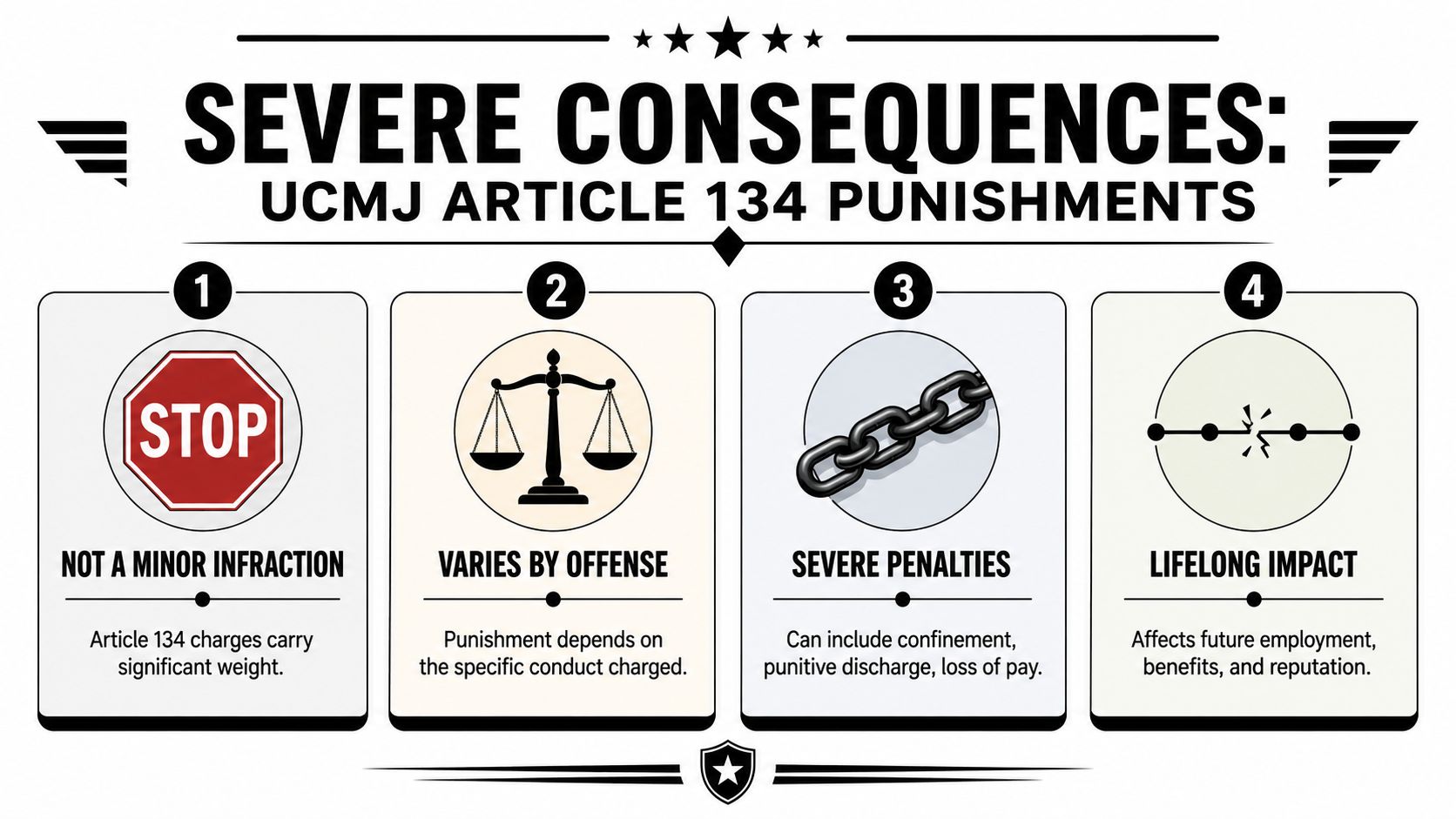
Too many service members hear “Article 134” and assume they’re dealing with a slap on the wrist. That’s a rookie mistake. Some Article 134 specifications carry punishments that can dismantle your life.
What punishment looks like on paper
For indecent conduct, the maximum punishment is severe. According to this breakdown of Article 134 indecent conduct penalties, the maximum punishment includes a dishonorable discharge, confinement for up to five years, and total forfeiture of all pay and allowances.
For extramarital sexual conduct, the earlier Article 134 source notes that the maximum punishment can include a dishonorable discharge, total forfeiture of pay and allowances, and confinement up to one year. The same source notes that punishments vary by specification, which is exactly why charging decisions matter so much.
Here’s the point. Prosecutors don’t just charge conduct. They choose a charging theory that sets the punishment ceiling and shapes plea pressure from day one.
What punishment does to your life
A punitive discharge is not some paperwork inconvenience. A dishonorable discharge is a federal criminal judgment from a court-martial. That follows you.
The consequences usually hit in layers:
- Career loss: promotion potential disappears, assignments collapse, and reenlistment is finished
- Financial damage: pay, allowances, and future earning power take a direct hit
- Reputation damage: your name gets tied to a criminal case, not just a command issue
- Post-service harm: jobs, licenses, security clearance issues, and background checks become much harder
If you’re underestimating the risk because the allegation sounds personal, embarrassing, or “not that serious,” you’re helping the government. The label may sound broad. The consequences are concrete.
How Article 134 Cases Unfold From Investigation to Trial
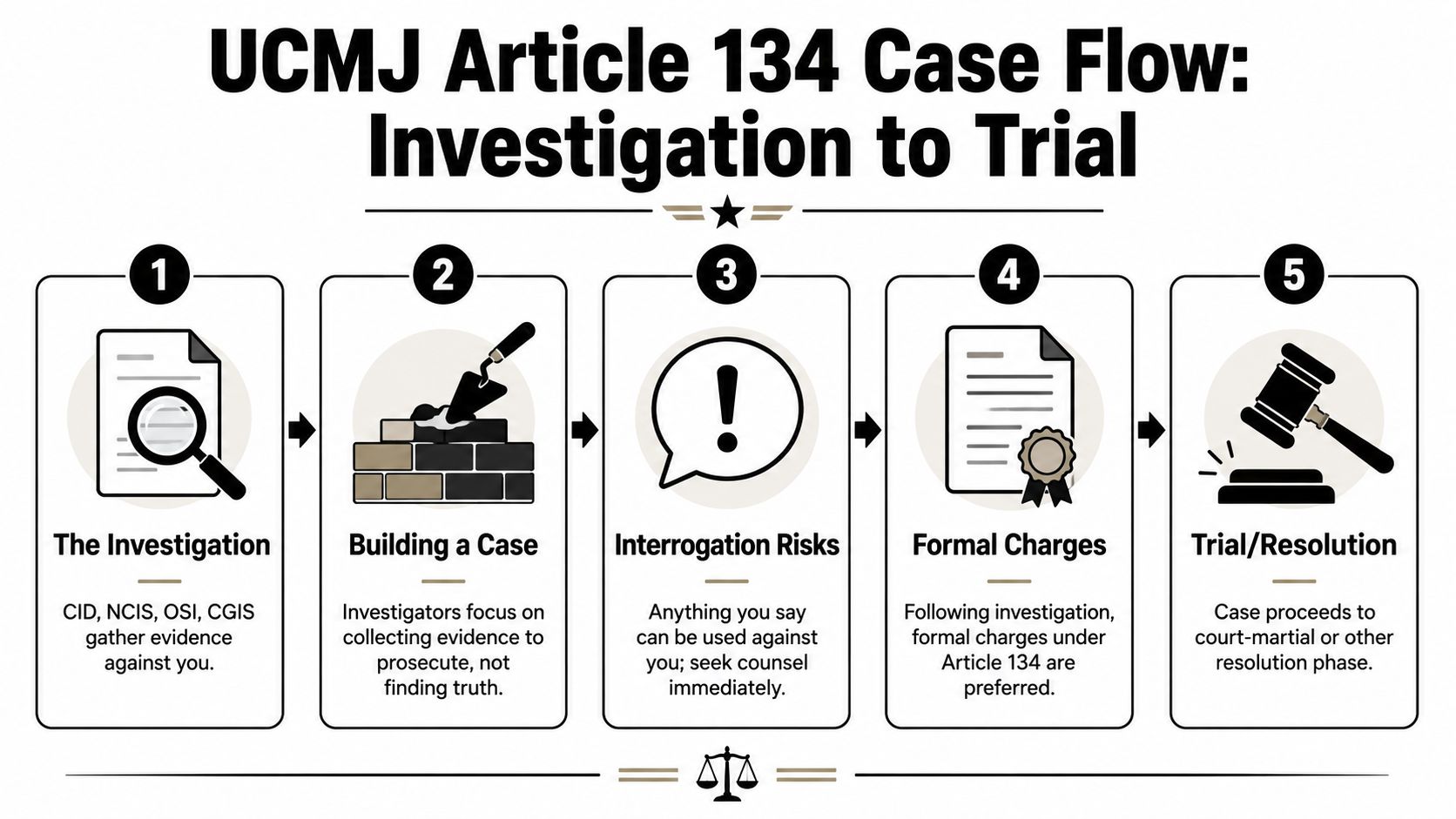
The process matters because each stage gives the government another chance to lock you into a bad position. Most damage happens early, before a service member understands what’s really happening.
The five stages that matter
Investigation
CID, NCIS, OSI, or CGIS starts gathering statements, messages, digital records, and witness accounts. Their mission is to build a prosecutable case. If you’re being questioned, you need to understand your rights under Article 31 of the UCMJ.Preferral of charges
This is when the allegation turns formal. The command signs off on charges and the case moves from rumor to machinery.Article 32 hearing
In a general court-martial track, this hearing tests probable cause and gives the defense a valuable chance to expose weaknesses. A prepared court-martial attorney can use it to challenge witness reliability early.Referral to court-martial
If the case survives, it gets referred for trial. At that point, the pressure rises. So do the stakes.Motions and trial strategy
Experienced military defense lawyers earn their keep by challenging weak specifications, attacking the terminal element, moving to suppress bad evidence, and forcing the prosecution to prove what it assumed.
A scared service member usually thinks the key moment is trial. It isn’t. Trial is where the damage shows up. The key moment is the first contact with investigators.
If you wait until charges are preferred to get serious, you’re starting late and uphill.
Common Mistakes That Will Ruin Your Article 134 Defense
Panic causes predictable mistakes. The same ones come up over and over. They don’t just hurt your case. They give the government an advantage.
Mistakes that come up over and over
Talking to investigators
You won’t outsmart a trained interrogation plan. You will fill gaps in their timeline, explain away facts they couldn’t otherwise prove, or give them inconsistent details to use later.Trusting command to be fair
Command cares about the unit first. That’s not personal. That’s the system. Once legal advice starts flowing to command, your interests are not the priority.Thinking Article 134 is too vague to stick
Vagueness doesn’t protect you. It gives prosecutors room to shape the case around whatever story sounds most damaging.Believing “there’s no evidence”
You don’t know what they have. You also don’t know what they think they can build out of partial texts, screenshots, hearsay, or one motivated witness.Waiting to hire counsel
Delay is expensive. Early intervention can shape interviews, preserve defense evidence, and sometimes stop a bad case from maturing.Texting friends about the allegation
Those texts are evidence. So are “private” messages, deleted threads, and half-joking comments.Trying to contact the accuser or witnesses
That can be painted as pressure, retaliation, or consciousness of guilt.
The right move is boring and disciplined. Shut up. Save evidence. Get a lawyer. Follow strategy.
Why An Experienced Civilian Military Lawyer Is Not Optional
When you’re facing Article 134, you need more than a warm body with a law license. You need an independent trial lawyer who knows how prosecutors overuse catch-all charges and how to dismantle them.

Independence changes the fight
Your appointed military defense counsel may be hardworking and sincere. Many are. But they are often overloaded, relatively early in their careers, and operating inside the same institution that is prosecuting you.
A civilian UCMJ lawyer brings something different:
- Independence: no command relationship, no institutional pressure
- Focus: your case is not one of many command-assigned files
- Strategic bluntness: an outside lawyer can tell you exactly how bad things are and how to fight back
If you’re comparing options, review civilian court-martial defense lawyers before you make a decision based only on convenience.
Trial experience matters most in vague charges
Article 134 cases are often won or lost on framing, cross-examination, and the ability to expose weak assumptions. That’s not entry-level work. That’s trial work.
A strong civilian military defense lawyer looks for things prosecutors hope nobody notices:
- charging theories that stretch beyond the facts
- witnesses who “heard about it” instead of seeing it
- gaps in phone data, message chains, or command knowledge
- terminal element arguments based on speculation rather than proof
This video gives a useful look at what serious military defense representation should feel like:
You’re not hiring confidence. You’re hiring judgment, independence, and courtroom force.
Your Immediate Next Steps and Finding Counsel
If you’re under investigation, your situation is already active. You don’t need more reassurance. You need answers and a plan.
Fast answers to the questions you’re asking right now
Can I be charged under Article 134 for violating a regulation?
Yes, if the government claims the conduct also hurt good order and discipline or brought discredit on the service. That still doesn’t relieve prosecutors of proving the terminal element.
Can private, off-base conduct still lead to charges?
Yes. Military jurisdiction doesn’t stop at the gate. Private conduct can still become a case if the government argues it affected the service.
If I’m legally separated, am I safe from an extramarital conduct charge?
Not automatically. As noted earlier, legal separation by court order became an important defense under the 2019 Manual for Courts-Martial revision, but a defense only helps if it is raised correctly and supported with the right evidence.
FAQ
Can I refuse to talk to CID, NCIS, or OSI?
Yes. You should invoke your rights and ask for counsel.
Will I go to jail for an Article 134 charge?
Possibly. It depends on the specification charged and how the case is resolved.
Is Article 134 only for serious crimes?
No. That’s part of the danger. It reaches a wide range of conduct, and prosecutors can use it aggressively.
Can command just “handle this discreetly”?
Sometimes a case resolves short of trial, but you should never rely on informal assurances.
Do I need a lawyer immediately?
Yes. Early action gives your defense the best chance to shape the outcome.
What matters most in an Article 134 case?
Usually the evidence, witness credibility, and whether the government can prove the terminal element.
If you are under investigation for UCMJ Article 134, do not wait for things to get worse. Do not agree to “just answer a few questions.” Do not assume command will protect you. Your career is on the line, your freedom may be on the line, and the record you build in the next few days will follow you.
Start calling qualified military defense lawyers now. Compare strategy, experience, and trial background. If you need a place to begin, use this guide to choosing a military defense lawyer to identify experienced civilian court-martial attorneys and set consultations immediately. Early action wins cases. Delay loses them.