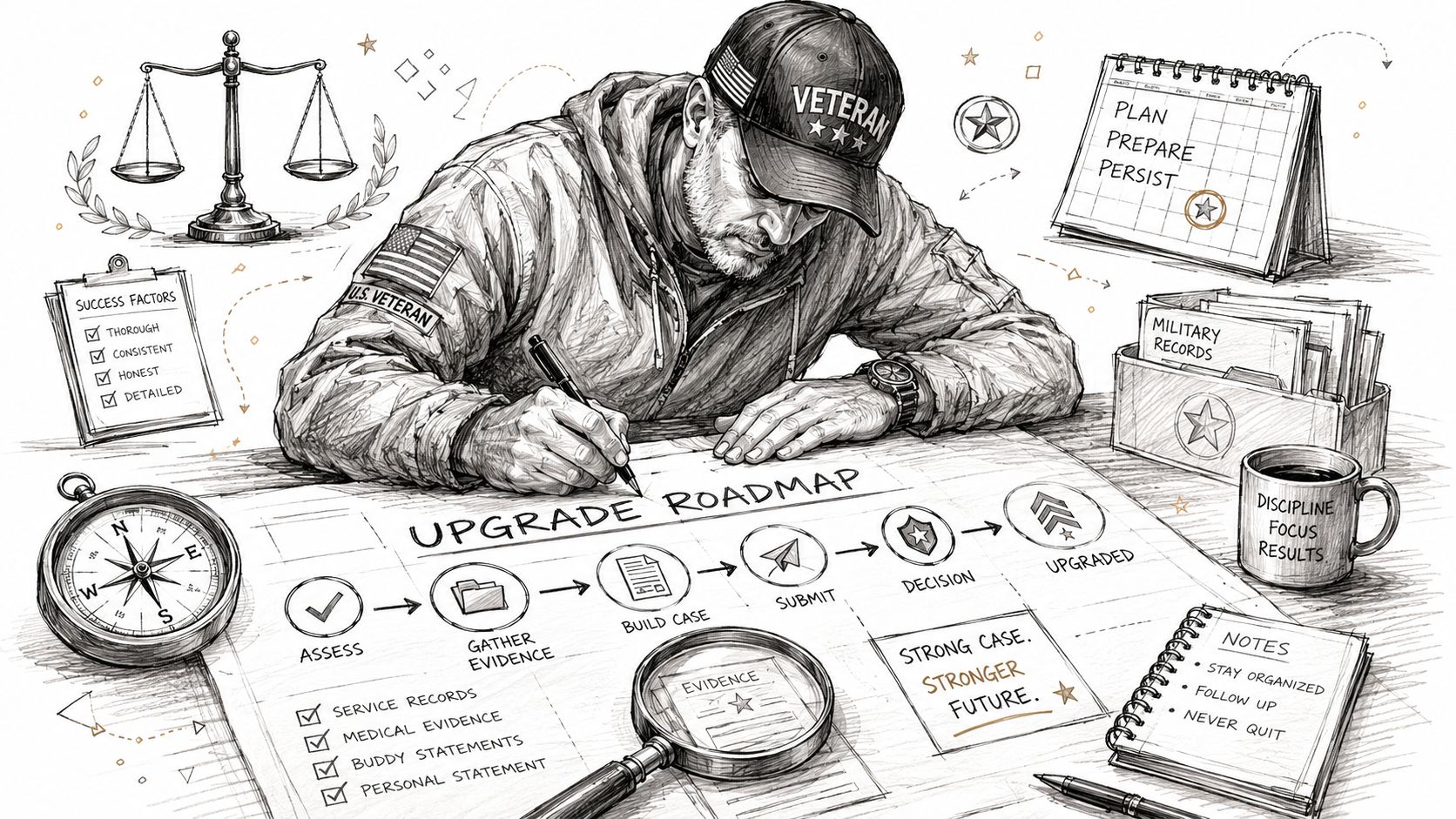
You’re probably reading this because your General (Under Honorable Conditions) discharge keeps showing up like a locked gate. You apply for benefits and hit friction. You explain your service to an employer and feel the room change. You know your record doesn’t tell the full story, and you’re tired of being judged by paperwork drafted at the worst point in your military life.
Good. Hold on to that anger, because a general discharge upgrade is not won by politely mailing forms and hoping strangers do the right thing. It’s won by building a record so organized, so credible, and so hard to ignore that the board has a practical reason to grant relief. This is strategic warfare on paper. That’s how you need to treat it.
If you want results, ask two questions first. Which board has authority over your case? And what evidence forces that board to act? Most veterans waste months on the wrong question. They argue feelings instead of proof, submit thin packets, and trust a broken narrative to fix itself. It won’t.
Table of Contents
- Your General Discharge Is a Wall Not a Dead End
- The Two Battlefields DRB vs BCMR
- Building Your Arsenal of Evidence
- Crafting the Winning Argument Inequity vs Impropriety
- Common Blunders That Will Sink Your Case
- Why a Civilian Defense Attorney Is Not a Luxury
- General Discharge Upgrade FAQ
Your General Discharge Is a Wall Not a Dead End
A General discharge doesn’t just sit on a DD-214. It follows you into jobs, benefits fights, school applications, and every moment where someone else gets to decide what your service meant. That’s why veterans get furious about it, and they should. A paper decision made by command at the end of your service can shape the next chapter of your life long after you’ve taken the uniform off.
But here’s the part too many people miss. A General discharge is a position taken by the government, not holy scripture. Boards reverse those positions when the applicant presents a disciplined, evidence-backed case that exposes unfairness, error, or both. If your first instinct is to explain yourself in a heartfelt letter and attach a few certificates, that’s not a strategy. That’s wishful thinking.
What you should be asking right now
Start with these questions:
- Was the discharge process flawed? Missing notice, weak documentation, ignored mitigation, procedural shortcuts, or command sloppiness can matter.
- Was the outcome too harsh? Good service, limited misconduct, mental health factors, immaturity, trauma, or strong post-service rehabilitation can shift the board’s view.
- What documents prove your version? Not your opinion. Not your frustration. Proof.
- Which forum can grant the relief you want? Filing in the wrong place wastes time and credibility.
Practical rule: Don’t approach a general discharge upgrade like customer service. Approach it like contested litigation conducted on paper.
There’s also a bigger point. Veterans often compare their case to others and spiral. Stop doing that. Your case rises or falls on the record you build, the errors you identify, and the credibility of the story you tell with documents, not excuses.
If you’re also trying to understand how discharge status can affect benefits and longer-term options, this guide on other than honorable discharge benefits helps frame the stakes. Even if your discharge is different, the same hard truth applies. Characterization matters, and fixing it can change your future.
What winning actually looks like
Winning isn’t always dramatic. Sometimes it means an upgraded characterization. Sometimes it means a corrected narrative reason, a cleaner record, or a better foundation for benefits and employment. The board doesn’t need to love your case. It needs a solid legal and factual basis to grant relief.
That is your job. Or, better yet, your lawyer’s.
The Two Battlefields DRB vs BCMR
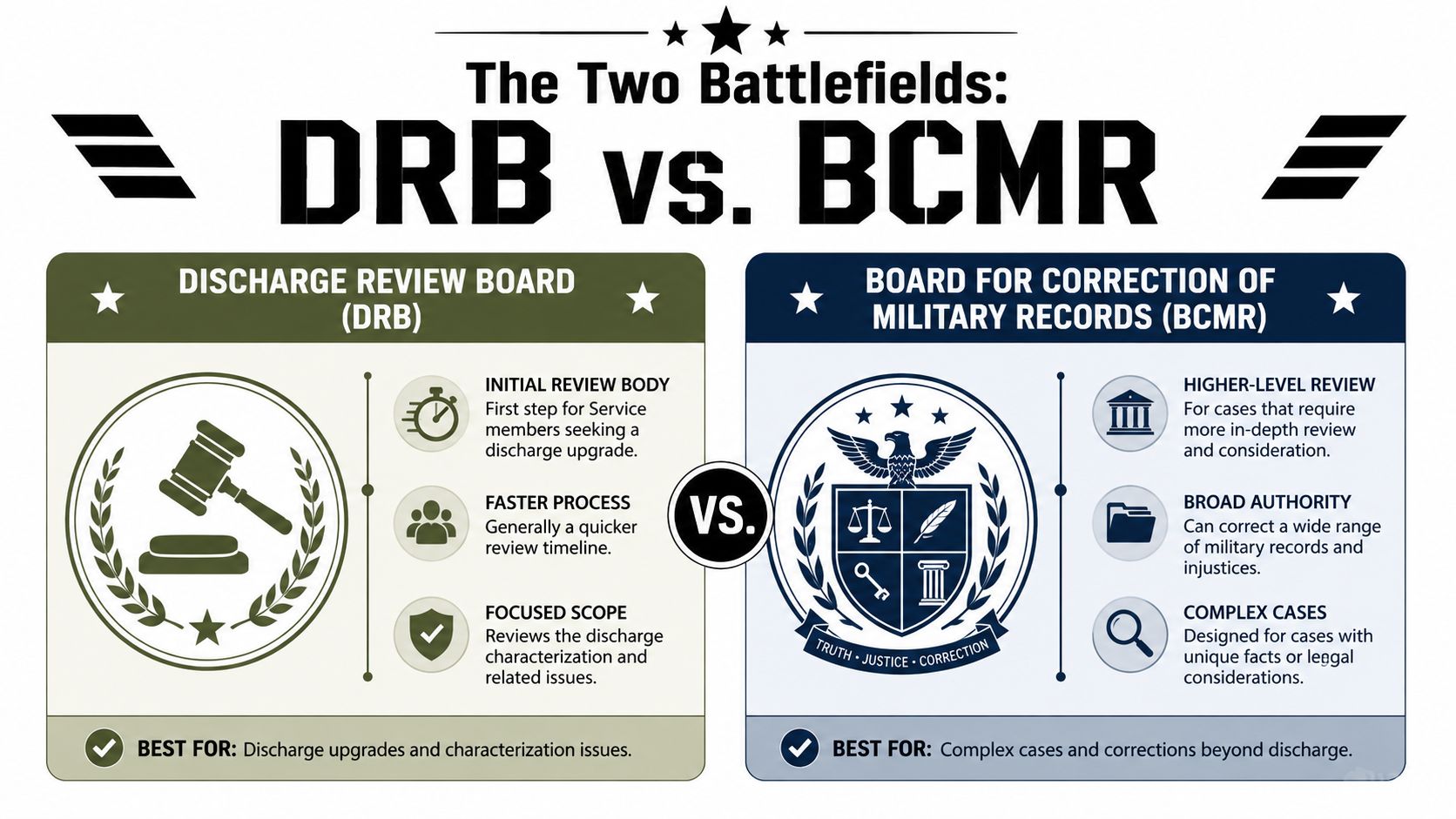
The first major mistake veterans make is assuming all military review boards do the same thing. They don’t. The Discharge Review Board, or DRB, and the Board for Correction of Military Records, or BCMR, are different battlefields with different rules, different authority, and different strategic value.
The first decision is jurisdiction
This part is not optional. The DRB has a strict, non-waivable 15-year statute of limitations from the date of discharge to accept an application for a discharge upgrade. If you were discharged more than 15 years ago, you must file with the BCMR instead, as explained in this guide to the military discharge upgrade process.
That deadline is a bright line. Not flexible. Not forgiving.
Here’s the short version:
| Board | Best used for | Key limit |
|---|---|---|
| DRB | More direct discharge upgrade review | Must be filed within 15 years of discharge |
| BCMR | Older cases and broader record correction issues | Used when DRB is unavailable or insufficient |
If you miss that DRB window, you don’t argue your way around it. You pivot to the BCMR and build accordingly.
What each board is really doing
The DRB is often the first-stop forum for discharge upgrade cases. In practical terms, it’s reviewing whether the characterization and reason for separation should stand. That makes it a targeted battlefield. You’re attacking the discharge itself.
The BCMR is broader. It can address deeper record issues and more complex correction requests. That sounds attractive, and sometimes it is, but broader authority usually means you need a tighter presentation, cleaner legal framing, and a stronger documentary record.
File in the wrong forum and you’ve already told the government you don’t understand your own case.
That’s why veterans should not treat board selection as clerical work. It’s strategic positioning. The right venue shapes the argument, the evidence, and the relief you request.
For service-specific discharge problems, this overview of Army administrative discharge issues is useful because it shows how separation decisions are built in the first place. You can’t dismantle the machine if you don’t understand what the machine used against you.
The smart comparison
Don’t ask which board is “better.” Ask which board gives you the cleanest line of attack.
- Choose the DRB if you’re within the filing window and your case is centered on the discharge characterization itself.
- Choose the BCMR if the DRB is closed to you by time, or if the case requires broader correction of the military record.
- Build for the board you have, not the one you wish you had. That means using the language, proof, and relief requests that match the forum.
Veterans lose cases because they think the board will sort out their theory for them. It won’t. You must walk in with a map.
Building Your Arsenal of Evidence
A board won’t upgrade your discharge because you’re sincere. It won’t do it because your family knows you’re a good person. It won’t do it because enough time has passed. It acts when the file in front of it shows a grounded, documented reason to change the record.
That means your general discharge upgrade packet needs to look less like a stack of papers and more like a trial notebook.
Start with the official file and hunt for gaps
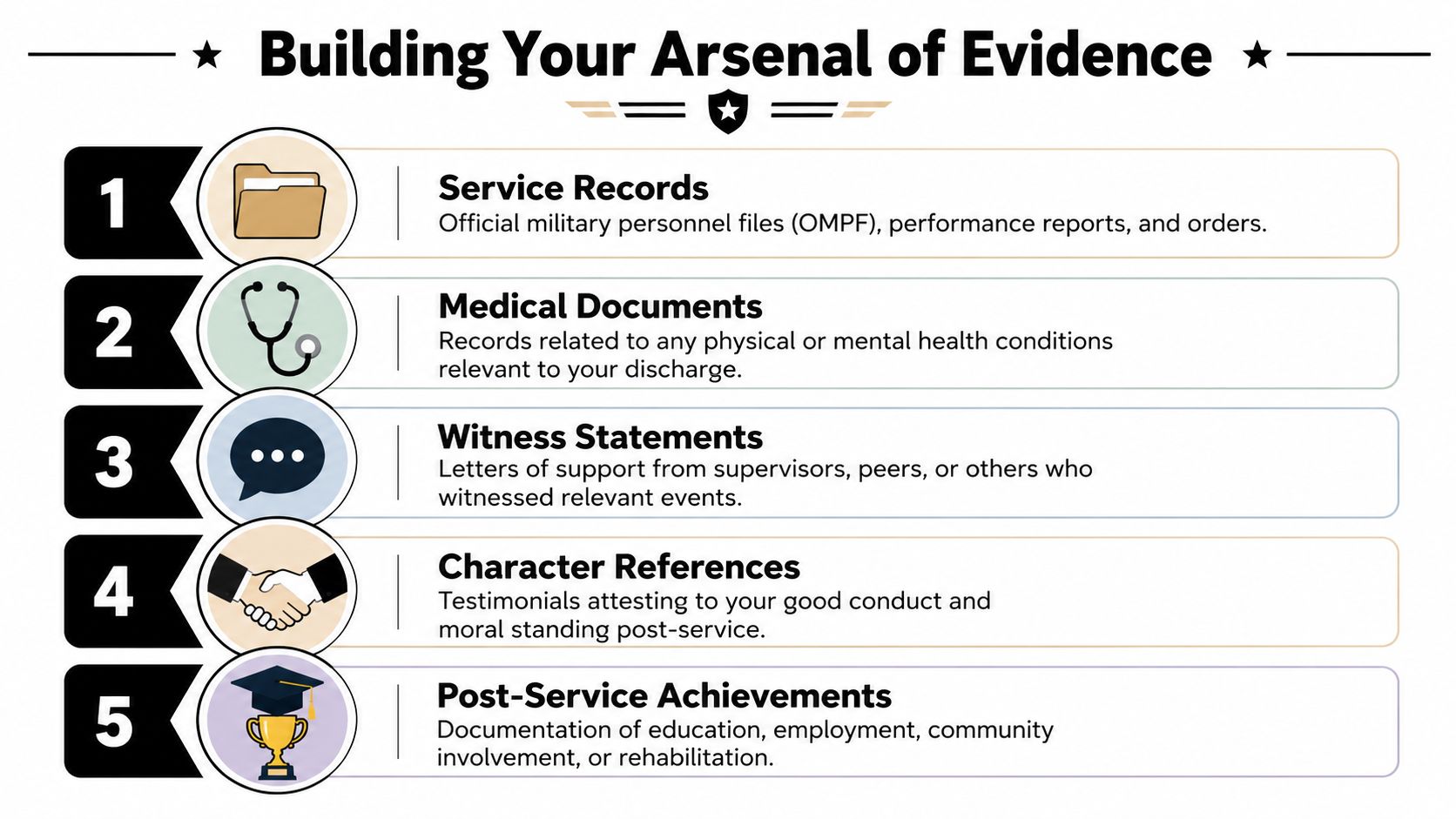
You need the official record first. That includes your DD-214, separation packet if available, counseling statements, evaluations, awards, medical records, and any disciplinary paperwork tied to the discharge. If you’re filing with the DRB, the application is typically made on DD Form 293. If you’re going to the BCMR, the application is typically made on DD Form 149.
Forms matter, but they are not your case. They are the envelope.
What matters is whether the underlying file shows cracks. Missing signatures. Thin justification. Contradictions between performance history and the final characterization. A command memo that overreaches. A medical issue that nobody addressed. A timeline that doesn’t add up.
Use this evidence sweep:
- Service records that show strong duty performance, deployments, schools, qualifications, positive evaluations, awards, and command trust.
- Disciplinary documents so you can test whether the misconduct narrative was exaggerated, unsupported, or detached from context.
- Separation paperwork to identify notice problems, procedural defects, and weak command reasoning.
- Medical and behavioral health records that may explain what command ignored.
- Prior statements you made because inconsistency will hurt you if your new submission contradicts the old record.
Build the rehabilitation record the board can trust
Boards care about what happened in service. They also care whether your current life confirms that the discharge no longer reflects who you are. Often, many applicants sabotage themselves. They submit glowing letters from friends who barely say anything useful.
Don’t collect praise. Collect evidence with a purpose.
Good support materials include:
- Employer letters that describe reliability, leadership, attendance, trust, and responsibility.
- Education records showing degrees, certifications, training, or sustained academic effort.
- Community involvement such as volunteer work, mentorship, coaching, or faith-based service.
- Rehabilitation evidence if substance use, anger, or instability played a role in the original discharge.
- Character statements from people who know the facts and can speak with detail, not vague admiration.
The best letters don’t say you’re “a great guy.” They describe conduct, consistency, and change in concrete terms.
Medical evidence changes weak cases into real cases
If trauma, mental health symptoms, head injury, substance dependence, or severe personal stress contributed to what happened, medical evidence can become the backbone of the case. But the board needs more than a diagnosis floating in isolation. It needs a coherent connection between the condition, the timing, the behavior, and the discharge.
That connection often comes from records, treatment history, and expert opinions that explain cause and effect in plain English.
Evidence checklist that actually wins cases
| Evidence type | Why it matters |
|---|---|
| Personnel records | Shows service quality and whether the discharge fits the full career picture |
| Medical documentation | Supports mitigation and explains conduct in context |
| Witness statements | Confirms facts command may have ignored or distorted |
| Post-service records | Proves rehabilitation, maturity, and credibility |
| Legal brief | Organizes everything into a theory the board can adopt |
A strong submission doesn’t drown the board in paper. It controls the board’s attention. Every exhibit should answer a question, fix a weakness, or prove a point. If a document doesn’t help you do that, it may not belong in the packet.
Crafting the Winning Argument Inequity vs Impropriety
Veterans must adopt an advocate’s mindset, or they risk losing the case prematurely. You need a legal theory. In most discharge cases, that theory is built on impropriety, inequity, or both.

Impropriety attacks the legality of the discharge
Impropriety means the discharge was wrong because the process or basis was defective. Maybe command ignored required procedures. Maybe the packet relied on bad information. Maybe you weren’t given the process due to you. Maybe the stated reason for discharge doesn’t match the evidence.
This is a surgical argument. You are not asking for mercy. You are showing the board that the original action should never have stood in its current form.
Look for issues like these:
- Regulatory violations
- Missing or inadequate notice
- Unsupported factual findings
- Failure to consider required evidence
- Procedural shortcuts that prejudiced the outcome
A good impropriety claim reads like a controlled demolition. You identify the exact defect, tie it to the record, and show why the board should no longer trust the discharge.
Inequity attacks the fairness of the result
Inequity is different. You’re arguing that even if the process was technically valid, the outcome was too harsh, too one-sided, or no longer fair when viewed in full context. In this context, strong service history, youth, trauma, mental health, family crisis, and post-service rehabilitation carry real force.
That does not mean writing a sympathy letter. It means proving that the characterization no longer matches the total record.
A board is far more likely to help you when your evidence shows growth, accountability, and context without self-pity.
Here’s what that looks like in practice. A service member with a strong record has a short period of misconduct tied to untreated mental health symptoms and a collapsing home situation. Command pushes the discharge through with a narrow snapshot of the worst weeks in the file. Years later, the veteran has stable employment, treatment records, educational progress, and credible support statements. That is not a guarantee of relief. But it is a real inequity argument if it is framed correctly.
This short video captures the difference between telling your story and structuring it for a board to act on it:
The strongest cases often combine both theories. The process was flawed, and the result was unfair. That is where experienced military defense lawyers and court-martial attorneys earn their keep. They don’t just gather exhibits. They build a reasoned attack.
Common Blunders That Will Sink Your Case
Most denied applications are not tragic mysteries. They fail for predictable reasons. Veterans rush, guess, minimize problems, or file a packet that reads like an apology letter instead of a disciplined legal submission.
Mistakes that come up over and over
Here are the blunders that wreck otherwise winnable cases:
- Missing the board deadline. If you’re outside the DRB filing window, that forum is gone. A veteran discharged more than 15 years ago must proceed through the BCMR, not the DRB, as covered earlier.
- Submitting a weak personal statement. A rambling letter full of anger, blame, and unsupported claims tells the board you haven’t done the work.
- Ignoring bad facts. If misconduct happened, deal with it directly. Don’t pretend the board won’t see what’s already in the record.
- Failing to show post-service conduct. The board wants proof that the current record is inaccurate, unfair, or outdated. Silence on your life after service hurts.
- Leaving medical issues vague. If health or trauma mattered, document it. Don’t hint at it and expect the board to fill in the gaps.
- Treating the packet like a form submission. The form opens the file. The evidence and argument win the case.
- Trying to do lawyer-level work without counsel. This process looks simple until you realize every sentence in your packet can help or hurt.
Delay is not neutral
Time matters for another reason. Even when you file a solid case, the process is not fast. The average processing time for a discharge upgrade decision ranges from 6 to 12 months nationally, but it varies by branch. The Air Force averages 6 to 10 months, Navy and Marine Corps cases often take 12 to 18+ months, and Coast Guard cases typically require 12 to 15 months, according to this explanation of military discharge upgrade processing times.
That means a careless filing doesn’t just risk denial. It can cost you a long stretch of waiting before you even know how badly the packet underperformed.
A thin application is not “better than nothing.” In a slow process, a weak filing can become a long, expensive mistake.
A blunt pre-filing checklist
Before anything gets sent, ask:
| Question | If the answer is no |
|---|---|
| Do I know which board has jurisdiction? | Stop and fix that first |
| Do I have a clear theory of impropriety or inequity? | Your packet is not ready |
| Does every key claim have documentary support? | You’re asking the board to guess |
| Have I addressed the bad facts directly? | The board will assume the worst |
| Has an experienced lawyer reviewed this? | You’re taking an unnecessary risk |
Veterans lose cases because they confuse effort with strategy. The board only rewards the second one.
Why a Civilian Defense Attorney Is Not a Luxury
A lot of veterans hesitate here because they think hiring civilian counsel is an added expense they should avoid if possible. Wrong mindset. If your discharge is blocking benefits, employment, credibility, or future opportunities, this is not an optional upgrade to the process. It’s an investment in the result.
Independence matters
Civilian military defense lawyers bring something you cannot manufacture on your own. Independence. They do not answer to your former chain of command. They are not trying to maintain workplace harmony with the people who created the record. They are paid to challenge the file, frame the case aggressively, and protect your interests.
That matters because a good UCMJ lawyer or discharge-upgrade attorney sees patterns veterans miss. Weak command logic. Missing mitigation. Administrative shortcuts. Credibility problems. Medical narratives that need expert support. Legal arguments that should be leading, not buried in an attachment.
A serious case deserves serious counsel. If you want to compare experienced firms that handle military justice and records-based advocacy, review these court-martial defense lawyers. The right lawyer won’t promise magic. They’ll tell you where the case is strong, where it’s vulnerable, and how to build pressure where the board can’t ignore it.
This is not the place to save money by gambling with your future.
General Discharge Upgrade FAQ
Can a bad conduct discharge or dishonorable discharge be upgraded
It can be attempted, but those are much harder fights than a general discharge upgrade. Court-martial-based discharges raise different problems and often require a more complex strategy. If that’s your situation, get a civilian attorney involved early.
Can an upgrade also change my RE code
Sometimes that issue can be part of a broader correction request, but don’t assume it happens automatically. You need to ask for the right relief and support it with a record-based argument.
What if the DRB denies my application
A denial is not always the end. In many cases, the next move is the BCMR. But don’t just recycle the same failed packet. Fix the theory, strengthen the evidence, and attack the weaknesses that caused the denial.
Should I ask for a records review or a hearing
That depends on the facts, the quality of your documents, and whether live presentation would help or hurt. Some cases win on paper. Others need a face, a voice, and direct answers to board questions. This is a strategy call, not a default choice.
Do I need a lawyer for a general discharge upgrade
Need? No. Should you have one if the discharge is affecting your future in a serious way? Yes. Most veterans are not trained to build a persuasive legal record, spot procedural defects, or package medical and service evidence into a coherent board-ready brief.
Can post service conduct really matter
Yes, if it is documented and tied to the argument properly. The board is looking for more than regret. It wants proof of rehabilitation, stability, responsibility, and credibility.
If you’re serious about a general discharge upgrade, stop thinking like an applicant and start thinking like a litigant. Get the right board. Build the right record. Make the right argument. And don’t hand a life-changing case to chance because the forms looked simple.
If your record is blocking benefits, jobs, or your reputation, act now. Waiting doesn’t strengthen evidence. It usually weakens it.
Your future is too important for a guess-and-mail approach.