
A charge sheet that says UCMJ Article 124 can describe two completely different crimes, and the number alone tells you almost nothing. For conduct before January 1, 2019, that article was maiming. For conduct on or after that date, it is fraud against the United States. Quote the wrong version and you quote the wrong elements, the wrong records, and the wrong maximum punishment.
If CID, NCIS, OSI, or CGIS is asking about a travel voucher, housing allowance, or property receipt, your career, pay, and freedom are already in play. An old record that uses the same article number may describe a serious injury case, not a money case at all. Sentencing exposure cannot be assessed until the conduct date is locked. You should not explain the file to an investigator before that date is locked either.
Table of Contents
- Which Version of Article 124 Applies to You
- Article 124 Punishments by Subsection
- What the Government Must Prove for Fraud Charges
- Maiming Cases and Why Intent to Injure Is Enough
- Where Government Fraud Cases Break Down
- Military-Appointed Versus Civilian Defense Counsel
- Confirm Your Conduct Date and Call Counsel Now
Which Version of Article 124 Applies to You
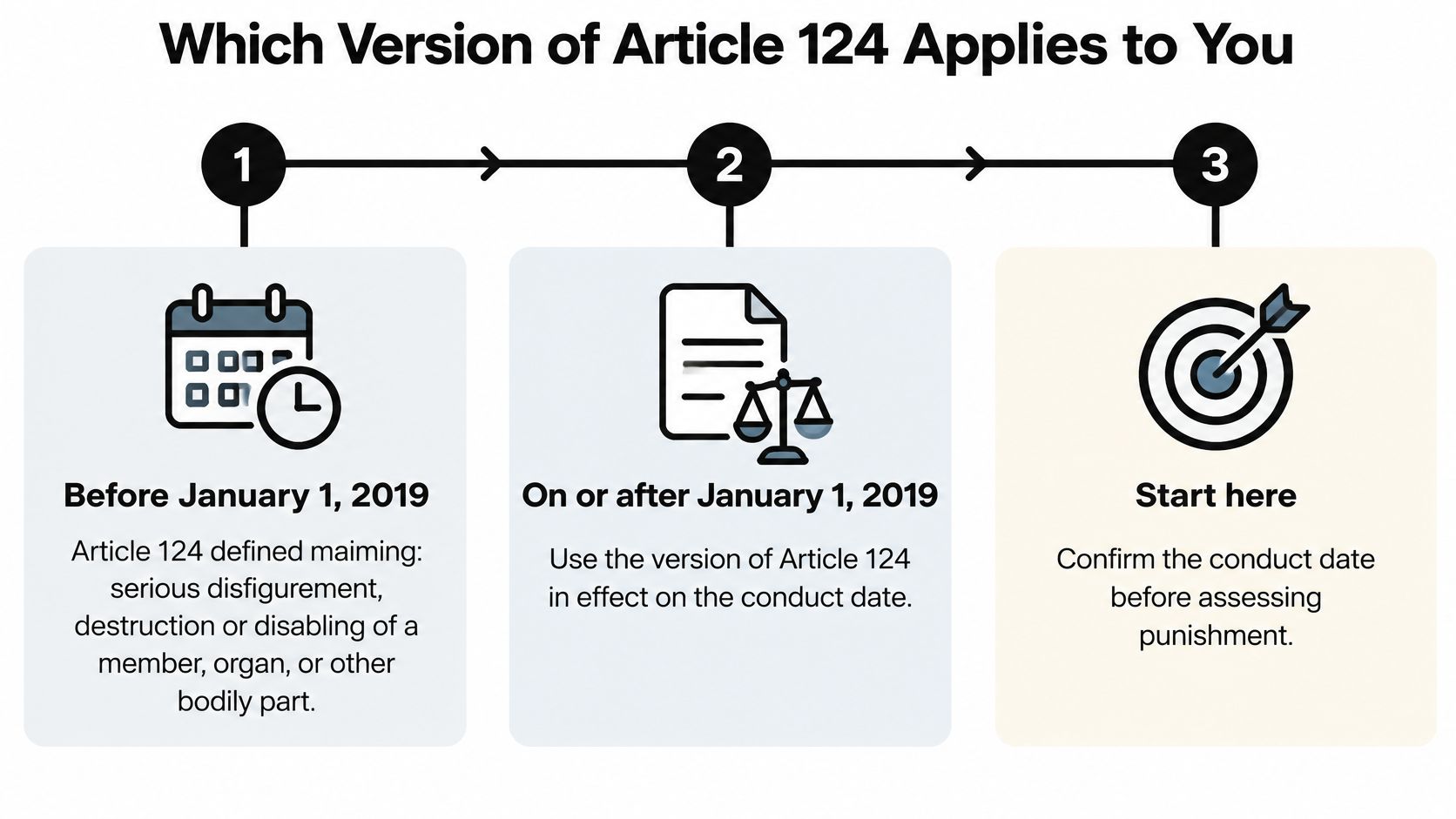
UCMJ Article 124 has no single meaning until the alleged conduct date is known. The 2015 edition of 10 U.S.C. § 924 defined Article 124 as maiming, covering serious disfigurement, destruction or disabling of a member or organ, or serious diminution of physical vigor. The Military Justice Act of 2016 moved maiming to Article 128a and placed frauds against the United States in Article 124, effective January 1, 2019.
| Conduct date | Article 124 covers | Maiming is charged under | Frauds against the U.S. are charged under |
|---|---|---|---|
| Before January 1, 2019 | Maiming | Article 124 | Article 132 |
| On or after January 1, 2019 | Frauds against the United States | Article 128a | Article 124 |
Run four checks before you accept any description of the offense.
- Find the conduct date. Use the voucher, receipt, or incident report, not the interview date.
- Read the offense label. The words on the charge sheet name the crime.
- Match that label to the law then in force. A pre-2019 maiming charge and a later fraud charge share a number and nothing else.
- Separate the statute citation from the offense name. A sheet can cite the section while describing a different crime.
Veterans reviewing old court-martial records, or seeking records correction, need this step first. Deployed personnel and Guard or Reserve members hit the same trap. A line that says Article 124 may be maiming, not fraud.
Article 124 Punishments by Subsection
These ceilings apply only if the conduct date is on or after January 1, 2019. Earlier fraud was charged under Article 132, and Article 124 then meant maiming, so this table does not apply to that file. The figures below are maximums a court-martial may impose. They are not sentences it must impose.
The Manual for Courts-Martial tiers punishment by subsection and, for subsections (3) and (4), by the amount involved. Subsections (1) and (2) authorize a dishonorable discharge, forfeiture of all pay and allowances, and five years' confinement. Subsections (3) and (4) authorize up to six months and a bad-conduct discharge when the amount is $1,000 or less, and up to five years and a dishonorable discharge when it exceeds $1,000.
| Subsection | Conduct | Amount involved | Maximum punishment |
|---|---|---|---|
| Article 124(1) | Knowingly making or presenting a false claim | Any amount | Dishonorable discharge, total forfeitures, 5 years' confinement |
| Article 124(2) | Delivering less property than the receipt states | Any amount | Dishonorable discharge, total forfeitures, 5 years' confinement |
| Article 124(3) and (4) | Property-receipt fraud with intent to defraud | $1,000 or less | Bad-conduct discharge, 6 months' confinement |
| Article 124(3) and (4) | Property-receipt fraud with intent to defraud | More than $1,000 | Dishonorable discharge, 5 years' confinement |
How the tiers actually work
Subsections (1) and (2) do not care about the dollar figure. A small false claim and a large one sit under the same ceiling: dishonorable discharge, total forfeitures, and five years. The fight there is knowledge and intent, not whether the sum looks modest on a spreadsheet.
Subsections (3) and (4) split at $1,000. Say a property-receipt case alleges $650. That amount, if proven, caps exposure at a bad-conduct discharge and six months. The same theory with $4,200 alleged moves the ceiling to a dishonorable discharge and five years. The number that matters is the amount on the charge sheet, not the amount you expected to pocket.
Practical rule: A lower tier changes exposure only when the government proves the amount. An unproven figure does not quietly drop you into the six-month range.
Check three things before you panic or relax. Confirm the subsection cited. Confirm the amount alleged. Confirm whether the government charged a claim or a receipt. An inaccurate form is not enough by itself. Trial counsel still has to tie you to that claim, receipt, or certification and prove the knowledge and intent-to-defraud piece that subsection requires.
What the Government Must Prove for Fraud Charges
An Article 124 fraud charge dies the moment one link in the government's chain is missing, and the first link is not the paperwork. It is jurisdiction.
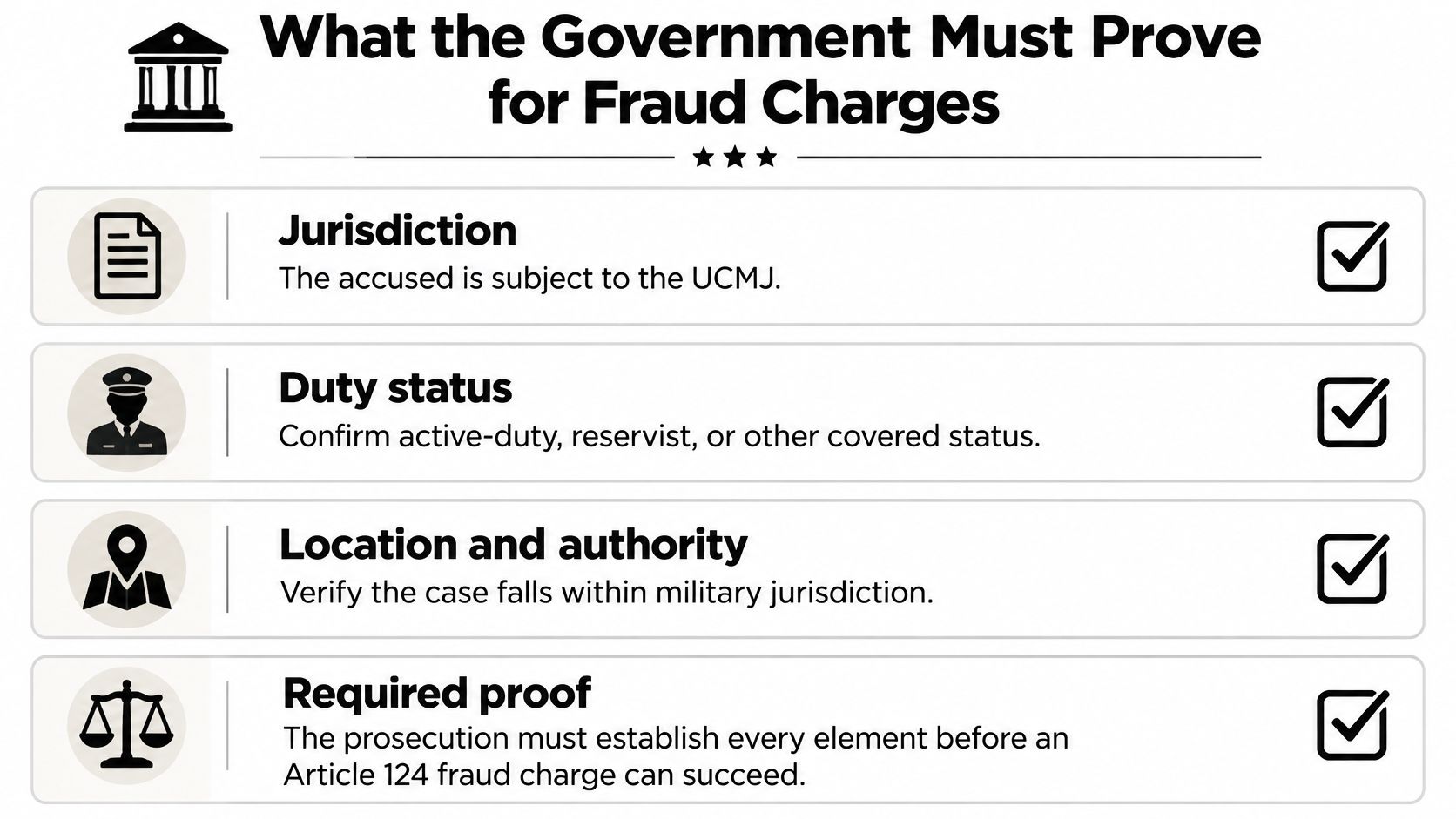
Article 124 sits in the punitive articles and opens with the phrase "Any person subject to this chapter." Nothing in the text limits where the fraud occurred, so a false claim filed in Germany and one filed in Texas are analyzed the same way. What the government must prove is your UCMJ status on the date of the claim or receipt. Counsel should test active-duty status, Guard or Reserve status, any order placing you on federal duty, and whether that status lined up with the document date. That date does double duty: it also settles whether the conduct falls under the fraud version of Article 124 at all, or under the older maiming text that governed before 2019.
The four proof points
- A document exists, and you touched it. There is a claim, receipt, or certification, and you made, presented, or delivered it. A unit form sitting in a shared drive is not your act until the government shows your role.
- The content is wrong in the way charged. The claim is false, or the property delivered falls short of what the receipt acknowledges.
- You had the required mental state. You knew the claim was false, or you issued the receipt without full knowledge that it was true.
- You intended to defraud the United States. A sloppy entry is not that intent, and the prosecution has to prove it rather than assume it from the size of the number.
A wrong number is not knowledge
Finance overpays you for two months because a pay system duplicated an entitlement. The ledger is wrong. That discrepancy alone does not show you knew it was wrong or meant to cheat the United States, and many cases weaken exactly here, when trial counsel cannot connect you personally to preparing or submitting the document. The gap between "the record is inaccurate" and "you made it inaccurate on purpose" is where these charges are won and lost.
Read every specification in two columns: what was claimed or delivered, and what you actually knew when it happened.
Maiming Cases and Why Intent to Injure Is Enough
For pre-2019 conduct, a punch meant to hurt can be enough for Article 124 maiming. The government does not have to prove you intended permanent disfigurement. That distinction decides cases. If your conduct date is 2019 or later, Article 124 is a fraud statute and this maiming analysis does not apply.
Older Article 124 maiming cases turn on mental state and how permanent the injury really was. In United States v. Spenhoff, the mental-state requirement is intent to cause some injury, not a specific intent to maim. The historical wording looked for qualifying injury inflicted with intent to injure, disfigure, or disable. The original text authorized punishment as a court-martial might direct. It did not write a fixed maximum into the statute. Confirm the Manual maximum in force for the specific charge before anyone quotes a number. Exposure follows the injury proven and the sentencing rules at trial.
A barracks fight, two injuries
Two roommates fight after midnight. One punch breaks a jaw. Surgery sets the bone, and a scar stays visible along the jawline months later. A second swing fractures a hand. That hand regains full function within weeks, with no lasting change anyone can see.
On the jaw, the government's theory runs in sequence. The punch was meant to injure. The injury inflicted was a broken jaw. The scar perceptibly and materially impairs appearance, so the serious and substantially permanent threshold is met. Later surgery does not erase the offense, because the crime can be complete even when surgery could cure the disfigurement. Recovery becomes mitigation, not an automatic defense.
On the hand, the defense attacks permanence. Full function within weeks undercuts "substantially permanent." A healed bone with no visible change is a serious assault theory, not maiming. Do not treat every bad fight as maiming, and do not treat every healed wound as legally insufficient.
Secure medical files, dated photographs, and a treatment timeline before memories and images scatter. Those records decide the permanence fight.
Where Government Fraud Cases Break Down
The common assumption is that a bad number on a pay record is the case. It is not. An accounting discrepancy shows a wrong figure. It does not show knowing falsity or intent to defraud. Keep those questions in separate columns on every review.
System error without your hand on it. Did a pay or allowance system generate the overpayment with no input from you? Demand the full audit trail and the entitlement history, not the one-page summary an agent hands you.
Rights and suspect status. Were you advised of your rights, and were you designated a suspect, before the statement? Map the sequence of contact. A casual "help us close the books" interview is still a statement.
Who built the claim. Can the government prove you prepared and submitted it? The gap widens when a unit administrator, a finance clerk, or a spouse handled the paperwork. Emails, DFAS tickets, and signature logs often show a different author than the specification names.
Dates that do not match. Does the alleged knowledge date line up with the document dates? If they say you knew on March 1, and the only notice in the file is a finance email from May, the intent theory has a hole. The same hole appears when prosecutors recast the file as a false official statement under Article 107 without proving you knew the words were false.
Credibility after the fact. Prompt, documented repayment does not prove innocence. It does change how a panel or a convening authority reads intent. Clean service history, a written explanation of how the claim process worked, and character evidence belong in the same packet. Do not volunteer a narrative to "fill the accounting gap." That statement can create the knowledge element the government did not have.
A helpful explanation given to finance can become the only proof that you understood the overpayment and kept it anyway.
Military-Appointed Versus Civilian Defense Counsel
The choice between appointed and civilian counsel changes the defense you can build before a sworn statement exists. It also changes who controls the case once a pay record, a DFAS ticket, or a claim history becomes the government's exhibit. A maiming charge and a fraud charge under Article 124 demand different defense plans, and the lawyer you retain should know which version governs before anyone discusses punishment.
| Factor | Military-appointed counsel | Civilian defense counsel |
|---|---|---|
| Cost to the member | Provided at no charge | Paid privately by the client according to the attorney's rates |
| Choice of lawyer | Assigned to you | You choose and retain counsel |
| Independence from command | Works within the military justice system | Retained by you and outside the chain of command |
| Court-martial trial experience | Depends on the assigned counsel's experience and current caseload | Verify through trial count and past results |
| Availability before charges | Usually assigned once charges are preferred; early access is not guaranteed | Available for pre-charge advice and investigation response |
| Fit for pay and records cases | Depends on the assigned counsel's finance and audit experience | Ask about DFAS, allowance and audit experience |
Appointed counsel can be excellent, and the defense is free. The limits are structural. You do not pick the lawyer, assignment drives the caseload, and detailed help often starts after charges are preferred. Civilian court-martial attorneys cost money, and you should verify trial count rather than trust a biography. What you buy is choice, independence from the chain of command, and the chance to have someone in the investigation before a sworn statement exists.
Fraud lives in paper. Ask about pay and allowance audits, housing and travel files, and rebuilding a claim history. When you choose a military defense lawyer, years of focused military law practice matter, especially sustained UCMJ and court-martial work. Attorneys showing 18 or more years of military law practice receive special weight, as does a primary focus on military criminal defense rather than general practice. A listing is a starting list of firms to call. No credential or listing guarantees any case outcome. Call at least two UCMJ lawyers and compare them yourself.
- Recent trials. How many courts-martial have you tried in the last three years, and in which branches?
- Fraud files. How many fraud or pay-record cases have you handled?
- Who shows up. Who will try the case, and will that person attend the first meeting?
- Before preferral. What does early representation cover before charges are preferred?
- Intent proof. How will you test the government's knowledge and intent evidence?
Confirm Your Conduct Date and Call Counsel Now
Act before you make any statement. Three steps, in this order.
- Write the facts down. Note the conduct date, the amount, the type of document, and whether the government charged a claim, a receipt, or a maiming offense.
- Stop talking. Do not discuss the claim with investigators, unit members, or family. Request counsel in writing. Your Article 31 rights exist so you are not forced to supply the missing piece of the case.
- Call civilian defense counsel before any interview, rights response, or sworn statement.
A rushed explanation can hand the government the knowledge it lacked, and you cannot take that statement back. At the top fraud tier the ceiling is a dishonorable discharge, total forfeitures, and five years of confinement, plus the career, pay, and benefits that go with them.
If you are under investigation or you already have a charge sheet, do not wait for command to sort it out. Command is not your advocate. Your lawyer is. Start with more than one military defense lawyer, compare how each would attack knowledge and intent, and remember that no list or credential guarantees any case outcome. Call today, before the next interview is on the calendar.