Your command tells you to report for an interview, or a charge sheet arrives while your family is still trying to understand the allegation. You’re wondering whether you’ll lose your career, face confinement, or be able to explain what happened before someone makes a decision.
The rules for court martial start with three questions: which court, which rule edition, and which procedural stage? Those answers determine your exposure, the procedures available to you, and what your defense needs to do next. Don’t assume that being truthful, cooperating quickly, or trusting command will resolve the case. You need a strategy before you give the government more evidence.
Table of Contents
- Which Court-Martial Forum You Face and What It Can Do
- Which Rules Govern Your Case and Which Version Applies
- How a Court-Martial Moves from Charges to Verdict
- Article 32 Hearings and Pretrial Motions
- Where Government Cases Break Down
- Pleas, Plea Agreements and Sentencing Exposure
- Post-Trial Review and Your Remaining Options
- Hire Civilian Defense Counsel Before Your First Interview
Which Court-Martial Forum You Face and What It Can Do
A notice arrives describing a disciplinary proceeding. Before discussing whether to fight or negotiate, identify exactly what proceeding you face. General, special, and summary courts-martial aren’t interchangeable, and nonjudicial punishment isn’t a criminal trial.
Cornell Law School’s court-martial overview explains that lawful proceedings require jurisdiction over the offense, personal jurisdiction over the accused, and a properly convened and composed court. An allegation alone doesn’t establish those prerequisites.
Court-martial forums compared
The Manual for Courts-Martial.PDF) supplies the governing forum and punishment rules, including the ordinary special court-martial confinement ceiling of 12 months and the preliminary-hearing requirement before general court-martial referral, subject to applicable exceptions and waiver.
| Forum | Offenses It Can Try | Who Can Be Tried | Maximum Exposure |
|---|---|---|---|
| General court-martial | Any offense punishable under the UCMJ | Officers and enlisted members subject to jurisdiction | Most severe authorized penalties, including dishonorable discharge, life imprisonment, or death where authorized |
| Special court-martial | Generally noncapital offenses | Officers and enlisted members subject to jurisdiction | Lesser authorized punishments, including a bad-conduct discharge and confinement up to 12 months in an authorized forum |
| Summary court-martial | Noncapital offenses | Most enlisted personnel; excludes officers, cadets, aviation cadets, and midshipmen | Confinement up to one month and other limited punishments |
These are forum ceilings, not automatic sentences. The charged offense, the particular form of proceeding, and other applicable restrictions may reduce what’s authorized.
At a trial before members, a military panel decides findings. In an authorized judge-alone trial, the military judge decides findings. Neither option is better for the defense. Technical evidence, witness credibility, and the theory of the case should drive that decision.
Confirm the proceeding before responding
A summary court’s limited punishment authority doesn’t make it a harmless administrative event. The result can still affect your military record and career.
Article 15 nonjudicial punishment isn’t a court-martial. Its procedures and protections differ from trial rights, although separate rights may apply, including rights concerning whether to accept the proceeding.
Before making decisions:
- Read the charge sheet: Identify each specification, not just the offense label.
- Identify the authority: Determine who convened or referred the case.
- Confirm the forum in writing: Don’t rely on a supervisor’s shorthand.
- Request an exposure analysis: Have counsel identify each charge’s authorized punishment and the applicable forum restrictions.
Which Rules Govern Your Case and Which Version Applies
Start a written chronology with the alleged offense date, referral date, and today’s date alongside the current procedural stage. If referral hasn’t occurred, mark it as pending. Counsel should use that chronology to identify the governing provisions and any transition rules.
The Uniform Code of Military Justice, or UCMJ, supplies statutory authority. The Manual for Courts-Martial, or MCM, provides the principal operating rules. The Congressional Research Service’s military justice overview explains how the statute works alongside the Rules for Courts-Martial, the Military Rules of Evidence, and appellate precedent.
The Rules for Courts-Martial govern jurisdiction, preferral and referral, discovery, pleas, trial procedure, sentencing, and post-trial action. Evidence rules address whether and how particular proof may be used. A procedural summary that ignores either body of rules can miss the issue that matters.
Separate binding rules from proposals
Not every document discussing military justice changes the law.
- Presidentially approved amendments: Check effective dates and transitional provisions before applying them.
- Supplementary guidance: Identify its authority, scope, and consistency with controlling law.
- Proposed amendments: Don’t treat a proposal as an operative rule without verifying later adoption.
The practical question isn’t merely whether you have the newest manual. It’s whether the particular provision applies to this case at this stage. An amendment may require a different analysis for an investigation, referral, trial, or appeal.
Our guide to the UCMJ system and military justice provides broader context, but case-specific advice needs the actual chronology and controlling text.
Practical rule: Put the dates and procedural stage on paper before accepting advice about what the government can or can’t do.
How a Court-Martial Moves from Charges to Verdict
A service member facing an investigation needs three answers before treating a procedural deadline as settled: which court-martial forum is involved, which rule edition governs, and what stage the case has reached. The process has several steps, and a missed opportunity during investigation may be difficult to recover at trial.
Presidential amendments to the Manual for Courts-Martial change over time. Counsel must check each amendment’s effective date and transitional provisions against the controlling text for the relevant procedural stage.
The overview below is simplified. Preliminary hearings, sentencing, and post-trial litigation require separate attention.
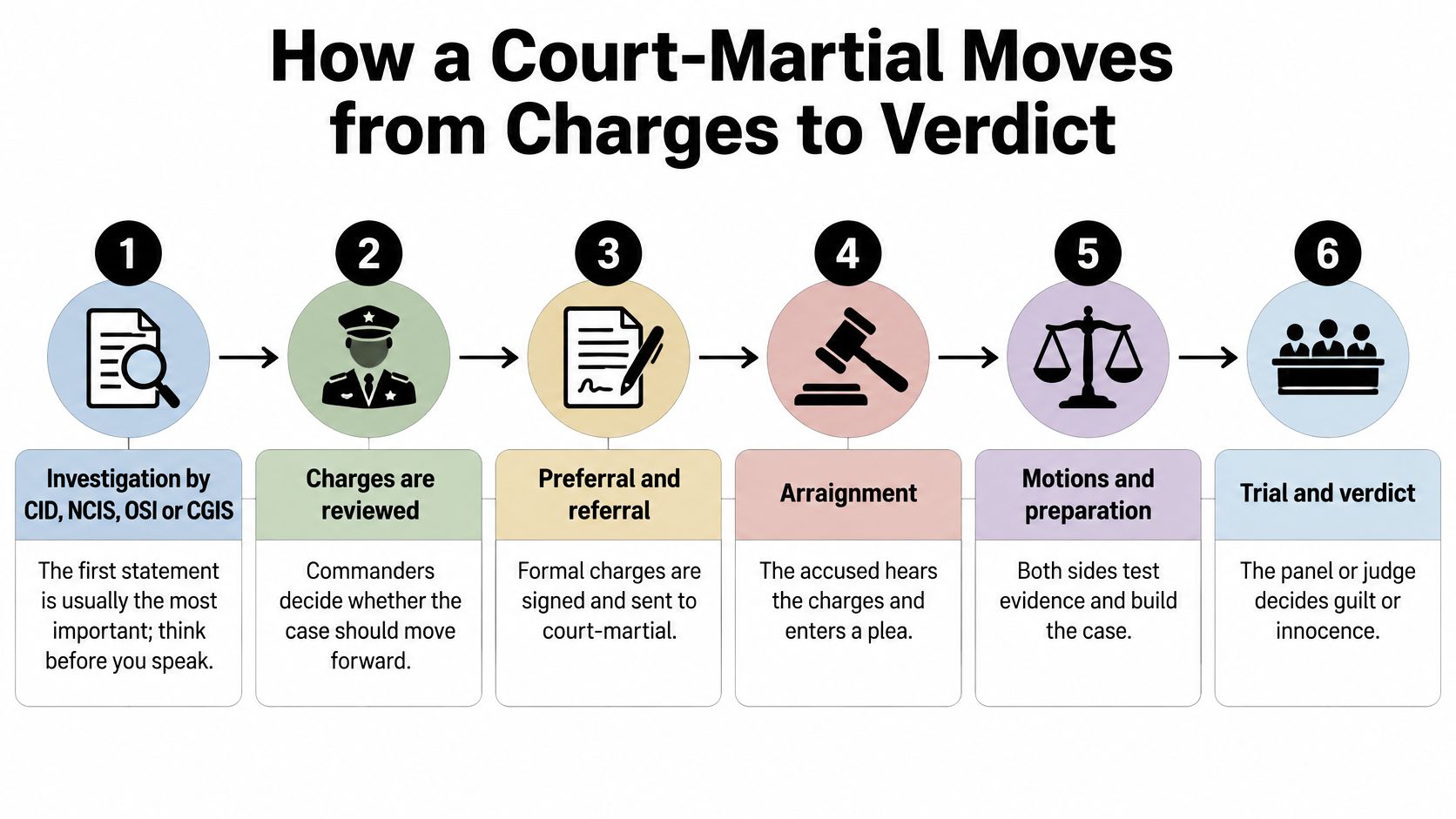
The decisions at each stage
Investigation by CID, NCIS, OSI, or CGIS. Agents collect statements, records, and physical or digital evidence. Consult counsel before an interview. The rules for questioning, searches, and investigative process depend on the governing law and the case’s timing.
Preferral. An accuser signs sworn charges. Check each specification for the alleged conduct, dates, and required elements.
Preliminary proceedings. In a general court-martial case, address the preliminary-hearing requirement and any proposed waiver. Confirm the rules that apply and preserve the record.
Referral. The authorized referring authority sends specified charges to a court-martial. Check the referral documents and the forum selected.
Arraignment and pleas. The accused is formally called upon to plead. Confirm the applicable deadlines, motions schedule, and consequences of each procedural choice.
Trial. Members or a military judge decide findings on each specification. The defense challenges admissibility and credibility and tests whether the prosecution proved the required elements.
Sentencing. After a conviction, the court considers authorized aggravation and defense sentencing evidence. Confirm the applicable sentencing framework.
Post-trial proceedings and appeal. Record preparation, submissions, review, and possible appellate litigation follow. Identify the review route and track each filing deadline.
Recheck the governing rules as the case moves from one stage to the next. A rule that applies at referral may not control a later procedural event.
Article 32 Hearings and Pretrial Motions
An Article 32 preliminary hearing isn’t a trial, and probable cause isn’t a finding of guilt. The hearing addresses the limited questions of probable cause, jurisdiction, the form of the charges, and whether the accused committed the alleged offenses. It must be recorded.
The preliminary-hearing officer’s disposition recommendation doesn’t bind the referring authority. A favorable recommendation therefore isn’t permission to stop preparing. Its value may lie in exposing evidentiary weaknesses, fixing a witness’s account, or supporting later litigation.
Use the hearing to answer disputed questions
Defense counsel should obtain the complete recording, test legally insufficient or unreliable evidence, and question available witnesses on facts material to probable cause. The objective isn’t to reveal every defense theory. It’s to obtain information worth the strategic cost of disclosing your questions.
For example, if a witness claims that a message establishes intent, counsel should determine whether the witness read the entire conversation or only a screenshot. That distinction can guide a discovery request without presenting the entire trial defense.
Common pretrial motions and when to file them
The timing below is a preparation guide, not a substitute for the governing rule or the military judge’s scheduling order.
| Motion | What It Challenges | When to File |
|---|---|---|
| Motion to dismiss for lack of jurisdiction | Jurisdiction over the offense or accused | Raise promptly when the defect becomes known, preferably before pleas; jurisdictional objections have distinct rules |
| Motion to suppress | Unlawfully obtained statements or evidence under the Military Rules of Evidence | Before trial, after discovery identifies the source, within applicable deadlines |
| Motion to compel discovery | Missing statements, reports, witness information, or evidence | Early, after identifying the request and unresolved production gap |
| Motion to compel witnesses | Refusal to produce a necessary witness | Before trial, explaining relevance and necessity |
| Motion for appropriate relief for unlawful command influence | Improper command interference with witnesses, proceedings, or members | Promptly after facts supporting interference become known |
| Motion for continuance | Inadequate preparation time or unresolved discovery | Before the scheduled proceeding, with specific reasons and requested relief |
A useful motion identifies the facts, the legal violation, and the remedy. Complaining that the investigation was unfair isn’t enough. Counsel needs supporting records, testimony, or a concrete explanation of what remains missing.
Missing a filing deadline can cause waiver or forfeiture under the applicable rule. Some issues receive different treatment, so don’t assume either that every late objection is lost or that an important objection can always wait.
Before the hearing, decide which questions must be answered: What did this witness personally observe? What record supports that account? What information could contradict it?
Where Government Cases Break Down
Don’t treat an investigation as neutral advice about your interests. Agents investigate suspected offenses, and prosecutors decide how to present the resulting evidence. Your defense needs an independent examination of what investigators collected, what they missed, and what the evidence supports.
A polished report can still rest on an incomplete extraction, an untested assumption, or a witness who repeated someone else’s account. The documents below illustrate the kinds of records counsel must reconcile, not merely read in isolation.
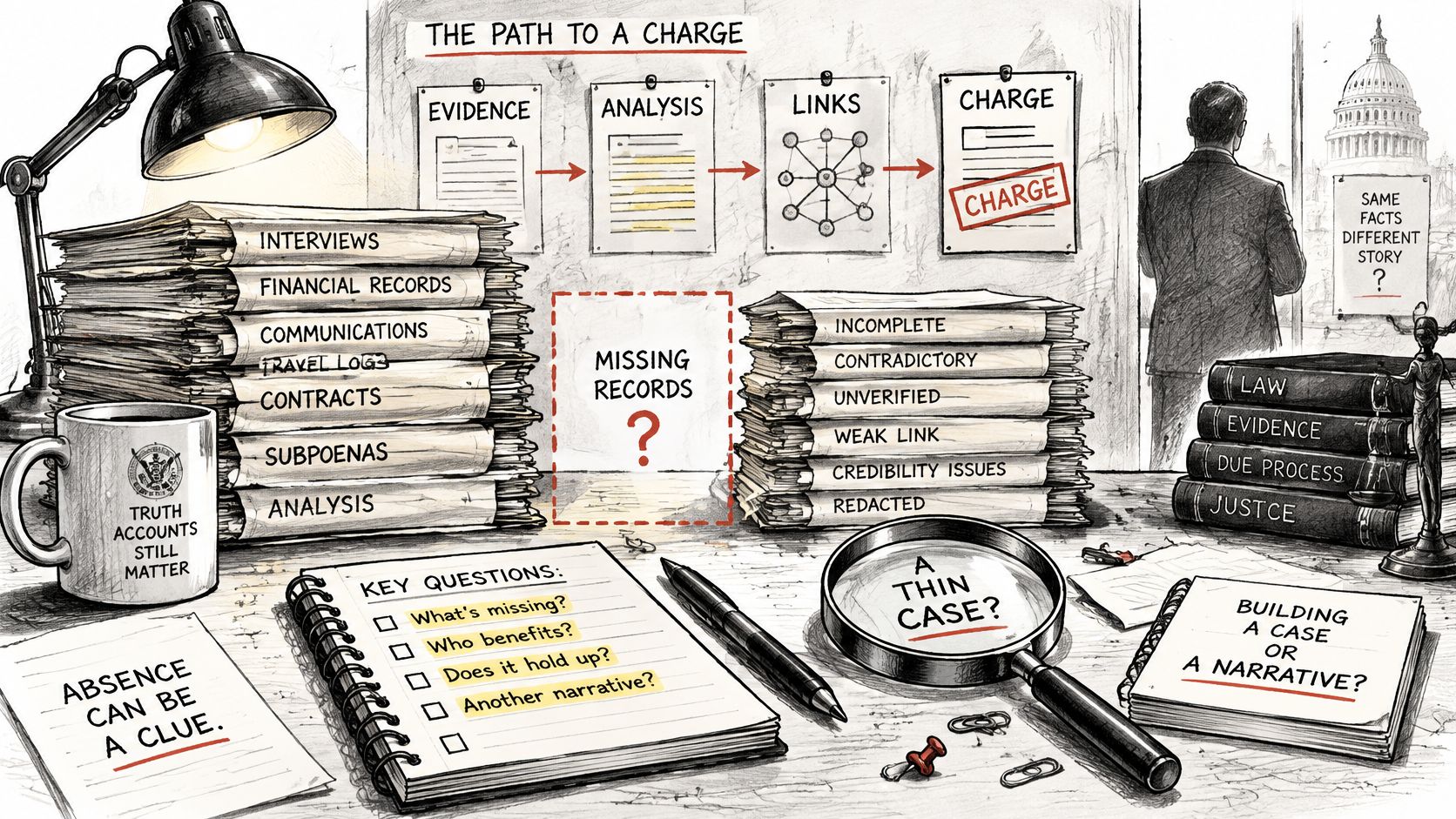
Test the evidence behind the summary
Defense counsel should examine:
- Interview methods: Compare recordings with reports. Identify leading questions, omitted qualifications, and circumstances affecting voluntariness.
- Collection gaps: Determine whether agents sought potentially exculpatory messages, location information, or independent witnesses.
- Timeline conflicts: Reconcile alleged events with duty schedules, access records, travel, and communications.
- Digital limitations: Examine extraction scope, account attribution, timestamps, missing attachments, and conversation context.
- Laboratory and custody records: Check collection, labeling, storage, transfers, testing limitations, and whether the conclusion exceeds the examiner’s findings.
Credibility requires the same discipline. Prior disputes, motives, changing accounts, and intoxication may matter, but none automatically proves dishonesty. Separate an inconsistency about a peripheral detail from a contradiction concerning an essential element.
If command pressure affected witnesses or the handling of evidence, document specific statements, actors, and consequences. Our explanation of unlawful command influence under the UCMJ addresses that distinct problem.
Build an element-by-element proof chart
For each specification, identify what the government must prove, which admissible evidence supports it, and what competing explanation remains. Inferences can be lawful evidence; the defense question is whether they’re justified and sufficient, not whether any inference exists.
Being certain of your account isn’t the same as being prepared to challenge the government’s proof.
A successful strategy connects weaknesses to a remedy, a negotiation position, or a persuasive trial theory. Truth matters, but counsel must make it usable through admissible evidence and disciplined questioning.
Pleas, Plea Agreements and Sentencing Exposure
The maximum punishment is a ceiling, not a forecast. A realistic exposure assessment considers the offense, forum restrictions, the admissible proof, your record, and the aggravation and mitigation evidence.
Ask counsel to distinguish a legally possible outcome from a reasonably supported assessment. A confident prediction without reviewing discovery isn’t a sound basis for pleading guilty or rejecting an offer.
Build mitigation while contesting the allegations
Preparing sentencing evidence doesn’t concede guilt. It prevents the defense from scrambling if findings go against you.
Useful material can include:
- Service history: Evaluations, awards, deployments, and documented responsibilities.
- Duty performance: Specific examples supported by records and knowledgeable witnesses.
- Medical and family circumstances: Relevant documentation, handled with attention to privacy and privilege.
- Character evidence: Credible witnesses who can explain what they know, rather than repeat generic praise.
Don’t contact potential witnesses in a way that could be interpreted as pressure or coordination. Have counsel direct that work.
Evaluate the agreement against the evidence
A guilty plea admits the offense and gives up important trial rights and defenses. It must be knowing and supported by the required factual basis. Pleading guilty to selected specifications doesn’t automatically limit punishment unless the agreement and applicable law create that protection.
Read every term of a plea agreement line by line. Address the charges covered, sentencing provisions, dismissal obligations, cooperation requirements, and consequences of noncompliance. Don’t rely on an oral assurance that isn’t reflected in the approved agreement.
The decision should follow investigation and motions analysis, not replace them. A strong suppression issue or a missing element can change what an acceptable agreement looks like.
Before signing, have counsel produce a charge-by-charge exposure assessment, identify the proof supporting each specification, explain the mitigation still needed, and compare the offer with realistic trial outcomes. The right question isn’t whether an offer sounds less frightening. It’s what protection it gives you.
Post-Trial Review and Your Remaining Options
The verdict doesn’t end the defense lawyer’s work. Post-trial action, record review, and possible appeal require their own strategy, and the available remedies depend on the governing rules and case posture.
The military victim-assistance regulation describes victim participation in Article 60 action and requires information about the deadline and method for written submissions under R.C.M. 1105A. It also describes convening-authority and judge-advocate review. Counsel must reconcile those provisions with the current statutory framework and the rules applicable to your case.
Protect the remaining opportunities
The defense should assess:
- Post-trial submissions: Request available clemency or other authorized relief with supporting documentation.
- Sentencing objections: Identify legal errors and distinguish them from requests for discretionary leniency.
- Record corrections: Compare transcripts, exhibits, rulings, and other required materials for omissions or inaccuracies.
- Appellate preservation: Ensure the record contains the objections, excluded evidence, and rulings needed for review.
- Victim submissions: Evaluate any authorized defense response and applicable procedural protections.
Clemency and appeal aren’t interchangeable. A request for mercy asks an authorized decision-maker to exercise discretion; an appellate claim identifies an error and the legal basis for relief.
Deadline discipline: Calendar every post-trial deadline when the triggering event occurs, and confirm who owns each submission.
Don’t assume an appeal will repair an incomplete trial record. Issues not properly raised may receive less favorable review, and some may be unavailable. Before sentencing begins, confirm who will handle post-trial work, how you’ll receive documents, and how counsel will remain reachable if you’re confined or transferred.
Hire Civilian Defense Counsel Before Your First Interview
Military-appointed defense counsel is generally provided without charge in general and special court-martial proceedings. Civilian counsel is retained at your expense and can bring a separately chosen practice focus, trial background, and availability. Military defense counsel also have professional independence obligations, so civilian status alone doesn’t establish superior representation.
The choice should turn on the lawyer’s preparation and relevant experience, not the label.

Compare counsel before committing
We recommend comparing multiple lawyers for sustained military justice experience, court-martial focus, teaching and writing credibility, leadership in defense organizations, and similar-case experience. No credential guarantees an outcome.
Ask prospective court-martial attorneys who will review discovery, litigate motions, try the case, and handle post-trial work. Evaluate communication and strategy alongside credentials.
Avoid these early mistakes:
- Giving an uncounseled interview: Review your Article 31 rights under the UCMJ before answering investigative questions.
- Trusting an informal promise: Command reassurance isn’t a defense agreement.
- Waiting until referral: Evidence preservation may already be urgent.
- Assuming there’s no evidence: Investigators don’t have to preview their file for you.
- Deleting or coordinating: Preserve records and don’t pressure witnesses.
Frequently asked questions
Can I refuse to talk to CID?
You can invoke applicable rights to silence and counsel. Don’t confuse declining questions with permission to disobey other lawful requirements.
What happens at an Article 32 hearing?
The hearing tests the limited preliminary issues supporting referral, not guilt at trial.
Will I go to jail?
No allegation alone answers that. Counsel needs the charges, forum, proof, and sentencing framework to assess confinement risk.
Which MCM edition applies to my case?
Counsel must match the relevant dates and stage to effective-date and transitional provisions.
Do I need a UCMJ lawyer immediately?
If investigators want to question you or charges are pending, consult counsel before making substantive decisions.
If you’re under investigation or facing court-martial charges, contact defense counsel this week, and before any scheduled interview. Bring the charge sheet, notices, interview requests, and a dated chronology. Preserve your records, identify approaching deadlines, and compare counsel who can explain a concrete plan for your forum and procedural stage. Your career and freedom deserve preparation before the government takes its next step.