If you’re reading this, the problem has already started.
Maybe CID called. Maybe NCIS asked you to “come in and clear a few things up.” Maybe OSI left a message and your first instinct was to cooperate because you think this is all a misunderstanding. That instinct can wreck your case.
An accusation under UCMJ Article 128 – Assault can threaten your liberty, your rank, your clearance, your family life, and your future outside the military. It can start with a shove, a heated argument, a bad witness, a relationship dispute, or a fight where both sides were drinking. It can also become far more serious, fast, if the government claims there was a weapon, serious injury, strangulation, or a protected victim.
You need to think like a defendant in a system already moving against you. Not like a good soldier trying to explain himself.
Table of Contents
- The Phone Call That Changes Everything
- Decoding UCMJ Article 128 Assault
- The Punishment Ladder What You Stand to Lose
- From Accusation to Trial The Military Justice Process
- How We Win Article 128 Cases Strategic Defenses
- Career-Ending Mistakes Service Members Make
- Your Appointed Lawyer vs A Civilian Court-Martial Attorney
- Frequently Asked Questions About Military Assault Charges
The Phone Call That Changes Everything
Your phone buzzes. Unknown number. The voice is calm, polite, practiced.
They say they just want your side. They say this is routine. They say now is your chance to help yourself.
That’s the trap.

By the time investigators call, the machine is already running. Somebody has made a report. A command has been notified. A file has started. People are already writing things down about you, often before anyone hears your version in full context.
You may be sitting in your car outside work, staring at your screen. Or walking into a plain room with a table, a recorder, and an agent who has done this many times before. You’re thinking honesty will fix it. They’re thinking admissions, inconsistencies, and impeachment material.
The first decision is the biggest one
Most service members damage their case before charges are even preferred. They talk because silence feels guilty. They explain because they think facts will save them. They try to sound reasonable. Then investigators compare every sentence to texts, witness statements, photos, call logs, and later testimony.
If you guessed wrong on one detail, they call it a lie.
Practical rule: If investigators want to talk about an assault allegation, you need counsel before you answer a single substantive question.
This isn’t about hiding. It’s about survival. Assault allegations often grow in the retelling. A shove becomes a strike. Mutual combat becomes one-sided violence. Horseplay becomes “offensive touching.” A bad relationship turns into a criminal file.
What you should do immediately
- Stop talking about the facts: Don’t explain the incident to investigators, your command, friends in the unit, or the alleged victim.
- Preserve evidence: Keep texts, call logs, photos, screenshots, social media, and location data.
- Write a private timeline for your lawyer: Do it while your memory is fresh, but keep it confidential and lawyer-directed when possible.
- Get legal representation fast: Early action changes cases. Delay usually helps the government.
The military justice system won’t slow down because you’re overwhelmed. You need a plan before they finish building theirs.
Decoding UCMJ Article 128 Assault
Article 128 is broad enough to trap service members who assume an assault case requires a punch, visible injury, or a chaotic scene. It does not. A threat, a lunge, a shove, an unwanted grab, or contact the other person describes as offensive can put you inside the statute.
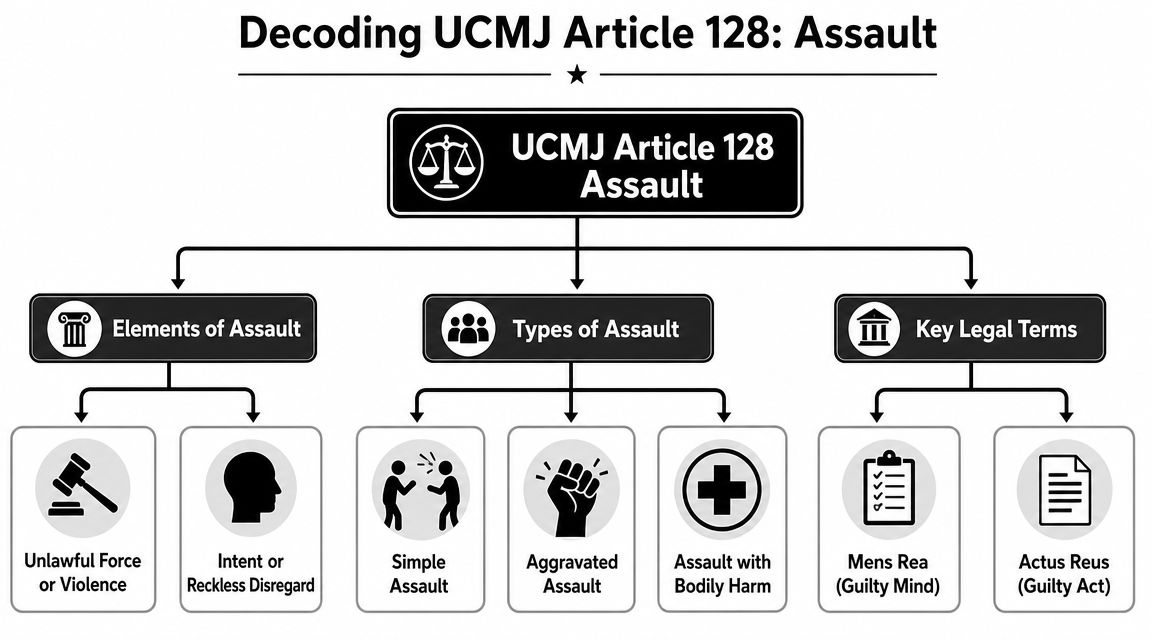
The legal framework starts with 10 U.S.C. § 928. Article 128 separates assault into categories that sound technical but drive charging decisions, plea pressure, and trial strategy. If you do not understand how the government is classifying the allegation, you are already behind.
What counts as assault
Here is the practical breakdown.
- Simple assault: An attempt or offer to do bodily harm. Physical contact is not required.
- Assault consummated by battery: Bodily harm or offensive touching. The contact can be minor and still be charged.
- Aggravated assault variants: Allegations involving more serious facts, such as the means used, the level of harm, or the intent the government claims it can prove.
That first category catches people off guard. Service members often say, “I never touched anyone.” That does not end the case. If the government claims you moved in a way that put someone in reasonable fear of immediate harm, they may still charge assault.
The Manual for Courts-Martial explains these offenses in detail, including the difference between attempt-type assault, offer-type assault, and battery, in the Punitive Articles discussion of Article 128%20(Accessible%20-%20Signed).pdf?ver=PZzgbN2996SdxPKsorI3lw%3d%3d). That matters because small factual disputes often control the outcome. Did you step forward or strike? Did contact occur, or did someone anticipate it? Was the touching unlawful, or was it incidental, defensive, or misread in the moment?
Why classification decides the case
The government benefits when the accusation stays vague. Your defense gets stronger when the facts are pinned down and the charge is forced into the right box.
| Allegation type | Core idea | Why it matters |
|---|---|---|
| Offer or attempt | Threatened or attempted bodily harm | The case can proceed without contact |
| Battery | Offensive touching or bodily harm | The government must prove contact and frame it as unlawful |
| Aggravated form | More serious facts are alleged | Punishment exposure and command pressure increase fast |
Good defense work changes the course of the fight. The default path is simple. Investigators write it up in the harshest terms, command adopts that version, and the allegation grows more serious with every retelling. A experienced lawyer attacks the classification early, strips away exaggeration, and forces the government to prove each added fact instead of coasting on emotion.
The critical fight is over what happened, what the government can prove, and which version of Article 128 fits those facts. Get that wrong, and a manageable allegation turns into a career-defining disaster. Get it right, and the entire case can shrink.
The Punishment Ladder What You Stand to Lose
If you want the blunt version, here it is. The punishment range under Article 128 is wide enough to lull people into fatal complacency.
A service member hears “assault” and thinks bar fight, counseling, maybe NJP. That can be a catastrophic misread.
How exposure escalates
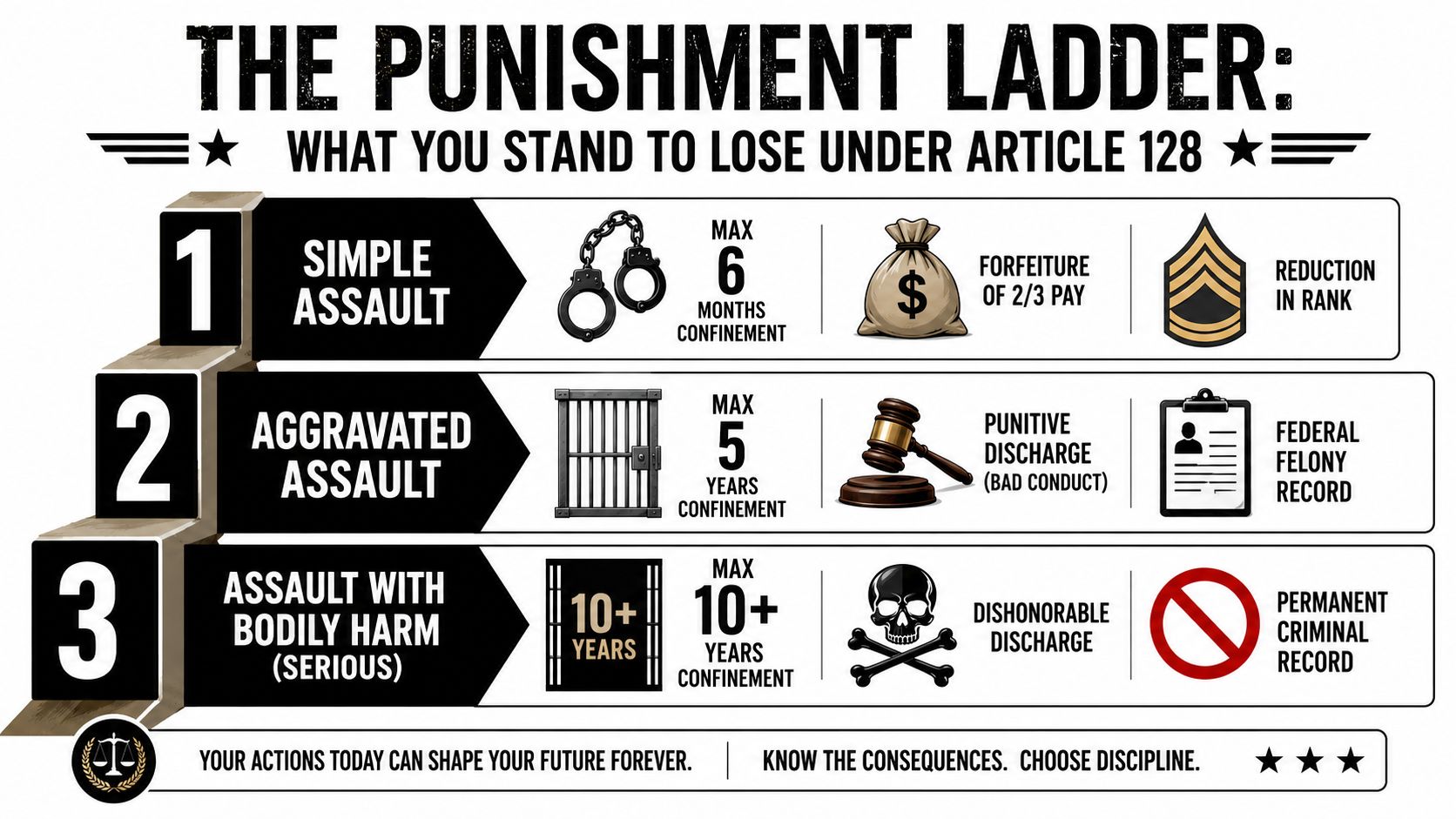
The lower end is still serious. Public summaries of the punishment structure report that simple assault can carry 3 months of confinement and forfeiture of two-thirds pay for 3 months, while more serious aggravated variants can reach 3, 5, 8, 10, or even 20 years of confinement depending on the facts proved under Article 128, as reflected in the federal statutory framework for 10 U.S.C. § 928.
Military-law summaries also note that simple assault is punishable by confinement for 3 months, while assaults involving a loaded firearm or a child under 16 can rise to 8 or 10 years, along with forfeiture of all pay and allowances and a dishonorable discharge, as discussed in this Article 128 punishment overview.
What this means in the real world
The military treats certain facts as aggravators because it cares about control, vulnerability, and order.
Examples include:
- Victim status matters: Allegations involving commissioned officers, warrant officers, NCOs, petty officers, sentinels, or look-outs can be treated more severely.
- Weapon allegations matter: Once the government claims a dangerous weapon or loaded firearm, the case can jump from disciplinary-level exposure to felony-level confinement.
- Child allegations matter: Cases involving a child under 16 carry severe punitive exposure.
- Injury theory matters: If prosecutors argue grievous bodily harm or an aggravated mechanism of force, everything gets more dangerous.
Below is the strategic point most accused service members miss.
| Government claim | Defense consequence |
|---|---|
| Minor unwanted contact | Fight classification, intent, consent, and context |
| Dangerous weapon | Fight whether the object and manner of use fit the aggravator |
| Serious injury theory | Fight mechanism, causation, and medical interpretation |
| Protected or vulnerable victim | Fight facts early because sentencing exposure spikes |
This is why you cannot treat an assault case as “just a misunderstanding.” Small factual disputes decide whether you’re facing a short confinement ceiling or years of exposure with a punitive discharge attached.
From Accusation to Trial The Military Justice Process
An Article 128 case doesn’t move in one clean line. It moves through people, discretion, paperwork, and pressure. But there is a standard pattern, and you need to know where the danger points are.
The default path if you do nothing
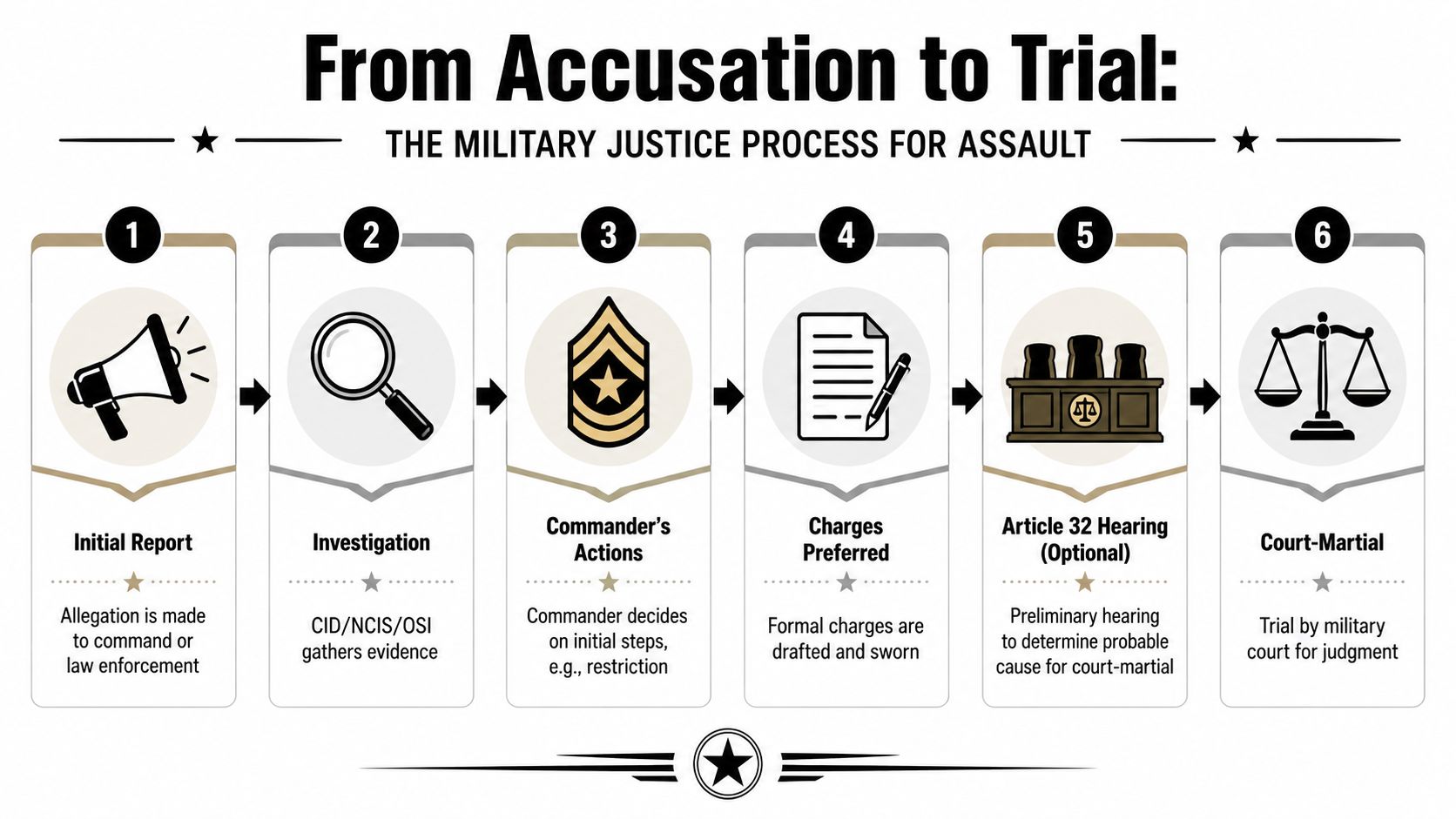
Step 1. A report is made.
That report may come from a spouse, another service member, local police, medical staff, a bystander, or your chain of command. Once the allegation is framed as assault, the system tends to preserve the accusation, not your context.
Step 2. Investigators get involved.
CID, NCIS, OSI, or CGIS may seek an interview. They may also collect texts, statements, photographs, medical records, and other digital evidence. If you’re trying to understand the broader trial path, review this guide to court-martial basics and process stages.
Step 3. Command takes immediate action.
That can include restrictions, no-contact orders, weapon restrictions, loss of positions of trust, or administrative pressure long before final charging decisions.
Your command may call these steps temporary. They still shape the case. They affect witnesses, access, reputation, and leverage.
The smarter path
Step 4. The legal fork appears.
Some cases stay at the command level and become counseling, reprimand, or nonjudicial punishment. Others move toward court-martial. The facts may not change much. The government’s theory of those facts does.
Step 5. Charges are preferred.
This is the point where broad suspicion becomes formal criminal exposure. Once charges are drafted, the language used in them matters. A skilled defense team starts attacking wording, theory, and proof immediately.
Step 6. Article 32 and trial preparation.
In more serious cases, there may be an Article 32 preliminary hearing before referral to trial. Witness handling, document review, and early impeachment work matter here. If your lawyer is reacting late, the government has already had too much uncontested runway.
What you should be thinking at each stage
- At the allegation stage: Preserve evidence and shut your mouth.
- During investigation: Force discipline into your defense. No side conversations. No emotional texting.
- At command action: Assume every statement and reaction is being evaluated.
- At charging: Focus on what can be proved, not what people are saying in the hallway.
- Before hearing or trial: Build a theory. Random denials don’t win. A coherent defense does.
The military justice process rewards preparation. The government gets a head start. Your lawyer’s job is to take that advantage away.
How We Win Article 128 Cases Strategic Defenses
An Article 128 case is won or lost early. If you wait for trial to start defending yourself, you are already behind. The government’s default path is simple. Accept the accusation, lock in statements, inflate the charge if possible, and force you to react. A experienced defense lawyer does the opposite. We interrupt that process fast, pin the allegation to specific facts, and stop vague claims from turning into a career-ending narrative.
That work starts before the government feels ready.
Force the case into specifics
Assault allegations grow when nobody challenges the details. “He threatened me.” “She put hands on me.” “It got physical.” Those phrases sound powerful and prove very little unless the government can tie them to a legally valid theory.
Our job is to narrow the case immediately.
- Self-defense: If you used force lawfully, that can defeat the charge outright.
- Consent: Mutual physical contact, horseplay, sports, or rough joking can matter if the facts support it.
- No unlawful touching: Contact alone is not enough. The government still has to prove the touching was unlawful.
- Overcharging: Commands and prosecutors often try to dress up a minor contact case as something more serious. Attack that early.
In simple assault cases, the government often relies on broad language and emotion. We strip that away and force precision. What was said. What was done. Who moved first. Who saw it clearly. Whether the contact was offensive, justified, accidental, or mutual. That is how weak cases start to crack.
If your case is still in the investigation stage, speed matters. Early defense work can shape witness interviews, preserve favorable evidence, and stop the government from framing the facts without resistance. Read how experienced military defense counsel shape cases during the military investigation phase.
Attack proof, credibility, and charge inflation
Many Article 128 cases rest on messy human evidence. Alcohol. Breakups. Barracks gossip. Half-seen encounters. Delayed reporting. Injuries with more than one possible cause.
That is where disciplined defense work matters.
- Compare every version of events: NCIS or CID interviews, command statements, text messages, social media messages, medical notes, and later testimony.
- Expose motive: Jealousy, retaliation, fear of getting in trouble first, custody disputes, and command pressure all change how an accusation should be viewed.
- Test the physical claim: Does the alleged force match the injury, timing, and witness account.
- Challenge aggravated theories: Allegations involving weapons, strangulation, or grievous bodily harm often depend on interpretation, not clean proof.
A redness photo is not a conviction. A medical record that repeats an accusation is not the same as medical proof. A witness who arrived late does not get to fill in the missing parts with assumptions.
Use those weaknesses aggressively.
Build the defense around the decision that protects you best
Some cases should be pushed toward no charges. Some should be cut down to a lesser theory. Some should be positioned for an Article 32 fight or trial. The right strategy depends on the evidence, the command climate, the alleged victim’s credibility, and your own digital footprint.
Bad defense work stays reactive. Good defense work chooses the battlefield.
Sometimes that means presenting defense evidence early to stop a bad charge from hardening. Sometimes it means giving the government nothing, preserving impeachment, and waiting for them to overcommit to a story they cannot prove. Sometimes it means attacking classification and forcing the case back down to what it really is.
That is how strong Article 128 defenses are built. Not with generic denials. With fast decisions, tight facts, and pressure on every weak point in the government’s case.
Career-Ending Mistakes Service Members Make
Strong cases get damaged by panic, pride, and bad advice from friends. Most of the damage happens early, and most of it is self-inflicted.
The mistakes that bury good defenses
- Talking to investigators to “clear it up”: You are not walking into a neutral conversation. You are walking into evidence collection.
- Trusting command to be fair: Command may care about optics, order, and speed. Those interests don’t always line up with your interests.
- Contacting the alleged victim: Even if your intent is peace, it can be framed as pressure, intimidation, or consciousness of guilt.
- Deleting messages or posts: That looks like obstruction. Preserve everything.
- Telling friends in the unit your version: Loose talk becomes witness statements.
- Assuming no visible injury means no case: That’s wrong, and in some allegations it’s dangerously wrong.
- Waiting too long to hire counsel: Delay gives the government time to lock in its narrative.
One mistake deserves special attention. People underestimate allegations involving strangulation or similar aggravated theories because they don’t see dramatic injuries. That’s reckless. Defense-oriented guidance warns that prosecutors may pursue severe aggravated charges even with limited visible injury, and the primary fight becomes mechanism-of-force evidence, medical documentation, and witness credibility, as discussed in this military assault defense analysis of strangulation allegations.
“No injury, no case” is one of the dumbest things a service member can say in an assault investigation.
If you’re already under scrutiny, your job is simple. Stop making the file worse.
Your Appointed Lawyer vs A Civilian Court-Martial Attorney
You are entitled to military defense counsel. Use that right. But don’t confuse entitlement with optimal protection.
What detailed counsel can do
Many military defense lawyers work hard and are very dedicated. Some are excellent. They know the system, the players, and the local process. In the right case, that matters.
But the system puts limits on them. Caseload. rotations. institutional constraints. variable trial depth. less freedom to devote outside resources to your case than a dedicated civilian team may bring.
What a civilian defense team adds
A strong civilian court-martial attorney brings something different.
- Independence: Civilian counsel is not part of the military chain.
- Focused experience: Experienced civilian military defense lawyers often spend their professional lives handling these cases.
- More aggressive early intervention: They can press hard during the investigation phase instead of waiting for the file to mature.
- Resources: Investigators, expert consultation, and broader strategic support can matter in witness-heavy assault cases.
- Trial posture: Serious Article 128 cases require lawyers who are comfortable being relentlessly adversarial.
If you’re trying to compare options, start with lawyers who focus specifically on courts-martial and serious UCMJ defense.
The blunt truth is this. If your freedom, career, retirement, or reputation is at stake, you should not make representation decisions based only on convenience or cost. You should make them based on who gives you the best chance to control the case.
Frequently Asked Questions About Military Assault Charges
Quick answers you need now
Can I be convicted of assault if nobody was touched?
Yes. Under Article 128, simple assault can be based on an attempt or offer to do bodily harm, even without contact. That’s why threatening gestures and alleged present ability matter so much.
Can mutual fighting still lead to charges?
Yes. Mutual combat doesn’t automatically save you. But it can change how the defense argues consent, aggressor status, and self-defense.
What if the alleged victim wants to drop the case?
That helps sometimes, but it doesn’t control the outcome. The command and prosecutors can still move forward.
Will I go to jail for UCMJ Article 128 assault?
It depends on how the case is charged and proved. Public military-law summaries note that simple assault can be as low as 3 months of confinement, while aggravated assault with a dangerous weapon can increase exposure to 8 to 10 years, which is why litigators fight so hard over whether the facts show offensive touching or a weapon or grievous-bodily-harm aggravator, as outlined in this Article 128 sentencing overview.
Do I need a lawyer for an Article 15 based on assault?
Yes. Even if the case never reaches court-martial, an assault-based Article 15 can damage your career, promotion path, and separation risk. Early counsel matters.
Can horseplay become an assault charge?
Absolutely. If the government treats the touching as offensive and without lawful consent, what felt informal at the time can become criminal later.
Should I talk to CID, NCIS, or OSI if I’m innocent?
No. Innocent people talk themselves into charges every week. Get counsel first.
Will an Article 128 allegation affect my career even without a conviction?
It can. Commands make decisions based on allegations, investigations, and perceived risk. That’s one reason fast, strategic lawyering matters.
If you’re under investigation, have been read your rights, received a no-contact order, or think charges are coming, act now.
Don’t wait for the command to “see the truth.” Don’t assume investigators are being fair. Don’t hand the government the statement it needs to charge you.
Get experienced legal help immediately. Your freedom, your career, and your future may depend on what you do in the next few hours. If you need to start comparing serious civilian options, use this guide to choosing a military defense lawyer to identify counsel with real court-martial and military justice focus.