
You just got hit with the kind of news that makes your stomach drop. Your command is talking about an Other Than Honorable discharge, and suddenly every plan you had after the military looks shaky. School. Benefits. VA care. Your record. Your reputation. All of it is now tied to decisions you make in a very short window.
Here it is plainly. An OTH is not the end of the road, but it is a serious threat to your future. If you’re still in uniform, this is the point where passive hope becomes a losing strategy. If you’ve already been separated, the fight shifts, but it does not disappear. You need a plan, and you need one fast.
A lot of service members make the same mistake. They assume they can “deal with benefits later.” That’s backwards. The smartest move is often to stop the OTH before it lands on your DD-214. If that window is gone, then you need to decide whether to push for a VA Character of Discharge review for limited benefits, a full discharge upgrade, or both in the right order.
Table of Contents
- The Moment of Impact Understanding Your OTH Discharge
- The Benefit Cliff What an OTH Discharge Immediately Costs You
- Finding the Cracks Exceptions and Pathways to Limited VA Benefits
- The Upgrade Offensive Fighting to Change Your DD-214
- Strategic Insight Why an Attorney is Your First Move Not Your Last Resort
- Common Career-Ending Mistakes to Avoid at All Costs
- Your Immediate Action Plan and Critical Questions
The Moment of Impact Understanding Your OTH Discharge
The conversation usually starts the same way. A supervisor tells you paperwork is moving. Someone says this is “just administrative.” Somebody else tells you to stay calm, sign what you need to sign, and explain your side later.
That advice gets people burned.
An Other Than Honorable discharge is an administrative characterization, not the same thing as a criminal conviction. But in real life, it can hit almost as hard. It can strip away major benefits, damage future job options, and lock you into years of cleanup work after you leave service. If you are facing separation now, your case is not a paperwork problem. It is a future problem.

The numbers should kill any illusion that this is rare or harmless. In the 2014-2015 fiscal year, out of about 207,000 discharged service members, only 78.29% received an Honorable discharge. Nearly 9% of all discharges fell short of Honorable status, including 2.09% classified as OTH, according to these military discharge statistics and benefit impacts.
That means two things. First, you’re not alone. Second, the system processes these cases all the time, and it won’t slow down just because your future is on the line.
What an OTH really means in practice
If command is pushing for an OTH, they are making a judgment about your service that will follow you long after the uniform comes off. They may frame it as a compromise because it avoids a harsher punitive discharge. Don’t confuse “less severe than the worst option” with “acceptable.”
Read up on the separation process if you need a baseline, but do it with your eyes open. This guide on administrative separation and military discharges is useful for orientation. It is not a substitute for a defense strategy tied to your facts.
Practical rule: The day you learn an OTH is possible is the day you stop treating the process like an HR issue and start treating it like a legal fight.
The Benefit Cliff What an OTH Discharge Immediately Costs You
An OTH creates a hard break between the benefits you expected and the benefits you may get. Some losses are immediate. Some show up later, when you try to use a program you thought you earned and learn your discharge blocks the door.
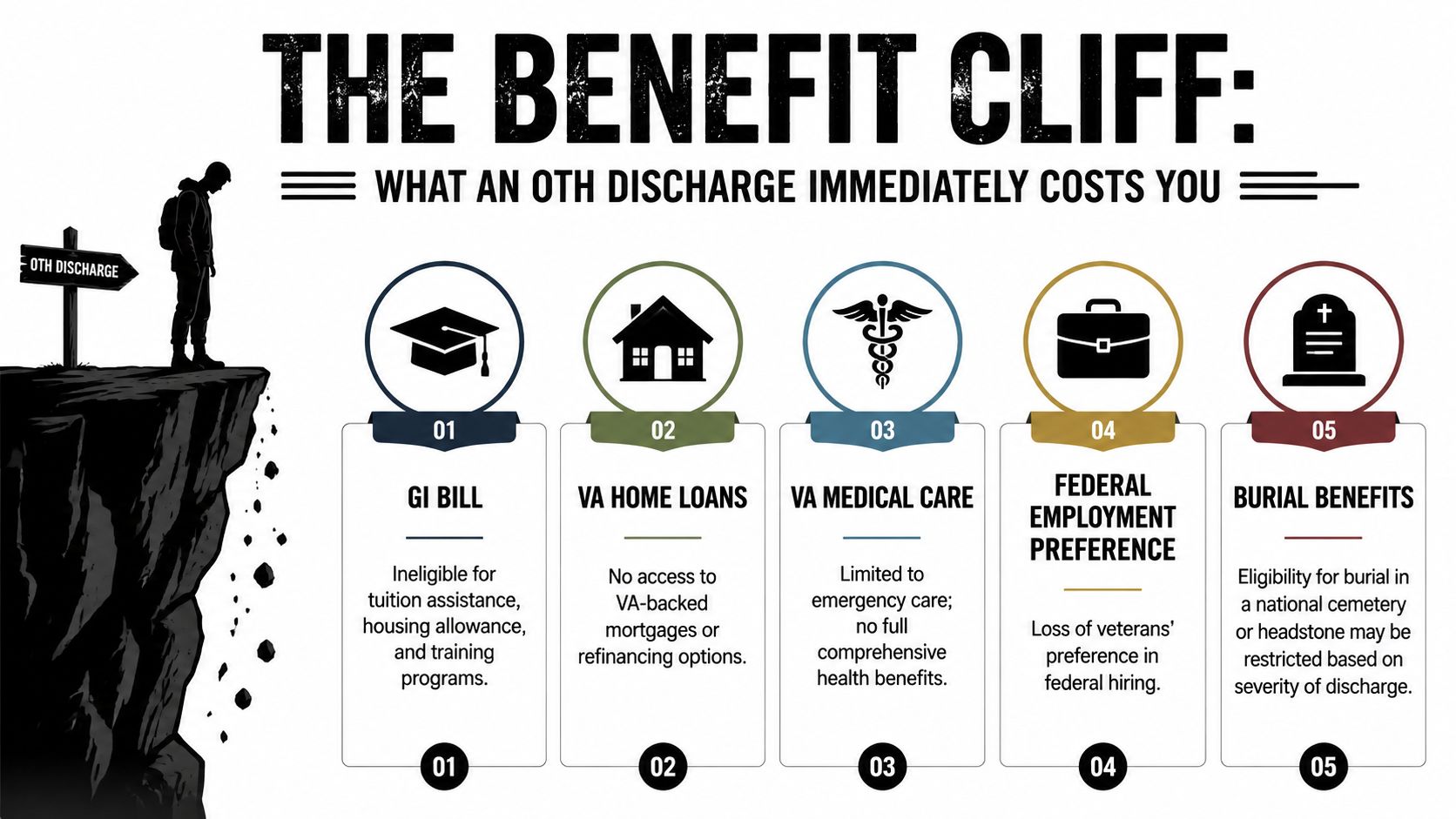
GI Bill and education loss
For many veterans, this is the biggest punch to the face.
The GI Bill is often gone with an OTH. That means no tuition support, no housing allowance tied to school, and no easy bridge into a civilian career change. If you planned to pivot into college, trade school, or technical training right after service, an OTH can crush that plan in a single line on your DD-214.
This isn’t a minor inconvenience. It changes what jobs you can qualify for, how fast you can recover financially, and whether you can afford to retrain at all.
Home loan barriers
A lot of service members don’t think about the VA home loan until they start planning a move, marriage, or first house. Then the discharge issue lands.
An OTH can block access to VA-backed home loan benefits. That matters because the VA path is often the cleanest route into homeownership for veterans and military families. If that benefit is cut off, you may face worse lending options, more cash needed up front, or a delayed home purchase entirely.
Health care and disability claims
This area is more complicated, which is exactly why people mishandle it.
An OTH does not always mean you get nothing from the VA. But it does mean you cannot assume you’ll receive full access automatically. Some veterans still qualify for certain care or compensation after a separate VA review. Others never apply because they assume the answer is no.
That self-defeat is a serious mistake.
Career and reputation fallout
The damage isn’t limited to VA programs.
An OTH can hurt civilian hiring, especially where employers ask for military service records or care about disciplinary history. It can also create problems for positions involving trust, licensing, or background reviews. Even when a job application doesn’t ask directly about discharge characterization, the surrounding facts can surface later.
Here’s the blunt version:
| Area | Likely impact of an OTH |
|---|---|
| Education | GI Bill access can be blocked |
| Housing | VA-backed mortgage path can be blocked |
| Medical support | VA access may require extra review |
| Disability compensation | Often depends on a separate VA determination |
| Employment | Record and credibility issues can follow you |
People often search for “other than honorable discharge benefits” hoping to find a hidden exception that restores everything. That’s not how this works. There may be pathways. There is no magic reset.
An OTH doesn’t just reduce benefits. It reduces options at the exact moment you need options most.
If you are still serving, understand the strategic point. The cheapest, fastest, strongest case is often the one where you prevent the OTH before separation rather than spending years trying to repair it afterward.
Finding the Cracks Exceptions and Pathways to Limited VA Benefits
There is one area where people regularly miss an opportunity. The VA does not copy the military’s label and stop thinking. The VA can make its own Character of Discharge determination for benefit purposes.
That matters because an OTH on your DD-214 does not always end the benefits conversation.

Why the VA path matters
A VA Character of Discharge review is not the same as a discharge upgrade. It does not rewrite your DD-214. It does not restore everything. What it can do is open the door to important benefits while your full upgrade fight is still pending or even if an upgrade never comes.
That distinction is where strategy starts.
For some veterans, the immediate need is health care, disability compensation, or mental health treatment. Waiting on a board to change the discharge may take too long. A VA review can be the faster lifeline, even if it is not the final answer.
What changed in June 2024
The VA changed the ground rules in a major way. The final rule effective June 25, 2024 eliminated categorical regulatory bars like “willful and persistent misconduct” and requires a more holistic review. It also recognizes that compelling circumstances such as documented PTSD or Military Sexual Trauma can presumptively overcome bars to benefits, according to the VA’s character of discharge rule guidance.
That is a real opening for veterans whose records do not tell the full story.
If trauma, mental health symptoms, family emergency, combat stress, or related medical conditions shaped the conduct behind the discharge, those facts now matter more. They should be documented aggressively and presented carefully.
What to file and what to gather
If you are pursuing this route, treat it like evidence work, not storytelling.
Build your file with:
- DD-214 and service records that show dates, assignments, awards, deployments, and the stated reason for separation
- Medical and mental health records that tie symptoms, treatment, or diagnosis to the period of misconduct
- Buddy statements from people who saw the change in your behavior, stress level, functioning, or trauma exposure
- Family statements if home crises or caregiving demands were part of what happened
- A clear timeline that lines up symptoms, events, and command action
If your misconduct has context, your file needs proof. The VA does not fill those gaps for you.
The most common mistake is filing a weak application with a strong story. Strong stories lose when the documents don’t support them. This path can help. But only if it is prepared with the same discipline you’d bring to a contested case.
The Upgrade Offensive Fighting to Change Your DD-214
If the VA path is about limited access, the upgrade path is about changing the record itself. That is the fight that can restore what an OTH took away. It is also the harder fight.

A lot of veterans make the mistake of treating the discharge upgrade packet like a personal statement with attachments. That is not enough. Boards do not upgrade records because they feel sorry for you. They act when the record shows error, unfairness, missing context, flawed process, or compelling mitigation.
DRB versus BCMR
You usually have two main boards in play.
DRB
The Discharge Review Board is often the first stop for former service members seeking to change the character or reason for discharge. It focuses on whether the discharge was improper or inequitable based on the facts and standards that applied.
This is often where people hope for a quick fix. Sometimes they get one. Often they don’t.
BCMR
The Board for Correction of Military or Naval Records is the deeper correction forum. It can address broader errors and injustices in the record. If the DRB route fails, or if the case has structural problems that go beyond the characterization alone, the BCMR may be the stronger battlefield.
The point is not to memorize board names. The point is to choose the right lane, with the right theory, in the right order.
What wins upgrade cases
Evidence wins. Not outrage. Not a vague apology. Not a generic “I’ve changed.”
Strong upgrade packages often include:
- Service records that show meritorious performance, deployments, evaluations, or periods of honorable service
- Medical evidence tying misconduct to trauma, TBI, PTSD, MST, or other service-connected issues
- Witness statements from leaders, peers, chaplains, doctors, or family members who can speak to context and character
- Post-service proof such as stable work, treatment, education, community involvement, or rehabilitation
- A targeted legal theory explaining why the discharge was improper, unjust, or unsupported
Here is the reality check. A VA Character of Discharge decision can take 3 to 6 months to over a year, and Discharge Review Board upgrades for OTH cases have historically succeeded at only about 10% to 15%, according to this review of VA and discharge upgrade paths.
Those odds are exactly why weak filings are a waste of time.
If you want a practical overview of the process, this guide on how to upgrade a military discharge is worth reading. Then get someone who knows how to build the case.
Here’s a useful walkthrough before you file anything serious:
Why timing and sequencing matter
Some veterans should push the VA review first for immediate support. Others need to build the upgrade case first so they do not lock themselves into bad admissions or sloppy narratives. There is no one-size-fits-all answer.
The biggest tactical mistake is assuming the VA path and the upgrade path are identical. They are not. One is about benefits access. The other is about changing the record that follows you everywhere.
That sequencing decision is where experienced counsel earns their fee.
Strategic Insight Why an Attorney is Your First Move Not Your Last Resort
Too many service members call a civilian lawyer after the damage is already done. That is backwards.
The best time to bring in counsel is when the command first starts building the misconduct case, the separation packet, or the paper trail that will later be used against you. A seasoned civilian military defense lawyer can shape what goes into the record, challenge the government’s version early, and protect you from making admissions that hurt both your separation case and any later appeal.
Why self-representation is a strategic error
The VA route and the discharge-upgrade route overlap, but they are not the same. What helps in one forum can hurt in another if it is framed badly. A veteran trying to “just get something filed” can easily submit statements that box him in later.
That’s not theory. That’s how people lose.
Appointed military counsel can be talented, but they operate inside the system and often carry heavy caseloads. Civilian counsel brings independence, focused strategy, and the ability to look at the whole fight, not just the next deadline.
Why structure matters even more now
Recent reporting says emerging 2025-2026 data shows cases with civilian attorney representation perform better in discharge upgrades, and that the DoD and VA are beginning to pilot AI tools for record reviews, which makes well-structured and legally sound submissions even more important, according to this discussion of attorney involvement and AI-assisted record review trends.
You do not beat that environment with a rushed personal statement and a few PDFs.
If you’re trying to figure out who is qualified, start with a serious framework for how to choose the right military defense lawyer. Then interview more than one.
Hire the lawyer who can explain your strategy in plain English, spot the risks you missed, and tell you what not to file yet.
Common Career-Ending Mistakes to Avoid at All Costs
Good cases get wrecked by preventable errors. Most of them come from delay, denial, or bad sequencing.
The mistakes that do real damage
Waiting for command to be fair
Command’s job is not to protect your post-service future. Once separation is moving, you need your own strategy and your own advocate.Talking too freely in hopes of “clearing things up”
Casual explanations become written admissions. Written admissions survive longer than your memory does.Assuming an OTH means zero benefits, so you never apply
That is flatly wrong. VA data shows mental health visits for OTH veterans surged 270% in FY 2021 over FY 2020, and the VA’s eligibility determination rate for those who apply exceeds 72%, according to the VA’s report on expanded mental health services for OTH veterans.Confusing a VA benefit win with a full discharge upgrade
A favorable VA decision can help you access some benefits. It does not automatically fix your DD-214.Filing pro se just to “get something on file”
Bad facts, bad framing, and inconsistent narratives can haunt every later stage of the case.Ignoring medical or trauma evidence
If PTSD, MST, TBI, depression, or family crisis played a role, that evidence needs to be developed properly, not mentioned in passing.Letting records sit in scattered folders
If your records are split between email, paper files, screenshots, and old phones, your case gets weaker and slower.Treating other than honorable discharge benefits like a yes-or-no question
The question is which path gives you the best result fastest, without damaging the larger case.
The hard truth
Some mistakes can be repaired. Some can only be managed. The earlier you act, the more choices you still have.
Your Immediate Action Plan and Critical Questions
You need a triage plan, not more internet wandering.
Start here:
Secure every document now
Save your separation paperwork, counseling statements, evaluations, awards, medical records, mental health records, CID or command paperwork, and your DD-214 if you already have it.Build a clean timeline
List key events in order. Include deployments, incidents, treatment, command action, witness names, and family emergencies. Keep it factual.Talk to experienced civilian counsel before you file anything major
The order of operations matters. So does wording. One bad filing can create avoidable problems in the next forum.
Can I get benefits while my upgrade is pending
Sometimes, yes. A VA Character of Discharge review may open the door to certain benefits even while the discharge itself remains unchanged. Whether that makes sense depends on your facts and the evidence you can prove.
Should I apply to the VA or the board first
It depends on your case. If you need immediate care or compensation, the VA route may be the right first move. If the facts require careful framing to protect the upgrade case, the sequence needs more thought.
Do I need a lawyer before I am discharged
Yes, if you can get one. That is often when the most valuable work gets done, before the record hardens against you.
What should I collect today
Get your service records, medical records, names of favorable witnesses, performance documents, awards, deployment history, and any proof of trauma, family emergency, or treatment. Don’t rely on memory later.
If you are facing an OTH, or you already have one, this is not the time to improvise. Your benefits, your record, and your civilian future can turn on decisions made in the next few days. Talk to an experienced civilian military defense lawyer now, and if you need a place to start comparing reputable options, use this guide to choosing a military defense lawyer to identify counsel who handles court-martial defense, discharge upgrades, and military records correction.