
You’re likely reading this with your stomach in your throat, staring at a Statement of Reasons, a Letter of Intent, or a notice that threatens the clearance your career depends on. That reaction is justified. In the military and national security world, a clearance problem isn’t paperwork. It’s a threat to your job, your reputation, your promotion path, and in some cases your ability to stay in uniform at all.
Service members make the same fatal mistake over and over. They treat the security clearance appeal process like a misunderstanding they can clear up with a quick explanation. That’s wrong. This is a formal fight inside a rigid system, and the system doesn’t care that you’re stressed, busy, deployed, or relying on somebody in command who says they’ll “help.”
The first question is not whether you’re a good person. The first question is whether you’re already behind.
Table of Contents
- Your Career Is on the Line the Moment You Get a Statement of Reasons
- The Two Arenas for Your Appeal DOHA and PSAB
- A Critical Distinction Military Suitability vs Security Clearance
- Building Your Case File Evidence and Documentation
- Common Mistakes That Will Destroy Your Appeal
- Why Your Appointed Military Counsel Is Not Enough
- Frequently Asked Questions and Your Next Move
Your Career Is on the Line the Moment You Get a Statement of Reasons
The day you receive a Statement of Reasons or Letter of Intent is the day the clock starts running against you. There is no grace period for panic. There is no bonus time because your command is busy. There is no allowance for “I thought I had more time.”
Under one published explanation of the process, service members face a strict 10-day deadline to file a Notice of Intent to Appeal after receiving a Letter of Intent to Deny and Statement of Reasons, and must then submit their full security clearance appeals letter with supporting evidence within 30 calendar days of the NOIA filing to avoid automatic denial (security clearance appeal deadlines explained here).
What the paperwork really means
That document in your hand is the government telling you it has identified concerns serious enough to deny or revoke access. It may involve finances, personal conduct, alcohol, drugs, criminal allegations, foreign influence, or honesty problems tied to your SF-86. The exact issue varies. The underlying fact is consistent.
You are no longer in an informal discussion. You are in a record-building contest, and whatever goes into that record can follow you long after this appeal is over.
Practical rule: The first response is often the cheapest chance to fix the case. Blow it, and every later stage gets harder.
A lot of service members also fail to see the larger career danger. Clearance problems can spill into collateral damage, including adverse personnel action, stalled assignments, and discharge-related consequences that affect long-term benefits. If your case is already touching separation issues, you also need to understand how discharge status can affect your future access to support and compensation, as explained in this guide to other than honorable discharge benefits.
What you need to do first
Your immediate job is simple.
- Read every line of the SOR or LOI.
- Calendar every deadline the same day.
- Preserve every document you received, including envelopes, emails, and attachments.
- Stop freelancing your response until somebody who handles these cases has reviewed it.
- Identify every allegation that needs evidence, not excuses.
Don’t hand in a rushed emotional rebuttal. Don’t assume your sincerity will carry the day. In the security clearance appeal process, timing and structure matter almost as much as the underlying facts.
The Two Arenas for Your Appeal DOHA and PSAB
You receive the denial packet, skim the allegations, and assume the appeal is one lane with one decision-maker. That mistake costs people their clearance. These cases split into different forums, and the forum shapes the record, the pressure points, and your odds.
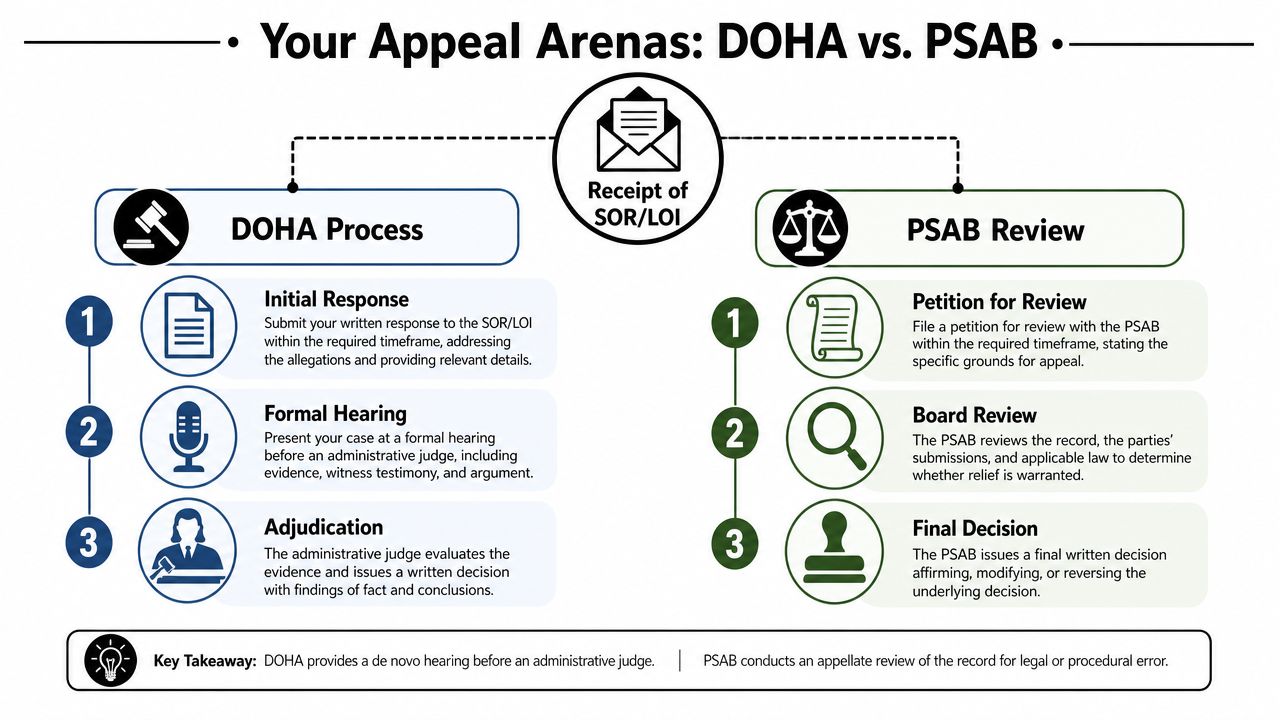
For most Department of Defense contractor and civilian clearance cases, the contested denial process runs through the Defense Office of Hearings and Appeals. DOHA handles hearings before an administrative judge and issues decisions in security clearance cases, as reflected in the agency’s own DOHA administrative judge decisions and appeal board records. That matters because a hearing case is not just paperwork. It is a chance to put witnesses, exhibits, explanations, and credibility into the record in a way a paper review never will.
The other arena is the appeal board process, often referred to in practice as PSAB review in military-related discussions. That route is narrower and less forgiving. Once you are in a board-style review posture, the written record controls. If your file is thin, disorganized, or full of holes, nobody is coming to rescue it.
Here is the practical difference:
| Appeal arena | What it means for you | Strategic reality |
|---|---|---|
| DOHA | You present the case to an administrative judge, usually with a developed evidentiary record | Strong preparation can repair a bad first impression. Weak preparation gets exposed under questioning |
| PSAB | A reviewing board examines the written record and the legal posture of the case | Your documents must carry the case. New explanations late in the process usually carry less weight |
That choice is not cosmetic. It affects how you should prepare from day one.
A DOHA hearing helps when credibility is a live issue, when the allegations need context, or when your mitigation makes sense only after someone hears the full timeline. A board review works better only if your documents already tell a clean, persuasive story. If your finances, foreign contacts, alcohol history, or personal conduct issues require nuance, betting everything on a cold written file is reckless.
Navy and other military-connected cases can get more complicated because the review chain may involve service-specific procedures layered on top of clearance adjudication. That is exactly why you need to separate the clearance fight from any collateral personnel consequences. A denial can trigger command action, duty restrictions, or separation problems that run on a different track from the clearance appeal itself. If your case is already bleeding into career status, read how those actions intersect in this guide to administrative separation and military discharges.
The hard truth is simple. You do not “save” your case for the final appeal.
You build it early, or you drag a weak record into a forum that is built to affirm what is already on paper. Talented service members can lose because they treat forum selection like a formality. It is strategy. Pick the wrong arena, or enter the right one unprepared, and the result is usually the same.
A Critical Distinction Military Suitability vs Security Clearance
One of the most dangerous misconceptions in this area is the belief that every military denial can be appealed through the same machinery. That’s false, and people waste valuable time because nobody explains the difference clearly.
These are not the same fight
A security clearance denial and a military suitability denial are not interchangeable. If you mix them up, you may spend weeks preparing for an appeal that doesn’t legally exist.
According to the verified background on this issue, if the military deems an applicant unsuitable for a specific rate or MOS, there is no statutory appeal path, only a Letter of Reprimand allowing limited perspective sharing. Unlike civilian DOJ or DoD clearance denials, which follow hearing and appeal processes, military suitability denials are administrative and non-reviewable, and recent 2024 to 2025 DoD directives confirm that non-appealability (the distinction is discussed here).
That is a brutal distinction, especially for Guard and Reserve members, prior-service applicants, and active-duty personnel trying to move into a different specialty. A person may have a history connected to clearance work and still hit a dead end on suitability for a specific military role.
Why this mistake costs people precious time
People use the wrong labels, chase the wrong office, and file the wrong paperwork while the actual problem sits untouched. That’s what happens when someone hears “denied” and assumes every denial triggers the same rights.
Use this quick comparison:
| Issue | Is there a formal appeal path | What you should focus on |
|---|---|---|
| Security clearance denial or revocation | Usually yes, through the applicable appeal structure | Deadlines, evidence, mitigation, forum selection |
| Military suitability denial for MOS or rate | No formal statutory appeal path under the verified guidance above | Identifying alternative administrative options, record framing, and broader career consequences |
If your problem is really about suitability, not a clearance, you may also be dealing with discharge exposure, retention issues, or other personnel actions. That’s why many service members in this position also need to understand the bigger administrative system, including administrative separation and military discharges.
This isn’t academic hair-splitting. It determines whether you’re walking into a courtroom, a review board, or a bureaucratic brick wall.
Building Your Case File Evidence and Documentation
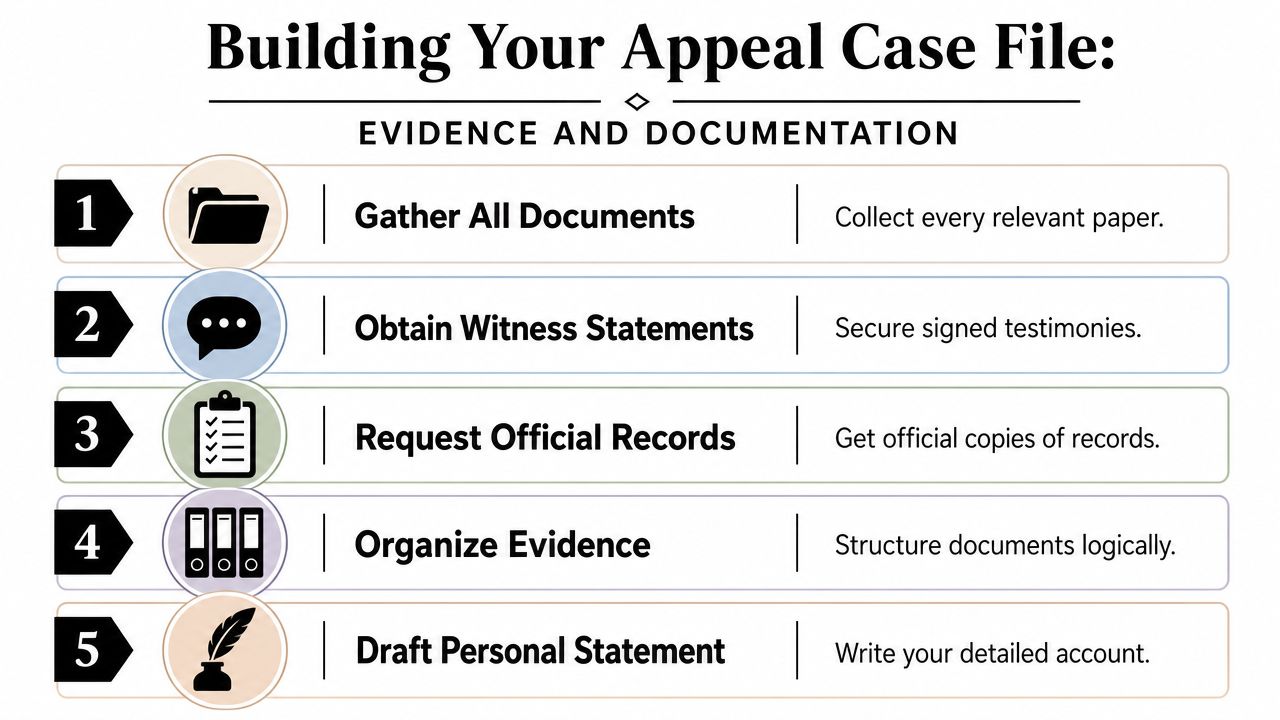
Most appeals fail because the applicant submits a story instead of a case file. You need both. The story explains the problem. The file proves why the problem should no longer control your future.
Start with the allegations, not your emotions
Your appeal package should track the SOR line by line. If the government listed financial delinquency, don’t send a general letter saying you’re responsible now. Show the payments, the settlement records, the counseling, the budget, and the timeline of correction.
If the concern involves alcohol, drugs, or misconduct, don’t give a vague promise that it won’t happen again. Show treatment, testing if available, evaluations, changed circumstances, command or employer observations, and the practical barriers that now make repetition less likely.
Your evidence should answer one question repeatedly. Why is the original concern no longer a current security risk?
A good file doesn’t dodge weak facts. It explains them, contains them, and then overwhelms them with mitigation.
Here’s a useful way to build it:
- Match each allegation to proof: Create a separate section for each concern named in the SOR.
- Fix inconsistencies first: If dates, jobs, debts, treatment history, or police contact are misstated anywhere, correct that early and cleanly.
- Use signed statements carefully: Character letters help when they are specific. “He is a good man” is weak. “I supervised her daily, observed her handling of sensitive duties, and can describe the changes after counseling” is better.
This walkthrough may also help you think about presentation and preparation:
What strong mitigation usually looks like
The right documents depend on the issue, but strong packages often include a mix of official records and personal explanation.
Some examples:
Financial cases
Payment records, tax filings, debt resolution documents, proof of budgeting, and a statement explaining the cause and correction.Conduct cases
Court records if applicable, counseling completion, professional evaluations, performance evidence, and a direct acknowledgment of what happened.Mental health or treatment issues
Appropriate clinical documentation, treatment compliance records, and evidence that the underlying concern is managed rather than ignored.Honesty and SF-86 issues
This is the hardest category. Minimization kills credibility. A persuasive response usually requires complete ownership, a coherent explanation, and independent documents that support the corrected version.
Organize the file like a lawyer would
Don’t dump documents into a PDF and hope the judge figures it out.
Use a clean structure:
- Section A for the notice and SOR
- Section B for your sworn personal statement
- Section C for issue-by-issue exhibits
- Section D for supporting letters
- Section E for a chronology
Then build a short index so every exhibit can be found fast. If a hearing happens, the ability to point the judge to the exact page matters. Sloppy files signal sloppy thinking. In the security clearance appeal process, presentation is part of persuasion.
Common Mistakes That Will Destroy Your Appeal
People don’t usually lose these cases because they’re evil. They lose because they make preventable mistakes under pressure.
The errors that sink otherwise winnable cases
Here are the most common ones.
Missing a deadline by assuming someone else filed the paperwork
Your supervisor, security manager, or coworker isn’t your defense team. If the filing doesn’t happen, the damage is yours.Submitting an emotional response instead of a legal response
“I’ve served honorably” is not a defense by itself. Neither is outrage. The appeal has to confront the stated concerns with documents and disciplined explanations.Trying to explain away obvious bad facts
If the record shows debt, arrest, omission, treatment failure, or misconduct, pretending it’s minor usually makes it worse. Judges and boards punish evasion.Believing there’s no case because the government has paperwork
Government files are often incomplete, poorly framed, or missing context. But that helps you only if you know how to expose the weakness.Reusing the same generic character letter five times
Weak letters say nothing. Strong letters describe personal knowledge, observations, reliability, changed behavior, and why the writer trusts you with responsibility.Assuming command advice is legal advice
Command may care about mission, manpower, optics, or speed. Your interests are narrower and more urgent.Waiting too long to get specialized help
Every day you wait, evidence gets harder to collect, witnesses get vaguer, and bad drafts harden into the record.
The system doesn’t reward effort. It rewards precision.
Another common blunder is misunderstanding what can be argued at which stage. Some stages are built for evidence. Later stages may be limited to errors in reasoning or procedure. If you miss the moment to build the factual record, you may never get it back.
Why Your Appointed Military Counsel Is Not Enough
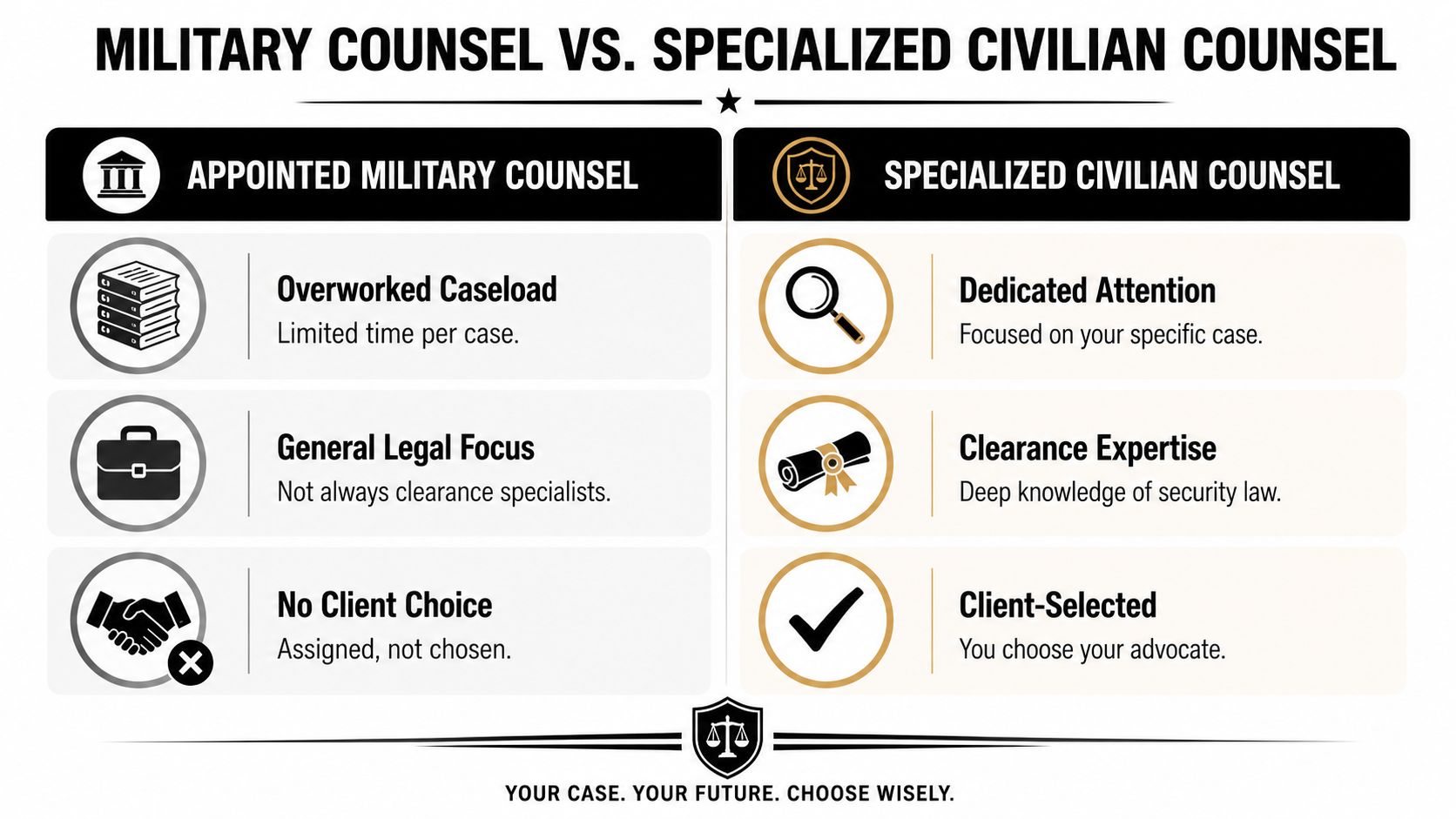
A lot of service members want to believe appointed counsel will cover everything. Sometimes that lawyer is smart, committed, and doing the best possible work under rough conditions. That still doesn’t mean the representation is enough for a serious clearance fight.
Independence matters
Appointed military counsel operates inside the same institution that is processing, documenting, and often reacting to the fallout from your case. That doesn’t make the lawyer disloyal. It does mean the environment is not built around your single problem.
A specialized civilian lawyer brings distance, independence, and one important advantage. You choose that lawyer, and that lawyer answers to you.
That matters when the case has spillover into command relationships, adverse paperwork, suitability issues, separation threats, or collateral UCMJ exposure. It also matters when hard strategic advice needs to be given without institutional friction.
Specialization matters more
Security clearance cases are niche matters. They sit at the intersection of military practice, administrative procedure, records analysis, mitigation development, and witness preparation. General legal competence is not the same thing as targeted experience.
A seasoned civilian defense lawyer who handles military and clearance-adjacent matters knows where these cases usually break:
- Thin mitigation packages
- Credibility gaps between forms and testimony
- Poorly framed personal statements
- Missed opportunities to humanize the record
- Failure to separate suitability problems from actual clearance appeal rights
If you’re evaluating counsel, start with this guide on how to choose the right military defense lawyer.
You don’t hire experienced counsel because the situation is routine. You hire experienced counsel because it isn’t.
Frequently Asked Questions and Your Next Move
FAQ
Can I appeal every denial related to military service?
No. A true clearance denial may be appealable through the applicable process. A military suitability denial for a specific MOS or rate may have no formal statutory appeal path.
Should I choose a hearing or a written appeal?
It depends on the facts, your credibility, and the strength of your documents. Many people underestimate how much preparation a hearing requires.
What happens if I win?
Winning doesn’t always mean immediate return to work in a cleared position. Verified reporting states that appeals can take 6 to 12 months, and 68% of successful appellants cannot immediately reinstate their DoD clearance without a new sponsoring employer. The same report says 2025 DCSA guidance requires a Customer Service Request for Reciprocity initiated solely by the FSO, not the applicant (post-appeal sponsorship and reciprocity issues are discussed here).
Can I fix the case by writing a sincere personal letter myself?
Not if the allegations require documents, mitigation, and legal framing. A personal statement matters, but it is not enough by itself.
Do I need a lawyer immediately?
Yes. Early action gives your lawyer time to preserve deadlines, shape the record, and stop you from making the kind of mistake that can’t be undone later.
Your next move
If you are in the security clearance appeal process right now, stop treating this like a paperwork problem. It’s a career survival problem. Delay makes your case weaker. Sloppy filings make it worse. False confidence can finish the job.
Talk to experienced civilian defense counsel now. If you need help identifying serious options, start with this guide to choosing a military defense lawyer, then speak with multiple lawyers quickly and choose the one who understands both the procedure and the strategy.
If you are under investigation, facing a clearance denial, or dealing with a suitability decision that could wreck your future, act today. Don’t wait for command to sort it out. Don’t trust a template. Don’t assume you’ll get another chance to explain yourself. Your career, reputation, and next chapter are on the line.