
You’re probably reading this after a phone call, a knock at the door, or a “quick chat” request from CID, NCIS, OSI, or CGIS. A fire happened. Somebody got nervous. Now your chain of command is acting polite, but the machine has already started moving. If investigators are asking about fire, smoke, accelerants, damage, texts, insurance, or who was where, treat it like a career emergency.
A lot of service members make the same bad move right here. They search arson 3rd degree, read a few state-law articles, and convince themselves the case sounds minor because the building wasn’t occupied or the property damage seems limited. That mistake can wreck your defense before it starts. In the military, the label you found online may have almost nothing to do with the charge the government is building.
It’s important to understand: Arson accusations don’t just threaten confinement. They put your clearance, rank, retirement, reputation, and future civilian job prospects at risk. If the government thinks the fire was intentional, they will also look for motive, cover-up, fraud, witness pressure, deleted messages, and prior statements that don’t line up.
Table of Contents
- Your Career Is on Fire The Reality of a Military Arson Investigation
- The Third-Degree Arson Trap What Military Prosecutors Actually Charge
- UCMJ Article 126 Explained Simple Arson vs Aggravated Arson
- How We Fight Arson Charges A Defense Lawyer’s Playbook
- Career-Ending Mistakes Service Members Make During an Arson Investigation
- Why Your Appointed JAG Is Not Enough for an Arson Charge
- Frequently Asked Questions About Military Arson Charges
Your Career Is on Fire The Reality of a Military Arson Investigation
The knock on the door is not routine
It usually starts subtly. An investigator asks if you’ve got a minute. Your first sergeant says they just want to clear something up. Somebody mentions a vehicle fire, a barracks incident, a storage area, a training-site burn, or damaged personal property. You think cooperation will make this go away.
That instinct gets people hurt.
Investigators in military fire cases aren’t there to comfort you. They’re there to lock down statements, compare your words to physical evidence, and see whether you help them prove intent. If you don’t understand how these agencies operate, read this plain-English guide to CID, NCIS, OSI, and CGIS investigations before you say another word.
Practical rule: If agents want to “hear your side,” you’re already in danger.
Why the government reacts hard to fire cases
The military takes fire allegations seriously because fire spreads, destroys evidence, and puts people at risk fast. Across the United States, intentionally set fires result in approximately 375 deaths, 1,300 injuries, and $1 billion in direct property loss, with about 210,300 intentional fires each year, representing 13% of all reported fires, according to the Illinois State Fire Marshal arson overview.
That matters for one reason. Once the government hears “intentional fire,” they stop thinking small. They start thinking public safety, property destruction, fraud, retaliation, and command discipline.
A young service member often sees a limited event. A scorched vehicle. Burned gear. A trash fire that got out of hand. Prosecutors see a fact pattern they can expand.
What you should assume immediately
- Your phone matters: texts, location data, photos, deleted messages, and search history can all become evidence.
- Your command is not neutral: command concerns include discipline, optics, readiness, and risk to the unit.
- Witnesses shift: friends who sounded supportive yesterday may start protecting themselves today.
- Small details become motive: a breakup, financial stress, an argument, an insurance issue, or a threat can all be used to build intent.
If you’re under scrutiny in any military arson investigation, stop trying to manage it socially. Start treating it like litigation.
The Third-Degree Arson Trap What Military Prosecutors Actually Charge
Why arson 3rd degree confuses service members
If you keep using the phrase arson 3rd degree, you may be building your defense around the wrong legal system.
That phrase comes from state law, and even there it’s inconsistent. Some states use a third-degree category. Some don’t. Florida, for example, does not recognize third-degree arson at all, and legal consultation logs cited by a Florida defense source reported that 42% of arson-related inquiries from some states incorrectly referenced “third-degree” charges. That’s one reason people walk in with the wrong expectations about what they’re facing, as discussed in this Florida arson charge analysis.
That confusion gets worse in the military. Service members Google a state-law term, find New York or Georgia definitions, then assume the military has a similar ladder. It doesn’t work that way.
What that means inside the military system
Under the UCMJ, the government is not required to honor the categories you found in civilian blog posts. Military prosecutors charge under Article 126, not under whatever state shorthand showed up in your search results. That’s the trap.
Here’s why this matters in real life:
| Issue | State-law mindset | Military reality |
|---|---|---|
| Charge label | “Third-degree arson” sounds lower-tier | Article 126 controls |
| Focus | Degree language can drive expectations | Elements and aggravators control exposure |
| Big risk | Reader assumes “less serious” | Human presence, value, and intent can escalate fast |
A service member who thinks, “This wasn’t a house fire, so it’s probably minor,” is already behind. The government may care less about the phrase and more about whether they can prove the act was willful and malicious, whether the property value crosses a threshold, whether someone was present, and whether there was an intent to defraud.
The internet’s state-law answer is often the wrong answer for a court-martial.
That’s why the better approach is to stop asking, “Is this arson 3rd degree?” and start asking, “What exact Article 126 theory is the government trying to prove, and where is it weak?”
That question gets you into defense mode. The other one keeps you stuck in false comfort.
UCMJ Article 126 Explained Simple Arson vs Aggravated Arson
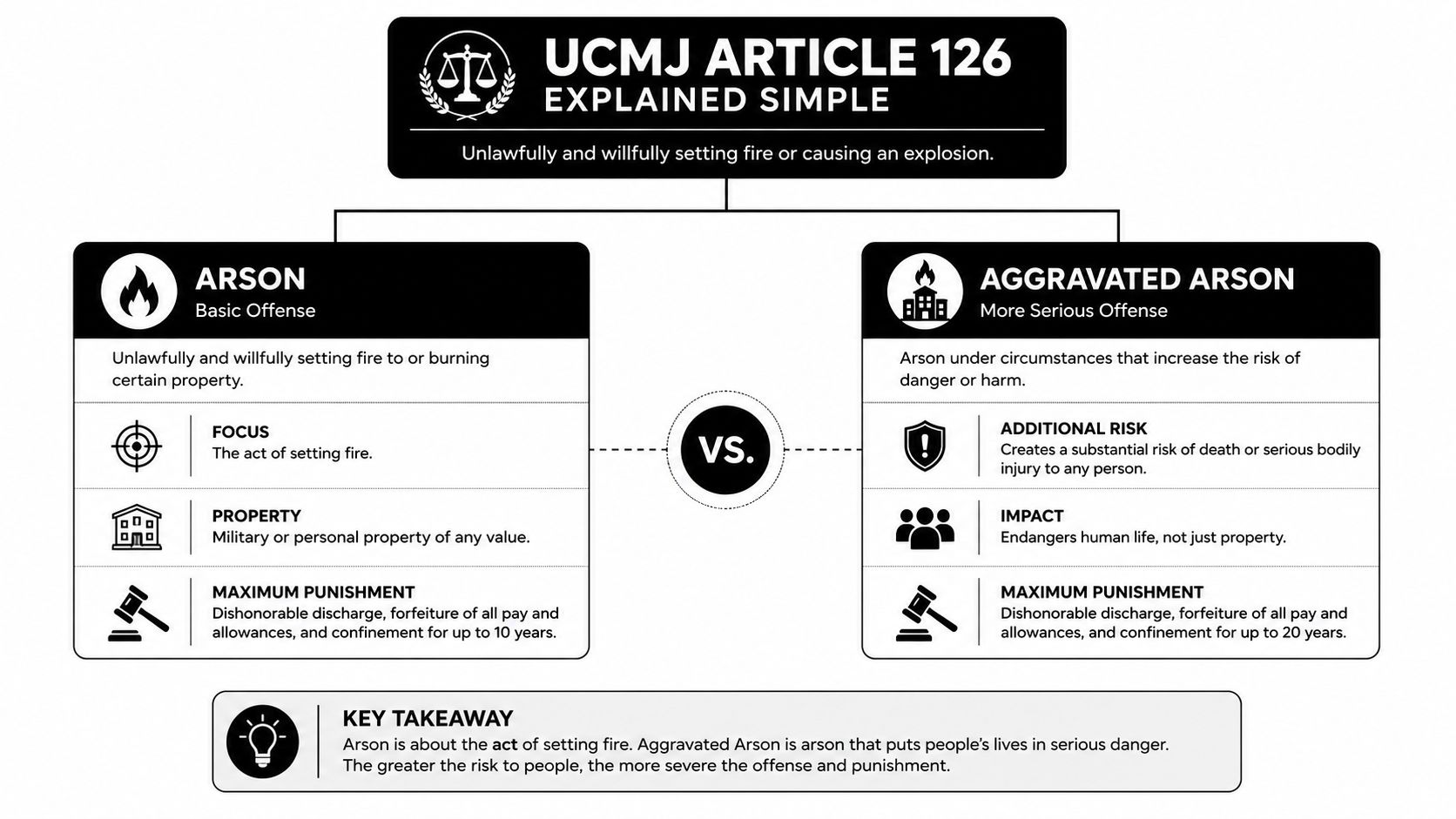
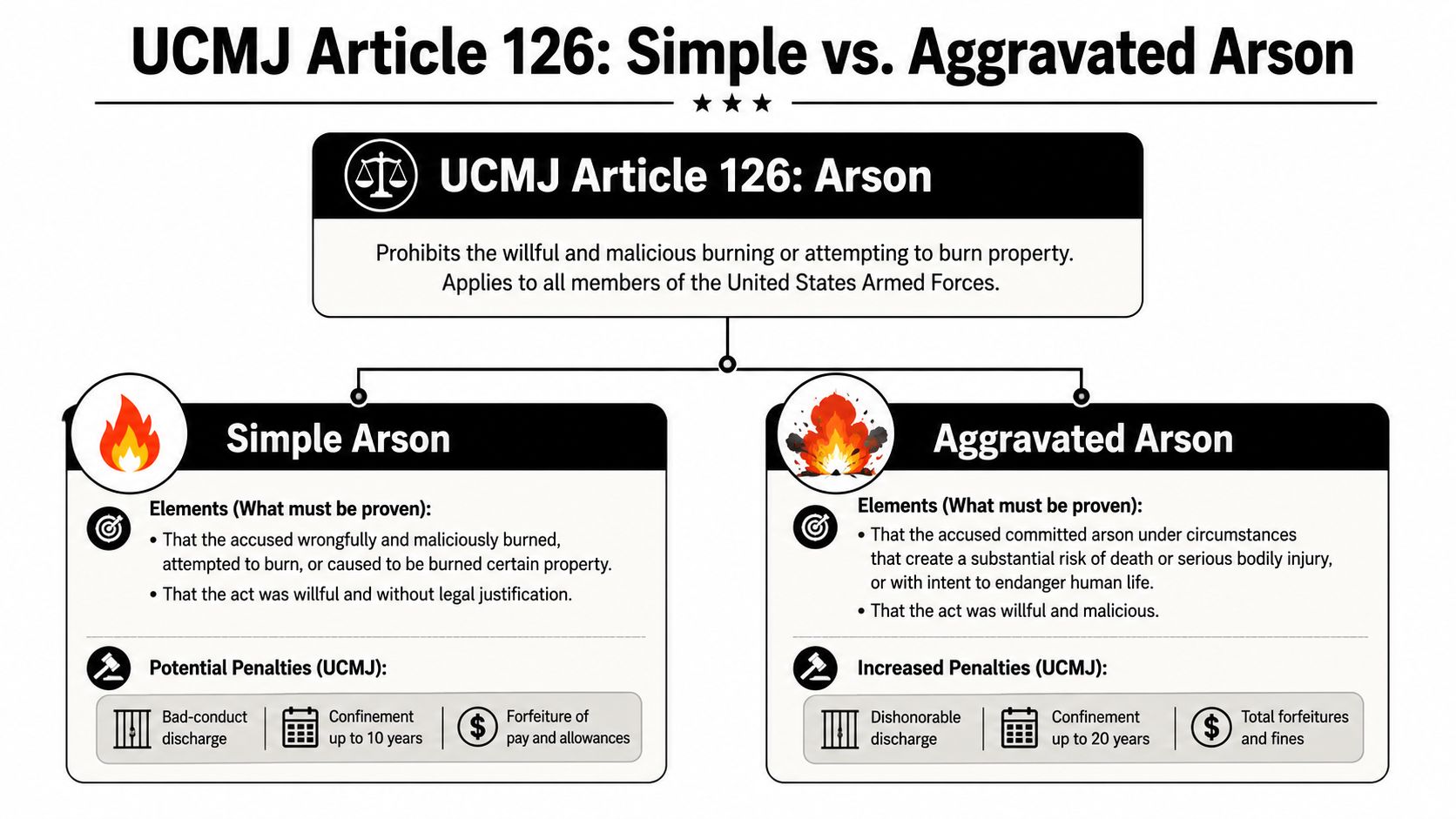
A lot of service members start by asking the wrong question. They ask whether the allegation sounds like “third-degree arson.” That label will not protect you at a court-martial. Article 126 is what matters, and the government will charge the version they can prove from the facts, not the version that sounds less serious on Google.
Start with the split that controls your exposure. Under Article 126, military prosecutors usually build the case as either simple arson or aggravated arson. The difference is not academic. It drives confinement risk, discharge risk, and how your defense needs to be built from day one.
Simple arson under Article 126
Simple arson usually centers on property that was burned or damaged by fire, with the government claiming the act was done willfully and maliciously. Those two words matter. Carelessness is not the same as a crime under this article, and an accident is not the same as malicious burning.
Property value also matters in simple arson cases. A valuation fight can change the punishment range in a serious way, which is why the government often pushes the highest number it can justify. Do not concede value early. Make them prove it.
That is one of the first reasons to study how experienced military defense counsel handle the investigation phase before charges harden. Early mistakes give prosecutors evidence. Early discipline takes options away from them.
Aggravated arson changes the whole case
Aggravated arson is where the danger spikes. If the allegation involves an inhabited dwelling, human presence, or facts showing a real risk to people, you are no longer dealing with a property-only case in the government’s eyes. You are dealing with a charge the prosecution will present as reckless disregard for human life.
That changes how commanders see you. It changes how hard the government pushes. It changes plea discussions. It changes sentencing exposure.
A young service member often focuses on the physical damage. The prosecutor focuses on who could have been inside, who lived there, who was nearby, and whether the structure counts as inhabited. That is the battlefield.
Intent to defraud is a separate threat
Article 126 can also be charged on an intent-to-defraud theory. That usually shows up when investigators think the fire was tied to money, reimbursement, debt, insurance, or some other financial motive.
This kind of allegation is dangerous because the government will not stop with the fire scene. They will dig through your texts, bank records, claims paperwork, command statements, and personal relationships looking for motive. A messy financial picture can become prosecution fuel fast.
What actually decides the charge
The government usually builds an Article 126 case around four pressure points:
Intent
They want your statements, your messages, your search history, your arguments, and your conduct before and after the fire.Nature of the property
They will argue over whether the place was inhabited, occupied, or posed a danger to people.Value and damage
They will use repair estimates, replacement numbers, and government witnesses to push punishment exposure higher.Motive
Money problems, anger, revenge, relationship conflict, or command trouble will be framed as your reason.
Here is the blunt truth. “Arson 3rd degree” is a state-law shortcut. Article 126 is the primary focus. If you do not know whether the government is aiming at simple arson, aggravated arson, or an intent-to-defraud theory, you are already behind.
How We Fight Arson Charges A Defense Lawyer’s Playbook
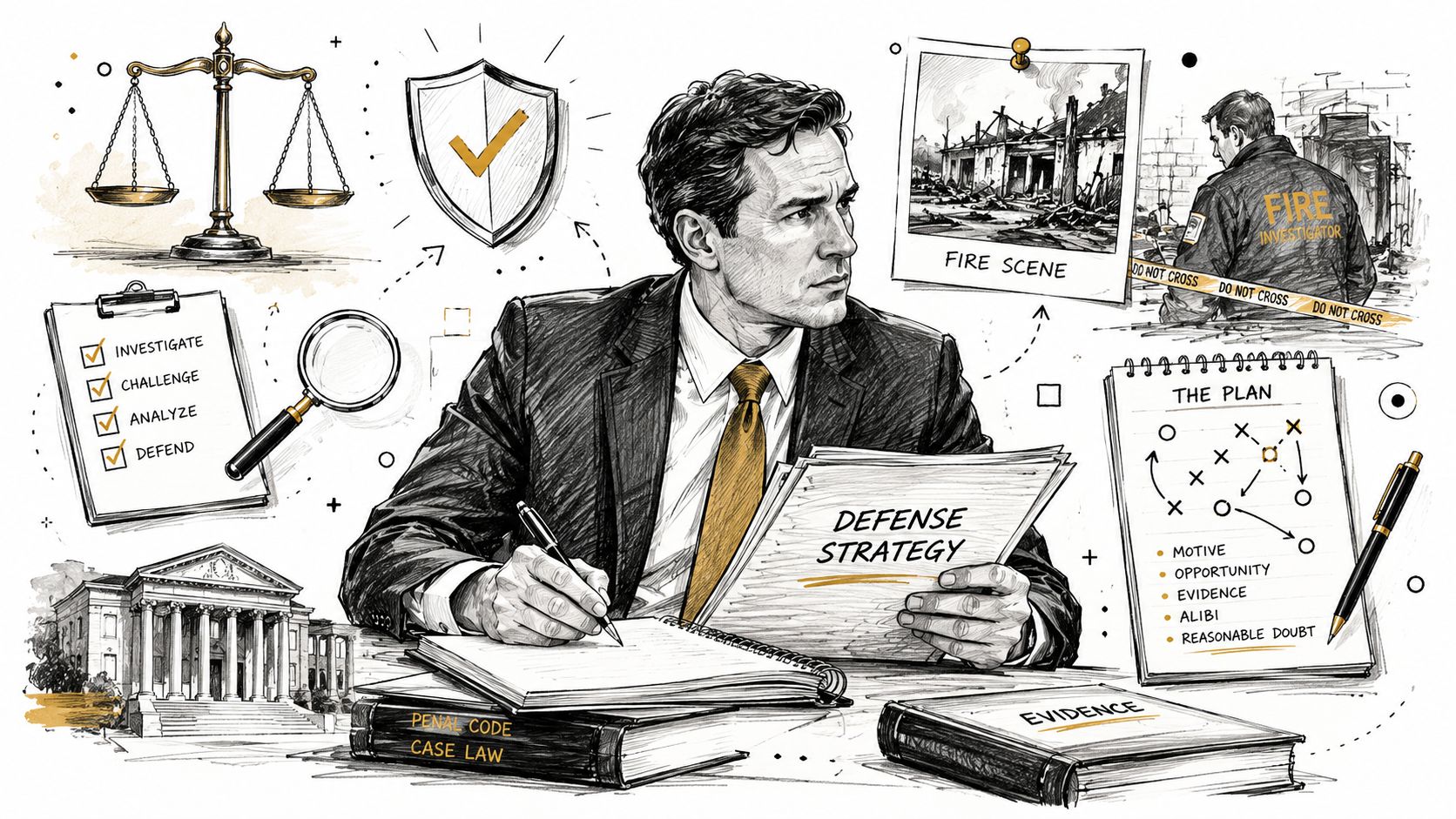
Start with the fire science
The government likes to present arson cases as solved by experts. Fire patterns. debris. accelerants. ignition points. That sounds clean in a report. It rarely stays clean under pressure.
Good defense starts by tearing apart the origin-and-cause story. Who entered the scene first? What moved? What got photographed late? What assumptions did the fire investigator make? Did the report jump from “suspicious” to “intentional” without enough support?
That early phase matters so much that it pays to study how experienced counsel win during the military investigation phase before they make a single strategic decision.
Attack intent and ownership issues
Even where there is fire damage, the government still has to prove criminal intent. That’s where smart defense work starts opening doors. A fire can be accidental. It can be misread. It can involve conduct that looks bad but doesn’t satisfy the charged offense.
Affirmative defenses matter too. In New York third-degree arson law, a defendant may raise defenses such as owner consent or lawful purpose, and a cited New York source states that 28% of third-degree arson convictions involving such claims were overturned when defendants proved those elements, as discussed in this New York arson defense analysis. That is state law, not military law, but the strategic lesson is valuable. Consent, lawful purpose, and risk-to-life analysis can matter a great deal in dismantling intent-based fire allegations.
The real defense checklist
- Scene integrity: Was the scene secured properly, or did multiple people contaminate it?
- Expert overreach: Did the fire investigator state conclusions stronger than the evidence supports?
- Alternative cause: Electrical fault, accident, poor storage, or another non-criminal explanation may fit better.
- Identity gap: Even if someone set the fire, can the government prove it was you?
- Statement suppression: If investigators cut corners in questioning, key admissions may be vulnerable.
- Ownership and permission facts: Who owned the property, controlled it, used it, or consented to what happened?
One more point. Fire cases often look stronger on paper than they do in court. Jurors and panel members hear “arson” and assume certainty. A battle-tested defense lawyer slows that down, forces precision, and makes the government prove every element instead of surfing on fear.
Career-Ending Mistakes Service Members Make During an Arson Investigation
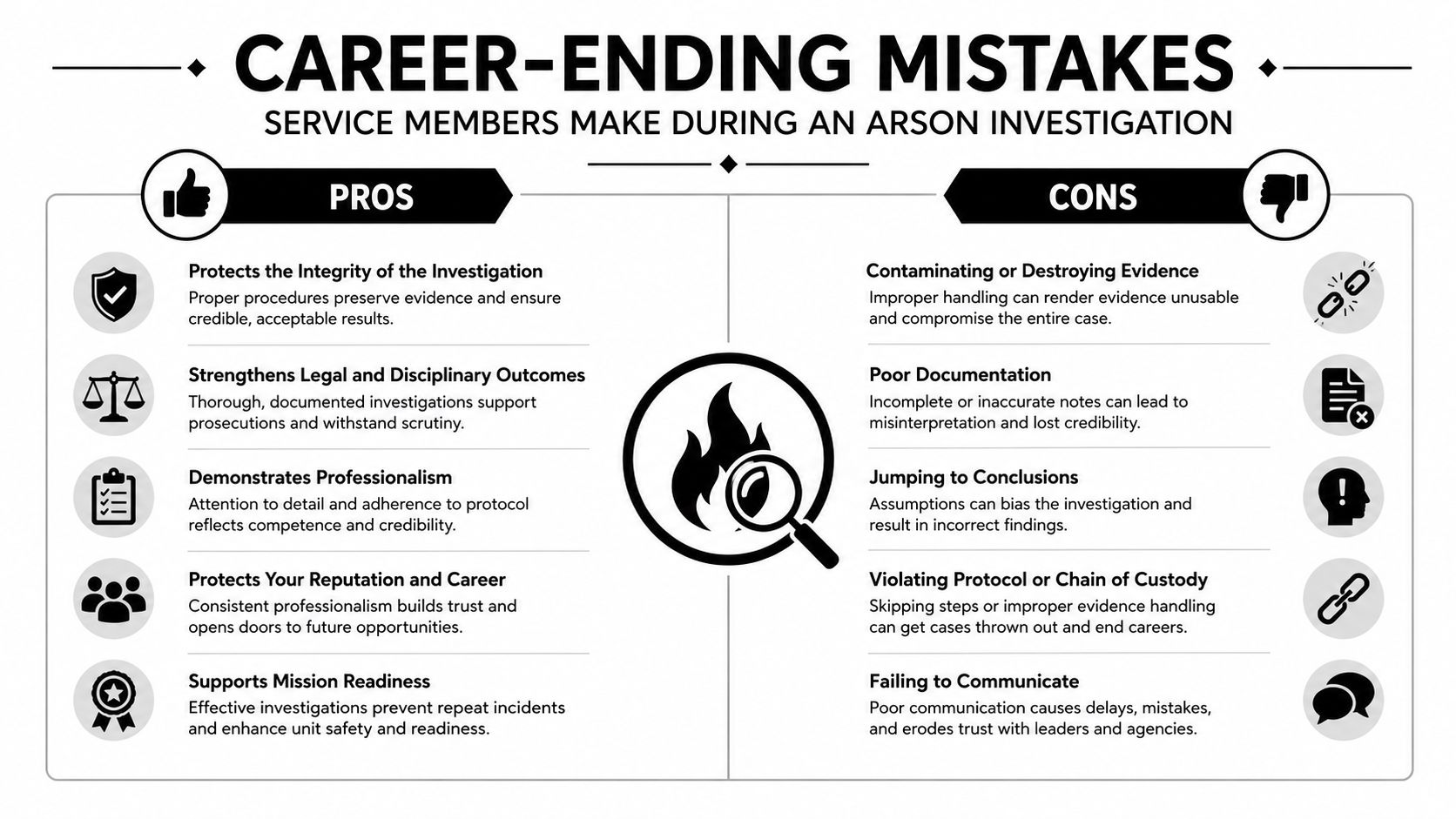
Five ways people sink their own case
Talking to investigators to “clear things up”
This is the biggest mistake. You think you’re giving context. They think you’re giving them admissions, inconsistencies, and motive.Trusting command to protect you
Your commander may like you. Your NCO may believe you. That doesn’t mean they control the investigation or will stop an adverse action once the case gathers momentum.Deleting messages or cleaning up your phone
That looks like consciousness of guilt. Even if your reason was panic, the government will argue you were trying to hide evidence.Waiting until charges are preferred
By then, the government may already have your statement, your device data, witness interviews, and a polished theory. Early defense work is where cases are won.Treating it like a “small” fire
Service members underestimate property cases all the time. Fire cases rarely stay small once prosecutors attach motive, valuation, or risk to others.
Three more mistakes that show up constantly
- Discussing the case with friends or coworkers: they can become witnesses.
- Posting online: jokes, vague posts, and angry responses can all be used against you.
- Assuming lack of evidence means safety: the government may still be building. Silence from investigators doesn’t mean you’re clear.
When you’re under investigation, your job is not to explain. Your job is to stop making the government’s case easier.
A blunt truth. Those involved don’t lose these cases because they’re obviously guilty. They lose because they act scared, impulsive, and unadvised in the first days.
Why Your Appointed JAG Is Not Enough for an Arson Charge
You walk into legal after learning investigators think a fire was intentional. Somebody in the barracks calls it “third-degree arson,” like this is a local civilian case with a familiar label and a predictable outcome. That misunderstanding gets service members hurt. Your problem is not a state shorthand. Your problem is a military prosecution under Article 126, with your rank, pay, clearance, and discharge on the table.
An appointed JAG may be smart, honest, and hardworking. That still does not solve the fundamental issue. Arson cases are technical, expert-driven, and often built on origin-and-cause opinions, witness timelines, phone data, and motive evidence. If your lawyer lacks fire-case experience, trial reps, or the time to get ahead of the government fast, you are already behind.
The stakes justify more than basic coverage. A conviction can put punitive discharge, reduction in rank, confinement, and long-term career damage in play. In a fire case, “good enough” is a bad strategy.
What independent civilian counsel changes
Independent civilian counsel works for you alone. That matters in a case where the government may dress up a weak theory with jargon, investigators, and a confident fire expert. You need someone who has seen that play before and knows how to tear it apart.
A strong civilian defense lawyer can press harder on expert selection, funding requests, cross-examination themes, and pretrial strategy. Just as important, that lawyer is not treating your case like one file among many on an office docket. If you are comparing options, read this guide on how to choose the right military defense lawyer for a serious case and ask direct questions about Article 126 experience, contested courts-martial, and forensic fire evidence.
| Question | Appointed JAG | Experienced civilian counsel |
|---|---|---|
| Who do they answer to? | Assigned within the military system | Retained to defend you only |
| Article 126 and fire-case experience | Inconsistent | You can target lawyers with relevant trial experience |
| Time for your case | Often split across many clients and duties | More focused attention if you choose carefully |
| Use of outside experts | Depends on approvals and office practice | More aggressive case-building, depending on resources |
| Strategic independence | Shaped by the system they work in | Built around your defense objectives |
Here is my advice. Do not assume “appointed counsel” and “protected” mean the same thing. In an arson case, you need independence, technical competence, and somebody willing to challenge the government early, hard, and without worrying about military office politics.
Frequently Asked Questions About Military Arson Charges
Direct answers you need right now
Can I refuse to talk to CID, NCIS, OSI, or CGIS?
Yes. You should exercise your rights and speak with counsel first. “Cooperating” without advice is how people hand the government its roadmap.
What if the fire was an accident?
Then intent becomes the battleground. Article 126 requires intentional, malicious conduct. A genuine accident is not the same thing as criminal arson, but don’t try to prove that alone in an interrogation room.
Can they convict me based only on a witness statement?
They can try. Whether that witness is believable, consistent, biased, or contradicted by physical evidence is where the fight happens.
Will I go to jail?
Possibly. The answer depends on the charge theory, value issues, whether people were present, your record, and how strong the government’s proof is. Don’t assume confinement is off the table.
Can my texts and social media be used against me?
Absolutely. Messages about anger, money problems, threats, deleting evidence, or trying to shape another witness’s story can become central exhibits.
What happens to my security clearance?
An arson investigation alone can trigger serious clearance problems. A conviction can be devastating for clearance retention and future employment.
Do I need a lawyer immediately, even if I haven’t been charged?
Yes. The investigation phase is where the case hardens. Waiting is how good defenses die.
Does “arson 3rd degree” help me understand my military case?
Usually not. It may help you understand what a state article meant. It does not tell you what the government will charge under the UCMJ.
If you are under investigation for a fire, smoke event, explosion, property burning, or anything investigators are calling arson 3rd degree, do not wait for the system to define your future for you. Get counsel now. Early action protects evidence, limits bad statements, and gives you a real chance to challenge the government before the case hardens.
Your career is on the line. Your freedom may be on the line.