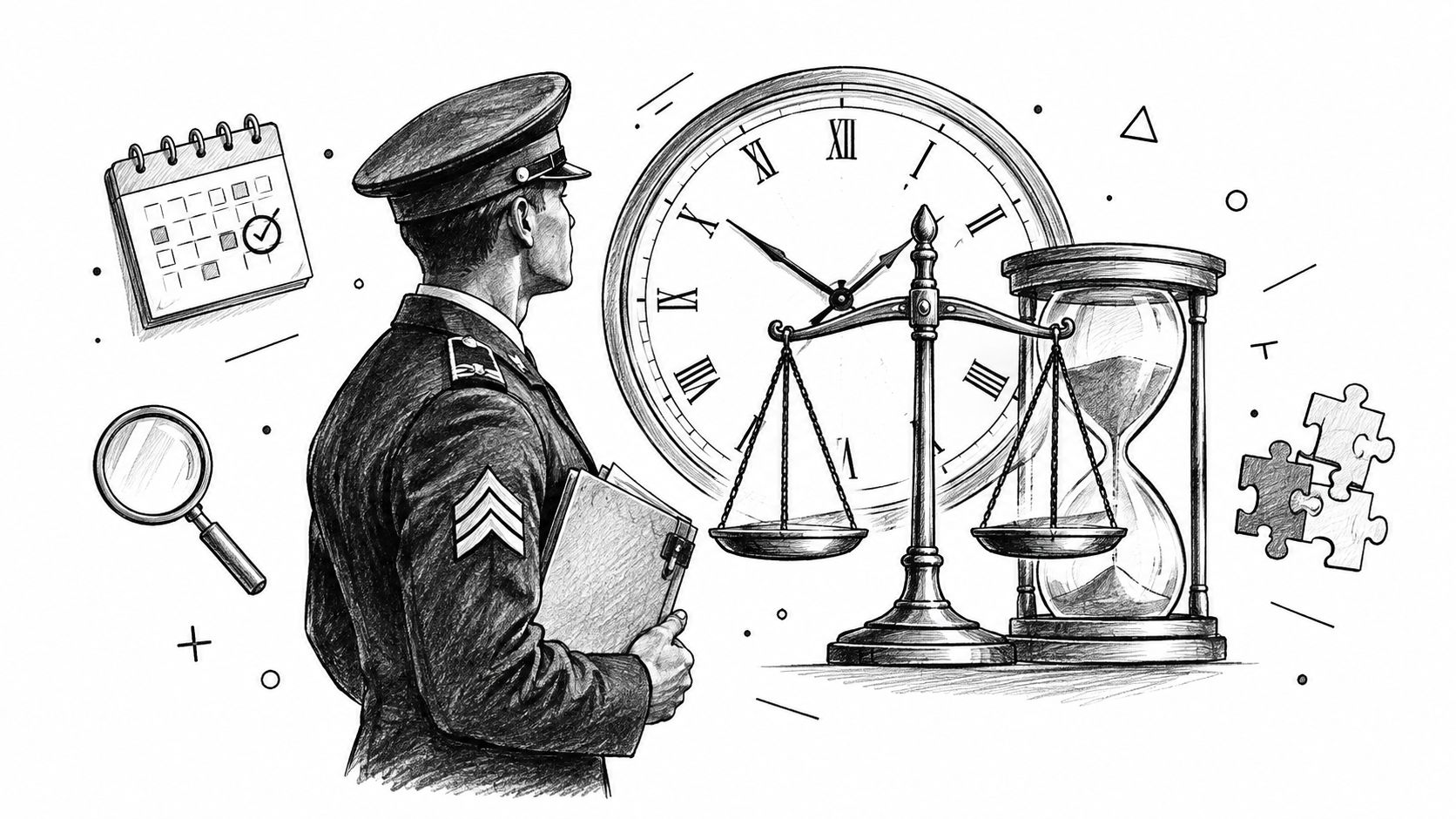
Most USMJ offenses carry a five-year statute of limitations under Article 43, but that rule has critical exceptions for murder, wartime desertion, and sexual offenses that can change when charges may be filed. The deadline often turns on the offense date, the version of Article 43 in force, tolling events, and the date sworn charges reached the proper commander.
You may be reading this because CID, NCIS, OSI, or CGIS has contacted you, or because your command has mentioned an investigation involving conduct that happened years ago. Your first instinct may be to explain, cooperate, or assume the passage of time protects you. That assumption can damage your position before you understand the legal timeline.
A military statute of limitations issue can affect your liberty, career, security clearance, retirement, reputation, and family. The law isn’t a simple calendar calculation. Article 43 requires a fact-specific review of the charge, the alleged conduct, the historical version of the statute, and every event that may have paused or preserved the government’s ability to prosecute.
Table of Contents
- Understanding Your Legal Timeline When Under Investigation
- The Core Rules and How They Apply to Your Case
- Critical Exceptions That Override the Five-Year Rule
- How Military Justice Differs From Civilian Systems
- Applying the Rules to Your Specific Situation
- Why Experienced Civilian Counsel Changes Your Outcome
- Frequently Asked Questions About Military Time Bars
- Does the military always have five years to prosecute?
- When does the military statute of limitations clock start?
- Can an old rape allegation still be prosecuted?
- Can AWOL or desertion charges be time-barred?
- What stops or extends the clock?
- Does dismissal end the case?
- Should I speak with CID, NCIS, OSI, or CGIS?
- Do I need counsel immediately?
Understanding Your Legal Timeline When Under Investigation
A service member receives a message from an investigator asking for an interview. The allegation concerns conduct that allegedly occurred years earlier. The member searches for “military statute of limitations,” sees the five-year rule, and decides there is no immediate danger.
That decision can be wrong in several ways. Most court-martial offenses generally must be received within five years of the offense date by the officer exercising summary court-martial jurisdiction, under the modern Article 43 framework explained in the current text of Article 43. The relevant event isn’t just when an investigator opened a file or when a command first heard a rumor. The legal analysis focuses on the offense date, the charge, and proper receipt of sworn charges.
The historical context matters. Congress enacted the original UCMJ in 1950 and put it into force in 1951. At enactment, Article 43 generally used a three-year limit for most offenses, while certain wartime desertion, aiding the enemy, mutiny, and murder offenses had no time limit. Congress later changed the ordinary period to five years, so older conduct may require analysis under more than one statutory version.
What investigators are doing while you wait
An investigation isn’t a neutral conversation. Investigators collect statements, preserve digital evidence, identify witnesses, and develop a theory of the case. Your explanation may become the government’s most useful evidence, even if you believe you’re clearing up a misunderstanding.
Don’t try to solve the limitations issue in the interview room. Invoke your rights respectfully, decline substantive questioning, and obtain legal advice before making a statement. A practical starting point is this guide to Article 31 rights, which explains why the setting and purpose of questioning matter.
Practical rule: Never assume that an old allegation is harmless because the date looks old. Give counsel the dates and documents, then let counsel test the calculation.
Counsel also needs an accurate chronology, including deployments, leave, confinement, changes of identity, transfers, periods outside military control, and any earlier charges. If you want a broader research workflow for organizing statutes, cases, and amendments, you can also find the best legal research software for legal research.
The Core Rules and How They Apply to Your Case
Article 43 starts with a general rule, but the application requires disciplined date analysis.
Start with the correct event
For most offenses, identify the alleged offense date first. Then determine whether sworn charges were received within the applicable period by the officer exercising summary court-martial jurisdiction. That receipt date can matter more than the date investigators began asking questions, the date a command notified you, or the date a prosecutor reviewed the file.
The distinction is practical. A command may discuss an allegation long before formal charges are received. Conversely, a charge may arrive close to the deadline, requiring counsel to examine whether it was properly sworn, properly preferred, and received by the correct official.
Test every tolling rule
Article 43 includes mechanisms that can suspend the limitations period in some circumstances. Periods involving absence or concealment may affect the calculation, so counsel must establish what happened during each relevant interval rather than count uninterrupted calendar days.
Operational cases require additional care. For certain fraud, real-property, and contract-related offenses, the limitations period is suspended for three years after the end of hostilities, as described in the Army’s Operational Law Handbook discussion of military justice. That rule can keep a wartime procurement or claims case viable when a basic date comparison suggests otherwise.
Review dismissal and refiling history
A dismissed charge doesn’t always end the government’s opportunity. Article 43 contains a savings clause for charges dismissed as defective or insufficient. The government may be permitted to re-pref er charges within the remaining limitations period or within six months after dismissal, whichever is later.
That means the file must show what was charged, why it was dismissed, when dismissal occurred, and whether the new preferral fits the savings provision. A defense lawyer who reviews only the current charge sheet may miss the timing significance of an earlier defective filing.
The right question isn’t “Has five years passed?” It is “Which version of Article 43 applies, what event started the period, and what legally changed the calculation?”
Critical Exceptions That Override the Five-Year Rule
The ordinary period is only the starting point. Article 43 states that offenses punishable by death may be tried at any time. The statute and its revisions also contain special treatment for serious offenses, including murder, rape, and certain wartime offenses. The historical statutory text of Article 43 shows why the date of alleged conduct can control the outcome.
Congress eliminated the statute of limitations for rape under the UCMJ in 2006. The Supreme Court’s decision in United States v. Briggs held that rape was punishable by death under the UCMJ during the 1986 to 2006 period, meaning those cases had no limitations period. A later 2020 CAAF decision in United States v. Adams illustrates that courts continue to litigate which version of Article 43 applies to older conduct.
A practical classification table
| Offense category | Statute of limitations | Key exceptions |
|---|---|---|
| Most routine court-martial offenses | Generally five years under modern Article 43 | Proper receipt of sworn charges, tolling, savings provisions, and the governing statutory version must be reviewed |
| Offenses punishable by death | May be tried at any time | The punishment authorized and the historical law in force require close analysis |
| Murder | May receive no-limit treatment under applicable Article 43 rules | The offense date and statutory version remain important |
| Rape and certain sexual offenses | The deadline depends on the offense date and governing law | The 2006 amendment, Briggs, later legislation, and charge classification can change the result |
| Wartime desertion, mutiny, or aiding the enemy | May fall within no-limit or special wartime treatment | Wartime facts and the precise statutory language control |
Wartime desertion can also create a result that differs sharply from a routine AWOL calculation. The same allegation may receive different treatment depending on whether the conduct occurred during hostilities and which statutory exception applies.
Don’t classify a case by its everyday label. “Sexual assault,” “AWOL,” or “fraud” may describe conduct broadly, but the legal charge and the applicable version of Article 43 determine the limitations analysis. That is why a charge-by-charge review matters more than a search result announcing a general rule.
How Military Justice Differs From Civilian Systems
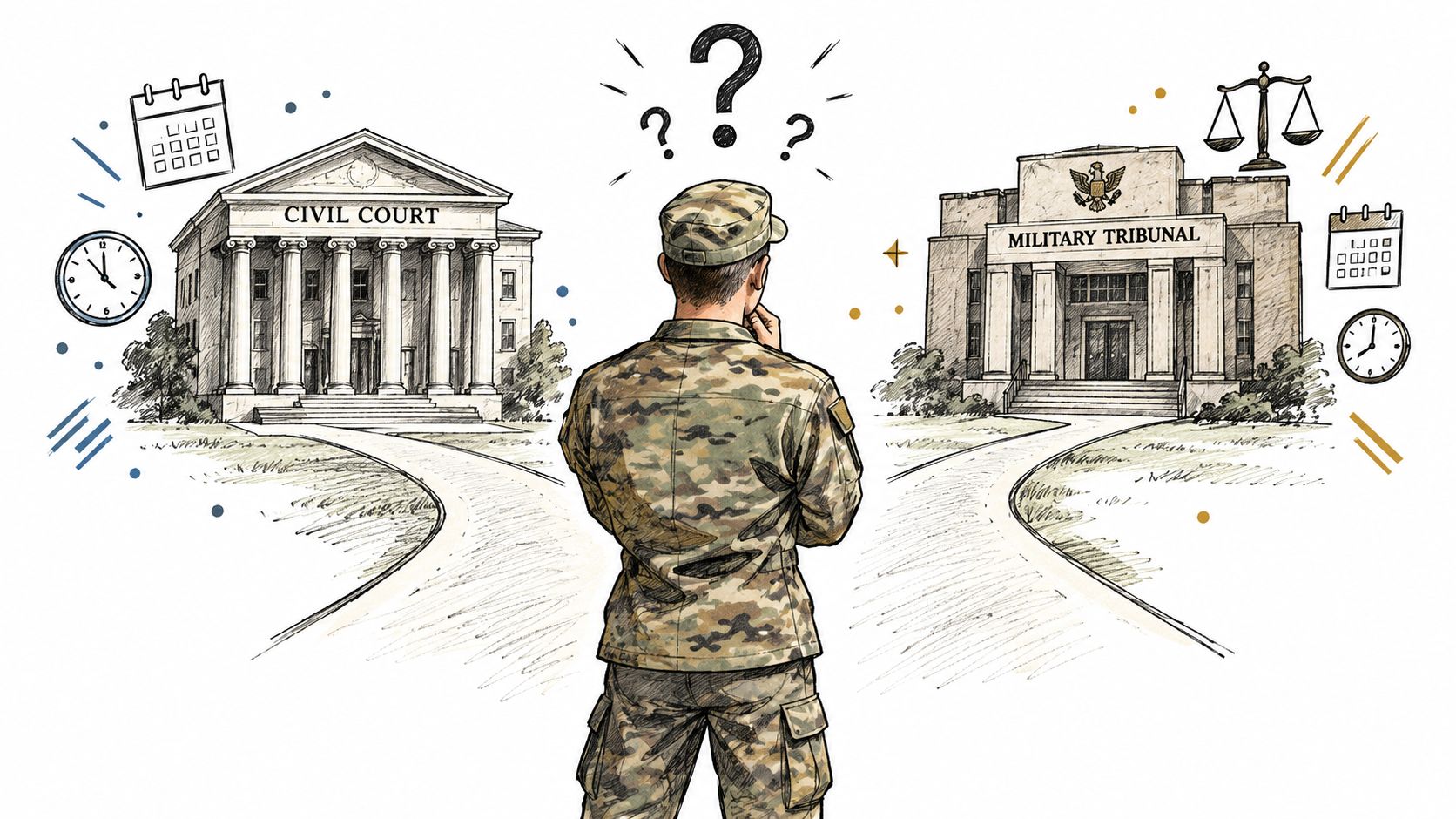
A civilian lawyer may instinctively compare the case to a state criminal code or federal limitations rule. That comparison can mislead a service member because the UCMJ operates through a uniform military statute with its own history, exceptions, tolling provisions, wartime rules, and command-based charging process.
The charging event is different
In a civilian case, people often focus on when police discovered the alleged conduct, when an arrest occurred, or when a prosecutor filed an indictment. Under Article 43, the receipt of sworn charges by the proper military authority is central to the ordinary limitations analysis.
That distinction creates practical risk. A service member may know that command learned of an allegation long ago but still not know whether charges were preferred or received. Counsel must obtain records, not rely on memory or informal statements.
The statute also contains military-specific exceptions. The current framework can treat murder, wartime desertion, and other serious conduct differently from routine offenses. The guide to the UCMJ system provides broader context for how military charges move through the system.
Amendment history can decide an old case
Congress has repeatedly revised military justice law. A rule that applied when conduct allegedly occurred may differ from the rule in force when investigators acted or prosecutors preferred charges. Courts then decide whether a later amendment applies constitutionally and legally to earlier conduct.
The confusion has continued with changes to military justice procedures, including 2025 amendments, and with ongoing litigation over older sexual-offense allegations. The safe approach is to preserve the old records, identify the alleged conduct precisely, and have counsel compare the relevant statutory versions.
Civilian timing logic can produce a confident answer that is still wrong under Article 43.
Applying the Rules to Your Specific Situation
A sound limitations review follows the evidence. It doesn’t begin with the government’s preferred date or with an investigator’s summary.
Build the chronology
Identify the alleged offense date. Pin down the day, location, duty status, and conduct alleged. A date near a statutory amendment may require analysis under competing versions of Article 43.
Identify the exact charge. Determine whether the allegation falls under the general rule or an exception. Do not rely on a shorthand description such as “old sexual assault” or “old AWOL.”
Locate sworn-charge receipt. Find proof of when charges were received by the officer exercising summary court-martial jurisdiction. Ask for the charge sheet, preferral documents, endorsements, and receipt records.
Search for tolling facts. Review absence, concealment, operational status, hostilities, and other facts that may suspend the period. These facts often appear in personnel, deployment, confinement, or investigative records.
Check prior filings. If charges were dismissed, determine whether the government relied on the savings clause and whether refiling occurred within the permitted window.
A hypothetical example
Assume a service member faces a routine offense allegedly committed several years ago. The defense sees that the ordinary period appears to have expired, but the government identifies a period of concealment and an earlier dismissal. The case can’t be resolved by subtracting one date from another. Counsel must determine whether the concealment legally suspended the period and whether the savings clause permits refiling.
An older rape allegation requires a different analysis. Under United States v. Briggs, rape punishable by death during the 1986 to 2006 period had no limitations period, while the 2006 legislative change and subsequent amendments affect later conduct and procedure. The Congressional Research Service analysis of Briggs and military sexual-offense limitations explains why offense date and statutory version remain decisive.
Bring counsel:
- Orders, evaluations, deployment records, and leave records
- All investigative notices and interview requests
- Charge sheets, preferral documents, and dismissal paperwork
- Messages or emails showing when command learned of the allegation
- Records showing absence, confinement, transfer, or identity changes
Don’t edit or delete anything. Preserve the original files and keep communications about the matter limited to your lawyer.
Why Experienced Civilian Counsel Changes Your Outcome
A military-appointed defense lawyer can provide representation and may know Article 43 well. In a serious or factually old case, however, the question isn’t whether appointed counsel is capable. The question is whether your defense has the time, independence, litigation experience, and investigative resources needed to challenge a complicated limitations record.

Civilian military defense lawyers work outside the command structure. They answer to you, maintain an independent professional relationship, and can be engaged before the government settles on a final theory. That independence matters when the case involves a command investigation, a high-profile allegation, or pressure to resolve the matter quickly.
What strong counsel examines
Experienced court-martial attorneys look beyond the charge sheet. They test whether:
- The correct officer received sworn charges
- The government can prove the receipt date
- The charged offense matches the alleged conduct
- The prosecution applied the correct historical statute
- Tolling facts are supported by admissible records
- A prior dismissal triggers the savings clause
- Investigators preserved exculpatory evidence
- Witness accounts changed as the case developed
A limitations motion may be dispositive, but it often succeeds only after counsel reconstructs the record carefully. Waiting until trial can make witnesses harder to locate and documents harder to authenticate. It can also surrender opportunities to challenge the investigation before prosecutors commit to a theory.
This discussion of how experienced counsel approach the investigation phase provides additional perspective on early defense strategy. Administrative support can also matter when a small practice is managing discovery, chronology, and records. A small firm guide for 2026 may help explain how legal assistants support document-heavy work, although support staff don’t replace a lawyer’s judgment.
A useful overview of timing strategy should supplement, not replace, a confidential consultation with counsel:
Verify fit directly, ask who will handle the case, and discuss experience with limitations litigation before hiring anyone.
Frequently Asked Questions About Military Time Bars
Does the military always have five years to prosecute?
No. The five-year rule generally applies to most offenses, but Article 43 includes exceptions and tolling provisions. Murder, wartime offenses, and sexual offenses may receive different treatment, and the offense date can determine which statute applies.
When does the military statute of limitations clock start?
For the ordinary Article 43 rule, the analysis focuses on the offense date and whether sworn charges were received within the applicable period by the proper officer. An investigation opening or informal command notice isn’t automatically the controlling event.
Can an old rape allegation still be prosecuted?
Possibly. Under United States v. Briggs, rape was punishable by death under the UCMJ during the 1986 to 2006 period, so those cases had no limitations period. Later congressional revisions, the exact offense date, and the charge require individualized legal review.
Can AWOL or desertion charges be time-barred?
They may be, but wartime exceptions and the precise charge can change the answer. Don’t apply a routine five-year calculation without checking whether the alleged conduct falls within a special wartime rule.
What stops or extends the clock?
Article 43 may suspend the period during certain periods of absence or concealment. Special operational rules can also suspend time for certain fraud, real-property, and contract-related offenses after hostilities, while the savings clause may permit refiling after a dismissal.
Does dismissal end the case?
Not necessarily. If the dismissal involved defective or insufficient charges, the savings clause may allow refiling within the remaining period or six months after dismissal, whichever is later. The documents and reason for dismissal matter.
Should I speak with CID, NCIS, OSI, or CGIS?
You should identify yourself and comply with lawful instructions, but don’t provide a substantive statement before consulting counsel. Investigators may use inconsistencies, omissions, and speculative explanations against you.
Do I need counsel immediately?
Yes, if an investigation concerns you, charges are threatened, or command asks for an interview. Early counsel can preserve records, control communications, identify the correct Article 43 version, and challenge timing before the government’s theory hardens.
If you’re under investigation or facing possible UCMJ charges, contact an experienced military defense lawyer now. Gather every notice, charge document, order, message, and date you can find, preserve your records, and don’t give investigators a substantive statement before receiving legal advice. The military statute of limitations may offer a defense, but only counsel who analyzes the exact charge, offense date, receipt history, tolling facts, and statutory version can determine whether that defense protects you.