You’re standing outside your commander’s office when a first sergeant hands you a paper and tells you to report immediately. Or CID, NCIS, OSI, or CGIS contacts you and says the command already knows about the allegation. You may be told it’s “just an administrative matter,” “a chance to explain,” or “something that can be handled at the lowest level.”
Treat it as a legal emergency. A commander can affect your rank, assignment, clearance, separation, liberty, and future before a courtroom ever opens. The military commander and the law operate together, but command authority has limits. Your first decision can determine whether those limits protect you or whether you walk into an avoidable disaster.
Table of Contents
- When a Commander Comes Calling
- Understanding the Military Commander and the Law
- How Commanders Make Legal Decisions Now
- NJP Versus Court-Martial Processing
- Unlawful Command Influence and Your Rights
- When and How to Consult Civilian Defense Counsel
- Critical Checklists and FAQs
When a Commander Comes Calling
A service member receives an Article 15 package late in the day. The paperwork alleges misconduct, the command wants a response quickly, and everyone around the member says the same thing: cooperate, be honest, and let the commander handle it. The member starts explaining the facts in text messages, then gives investigators a detailed account without counsel.
That sequence creates risk. Investigations aren’t neutral conversations. Investigators collect information for a command decision or prosecution. A statement made to “clear things up” can become an admission, expose inconsistencies, identify witnesses the government hadn’t found, or lock you into a version of events before you understand the evidence.
The consequences depend on the allegation and the forum. They can include loss of rank, adverse administrative action, separation, confinement, a damaged reputation, and problems with a security clearance. A record created during an investigation can follow you into every later decision, even when the original allegation never produces a conviction.
What to do before you answer
- Stop substantive discussions: Don’t explain the allegation to investigators, command personnel, friends, or coworkers before speaking with counsel.
- Preserve everything: Keep texts, emails, social media messages, location records, photographs, medical records, and names of witnesses. Don’t delete or alter anything.
- Read every document: Identify the allegation, response deadline, proposed forum, and any rights advisement.
- Contact defense counsel: Speak with a UCMJ lawyer before making a statement, accepting punishment, consenting to a search, or signing paperwork.
Your commander may have substantial authority, but that doesn’t mean the commander controls the final legal outcome. The central question is which decision-maker has authority at which stage. That answer changed materially with recent military justice reforms, and guessing wrong is how service members surrender control.
Understanding the Military Commander and the Law
Congress enacted the Uniform Code of Military Justice in 1950, after years of legislative study and hearings, to create a unified legal framework for all service branches. The system built on earlier military justice traditions, including the Articles of War passed for the Army in 1775. The commander remained central through convening authority and command discipline, shaping military law through the post-World War II era. The historical development is discussed in this overview of the UCMJ system and military justice.
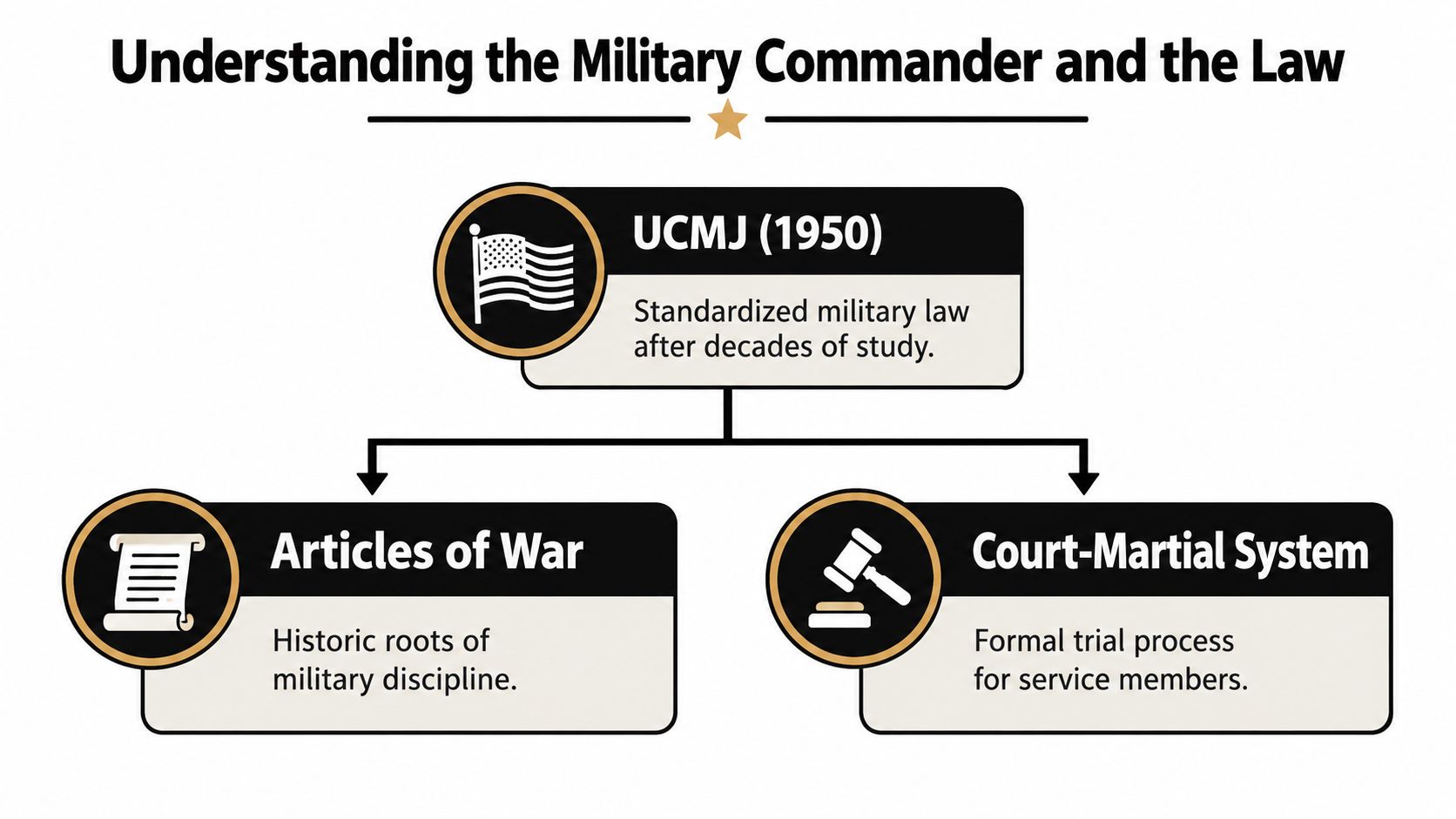
That history matters because command authority isn’t merely managerial. A commander controls personnel and resources, maintains good order and discipline, supports investigations, and must respect constitutional rights. The commander also has to make legally independent decisions and avoid improper pressure from superiors. The Government Accountability Office’s military justice review describes this role as demanding better preparation in investigations, discipline, and constitutional constraints.
The terms that control your case
A convening authority is the official with the power to convene a court-martial and, subject to legal restrictions, refer charges to that court. Referral is the formal order directing that specified charges and specifications be tried by a particular court-martial. Under the Manual for Courts-Martial%20(2023_08_29).pdf?ver=-he0_1JYeb8wsfcAxH_lrQ==), an accuser can’t refer charges to a general or special court-martial.
The staff judge advocate, often called the SJA, provides required legal advice to the convening authority. That advice isn’t a rubber stamp. It can affect charging, referral, evidentiary decisions, and the recommended forum. Your commander may initiate or recommend action, but legal authority is distributed across command, prosecutors, judge advocates, and the court.
The practical rule is simple: command power carries legal responsibility, not unlimited discretion. A commander must preserve discipline while avoiding unlawful command influence, constitutional violations, and legally defective processing. Those obligations create defense opportunities, but only if counsel identifies the error and raises it at the right time.
How Commanders Make Legal Decisions Now
The commander-centered model changed with the reforms that began in 2022. Disposal authority over three categories of covered offenses moved from senior commanders to special trial counsel. That shift affected a substantial share of military justice cases, not just a narrow group of unusual prosecutions.
In the most recent twelve-month period cited by the research, the armed forces tried 1,285 general and special courts-martial, and 570 cases, or 44.4%, involved covered offenses. The Army handled 526 general and special courts-martial, including 299 cases, or 56.8%, involving covered offenses. Those figures are reported in Lawfare’s analysis of authority between special trial counsel and commanders. They show why a service member can’t assume the commander remains the central gatekeeper in a serious case.
The post-reform decision tree
First, identify the allegation. If it falls within a covered category, special trial counsel may control disposal authority that previously rested with senior commanders. The commander still matters, but the commander may no longer decide whether the case proceeds in the same way as before the reform.
Next, identify the proposed forum. Administrative action, nonjudicial punishment, special court-martial, and general court-martial carry different procedures and consequences. A commander can still exercise important disciplinary authority in matters outside transferred categories, recommend action, initiate administrative processes, and influence the command record.
Then, check the legal review. Before charges and specifications go to a general court-martial, the 2024 Manual for Courts-Martial requires the convening authority to submit the matter to the SJA for written advice. This is a mandatory pre-referral checkpoint, reflected in the 2024 Manual for Courts-Martial supplemental material.
Where command discretion ends
A commander can’t lawfully predetermine guilt, demand a particular sentence, or pressure subordinates to produce a desired result. A commander may make a recommendation or take authorized action, but the military justice process requires independent legal judgments by the people assigned to make them.
The Air Force’s 2026 Military Commander’s Legal Review still treats commanders as critical to good order and discipline, while recognizing the need for stronger preparation in legal responsibilities. That tension is the reality. Commanders remain operationally important, but the serious-case decision tree now sends more authority to special trial counsel and requires formal legal review at key points.
If you receive notice that a covered offense is under consideration, don’t waste time arguing that your commander “can’t do anything.” That may be wrong. Instead, determine who has authority, what has already been decided, what remains discretionary, and what legal review is required.
NJP Versus Court-Martial Processing
An Article 15, also called nonjudicial punishment, isn’t a court-martial. It is a command disciplinary process designed to address misconduct without a formal criminal trial. A court-martial is a structured criminal proceeding with counsel, a military judge, evidentiary rules, and the possibility of a panel.
The commander’s role is more direct in NJP. Depending on the circumstances and authority involved, the commander may offer or impose punishment within authorized limits, while the service member may have rights to consult counsel, demand trial in some circumstances, present matters, and challenge the process. The military NJP guide explains why accepting an Article 15 requires a deliberate decision, not an automatic effort to avoid court.
A court-martial creates more procedural protection, but it also exposes the accused to a more formal prosecution. The government must prove its case under the applicable rules, and the defense can litigate statements, searches, witness credibility, command influence, charging defects, and other issues.
Commander Authority Across Disciplinary Forums
| Forum | Commander Role | Special Trial Counsel Role | Likely Outcome |
|---|---|---|---|
| Administrative action | Initiates or recommends adverse personnel action and develops the command record | May advise or participate depending on the matter | Counseling, reprimand, separation, or other personnel consequence |
| Article 15 or NJP | Offers or imposes authorized nonjudicial punishment and considers the member’s response | May become involved where the allegation falls within transferred authority or prosecution is considered | Command punishment without a court-martial |
| Special court-martial | May initiate, recommend, or refer charges when legally authorized | Controls covered-offense authority where assigned by law | Formal trial with a military judge and available panel procedures |
| General court-martial | Acts through convening authority and must obtain SJA written advice before referral | Controls covered offenses within its statutory responsibility | Most serious formal military criminal proceeding |
What moves a case upward
Severity matters, but it isn’t the only factor. Command recommendations, available evidence, the accused’s status, victim and witness issues, SJA advice, and the statutory category of the offense all affect the path.
Don’t accept the argument that NJP is automatically safer. An Article 15 can affect promotion, assignments, clearance decisions, evaluations, and later charging decisions. Don’t assume court-martial is automatically hopeless either. A formal process gives defense counsel tools to test the government’s evidence and expose unlawful influence.
Practical rule: Never choose a forum based on fear alone. Choose after counsel evaluates the evidence, the proposed punishment, collateral consequences, and the command’s legal authority.
Unlawful Command Influence and Your Rights
Commanders can’t turn the military justice system into a predetermined result. Article 37 of the UCMJ prohibits coercing or improperly influencing a court-martial, military tribunal, convening authority, approving authority, reviewing authority, or preliminary hearing officer. The statutory language appears in 10 U.S.C. § 837.
Unlawful command influence can be obvious. A commander may imply that an accused will receive leniency for admitting guilt, threaten harsher treatment for requesting counsel, tell subordinates what sentence should be imposed, or demand a particular charging decision. It can also be more subtle, such as a command climate that rewards conviction-oriented decisions or punishes personnel who question the preferred outcome.
Why UCI matters strategically
When unlawful command influence is raised, the government must prove beyond a reasonable doubt that the predicate facts don’t exist, that those facts don’t amount to unlawful command influence, or that the influence didn’t prejudice the proceedings, findings, or sentence. That burden makes UCI litigation powerful when the defense can establish the command’s statements, timing, audience, and effect. The Armed Forces Court of Criminal Appeals decision describing the government’s burden provides the governing framework cited here.
A defense lawyer will look for emails, briefing slides, talking points, texts, meeting notes, witness accounts, and unusual changes in processing. Timing matters. So does the identity of the person applying pressure and the decision-maker who received it.
This doctrine doesn’t mean every command opinion is unlawful. Commanders can enforce discipline, receive recommendations, and make authorized decisions. The line is crossed when pressure replaces independent judgment or contaminates the proceeding.
Command responsibility in operations
The law of armed conflict imposes a separate, demanding form of command responsibility. A commander may face personal liability for ordering violations, or for knowing or having reason to know that subordinates were committing or about to commit war crimes and failing to prevent, stop, punish, or report them.
The required standard is all feasible measures within the commander’s power. That includes training subordinates on the law of armed conflict, investigating allegations, reporting violations, and taking corrective action when misconduct is substantiated. The International Committee of the Red Cross explanation of command responsibility details those obligations.
For service members, the lesson is practical. Preserve orders, reporting chains, training records, communications, and evidence showing what was known and when. For commanders, weak supervision and missing reports can transform subordinate misconduct into personal exposure.
When and How to Consult Civilian Defense Counsel
Call counsel when investigators first contact you, not after you give them your version. A military-appointed defense lawyer can provide capable representation and is available under the military justice system. A civilian military defense lawyer adds independence from the chain of command, focused attention, and experience handling serious courts-martial and Article 32 proceedings.
The difference is strategic, not merely cosmetic. Appointed counsel works inside a military system with competing obligations and institutional constraints. Civilian counsel isn’t part of your chain of command and can build a defense around the entire problem, including parallel administrative action, clearance consequences, command influence, and trial strategy.
The immediate process
Say you want counsel. Don’t answer substantive questions before receiving legal advice. Article 31 rights are central when the government questions a suspect, and this plain-language guide to Article 31 explains why casual questioning can become evidence.
Document contact. Write down who contacted you, what was said, when it happened, where it occurred, and whether anyone else was present.
Preserve evidence. Save communications in their original form. Don’t coach witnesses, coordinate stories, or conduct your own confrontation.
Ask counsel for the decision tree. You need to know whether the matter involves investigation, NJP, administrative separation, special trial counsel, special court-martial, or general court-martial processing.
Evaluate experience. Ask prospective court-martial attorneys about actual trial work, Article 32 experience, appellate understanding, branch familiarity, overseas representation, and communication during emergencies.
A directory can help with initial screening.
Your first statement is evidence. Your first lawyer consultation should happen before it exists.
Critical Checklists and FAQs
The safest approach is to prepare before a problem reaches your door. Command climate, unit relationships, prior counseling, digital communications, and witness availability can change quickly once an allegation surfaces.
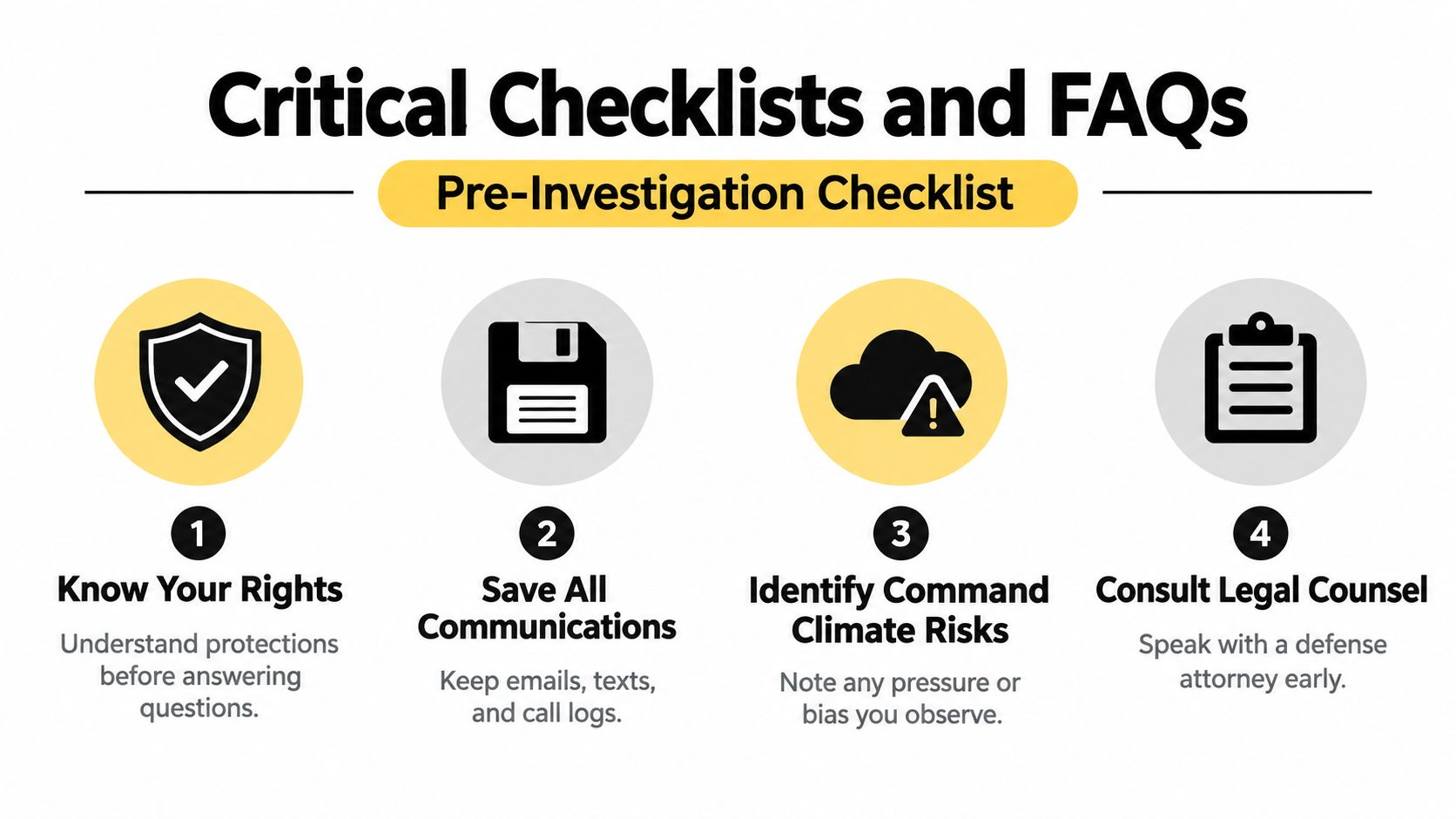
Pre-investigation checklist
- Know your rights: Understand your rights before answering questions or consenting to a search.
- Save all communications: Keep emails, texts, call logs, photographs, and relevant records.
- Identify command climate risks: Note pressure, bias, threats, promises, or statements suggesting a preferred result.
- Consult legal counsel: Keep defense counsel’s contact information available and call early.
After contact with command or investigators
- Don’t explain: Say you want to consult counsel. Don’t fill silence with speculation.
- Don’t sign blindly: Read proposed statements, counseling forms, Article 15 paperwork, and waivers with counsel.
- Don’t delete evidence: Preservation protects you. Destruction can create a separate problem.
- Don’t discuss strategy: Avoid group texts and social media posts about the allegation.
- Request clarity: Ask counsel what authority the commander has, what forum is proposed, and what deadlines apply.
Frequently asked questions
Can I refuse to talk to CID
You can invoke your rights and request counsel before answering questions when you’re suspected of an offense. Don’t lie, obstruct, destroy evidence, or make a spontaneous explanation. State clearly that you want legal counsel and follow counsel’s advice.
What happens at an Article 32 hearing
An Article 32 preliminary hearing examines the charges and the available evidence before a general court-martial referral. The defense may use the proceeding to test allegations, identify weaknesses, examine witness issues, and develop litigation strategy. Your lawyer should explain whether participation, questioning, or submission of evidence serves your interests.
Will I go to jail
You might, depending on the allegation, evidence, charging decision, forum, findings, sentence, and pretrial decisions. No honest lawyer can predict confinement from a notice alone. Get an evidence-based assessment before making admissions or accepting a proposed disposition.
Do I need a lawyer immediately
Yes, if investigators contact you, command gives you paperwork, or you learn that charges may be considered. Early counsel can prevent damaging statements, preserve evidence, address search issues, and shape the defense before the government fixes its narrative.
Can my commander force me to accept Article 15
A commander can’t force you to waive applicable rights or manufacture consent. Whether you can demand trial, what punishment is available, and what deadlines apply depend on the specific paperwork, status, and authority involved. Have counsel review the offer before you respond.
Can my commander control a court-martial outcome
No. A commander may retain authority over certain charging, referral, discipline, and administrative decisions, but can’t lawfully coerce or improperly influence the court-martial or predetermine its result. Covered offenses and serious cases may also fall within special trial counsel authority and mandatory legal review.
When should I hire a civilian UCMJ lawyer
Hire one before an interview, before signing a statement, and before accepting NJP or agreeing to a case resolution. Civilian counsel is especially important when confinement, separation, a security clearance, a covered offense, or general court-martial referral is possible.
The military commander and the law create a system where authority is real, distributed, and constrained. Your job isn’t to argue with every command decision. Your job is to protect your rights, preserve evidence, and force every decision-maker to follow the law.
If you’re under investigation, have received an Article 15 package, or learned that court-martial charges are being considered, contact an experienced civilian military defense lawyer today. Don’t give investigators a statement, sign a waiver, or accept command assurances before counsel reviews your position. Your freedom, career, clearance, and permanent record may depend on what you do before the next meeting.