You get the call late in the day. CID, NCIS, OSI, or CGIS wants to speak with you. Your commander says the matter is serious but tells you not to panic. Someone has made an allegation, and suddenly your career, security clearance, marriage, finances, freedom, and reputation are all exposed.
That moment creates pressure to explain yourself. Resist it. A military court martial isn’t a conversation you can casually talk your way out of. Investigations aren’t neutral, command decisions have legal consequences, and a harmless-looking statement can become the most damaging evidence in the case.
Your first strategic move is to understand the process before you answer questions, sign documents, consent to searches, contact witnesses, or accept an informal resolution. This guide explains what a military court martial is, how the three forums differ, why referral is a major defense battleground, how panel elections affect strategy, what happens after trial, and why early action matters.
Table of Contents
- Introduction When a Military Court Martial Threatens Everything
- What a Military Court Martial Really Is and Why It Is Different
- The Three Types of Courts Martial and How Panel Rules Shape Risk
- How a Military Court Martial Moves From Investigation to Referral and Trial
- Strategic Insights Most Service Members Never Hear Until It Is Too Late
- Common Mistakes That Destroy a Military Court Martial Defense
- Your Next Steps FAQs and Finding the Right Civilian UCMJ Counsel
Introduction When a Military Court Martial Threatens Everything
A service member under investigation often believes the truth will solve the problem. That belief is understandable, but it can be dangerous. Investigators may already have a theory, witness statements, digital evidence, medical records, command messages, or information from another agency. Your explanation may not correct the record. It may fill gaps the government didn’t know how to fill.
The military justice system serves legitimate discipline and accountability functions, but it isn’t designed to protect the accused from every consequence of a poor decision. The government has investigators, prosecutors, command authority, expert resources, and procedural tools. You need your own strategy before the government finishes building its case.
The stakes depend on the allegations and the forum. A court-martial conviction can affect confinement, rank, pay, discharge characterization, employment, professional licensing, immigration, firearms access, and security-clearance decisions. Even when confinement isn’t imposed, a conviction or related administrative action can follow you into civilian life.
Practical rule: Don’t give investigators your version of events before a qualified military defense lawyer has reviewed the situation.
The process can also feel opaque because cases move through multiple decision points. Investigators develop the factual record. Charges may be preferred. An Article 32 preliminary hearing tests the case in a formal setting. A referral authority decides whether specific charges proceed to a specified court-martial. Then counsel litigate motions, evidence, panel selection, findings, sentencing, and post-trial review.
The legal system has deep historical roots. The modern U.S. framework rests on the Uniform Code of Military Justice, adopted in 1950, followed by the Manual for Courts-Martial in 1951, as described in the Joint Service Committee historical report. The name itself is older, tracing back to the “court of the marshal,” an English military tribunal.
You don’t need to master every rule tonight. You do need to stop making unreviewed decisions. Preserve messages and documents, avoid discussing the facts with potential witnesses, and obtain independent counsel immediately.
What a Military Court Martial Really Is and Why It Is Different
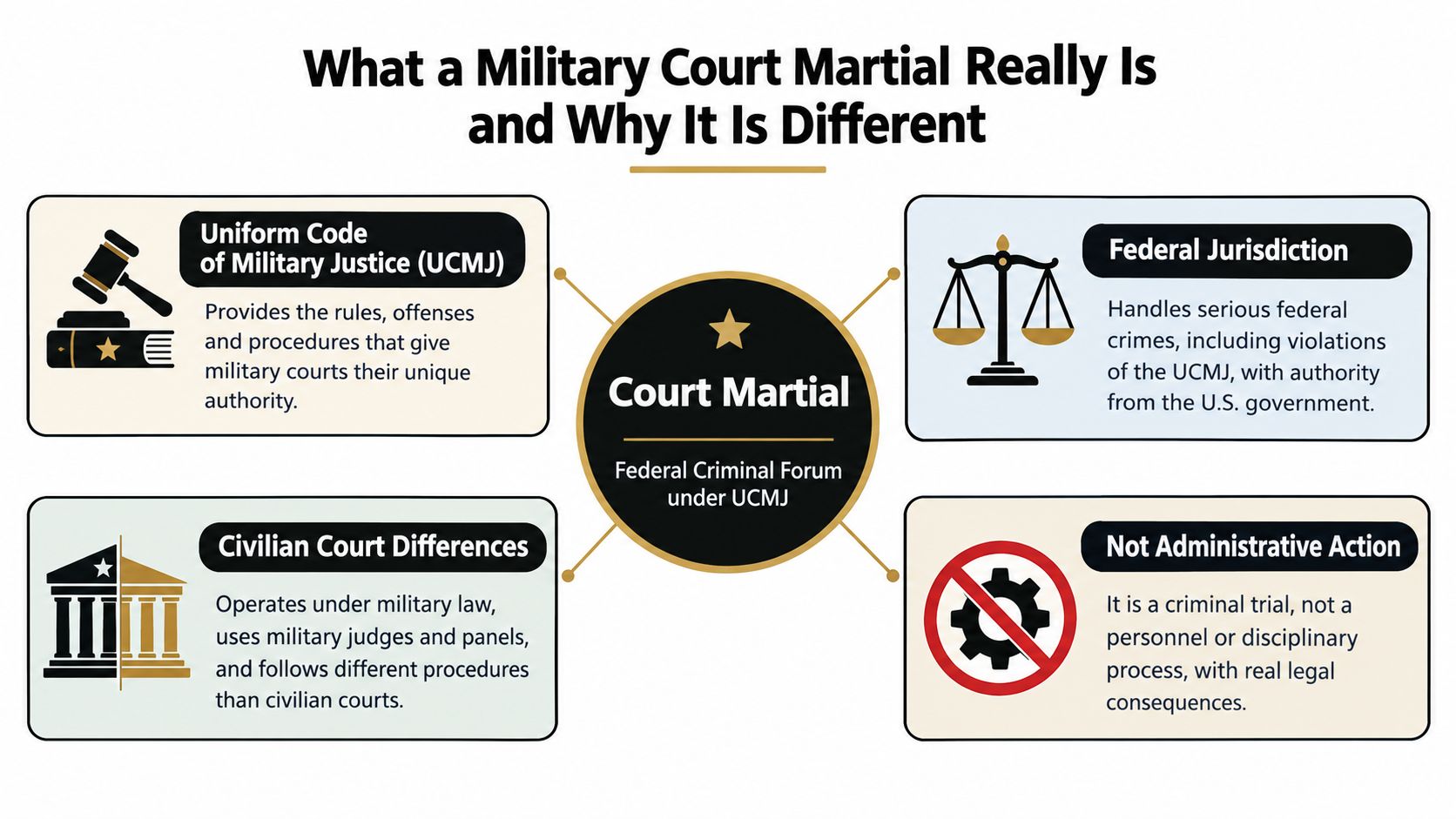
A military court martial is a criminal trial conducted under the UCMJ. It isn’t the same as an Article 15, nonjudicial punishment, administrative separation, or command counseling. Those actions can still damage a career, but a court-martial is a formal criminal forum with its own rules, evidence standards, trial procedures, sentencing structure, and appellate system.
Think of the process as a series of locked gates. An investigation creates the factual record. Preferral places formal charges before military authorities. A preliminary hearing examines the allegations. Referral selects the forum that will try the charges. Trial determines findings and, if necessary, sentence. A mistake at one gate can restrict your options at the next.
The legal framework matters
The court-martial basics guide provides a useful starting point, but don’t mistake a general explanation for case-specific advice. The charge wording, alleged conduct, service branch, evidence, accused’s status, forum, and procedural history all affect defense decisions.
A court-martial can produce consequences outside the courtroom. Civilian employers may ask about criminal convictions. Licensing bodies may review military outcomes. Security-clearance authorities may assess the underlying conduct, the disposition, and whether the service member was candid during the process. Immigration and firearms consequences can also become separate problems.
That fallout isn’t uniform. It depends on the offense category, sentence, discharge, branch, record, and the rules governing the civilian decision-maker. A military conviction doesn’t operate in a vacuum, and defense counsel must plan for the post-verdict consequences before trial begins.
The system has three forums
The UCMJ recognizes general, special, and summary courts-martial, each with different sentencing ceilings and procedural protections, according to the UCMJ text. Calling every court-martial “the same” is a serious analytical mistake. Forum selection can determine practical exposure, panel composition, litigation resources, and appellate posture.
The government doesn’t need to prove your case is emotionally compelling. It must prove the charged elements under the applicable law. Your defense lawyer’s job is to test whether the evidence meets that burden, not merely whether the allegation sounds serious.
The Three Types of Courts Martial and How Panel Rules Shape Risk
The forum is a strategic decision, not a label. A summary court-martial is the least formal forum and carries narrower protections. A special court-martial occupies the middle ground. A general court-martial handles the most serious exposure and provides the fullest trial structure, but referral there can place your career and liberty at greater risk.
| Forum | Maximum Stakes | Panel and Protections |
|---|---|---|
| Summary court-martial | Limited sentencing authority and reduced procedural protections | A streamlined forum that requires careful advice before acceptance |
| Special court-martial | Greater exposure than summary proceedings, with a more formal criminal trial structure | Four members for a modern special court-martial referred on or after 1 January 2019, under the current panel rules |
| General court-martial | The most serious criminal exposure authorized for the charged offenses | Eight members for a non-capital general court-martial referred on or after 1 January 2019, and twelve members for a capital general court-martial under the same modern rules |
A general court-martial isn’t automatically a conviction. It is, however, the forum where the consequences can be most severe. A special court-martial isn’t automatically minor either. Its criminal character and possible sentence can affect your future long after the proceedings end.
Panel election creates leverage
An enlisted accused can request all-officer members or a panel containing at least one-third enlisted members. The request must be made in writing and signed, or stated orally on the record before assembly, as provided in the Rules for Courts-Martial.
The math matters. In a special court-martial, the one-third enlisted requirement means at least two enlisted members. In a non-capital general court-martial, it means at least three enlisted members. That choice may affect how panel members evaluate testimony, military culture, orders, relationships, and alleged misconduct.
This isn’t a popularity contest. Counsel should analyze the case theory, the likely panel pool, rank structure, occupational background, command climate, and the facts that will matter during voir dire. The accused shouldn’t make the election reflexively or rely on old articles describing pre-2019 panel rules.
Panel composition is part of trial strategy. Treat the election as a case decision, not a formality.
The forum also affects appellate posture and sentencing. A lawyer reviewing referral should ask what authority selected the forum, whether the charge language is legally sufficient, whether the evidence supports the chosen allegations, and whether the government is using forum designation to increase pressure for a pretrial agreement.
How a Military Court Martial Moves From Investigation to Referral and Trial
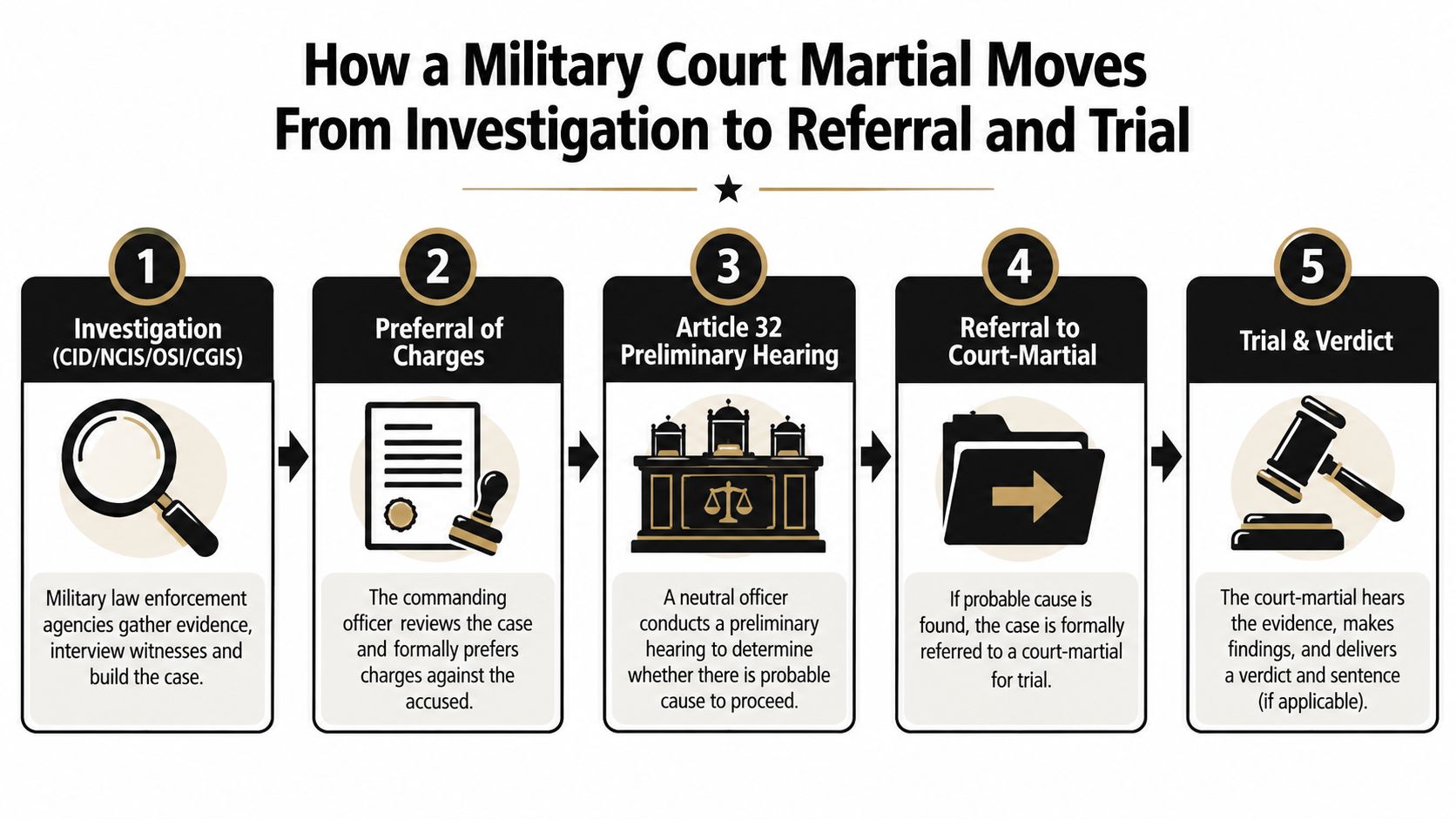
A military court-martial case reaches trial through a chain of decisions. Investigators gather facts, commanders choose how to respond, prosecutors shape charges, a preliminary hearing officer tests the record, and the convening authority decides whether the case proceeds. Each stage gives the defense a chance to expose weaknesses, preserve objections, and stop an incomplete government theory from becoming the official narrative.
Step 1 begins with investigation
CID, NCIS, OSI, or CGIS may collect statements, electronic communications, physical evidence, medical information, access records, and witness accounts. An investigator may present the contact as routine or informal. That setting does not make questioning safe.
Invoke your rights and request counsel. Read about Article 31 rights and military custodial questioning before answering substantive questions. Preserve your own records without altering, deleting, forwarding, or annotating them. Do not contact an alleged victim to “clear things up,” and do not ask friends to coordinate accounts.
Step 2 is preferral of charges
Preferral is the formal accusation stage. The government identifies charges and specifications, but preferral is different from referral to trial. The language still matters because it frames the case and may reveal defects involving dates, locations, acts, mental states, jurisdiction, or statutory elements.
Defense counsel should compare the charge sheet with the investigative record. Look for inconsistent theories, omitted exculpatory information, duplicative specifications, and allegations unsupported by the available evidence. A defective specification can give the defense an early basis to seek correction, dismissal, or limits on what the government may prove.
Step 3 is the Article 32 preliminary hearing
The Article 32 process provides formal review of the preferred charges. A preliminary hearing officer examines the allegations and evidence, then makes recommendations. The hearing does not decide guilt, but it can expose witness problems, evidence gaps, investigative bias, and contradictions before the government commits to trial.
Use the hearing as a discovery and litigation opportunity. Do not treat it as a rehearsal for explaining every fact. Test the government’s proof, preserve favorable testimony, identify missing evidence, and force weaknesses into the record.
Step 4 is referral, the decisive gate
Under the 2023 Manual for Courts-Martial%20%20(2023%20Edition).pdf?ver=pECkw6O3nIfQNYsmCAwIKg==), referral is the convening authority’s order sending specified charges and specifications to a specified court-martial. For a general court-martial, the convening authority must first obtain written staff judge advocate advice.
Referral is a legal checkpoint, not clerical processing. It determines the forum, panel structure, punishment exposure, and later review. Defense counsel should submit focused objections to legally insufficient charges, evidentiary defects, investigative failures, and reasons the case should not proceed as referred. This is a principal point of government gatekeeping. Once referral occurs, the defense faces a more expensive and consequential fight.
Step 5 covers trial and post-trial review
After referral, the court addresses arraignment, discovery, motions, witnesses, experts, exhibits, defenses, panel selection, findings, and sentencing. A conviction starts a structured post-trial process, so counsel must protect the record during trial rather than wait for appeal.
The record can decide whether an appellate court can address an error. The MCM supplementary materials state that documentary and real evidence should be marked when first referenced and included in the record whether admitted or not, as explained in the MCM supplementary materials. Missing or mishandled exhibits can complicate review.
Serious cases also receive staff judge advocate review before action. A post-trial recommendation may affect sentence approval, corrective action, and appellate issues. Pending cases can take time to resolve. Public result datasets, including the UK government’s machine-readable court-martial results collection, provide public information about case outcomes and tracking.
Strategic Insights Most Service Members Never Hear Until It Is Too Late
The government case often breaks at the seams, not at the headline allegation. Experienced military defense lawyers examine how the investigation began, what investigators ignored, which witnesses changed their accounts, and whether the physical or digital evidence proves an element.
That image URL contains a mismatch with the supplied asset path, so it cannot be reproduced without altering the required URL. However, the defense checklist remains straightforward.
Credibility usually decides the close case
Witness credibility is not a side issue. It can determine whether the panel accepts competing accounts, interprets ambiguous messages, or believes a delayed disclosure. Counsel should compare every version of a witness’s story against texts, location information, calendars, medical records, social media, prior statements, and testimony from other witnesses.
Look for:
- Contradictions: A change in timing, sequence, identity, or detail can affect reliability.
- Motive: Benefits, retaliation, relationship conflict, command pressure, fear, or personal advantage may explain a witness’s account.
- Corroboration gaps: A serious allegation still requires proof of the charged elements.
- Objective conflicts: Digital or physical evidence may undermine testimony that otherwise sounds persuasive.
- Interview conditions: Leading questions, repeated interviews, promises, threats, or selective documentation can matter.
Investigators may focus on evidence supporting the allegation and overlook evidence that complicates it. Defense counsel must obtain the complete investigative file and test what was not collected, preserved, disclosed, or explained.
Evidence handling can create pressure
Real evidence, digital files, photographs, laboratory material, and documents must be authenticated and connected to the allegations. Chain-of-custody gaps, missing metadata, unexplained transfers, altered files, and incomplete downloads can create reasonable doubt or support a motion.
A defense lawyer should also assess search authority, consent, scope, timing, and the way agents obtained statements. A service member who consents because an investigator sounds friendly may later face a difficult suppression argument. The safest course is to request counsel before consenting.
Referral and agreements are bargaining points
Referral gives the government an advantage, but it also gives the defense a target. Counsel should scrutinize the staff judge advocate advice, charge selection, forum designation, and whether the evidence supports the proposed specifications.
A pretrial agreement has limits. The convening authority’s authority to enter one extends only to courts-martial, and sentence credit applies against the lesser of the adjudged sentence or the agreement’s cap unless the agreement says otherwise, under the Manual for Courts-Martial agreement provisions. Read every clause. A cap can look favorable until credit language changes the result.
The FY18 DACIPAD data report found that enlisted personnel represented roughly 80% of the active-duty force but 92% of the cases in the database, and that 378 cases were referred to trial by general, special, and summary court-martial in FY18. It also reported that 66% of preferred cases were referred to trial, compared with 64% in FY17, and that conviction likelihood varied by branch. Those figures reinforce a practical point. Exposure isn’t distributed evenly, and branch-specific patterns deserve attention.
Common Mistakes That Destroy a Military Court Martial Defense
Most damaged defenses don’t begin with a courtroom error. They begin when a frightened service member makes an avoidable decision during the investigation.

- Talking to investigators without counsel: Even truthful answers can create inconsistencies or supply details the government lacked. Invoke your rights and obtain advice first.
- Trusting command to handle it informally: Commanders may care about fairness, but they also have duties to discipline, report, protect victims, and preserve evidence. Don’t confuse authority with advocacy.
- Waiting to hire counsel: Early counsel can shape interviews, preservation, searches, witnesses, and referral presentations. Delay gives the government time to define the case without you.
- Assuming no evidence means no case: You may not know what investigators possess. A case can rely on statements, records, messages, or evidence you haven’t seen.
- Consenting to a search: Don’t agree to searches of rooms, devices, vehicles, accounts, or records without legal advice.
- Contacting an alleged victim or witness: A message intended as an apology or explanation can be characterized as pressure, coordination, retaliation, or consciousness of guilt.
- Posting online: Social media can preserve emotion, speculation, jokes, arguments, and admissions for the government, command, civilian employers, or licensing authorities.
- Deleting or altering records: Destruction or editing can create a separate credibility and evidence problem. Preserve material and let counsel decide how to use it.
Why civilian counsel changes the defense
Military-appointed counsel can provide valuable representation and understand the system. Civilian military defense lawyers add independence from command, freedom to focus on your case, and often deep experience with serious trials, investigations, panel selection, evidence litigation, and appeals.
The right civilian lawyer should explain risks without promising an outcome. Ask about actual court-martial trial experience, experience with your service branch, willingness to litigate rather than negotiate, handling of digital and forensic evidence, and post-trial planning.
A directory can help you compare candidates, but don’t outsource the decision to a ranking. Your lawyer must understand the facts, communicate clearly, and build a strategy around your specific exposure.
Your Next Steps FAQs and Finding the Right Civilian UCMJ Counsel
Can I refuse to talk to CID, NCIS, OSI, or CGIS?
You can invoke your rights and request counsel. Don’t lie, speculate, volunteer a narrative, or assume a friendly interview is harmless. Tell investigators you want legal advice before answering questions.
What happens at an Article 32 hearing?
A preliminary hearing officer reviews the preferred charges and available evidence and makes recommendations. It isn’t a verdict, but defense counsel can use it to expose weaknesses, preserve issues, and challenge whether referral is justified.
Will I go to jail?
You may face confinement if convicted and sentenced to it, but the result depends on the charges, forum, evidence, findings, sentencing rules, and mitigation. No lawyer can responsibly guarantee the outcome before reviewing the case.
How long does a military court martial take?
There is no reliable universal timeline. Investigations, discovery, expert review, motions, witness availability, command decisions, and post-trial processing can all affect duration. Pending-case data shows that backlogs and processing pressure are real, not imaginary.
Can a conviction affect civilian employment or a security clearance?
Yes, it can. Employers, licensing authorities, immigration officials, firearms decision-makers, and clearance authorities may evaluate the conviction, underlying conduct, sentence, discharge, and your candor. Ask counsel about collateral consequences before deciding whether to negotiate or litigate.
How do I choose a civilian UCMJ lawyer?
Choose counsel with meaningful court-martial trial experience, not merely a general criminal-law website. Review trial and appellate experience, service-branch familiarity, investigative strategy, communication practices, and whether the lawyer teaches or writes substantively about military justice. When evaluating a firm’s online authority and visibility, resources on attorney SEO in AI search can help explain why credible legal information appears in search results, but search visibility isn’t a substitute for courtroom experience.
If you’re under investigation, facing preferral, awaiting an Article 32 hearing, or dealing with referral, act now. Don’t give another statement, consent to a search, contact a witness, or sign an agreement before speaking with independent civilian military defense counsel. Contact a qualified UCMJ lawyer today, preserve every relevant record, and get a defense strategy in place before the government makes the next move.