
A Staff Sergeant is standing in a motor pool at 0200, exhausted, dirty, and one signature away from a deadline her unit is about to miss. A captain tells her to fix the dispatch log so the numbers line up. She hesitates. He gets sharper and says, “That's an order.”
That is the moment people misunderstand.
The legal danger in disobeying a lawful order doesn't start when charges are preferred. It starts the second the order is given and the subordinate has to decide whether to comply, refuse, stall, ask questions, or create a record. In the military justice system, orders are presumed lawful unless challenged. That means the service member carries the practical risk from the start, even before a lawyer is called, before CID or NCIS opens a file, and before anyone says “Article 92.”
Most Article 92 cases don't begin with some cartoon version of criminal misconduct. They start in gray space. An order is rushed, verbal, incomplete, badly phrased, retaliatory, or tied to optics. The subordinate reads the room and realizes the wrong move can wreck rank, career, freedom, and reputation.
If you're in that position right now, stop thinking only in terms of obedience versus refusal. The problem is evidence. If this turns into an investigation, the command will have emails, logs, sworn statements, and a clean narrative. If you have nothing but memory, you're already behind.
Table of Contents
- When a Direct Order Becomes a Career Crisis
- What Article 92 Actually Prohibits
- Maximum Punishment and How Command Discretion Changes the Math
- Why Obeying First and Complaining Later Is Dangerous Advice
- How Defense Lawyers Attack Article 92 Cases
- From Investigation to Court-Martial: What Happens
- Common Mistakes That Destroy Article 92 Defenses
- Why Civilian Military Defense Counsel and a Path to Next Steps
When a Direct Order Becomes a Career Crisis
At street level, these cases are rarely about dramatic mutiny. They're about pressure.
A platoon leader tells an NCO to backdate a counseling. A chief tells a sailor to stay quiet about a maintenance problem until an inspection passes. A supervisor gives a vague verbal command, then later tightens the wording after the fact. The subordinate knows something feels off, but also knows that hesitation can be treated as defiance.
That's why the moment matters so much. Once the order is issued, the presumption of lawfulness begins working against the service member. If the order later becomes the subject of an Article 92 charge, the cleanest evidence usually belongs to the government unless the subordinate preserved something in real time.
What smart service members do in that moment
The best move usually isn't theatrical refusal. It's controlled documentation.
- Ask for clarification: If the order is vague, ask what exactly is required, by when, and under whose authority.
- Create a written record: A respectful follow-up text or email can pin down wording that otherwise becomes slippery later.
- Preserve context: Save duty logs, screenshots, schedule changes, and any message that shows why the order was given.
- Identify witnesses early: People transfer, forget, or decide they don't want involvement once the chain of command closes ranks.
Practical rule: If an order feels questionable, your first job is to preserve the facts before someone else edits them.
They wait too long. They think the issue will blow over, or command will “handle it internally.” Then an investigator shows up, and the service member realizes the case was built weeks earlier.
The real exposure starts before any charge sheet
A service member can damage a future defense by complying, refusing emotionally, or arguing verbally without making a record. All three happen constantly.
What works is slower and less satisfying. Clarify. Confirm. Save. Say less. Get counsel early. The service member who does those things has options later. The one who reacts on instinct usually hands the government the easier case.
What Article 92 Actually Prohibits
Article 92 is the modern core offense for failure to obey a lawful order or regulation. It was enacted as part of the UCMJ when Congress passed the code on May 5, 1950, and it was signed into law on May 6, 1950. It replaced the earlier Articles of War and remained central through later military justice revisions in 1968 and 1983. That history matters because it shows how this offense is tied to discipline across the armed forces, not to one passing policy fight or command issue (Rutgers Law guide to the UCMJ history).
The statute itself recognizes three distinct offenses under Article 92: violating or failing to obey a lawful general order or regulation, having knowledge of another lawful order and failing to obey it, and dereliction in the performance of duties (Article 92 statutory text).
The three buckets that matter
Here is the quick comparison.
| Article 92 Clause | Legal Trigger | Government Must Prove | Typical Scenario |
|---|---|---|---|
| Violating a lawful general order or regulation | A general order or regulation applies | The order or regulation existed, was lawful, applied to the accused, and was violated | Installation-wide restriction, deployment rule, or command regulation |
| Failing to obey another lawful order | A specific lawful order was given | A lawful order existed, the accused had a duty to obey, knew of the order, and failed to obey it | A supervisor gives a direct command tied to duty |
| Dereliction of duty | A duty existed and was not properly performed | A duty existed and the accused failed in performing it | Failure to carry out an assigned responsibility |
For the “other lawful order” version, the proof structure is especially important. The government must show a lawful order in effect, the accused's duty to obey it, and the accused's violation or failure to obey it. For a non-general order, the prosecution must also prove the accused had knowledge of the order (Manual for Courts-Martial discussion of Article 92 elements).
What makes an order lawful
A lawful order isn't just any statement from someone senior. Appellate military authority describes a lawful order as one that has a valid military purpose, is clear, specific, and narrowly drawn, comes from competent authority, and bears a direct relationship to military duty. Orders that are vague, exceed the issuer's authority, or intrude on private rights without a military nexus are more vulnerable to challenge (digest of lawful order principles from the Court of Appeals for the Armed Forces).
That's the practical test, not whether the order felt unfair.
A bad order isn't automatically an unlawful order. A rude order isn't automatically an unlawful order. A stupid order isn't automatically an unlawful order.
If your issue involves a superior commissioned officer's personal command rather than Article 92, the overlap with willful disobedience under Article 90 becomes important fast.
Maximum Punishment and How Command Discretion Changes the Math
People fixate on the punishment chart. That's understandable, but it can also mislead you.
The historically important split in Article 92 punishment is this. Violating a lawful general order or regulation can carry a dishonorable discharge, forfeiture of all pay and allowances, and up to 2 years of confinement. Disobeying another lawful order can carry a bad-conduct discharge and up to 6 months of confinement. Military justice materials also note that orders are presumed lawful unless challenged, which is exactly why these cases can become dangerous so quickly (Army criminal law deskbook discussion of Article 92 punishment and lawfulness).
The same 6 months of confinement, forfeiture of all pay and allowances, and a bad-conduct discharge appears in the Article 92 punishment materials for failure to obey another lawful order (Joint Service Committee Article 92 materials).
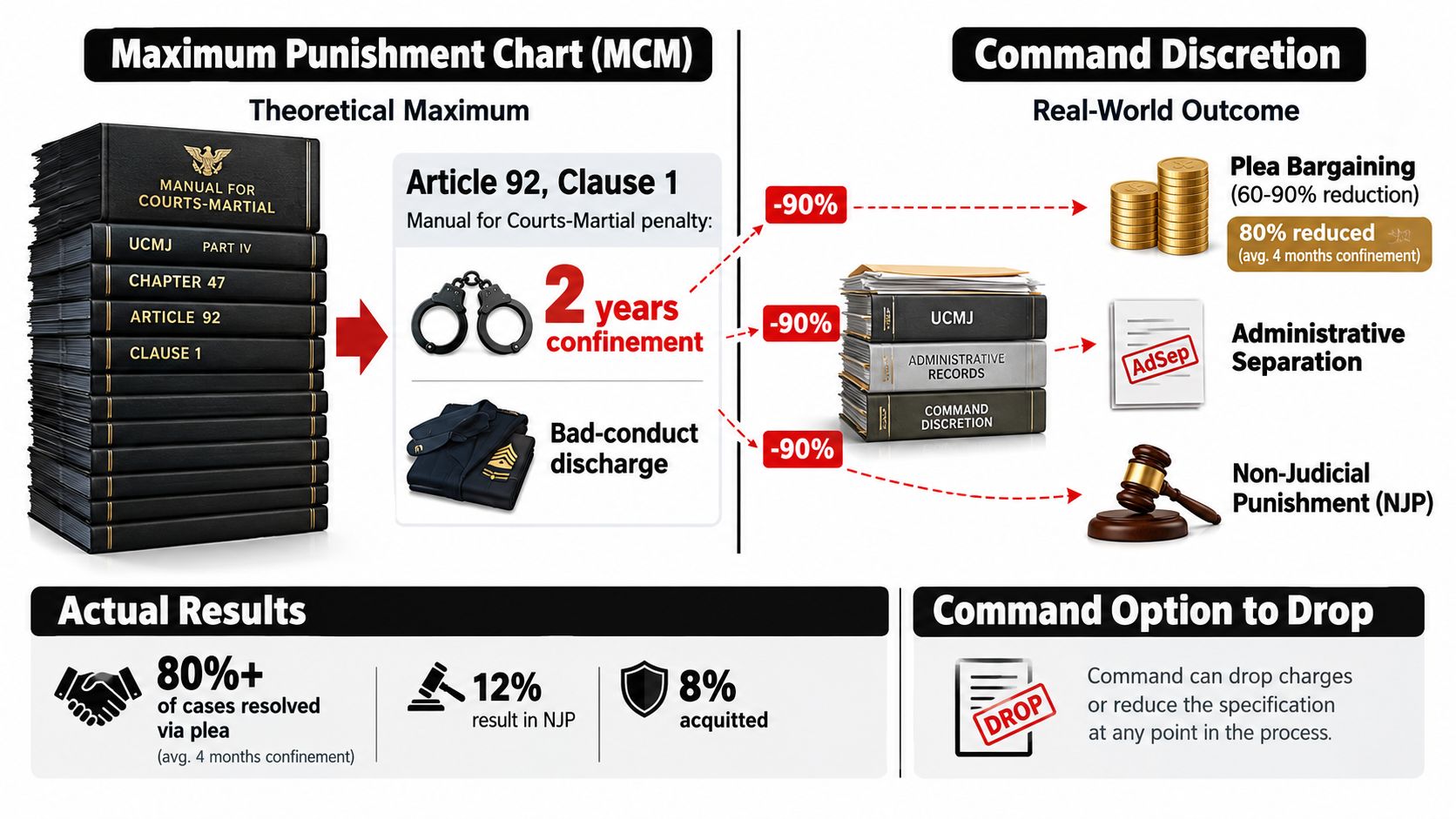
Why the chart doesn't decide your case
Maximum punishment tells you exposure. It doesn't tell you outcome.
Real-world results often turn on command discretion long before a military judge enters the picture. A commander can choose counseling, adverse paperwork, Article 15, administrative separation processing, or court-martial. The same allegation can travel down completely different tracks depending on command appetite, witness strength, politics, timing, and whether the file embarrasses somebody important.
Recent government reporting shows the Army imposed nonjudicial punishment in 6,220 cases in FY2025, which is a useful reminder that many discipline problems, including alleged order violations, never become a litigated court-martial file (FY2025 Article 146a combined report).
What actually changes the outcome
In practice, these factors usually matter more than the top-end sentence on paper:
- Who gave the order: A company-grade officer, a battalion commander, and a flag officer create different institutional pressure.
- How clean the facts look: A documented refusal is different from a disputed conversation in a loud workspace.
- What else is in the file: One Article 92 charge attached to broader misconduct changes the risk.
- Whether the command feels challenged: Some cases are really about discipline. Others are about saving face.
When clients ask me what the punishment “is,” the right answer is usually two answers. One answer comes from the Manual for Courts-Martial. The other comes from the humans holding discretion. The second answer is the one that usually decides your life.
Why Obeying First and Complaining Later Is Dangerous Advice
“Obey now, grieve later” sounds tidy. It's often terrible advice.
The reason is simple. Once an order is presumed lawful, the subordinate carries the evidentiary risk. If the service member complies without documenting what was said, who was present, why it was questionable, and what clarification was sought, the defense may later have almost nothing concrete to work with.
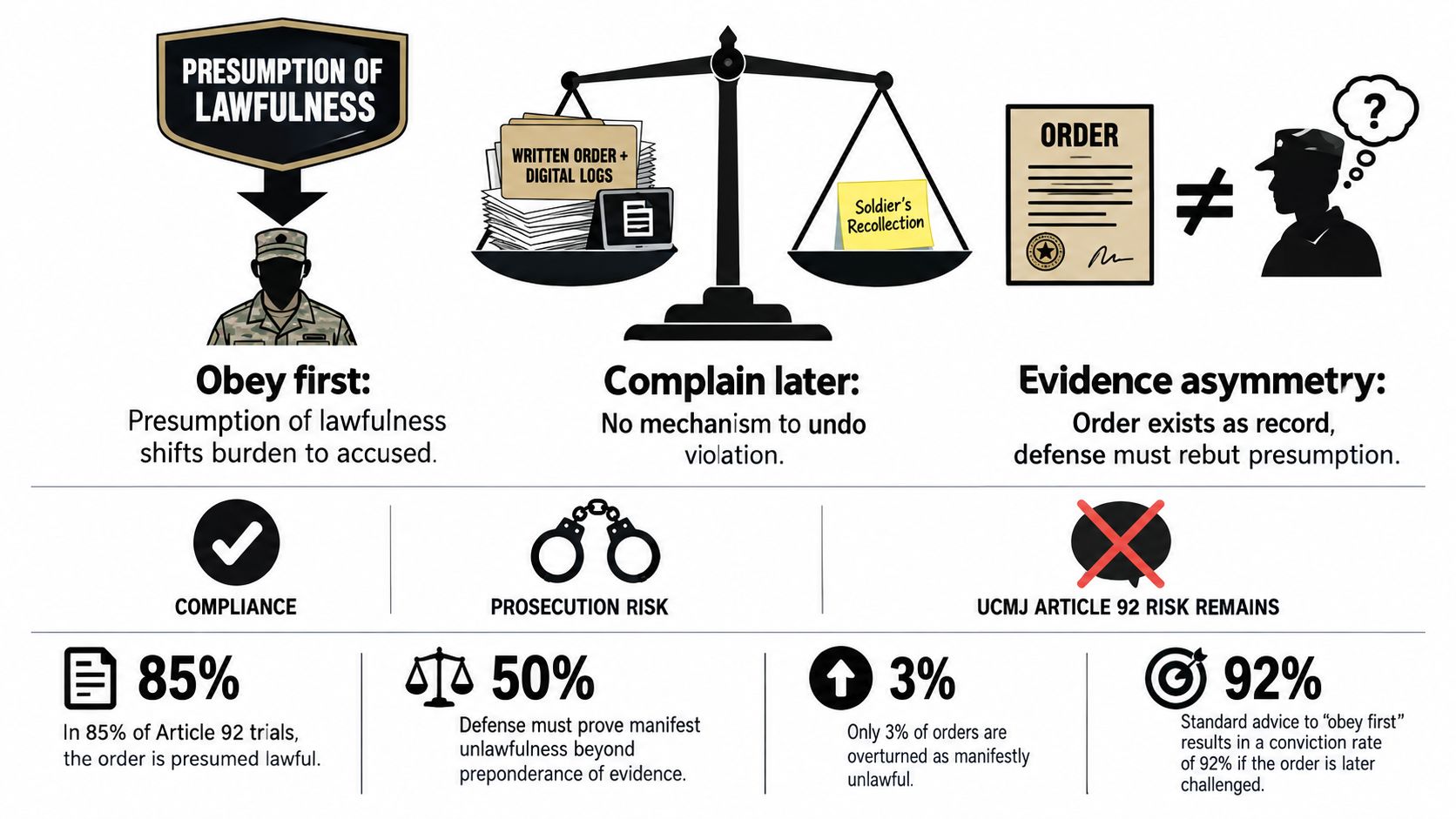
Silent compliance often destroys the defense
This is the trap. The service member thinks compliance is the safer option because it avoids immediate confrontation. Sometimes it does. But if the order itself becomes the issue later, compliance can erase the best proof that the order was vague, improper, retaliatory, or outside authority.
By the time counsel gets involved, the command may already have:
- A polished written account from the issuer
- Follow-up messages framed to support the command version
- Witness statements taken after memories aligned
- Administrative records that make the order look routine
The subordinate, by contrast, often has memory and regret.
The better question to ask
Don't ask only, “Can I disobey this?”
Ask these instead:
- Can I respectfully ask for the order in writing?
- Can I confirm my understanding by text or email?
- Can I identify the military purpose being asserted?
- Can I preserve the exact wording before it changes?
Critical point: In many cases, the future defense is won or lost before anyone says “lawyer,” because the factual record hardens immediately.
That does not mean every questionable order should be refused on the spot. It means blind compliance is not a strategy. A service member needs a record. If you later have to challenge scope, authority, clarity, or military nexus, that record may be the only thing standing between a defensible case and a conviction built on paperwork you never controlled.
How Defense Lawyers Attack Article 92 Cases
A strong Article 92 defense is not built on indignation. It's built on pressure points.
The government wants a simple story: lawful order, knowledge, disobedience. Defense counsel's job is to break that story into parts and force proof on each one. In serious cases, that means attacking the order itself, the issuer, the communication chain, the accused's knowledge, and the investigation methods.
A useful visual summary sits below.
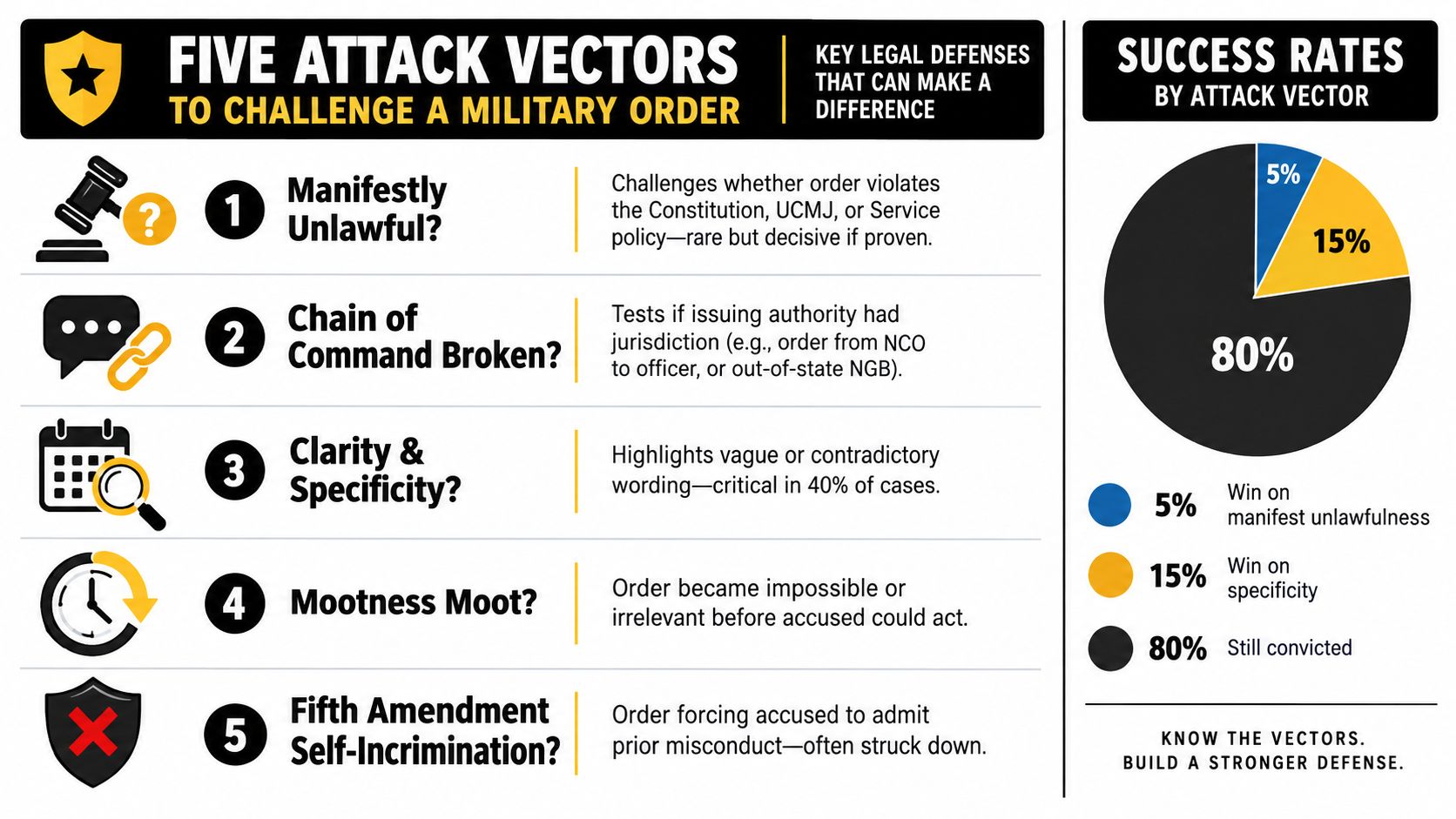
The order has to be defined with precision
One of the first things experienced court-martial attorneys do is force the government to state the exact order. Not the cleaned-up version. Not the command interpretation. The actual words.
If the wording shifts from witness to witness, that matters. If the order was broad, conditional, contradictory, or impossible to execute as phrased, that matters more.
The issuer's authority is never assumed by the defense
Commands assume authority. Defense counsel tests it.
Questions that often matter:
- Did the issuer have authority over the member and the subject matter?
- Was the directive tied to military duty, readiness, or discipline?
- Did the order intrude into private conduct without a valid military purpose?
- Did it conflict with regulation, statute, or constitutional protection?
A lot of weak cases survive only because no one forced the command to spell out the military purpose carefully.
Knowledge and intent are usually where the fight is
Especially in verbal-order cases, knowledge becomes contested fast. Did the member hear it? Understand it? Receive it in a form specific enough to obey? Was there conflicting guidance from someone else in the chain?
Then comes mental state. Even when the government proves an order existed, it may still struggle to prove the accused knowingly failed to obey as charged.
Later in the case, the goal is to keep the factfinder focused on uncertainty, not on command rank.
Statements can poison the defense before trial
A separate attack line is suppression.
If investigators or command obtained statements without respecting Article 31 protections, the defense should examine whether those statements can be excluded. In many files, the most damaging evidence isn't the order. It's the service member's own explanation, apology, or attempt to “clear things up.”
Don't help the government prove knowledge, intent, and wording in a single interview.
That is why seasoned military defense lawyers, court-martial attorneys, and any serious UCMJ lawyer start early and treat initial questioning as a battlefield, not a formality.
From Investigation to Court-Martial: What Happens
A staff sergeant gets called in for a “quick chat” about a missed movement restriction. By the end of the week, the command has screenshots, sworn statements, and a draft charge sheet. That is how many Article 92 cases begin. Fast, and with the government building a cleaner record than the accused.
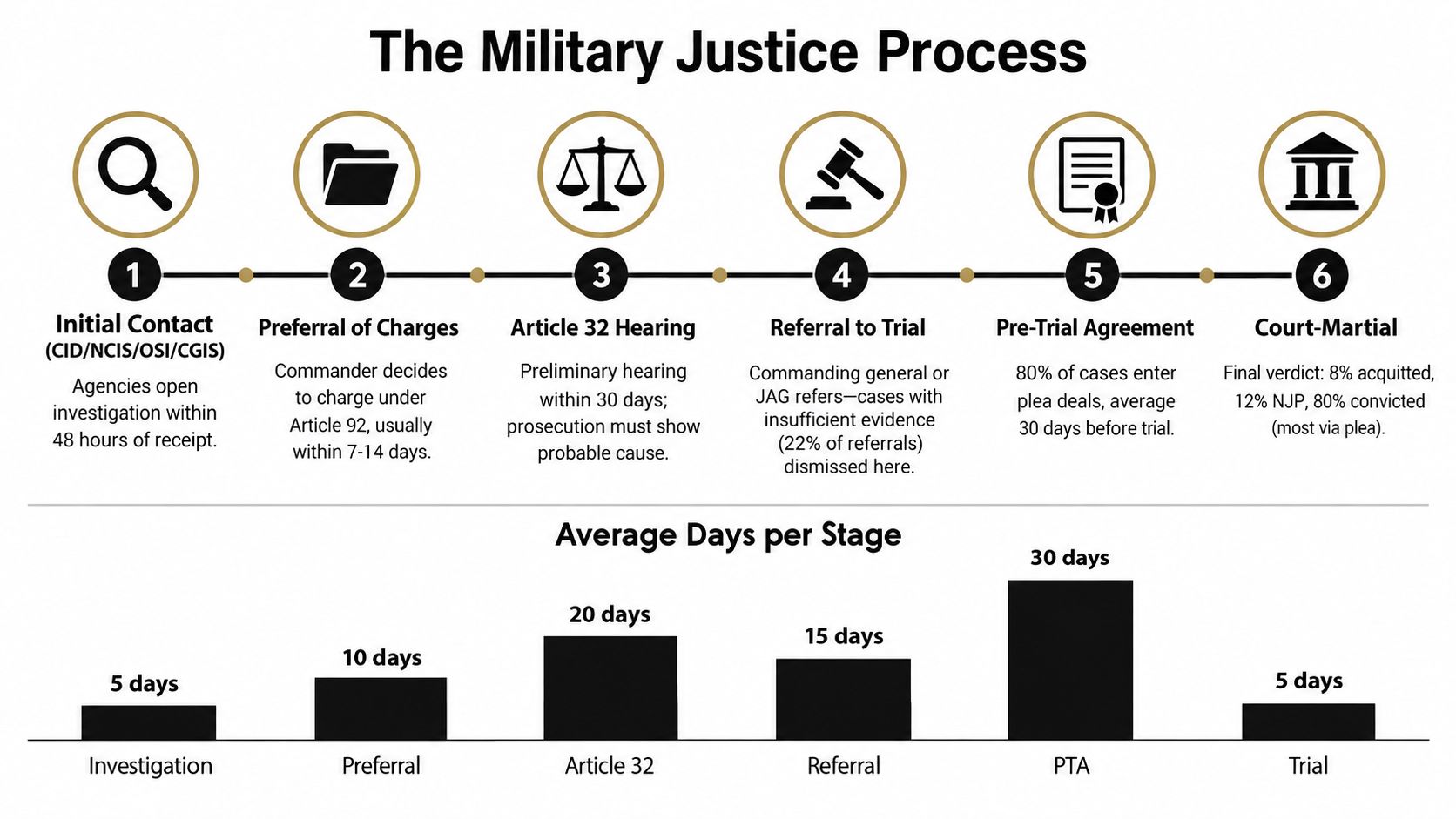
The key problem is evidentiary asymmetry. Command starts from a presumption that the order was lawful, clear, and known. If the defense wants to challenge any of that later, it needs records, context, and disciplined decisions early.
Step 1 through Step 3
Initial contact from CID, NCIS, OSI, or CGIS
People often damage their cases at this stage. The agent sounds polite. The meeting sounds informal. It is still an evidence-gathering event. Invoke your rights, decline to answer questions, and get counsel before saying a word about the order, your understanding of it, or why you did what you did.Command inquiry and paperwork gathering
While the service member is being told not to worry, the file is taking shape. Command collects screenshots, duty rosters, sign-in logs, counseling forms, watch bills, text messages, and witness statements. Preserve your own devices, notes, calendars, and messages. Do not delete anything, edit threads, or ask others to “fix” their statements.Preferral of charges
Once charges are preferred, the matter feels formal because it is. By then, the government may already have the language of the order, proof of notice, and admissions that fill the gaps. If a parallel command inquiry is underway, learn how those records are built in a 15-6 military investigation, because those findings often shape the prosecution file long before trial.
Step 4 through Step 6
Article 32 preliminary hearing
In a general court-martial track, this is the first real chance to test the government's theory in public. A good defense uses it to pin down wording, expose witness assumptions, and show where command has blurred “bad judgment” into “disobedience of a lawful order.” A bad defense treats it like a scheduling stop and learns nothing useful.Referral decision
The convening authority decides whether to refer the case and at what level. That decision is not made in a vacuum. Early witness interviews, mitigation, documentary context, and targeted legal submissions can push a case toward lesser disposition or force the government to confront weak proof on knowledge, clarity, or lawfulness.Pretrial litigation or trial
By this point, the fight is narrower. The defense should already know whether the case turns on the wording of the order, conflicting guidance, notice, lawfulness, or a bad statement made early in the investigation. If you wait until this stage to organize texts, identify witnesses, or explain the timeline, you are usually playing catch-up against a file the government has been building for months.
What to do at every stage
- Invoke Article 31 rights early: Do not treat “just explain your side” as harmless.
- Ask for the order in writing if possible: If the wording matters, memory will not help you later nearly as much as a document will.
- Preserve records immediately: Texts, emails, duty logs, group chats, and calendar entries can rebut the government's version.
- Avoid informal cleanup conversations: Apologies and explanations often become the proof of knowledge and intent.
- Retain counsel before you engage command or investigators: Early strategy can preserve defenses that disappear once the statements are made.
The service member who documents, preserves, and shuts up at the right time usually has options later. The one who talks first often gives the government the missing pieces it needed.
Common Mistakes That Destroy Article 92 Defenses
The same mistakes come up over and over. They don't just hurt. They narrow the defense until the case becomes much harder than it should have been.
Five recurring self-inflicted wounds
Walking into the suspect interview alone
A service member thinks cooperation will make the matter disappear. Instead, the sworn statement locks in knowledge, wording, motive, and intent before counsel has reviewed a single exhibit.Texting the chain in anger
A message written in frustration often reads like flat insubordination when stripped of context. Tone never survives well on a charge sheet.Posting or venting on social media
Complaints sent to a group chat, Facebook post, or private message thread have a way of becoming government exhibits. People screenshot everything.Trusting command to “work it out”
Sometimes command does resolve things. Sometimes command builds a cleaner file while the service member waits. Hope is not a defense plan.Waiting until preferral to hire civilian counsel
By then, the government may already have statements, aligned witnesses, and a theory of intent. Early mistakes become permanent features of the case.
What these mistakes cost you
Each error makes a future defense weaker in a different way.
One statement may prove knowledge. One message may prove attitude. One deleted thread may create a consciousness-of-guilt argument. One month of delay may let a favorable witness PCS, retire, or decide it's safer not to help.
The defense timeline starts at first contact, not at arraignment.
What works instead
If you think an order may become a legal issue, your posture should be disciplined and boring.
- Write down facts immediately: Exact words, time, place, witnesses.
- Preserve communications: Don't edit, delete, or annotate them.
- Stop explaining yourself: Especially to investigators or supervisors collecting statements.
- Get legal advice fast: The first good decision often prevents five bad ones.
Why Civilian Military Defense Counsel and a Path to Next Steps
In a serious Article 92 case, experienced civilian counsel is not a luxury item. It's often the difference between reacting to the government's record and building your own before the file hardens.
Military defense counsel serve an important role, and many are excellent lawyers. But the system is what it is. Detailed counsel often carry heavy caseloads, rotate assignments, and work inside the same institution that is prosecuting the case. In contested lawful-order litigation, the defense usually needs deep document review, aggressive witness development, fast motion practice, and independence from command pressure.
Why civilian counsel changes the fight
A battle-tested civilian military defense lawyer brings a different posture.
- Independence: Civilian counsel doesn't answer to the installation, the staff judge advocate, or the convening authority.
- Continuity: The lawyer you hire stays with the case instead of rotating out.
- Trial focus: Serious court-martial attorneys know how to attack the order, the proof of knowledge, and the credibility of the issuer.
- Early deployment: Good civilian teams move before preferral, not after damage is done.
If you're comparing options, this guide to court-martial defense lawyers explains what to look for in civilian attorneys who focus on military justice. Pair it with your own screening and consultations.
The right next steps
If you're under investigation or worried that disobeying a lawful order may be alleged, do these things now:
Write down everything
Capture the exact words of the order, who was present, the time, the location, and what happened next.Preserve every communication
Save texts, emails, signal messages, duty logs, dispatch records, counseling forms, and notes.Identify favorable witnesses
Don't assume they'll remember later. Don't assume they'll stay available.Refuse interviews without counsel
That includes “informal” command chats, sworn statements, and polygraph requests.Invoke Article 31 rights clearly
Then stop talking about the facts with investigators and command representatives gathering evidence.Retain qualified civilian counsel immediately
You want someone who has tried courts-martial, understands Article 92 pressure points, and can act before the command narrative hardens.
The first stretch of an Article 92 case is often where outcome is set. Memory fades. Phones get replaced. Witnesses scatter. Commands turn rough facts into neat memoranda.
If you are under investigation, being pressured for a statement, or facing NJP, administrative separation, or court-martial over an alleged order violation, act now. Waiting usually helps the government, not you.
If your career, clearance, rank, or freedom is at risk over an alleged failure to obey, get experienced counsel involved immediately. Don't guess whether the order was lawful. Don't try to talk your way out of it. Don't wait for charges to make it “serious.” Contact a qualified civilian military defense lawyer today for a confidential consultation before the record is built without you.