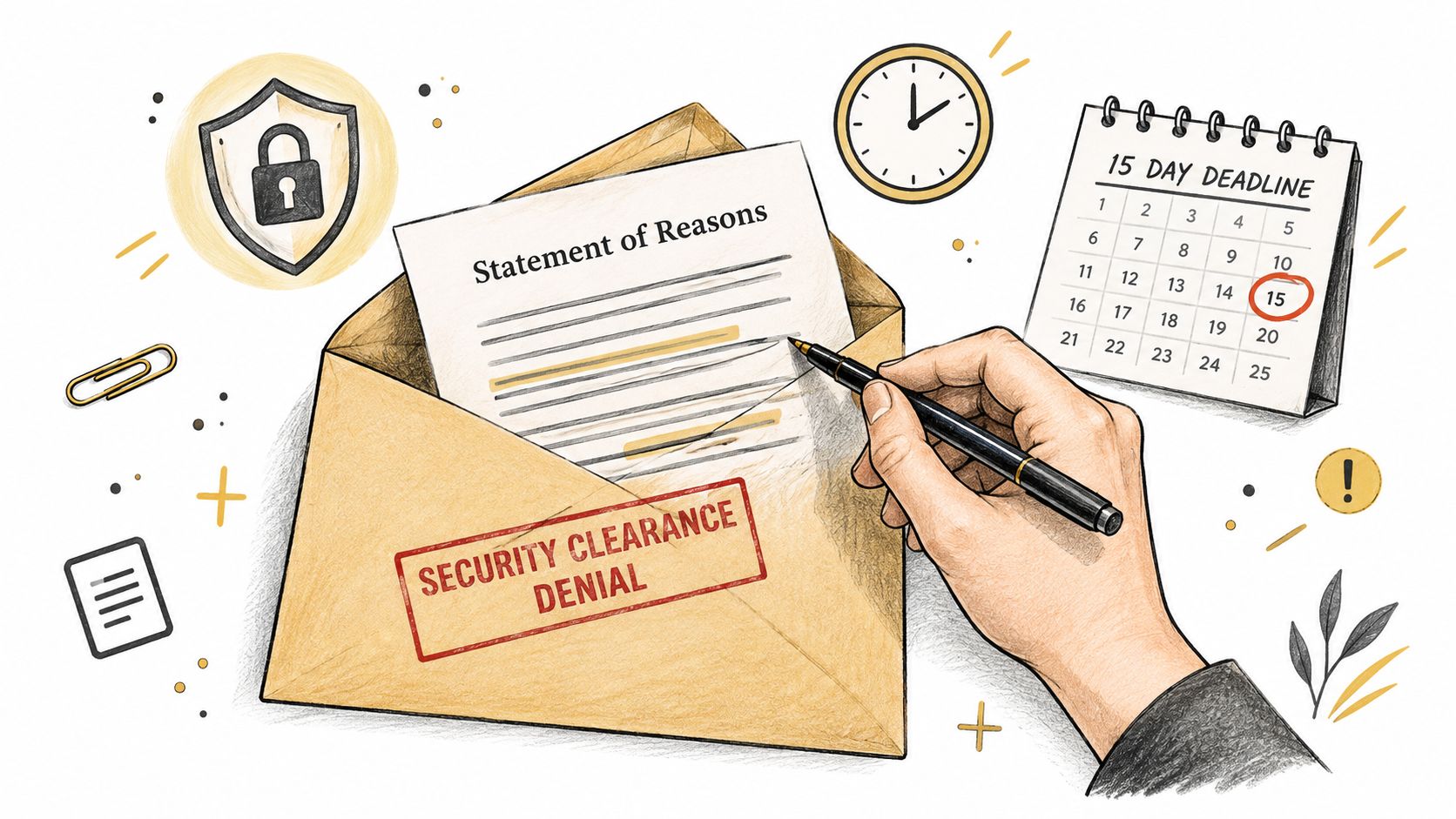
A security clearance denial can arrive as an email, a letter, or a formal Statement of Reasons while you’re trying to keep your job, promotion, assignment, or contract moving. The notice may list financial problems, criminal conduct, drug involvement, foreign contacts, or alleged dishonesty. It can feel like a final judgment. It isn’t necessarily final, but the process becomes much harder once you miss a deadline or create an inconsistent record.
The first decision is procedural: which appeal path applies to you? A defense contractor, DoD civilian employee, and military member may face different decision-makers, hearing rights, and filing requirements. The second decision is strategic: can you connect credible, current evidence to each specific Adjudicative Guideline, or are you relying on general statements about being a good person? Adjudicators decide national security eligibility from the record in front of them.
Table of Contents
- The Moment You Receive a Security Clearance Denial
- Why Security Clearance Denials Actually Happen
- Which Appeal Path Applies to Your Case
- Building a Record That Can Survive Appeal
- What the Appeal Numbers Really Show
- Why Civilian Defense Counsel Changes the Math
- Your First 48 Hours and What Comes Next
The Moment You Receive a Security Clearance Denial
The document in your inbox may be titled a Statement of Reasons, or SOR. It may come from DCSA, ODNI, or a service component. Read it as a charging document for the clearance process, not as a casual request for clarification. The SOR itemizes allegations and assigns them to specific Adjudicative Guidelines.
For many cases, the notice gives you 15 days to submit a written Answer. That deadline controls your immediate options. If you fail to respond, the government can proceed toward a default denial without receiving your explanation or supporting evidence.
What to do before drafting
Don’t start by writing an emotional narrative. Start by building an allegation chart.
- Mark every allegation: Copy each factual claim into a separate line, including dates, accounts, contacts, statements, and omissions.
- Identify every Guideline: Note the letter and subject, such as Guideline F for financial considerations or Guideline E for personal conduct.
- Separate agreement from dispute: Some facts may be accurate but mitigable. Others may be incomplete, outdated, or wrong.
- Inventory available proof: Gather payment records, tax documents, treatment records, urinalysis results, court dispositions, employment records, and relevant correspondence.
- Preserve the original notice: Keep the SOR, cover letter, delivery record, and attachments in a controlled folder.
A written Answer isn’t the place to deny everything reflexively or blame the investigator. It should respond to each allegation, explain the relevant circumstances, and identify the exhibit that proves the explanation. The answer also defines the factual scope of what you’ll later defend.
Practical rule: Never assume a later hearing will rescue an incomplete Answer. Build the first response as though an administrative judge will read it without giving you the benefit of the doubt.
Don’t call the adjudicator, investigator, or references to argue your case. Unplanned conversations create admissions, inconsistent wording, and new questions. The first 48 hours should be used to preserve evidence, identify counsel, and calculate the actual deadline from the notice, not to vent or negotiate informally.
Why Security Clearance Denials Actually Happen
The government evaluates eligibility under 13 Adjudicative Guidelines in SEAD 4. The framework includes foreign influence, foreign preference, sexual behavior, personal conduct, financial considerations, alcohol consumption, drug involvement, psychological conditions, criminal conduct, handling protected information, outside activities, use of information technology, and allegiance to the United States. The State Department describes these guidelines as the common framework for deciding whether access is clearly consistent with national security interests in its overview of security clearance standards.
An SOR isn’t a criminal charge. It doesn’t require proof beyond a reasonable doubt, and a clearance decision doesn’t determine whether you’ve committed a crime. The practical burden is still severe because the applicant must present enough reliable information to resolve or mitigate the government’s concerns.
Financial considerations usually deserve immediate attention. RAND found that financial considerations represented 45.6% of denial reasons in 2019, or 522 of 1,144 reasons, and 48.7% in 2020, or 287 of 589 reasons. Personal conduct was the second-most common basis in those datasets, at 18.4% in 2019 and 20.9% in 2020. A separate DCSA update covering October 2021 through July 2022 listed financial considerations as 29% of denials or revocations, followed by criminal conduct at 19.4% and personal conduct at 16.4%, as reported in RAND’s adjudication analysis.
Top denial drivers by adjudicative guideline
| Adjudicative Guideline | Common Conduct | Mitigation Focus |
|---|---|---|
| Guideline F, Financial Considerations | Delinquent debt, collections, tax problems, unstable repayment | Payment plans, dispute records, repayment proof, tax compliance, financial counseling |
| Guideline E, Personal Conduct | False statements, omissions, unreliable answers, rule violations | A precise explanation, corrected disclosures, corroboration, demonstrated candor |
| Guideline J, Criminal Conduct | Arrests, convictions, repeat misconduct, unresolved legal matters | Court records, completed obligations, changed conduct, credible rehabilitation |
| Guideline H, Drug Involvement | Illegal drug use, possession, distribution, or unreliable disclosures | Abstinence evidence, clean urinalysis where relevant, treatment or counseling records |
| Guideline G, Alcohol Consumption | Abuse, alcohol-related incidents, failed treatment, recurring misconduct | Treatment completion, sobriety evidence, relapse prevention, sustained behavioral change |
| Guidelines B and C, Foreign Influence and Preference | Foreign contacts, obligations, property, citizenship, or divided loyalty concerns | Clarifying relationships, obligations, travel, financial interests, and allegiance |
| Guidelines M and N, Information Technology and Protected Information | Mishandling systems or sensitive information, poor security practices | Incident records, corrective training, responsible conduct, credible explanations |
The table isn’t a substitute for guideline-specific analysis. A repayment plan may address Guideline F but do little for a separate candor issue under Guideline E. Likewise, a clean urinalysis won’t answer an allegation that you denied prior drug use on an official form.
Adjudicators consider recency, pattern, seriousness, and whether conditions have changed. Generic character letters rarely carry a case by themselves. The evidence must show what happened, what you did afterward, and why the risk is reduced now.
Which Appeal Path Applies to Your Case
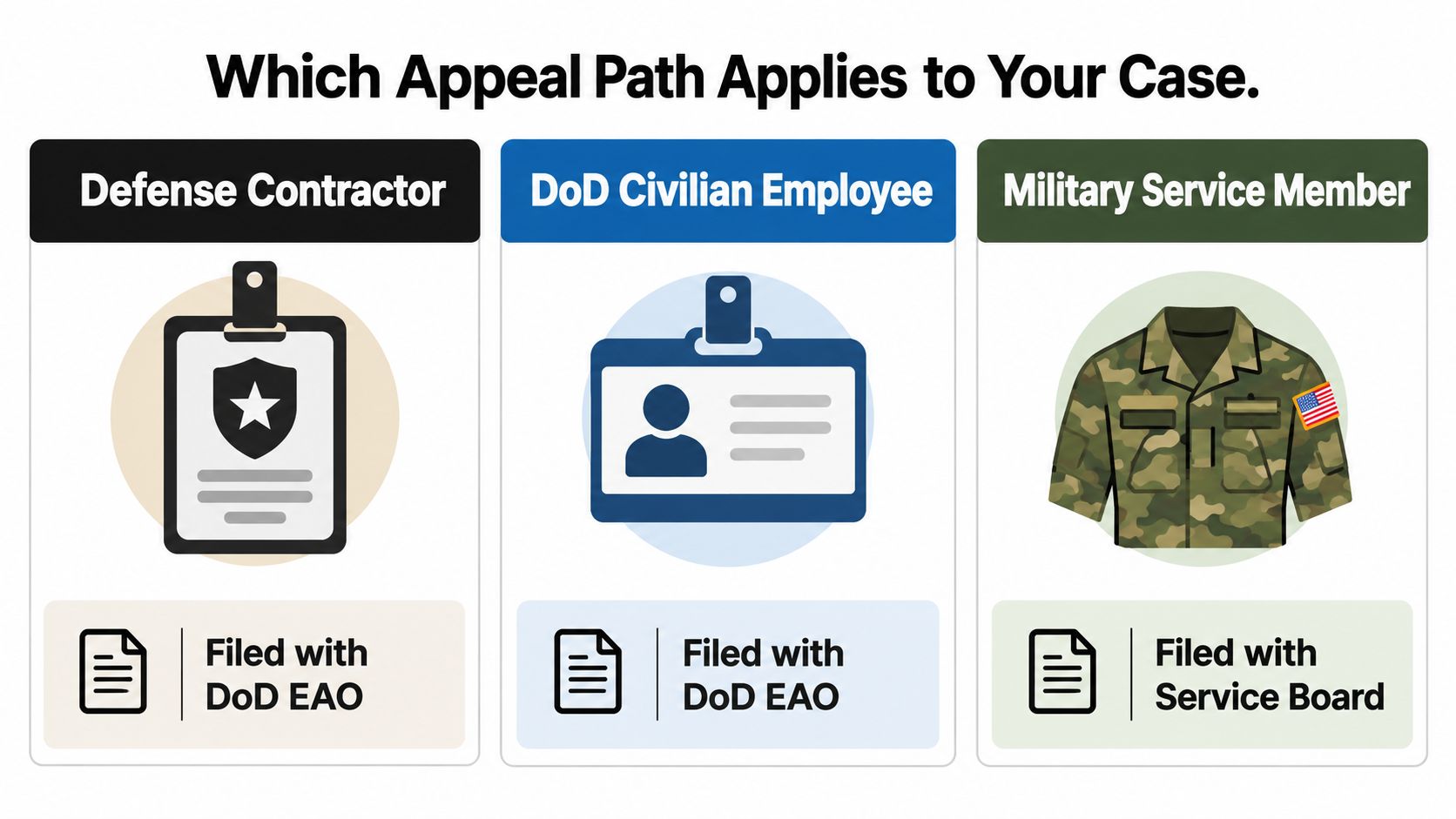
Status matters before strategy. Defense contractors, federal employees, and military members don’t automatically use the same appeal route. Confirm the sponsoring agency, the procedural notice, and the authority named in your paperwork before selecting a hearing or written review.
For a DoD contractor, the case commonly proceeds through the Defense Office of Hearings and Appeals, or DOHA. A contractor receives an SOR, submits an Answer, and may request a hearing before a DOHA administrative judge. The record can include documents, testimony, and cross-examination. DCSA’s facility security guidance describes the SOR, written response, hearing request, and presentation of relevant information in its facility security FAQ.
A federal employee or DoD civilian applicant may have a written route through the Personnel Security Appeals Board, or PSAB, depending on the governing procedure. Some applicants may elect a DOHA hearing, while others proceed on the written record. Military members may face a service-specific process, including a personal appearance before the relevant board or authority. Don’t assume a contractor’s DOHA timetable applies to a service member.
Compare the practical choices
| Status | Typical forum or route | Strategic consequence |
|---|---|---|
| Defense contractor | DOHA administrative judge, usually after a written Answer and appeal election | A hearing can develop testimony and permit cross-examination |
| DoD civilian employee | DOHA or PSAB, depending on the applicable procedure | A written record may become decisive if no live hearing is available |
| Military service member | Service-specific board or personal appearance process | The governing service regulation and board rules control the opportunity to speak |
Procedures can change, and recent DoD due-process changes may affect which groups can elect between PSAB and DOHA. Your counsel should verify the current notice rather than rely on an online checklist.
A clearance denial can also exist alongside administrative separation, discharge characterization, or records-correction issues. Those are separate proceedings with separate standards and deadlines. For related military administrative consequences, review administrative separation and military discharges without treating it as a substitute for the clearance notice itself.
Building a Record That Can Survive Appeal
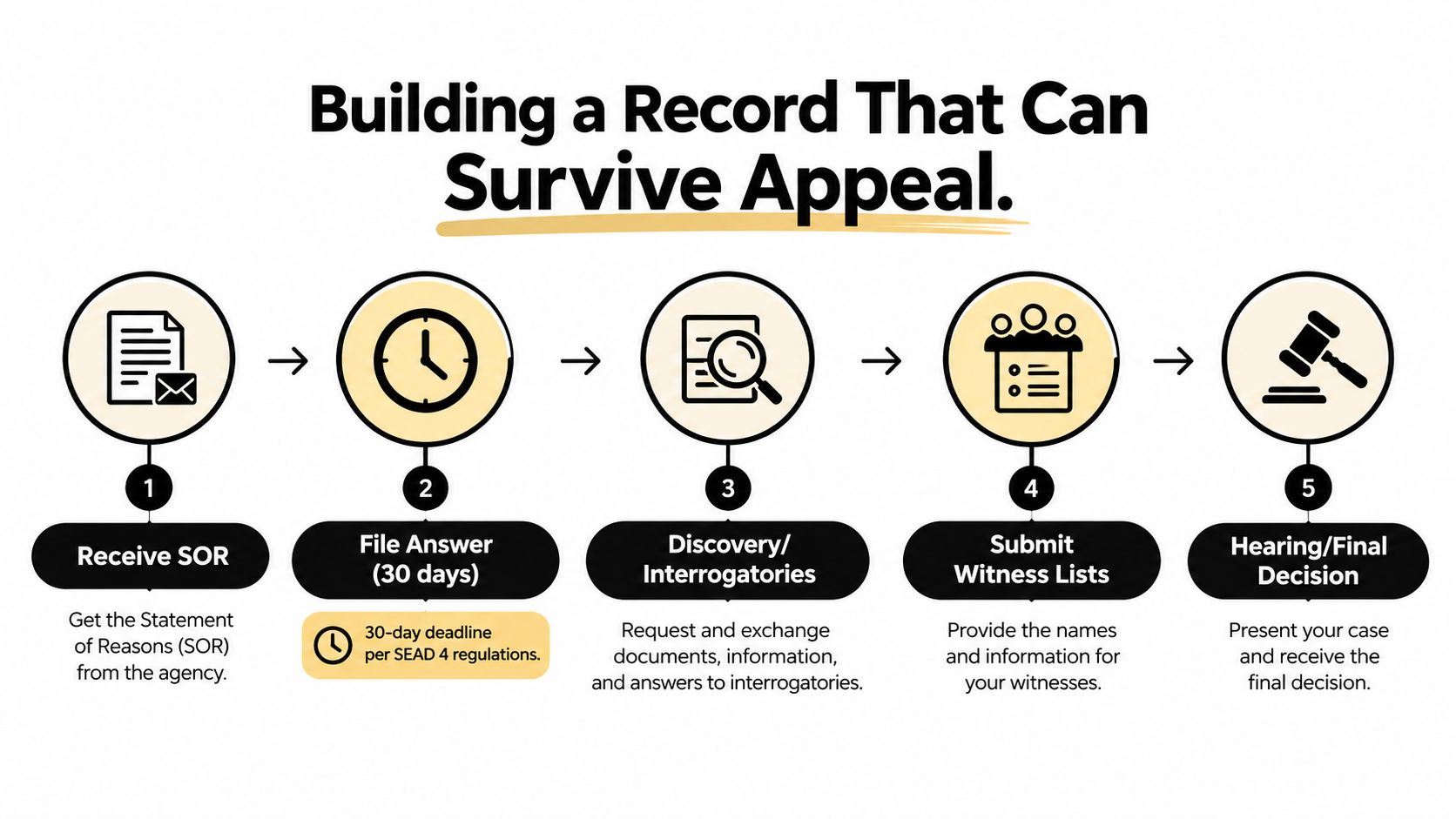
A strong appeal is assembled in sequence. First, answer the SOR allegation by allegation. Next, tie every exhibit to a specific fact and guideline. Then prepare testimony that matches the documents and the disclosures in your security questionnaire.
The precise deadlines depend on your notice and procedure. Some materials describe a 15-day Answer period for the initial SOR, while later appeal elections and briefs may have separate deadlines. The applicable notice controls. Don’t rely on a visual timeline that conflicts with the paperwork you received.
Build the evidence around the guideline
For financial considerations, obtain current credit reports, creditor statements, payment-plan agreements, settlement documents, tax filings, proof of payment, and records explaining any dispute. A counseling certificate with no date, provider credentials, or explanation of what changed is weak.
For personal conduct, identify the exact statement or omission. Explain when you learned it was inaccurate, what you corrected, and why the original wording occurred. If the government alleges dishonesty, a vague assertion that you “made a mistake” may worsen the problem.
For criminal conduct, use certified dispositions and proof that every obligation was completed. For drug or alcohol concerns, document treatment, abstinence, testing, counseling, and the conditions that support continued stability. Character references should come from people who know the underlying conduct and can describe observed change, not just your general reputation.
The adjudicator needs a completed story, not a stack of favorable adjectives.
Organization affects credibility. A chronological index, exhibit labels, and a short statement explaining the purpose of each document let the decision-maker follow your mitigation without guessing. Lawyers and legal teams can use structured methods for organizing case files for law firms, but the principle is simple: every allegation should point to an answer, every answer should point to proof, and every proof item should be authentic and dated.
The whole-person concept gives the adjudicator room to weigh the complete record, including age, circumstances, recurrence, rehabilitation, and current responsibility. It doesn’t excuse missing evidence. Your closing argument should explain why the record, taken as a whole, resolves the specific national security concern.
A clearance appeal may also intersect with discharge characterization or correction issues, but those proceedings shouldn’t be blended casually. If both are active, counsel should coordinate the factual record. A statement made to solve one problem can create another. For background on a separate records issue, see how to upgrade a military discharge.
What the Appeal Numbers Really Show
Appeal statistics should change your preparation, not eliminate your effort. A large analysis of DOHA outcomes found that 13,623 applicants, or 68%, were denied a clearance on appeal, while 6,112, or 31%, were granted one, according to the Defense Technical Information Center analysis of appeal outcomes. The exact forum and record matter, but the broad message is clear. Most applicants don’t win by submitting a general letter after denial.
Another historical dataset reported 643 denied cases, of which 133, or 21%, were appealed, and only 2 received clearance on appeal, a success rate of about 1.5% among appealed denials. That older dataset appears in this DTIC report on clearance denial appeals. It shouldn’t be treated as a forecast for every current case, but it does show why late, unsupported appeals are dangerous.
The record characteristics that give an appeal a fighting chance are consistent:
- Guideline precision: The response addresses every allegation under the correct standard.
- Corroboration: Independent records support the applicant’s account.
- Recency analysis: The submission explains what changed and how long the change has lasted.
- Credible testimony: The applicant admits unfavorable facts without minimizing or shifting blame.
- Hearing preparation: Counsel uses testimony and cross-examination to expose inaccurate, incomplete, or poorly supported allegations.
DOHA appeal outcomes by adjudicative guideline
A guideline-by-guideline table with denial-affirmed, remanded, and granted counts can’t be responsibly supplied from the verified data available here. The verified material provides aggregate DOHA outcomes and denial-driver percentages, but it doesn’t provide a complete, source-supported breakdown of affirmed, remanded, and granted results for each guideline. Any invented table would give false precision.
What can be said is more useful than a fabricated ranking. Financial, criminal, and personal conduct concerns repeatedly appear among the leading denial categories. Cases involving multiple guidelines require a unified explanation because success on one issue won’t cure an unresolved candor or reliability problem elsewhere.
Some cases should be appealed aggressively. Others need a candid assessment of whether the evidence can improve after the current proceeding, including whether a later reapplication is more sensible than a weak appeal. Neutral congressional background explains why final denials are generally uncommon across the federal system, while also emphasizing that rates vary by agency and clearance type in its security clearance overview. A rare denial still carries serious career consequences.
Why Civilian Defense Counsel Changes the Math
Assigned military counsel and installation legal offices can provide important assistance, but a security clearance appeal often demands sustained, specialized preparation. The lawyer must understand the adjudicative guidelines, administrative procedure, documentary proof, hearing testimony, and the career consequences outside the immediate command.
Civilian defense counsel brings independence. A lawyer retained by the client isn’t part of the command structure that sponsored the investigation, issued the adverse action, or manages the applicant’s duties. That separation makes it easier to challenge an inaccurate allegation, advise against an unsafe statement, and develop a record that may outlast the current assignment.
The difference shows up in preparation
Effective counsel should:
- Audit the SOR: Find factual errors, duplicated allegations, missing context, and unsupported inferences.
- Build the chronology: Align forms, interviews, financial records, treatment records, and testimony.
- Test mitigation: Reject documents that are generic, undated, unauthenticated, or disconnected from the alleged risk.
- Prepare testimony: Practice direct answers, difficult follow-ups, and questions about omissions or inconsistencies.
- Control the closing argument: Tie the whole-person analysis to the exact guideline concerns.
The trade-off is cost. Civilian representation requires an investment at a time when the denial may already threaten income or assignment stability. The opposing cost can include lost employment opportunities, reassignment, promotion problems, and a clearance record that follows you when another agency or contractor evaluates you.
Don’t hire based only on a lawyer’s general military background. Ask about actual DOHA hearings, PSAB reviews, personal appearances, security questionnaire disputes, and guideline-specific mitigation. The guide to selecting a military defense lawyer offers a starting point for evaluating experience, independence, and fit.
Your First 48 Hours and What Comes Next
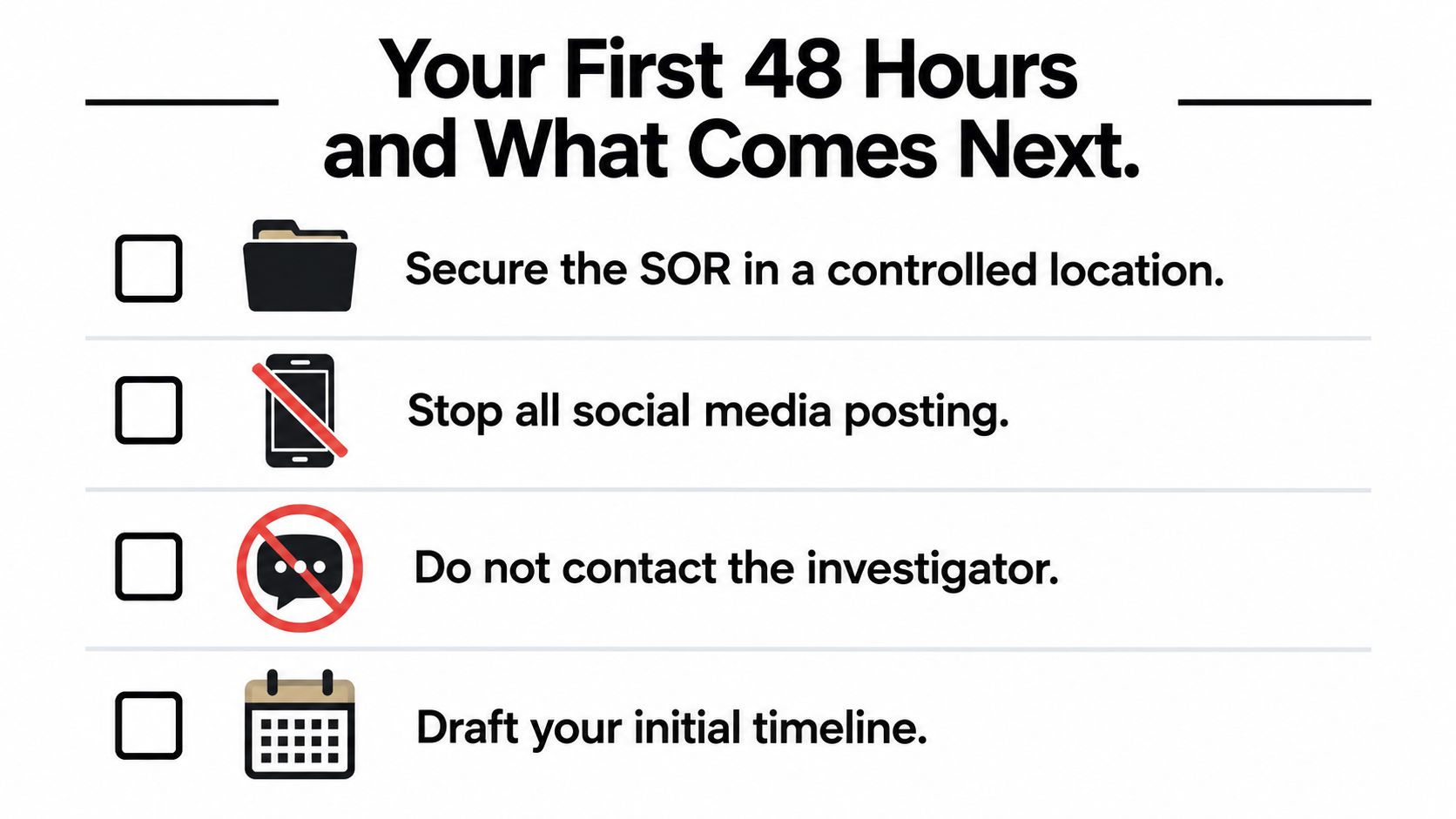
The first two days should be quiet, organized, and deliberate. Save the SOR in one controlled location, stop discussing the matter casually, and preserve every document connected to the allegations. Don’t post about the denial or your investigator on social media. A frustrated post can become an exhibit.
Don’t contact the investigator, adjudicator, or listed references without a plan. You may believe you’re correcting the record, but unsolicited contact can produce new statements, pressure witnesses, or create an appearance that you’re trying to influence the process.
Use the first 48 hours productively
- Calculate the deadline: Record when you received the notice, the Answer deadline, and every later filing date listed in the paperwork.
- Create a master timeline: Include the alleged conduct, discovery of the issue, corrective action, SOR receipt, and all procedural events.
- Request relevant records: Consider a Privacy Act request for the investigative file, while recognizing that production timing may not match your response deadline.
- Start evidence collection: Obtain credit reports, creditor records, court dispositions, tax documentation, treatment records, testing records, and qualified reference letters as applicable.
- Research the cited guideline: Study the concern itself and prior DOHA decisions with counsel, looking for the evidence adjudicators found persuasive.
- Choose the forum carefully: A hearing may provide testimony and cross-examination, while a written appeal may be the only available route in some procedures.
The most common self-inflicted errors are predictable. Applicants miss the deadline, submit a blanket denial, minimize debt, conceal a prior disclosure, use inconsistent dates, send generic letters, or assume an investigator’s mistake makes the entire case disappear. They also wait until after the final denial to seek counsel, when the record is already fixed and the available options are narrower.
Don’t confuse a sympathetic explanation with mitigation. Mitigation shows changed risk through reliable proof.
A security clearance denial isn’t something to manage around the edges of your schedule. Contact experienced civilian defense counsel within 48 hours, provide the notice and exact deadline, and stop making unsupervised statements about the allegations. Your job, clearance eligibility, and future access may depend on the record you create now.
If you’ve received a Statement of Reasons, Notice of Intent, revocation notice, or final security clearance denial, contact civilian defense counsel today. Send the complete notice, identify whether you’re a contractor, federal employee, or military member, and state the response deadline. Don’t wait for the denial to become final before getting help.