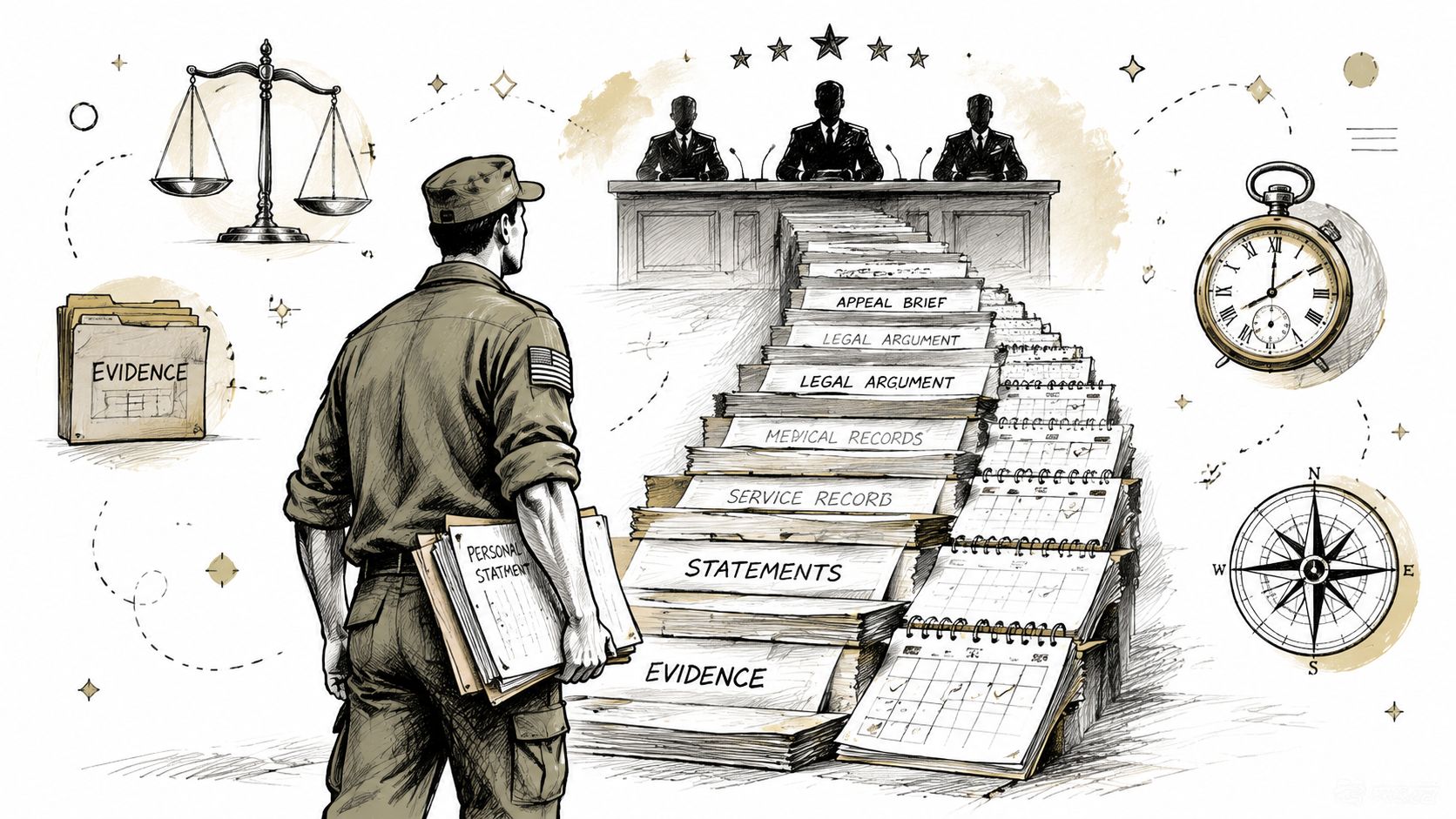
A bad discharge follows you into rooms you haven’t even entered yet. It shows up when a background check stalls a job offer, when VA benefits get questioned, when a landlord or licensing board asks for paperwork, and when your family asks why service that once defined you now feels like a permanent mark against you. That’s where a lot of people are when they start looking into discharge review boards. They’re angry, embarrassed, broke, and tired of being told to “just apply” as if this were a simple administrative fix.
It isn’t simple. It’s a contested credibility fight on paper, and sometimes in person, before senior officers who weren’t there when your career came apart. If you walk in with a weak file, a vague story, and no strategy, you’ll likely get exactly what weak files usually get. A denial. If you build the case correctly, you can reclaim opportunities, benefits, and your name.
Table of Contents
- Your DD214 Is Not Set in Stone
- DRB vs BCMR Understanding Your Options
- Navigating the Discharge Upgrade Application Process
- Building a Case That Persuades the Board
- Critical Errors That Guarantee a Denial
- Why You Cannot Afford to Go It Alone
- Find Your Advocate and Take Back Your Future
Your DD214 Is Not Set in Stone
A lot of veterans come to this fight after months or years of hitting the same wall. The interview goes well until HR asks for the DD214. A benefits question turns into a character-of-service problem. A security-related opportunity disappears without anyone saying much out loud. The discharge becomes the explanation for everything, even when the full story is far more complicated.
That’s the part civilians rarely understand. A discharge doesn’t just summarize the end of military service. It can distort it. One rough chapter, one mental health spiral, one command that wanted you gone fast, or one investigation handled badly can outweigh years of good service unless someone forces the record back into focus.
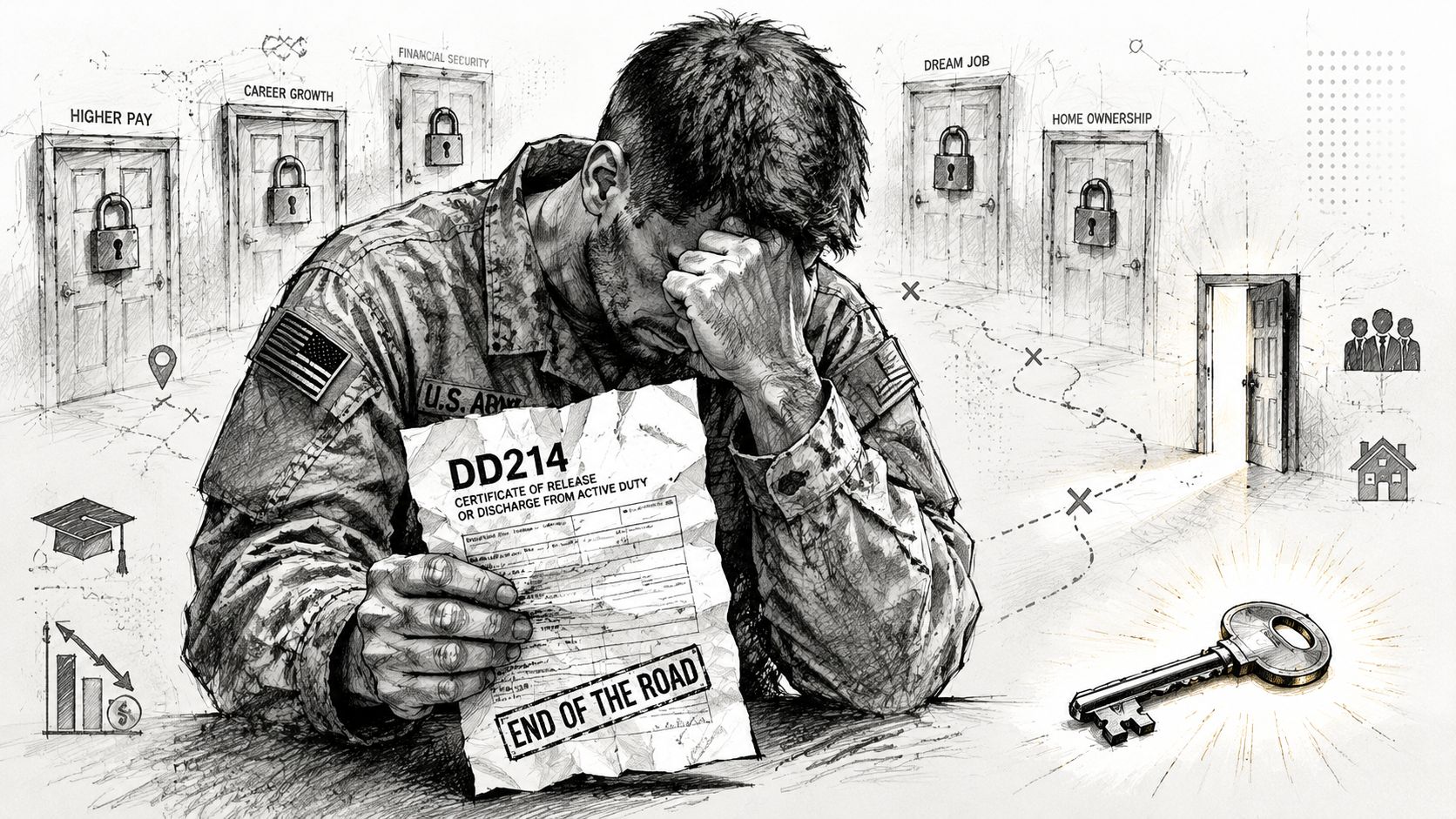
If you’re dealing with an other-than-honorable discharge and trying to understand the practical fallout, this guide on benefits tied to an other-than-honorable discharge is a useful place to understand what’s at stake.
What most people get wrong
Most guides describe discharge review boards like they’re paperwork stations. They aren’t. They’re decision-makers evaluating whether your discharge was proper and equitable. They’re looking at your file, your evidence, your explanation, and whether you’ve demonstrated anything worth acting on.
Practical rule: The board won’t rescue a case you didn’t build.
That sounds harsh, but it’s the truth. Applicants with sympathetic facts can lose because they submit almost nothing beyond a personal statement. Cases with ugly records can also become viable when the evidence finally explains the misconduct, the missing diagnosis, the retaliation issue, or the command failures behind the separation.
What this means for you
You need to stop treating your DD214 like a permanent verdict. It isn’t. It’s an outcome that can sometimes be changed, corrected, or upgraded if you use the right forum and make the right argument.
Discharge review boards are where many veterans get the first real chance to fight back. Not with outrage. Not with a generic claim that “it was unfair.” With records, framing, and strategy. That’s how you reclaim your future.
DRB vs BCMR Understanding Your Options
The first strategic mistake happens before the case even starts. People file with the wrong board. That wastes time, weakens momentum, and tells the reviewing authority you don’t understand the rules of the battlefield.
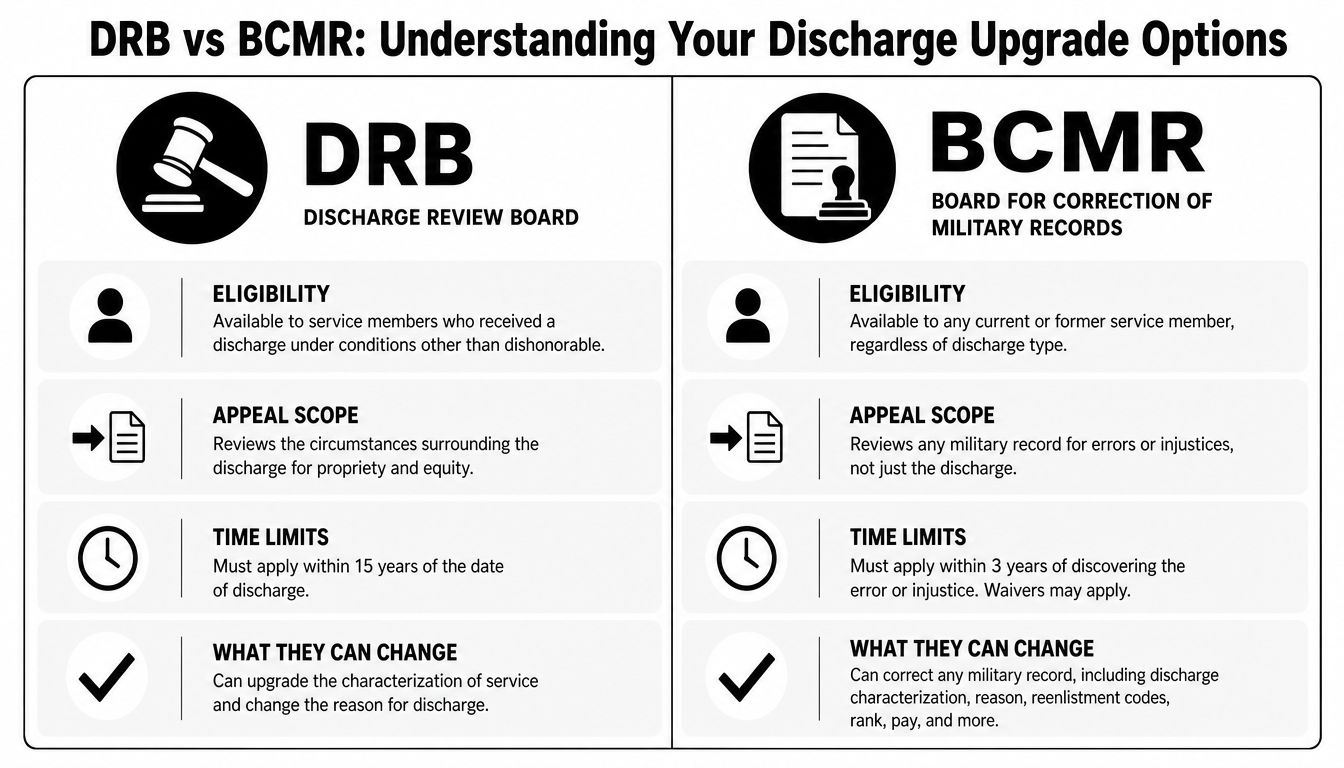
The Discharge Review Board, or DRB, is not the same as the Board for Correction of Military or Naval Records, often called BCMR or BCNR. These boards overlap in subject matter, but they don’t do the same job.
Use the DRB for the right kind of case
If your discharge falls within the DRB’s jurisdiction, that is usually the first place to look. Under the governing rule on DRB authority and time limits, discharge review boards are established under 10 U.S.C. § 1553 and there is a strict 15-year statute of limitations from the date of separation. If the discharge is older than 15 years, or if it resulted from a General Court-Martial, the DRB has no jurisdiction and you must go to the BCM/NR instead.
That isn’t a technical footnote. It’s a gatekeeper issue. If the board lacks jurisdiction, the quality of your evidence won’t matter because the board legally can’t give you relief.
Use the BCMR or BCNR when the DRB cannot act
The BCMR or BCNR is the route for cases outside DRB authority, especially older cases and cases tied to a General Court-Martial. It operates under different statutory authority and different standards. That matters because the way you frame the request often changes with the forum.
Here’s the practical breakdown:
| Board | Best used for | Hard stop issues |
|---|---|---|
| DRB | Administrative discharge review within the allowed time window | No jurisdiction after 15 years. No review of discharges from a General Court-Martial |
| BCMR or BCNR | Older cases, broader record corrections, matters outside DRB jurisdiction | Different process, different framing, and often a more document-heavy correction strategy |
A strong overview of the larger process is this guide on how to upgrade a military discharge.
Don’t confuse eligibility with merit
A lot of applicants think, “I’m eligible, so I’ve got a real shot.” Those are different questions.
Eligibility means the board can hear you. Merit means you’ve proved enough to justify relief. You need both.
Filing with the right board is the first move. Winning there is a separate fight.
If you’re inside the DRB window, use that opportunity intelligently. If you’re outside it, pivot fast and build for BCMR or BCNR without wasting months pretending jurisdiction doesn’t matter. This isn’t a place for hopeful guessing.
Navigating the Discharge Upgrade Application Process
The application process is where discipline starts to matter. Sloppy applicants lose before the merits are even discussed. Organized applicants give themselves a chance.
What the board is actually deciding
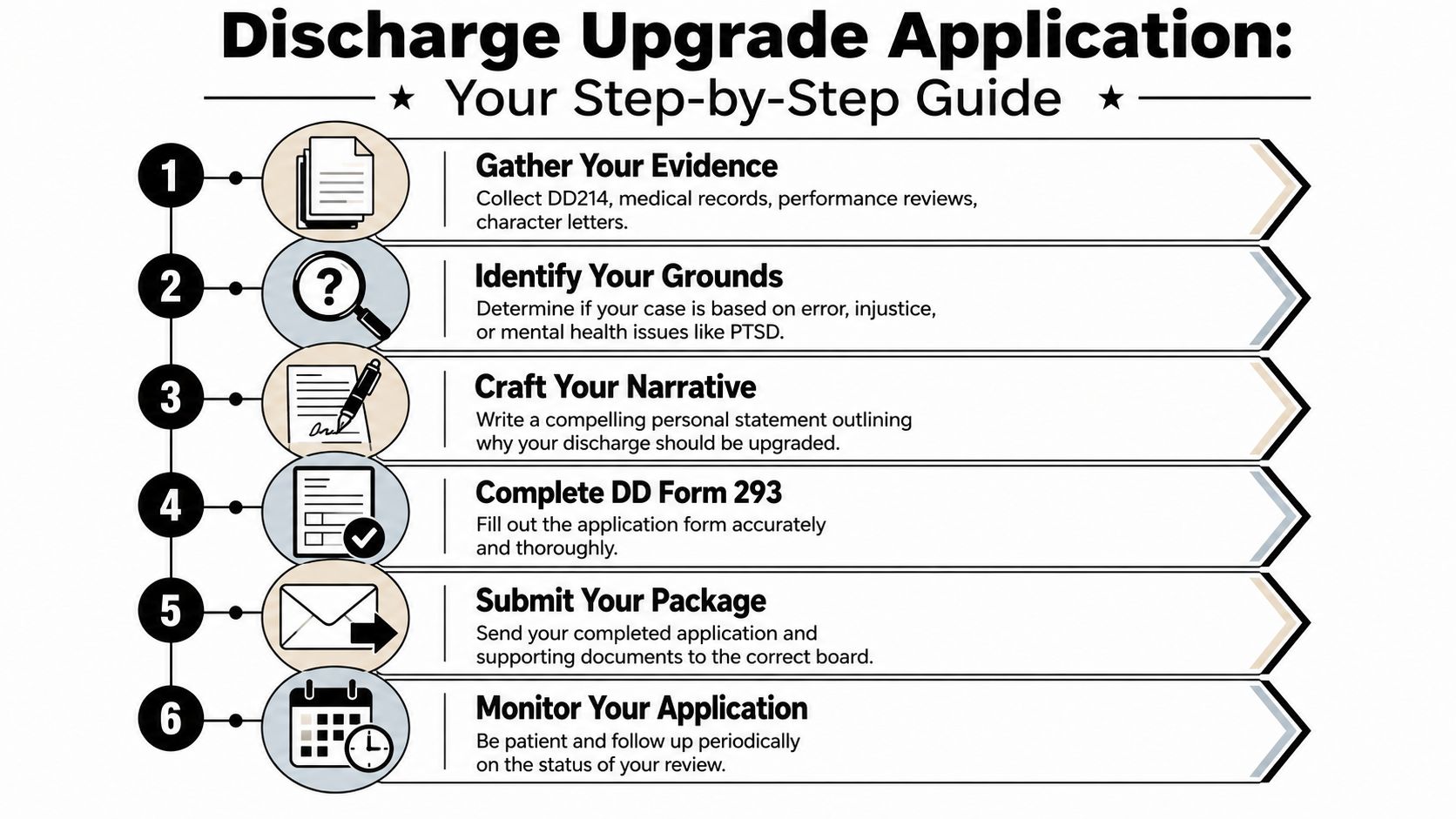
The DRB adjudication process involves a panel of five senior military officers who require a majority vote to grant an upgrade, and success depends on proving an error, injustice, or inequity with concrete evidence such as medical records, performance evaluations, awards, and post-service rehabilitation documentation, as described by the Army Review Boards Agency.
That tells you almost everything you need to know about how to prepare. You are not submitting a complaint. You are building a record for five senior officers who will vote on whether your discharge should stand.
A step-by-step approach that works
Step 1. Get the core documents first
Start with the basics. Your DD214, separation packet if you have it, counseling history, evaluations, awards, medical records, mental health records, and anything tied to the alleged misconduct. Don’t guess about dates, events, or diagnoses if the file can answer those questions.
Step 2. Pick your theory before you write a word
Your case should be built around one or more legal themes:
- Improper action: The process or basis for discharge was legally or procedurally flawed.
- Inequitable result: The discharge may have followed procedure, but the outcome was unfair in light of your service, mitigation, or current standards.
- Mental health or trauma connection: Service-related conditions help explain the conduct and reduce blameworthiness.
If you don’t know your theory, your narrative will drift.
Step 3. Build a timeline
Create a clean chronology. Include service milestones, deployments, awards, medical events, command actions, investigations, discipline, treatment, and discharge processing. Board members need to see causation and sequence, not chaos.
The evidence that actually matters
Not all documents carry equal weight. Some move the case. Some are filler.
Focus on evidence that does one of these jobs:
- Explains the conduct: Medical records, treatment notes, symptom history, witness statements.
- Rehabilitates credibility: Evaluation reports, awards, commendations, performance trends.
- Shows who you became after discharge: School records, employment history, counseling completion, community service, sobriety work, stable family responsibilities.
- Exposes gaps in the original process: Missing records, contradictory allegations, rushed separation actions, ignored mitigation.
A good packet doesn’t just say the discharge was wrong. It shows why the original decision-maker missed key facts or reached a result that no longer holds up.
Writing DD Form 293 the right way
DD Form 293 is not where you dump emotions. It’s where you present an organized request with a disciplined theory of relief. Your personal statement should sound like someone who understands the record, accepts what must be accepted, and can prove what needs proving.
A strong statement usually does three things:
- It identifies the reason relief is justified.
- It ties the documents to that reason.
- It explains the practical significance without sounding desperate or theatrical.
Avoid rambling. Avoid attacking everyone involved unless you can back it up. Avoid unsupported claims that invite skepticism.
Submission and follow-through
Once the package is complete, submit it to the correct board and keep copies of everything. Track what was sent. If you request a hearing, prepare like it matters, because it does. Senior officers can spot exaggeration fast.
Patience is part of this process, but passivity is not. Monitor the case, update your file when appropriate, and stay ready to sharpen the presentation if the board process calls for it.
Building a Case That Persuades the Board
You sit down to write your upgrade packet and start with the part that still burns. The command was unfair. The punishment was too harsh. People lied. You were struggling. All of that may be true. If you present it like a grievance, you lose.
Boards do not reward emotion. They reward theory, proof, and disciplined presentation. The winning question is never just what happened. The winning question is why this board has a sound reason to change the record now.
That is the tactical shift many applicants miss.
Impropriety and inequity are different lanes
A persuasive case gives the board a clean lane to grant relief. Usually that lane is impropriety, inequity, or both, but each one needs its own support.
An impropriety argument says the original discharge action was wrong when it happened. The command skipped required steps. The file contains bad information. The regulation was misapplied. The separation authority acted on an incomplete or defective record. This is a legal attack. It lives or dies on documents.
An inequity argument says the discharge may have been processed correctly on paper, but the outcome was too harsh in light of the full record, mitigation, later policy guidance, or the member’s overall service. This is where context matters. Strong service, isolated misconduct, untreated trauma, and post-service rehabilitation often fit here.
Keep the theory clean.
- Broken process requires proof of the break.
- Overly harsh result requires proof of why the result no longer holds up.
- Mental health, trauma, or command failure requires a documented chain between the condition and the discharge basis.
Sloppy packets throw every argument at the wall and hope one sticks. Good packets make it easy for a board member to say yes for a specific reason.
Liberal Consideration only helps if you build the record for it
Many self-filed cases fail because the applicant mentions PTSD, TBI, or MST but never proves how those facts shaped the misconduct or decline in performance. Liberal Consideration is a powerful tool. It is not magic.
As noted in this discussion of Liberal Consideration for PTSD, TBI, and MST cases, the board must apply a more favorable review standard in the right case. Your job is to give the board a record that supports using it.
That means showing four things with discipline:
- Symptoms were present during service or near the misconduct
- Those symptoms affected judgment, behavior, performance, or self-control
- The condition is supported by records, witness statements, or later medical evidence
- The discharge should be reconsidered through that medical and factual lens
A bare statement saying, “I had PTSD,” does not carry the case. Medical records help. Service treatment notes help. Civilian evaluations help. Buddy statements help if they describe concrete behavior changes instead of vague praise. If the diagnosis came later, document the earlier symptoms with dates, incidents, and observations that make the timeline believable.
The strongest trauma-based cases do one thing well. They connect condition, symptoms, misconduct, and outcome in a straight line the board can follow without guessing.
Tailor the case to the board in front of you
Each branch board has its own habits, tolerance for weak proof, and reaction to mitigation. Treating every DRB the same is amateur work.
Some boards respond well to a tightly documented rehabilitation story. Others care more about defects in the original process. Some will give real weight to mental health mitigation if you present it with precision. Others will punish any exaggeration and focus hard on the misconduct itself. If you do not understand the board’s tendencies, you will over-argue the wrong points and under-develop the ones that matter.
That is why tactics matter more than generic advice. You are not filing a memoir. You are building a vote.
What strong advocates look for first
Experienced military defense lawyers start by hunting for the pressure point. Not the loudest point. The point that changes the board’s view of the case.
That usually means asking questions like these:
- What fact would make a board member stop and reread the file?
- What document was ignored, missing, or misunderstood?
- What part of the misconduct looks different once the medical evidence is added?
- What can be conceded without destroying credibility?
- What is the cleanest reason the board can cite if it grants relief?
That last question matters more than applicants realize. Board members write decisions. Give them a disciplined path to justify relief and you improve your odds. Force them to sort through anger, blame, and scattered claims, and you make denial easy.
Credibility is the backbone of the packet. Admit the bad facts you cannot dispute. Put them in context. Prove the mitigation. Show why the discharge, as it stands today, is no longer the right outcome. That is how persuasive cases are built.
Critical Errors That Guarantee a Denial
You spent months working up the nerve to file. Then you send in a thin packet, dodge the worst facts, aim at the wrong board, and write like the government owes you an apology. That is how people lose cases they might have won.
Bad outcomes usually come from predictable mistakes. The board did not deny you because your story was emotional. It denied you because your package gave members no clean, defensible reason to vote yes.
Here are the errors that kill discharge upgrade cases.
Filing in the wrong forum
If the DRB lacks jurisdiction because of timing or the type of relief requested, the case is dead on arrival. Get that wrong and nothing else in the packet matters.Sending a form instead of a case
A DD Form 293 with a short personal statement and no real exhibits signals laziness or confusion. Board members see that and assume the record probably supports the original discharge.Claiming unfairness without a theory
“Unfair” is not an argument. You need a theory the board can act on: error, injustice, inequity, mitigation, or post-service rehabilitation tied to the discharge characterization.Avoiding the misconduct
If the discharge was based on misconduct, address it head-on. Admit what is true, correct what is false, and explain what the record missed. Evasion destroys credibility fast.Writing like a victim instead of an advocate
Anger, blame, threats, and conspiracy claims make board members stop listening. Strong packets are controlled, specific, and disciplined. They sound like someone asking for correction, not revenge.Using a generic package for a branch-specific board
Each board has its own habits, pressure points, and tolerance for certain arguments. As noted earlier, grant patterns differ sharply by branch. That means your case theory, evidence order, and hearing strategy must fit the board reviewing it. A recycled packet is a lazy packet, and lazy packets lose.Acting entitled to relief
No board owes you a reset. You are asking senior officers to change an official military record, often years after the fact. Expect skepticism and build for it.
One more mistake belongs on this list because it shows up constantly. Applicants submit everything they have and prove nothing. Fifty pages of treatment records, character letters, and service documents will not save you if none of it is organized around a persuasive theory. Volume is not strategy.
Weak applications fail for a simple reason. The board can deny them without working hard.
If your draft does any of this, stop. Fix it before you file.
Why You Cannot Afford to Go It Alone
You have three basic options. Do it yourself. Get help from a veterans organization. Hire experienced civilian counsel. Those options are not equal.
A self-filed case can work, but most applicants don’t know how to separate emotion from argument, theory from evidence, or mitigation from excuse-making. They know what happened to them. They usually don’t know what persuades a panel of senior officers.
The problem with doing it yourself
When veterans go alone, they commonly make one of two mistakes. They either understate the case and submit too little, or they overshare and bury the board in disorganized facts. Both approaches fail for the same reason. Neither produces a clean theory supported by evidence.
A good discharge upgrade package needs legal judgment. It needs someone who can identify whether your strongest lane is procedural error, inequity, trauma mitigation, post-service rehabilitation, or a combination built in the right order.
Where VSOs help and where they don’t
Veterans Service Organizations can be helpful, especially for pointing people in the right direction and helping them start the process. That said, many of these cases require more than administrative assistance. They require strategic advocacy.
That’s especially true when the file involves:
- UCMJ-related allegations
- complicated mental health evidence
- conflicting records
- retaliation or command climate issues
- prior proceedings that need careful framing
Those are lawyer problems, not form-completion problems.
Why civilian defense counsel matters
Experienced civilian military defense lawyers bring three things to the table that matter in hard cases.
First, independence. They answer to you, not the command, not the agency, and not the system that already processed you out.
Second, pattern recognition. Court-martial attorneys and seasoned UCMJ lawyers have seen how investigations go wrong, how commands overreach, how records get read selectively, and how to rebuild a narrative the government flattened.
Third, presentation discipline. They know what to concede, what to challenge, how to draft affidavits, how to organize exhibits, and how to make a board member’s vote easier.
A military-appointed attorney may be capable in some settings, but discharge review boards are often won by lawyers who know both the military culture and the post-service consequences. That combination is hard to fake.
If your future, benefits, reputation, and employability turn on this record, treating the case like a DIY project is a bad gamble.
Find Your Advocate and Take Back Your Future
You already know what a bad discharge costs. Jobs. Benefits. Credibility. Peace at home. Time. The only useful question now is what you’re going to do about it.

Start by finding counsel who handles military justice and discharge cases, not a general practice lawyer dabbling in veteran matters. If you need a practical framework, use this guide on how to choose a military defense lawyer. Then compare lawyers based on military trial experience, discharge upgrade work, communication, and whether they can explain your theory of relief in plain English.
A strong advocate doesn’t just file papers. That lawyer builds the record, sharpens the narrative, and protects you from avoidable mistakes.
For a quick orientation, watch this:
Don’t wait for another denial, another lost opportunity, or another year of living under a record that may be fixable.
If your discharge is holding your life hostage, act now. Get the right lawyer. Build the case correctly. Fight for the upgrade like your future depends on it, because it does.